


 |
市場調查報告書
商品編碼
2154951
南美洲自動化危險廢棄物管理:市場佔有率分析、產業趨勢和統計數據以及成長預測(2026-2031 年)South America Hazardous Waste Handling Automation - Market Share Analysis, Industry Trends & Statistics, Growth Forecasts (2026 - 2031) |
||||||

※ 本網頁內容可能與最新版本有所差異。詳細情況請與我們聯繫。
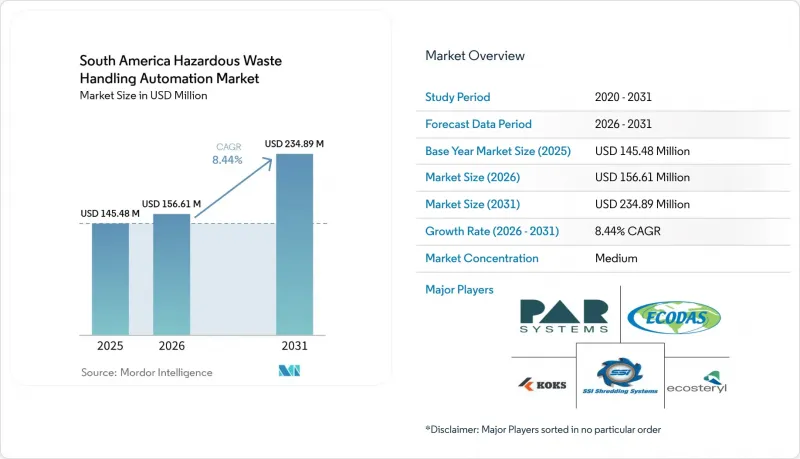
據 Mordor Intelligence 稱,2025 年南美危險廢棄物處理自動化市場價值為 1.4548 億美元,預計從 2026 年的 1.5661 億美元成長到 2031 年的 2.3489 億美元。
預計 2026 年至 2031 年的預測期內複合年成長率為 8.44%。
南美洲危險廢棄物處理自動化市場趨勢與洞察。
巴西的工業危險廢棄物產生量正在增加。
巴西集中了化學製造、石油煉製和非鐵金屬加工等產業,擁有該地區最廣泛的工業危險廢棄物來源。聖保羅-坎皮納斯走廊和帕拉州的卡拉加斯礦區是重要的樞紐,因為這些地區的工業活動會產生需要收集、運輸、分類和處理的廢棄物。這些廢棄物不僅滿足一次性專案的需求,也滿足對處理設施的持續需求。業者需要能夠在受控條件下處理有毒、反應性、易燃和污染物的系統。大規模工廠加快資本投資以改善其廢棄物處理流程,這正推動著南美危險廢棄物處理自動化市場的發展。此外,隨著數位化記錄和可審計的廢棄物管理計劃成為常規合規措施的一部分,小規模的本地廢棄物產生者也可能成為設備的購買者。
強制性數位化可追溯性和合規性文件
哥倫比亞於2026年7月15日頒布的第766號法令重新界定了危險廢棄物產生者、運輸者和管理者的責任。該法令要求國家廢棄物登記冊和國家運輸登記冊之間實現資訊互通。它也更強調在危險廢棄物處理鏈的每個環節建立可靠的記錄。自動化設備可以透過協調運輸事件、感測器、容器和運作記錄來滿足這項需求。 2024年一項針對哥倫比亞RESPEL框架的學術評估指出,持證管理營運商的覆蓋範圍有限以及技術投資獎勵不足是阻礙廢棄物管理改進的限制阻礙因素。因此,南美危險廢棄物處理自動化市場對結合物理處理和可追溯性的系統仍有發展空間。
進口設備和零件成本高昂
先進的機械手臂、配備人工智慧的分類機和工業切碎機設備通常從南美洲以外的地區採購。買家通常以美元支付這些設備及其更換零件的費用,這使得專案面臨該地貨幣波動的風險。阿根廷披索和巴西幣波動可能會在預算週期內影響專案的獲利能力。如果外匯狀況惡化,營運商可能會推遲採購、縮減專案規模或購買功能較少的設備。進口限制、許可證要求和關稅可能會給跨境廢棄物管理系統帶來額外的成本和行政負擔。對於無法在資本設備長期生命週期內有效管理外匯風險的中型業者而言,這些因素是最大的限制因素。
細分市場分析
到2025年,「特定廢棄物」將佔南美危險廢棄物處理自動化市場38.47%的佔有率。這一佔有率反映了化學品製造、石油煉製和非鐵金屬加工過程中產生的大量有毒、反應性、腐蝕性和易燃性殘留物。這些物質需要進行受控的密封處理,因為人工處理會增加安全性和環境風險。此類廢棄物需要在運輸、處理或處置前進行分類並記錄在案。自動化轉運、密封儲存和分類系統有助於設施規範這些廢棄物的處理。 「指定廢棄物」和「一般用途廢棄物」的需求不斷成長,例如廢棄電池、螢光、農藥容器和類似材料。巴西和哥倫比亞的生產者延伸責任制(EPR)計畫增加了對這些類型廢棄物進行系統收集和處理的需求。處理設施需要能夠在裝卸過程中隔離材料,同時避免造成進一步暴露的設備。南美洲危險廢棄物自動化處理市場仍然高度依賴工業運營商對分類和處理要求的執行程度。該領域繼續為擁有強大防控和服務能力的供應商提供穩定的基礎。
預計到2031年,混合廢棄物的年複合成長率將達到9.24%。製藥污水、垃圾焚化發電殘渣以及電子和特殊材料工廠產生的混合化學品通常含有多種物質,無法透過單一簡單的製程進行處理。因此,能夠識別和分離物質並將其引導至相應處理路徑的系統顯得尤為重要。當進料成分波動時,操作人員可以利用感測器、影像處理工具、封閉式輸送機和受控分類站。 2024年,秘魯基爾馬納的掩埋開展了一項研究,評估了一套基於人工智慧、物聯網和區塊鏈的掩埋管理系統。研究報告顯示,在12個月的時間裡,送往掩埋的殘餘廢棄物減少了35%,甲烷(CH4)排放量減少了40%。雖然這項研究並未驗證其在所有危險廢棄物處理應用中的性能,但它提供了一個關於廢棄物管理領域數位化分類和監測的本地案例研究。供應商可以利用類似的案例來展示自動化如何幫助分類複雜物質。處理混合廢棄物流的操作人員還需要應對每批廢棄物包裝、水分含量和污染程度的差異。此外,混合廢物流促使處理設施考慮採用整合系統而非獨立的封閉式設施。這項需求可能會推動南美洲危險廢棄物處理自動化市場對彈性配置的需求。
到2025年,機械手臂將佔產品銷售額的36.19%。它們用於需要高機動性的任務,例如移動桶、分類容器、在手套箱內作業以及轉移工人不得直接接觸的物料。其市場地位的穩固源自於對運動範圍、可控運動以及將工人與危險物質隔離等需求的綜合考量。機械手臂可應用於化工廠、實驗室、加工廠以及某些採礦作業。它們還可以整合攝影機、遙控器、力回饋系統或密封艙。 2026年3月,RAICo和核修復服務公司聯合舉辦了一場演示,展示了一種結合了3D視覺化和力回饋控制的觸覺遙控系統,用於碎片分類。此類系統展示了在直接可視性或物理接觸受限的應用中行之有效的運行原理。客戶也十分欣賞這些機械手臂能夠在狹小空間內作業而無需對場地進行大規模改造的特性。伸縮桅杆、起重機和桁架在儲槽區、大規模廢棄物坑和公共產業設施中繼續發揮至關重要的作用,在這些場所,起重能力和作業範圍比精細操作更為重要。這類設備使南美洲危險廢棄物處理自動化市場能夠同時滿足精密作業和基礎設施規模作業的需求。
預計到2031年,破碎系統市場將以9.41%的複合年成長率成長。當物料的尺寸、形狀或包裝阻礙下游製程的高效處理時,操作人員會在焚燒或安全掩埋處置之前使用破碎、造粒和預處理系統。這些系統對於化學固體、醫藥廢棄物、容器和其他需要持續預處理的危險物質尤其重要。此外,這些系統可以將體積龐大且形狀不規則的物料分解成更易於處理的形式,從而提高處理操作的可預測性。在設計過程中,必須仔細考慮物料的密封性、清潔性、維護性和工人安全性。市場需求源自於對廢棄物進行適當預處理的需求,而不是將未經處理的材料直接送往掩埋場。供應商可以透過耐用性、密封性能和服務支援來區分其系統。客戶也會評估系統是否能夠在原料用量波動的情況下避免頻繁停機或繁瑣的清潔程序。對於希望減輕儲存負擔和簡化處理流程的設施而言,此類產品類型也具有優勢。其性能對整個南美危險廢棄物處理自動化市場至關重要,因為原料體積的減少會影響後續的每個處理階段。
其他好處:
- Excel格式的市場預測(ME)表
- 3個月的分析師支持
目錄
第1章:引言
- 研究假設和市場定義
- 調查範圍
第2章:調查方法
第3章執行摘要
第4章 市場狀況
- 市場概覽
- 市場促進因素
- 巴西工業危險廢棄物處理設施擴建
- 強制性數字可追溯性和合規性相關文件
- 減少高風險工業活動中工人的暴露風險
- 採礦、化工、能源和醫療產業的廢棄物排放量增加。
- 醫療廢棄物現場處置的需求日益成長
- 對老舊、人工操作的貨物裝卸基礎設施進行維修的需求。
- 市場限制因素
- 進口設備和零件成本高昂
- 南美國家執法和許可證取得方面的不一致
- 缺乏本地自動化、服務和維護能力。
- 廢棄物處理量多樣化,延長設備投資回收期。
- 宏觀經濟因素對市場的影響
- 產業價值鏈分析
- 監理情勢
- 技術展望
- 波特五力分析
第5章 市場規模與成長預測
- 廢棄物類型
- 指定廢棄物
- 典型廢棄物
- 一般廢棄物
- 混合廢棄物
- 依產品類型
- 機械手臂
- 伸縮桅杆
- 起重機
- 桁架
- 研磨系統
- 透過自動化架構
- 半自動系統
- 全自動系統
- 人工智慧驅動的自主系統
- 按最終用戶行業分類
- 製造業
- 化工/石油化工
- 能源公用事業
- 採礦和金屬
- 製藥公司和研究機構
- 政府/國防
- 廢棄物管理業者
- 按地區
- 巴西
- 阿根廷
- 哥倫比亞
- 其他南美國家
第6章 競爭情勢
- 市場集中度
- 策略趨勢
- 市佔率分析
- 公司簡介
- PaR Systems, Inc.
- KOKS Group BV
- ECODAS SAS
- Ecosteryl SA
- Tesalys SAS
- Celitron Medical Technologies BV
- SSI Shredding Systems, Inc.
- Granutech-Saturn Systems Corporation
- International Waste Industries, Inc.
- Pallmann Maschinenfabrik GmbH & Co. KG
- Cleanrobotics
- Fortive Corporation
- Sutco Contracting GmbH
- STADLER Anlagenbau GmbH
- Vecoplan AG
- BHS-Sonthofen GmbH
- ZenRobotics Oy
- Recycleye Ltd.
- Waste Robotics Inc.
- Danu Robotics Ltd.
第7章 市場機會與未來展望
According to Mordor Intelligence, the South America hazardous waste handling automation market size was valued at USD 145.48 million in 2025 and is estimated to expand from USD 156.61 million in 2026 to reach USD 234.89 million by 2031, at a CAGR of 8.44% during the forecast period 2026-2031.
South America Hazardous Waste Handling Automation Market Trends and Insights
Expansion of Brazil's Industrial Hazardous Waste Base
Brazil's concentration of chemical production, oil refining, and base-metal processing gives it the region's broadest base of hazardous industrial waste. The Sao Paulo-Campinas corridor and Para's Carajas mineral province are important locations because their industrial operations create material that needs containment, transport, classification, and treatment. This waste base supports recurring demand for handling equipment rather than only occasional project demand. Operators need systems that can handle toxic, reactive, flammable, and contaminated material under controlled conditions. The South America hazardous waste handling automation market benefits when large plants move capital spending forward to improve their waste-handling processes. Smaller regional generators can also become equipment buyers when digital records and auditable waste plans become part of ordinary compliance practice.
Mandatory Digital Traceability and Compliance Documentation
Colombia's Decreto 766, issued on July 15, 2026, redefined responsibilities for hazardous waste generators, transporters, and managers. The measure requires interoperable information flows between the national waste registry and the national transport registry. It places more value on reliable records at each movement point in the hazardous-waste chain. Automated equipment can support this need by connecting transfer events, sensors, containment units, and operating records. A 2024 academic review of Colombia's RESPEL framework identified limited coverage by licensed managers and insufficient incentives for technology investment as constraints to better waste management. The South America hazardous waste handling automation market, therefore, has an opening for systems that combine physical handling with traceability functions.
High Imported Equipment and Spare-Parts Costs
Advanced manipulator arms, AI-enabled sorting equipment, and industrial shredding installations are commonly supplied from outside South America. Buyers often pay for this equipment and its replacement parts in USD, which exposes projects to local currency movements. Peso depreciation in Argentina and volatility in the Brazilian real can change a project's economics during a budget cycle. Operators may defer purchases, reduce the project scope, or buy less integrated equipment when exchange conditions worsen. Import controls, licensing requirements, and tariffs can add further cost and administrative work for systems linked to cross-border waste treatment. These conditions limit adoption most sharply among mid-sized operators that cannot manage foreign-exchange exposure over long capital-equipment cycles.
Other drivers and restraints analyzed in the detailed report include:
- Worker Exposure Reduction in High-Risk Industrial Operations
- Growth of Mining, Chemicals, Energy, and Healthcare Waste Streams
- Uneven Enforcement and Permitting Across South American Countries
For complete list of drivers and restraints, kindly check the Table Of Contents.
Segment Analysis
Characteristic Wastes held 38.47% of the South America hazardous waste handling automation market share in 2025. This position reflects the large volumes of toxic, reactive, corrosive, and flammable residues created by chemical production, oil refining, and base metals processing. These materials require controlled containment because manual handling can increase safety and environmental risks. The category includes waste streams that often need documented classification before transport, treatment, or disposal. Automated transfer, sealed storage, and sorting systems can help facilities standardize the handling of these streams. Listed Wastes and Universal Wastes provide additional demand from spent batteries, fluorescent lamps, pesticide containers, and similar materials. Extended producer responsibility programs in Brazil and Colombia add to the need for organized collection and treatment of these waste types. Treatment facilities need equipment that can isolate materials without creating additional exposure during loading or unloading. The South America hazardous waste handling automation market remains tied to how consistently industrial operators apply classification and handling requirements. This segment continues to provide a stable base for suppliers with strong containment and service capabilities.
Mixed Wastes are projected to expand at a 9.24% CAGR through 2031. Pharmaceutical effluents, energy-from-waste residues, and blended chemical streams from electronics and specialty-material facilities often contain multiple material types that a single, simple process cannot manage. This increases the value of systems that identify, separate, and direct material into the right treatment path. Operators may use sensors, vision tools, enclosed conveyors, and controlled sorting stations when the composition of incoming material varies. A 2024 study at a landfill in Quilmana, Peru, evaluated an AI-, IoT-, and blockchain-based system for landfill management and reported a 35% reduction in residual waste sent to the landfill and a 40% decline in CH4 emissions over 12 months. The study does not establish performance across all hazardous waste applications, but it provides a regional example of digital classification and monitoring in a waste-management setting. Vendors can use comparable evidence to explain how automation could support complex material segregation. Mixed-stream operators must also manage variation in packaging, moisture, and contamination between loads. Mixed streams also encourage facilities to consider integrated systems instead of standalone containment equipment. This requirement can increase demand for flexible configurations within the South America hazardous waste handling automation market.
Manipulator Arms accounted for 36.19% of product revenue in 2025. They are used in high-dexterity tasks such as drum movement, container sorting, glovebox work, and transferring materials that workers should not touch directly. Their established position comes from the need to combine reach, controlled motion, and separation between the operator and hazardous material. Arms can be used in chemical plants, laboratories, treatment facilities, and selected mining applications. They may also be integrated with cameras, remote controls, force feedback, or enclosed cells. The March 2026 RAICo and Nuclear Restoration Services demonstration showed a haptic teleoperation arrangement that combined 3D visualization with force-feedback control for debris sorting. Such systems demonstrate a useful operating principle for applications where direct visibility and direct physical access are limited. Customers also value arms that can operate in constrained spaces without requiring a major site redesign. Telescoping masts, cranes, and trusses remain relevant at tank farms, large waste pits, and utility sites where lifting capacity and reach matter more than fine manipulation. These equipment choices allow the South America hazardous waste handling automation market to serve both precision and infrastructure-scale tasks.
Size Reduction Systems are expected to advance at a 9.41% CAGR through 2031. Operators use shredding, granulation, and pre-treatment equipment before incineration or secure landfill when material size, shape, or packaging prevents efficient downstream processing. These systems are especially relevant for chemical solids, pharmaceutical waste, containers, and other hazardous materials that require consistent preparation. The equipment can also make handling more predictable by reducing bulky or irregular materials into a manageable form. It must be designed with containment, cleaning, maintenance, and worker safety in mind. Demand is driven by the need to prepare waste before final treatment, rather than sending unprocessed material directly for disposal. Equipment vendors can differentiate their systems through durability, containment performance, and service support. Customers also assess whether a system can manage variable feedstock without frequent stoppages or difficult cleaning procedures. The product category also benefits when facilities seek to reduce storage burdens and simplify their treatment workflow. Its performance is important to the broader South America hazardous waste handling automation market because reduction can shape every later treatment stage.
Complete Report Scope:
- By Waste Type
- Listed Wastes
- Characteristic Wastes
- Universal Wastes
- Mixed Wastes
- By Product Type
- Manipulator Arms
- Telescoping Masts
- Cranes
- Trusses
- Size Reduction Systems
- By Automation Architecture
- Semi-Automated Systems
- Fully Automated Systems
- AI-Enabled Autonomous Systems
- By End-User Industry
- Manufacturing
- Chemical and Petrochemical
- Energy and Utilities
- Mining and Metals
- Pharmaceutical and Research Institutions
- Government and Defense
- Waste Management Operators
- By Geography
- Brazil
- Argentina
- Colombia
- Rest of South America
List of Companies Covered in this Report:
- PaR Systems, Inc.
- KOKS Group B.V.
- ECODAS S.A.S.
- Ecosteryl S.A.
- Tesalys S.A.S.
- Celitron Medical Technologies B.V.
- SSI Shredding Systems, Inc.
- Granutech-Saturn Systems Corporation
- International Waste Industries, Inc.
- Pallmann Maschinenfabrik GmbH & Co. KG
- Cleanrobotics
- Fortive Corporation
- Sutco Contracting GmbH
- STADLER Anlagenbau GmbH
- Vecoplan AG
- BHS-Sonthofen GmbH
- ZenRobotics Oy
- Recycleye Ltd.
- Waste Robotics Inc.
- Danu Robotics Ltd.
Additional Benefits:
- The market estimate (ME) sheet in Excel format
- 3 months of analyst support
TABLE OF CONTENTS
1 INTRODUCTION
- 1.1 Study Assumptions and Market Definition
- 1.2 Scope of the Study
2 RESEARCH METHODOLOGY
3 EXECUTIVE SUMMARY
4 MARKET LANDSCAPE
- 4.1 Market Overview
- 4.2 Market Drivers
- 4.2.1 Expansion of Brazil's Industrial Hazardous Waste Base
- 4.2.2 Mandatory Digital Traceability and Compliance Documentation
- 4.2.3 Worker Exposure Reduction in High-Risk Industrial Operations
- 4.2.4 Growth of Mining, Chemicals, Energy, and Healthcare Waste Streams
- 4.2.5 Rising Demand for On-Site Medical Waste Treatment
- 4.2.6 Retrofit Demand from Aging Manual Handling Infrastructure
- 4.3 Market Restraints
- 4.3.1 High Imported Equipment and Spare-Parts Costs
- 4.3.2 Uneven Enforcement and Permitting Across South American Countries
- 4.3.3 Limited Local Automation-Service and Maintenance Capability
- 4.3.4 Fragmented Waste Volumes and Long Equipment Payback Periods
- 4.4 Impact of Macroeconomic Factors on the Market
- 4.5 Industry Value Chain Analysis
- 4.6 Regulatory Landscape
- 4.7 Technological Outlook
- 4.8 Porter's Five Forces Analysis
- 4.8.1 Bargaining Power of Suppliers
- 4.8.2 Bargaining Power of Buyers
- 4.8.3 Threat of New Entrants
- 4.8.4 Threat of Substitutes
- 4.8.5 Intensity of Competitive Rivalry
5 MARKET SIZE AND GROWTH FORECASTS (VALUE)
- 5.1 By Waste Type
- 5.1.1 Listed Wastes
- 5.1.2 Characteristic Wastes
- 5.1.3 Universal Wastes
- 5.1.4 Mixed Wastes
- 5.2 By Product Type
- 5.2.1 Manipulator Arms
- 5.2.2 Telescoping Masts
- 5.2.3 Cranes
- 5.2.4 Trusses
- 5.2.5 Size Reduction Systems
- 5.3 By Automation Architecture
- 5.3.1 Semi-Automated Systems
- 5.3.2 Fully Automated Systems
- 5.3.3 AI-Enabled Autonomous Systems
- 5.4 By End-User Industry
- 5.4.1 Manufacturing
- 5.4.2 Chemical and Petrochemical
- 5.4.3 Energy and Utilities
- 5.4.4 Mining and Metals
- 5.4.5 Pharmaceutical and Research Institutions
- 5.4.6 Government and Defense
- 5.4.7 Waste Management Operators
- 5.5 By Geography
- 5.5.1 Brazil
- 5.5.2 Argentina
- 5.5.3 Colombia
- 5.5.4 Rest of South America
6 COMPETITIVE LANDSCAPE
- 6.1 Market Concentration
- 6.2 Strategic Moves
- 6.3 Market Share Analysis
- 6.4 Company Profiles (includes Global Level Overview, Market Level Overview, Core Segments, Financials as available, Strategic Information, Market Rank/Share, Products and Services, Recent Developments)
- 6.4.1 PaR Systems, Inc.
- 6.4.2 KOKS Group B.V.
- 6.4.3 ECODAS S.A.S.
- 6.4.4 Ecosteryl S.A.
- 6.4.5 Tesalys S.A.S.
- 6.4.6 Celitron Medical Technologies B.V.
- 6.4.7 SSI Shredding Systems, Inc.
- 6.4.8 Granutech-Saturn Systems Corporation
- 6.4.9 International Waste Industries, Inc.
- 6.4.10 Pallmann Maschinenfabrik GmbH & Co. KG
- 6.4.11 Cleanrobotics
- 6.4.12 Fortive Corporation
- 6.4.13 Sutco Contracting GmbH
- 6.4.14 STADLER Anlagenbau GmbH
- 6.4.15 Vecoplan AG
- 6.4.16 BHS-Sonthofen GmbH
- 6.4.17 ZenRobotics Oy
- 6.4.18 Recycleye Ltd.
- 6.4.19 Waste Robotics Inc.
- 6.4.20 Danu Robotics Ltd.
7 MARKET OPPORTUNITIES AND FUTURE OUTLOOK
- 7.1 White-Space and Unmet-Need Assessment

 PCB廢棄物處理服務市場:全球市場預測,2026-2032年
 2026年全球自動化危險廢棄物處理市場報告
 危險廢棄物市場:依類型、廢棄物類別、服務和行業劃分 - 至2036年的全球預測
 危險廢棄物處理自動化市場分析及預測(至2035年):類型、產品、服務、技術、組件、應用、製程、最終用戶、設備
 全球危險廢棄物管理市場:市場規模、佔有率和趨勢分析(按類型、處理方法、處置方法、來源、化學成分和地區分類),細分市場預測(2026-2033 年)
 全球危險廢棄物管理市場規模、佔有率、趨勢和成長分析報告(2026-2034年)
 2026-2030年全球危險廢棄物處理自動化市場高風險廢棄物處置服務市場(按服務類型、廢棄物類型、廢棄物來源、危險等級和最終用戶產業分類),全球預測(2026-2032年)
 危險廢棄物處理自動化市場規模、佔有率和成長分析(按類型、應用、自動化程度和地區分類)-2026-2033年產業預測
 危險廢棄物管理市場規模、佔有率和成長分析(按廢棄物類型、服務類型、化學成分、廢棄物來源、最終用戶和地區分類)—產業預測(2026-2033 年)