


 |
市場調查報告書
商品編碼
2154935
石油和天然氣腐蝕防護:市場佔有率分析、行業趨勢和統計數據、成長預測(2026-2031 年)Oil and Gas Corrosion Protection - Market Share Analysis, Industry Trends & Statistics, Growth Forecasts (2026 - 2031) |
||||||

※ 本網頁內容可能與最新版本有所差異。詳細情況請與我們聯繫。
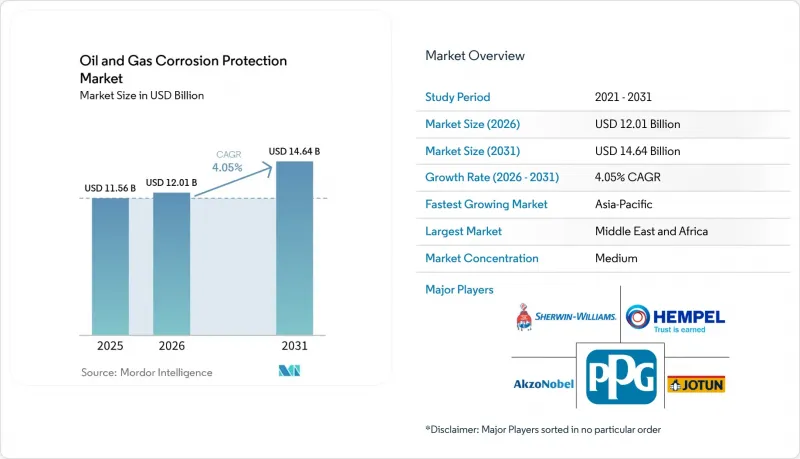
據 Mordor Intelligence 稱,2025 年石油和天然氣行業的防腐蝕市場價值為 115.6 億美元,預計到 2031 年將達到 146.4 億美元,而 2026 年為 120.1 億美元,2026 年至 2031 年預測成長率為 4.05%。
全球油氣產業防腐蝕市場的趨勢與洞察。
老化的管線、平台、煉油廠和倉儲設施
目前運作中的油氣基礎設施大多建於上世紀60年代至1980年代。隨著時間的推移,保護塗層會變薄,陰極防蝕電位會發生偏移,並且會產生一些常規檢測方法無法發現的微小裂縫。因此,油氣防腐市場正逐漸從單純依靠新建設的需求轉向依賴常規維護。根據材料防護與性能協會(AMPP)預測,到2024年,美國超過25%的管道事故將歸因於腐蝕,高於18%的歷史平均值。鑑於這些趨勢,繼續依賴為相對較新的資產設計的檢測方法已不再可行。由於不採取任何措施所帶來的安全和監管影響可能超過延遲施工所節省的成本,因此,更新項目正在推動對塗層、緩蝕劑和陰極防蝕的需求。到2025年,全球油氣基礎建設活動將包括興建中的15,000公里原油和液態天然氣(NGL)管道,另有27,000公里管道正在規劃建設中。其中一些項目涉及更換劣化的管道段,凸顯了管道保護工作的持續性。
拓展海上、深海和酸性天然氣業務
在深海和酸性天然氣作業中,設備會受到硫化氫和二氧化碳的混合腐蝕。與傳統的陸上作業相比,這些環境需要更專業的合金、塗層、陰極防蝕和化學注入。對超級雙相不銹鋼在二氧化碳和硫化氫混合腐蝕環境下的研究表明,其獨特的腐蝕行為無法僅透過單一氣體數據來描述。石油和天然氣腐蝕防護市場主要受高酸性天然氣開發項目(例如沙烏地阿拉伯的傑夫拉油田開發項目和卡達的諾斯菲爾德擴建項目)的驅動。這些項目需要能夠在設備整個使用壽命期間應對嚴苛流體化學特性的防腐蝕系統。此外,這些項目的生產配置即使在初始建設完成後,也持續需要酸性天然氣化學品和耐腐蝕合金管材。在混合腐蝕環境下,材料選擇變得特別關鍵,因為在單一腐蝕性氣體下表現良好的系統可能無法滿足混合氣體環境的要求。防腐蝕供應商必須證明其產品在每個油田預期的各種實際運作條件下都能保持優異的效能。
高昂的資本成本和延遲的維護預算
實施先進的防腐蝕系統需要營運商在資產狀況惡化之前進行投資。在維持利潤率的壓力下,確保對持續監測、數位整合、高品質塗層和耐腐蝕合金的投資並非易事。深水環境下陰極防蝕的單位成本是同等陸上裝置的兩到三倍。大規模海上平台塗層的全面更換可能需要花費數千萬美元。當規模較小的上游業者延後工程時,石油和天然氣產業的腐蝕防護市場會面臨暫時的延誤。維修延誤會增加後續的維修需求,因為錯過最佳維護時機會使塗層損傷的修復更加困難和高成本。財務影響並非線性成長,因為即使是初期局部損傷也可能擴散到更大範圍或侵蝕到底層基材。此外,當運營商合併、供應商名單和營運預算審查期間,維護計劃可能會暫時中斷,從而導致採購方面的不確定性。
細分市場分析
截至2025年,塗料佔產品總量的38.47%。這一佔有率反映了塗料在管道外表面、海上結構、儲存槽和製程設備等領域的廣泛應用。塗料透過隔離金屬表面與水分、鹽分和其他腐蝕性因素,為陸地和海洋環境提供全面的保護。此類別產品廣泛應用於新建設和維護項目,使供應商能夠獲得豐富的成功案例。高性能配方可延長重塗週期並降低生命週期成本,因此在維護成本和停機成本較高的情況下,高級產品更受青睞。操作人員通常根據表面處理品質、施工條件、耐久性和未來維護時間來評估塗料性能。即使與陰極防蝕和化學處理結合使用,塗料仍然發揮著至關重要的作用。
預計2026年至2031年間,緩蝕劑的複合年成長率將達到4.24%。由於無需直接物理干預即可調節注入速率,緩蝕劑適用於深海和酸性環境。這種柔軟性在製程條件波動且設備介入需要大量停機成本或海上船舶協助的情況下至關重要。 2026年的科學綜述發現,在受控條件下,緩蝕劑系統的效率可超過95%。對於單一產品類型無法滿足全部防護需求的海底和埋地資產,陰極防蝕、襯裡和複合防腐蝕仍然不可或缺。沙烏地阿美已在特定應用中部署了超過19,000公里的非金屬管道,作為傳統鋼管的替代方案。這種材料選擇方法可能會在預測期後半段逐漸改變不同產品類型之間的平衡。因此,油氣腐蝕防護市場既包括成熟的塗層需求,也包括受流體化學性質和資產設計影響的產品選擇。在惡劣環境下,營運商通常會對資產採取多層保護措施,因此供應商需要證明不同的產品如何協同工作。
截至2025年,海上應用佔油氣產業防蝕市場的55.56%。由於海上設備暴露於海水、靜水壓力、動態負荷以及高濃度硫化氫和二氧化碳等環境中,因此該領域具有極高的價值密度。這些條件會加速劣化,其速度甚至劣化許多陸上設備。海上計畫通常需要多個防護系統協同運行,而非單一防護層。典型的防護系統包括外部塗層、陰極防蝕、連續化學注入以及考慮作業空間限制而製定的檢查計劃。此外,營運商還必須考慮設備安裝於水下或遠端平台後,進行檢查、維修或更換的實際困難。
此外,預計2026年至2031年間,海上油氣產業將以4.67%的複合年成長率成長。巴西鹽層下盆地、墨西哥灣和東南亞地區新的深海和超深海開發案是推動這一成長的主要因素。每個項目都可能需要特殊的陽極氧化合金、海底工程以及長期的緩蝕劑供應合約。在2026年海上技術大會(OTC)上發表的一篇論文說明了一種自動化腐蝕建模方法,該方法能夠捕捉靜態評估中經常被忽略的短期海底作業變化。這些資訊有助於操作員在短期作業變化導致材料厚度減少之前調整緩蝕劑的用量。遙控潛水器(ROV)和潛水支援船的成本推高了海上作業的價格。 DNV-RP-F103為海底管線的陰極防蝕設計提供了技術基礎。由於設備常年浸泡在鹽水中,處於惡劣的流體環境中,且維護保養受限,因此預防措施可能比被動維修更具成本效益。該標準還支援涵蓋監測、化學處理和設備狀況評估的長期服務合約。
區域分析
2025年,中東和非洲佔全部區域的35.82%。該地區的排名反映了波灣合作理事會(GCC)的天然氣產量、加工能力、下游加工能力和出口基礎設施。沙烏地阿拉伯和阿拉伯聯合大公國(阿拉伯聯合大公國)是該地區需求的主要指標,擁有大規模的資產基礎,需要在上游、中游和下游營運中進行保護。酸性天然氣開發項目,例如賈夫拉項目和卡達北田擴建項目,需要腐蝕抑制劑、耐腐蝕合金管材、防護塗層和長期健康規劃。西非的近海計畫和東非的液化天然氣(LNG)計畫進一步推動了對新資產開發的需求。該地區的專案基礎,得益於成熟的設施、不斷擴大的天然氣產量和近海作業,為新設施的保護和延壽工作提供了支援。
預計到2031年,亞太地區將以4.43%的複合年成長率(CAGR)實現最高成長。中國、印度和東南亞將佔據該地區新增需求的大部分。中國國有石油公司正在大力投資上游生產、管線和煉油系統。印度天然氣管道網路的擴張和煉油廠的新增,推動了對管道塗層和完整性管理方案的需求。東南亞的LNG接收站和石化聯合企業為區域塗層供應商提供了初步確定規格的機會。一項於2026年在中國進行的針對高硫化氫、高二氧化碳和高壓氣井的研究發現,在122 度C和85MPa的條件下,鎳鎢合金塗層實現了每年0.004毫米的均勻腐蝕速率。南美洲仍然是一個次要的成長區域,這主要得益於巴西鹽層下的開發和阿根廷瓦卡穆埃爾塔油田的擴建。
北美和歐洲是成熟市場,其需求受到設備更新周期、完整性要求和延壽工程的支持。 2025年,美國聯邦政府津貼支持了19個州的腐蝕預防措施和鋼管維修。北海油田營運商正在投資海洋塗料、陰極防蝕和海底監測,以延長成熟油田的產量。德國的氫氣管道計畫正在製定氫氣運輸所用材料和抑制劑的產品認證要求。根據管道和危險物質安全管理局 (PHMSA) 的框架,美國的天然氣和液體運輸網路仍然需要接受檢查和完整性管理,因此維護和評估一直是該地區持續的需求要素。北美和歐洲市場的需求既得益於資產維護,也得益於新興的認證要求。
其他好處:
- Excel格式的市場預測(ME)表
- 3個月的分析師支持
目錄
第1章:引言
- 研究假設和市場定義
- 調查範圍
第2章:調查方法
第3章執行摘要
第4章 市場狀況
- 市場概覽
- 市場促進因素
- 老化的管線、平台、煉油廠和倉儲設施
- 拓展海上、深海和酸性天然氣業務
- 加強對管道安全和遵守環境法規的要求。
- 數位腐蝕監測和預測性維護管理
- 檢測隔熱材料下的腐蝕和隱蔽損傷
- 市場限制因素
- 高昂的資本成本和維護預算的延遲
- 腐蝕工程及應用領域熟練人員短缺
- 感測器可靠性、數據品質以及與舊有系統的整合
- 價值鏈分析
- 波特五力分析
第5章 市場規模與成長預測
- 按類型
- 塗層
- 腐蝕抑制劑
- 陰極防蝕
- 襯裡和複合材料的保護
- 其他
- 按位置
- 離岸
- 陸上
- 透過使用
- 管道
- 海洋平台和海底結構
- 煉油廠及石化處理設施
- 其他
- 按最終用戶行業分類
- 上游部門
- 中游
- 下游產業
- 按地區
- 亞太地區
- 中國
- 印度
- 日本
- 韓國
- 東南亞國協
- 其他亞太國家
- 北美洲
- 美國
- 加拿大
- 墨西哥
- 歐洲
- 德國
- 英國
- 法國
- 義大利
- 北歐國家
- 其他歐洲國家
- 南美洲
- 巴西
- 阿根廷
- 其他南美國家
- 中東和非洲
- 沙烏地阿拉伯
- 南非
- 其他中東和非洲國家
- 亞太地區
第6章 競爭情勢
- 市場集中度
- 策略趨勢
- 市佔率和排名分析
- 公司簡介
- 3M
- AkzoNobel NV
- Axalta Coating Systems
- BASF
- Belzona International Ltd.
- Carboline Company
- Chase Corporation
- Cortec Corporation
- Hempel A/S
- Jotun
- Kansai Paint Co.,Ltd.
- Nippon Paint Holdings Co., Ltd.
- PPG Industries, Inc.
- The Sherwin-Williams Company
- Tnemec
第7章 市場機會與未來展望
According to Mordor Intelligence, the oil and gas corrosion protection market size was valued at USD 11.56 billion in 2025 and is estimated to grow from USD 12.01 billion in 2026 to reach USD 14.64 billion by 2031, at a CAGR of 4.05% during the forecast period 2026-2031.
Global Oil and Gas Corrosion Protection Market Trends and Insights
Aging Pipelines, Platforms, Refineries, and Storage Assets
Much of the oil and gas infrastructure currently in service was installed between the 1960s and the 1980s. Over time, protective coatings can thin, cathodic protection can drift, and small cracks can develop undetected under older inspection schedules. As a result, the oil and gas corrosion protection market has a recurring maintenance base rather than a demand profile driven solely by new construction. The Association for Materials Protection and Performance (AMPP) reported that corrosion accounted for more than 25% of U.S. pipeline incidents in 2024, compared with a historical average of 18%. This pattern makes continued reliance on inspection methods designed for younger assets less viable. Replacement work supports demand for coatings, inhibitors, and cathodic protection, as the safety and regulatory consequences of inaction can exceed the savings from postponement. Global oil infrastructure activity included 15,000 km of crude oil and natural gas liquids pipelines under construction in 2025, with a further 27,000 km proposed. Some of this work replaces degraded sections, reinforcing the recurring nature of protection demand.
Expansion of Offshore, Deepwater, and Sour-Gas Operations
Deepwater and sour-gas operations expose equipment to combined hydrogen sulfide and carbon dioxide attack. These environments require more specialized alloys, coatings, cathodic protection, and chemical dosing than conventional onshore operations. Research on superduplex stainless steel under combined exposure to carbon dioxide and hydrogen sulfide revealed distinct corrosion behavior that cannot be captured by single-gas data alone. The oil and gas corrosion protection market is supported by gas developments with high sour-gas content, including Saudi Arabia's Jafurah development and Qatar's North Field expansion. These projects require protection systems that manage demanding fluid chemistry over long asset lives. Their production mix also creates sustained demand for sour-service chemistry and corrosion-resistant alloy tubulars after initial project construction is complete. Combined exposure makes material selection more consequential, as a system that performs well under one corrosive gas may not meet the requirements of a mixed-gas environment. Protection suppliers must demonstrate performance across the actual operating conditions expected at each field.
High Capital Cost and Deferred Maintenance Budgets
Advanced protection systems require operators to commit funds before an asset's condition becomes critical. Continuous monitoring, digital integration, premium coatings, and corrosion-resistant alloys are difficult to fund when margins are under pressure. Deepwater cathodic protection costs 2-3 times as much per unit as comparable onshore installations. A full coating replacement on a large offshore platform can require tens of millions of dollars. The oil and gas corrosion protection market faces temporary delays when smaller upstream operators defer projects. Delayed maintenance increases remediation needs later because coating damage becomes harder and more expensive to correct after missed maintenance windows. The financial effect is not linear because damage that remains localized at an early stage can spread over a wider area or reach the underlying substrate. Procurement uncertainty can also arise when operators merge and temporarily pause maintenance plans while vendor lists and operating budgets are reviewed.
Other drivers and restraints analyzed in the detailed report include:
- Digital Corrosion Monitoring and Predictive Integrity Management
- Stricter Pipeline Safety and Environmental Compliance
- Skilled Corrosion-Engineering and Application Workforce Shortage
For complete list of drivers and restraints, kindly check the Table Of Contents.
Segment Analysis
Coatings held 38.47% of the product total in 2025. Their share reflects their widespread use on pipeline exteriors, offshore structures, storage tanks, and process equipment. Coatings provide broad protection across onshore and offshore environments by separating metal surfaces from moisture, salts, and other corrosive exposures. The category is used in both new construction and maintenance projects, giving suppliers access to a large installed base. High-performance formulations can extend recoating intervals and improve lifecycle cost outcomes, supporting premium product selection where access and shutdown costs are high. Operators typically assess coating performance based on surface preparation quality, application conditions, durability, and the expected timing of future maintenance. Coatings remain relevant even when cathodic protection or chemical treatment is used alongside them.
Corrosion inhibitors are projected to record a 4.24% CAGR between 2026 and 2031. They are suited to deepwater and sour-service settings because injection rates can be adjusted without direct physical intervention. This flexibility is important when process conditions vary, and equipment intervention would require a costly shutdown or offshore vessel support. A 2026 scientific review found that inhibitor systems in controlled conditions can achieve efficiencies above 95%. Cathodic protection, linings, and composite protection remain essential for subsea and buried assets, where a single product class cannot meet the full protection requirement. Saudi Aramco has deployed more than 19,000 km of non-metallic piping as an alternative to conventional steel in selected applications. This material approach may gradually shift the balance among product categories over the later forecast period. The oil and gas corrosion protection market therefore includes both established coating demand and product choices shaped by fluid chemistry and asset design. Suppliers must demonstrate how different products work together, as operators typically apply multiple layers of protection on demanding assets.
Offshore applications accounted for 55.56% of the oil and gas corrosion protection market in 2025. The segment has higher value density because assets are exposed to seawater, hydrostatic pressure, dynamic loading, and elevated concentrations of hydrogen sulfide and carbon dioxide. These conditions can accelerate deterioration beyond the rates experienced by many onshore assets. Offshore projects often require several protection systems operating together rather than a single protective layer. Typical systems include external coatings, cathodic protection, continuous chemical injection, and inspection programs planned around restricted access. Operators must also account for the practical difficulty of inspecting, repairing, or replacing equipment once it is installed underwater or on a remote platform.
The offshore segment is also projected to grow at a 4.67% CAGR from 2026 to 2031. Brazil's pre-salt basin, the Gulf of Mexico, and Southeast Asia support demand from new deepwater and ultra-deepwater developments. Each project can require specialized anode alloys, subsea engineering, and long-term inhibitor supply arrangements. A 2026 Offshore Technology Conference paper described automated corrosion modeling that captures short-duration subsea operating changes missed by static assessments. This information can help operators adjust inhibitor dosing before a short operating change results in material wall loss. The cost of remotely operated vehicles and diving support vessels contributes to the price premium for offshore work. DNV-RP-F103 provides a technical basis for cathodic protection design on submarine pipelines. The combination of saltwater immersion, challenging fluids, and restricted access for maintenance means that prevention can be less costly than reactive repair. It also supports long-term service arrangements covering monitoring, chemical treatment, and equipment condition assessment.
Complete Report Scope:
- By Type
- Coatings
- Corrosion Inhibitors
- Cathodic Protection
- Linings and Composite Protection
- Others
- By Location
- Offshore
- Onshore
- By Application
- Pipelines
- Offshore Platforms and Subsea Structures
- Refineries and Petrochemical Processing Facilities
- Others
- By End-User Industry
- Upstream
- Midstream
- Downstream
- By Geography
- Asia-Pacific
- China
- India
- Japan
- South Korea
- ASEAN Countries
- Rest of Asia-Pacific
- North America
- United States
- Canada
- Mexico
- Europe
- Germany
- United Kingdom
- France
- Italy
- NORDIC Countries
- Rest of Europe
- South America
- Brazil
- Argentina
- Rest of South America
- Middle East and Africa
- Saudi Arabia
- South Africa
- Rest of Middle East and Africa
- Asia-Pacific
Geography Analysis
The Middle East and Africa accounted for 35.82% of the regional total in 2025. The region's position reflects Gulf Cooperation Council production, gas processing, downstream capacity, and export infrastructure. Saudi Arabia and the United Arab Emirates are primary sources of regional demand, with large asset bases requiring protection across upstream, midstream, and downstream operations. Sour-gas developments such as Jafurah and Qatar's North Field expansion require corrosion inhibitors, corrosion-resistant alloy tubulars, protective coatings, and long-term integrity planning. West African offshore projects and East African LNG projects add demand from newer asset development. The regional project base supports both new-build protection and life-extension work, driven by mature facilities, gas expansion, and offshore activity.
Asia-Pacific is projected to record the fastest regional CAGR at 4.43% through 2031. China, India, and Southeast Asia account for most of the region's incremental requirements. Chinese national oil companies invest across upstream production, pipelines, and refinery systems. India's gas grid expansion and refinery additions support demand for pipeline coatings and integrity-management programs. Southeast Asian LNG terminals and petrochemical complexes provide initial specification opportunities for regional coating suppliers. A 2026 study of high-hydrogen-sulfide, high-carbon-dioxide, and high-pressure gas wells in China found that nickel-tungsten alloy coatings achieved a uniform corrosion rate of 0.004 mm per year under 122°C and 85 MPa conditions. South America remains a secondary growth area, led by Brazil's pre-salt development and Argentina's Vaca Muerta expansion.
North America and Europe are mature markets, sustained by replacement cycles, integrity requirements, and life-extension work. U.S. federal grants supported corrosion control and steel-line upgrades across 19 states in 2025. North Sea operators invest in marine coatings, cathodic protection, and subsea monitoring to extend production from mature fields. Germany's hydrogen pipeline initiative creates product qualification requirements for materials and inhibitors used in hydrogen service. U.S. gas and liquid transmission networks remain subject to inspection and integrity-management requirements under the Pipeline and Hazardous Materials Safety Administration (PHMSA) framework, making maintenance and assessment a continuing component of regional demand. The market in North America and Europe is sustained by both asset preservation and new qualification requirements.
- 3M
- AkzoNobel N.V.
- Axalta Coating Systems
- BASF
- Belzona International Ltd.
- Carboline Company
- Chase Corporation
- Cortec Corporation
- Hempel A/S
- Jotun
- Kansai Paint Co.,Ltd.
- Nippon Paint Holdings Co., Ltd.
- PPG Industries, Inc.
- The Sherwin-Williams Company
- Tnemec
Additional Benefits:
- The market estimate (ME) sheet in Excel format
- 3 months of analyst support
TABLE OF CONTENTS
1 Introduction
- 1.1 Study Assumptions and Market Definition
- 1.2 Scope of the Study
2 Research Methodology
3 Executive Summary
4 Market Landscape
- 4.1 Market Overview
- 4.2 Market Drivers
- 4.2.1 Aging Pipelines, Platforms, Refineries, and Storage Assets
- 4.2.2 Expansion of Offshore, Deepwater, and Sour-Gas Operations
- 4.2.3 Stricter Pipeline Safety and Environmental Compliance
- 4.2.4 Digital Corrosion Monitoring and Predictive Integrity Management
- 4.2.5 Corrosion Under Insulation and Hidden-Damage Detection
- 4.3 Market Restraints
- 4.3.1 High Capital Cost and Deferred Maintenance Budgets
- 4.3.2 Skilled Corrosion-Engineering and Application Workforce Shortage
- 4.3.3 Sensor Reliability, Data Quality, and Legacy-System Integration
- 4.4 Value Chain Analysis
- 4.5 Porter's Five Forces Analysis
- 4.5.1 Bargaining Power of Suppliers
- 4.5.2 Bargaining Power of Buyers
- 4.5.3 Threat of Substitutes
- 4.5.4 Threat of New Entrants
- 4.5.5 Competitive Rivalry
5 Market Size and Growth Forecasts (Value)
- 5.1 By Type
- 5.1.1 Coatings
- 5.1.2 Corrosion Inhibitors
- 5.1.3 Cathodic Protection
- 5.1.4 Linings and Composite Protection
- 5.1.5 Others
- 5.2 By Location
- 5.2.1 Offshore
- 5.2.2 Onshore
- 5.3 By Application
- 5.3.1 Pipelines
- 5.3.2 Offshore Platforms and Subsea Structures
- 5.3.3 Refineries and Petrochemical Processing Facilities
- 5.3.4 Others
- 5.4 By End-User Industry
- 5.4.1 Upstream
- 5.4.2 Midstream
- 5.4.3 Downstream
- 5.5 By Geography
- 5.5.1 Asia-Pacific
- 5.5.1.1 China
- 5.5.1.2 India
- 5.5.1.3 Japan
- 5.5.1.4 South Korea
- 5.5.1.5 ASEAN Countries
- 5.5.1.6 Rest of Asia-Pacific
- 5.5.2 North America
- 5.5.2.1 United States
- 5.5.2.2 Canada
- 5.5.2.3 Mexico
- 5.5.3 Europe
- 5.5.3.1 Germany
- 5.5.3.2 United Kingdom
- 5.5.3.3 France
- 5.5.3.4 Italy
- 5.5.3.5 NORDIC Countries
- 5.5.3.6 Rest of Europe
- 5.5.4 South America
- 5.5.4.1 Brazil
- 5.5.4.2 Argentina
- 5.5.4.3 Rest of South America
- 5.5.5 Middle East and Africa
- 5.5.5.1 Saudi Arabia
- 5.5.5.2 South Africa
- 5.5.5.3 Rest of Middle East and Africa
- 5.5.1 Asia-Pacific
6 Competitive Landscape
- 6.1 Market Concentration
- 6.2 Strategic Moves
- 6.3 Market Share (%)/Ranking Analysis
- 6.4 Company Profiles (includes Global Overview, Market Overview, Core Segments, Financials as available, Strategic Information, Products and Services, and Recent Developments)
- 6.4.1 3M
- 6.4.2 AkzoNobel N.V.
- 6.4.3 Axalta Coating Systems
- 6.4.4 BASF
- 6.4.5 Belzona International Ltd.
- 6.4.6 Carboline Company
- 6.4.7 Chase Corporation
- 6.4.8 Cortec Corporation
- 6.4.9 Hempel A/S
- 6.4.10 Jotun
- 6.4.11 Kansai Paint Co.,Ltd.
- 6.4.12 Nippon Paint Holdings Co., Ltd.
- 6.4.13 PPG Industries, Inc.
- 6.4.14 The Sherwin-Williams Company
- 6.4.15 Tnemec
7 Market Opportunities and Future Outlook
- 7.1 White-Space and Unmet-Need Assessment

 全球油氣產業MIC檢測市場報告:2021-2032年歷史績效及預測
 《2026年全球油氣產業MIC檢測市場研究報告》
 石油和天然氣防腐蝕市場報告:按類型、安裝位置、行業和地區分類,2026-2034 年
 石油和天然氣MIC檢測市場:按檢測類型、設備、服務模式、材質、應用和最終用戶分類 - 全球預測(2026-2032年)
 石油和天然氣腐蝕防護市場-全球產業規模、佔有率、趨勢、機會和預測,按類型、地點、產業、地區和競爭格局分類,2020-2030年預測
 全球車輛保護服務市場
 陰極防腐蝕市場 - 成長、未來展望、競爭分析,2025 年至 2033 年