


 |
市場調查報告書
商品編碼
2154931
超聚合材料:市場佔有率分析、產業趨勢與統計、成長預測(2026-2031)Superplasticizers - Market Share Analysis, Industry Trends & Statistics, Growth Forecasts (2026 - 2031) |
||||||

※ 本網頁內容可能與最新版本有所差異。詳細情況請與我們聯繫。
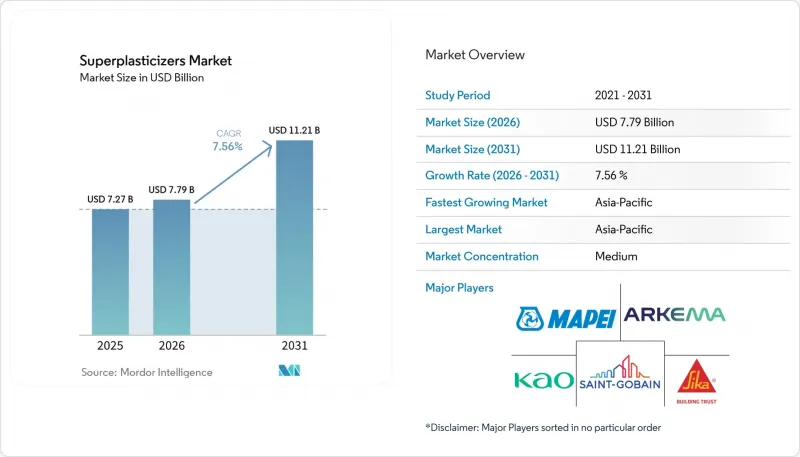
據 Mordor Intelligence 稱,高性能減水劑的市場規模在 2025 年估計為 72.7 億美元,預計在預測期(2026-2031 年)內將以 7.56% 的複合年成長率成長,從 2026 年的 77.9 億美元成長到 2031 年的 111 億美元。
全球高效減水劑市場趨勢與洞察
低碳混凝土和水泥減量要求
隨著低碳建築的要求日益提高,混凝土中輔助膠凝材料的使用量也隨之增加,每立方公尺混凝土對外加劑的需求也隨之上升。這是因為這些接合材料會影響混凝土的需水量、分散性能和澆築性能。 2025年發表於《科學報告》(Scientific Reports)的一項研究表明,石灰石煅燒粘土水泥中煅燒粘土的含量越高,維持混凝地工作性能所需的超塑性塑化劑用量就越多。由於鍛燒黏土具有較大的比表面積,會減少混合物中可利用的自由水,因此控制混凝土的工作性能高度依賴外加劑的選擇和用量。在這種情況下,對於低水泥熟料混凝土而言,精確分散顯得特別重要。 2025年發表於《建築》(Buildings)的一項研究報告稱,當向CEM III/A和CEM V/B混合料中添加聚羧酸醚(PCE)基高性能減水劑時,其28天抗壓強度與標準CEM I混合料的抗壓強度持平或更高。歐洲對檢驗的低碳產品的採購要求使得這種化學成分在公共和私人建設項目中非常重要,因為排放文件會影響材料的選擇。
預拌混凝土的配料和坍落度保持要求
在預拌混凝土攪拌站,混凝土必須在配料、運輸、澆築和泵送等整個過程中保持良好的可操作性。自動化攪拌站採用液態配方,並配備計量和配料裝置,使攪拌站管理人員能夠更精確地控制外加劑與水的比例以及批次間的一致性。可預測的配料量有助於攪拌站進行品質保證,同時減少批次間的差異和材料浪費。供應商提供的產品旨在滿足特定的坍落度保持需求,包括在長途運輸、擁擠的施工現場或高溫天氣條件下保持穩定的混凝土。這些要求對於大規模城市專案至關重要,因為這些專案每天都需要向多個施工現場供應運輸混凝土,延誤可能會影響澆築品質、勞動力利用率和專案進度。
原物料價格和供應狀況的波動
丙烯酸、甲基丙烯酸和環氧乙烷或環氧丙烷合計佔聚羧酸醚(PCE)生產成本的60-70%。這些原料的價格波動會影響配方利潤率和採購決策,尤其是在供應商無法調整客戶價格或確保穩定的原料供應時。此外,PCE生產商也依賴聚醚側鏈的原料,因此上游價格的劇烈波動會帶來不不確定性。磺酸鹽萘甲醛(SNF)生產商也面臨另一個風險:煤焦油精煉過程中產生的硫酸和萘。這使得生產商暴露於多條商品鏈,這些商品鏈的價格形成模式、供應商基礎、物流要求和供應中斷風險各不相同。與在現貨市場採購原料的配方生產商相比,自行生產單體或擁有長期原料合約的生產商能夠更有效地管理這些風險。
細分市場分析
預計到2025年,聚羧酸衍生物將佔據高效減水劑市場40.45%的佔有率,並在2031年之前以8.34%的複合年成長率成長。其聚羧酸主鏈和聚環氧乙烷側鏈透過空間位阻促進顆粒分散,幫助生產者在控制用水量的同時保持配合比設計的柔軟性。這種結構允許在不永久吸附到水泥顆粒上的情況下減少用水量,因此在生產商需要平衡混凝土的可加工性、凝結性能、強度發展以及與當地材料的相容性時,聚羧酸衍生物非常實用。 PCE等級的聚羧酸衍生物是既需要減少用水量又需要良好可加工性的通用混凝土的理想選擇。
產品選擇取決於配合比設計和應用。 2026年發表在《科學報告》(Scientific Reports)上的一項研究表明,添加1%的磺酸鹽萘甲醛(SNF)可使單組分地無機聚合物混凝土的相對坍落度提高272.9%,而聚羧酸醚(PCE)對可加工性的改善有限,且用量增加會導致強度下降。這些結果支持在預製件和特殊土木工程應用中繼續使用SNF,因為在這些應用中,長期坍落度保持並非主要要求,而初始強度控制和成本才是優先考慮的因素。改質磺酸鹽在價格敏感型應用中仍然有用,但其較低的減水能力限制了其在結構混凝土中的應用。由於合規成本,磺酸鹽三聚氰胺甲醛(SMF)在歐洲和美國市場的需求受到壓力,但在南亞和東南亞部分地區仍然適用。這些地區的產品轉型取決於當地法規、資金和客戶接受度。
區域分析
預計到2025年,亞太地區將佔據超塑化劑市場45.91%的佔有率,並在2031年之前以8.94%的複合年成長率成長。中國對水力發電、高鐵和住宅的持續投資,以及對混凝土性能要求的提高,正在推動超塑化劑使用量的成長和對更嚴格外加劑規格的需求。印度的基礎設施發展計畫和住宅計畫正在促進預拌混凝土的應用。在日本和韓國,預製構件建設和抗震要求支撐了市場需求,這些因素往往強調對結構應用中混凝土性能的控制。由於收費公路、機場和地鐵系統的持續建設,印尼、越南和菲律賓對預拌混凝土供應和項目專用外加劑的需求不斷成長,創造了更多商機。
在亞太地區,各地區的要求不盡相同。例如,中國採用GB 8076標準規定外加劑的性能,而印度則採用IS 9103標準。標準的差異意味著不同國家建築市場的合規文件、測試方法和客戶期望各不相同,因此,針對不同地區的混凝土配合比設計和技術支援對供應商至關重要。北美的需求主要來自使用高性能混凝土的基礎設施項目,而歐洲的需求則與低水泥熟料混凝土和低碳需求有關。 EN 934-2標準為歐洲外加劑品質提供了一個通用架構。
儘管南美洲、中東和非洲在高效減水劑市場中所佔佔有率仍然相對較小,但這些地區的項目構成基於當地物流、氣候和性能要求,產生了獨特的市場需求。在巴西和阿根廷,住宅和保障性住宅計畫支撐了市場需求,建設活動和當地生產條件影響外加劑的需求。沙烏地阿拉伯計劃在2026年前投資建造交通和工業走廊,這將推動對ISO認證外加劑的需求。 NEOM專案需要在對長期可操作性有較高要求的條件下進行大規模混凝土澆築,因此耐熱性和確保可靠的澆築時間成為材料選擇的關鍵標準。 SASO 2451規定了沙烏地阿拉伯混凝土外加劑的測試和註冊要求,因此,對於尋求專案批准的供應商而言,合規準備和本地技術文件至關重要。南非和東非市場受益於區域供應網路,其中包括在坦尚尼亞的生產。
其他好處:
- Excel格式的市場預測(ME)表
- 3個月的分析師支持
目錄
第1章:引言
- 研究假設和市場定義
- 調查範圍
第2章:調查方法
第3章執行摘要
第4章 市場狀況
- 市場概覽
- 市場促進因素
- 對基礎設施和公共工程的投資
- 低碳混凝土和水泥減量要求
- 預拌混凝土的配料和坍落度保持要求
- 採用預製、模組化和高性能混凝土
- 人工智慧最佳化的配方設計與自動分裝
- 市場限制因素
- 原物料價格和供應狀況的波動
- 水泥與骨材相容性的變化
- 遵守甲醛、殘留物和化學品法規的負擔。
- 價值鏈分析
- 波特五力分析
第5章 市場規模與成長預測
- 依產品類型
- 多羧酸衍生物(PC)
- 磺酸鹽萘甲醛縮合物(SNF)
- 磺酸鹽三聚氰胺-甲醛縮合物(SMF)
- 改質磺酸鹽(MLS)
- 其他產品類型
- 按形式
- 液體
- 粉末
- 透過使用
- 預拌混凝土
- 預製混凝土
- 高性能混凝土
- 自密實混凝土
- 其他用途
- 按地區
- 亞太地區
- 中國
- 印度
- 日本
- 韓國
- 東南亞國協
- 其他亞太國家
- 北美洲
- 美國
- 加拿大
- 墨西哥
- 歐洲
- 德國
- 英國
- 法國
- 義大利
- 北歐國家
- 其他歐洲國家
- 南美洲
- 巴西
- 阿根廷
- 其他南美國家
- 中東和非洲
- 沙烏地阿拉伯
- 南非
- 其他中東和非洲國家
- 亞太地區
第6章 競爭情勢
- 市場集中度
- 策略趨勢
- 市佔率和排名分析
- 公司簡介
- Arkema
- Chembond Chemicals Limited
- Concrete Additives & Chemicals Pvt. Ltd.
- Enaspol as
- Ha-Be Betonchemie GmbH
- Jiangsu Sobute New Materials Co., Ltd.
- Kao Corporation
- MAPEI SpA
- MC-Bauchemie Muller GmbH & Co. KG
- MUHU(China)Co., Ltd.
- Rhein-Chemotechnik GmbH
- Saint-Gobain
- Shandong Wanshan Chemical Co., Ltd.
- Sika AG
- The Euclid Chemical Company
第7章 市場機會與未來展望
According to Mordor Intelligence, the superplasticizers market size was estimated at USD 7.27 billion in 2025 and is estimated to grow from USD 7.79 billion in 2026 to USD 11.21 billion by 2031, at a CAGR of 7.56% during the forecast period (2026-2031).
Global Superplasticizers Market Trends and Insights
Low-Carbon Concrete and Cement-Reduction Requirements
Low-carbon construction requirements increase admixture demand per cubic meter when concrete incorporates more supplementary cementitious materials, because these binders can alter water demand, dispersion behavior, and placement performance. A 2025 Scientific Reports study found that higher calcined-clay content in Limestone Calcined Clay Cement increased the superplasticizer dosage required to maintain workability. Calcined clay has a high specific surface area and reduces available free water in the mix, making workability control more dependent on admixture selection and dosing. This condition also makes accurate dispersion more important for low-clinker concrete. A 2025 Buildings study reported that Polycarboxylate Ether (PCE)-based superplasticizers in CEM III/A and CEM V/B blends maintained 28-day compressive strength at or above CEM I reference mixes. European procurement requirements for verified low-carbon products make this chemistry relevant to public works and private construction, where emissions documentation influences material selection.
Ready-Mix Batching and Slump-Retention Requirements
Ready-mix plants require concrete that remains workable during batching, transit, placement, and pumping. Liquid formulations are used with metered dosing equipment in automated plants, giving plant managers greater control over admixture-to-water ratios and batch consistency. Predictable dosing helps plants reduce batch variability and material waste while supporting quality assurance. Suppliers provide products designed for specific slump-retention needs, including mixes stable during long transit times, on congested sites, or in hot weather. These requirements are relevant in large urban projects where transit-mix concrete serves multiple construction sites daily and where delays affect placement quality, labor use, and project schedules.
Raw-Material Price and Availability Volatility
Acrylic acid, methacrylic acid, and ethylene or propylene oxide together represent 60-70% of Polycarboxylate Ether (PCE) production costs. Volatility in these inputs affects formulation margins and procurement decisions, particularly when suppliers cannot adjust customer prices or secure consistent material availability. PCE producers also depend on polyether side-chain inputs, which creates uncertainty when upstream pricing changes quickly. Sulfonated Naphthalene Formaldehyde (SNF) producers face separate exposure to sulfuric acid and naphthalene from coal-tar refining. This leaves producers exposed to multiple commodity chains with different pricing patterns, supplier bases, logistics requirements, and supply interruption risks. Manufacturers with monomer integration or long-term feedstock contracts manage this risk more effectively than formulators buying materials on the spot market.
Other drivers and restraints analyzed in the detailed report include:
- Precast, Modular, and High-Performance Concrete Adoption
- AI-Optimized Mix Design and Automated Dosing
- Cement and Aggregate Compatibility Variability
For complete list of drivers and restraints, kindly check the Table Of Contents.
Segment Analysis
Polycarboxylate derivatives held 40.45% of the superplasticizers market share in 2025 and are projected to grow at an 8.34% CAGR through 2031. Their polycarboxylate backbone and polyethylene oxide side chains promote particle dispersion through steric hindrance, helping producers manage water reduction while retaining flexibility in formulation design. This structure supports water reduction without permanently adsorbing to cement particles, which is useful when producers need to balance workability, set behavior, strength development, and local material compatibility. PCE grades are well-suited to general-purpose concrete where both water reduction and workable placement are required.
Product selection depends on the mix design and the intended application. A 2026 Scientific Reports study found that 1% Sulfonated Naphthalene Formaldehyde (SNF) increased relative slump by 272.9% in one-part geopolymer concrete, whereas Polycarboxylate Ether (PCE) yielded limited workability gains and caused strength reductions at higher dosages. This supports continued SNF use in precast and specialty civil applications that prioritize controlled early strength and cost, where extended slump retention is not the primary requirement. Modified lignosulfonates remain relevant in price-sensitive applications, although their lower water-reduction capability limits their role in structural concrete. Sulfonated Melamine Formaldehyde (SMF) demand is under pressure in Western markets due to compliance costs, but it remains applicable in parts of South Asia and Southeast Asia, where product transitions depend on local compliance, capital, and customer acceptance.
Complete Report Scope:
- By Product Type
- Polycarboxylate Derivatives (PC)
- Sulfonated Naphthalene-Formaldehyde Condensates (SNF)
- Sulfonated Melamine-Formaldehyde Condensates (SMF)
- Modified Lignosulfonates (MLS)
- Other Product Types
- By Form
- Liquid
- Powder
- By Application
- Ready-Mix Concrete
- Precast Concrete
- High-Performance Concrete
- Self-Compacting Concrete
- Other Applications
- By Geography
- Asia-Pacific
- China
- India
- Japan
- South Korea
- ASEAN Countries
- Rest of Asia-Pacific
- North America
- United States
- Canada
- Mexico
- Europe
- Germany
- United Kingdom
- France
- Italy
- NORDIC Countries
- Rest of Europe
- South America
- Brazil
- Argentina
- Rest of South America
- Middle East and Africa
- Saudi Arabia
- South Africa
- Rest of Middle East and Africa
- Asia-Pacific
Geography Analysis
Asia-Pacific held 45.91% of the superplasticizers market share in 2025 and is forecast to grow at an 8.94% CAGR through 2031. China's continued investment in hydropower, high-speed rail, and housing, combined with concrete performance requirements, supports higher usage and more demanding admixture specifications. India's infrastructure pipeline and housing programs support the adoption of ready-mix concrete. Japan and South Korea maintain demand through precast construction methods and earthquake-resistance requirements, which favor controlled concrete properties in structural applications. Indonesia, Vietnam, and the Philippines present additional opportunities as toll roads, airports, and metro systems enter construction, increasing the need for ready-mix supply and project-specific admixture support.
Regional requirements vary across the Asia-Pacific. China uses GB 8076, and India uses IS 9103 to govern admixture performance. This fragmentation makes localized formulation and technical support important for suppliers, as compliance documentation, test practices, and customer expectations differ across national construction markets. North American demand is driven by infrastructure projects using high-performance concrete, while European demand is linked to lower-clinker blends and embodied-carbon requirements. EN 934-2 provides a common European framework for admixture quality.
South America, the Middle East, and Africa remain smaller parts of the superplasticizers market, but their project mix supports specialized demand based on regional logistics, climate, and performance requirements. Brazil and Argentina are supported by residential and social housing programs, where construction activity and local production availability influence admixture demand. Saudi Arabia's 2026 transport and industrial corridor investment supports demand for ISO-certified admixtures. NEOM requires large-scale concrete placements under conditions demanding extended workability, making heat-resistant performance and dependable placement windows key material selection criteria. SASO 2451 establishes testing and registration requirements for concrete admixtures in Saudi Arabia, making compliance readiness and local technical documentation relevant for suppliers seeking project approvals. South Africa and East African markets benefit from regional supply links, including production in Tanzania.
- Arkema
- Chembond Chemicals Limited
- Concrete Additives & Chemicals Pvt. Ltd.
- Enaspol a.s.
- Ha-Be Betonchemie GmbH
- Jiangsu Sobute New Materials Co., Ltd.
- Kao Corporation
- MAPEI S.p.A.
- MC-Bauchemie Muller GmbH & Co. KG
- MUHU (China) Co., Ltd.
- Rhein-Chemotechnik GmbH
- Saint-Gobain
- Shandong Wanshan Chemical Co., Ltd.
- Sika AG
- The Euclid Chemical Company
Additional Benefits:
- The market estimate (ME) sheet in Excel format
- 3 months of analyst support
TABLE OF CONTENTS
1 Introduction
- 1.1 Study Assumptions and Market Definition
- 1.2 Scope of the Study
2 Research Methodology
3 Executive Summary
4 Market Landscape
- 4.1 Market Overview
- 4.2 Market Drivers
- 4.2.1 Infrastructure and Public-Works Investment
- 4.2.2 Low-Carbon Concrete and Cement-Reduction Requirements
- 4.2.3 Ready-Mix Batching and Slump-Retention Requirements
- 4.2.4 Precast, Modular and High-Performance Concrete Adoption
- 4.2.5 AI-Optimized Mix Design and Automated Dosing
- 4.3 Market Restraints
- 4.3.1 Raw-Material Price and Availability Volatility
- 4.3.2 Cement and Aggregate Compatibility Variability
- 4.3.3 Formaldehyde, Residue and Chemical-Compliance Burden
- 4.4 Value Chain Analysis
- 4.5 Porter's Five Forces Analysis
- 4.5.1 Bargaining Power of Suppliers
- 4.5.2 Bargaining Power of Buyers
- 4.5.3 Threat of New Entrants
- 4.5.4 Threat of Substitutes
- 4.5.5 Competitive Rivalry
5 Market Size and Growth Forecasts (Value)
- 5.1 By Product Type
- 5.1.1 Polycarboxylate Derivatives (PC)
- 5.1.2 Sulfonated Naphthalene-Formaldehyde Condensates (SNF)
- 5.1.3 Sulfonated Melamine-Formaldehyde Condensates (SMF)
- 5.1.4 Modified Lignosulfonates (MLS)
- 5.1.5 Other Product Types
- 5.2 By Form
- 5.2.1 Liquid
- 5.2.2 Powder
- 5.3 By Application
- 5.3.1 Ready-Mix Concrete
- 5.3.2 Precast Concrete
- 5.3.3 High-Performance Concrete
- 5.3.4 Self-Compacting Concrete
- 5.3.5 Other Applications
- 5.4 By Geography
- 5.4.1 Asia-Pacific
- 5.4.1.1 China
- 5.4.1.2 India
- 5.4.1.3 Japan
- 5.4.1.4 South Korea
- 5.4.1.5 ASEAN Countries
- 5.4.1.6 Rest of Asia-Pacific
- 5.4.2 North America
- 5.4.2.1 United States
- 5.4.2.2 Canada
- 5.4.2.3 Mexico
- 5.4.3 Europe
- 5.4.3.1 Germany
- 5.4.3.2 United Kingdom
- 5.4.3.3 France
- 5.4.3.4 Italy
- 5.4.3.5 NORDIC Countries
- 5.4.3.6 Rest of Europe
- 5.4.4 South America
- 5.4.4.1 Brazil
- 5.4.4.2 Argentina
- 5.4.4.3 Rest of South America
- 5.4.5 Middle East and Africa
- 5.4.5.1 Saudi Arabia
- 5.4.5.2 South Africa
- 5.4.5.3 Rest of Middle East and Africa
- 5.4.1 Asia-Pacific
6 Competitive Landscape
- 6.1 Market Concentration
- 6.2 Strategic Moves
- 6.3 Market Share (%)/Ranking Analysis
- 6.4 Company Profiles (includes Global Overview, Market Overview, Core Segments, Financials as available, Strategic Information, Products and Services, and Recent Developments)
- 6.4.1 Arkema
- 6.4.2 Chembond Chemicals Limited
- 6.4.3 Concrete Additives & Chemicals Pvt. Ltd.
- 6.4.4 Enaspol a.s.
- 6.4.5 Ha-Be Betonchemie GmbH
- 6.4.6 Jiangsu Sobute New Materials Co., Ltd.
- 6.4.7 Kao Corporation
- 6.4.8 MAPEI S.p.A.
- 6.4.9 MC-Bauchemie Muller GmbH & Co. KG
- 6.4.10 MUHU (China) Co., Ltd.
- 6.4.11 Rhein-Chemotechnik GmbH
- 6.4.12 Saint-Gobain
- 6.4.13 Shandong Wanshan Chemical Co., Ltd.
- 6.4.14 Sika AG
- 6.4.15 The Euclid Chemical Company
7 Market Opportunities and Future Outlook
- 7.1 White-Space and Unmet-Need Assessment

 全球高性能混凝土減水劑市場(至 2031 年):依產品形式、產品類型、應用和地區分類。
 高性能混凝土減水劑市場規模、佔有率及成長分析:依產品化學類型、形態、應用、通路及地區分類-2026-2033年產業預測
 高性能混凝土減水劑市場:按類型、最終用途、形式和應用分類-2026-2032年全球市場預測
 多元羧酸醚市場:依產品類型、建設產業和地區分類。
 全球聚羧酸係高性能減水劑單體市場規模、佔有率、趨勢及成長分析報告(2026-2034)全球超塑性塑膠市場規模、佔有率、趨勢和成長分析報告(2026-2034年)
 2026年全球多元羧酸醚市場報告
 混凝土高效減水劑市場規模、佔有率和趨勢分析報告:按產品、應用、形態、地區和細分市場預測,2026-2033年
 聚羧酸醚市場規模、佔有率及成長分析(按形態、聚合度、應用和地區分類)-2026-2033年產業預測
 高效能節水器市場規模、佔有率及成長分析(按類型、形式、應用和地區分類)-2026-2033年產業預測