


 |
市場調查報告書
商品編碼
2154928
南美洲袋包裝:市場佔有率分析、產業趨勢與統計及成長預測(2026-2031 年)South America Pouch Packaging - Market Share Analysis, Industry Trends & Statistics, Growth Forecasts (2026 - 2031) |
||||||

※ 本網頁內容可能與最新版本有所差異。詳細情況請與我們聯繫。
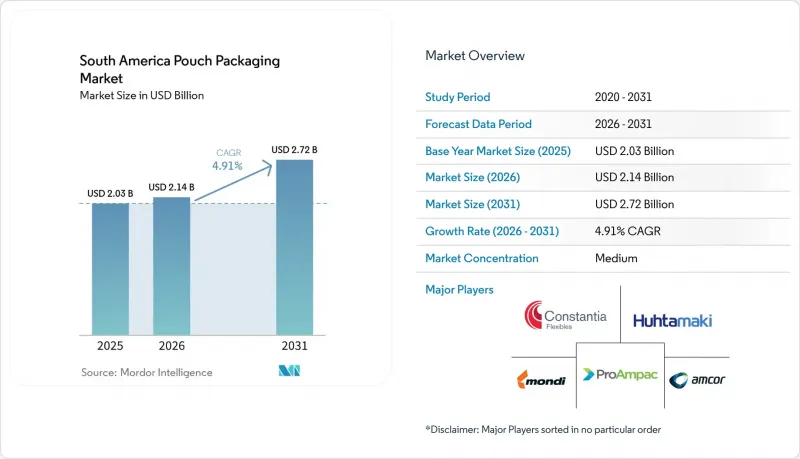
根據 Mordor Intelligence 預測,南美洲袋裝包裝市場規模將從 2025 年的 20.3 億美元和 2026 年的 21.4 億美元成長到 2031 年的 27.2 億美元,2026 年至 2031 年的年複合成長率(CAGR)為 4.91%。
南美軟包裝市場趨勢與洞察
從硬質包裝過渡到軟質包裝
整個南美食品加工產業正從硬質包裝轉向軟包裝,推動市場對軟包裝的需求成長。與玻璃和金屬包裝相比,軟包裝重量顯著減輕,從而降低了出口和國內分銷的運輸成本。隨著品牌商將生產線改造為與軟包裝相容的成型、填充和封口 (FFS) 系統,聚乙烯軟包裝的需求持續超過硬質塑膠包裝。一旦生產商投資軟包裝填充設備,若要恢復使用硬包裝,可能需要進一步的資本投入。此外,殺菌袋和無菌軟包裝也拓展了軟包裝在常溫蛋白食品、即食食品和嬰幼兒食品的應用。這為南美軟包裝市場帶來了更永續的需求基礎,超越了對短期包裝形式的偏好。
有組織的零售和現代貿易的擴張
正規零售商青睞軟包裝袋,因為它們包裝便於上架,展示標準化,且能促進重複購買。 Cencosud 已投入巨資,主要用於在南美洲各地擴張和分店新店。 Jeronimo Martins 透過在波哥大地區開設多家「Ara」門市並整合數十家「Colsubsidio」門市,擴大了其正規的食品零售網路。這些零售網路依賴更短的產品週轉週期和符合展示要求的包裝。可重複密封、常溫保存的軟包裝袋恰好滿足食品、乳製品、零食和個人保健產品的這些要求。因此,隨著現代零售通路從非正規零售通路搶佔市場佔有率,南美洲的軟包裝袋市場也從中受益。
聚乙烯和聚丙烯樹脂的成本波動很大。
聚乙烯和聚丙烯在包裝袋生產商的原料成本中佔很大比例。南美生產商尤其容易受到外部價格波動的影響,因為該地區的蒸汽裂解裝置主要使用石腦油作為原料。在中東供應中斷影響價格之前,聚乙烯和聚丙烯的價格已經回升至高點。巴西化學集團Braschem提高了國產低密度聚乙烯(LDPE)、高密度聚乙烯(HDPE)和線性低密度聚乙烯(LLDPE)的價格,而巴西政府則對美國聚乙烯徵收了反傾銷稅。這些壓力可能會限制採購柔軟性,並擠壓中小加工企業的利潤空間。
細分市場分析
到2025年,聚乙烯將佔據南美軟包裝市場32.46%的佔有率,成為最大的材料類別。這一地位反映了聚乙烯的成本競爭力、與眾多加工商的兼容性以及Braschem在各區域工廠的生產能力。位於巴西、阿根廷和智利的吹膜和流延擠出生產線專為生產低密度聚乙烯(LDPE)、線性低密度聚乙烯(LLDPE)和茂金屬基聚乙烯而設計。這些聚乙烯廣泛應用於食品、農產品和消費品包裝領域。聚丙烯由於其比聚乙烯更高的耐熱性,在熱填充和蒸餾應用中發揮著至關重要的作用。聚對苯二甲酸乙二醇酯(PET)和聚氯乙烯(PVC)在某些透明袋、熱成型袋和特殊袋應用中仍然佔據重要地位。
預計從2026年到2031年,可生物分解和可堆肥包裝形式的複合年成長率將達到5.14%,在所有材料細分領域中成長最高。品牌商正在探索這些選項,以尋求在處置時能更清楚地考慮環境因素的包裝。 Braschem公司的生物基聚乙烯「I'm green」採用甘蔗衍生的乙醇製成,適用於食品接觸材料。據該公司稱,該材料已獲得「從搖籃到大門」的負碳足跡認證。鋁箔在藥品包裝、阻隔性殺菌袋以及對氧氣和水分防護要求高的優質食品包裝中仍然發揮著重要作用。同時,對再生材料含量的目標以及單一材料再設計計劃正迫使供應商重新思考多層結構。
到2025年,立式袋將佔產品類型的33.42%,在南美袋裝包裝市場佔據領先地位。由於其貨架可見性好、便於攜帶,且相容於拉鍊和吸嘴封口,自立袋廣泛應用於食品、寵物護理和個人護理行業。巴西和阿根廷現有的泡棉填充封口(FFS)設備已配置為可容納常見立式袋的尺寸。這些已安裝的設備支援自立袋在批量生產包裝商品中的持續應用。扁平枕式和側封式包裝仍然是普通食品和單份包裝的常用選擇。此外,對於需要常溫保存的加工肉品、調理食品和嬰幼兒食品,蒸餾和無菌包裝設計也日益普及。
預計2026年至2031年間,吸嘴袋市場將以5.11%的複合年成長率成長。這種包裝形式廣泛應用於飲料、嬰兒食品、調味品和個人保健產品等領域,這些領域對精準分裝和重新密封的要求較高。 2026年3月,SIG整合了其在南美洲的盒中袋和吸嘴袋業務,並將位於維涅多的工廠打造為區域中心。該公司在其草案中將該工廠描述為全球最大的吸嘴袋生產基地之一。條狀包裝和小袋則滿足了對價格敏感、購買少量營養補充劑、清潔劑和藥品等產品的客戶的需求。捲材和成品袋也為代工生產商和擁有自有產品線的品牌提供支持,使其能夠提供豐富的產品種類。
其他好處:
- Excel格式的市場預測(ME)表
- 3個月的分析師支持
目錄
第1章:引言
- 研究假設和市場定義
- 調查範圍
第2章:調查方法
第3章執行摘要
第4章 市場狀況
- 市場概覽
- 市場促進因素
- 從硬質包裝過渡到軟質包裝
- 有組織的零售和現代零售的擴張
- 輕鬆易攜的食品包裝發展
- 採用可回收的單一材料包裝袋
- 阻隔性及現場蒸餾加工能力
- 優質寵物食品和份量調整套餐
- 市場限制因素
- 聚乙烯和聚丙烯樹脂的成本波動很大。
- 收集和回收基礎設施不足
- 高速灌裝和蒸餾設備的資本密集度
- 可回收性和阻隔性能之間的技術權衡
- 產業價值鏈分析
- 宏觀經濟因素對市場的影響
- 監理情勢
- 技術展望
- 波特五力分析
第5章 市場規模與成長預測
- 材料
- 塑膠
- 聚乙烯(PE)
- 聚丙烯(PP)
- 聚對苯二甲酸乙二醇酯(PET)
- 聚氯乙烯樹脂(PVC)
- 其他塑膠
- 紙
- 鋁箔
- 可生物分解/可堆肥
- 塑膠
- 依產品類型
- 平型(枕形和側邊密封)
- 起來
- 帶傾倒嘴
- 蒸餾
- 無菌
- 條裝/小袋
- 卷材/預製袋
- 透過封裝方法
- 拉鍊
- 壺嘴和蓋子
- 蒂亞諾西
- 滑桿
- 其他類型的帽子
- 按最終用戶行業分類
- 食物
- 糖果和糖果甜點
- 冷凍食品
- 生鮮食品
- 乳製品
- 乾貨和穀物
- 肉類、雞肉、魚貝類
- 寵物食品
- 其他食品(醬料、調味品、抹醬)
- 飲料
- 酒精飲料
- 非酒精性
- 醫療和製藥
- 個人護理化妝品
- 居家照護和家務
- 其他終端用戶產業
- 食物
- 按地區
- 巴西
- 阿根廷
- 哥倫比亞
- 智利
- 秘魯
- 其他南美國家
第6章 競爭情勢
- 市場集中度
- 策略趨勢
- 市佔率分析
- 公司簡介
- Amcor plc
- ProAmpac Holdings, Inc.
- Mondi plc
- Constantia Flexibles Group GmbH
- Huhtamaki Oyj
- Sonoco Products Company
- Gualapack Spa
- SIG Group AG
- Sealed Air Corporation
- Uflex Ltd.
- Berry Global Group, Inc.
- Toppan Holdings Inc.
- ZARAPLAST SA
- Plastrela Embalagens Flexiveis Ltda
- Bolsafilm SA
- Transcontinental Inc.
- FlexPak Services
- Coveris Holdings SA
- Aluflexpack AG
- Bischof+Klein SE and Co. KG
第7章 市場機會與未來展望
According to Mordor Intelligence, the South America pouch packaging market size is projected to expand from USD 2.03 billion in 2025 and USD 2.14 billion in 2026 to USD 2.72 billion by 2031, registering a CAGR of 4.91% between 2026 to 2031.
South America Pouch Packaging Market Trends and Insights
Shift From Rigid to Flexible Packaging
The shift from rigid packaging to pouches supports demand across South America's food processing sector. Pouches can substantially reduce packaging weight compared with glass or metal alternatives, which can lower freight costs on export and domestic distribution routes. Flexible packaging demand for polyethylene has continued to outpace rigid-plastic demand as brand owners adapt lines for pouch-compatible form-fill-seal systems. Once a producer invests in pouch filling equipment, returning to rigid formats can require further capital spending. Retort and aseptic pouches are also widening the use of flexible packaging in shelf-stable proteins, ready-to-eat meals, and infant nutrition. This gives the South America pouch packaging market a more durable base of demand than a short-term format preference.
Expansion of Organized Retail and Modern Trade
Organized retail favors pouches because retailers need shelf-ready packs, standardized displays, and formats that support repeat purchases. Cencosud allocated substantial capital expenditure, with the majority directed toward store growth and greenfield development across its South American operations. Jeronimo Martins opened numerous Ara stores and integrated dozens of Colsubsidio stores in Colombia, increasing the reach of formal grocery retail in the Bogota area. These networks rely on shorter refresh cycles and packaging that meets display requirements. Resealable and shelf-stable pouches fit those requirements in food, dairy, snacks, and personal care. The South America pouch packaging market, therefore, benefits as modern trade gains share from informal retail channels.
Volatile Polyethylene and Polypropylene Resin Costs
Polyethylene and polypropylene represent a substantial share of pouch converters' material costs. South American producers are exposed to external pricing changes because regional steam crackers depend mainly on naphtha feedstocks. Polyethylene and polypropylene prices returned to elevated levels before supply disruptions in the Middle East affected pricing. Braskem raised domestic LDPE, HDPE, and LLDPE prices, while Brazil imposed an antidumping duty on U.S.-origin polyethylene. These pressures limit sourcing flexibility and can narrow margins for smaller and mid-sized converters.
Other drivers and restraints analyzed in the detailed report include:
- Growth of Lightweight and Portable Food Packaging
- Adoption of Recycle-Ready Mono-Material Pouches
- Underdeveloped Collection and Recycling Infrastructure
For complete list of drivers and restraints, kindly check the Table Of Contents.
Segment Analysis
Polyethylene held 32.46% of the South America pouch packaging market share in 2025, making it the largest material category. Its position reflects cost competitiveness, broad converter compatibility, and production availability from Braskem's regional operations. Blown-film and cast-extrusion lines in Brazil, Argentina, and Chile are designed for LDPE, LLDPE, and metallocene polyethylene grades. These grades serve food, agro-industrial, and consumer goods packaging applications. Polypropylene has an important role in hot-fill and retort uses because it offers stronger heat resistance than polyethylene. PET and PVC remain relevant for selected transparent, thermoformed, and specialty pouch uses.
Biodegradable and compostable formats are projected to expand at a 5.14% CAGR from 2026 to 2031, the fastest rate among material subsegments. Brands are assessing these options as they seek packaging with clearer end-of-life credentials. Braskem's I'm green bio-based polyethylene is produced from sugarcane ethanol and can be used as a food-contact material. The company states that the material has a certified negative cradle-to-gate carbon footprint. Aluminum foil remains important in pharmaceutical packs, high-barrier retort pouches, and premium foods where oxygen and moisture protection requirements are high. At the same time, recycled-content targets and mono-material redesign programs are encouraging suppliers to reconsider multilayer structures.
Stand-up pouches held 33.42% of the product category in 2025, giving them the leading position in the South America pouch packaging market. They are widely used in food, pet care, and personal care because they provide shelf visibility, portability, and compatibility with zipper and spout closures. Existing form-fill-seal equipment in Brazil and Argentina is already configured for common stand-up pouch dimensions. This installed base supports continued use across high-volume packaged goods. Flat pillow and side-seal formats remain common in commodity food and single-serve applications. Retort and aseptic designs are also being adopted for processed meats, ready meals, and infant nutrition that require ambient shelf life.
Spouted pouches are projected to expand at a 5.11% CAGR from 2026 to 2031. Beverage, baby food, condiment, and personal care applications use this format when controlled dispensing and resealing are needed. SIG consolidated its bag-in-box and spouted pouch operations in South America in March 2026, naming its Vinhedo facility as the regional hub. The company described the facility as one of its largest spouted pouch operations globally in the draft. Stick packs and sachets serve price-sensitive customers who purchase smaller units of nutrition, detergent, and pharmaceutical products. Rollstock and premade pouches also support co-manufacturers and brand-owned lines that handle many product variations.
Complete Report Scope:
- By Material
- Plastics
- Polyethylene (PE)
- Polypropylene (PP)
- Polyethylene Terephthalate (PET)
- Polyvinyl Chloride Resin (PVC)
- Other Plastics
- Paper
- Aluminum Foil
- Bio-degradable/Compostable
- Plastics
- By Product Type
- Flat (Pillow and Side-Seal)
- Stand-Up
- Spouted
- Retort
- Aseptic
- Stick-Pack / Sachet
- Rollstock / Premade Pouch
- By Closure Type
- Zipper
- Spout and Cap
- Tear-Notch
- Slider
- Other Closure Type
- By End-User Industry
- Food
- Candy and Confectionery
- Frozen Foods
- Fresh Produce
- Dairy Products
- Dry Foods and Cereals
- Meat, Poultry and Seafood
- Pet Food
- Other Foods (Sauces, Condiments, Spreads)
- Beverage
- Alcoholic
- Non-Alcoholic
- Medical and Pharmaceutical
- Personal Care and Cosmetics
- Home Care and Household
- Other End-User Industry
- Food
- By Geography
- Brazil
- Argentina
- Colombia
- Chile
- Peru
- Rest of South America
List of Companies Covered in this Report:
- Amcor plc
- ProAmpac Holdings, Inc.
- Mondi plc
- Constantia Flexibles Group GmbH
- Huhtamaki Oyj
- Sonoco Products Company
- Gualapack S.p.a.
- SIG Group AG
- Sealed Air Corporation
- Uflex Ltd.
- Berry Global Group, Inc.
- Toppan Holdings Inc.
- ZARAPLAST S.A.
- Plastrela Embalagens Flexiveis Ltda
- Bolsafilm S.A.
- Transcontinental Inc.
- FlexPak Services
- Coveris Holdings S.A.
- Aluflexpack AG
- Bischof + Klein SE and Co. KG
Additional Benefits:
- The market estimate (ME) sheet in Excel format
- 3 months of analyst support
TABLE OF CONTENTS
1 INTRODUCTION
- 1.1 Study Assumptions and Market Definition
- 1.2 Scope of the Study
2 RESEARCH METHODOLOGY
3 EXECUTIVE SUMMARY
4 MARKET LANDSCAPE
- 4.1 Market Overview
- 4.2 Market Drivers
- 4.2.1 Shift From Rigid to Flexible Packaging
- 4.2.2 Expansion of Organized Retail and Modern Trade
- 4.2.3 Growth of Lightweight and Portable Food Packaging
- 4.2.4 Adoption of Recycle-Ready Mono-Material Pouches
- 4.2.5 Localized High-Barrier and Retort Capability
- 4.2.6 Premium Pet Food and Portion-Control Packaging
- 4.3 Market Restraints
- 4.3.1 Volatile Polyethylene and Polypropylene Resin Costs
- 4.3.2 Underdeveloped Collection and Recycling Infrastructure
- 4.3.3 Capital Intensity of High-Speed Filling and Retort Equipment
- 4.3.4 Technical Trade-Offs Between Recyclability and Barrier Performance
- 4.4 Industry Value Chain Analysis
- 4.5 Impact of Macroeconomic Factors on the Market
- 4.6 Regulatory Landscape
- 4.7 Technological Outlook
- 4.8 Porter's Five Forces Analysis
- 4.8.1 Bargaining Power of Suppliers
- 4.8.2 Bargaining Power of Buyers
- 4.8.3 Threat of New Entrants
- 4.8.4 Threat of Substitutes
- 4.8.5 Competitive Rivalry
5 MARKET SIZE AND GROWTH FORECASTS (VALUE)
- 5.1 By Material
- 5.1.1 Plastics
- 5.1.1.1 Polyethylene (PE)
- 5.1.1.2 Polypropylene (PP)
- 5.1.1.3 Polyethylene Terephthalate (PET)
- 5.1.1.4 Polyvinyl Chloride Resin (PVC)
- 5.1.1.5 Other Plastics
- 5.1.2 Paper
- 5.1.3 Aluminum Foil
- 5.1.4 Bio-degradable/Compostable
- 5.1.1 Plastics
- 5.2 By Product Type
- 5.2.1 Flat (Pillow and Side-Seal)
- 5.2.2 Stand-Up
- 5.2.3 Spouted
- 5.2.4 Retort
- 5.2.5 Aseptic
- 5.2.6 Stick-Pack / Sachet
- 5.2.7 Rollstock / Premade Pouch
- 5.3 By Closure Type
- 5.3.1 Zipper
- 5.3.2 Spout and Cap
- 5.3.3 Tear-Notch
- 5.3.4 Slider
- 5.3.5 Other Closure Type
- 5.4 By End-User Industry
- 5.4.1 Food
- 5.4.1.1 Candy and Confectionery
- 5.4.1.2 Frozen Foods
- 5.4.1.3 Fresh Produce
- 5.4.1.4 Dairy Products
- 5.4.1.5 Dry Foods and Cereals
- 5.4.1.6 Meat, Poultry and Seafood
- 5.4.1.7 Pet Food
- 5.4.1.8 Other Foods (Sauces, Condiments, Spreads)
- 5.4.2 Beverage
- 5.4.2.1 Alcoholic
- 5.4.2.2 Non-Alcoholic
- 5.4.3 Medical and Pharmaceutical
- 5.4.4 Personal Care and Cosmetics
- 5.4.5 Home Care and Household
- 5.4.6 Other End-User Industry
- 5.4.1 Food
- 5.5 By Geography
- 5.5.1 Brazil
- 5.5.2 Argentina
- 5.5.3 Colombia
- 5.5.4 Chile
- 5.5.5 Peru
- 5.5.6 Rest of South America
6 COMPETITIVE LANDSCAPE
- 6.1 Market Concentration
- 6.2 Strategic Moves
- 6.3 Market Share Analysis
- 6.4 Company Profiles (includes Global Level Overview, Market Level Overview, Core Segments, Financials as available, Strategic Information, Market Rank/Share, Products and Services, Recent Developments)
- 6.4.1 Amcor plc
- 6.4.2 ProAmpac Holdings, Inc.
- 6.4.3 Mondi plc
- 6.4.4 Constantia Flexibles Group GmbH
- 6.4.5 Huhtamaki Oyj
- 6.4.6 Sonoco Products Company
- 6.4.7 Gualapack S.p.a.
- 6.4.8 SIG Group AG
- 6.4.9 Sealed Air Corporation
- 6.4.10 Uflex Ltd.
- 6.4.11 Berry Global Group, Inc.
- 6.4.12 Toppan Holdings Inc.
- 6.4.13 ZARAPLAST S.A.
- 6.4.14 Plastrela Embalagens Flexiveis Ltda
- 6.4.15 Bolsafilm S.A.
- 6.4.16 Transcontinental Inc.
- 6.4.17 FlexPak Services
- 6.4.18 Coveris Holdings S.A.
- 6.4.19 Aluflexpack AG
- 6.4.20 Bischof + Klein SE and Co. KG
7 MARKET OPPORTUNITIES AND FUTURE OUTLOOK
- 7.1 White-Space and Unmet-Need Assessment


