


 |
市場調查報告書
商品編碼
2154904
南美洲保全服務:市場佔有率分析、產業趨勢與統計及成長預測(2026-2031 年)South America Security Services - Market Share Analysis, Industry Trends & Statistics, Growth Forecasts (2026 - 2031) |
||||||

※ 本網頁內容可能與最新版本有所差異。詳細情況請與我們聯繫。
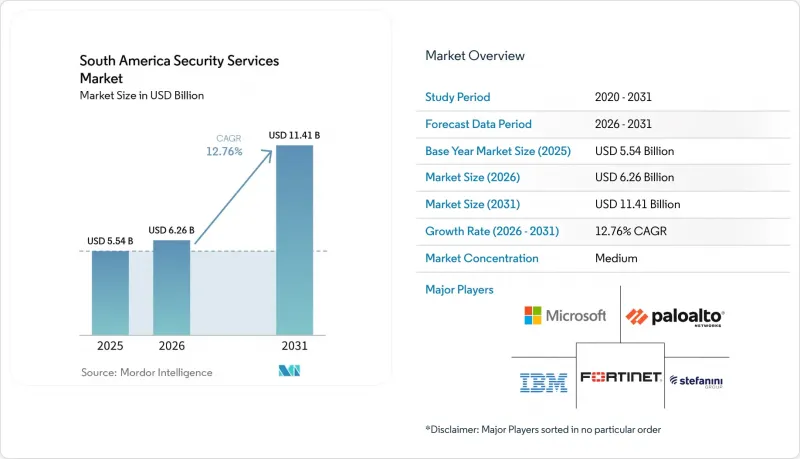
據 Mordor Intelligence 稱,2025 年南美保全服務市場價值 55.4 億美元,預計將從 2026 年的 62.6 億美元成長到 2031 年的 114.1 億美元。
預計 2026 年至 2031 年的預測期內複合年成長率將達到 12.76%。
南美洲保全服務市場趨勢與洞察
勒索軟體攻擊的頻率和嚴重性都在增加。
勒索軟體即服務 (RaaS) 降低了攻擊者在南美洲的進入門檻,攻擊目標從大型金融中心擴展到小規模的城市和工業區。醫療機構、地方政府、物流供應商和金融機構如今面臨更廣泛的攻擊,這些攻擊可能導致服務中斷、資料外洩和營運延遲。哥倫比亞的機構在從勒索軟體攻擊中恢復方面投入了大量資金。此外,與先前的調查相比,一週內恢復的機構比例顯著增加。這種復原能力的提升使得固定費率的託管偵測與回應 (MDR) 合約不再只是大型機構的專屬高級選項,而成為一種更普遍的預期。保險公司也可能更加重視客戶的遏制能力,這進一步提升了持續監控在保險合約談判中的重要性。南美洲保全服務市場正受益於買家對更快遏制速度、事件回應記錄和快速獲得專業回應團隊支援的需求。
雲端遷移和混合環境的擴展
隨著應用程式、身分和資料遷移到內部網路之外,雲端遷移正在重塑全部區域對保全服務的需求。隨著雲端採用擴大了業務系統的暴露範圍,預計未來幾年巴西將在網路安全方面進行大量投資。隨著企業擴大使用多種雲端環境和軟體即服務 (SaaS) 應用程式,雲端存取安全仲介)、雲端安全態勢管理和工作負載保護的重要性日益凸顯。傳統的本地部署合約通常無法為雲端原生工作負載提供必要的控制,尤其是在系統使用應用程式介面 (API) 和分散式身分識別管理時。中型企業經常在安全團隊有機會為相關風險和營運變更做好準備之前就採用雲端服務。這種差距可能導致企業購買託管服務,從而可能產生比最初預期更長的合約期限。
認證網路安全專業人員短缺
人才短缺推動了外包,同時也限制了服務提供者擴展服務交付能力的速度。對於需要經驗豐富的分析師全天候提供服務的機構而言,這一點尤其明顯。大型服務供應商在招募 CISSP、CEH 和 GIAC 認證分析師方面面臨著漫長的招募週期,而對這些技能人才的競爭也推高了服務交付成本。在聖保羅、波哥大和聖地牙哥以外的地區,這個問題更為突出,因為這些城市集中了培訓資源、大型雇主和成熟的安全社區。秘魯和安第斯山脈地區的小規模市場可能被迫依賴遠端交付來進行威脅狩獵、營運技術 (OT) 安全和雲端工作負載保護,這可能會帶來響應速度和語言方面的挑戰。巴西的「Hackers do Bem」計畫旨在培養網路安全專業人員,但合格人員的短缺仍然是一個重大限制。因此,南美保全服務市場不僅可能受到客戶需求的限制,也可能受到服務提供者人才儲備的限制。
細分市場分析
到2025年,託管安全服務將佔南美保全服務市場31.23%的佔有率,主要得益於位於聖保羅和聖地牙哥的安全營運中心的支援。長期客戶關係、與現有工作流程的整合以及多年期契約,也使得需要不間斷監控的買家面臨高昂的轉換成本。專業服務和整合服務,以及諮詢和評估服務,正在幫助企業重新設計其安全架構,以適應雲端遷移和零信任計劃,包括控制設計、部署規劃和合規性準備。隨著買家不再只專注於警報,而是主動偵測當地威脅行為者、支付詐騙宣傳活動、憑證濫用和有針對性的社交工程攻擊,威脅情報和威脅狩獵服務正日益受到關注。事件回應和託管偵測與回應 (MDR) 服務預計到2031年將以13.11%的複合年成長率成長,成為成長最快的服務類別。
網路犯罪的平均檢測時間已顯著縮短,導致人工回應團隊可用的時間減少。 Redbelt Security 和 ISH Tecnologia 等區域性供應商正在建立關於 Boreto詐騙、Pix 篡改和葡萄牙語社交工程的情報。 IBM 的一份報告指出,與僅依賴人工的方案相比,利用人工智慧和自動化技術的安全方案已顯著縮短了攻擊生命週期。企業越來越需要對雲端、終端、身分和營運技術 (OT) 系統進行全面保護。隨著供應商不斷擴展其檢測和響應能力、建立專門的情報研究部門、利用區域客製化的 MITRE ATT&CK 映射以及將雲端、終端、身份和 OT 監控整合到同一服務中,傳統託管安全和託管檢測與響應 (MDR) 之間的界限正變得模糊。因此,買家現在會根據供應商的區域情報深度、事件回應速度以及遏制流程的可操作性來比較不同的供應商。
至2025年,雲端採用將佔南美保全服務市場62.67%的佔有率。這主要得益於聖保羅和聖地牙哥基礎設施的擴張,為受監管的工作負載提供低延遲的區域可用性。隨著區域雲端容量的擴展,安全即服務 (SaaS) 模式變得更加可行,為服務供應商提供了一條清晰的路徑,以交付可擴展的監控、安全態勢管理和雲端工作負載保護。將應用程式遷移到雲端平台的企業通常發現,傳統的本地工具無法充分保護雲端原生工作負載,尤其是在應用程式介面、身分和資料儲存跨越多個環境的情況下。這需要重新評估安全支出分配,即使是那些原本沒有計劃更換供應商的公司也需要這樣做。巴西網路安全投資前景反映出對雲端安全訂閱的日益關注。
在國防、中央銀行和工業控制等領域,本地部署仍然至關重要。這些產業可能需要空氣間隙系統來確保資料主權、業務永續營運或限制雲端連線。此外,阿根廷貨幣的不穩定性導致以美元計價的雲端合約未來以披索計價的成本存在不確定性,促使一些組織考慮延長本地部署協議。本地安全整合商在這些合約續約工作中可以繼續發揮關鍵作用。同時,混合環境的普及進一步增加了對諮詢服務的需求,因為組織需要確定哪些工作負載可以遷移到基於雲端的保全服務。這些決策通常涉及遺留工業系統、受監管資料、恢復要求以及與本地整合商簽訂的長期合約。即使雲端採用變得越來越普遍,能夠評估這些限制並有效管理兩種環境的供應商仍然至關重要。
其他好處:
- Excel格式的市場預測(ME)表
- 3個月的分析師支持
目錄
第1章:引言
- 研究假設和市場定義
- 調查範圍
第2章:調查方法
第3章執行摘要
第4章 市場狀況
- 市場概覽
- 市場促進因素
- 勒索軟體攻擊的頻率和嚴重程度都在增加。
- 雲端遷移和混合環境的擴展
- 監管機構要求持續監測和事件回應
- 由於網路安全人員短缺而進行外包
- 針對葡萄牙語和西班牙語買家的語言最佳化保全行動。
- 資訊科技與營運技術在工業基礎設施中的融合正在不斷推進。
- 市場限制因素
- 認證網路安全專業人員短缺
- 中小企業經濟波動與安保預算削減
- 資料保護與網路安全法規碎片化
- 先進檢測平台整合高成本、複雜。
- 產業價值鏈分析
- 監理情勢
- 宏觀經濟因素對市場的影響
- 技術展望
- 波特五力分析
第5章 市場規模與成長預測
- 按服務類型
- 託管安全服務
- 專業/整合服務
- 諮詢和評估服務
- 威脅情報和狩獵服務
- 事件回應和 MDR 服務
- 部署模式
- 現場
- 雲
- 按最終用戶行業分類
- IT/通訊
- 政府/國防
- BFSI
- 醫療保健和生命科學
- 工業和關鍵基礎設施
- 運輸/物流
- 其他終端用戶產業
- 安全框架
- 零信任架構
- 基於 ISO/IEC 的託管服務
- 符合 NIST CSF 標準的服務
- 按組織規模
- 大公司
- 小型企業
- 按地區
- 巴西
- 阿根廷
- 智利
- 哥倫比亞
- 秘魯
- 其他南美國家
第6章 競爭情勢
- 市場集中度
- 策略趨勢
- 市佔率分析
- 公司簡介
- IBM Corporation
- Microsoft Corporation
- Palo Alto Networks, Inc.
- Fortinet, Inc.
- Stefanini Participacoes SA
- Telefonica Brasil SA
- Cisco Systems, Inc.
- Check Point Software Technologies Ltd.
- CrowdStrike Holdings, Inc.
- Zscaler, Inc.
- Broadcom Inc.
- Trend Micro Incorporated
- Sophos Limited
- Kaspersky Lab
- Wipro Limited
- Capgemini SE
- Fujitsu Limited
- NTT DATA Group Corporation
- Tempest Security Intelligence
- ISH Tecnologia SA
- Modulo Security Solutions SA
- Clavis Seguranca da Informacao Ltda.
第7章 市場機會與未來展望
According to Mordor Intelligence, the South America security services market size was valued at USD 5.54 billion in 2025 and estimated to expand from USD 6.26 billion in 2026 to reach USD 11.41 billion by 2031, at a CAGR of 12.76% during the forecast period 2026-2031.
South America Security Services Market Trends and Insights
Rising Frequency and Severity of Ransomware Attacks
Ransomware-as-a-service programs have lowered the entry barrier for attackers across South America, extending campaigns from large financial centers into smaller cities and industrial corridors. Healthcare providers, municipal bodies, logistics operators, and financial firms now face a broader range of attacks that can disrupt services, expose data, and delay operations. Colombian organizations faced substantial ransomware recovery costs. Additionally, a significantly higher proportion recovered within one week than in the preceding study. This improvement in recovery performance makes managed detection and response retainers a more common expectation, rather than a premium option reserved for the largest organizations. Insurance providers may also place more value on a customer's containment capability, which makes continuous monitoring more relevant during policy discussions. The South America security services market benefits as buyers seek faster containment, documented incident handling, and ready access to specialist responders.
Cloud Migration and Hybrid-Environment Expansion
Cloud migration is reshaping demand for security services across the region, as applications, identities, and data move beyond internal networks. Brazil is expected to make significant cybersecurity investments in the coming years as cloud adoption expands the exposure of business systems. Cloud access security brokers, cloud security posture management, and workload protection have become more relevant as organizations use multiple cloud environments and software-as-a-service applications. Legacy on-premises contracts often cannot provide the controls needed for cloud-native workloads, particularly where systems use application programming interfaces and distributed identity management. Mid-sized businesses are frequently adopting cloud services faster than their security teams can prepare for the related risks and operating changes. That gap leads to managed service purchases and may result in longer contracts than buyers initially expected.
Shortage of Certified Cybersecurity Professionals
The same shortage that prompts outsourcing also limits how quickly providers can add delivery capacity, particularly for services that require experienced analysts at all hours. Established providers face long hiring cycles for CISSP, CEH, and GIAC-certified analysts, and competition for these skills raises delivery costs. The problem is more pronounced outside Sao Paulo, Bogota, and Santiago, where training resources, larger employers, and more mature security communities are concentrated. Peru and smaller Andean markets may depend on remote delivery for threat hunting, operational technology security, and cloud workload protection, which can introduce response and language challenges. Brazil's Hackers do Bem program aimed to train cybersecurity professionals, but the shortage of qualified talent remained a critical constraint. The South America security services market may therefore be limited by the provider talent pipeline as well as customer demand.
Other drivers and restraints analyzed in the detailed report include:
- Regulatory-Driven Demand for Continuous Monitoring and Incident Response
- Outsourcing Caused by Cybersecurity Talent Shortages
- Economic Volatility and Reduced SME Security Budgets
For complete list of drivers and restraints, kindly check the Table Of Contents.
Segment Analysis
Managed Security Services held 31.23% of the South America security services market in 2025, supported by established security operations centers in Sao Paulo and Santiago. Long-term customer relationships, existing workflow integration, and multiyear agreements also create significant switching costs for buyers that need uninterrupted monitoring. Professional and Integration Services and Consulting and Assessment Services support organizations redesigning security architectures for cloud migration and zero-trust programs, including control design, implementation planning, and compliance readiness. Threat Intelligence and Hunting Services are gaining interest as buyers move beyond alert review toward active detection of regional threat actors, payment fraud campaigns, credential abuse, and targeted social engineering. Incident Response and MDR Services are projected to expand at a 13.11% CAGR through 2031, making them the fastest service category.
The average eCrime breakout time has declined significantly, narrowing the window available for manual response teams. Regional providers, such as Redbelt Security and ISH Tecnologia, are developing intelligence on boleto fraud, Pix manipulation, and Portuguese-language social engineering. IBM reported that security programs using AI and automation shortened the attack life cycle considerably compared with manual-only programs. Enterprises increasingly need coverage across cloud, endpoint, identity, and operational technology systems. The boundary between conventional managed security and MDR is becoming less distinct as providers expand detection and response capabilities, create dedicated intelligence research units, use locally tuned MITRE ATT&CK mappings, and connect cloud, endpoint, identity, and operational technology monitoring within the same service, and buyers are consequently comparing providers on the depth of their regional intelligence, the speed of their incident response, and the practical quality of their containment processes.
Cloud deployment accounted for 62.67% of the South America security services market in 2025, supported by infrastructure expansion in Sao Paulo and Santiago, where regional availability supports lower latency for regulated workloads. Security-as-a-service models have become more feasible as regional cloud capacity has expanded, giving providers a clearer path to deliver scalable monitoring, posture management, and cloud workload protection. Organizations that migrate applications to cloud platforms often find that legacy on-premises tools cannot adequately protect cloud-native workloads, particularly when application interfaces, identities, and data stores span multiple environments. This creates a need to reallocate security spending, even when a business has not planned to change vendors. Brazil's cybersecurity investment outlook reflects the growing focus on cloud security subscriptions.
On-premises delivery remains important for defense, central banking, and industrial control environments. These sectors may require data sovereignty, operational continuity, or air-gapped systems that restrict cloud connectivity. Argentina's currency instability is also encouraging some organizations to extend on-premises agreements when the future peso cost of USD cloud contracts is uncertain. Local security integrators can retain a role in this renewal activity, while hybrid environments create further demand for consulting because buyers must decide which workloads can move to cloud-delivered security services. These decisions often involve legacy industrial systems, regulated data, recovery requirements, and long-standing contracts with local integrators, while providers that can assess these constraints and manage controls across both environments can maintain an important role even as cloud deployment becomes more common.
Complete Report Scope:
- By Service Type
- Managed Security Services
- Professional/Integration Services
- Consulting and Assessment Services
- Threat-Intelligence and Hunting Services
- Incident Response and MDR Services
- By Deployment Mode
- On-premises
- Cloud
- By End-user Industry
- IT and Telecom
- Government and Defense
- BFSI
- Healthcare and Life Sciences
- Industrial and Critical Infrastructure
- Transportation and Logistics
- Other End-user Industries
- By Security Framework
- Zero-Trust Architecture
- ISO/IEC-based Managed Services
- NIST CSF-aligned Services
- By Organization Size
- Large Enterprises
- Small and Medium-sized Enterprises
- By Geography
- Brazil
- Argentina
- Chile
- Colombia
- Peru
- Rest of South America
List of Companies Covered in this Report:
- IBM Corporation
- Microsoft Corporation
- Palo Alto Networks, Inc.
- Fortinet, Inc.
- Stefanini Participacoes S.A.
- Telefonica Brasil S.A.
- Cisco Systems, Inc.
- Check Point Software Technologies Ltd.
- CrowdStrike Holdings, Inc.
- Zscaler, Inc.
- Broadcom Inc.
- Trend Micro Incorporated
- Sophos Limited
- Kaspersky Lab
- Wipro Limited
- Capgemini SE
- Fujitsu Limited
- NTT DATA Group Corporation
- Tempest Security Intelligence
- ISH Tecnologia S.A.
- Modulo Security Solutions S.A.
- Clavis Seguranca da Informacao Ltda.
Additional Benefits:
- The market estimate (ME) sheet in Excel format
- 3 months of analyst support
TABLE OF CONTENTS
1 INTRODUCTION
- 1.1 Study Assumptions and Market Definition
- 1.2 Scope of the Study
2 RESEARCH METHODOLOGY
3 EXECUTIVE SUMMARY
4 MARKET LANDSCAPE
- 4.1 Market Overview
- 4.2 Market Drivers
- 4.2.1 Rising Frequency and Severity of Ransomware Attacks
- 4.2.2 Cloud Migration and Hybrid-Environment Expansion
- 4.2.3 Regulatory-Driven Demand for Continuous Monitoring and Incident Response
- 4.2.4 Outsourcing Caused by Cybersecurity Talent Shortages
- 4.2.5 Language-Localized Security Operations for Portuguese- and Spanish-Speaking Buyers
- 4.2.6 Increasing IT and Operational Technology Convergence in Industrial Infrastructure
- 4.3 Market Restraints
- 4.3.1 Shortage of Certified Cybersecurity Professionals
- 4.3.2 Economic Volatility and Reduced SME Security Budgets
- 4.3.3 Fragmented Data-Protection and Cybersecurity Regulations
- 4.3.4 High Cost and Integration Complexity of Advanced Detection Platforms
- 4.4 Industry Value Chain Analysis
- 4.5 Regulatory Landscape
- 4.6 Impact of Macroeconomic Factors on the Market
- 4.7 Technological Outlook
- 4.8 Porter's Five Forces Analysis
- 4.8.1 Bargaining Power of Suppliers
- 4.8.2 Bargaining Power of Buyers
- 4.8.3 Threat of New Entrants
- 4.8.4 Threat of Substitutes
- 4.8.5 Competitive Rivalry
5 MARKET SIZE AND GROWTH FORECASTS (VALUE)
- 5.1 By Service Type
- 5.1.1 Managed Security Services
- 5.1.2 Professional/Integration Services
- 5.1.3 Consulting and Assessment Services
- 5.1.4 Threat-Intelligence and Hunting Services
- 5.1.5 Incident Response and MDR Services
- 5.2 By Deployment Mode
- 5.2.1 On-premises
- 5.2.2 Cloud
- 5.3 By End-user Industry
- 5.3.1 IT and Telecom
- 5.3.2 Government and Defense
- 5.3.3 BFSI
- 5.3.4 Healthcare and Life Sciences
- 5.3.5 Industrial and Critical Infrastructure
- 5.3.6 Transportation and Logistics
- 5.3.7 Other End-user Industries
- 5.4 By Security Framework
- 5.4.1 Zero-Trust Architecture
- 5.4.2 ISO/IEC-based Managed Services
- 5.4.3 NIST CSF-aligned Services
- 5.5 By Organization Size
- 5.5.1 Large Enterprises
- 5.5.2 Small and Medium-sized Enterprises
- 5.6 By Geography
- 5.6.1 Brazil
- 5.6.2 Argentina
- 5.6.3 Chile
- 5.6.4 Colombia
- 5.6.5 Peru
- 5.6.6 Rest of South America
6 COMPETITIVE LANDSCAPE
- 6.1 Market Concentration
- 6.2 Strategic Moves
- 6.3 Market Share Analysis
- 6.4 Company Profiles (includes Global Level Overview, Market Level Overview, Core Segments, Financials as available, Strategic Information, Market Rank/Share, Products and Services, Recent Developments)
- 6.4.1 IBM Corporation
- 6.4.2 Microsoft Corporation
- 6.4.3 Palo Alto Networks, Inc.
- 6.4.4 Fortinet, Inc.
- 6.4.5 Stefanini Participacoes S.A.
- 6.4.6 Telefonica Brasil S.A.
- 6.4.7 Cisco Systems, Inc.
- 6.4.8 Check Point Software Technologies Ltd.
- 6.4.9 CrowdStrike Holdings, Inc.
- 6.4.10 Zscaler, Inc.
- 6.4.11 Broadcom Inc.
- 6.4.12 Trend Micro Incorporated
- 6.4.13 Sophos Limited
- 6.4.14 Kaspersky Lab
- 6.4.15 Wipro Limited
- 6.4.16 Capgemini SE
- 6.4.17 Fujitsu Limited
- 6.4.18 NTT DATA Group Corporation
- 6.4.19 Tempest Security Intelligence
- 6.4.20 ISH Tecnologia S.A.
- 6.4.21 Modulo Security Solutions S.A.
- 6.4.22 Clavis Seguranca da Informacao Ltda.
7 MARKET OPPORTUNITIES AND FUTURE OUTLOOK
- 7.1 White-space and Unmet-Need Assessment


