


 |
市場調查報告書
商品編碼
2154897
南美洲巨量資料分析:市場佔有率分析、產業趨勢與統計、成長預測(2026-2031)South America Big Data Analytics - Market Share Analysis, Industry Trends & Statistics, Growth Forecasts (2026 - 2031) |
||||||

※ 本網頁內容可能與最新版本有所差異。詳細情況請與我們聯繫。
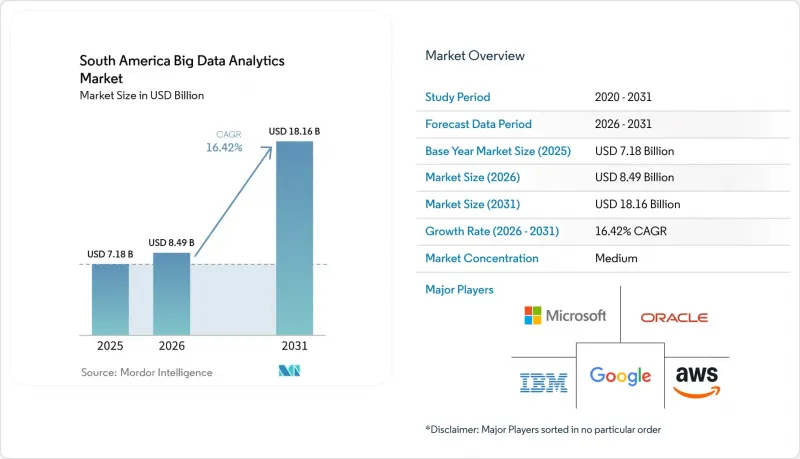
根據 Mordor Intelligence 預測,南美巨量資料分析市場規模將從 2025 年的 71.8 億美元成長到 2026 年的 84.9 億美元,到 2031 年達到 181.6 億美元,2026 年至 2031 年的複合年成長率為 16.42%。
南美巨量資料分析市場的趨勢與洞察
雲端和超大規模資料中心基礎架構的擴展
雲端投資正在緩解南美洲巨量資料分析市場的核心基礎設施瓶頸。 AWS已承諾在未來十年內投入巨資,擴展其在巴西的資料中心營運。 AWS也宣佈為AWS南美智利區域提供大量資金,該區域計劃於2026年底投入營運。微軟也宣布將在未來幾年內對巴西的雲端和人工智慧基礎設施進行重大投資。 Ascenty已在巴西進行了大量投資,並開始建造大規模人工智慧資料中心園區。本地處理能力的提升將能夠支援對延遲敏感的工作負載以及具有資料居住要求的工作負載,例如銀行和公共部門應用程式。因此,南美巨量資料分析市場將能夠觸及那些先前認為本地託管能力不足以滿足其企業服務需求的客戶。
企業對數據驅動決策的需求日益成長
各組織越來越重視分析專案帶來的可衡量成果。儘管該地區許多大型企業至少有一個人工智慧或分析專案正在生產環境中運作,但只有少數企業報告稱這些專案對業務指標產生了可衡量的影響。然而,許多受訪的南美企業正努力將他們在人工智慧方面的投資轉化為可衡量的價值。這種差距正在推動對資料管治、模型監控和人工智慧維運工具的需求,這些工具能夠提升生產效能。例如,波哥大銀行將多個分析模型遷移到Google雲端BigQuery,顯著縮短了處理時間。這顯示營運優先順序如何影響技術決策。在南美巨量資料分析市場,企業可能會越來越傾向於選擇能夠將部署與實際業務成果掛鉤的平台和服務供應商,而不僅僅是添加新模型。
數據工程和分析人才短缺
數據工程和分析人才供不應求仍然是限制南美巨量資料分析市場發展的一大難題。世界經濟論壇的一份報告指出,許多南美雇主計劃提升員工的數據和數位化技能,因為他們認為未來幾年外部人才招募前景黯淡。報告也指出,許多巴西公司在招募資料工程師方面也面臨挑戰。來自北美技術相關合約的競爭可能會進一步加劇南美雇主留住人才的壓力。大型企業可以透過基於平台的自助服務工具和內部培訓來解決部分問題。然而,中小企業由於缺乏足夠的資金投入專業團隊、資料管治職能和大規模部署中,因此仍然更加脆弱。
細分市場分析
預計到2031年,中小企業將以16.77%的複合年成長率成長。這一前景反映了雲端原生和低程式碼工具的日益普及,這些工具減少了對大規模內部工程團隊的需求。 TOTVS每天在其部署用戶群(主要由中小企業組成)中處理超過10億筆新資料記錄。該公司將分析功能和人工智慧代理整合到其Protheus和零售智慧產品中。 LYNN專為B2B和中小企業用例而設計,可以幫助使用者在其熟悉的業務系統中部署人工智慧功能。區域ERP整合產品可以減輕專業服務的負擔,這些服務先前限制了中小型製造商、零售商和物流供應商的部署。
到2025年,大型組織將佔據南美巨量資料分析市場規模的62.34%。銀行、電信集團和國營企業擁有全面部署平台所需的資料基礎設施、管治流程和預算。 Databricks已將企業發展拓展至巴西各大雲端平台,為大規模買家提供多重雲端選擇。根據相關資料,該公司近期在巴西的收入顯著成長,其位於聖保羅的辦公空間也大幅擴張。 SAP正利用其遷移週期,將SAP Analytics Cloud和SAP Datasphere連接到其現有的ERP環境。 Riachuelo近期的一次部署顯著縮短了分析擷取器的開發時間。隨著雲端定價和整合平台的普及,部署所需的最低投資金額不斷降低,大型企業和中型企業用戶之間的功能差距可能會縮小。
其他好處:
- Excel格式的市場預測(ME)表
- 3個月的分析師支持
目錄
第1章:引言
- 研究假設和市場定義
- 調查範圍
第2章:調查方法
第3章執行摘要
第4章 市場狀況
- 市場概覽
- 宏觀經濟因素對市場的影響
- 市場促進因素
- 雲端和超大規模資料中心基礎架構的擴展
- 企業對數據驅動決策的需求日益成長
- 人工智慧與機器學習融合的進展
- 數位商務的擴張和連網設備產生的數據量的增加。
- 分析內容在地化為西班牙語和葡萄牙語
- 現有工業資產中分析技術應用現狀
- 市場限制因素
- 數據工程和分析領域人才短缺
- 資料隱私合規和跨境資料管治
- 資料架構因國家和產業而異
- 傳統工業設備的高整合成本
- 產業價值鏈分析
- 監理情勢
- 技術展望
- 波特五力分析
第5章 市場規模與成長預測
- 按組織規模
- 小型和中型
- 大型組織
- 按最終用戶行業分類
- IT/通訊
- BFSI
- 零售和消費品
- 製造業
- 醫療保健和生命科學
- 政府
- 其他終端用戶產業
- 按地區
- 巴西
- 阿根廷
- 哥倫比亞
- 其他南美國家
第6章 競爭情勢
- 市場集中度
- 策略趨勢
- 市佔率分析
- 公司簡介
- International Business Machines Corporation
- Microsoft Corporation
- Amazon Web Services, Inc.
- Google LLC
- Oracle Corporation
- SAP SE
- SAS Institute Inc.
- Teradata Corporation
- Salesforce, Inc.
- Snowflake Inc.
- Databricks, Inc.
- Cloudera, Inc.
- QlikTech International AB
- Alteryx, Inc.
- Accenture plc
- Capgemini SE
- Globant SA
- TOTVS SA
- TIVIT Terceirizacao de Processos, Servicos e Tecnologia SA
- Sonda SA
- Baufest SA
- NeuralMind Tecnologia Ltda.
- Involves Tecnologia Ltda.
- Axur Tecnologia Ltda.
- Nubank SA
第7章 市場機會與未來展望
According to Mordor Intelligence, the South America big data analytics market size is expected to increase from USD 7.18 billion in 2025 to USD 8.49 billion in 2026 and reach USD 18.16 billion by 2031, growing at a CAGR of 16.42% over 2026-2031.
South America Big Data Analytics Market Trends and Insights
Expansion of Cloud and Hyperscale Data-Center Infrastructure
Cloud investment is reducing a core infrastructure constraint for the South America big data analytics market. AWS has committed substantial investments to expand its Brazilian data center operations through the next decade. AWS has also announced significant funding for the AWS South America Chile Region, which is scheduled to begin operating by the end of 2026. Microsoft announced significant investment in Brazilian cloud and AI infrastructure over several years. Ascenty began building a large-scale AI data center campus in Brazil with substantial investment. Greater local capacity can support workloads that are sensitive to latency or subject to data-residency requirements, including banking and public-sector applications. The South America big data analytics market can therefore reach buyers that previously found local hosting capacity inadequate for enterprise service commitments.
Growing Enterprise Demand for Data-Driven Decision-Making
Organizations are placing more emphasis on measurable results from analytics programs. Many large enterprises in the region have at least one AI or analytics project in production, while a smaller share reports measurable impact on business metrics. However, many South American enterprise respondents struggle to translate AI investment into measurable value. This gap supports demand for data governance, model monitoring, and AI operations tools that can improve production performance. Banco de Bogota migrated several analytical models to Google Cloud BigQuery and substantially reduced processing time, showing how operational priorities can shape technology decisions. The South America big data analytics market is likely to favor platforms and service providers that can connect deployments to visible business outcomes, rather than only adding new models.
Shortage of Data Engineering and Analytics Talent
The supply of data engineering and analytics talent remains a material constraint on the South America big data analytics market. The World Economic Forum reported that a large share of employers in South America planned to upskill their workforces for data and digital roles because external talent availability was not expected to improve over the coming years. The supplied material also stated that many companies in Brazil faced difficulty hiring data engineers. Competition from North American technology contracts can further increase retention pressure for regional employers. Large organizations can address part of the issue through platform-based self-service tools and internal training. Smaller organizations remain more exposed because they have less capacity to fund specialized teams, data governance functions, and extended implementation work.
Other drivers and restraints analyzed in the detailed report include:
- Increasing AI and Machine Learning Integration
- Rising Digital Commerce and Connected-Device Data Generation
- Data-Privacy Compliance and Cross-Border Data Governance
For complete list of drivers and restraints, kindly check the Table Of Contents.
Segment Analysis
Small and medium-scale organizations are expected to expand at a 16.77% CAGR through 2031. This outlook reflects the wider availability of cloud-native and low-code tools that reduce the need for large internal engineering teams. TOTVS processes more than 1 billion new data records each day across an installed base led by small and medium-sized businesses. The company is embedding analytics and AI agents into Protheus and retail intelligence products. LYNN was designed for B2B and SME use cases, which may help users adopt AI-enabled functions within familiar business systems. Regional ERP-linked products can reduce the professional-services burden that previously limited adoption by small manufacturers, retailers, and logistics operators.
Large-scale organizations held 62.34% of the South America big data analytics market size in 2025. Banks, telecommunications groups, and state-owned enterprises have the data infrastructure, governance processes, and budgets needed for full platform deployments. Databricks expanded its Brazil presence across major cloud platforms, giving large buyers a multi-cloud option. The supplied material indicated that its Brazil revenue grew significantly over a recent period and that it substantially expanded its Sao Paulo office space. SAP uses migration cycles to connect SAP Analytics Cloud and SAP Datasphere to existing ERP environments. Riachuelo's recent deployment significantly reduced analytics extractor development time. The capability gap between large organizations and mid-market users may narrow as cloud pricing and consolidated platforms lower the minimum investment needed for deployment.
Complete Report Scope:
- By Organization Size
- Small and Medium Scale
- Large Scale Organization
- By End-User Vertical
- IT and Telecommunication
- BFSI
- Retail and Consumer Goods
- Manufacturing
- Healthcare and Lifesciences
- Government
- Rest of End-User Verticals
- By Geography
- Brazil
- Argentina
- Colombia
- Rest of South America
List of Companies Covered in this Report:
- International Business Machines Corporation
- Microsoft Corporation
- Amazon Web Services, Inc.
- Google LLC
- Oracle Corporation
- SAP SE
- SAS Institute Inc.
- Teradata Corporation
- Salesforce, Inc.
- Snowflake Inc.
- Databricks, Inc.
- Cloudera, Inc.
- QlikTech International AB
- Alteryx, Inc.
- Accenture plc
- Capgemini SE
- Globant S.A.
- TOTVS S.A.
- TIVIT Terceirizacao de Processos, Servicos e Tecnologia S.A.
- Sonda S.A.
- Baufest S.A.
- NeuralMind Tecnologia Ltda.
- Involves Tecnologia Ltda.
- Axur Tecnologia Ltda.
- Nubank S.A.
Additional Benefits:
- The market estimate (ME) sheet in Excel format
- 3 months of analyst support
TABLE OF CONTENTS
1 INTRODUCTION
- 1.1 Study Assumptions and Market Definition
- 1.2 Scope of the Study
2 RESEARCH METHODOLOGY
3 EXECUTIVE SUMMARY
4 MARKET LANDSCAPE
- 4.1 Market Overview
- 4.2 Impact of Macroeconomic Factors on the Market
- 4.3 Market Drivers
- 4.3.1 Expansion of Cloud and Hyperscale Data-Center Infrastructure
- 4.3.2 Growing Enterprise Demand for Data-Driven Decision-Making
- 4.3.3 Increasing AI and Machine Learning Integration
- 4.3.4 Rising Digital Commerce and Connected-Device Data Generation
- 4.3.5 Localization of Spanish and Portuguese Language Analytics
- 4.3.6 Analytics Adoption Across Brownfield Industrial Assets
- 4.4 Market Restraints
- 4.4.1 Shortage of Data Engineering and Analytics Talent
- 4.4.2 Data-Privacy Compliance and Cross-Border Data Governance
- 4.4.3 Fragmented Data Architectures Across Countries and Industries
- 4.4.4 High Integration Costs for Legacy Industrial Equipment
- 4.5 Industry Value-Chain Analysis
- 4.6 Regulatory Landscape
- 4.7 Technological Outlook
- 4.8 Porter's Five Forces Analysis
- 4.8.1 Bargaining Power of Suppliers
- 4.8.2 Bargaining Power of Buyers
- 4.8.3 Threat of New Entrants
- 4.8.4 Threat of Substitutes
- 4.8.5 Competitive Rivalry
5 MARKET SIZE AND GROWTH FORECASTS (VALUE)
- 5.1 By Organization Size
- 5.1.1 Small and Medium Scale
- 5.1.2 Large Scale Organization
- 5.2 By End-User Vertical
- 5.2.1 IT and Telecommunication
- 5.2.2 BFSI
- 5.2.3 Retail and Consumer Goods
- 5.2.4 Manufacturing
- 5.2.5 Healthcare and Lifesciences
- 5.2.6 Government
- 5.2.7 Rest of End-User Verticals
- 5.3 By Geography
- 5.3.1 Brazil
- 5.3.2 Argentina
- 5.3.3 Colombia
- 5.3.4 Rest of South America
6 COMPETITIVE LANDSCAPE
- 6.1 Market Concentration
- 6.2 Strategic Moves
- 6.3 Market Share Analysis
- 6.4 Company Profiles (includes Global Level Overview, Market Level Overview, Core Segments, Financials as available, Strategic Information, Market Rank/Share, Products and Services, Recent Developments)
- 6.4.1 International Business Machines Corporation
- 6.4.2 Microsoft Corporation
- 6.4.3 Amazon Web Services, Inc.
- 6.4.4 Google LLC
- 6.4.5 Oracle Corporation
- 6.4.6 SAP SE
- 6.4.7 SAS Institute Inc.
- 6.4.8 Teradata Corporation
- 6.4.9 Salesforce, Inc.
- 6.4.10 Snowflake Inc.
- 6.4.11 Databricks, Inc.
- 6.4.12 Cloudera, Inc.
- 6.4.13 QlikTech International AB
- 6.4.14 Alteryx, Inc.
- 6.4.15 Accenture plc
- 6.4.16 Capgemini SE
- 6.4.17 Globant S.A.
- 6.4.18 TOTVS S.A.
- 6.4.19 TIVIT Terceirizacao de Processos, Servicos e Tecnologia S.A.
- 6.4.20 Sonda S.A.
- 6.4.21 Baufest S.A.
- 6.4.22 NeuralMind Tecnologia Ltda.
- 6.4.23 Involves Tecnologia Ltda.
- 6.4.24 Axur Tecnologia Ltda.
- 6.4.25 Nubank S.A.
7 MARKET OPPORTUNITIES AND FUTURE OUTLOOK
- 7.1 White-Space and Unmet-Need Assessment

 2026年全球流數據處理系統軟體市場報告
 巨量資料諮詢服務市場:全球市場預測,2026-2032年
 超大規模市場追蹤報告(2026年第二季):資本支出突破7,000億美元;得益於Alphabet的業績表現,淨利潤率創下新高;自由現金流利潤率則降至新低。工業監控巨量資料服務市場 - 全球預測(2026-2032年)2026年全球農業衛星資訊服務市場報告
 建築業巨量資料分析:市場機會、成長要素、產業趨勢分析及2026-2035年預測
 銀行、金融服務和保險 (BFSI) 市場的巨量資料分析:市場規模、佔有率和成長分析(按組件、部署模式、應用、最終用戶和地區分類)—2026-2033 年行業預測
 石油數據分析市場規模、佔有率、成長率、全球產業分析、區域分析及未來預測(2026-2034)
 供應鏈巨量資料分析:市場佔有率分析、產業趨勢與統計、成長預測(2026-2031)全球石油數據分析市場規模、佔有率、趨勢和成長分析報告(2026-2034)