


 |
市場調查報告書
商品編碼
2154888
南美聚丙烯(PP)包裝薄膜:市佔率分析、產業趨勢與統計及成長預測(2026-2031)South America Polypropylene (PP) Packaging Film - Market Share Analysis, Industry Trends & Statistics, Growth Forecasts (2026 - 2031) |
||||||

※ 本網頁內容可能與最新版本有所差異。詳細情況請與我們聯繫。
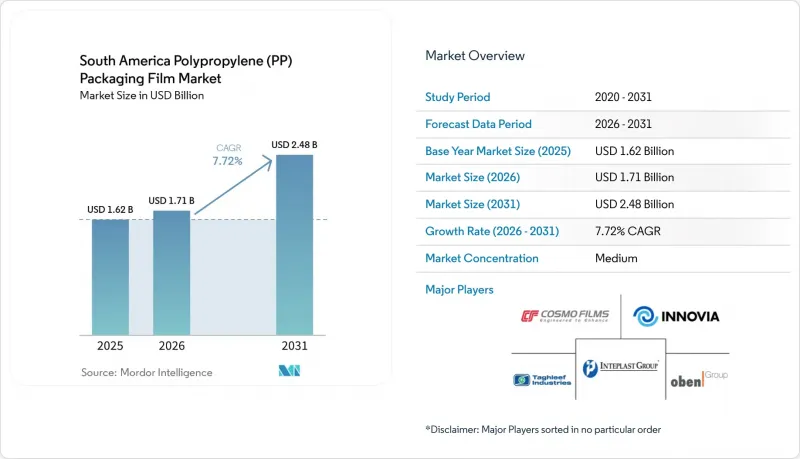
據 Mordor Intelligence 稱,2025 年南美聚丙烯 (PP) 包裝薄膜市場價值為 16.2 億美元,預計到 2031 年將從 2026 年的 17.1 億美元成長至 24.8 億美元,預測期(2026-2031 年)複合年成長率為 7.72%。
南美洲聚丙烯(PP)包裝薄膜市場趨勢及洞察。
包裝食品和簡便食品的消費量增加
在南美洲聚丙烯(PP)包裝薄膜市場(涵蓋巴西、哥倫比亞、阿根廷和智利),加工食品和簡便食品的需求仍然穩定。預計到2025年,南美和加勒比地區的經濟成長率將達到2.5%,高於2024年的2.2%,這將支撐全部區域家庭在包裝產品上的支出。巴西食品加工商使用塗層和非塗層雙向拉伸聚丙烯(BOPP)薄膜來包裝烘焙產品、糖果甜點、零食、乳製品和生鮮食品,這些產品需要透明度、密封可靠性和防潮性。與許多開放式市場銷售不同,在有組織的零售業中,每件產品在倉儲、運輸和商店展示過程中都必須進行密封、貼標和保護。這種轉變導致每個零售單元的薄膜用量增加,要求加工商提供穩定的印刷品質、阻隔性能、防滑性和可靠的機械性能。安第斯山脈地區的零食和穀物生產商正在為都市區消費者選擇金屬化和高阻隔阻隔性BOPP 等級的產品,這推動了從基本重疊包裝到每公斤盈利更高且符合更嚴格產品規格的材料的轉變。
過渡到可回收的單一聚丙烯結構
在南美洲聚丙烯 (PP) 包裝薄膜市場,轉向單層聚丙烯包裝正成為商業要求。巴西第 12,688/2025 號法令規定,自 2026 年 1 月起,大型企業包裝中再生材料的含量必須達到 22%,回收率必須達到 32%,併計劃到 2040 年將這兩個目標分別提高到 40% 和 50%。哥倫比亞 2024 年第 803 號決議也對包裝材料的收集、追蹤和再生材料的使用提出了要求,這增加了傳統多材料結構包裝的商業成本。 Vitopel 公司引進了 BOBST EXPERT K5 金屬化設備,使其金屬化薄膜產能提高了 40%,並實現了可回收單層 PP 結構的生產。較薄的單層 PP 結構在保持阻隔性能的同時,減少了每個包裝的塑膠用量,即使在製作流程中對卷材的需求不斷成長,品牌商尋求減少材料用量的情況下,也能滿足這些需求。 ABRE 和 Abiplast 推廣的認證流程可協助加工商證明其包裝符合可回收性要求,向客戶記錄其材料選擇,並改善其獲得正式合規計畫的機會。
聚丙烯樹脂價格波動
樹脂價格波動仍然是南美聚丙烯(PP)包裝薄膜市場加工商面臨的直接限制阻礙因素。 2025年5月,巴西PP均聚物的現貨價格在每噸970美元至1,020美元之間波動,隨後的供應中斷加劇了當地價格的上漲壓力。許多加工商以美元購買樹脂,卻以該地貨幣出售成品薄膜,這使得他們極易受到樹脂價格上漲和貨幣貶值的雙重影響。巴西2025年進口塑膠樹脂332萬噸,這顯示加工商仍在不斷調整進口來源,而不是減少原料需求。巴西的PRESIQ計畫將從2027年開始,每年向化學工業提供30億雷亞爾(約5.8億美元)的補貼,為期五年,但這並不能緩解現貨市場的短期風險。對於旨在維持利潤率的加工商而言,長期樹脂合約、靈活的採購、謹慎的價格傳遞和高效的庫存計劃仍然是至關重要的要素。
細分市場分析
到了2025年,雙向拉伸聚丙烯(BOPP)薄膜在南美聚丙烯(PP)包裝薄膜市場佔72.34%的佔有率。其市場地位得益於BOPP薄膜與凹版印刷和柔版印刷的廣泛兼容性、高加工速度以及在零食、咖啡、乳製品和糖果甜點包裝領域的廣泛應用。透明BOPP薄膜因其高可見度和在自動化生產線上的高效加工能力,被廣泛用於包裝常溫保存的烘焙產品和零食。 2024年,維托佩爾(Vitopel)投資建造金屬化設備,使BOPP薄膜的產能提高了40%,金屬化BOPP薄膜也因此廣受歡迎,並主要應用於加工起士、奶粉和油籽的包裝。塗覆PVDC、丙烯酸或EVOH塗層的BOPP薄膜則用於需要更強氧氣和水分成本績效糖果甜點包裝等領域。
流延聚丙烯(通常稱為CPP)預計到2031年將以8.16%的複合年成長率成長,是所有薄膜類型中成長最快的。其熱穩定性和可控的密封剝離性能使其在藥品蓋和泡殼包裝應用中備受青睞,而通用級CPP則適用於多層包裝袋和複合基材。蒸餾級CPP用於調理食品和加工食品,這些食品需要在高溫滅菌循環中保持薄膜的完整性。金屬化CPP在高階咖啡和零食包裝領域越來越受歡迎,成為鋁箔結構的替代品,尤其是在單一材料可回收至關重要的情況下。其他拉伸和流延聚丙烯變體在南美聚丙烯(PP)包裝薄膜行業佔據小規模的技術細分市場,滿足特定的阻隔性、密封性和加工要求。
其他好處:
- Excel格式的市場預測(ME)表
- 3個月的分析師支持
目錄
第1章:引言
- 研究假設和市場定義
- 調查範圍
第2章:調查方法
第3章執行摘要
第4章 市場狀況
- 市場概覽
- 市場促進因素
- 加工食品和便利消費的擴張
- 向可回收材料和聚丙烯結構過渡
- 電子商務及二級包裝的彈性需求
- 區域性BOPP和CPP產能擴張
- 對更高阻隔性和保存期限的要求
- 出口用生鮮食品和水產品包裝市場成長
- 市場限制因素
- 聚丙烯樹脂價格波動
- 與紙、鋁和聚乙烯結構產品競爭。
- 缺乏收集和回收基礎設施
- 面臨電力、外匯和進口成本風險
- 宏觀經濟因素對市場的影響
- 產業價值鏈分析
- 監理情勢
- 技術展望
- 波特五力分析
第5章 市場規模與成長預測
- 按膠片類型
- 雙軸延伸聚丙烯(BOPP)薄膜
- 塗層 BOPP(PVDC、丙烯酸、EVOH)
- 未塗層雙向拉伸聚丙烯薄膜
- 氯化聚丙烯(CPP)薄膜
- 通用 CPP
- 用於蒸餾的CPP
- 金屬化CPP
- 其他膠片類型
- 雙軸延伸聚丙烯(BOPP)薄膜
- 按包裝類型
- 包裝和重疊
- 標籤和感壓膠帶
- 袋子和小袋
- 蓋膜和枕式包裝膜
- 泡殼包裝和帶狀包裝
- 按最終用途行業分類
- 食物
- 麵包糖果甜點
- 零食和早餐用麥片穀類
- 生鮮食品
- 肉類、雞肉、魚貝類
- 乳製品
- 飲料
- 不含酒精的飲料
- 瓶裝水
- 碳酸飲料
- 果汁
- 其他非酒精飲料
- 酒精飲料
- 啤酒
- 蒸餾酒
- 其他酒精飲料
- 不含酒精的飲料
- 藥品和醫療保健
- 個人護理化妝品
- 產業
- 其他終端用戶產業
- 食物
- 按地區
- 巴西
- 阿根廷
- 智利
- 哥倫比亞
- 其他南美國家
第6章 競爭情勢
- 市場集中度
- 策略趨勢
- 市佔率分析
- 公司簡介
- Oben Holding Group SAC
- Taghleef Industries, Inc.
- Innovia Films Limited
- Cosmo Films Limited
- Inteplast Group, Ltd.
- Toray Industries, Inc.
- UFlex Limited
- Manucor SpA
- Poligal SA
- Vacmet India Limited
- Toppan Speciality Films Private Limited
- Altopro SA de CV
- Grupo Plastilene SAS
- Vitopel do Brasil Ltda.
- Innova SA
- Valfilm SA
- Prolam SA
- Sigmaplast SA
第7章 市場機會與未來展望
According to Mordor Intelligence, the South America polypropylene (PP) packaging film market size was valued at USD 1.62 billion in 2025 and estimated to grow from USD 1.71 billion in 2026 to reach USD 2.48 billion by 2031, at a CAGR of 7.72% during the forecast period (2026-2031).
South America Polypropylene (PP) Packaging Film Market Trends and Insights
Packaged Food and Convenience Consumption Expansion
Processed and convenience food remains a stable source of demand for the South America polypropylene (PP) packaging film market across Brazil, Colombia, Argentina, and Chile. South America and the Caribbean economies grew 2.5% in 2025, compared with 2.2% in 2024, supporting household spending on packaged products across the region. Brazil's food processors use coated and uncoated BOPP film for bakery, confectionery, snacks, dairy, and fresh-produce products that require clarity, seal reliability, and moisture protection. Organized retail requires each product to be sealed, labeled, and protected during warehousing, transport, and shelf display, unlike many open-market sales. This change increases film use per retail unit and encourages converters to offer consistent printing, barrier performance, controlled slip, and dependable machine performance. Snack and cereal producers in Andean countries are selecting metalized and high-barrier BOPP grades for urban consumers, supporting a shift from basic overwrap toward materials with higher revenue per kilogram and more demanding product specifications.
Shift Toward Recyclable Mono-Polypropylene Structures
The move to mono-polypropylene packaging is becoming an operating requirement for the South America polypropylene (PP) packaging film market. Brazil's Decree No. 12,688/2025 established a 22% recycled-content requirement and a 32% recovery rate for large companies from January 2026, with targets increasing to 40% and 50% by 2040. Colombia's Resolution 803 of 2024 also set requirements for packaging collection, material tracking, and the use of recycled raw materials, raising the commercial cost of conventional multi-material structures. Vitopel installed a BOBST EXPERT K5 metallizer, which increased its metalized film capacity by 40% and enabled recyclable mono-PP structures. Thinner mono-PP structures can maintain barrier performance while lowering plastic use per pack, even as roll demand rises in converting operations and brands pursue lower material intensity. Certification pathways promoted by ABRE and Abiplast can help converters show that their packaging meets recyclability requirements, document material choices for customers, and improve access to formal compliance programs.
Volatility in Polypropylene Resin Prices
Resin price changes remain a direct margin constraint for converters in the South America polypropylene (PP) packaging film market. PP homopolymer spot prices in Brazil ranged from USD 970 to USD 1,020 per metric ton in May 2025, and subsequent supply disruptions increased local price pressure. Many converters buy resin in USD while selling finished film in the local currency, creating simultaneous exposure to resin price increases and currency depreciation. Brazil imported 3.32 million metric tons of plastic resin in 2025, showing that converters continue to replace import origins rather than reduce their material needs. Brazil's PRESIQ program is set to provide BRL 3 billion (USD 580 million) in annual chemical-industry incentives for 5 years from 2027, but it does not remove near-term spot-market risk. Long-term resin contracts, flexible sourcing, careful price pass-through, and efficient inventory planning remain important for converters seeking to protect margins.
Other drivers and restraints analyzed in the detailed report include:
- E-Commerce and Secondary Packaging Resilience Requirements
- Regional BOPP and CPP Capacity Additions
- Competition From Paper, Aluminum, and Polyethylene Structures
For complete list of drivers and restraints, kindly check the Table Of Contents.
Segment Analysis
BOPP film held 72.34% of the South America polypropylene (PP) packaging film market in 2025. Its position rests on broad compatibility with gravure and flexographic printing, high processing speeds, and use across snack, coffee, dairy, and confectionery packaging. Transparent grades are widely used for shelf-stable bakery and snack wraps because they provide product visibility and work efficiently on automated lines. Metallized BOPP gained support after Vitopel's 2024 metallizer investment increased capacity by 40% and targeted processed cheese, powdered milk, and oilseed packaging. Coated grades with PVDC, acrylic, or EVOH layers serve export food formats that need stronger oxygen and moisture barriers, while uncoated BOPP remains common in label stock, primary wraps, and value-oriented confectionery applications.
Cast polypropylene, commonly called CPP, is projected to grow at an 8.16% CAGR through 2031, the fastest rate among film types. Pharmaceutical lidding and blister applications value its thermal stability and controlled seal-peel performance, while general-purpose grades support multilayer pouches and laminate substrates. Retort-grade CPP is used for ready meals and processed foods that must retain film integrity during high-temperature sterilization cycles. Metallized CPP is gaining use in premium coffee and snack packs as an alternative to foil-based structures where mono-material recyclability is important. Other oriented and cast PP variants occupy smaller technical niches in the South America polypropylene (PP) packaging film industry, serving specific barrier, sealing, and processing requirements.
Complete Report Scope:
- By Film Type
- Biaxially Oriented Polypropylene (BOPP) Film
- Coated BOPP (PVDC, Acrylic, EVOH)
- Uncoated BOPP
- Chlorinated Polypropylene (CPP) Film
- General-Purpose CPP
- Retort-Grade CPP
- Metallized CPP
- Other Film Types
- Biaxially Oriented Polypropylene (BOPP) Film
- By Packaging Format
- Wraps and Over-wraps
- Labels and Pressure-Sensitive Tapes
- Bags and Pouches
- Lidding and Flow-wrap Films
- Blister and Strip Packs
- By End-Use Industry
- Food
- Bakery and Confectionery
- Snacks and Breakfast Cereals
- Fresh Produce
- Meat, Poultry, and Seafood
- Dairy Products
- Beverages
- Non-Alcoholic Beverages
- Bottled Water
- Carbonated Drinks
- Juices
- Other Non-Alcoholic Beverages
- Alcoholic Beverages
- Beer
- Spirits
- Other Alcoholic Beverages
- Non-Alcoholic Beverages
- Pharmaceutical and Healthcare
- Personal Care and Cosmetics
- Industrial
- Other End-Use Industries
- Food
- By Geography
- Brazil
- Argentina
- Chile
- Colombia
- Rest of South America
List of Companies Covered in this Report:
- Oben Holding Group S.A.C.
- Taghleef Industries, Inc.
- Innovia Films Limited
- Cosmo Films Limited
- Inteplast Group, Ltd.
- Toray Industries, Inc.
- UFlex Limited
- Manucor S.p.A.
- Poligal S.A.
- Vacmet India Limited
- Toppan Speciality Films Private Limited
- Altopro S.A. de C.V.
- Grupo Plastilene S.A.S.
- Vitopel do Brasil Ltda.
- Innova S.A.
- Valfilm S.A.
- Prolam S.A.
- Sigmaplast S.A.
Additional Benefits:
- The market estimate (ME) sheet in Excel format
- 3 months of analyst support
TABLE OF CONTENTS
1 INTRODUCTION
- 1.1 Study Assumptions and Market Definition
- 1.2 Scope of the Study
2 RESEARCH METHODOLOGY
3 EXECUTIVE SUMMARY
4 MARKET LANDSCAPE
- 4.1 Market Overview
- 4.2 Market Drivers
- 4.2.1 Packaged Food and Convenience Consumption Expansion
- 4.2.2 Shift Toward Recyclable Mono-Polypropylene Structures
- 4.2.3 E-Commerce and Secondary-Packaging Resilience Requirements
- 4.2.4 Regional BOPP and CPP Capacity Additions
- 4.2.5 Higher Barrier and Shelf-Life Requirements
- 4.2.6 Export-Oriented Fresh Food and Seafood Packaging Growth
- 4.3 Market Restraints
- 4.3.1 Volatility in Polypropylene Resin Prices
- 4.3.2 Competition From Paper, Aluminum and Polyethylene Structures
- 4.3.3 Limited Collection and Recycling Infrastructure
- 4.3.4 Electricity, Foreign-Exchange and Import-Cost Exposure
- 4.4 Impact of Macroeconomic Factors on the Market
- 4.5 Industry Value Chain Analysis
- 4.6 Regulatory Landscape
- 4.7 Technological Outlook
- 4.8 Porter's Five Forces Analysis
- 4.8.1 Bargaining Power of Suppliers
- 4.8.2 Bargaining Power of Buyers
- 4.8.3 Threat of New Entrants
- 4.8.4 Threat of Substitutes
- 4.8.5 Competitive Rivalry
5 MARKET SIZE AND GROWTH FORECASTS (VALUE)
- 5.1 By Film Type
- 5.1.1 Biaxially Oriented Polypropylene (BOPP) Film
- 5.1.1.1 Coated BOPP (PVDC, Acrylic, EVOH)
- 5.1.1.2 Uncoated BOPP
- 5.1.2 Chlorinated Polypropylene (CPP) Film
- 5.1.2.1 General-Purpose CPP
- 5.1.2.2 Retort-Grade CPP
- 5.1.2.3 Metallized CPP
- 5.1.3 Other Film Types
- 5.1.1 Biaxially Oriented Polypropylene (BOPP) Film
- 5.2 By Packaging Format
- 5.2.1 Wraps and Over-wraps
- 5.2.2 Labels and Pressure-Sensitive Tapes
- 5.2.3 Bags and Pouches
- 5.2.4 Lidding and Flow-wrap Films
- 5.2.5 Blister and Strip Packs
- 5.3 By End-Use Industry
- 5.3.1 Food
- 5.3.1.1 Bakery and Confectionery
- 5.3.1.2 Snacks and Breakfast Cereals
- 5.3.1.3 Fresh Produce
- 5.3.1.4 Meat, Poultry, and Seafood
- 5.3.1.5 Dairy Products
- 5.3.2 Beverages
- 5.3.2.1 Non-Alcoholic Beverages
- 5.3.2.1.1 Bottled Water
- 5.3.2.1.2 Carbonated Drinks
- 5.3.2.1.3 Juices
- 5.3.2.1.4 Other Non-Alcoholic Beverages
- 5.3.2.2 Alcoholic Beverages
- 5.3.2.2.1 Beer
- 5.3.2.2.2 Spirits
- 5.3.2.2.3 Other Alcoholic Beverages
- 5.3.2.1 Non-Alcoholic Beverages
- 5.3.3 Pharmaceutical and Healthcare
- 5.3.4 Personal Care and Cosmetics
- 5.3.5 Industrial
- 5.3.6 Other End-Use Industries
- 5.3.1 Food
- 5.4 By Geography
- 5.4.1 Brazil
- 5.4.2 Argentina
- 5.4.3 Chile
- 5.4.4 Colombia
- 5.4.5 Rest of South America
6 COMPETITIVE LANDSCAPE
- 6.1 Market Concentration
- 6.2 Strategic Moves
- 6.3 Market Share Analysis
- 6.4 Company Profiles (includes Global Level Overview, Market Level Overview, Core Segments, Financials as available, Strategic Information, Market Rank/Share, Products and Services, Recent Developments)
- 6.4.1 Oben Holding Group S.A.C.
- 6.4.2 Taghleef Industries, Inc.
- 6.4.3 Innovia Films Limited
- 6.4.4 Cosmo Films Limited
- 6.4.5 Inteplast Group, Ltd.
- 6.4.6 Toray Industries, Inc.
- 6.4.7 UFlex Limited
- 6.4.8 Manucor S.p.A.
- 6.4.9 Poligal S.A.
- 6.4.10 Vacmet India Limited
- 6.4.11 Toppan Speciality Films Private Limited
- 6.4.12 Altopro S.A. de C.V.
- 6.4.13 Grupo Plastilene S.A.S.
- 6.4.14 Vitopel do Brasil Ltda.
- 6.4.15 Innova S.A.
- 6.4.16 Valfilm S.A.
- 6.4.17 Prolam S.A.
- 6.4.18 Sigmaplast S.A.
7 MARKET OPPORTUNITIES AND FUTURE OUTLOOK
- 7.1 White-Space and Unmet-Need Assessment

