


 |
市場調查報告書
商品編碼
2154854
工業催化劑:市場佔有率分析、產業趨勢與統計、成長預測(2026-2031)Industrial Catalysts - Market Share Analysis, Industry Trends & Statistics, Growth Forecasts (2026 - 2031) |
||||||

※ 本網頁內容可能與最新版本有所差異。詳細情況請與我們聯繫。
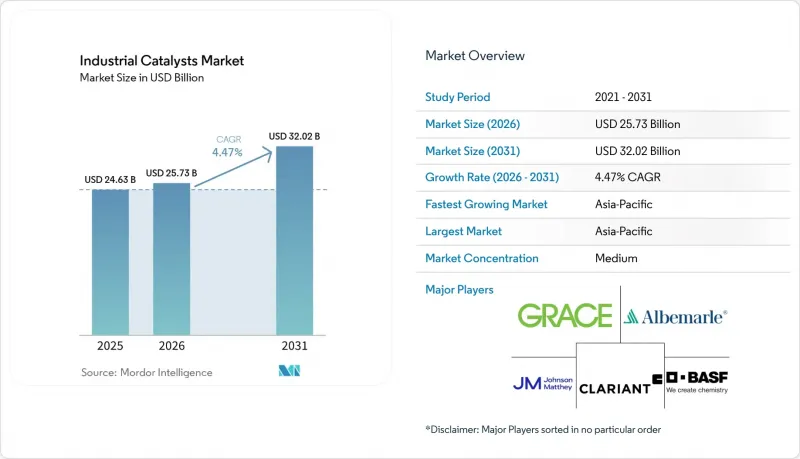
據 Mordor Intelligence 稱,2025 年工業催化劑市值為 246.3 億美元,預計到 2031 年將達到 320.2 億美元,而 2026 年為 257.3 億美元,預測期(2026-2031 年)複合年成長率為 4.47%。
全球工業催化劑市場趨勢與洞察
擴大煉油廠和石化廠的生產能力
新建的待開發區工廠支撐著工業催化劑市場,因為每個製程單元在運作初期都需要補充新的催化劑。這些工廠在其整個運作內,透過催化劑的再生和更換循環,持續產生需求。中國、印度和海灣國家的多個項目都需要用於流體化媒裂、加氫裂解和丙烯生產的催化劑系統。 2026年4月,Honeywell國際公司與丹格特集團旗下的雷基煉油廠簽署了一份催化劑和技術契約,該項目年丙烯產能為75萬噸。與傳統的以汽油生產為主的煉油廠相比,旨在最大限度提高丙烯收率的一體化石化煉油廠,單位原料所需的催化劑用量更多。因此,目前的在建項目是工業催化劑市場持續需求的重要來源。
更嚴格的燃料和工業排放標準
更嚴格的排放法規導致工業設備和燃料處理系統所需的催化劑用量增加。 2026年1月9日,美國環保署 (EPA) 最終修訂了固定式燃氣渦輪機的《新污染源排放標準》(NSPS),強制要求在某些燃氣渦輪機子類別中使用選擇性催化還原 (SCR) 技術來控制氮氧化物 (NOx) 排放。 2026年5月1日,國際海事組織 (IMO) 將北大西洋東北部劃定為氮氧化物、硫氧化物和粒狀物排放的管制區。這些要求推動了對選擇性催化還原 (SCR) 及相關廢氣處理技術的需求成長。即使投入成本上升,營運商也必須符合性能標準。這種合規要求是工業催化劑市場的主要驅動力,因為與可自由支配的資本項目不同,這筆支出無法輕易延後。
貴金屬和重要礦產的價格波動
鉑、鈀和銠是許多高性能非均質相觸媒組合物中必不可少的活性成分。這些材料的價格波動會迅速推高製造成本,並對供應商的利潤率造成壓力。莊信萬豐公司的一份報告指出,2025年鉑金市場將連續第三年面臨結構性供不應求,而化工、玻璃和合成燃料等行業的工業需求預計將溫和成長。金屬價格上漲可能導致客戶延長再生週期並推遲購買替代產品。這可能導致選擇性降低,並增加運作中中工廠製程損失的風險。由於採購決策對短期投入成本更加敏感,這種影響將限制工業催化劑市場的發展。
細分市場分析
到2025年,金屬催化劑將佔工業催化劑市場38.23%的佔有率,這主要得益於它們在加氫裂解、蒸氣甲烷重整和催化重整等製程的應用。鎳、鈷、鉬和鉑族金屬為連續工業流程提供了所需的活性和穩定性。沸石在流體化媒裂和加氫裂解中發揮著至關重要的作用,決定轉化率和產物分佈。 Zeolist International的加氫裂解催化劑產品組合滿足了全球30%的加氫裂解催化劑需求,其「Opal Renew」沸石則應用於可再生柴油和永續航空燃料領域。化學化合物支持酸催化甲醇烷基化和異構化反應,但其更換時機很大程度上取決於工廠的經濟效益。
預計到2031年,有機金屬材料將以5.32%的複合年成長率成長。其需求與藥物活性成分的合成、特種聚合物、二氧化碳利用途徑密切相關。在萊布尼茨催化研究所、魯爾大學波鴻分校和贏創工業集團的研究人員在2025年發表於《美國化學會誌》的一項研究中,報導了一種銥鈀雙金屬催化劑,該催化劑可將二氧化碳和綠色氫氣直接轉化為化學中間體。 UmiCore公司目前正在奧克拉荷馬州卡圖圖薩建造一座格拉布斯催化劑生產設施,計劃於2027年初投產。混合金屬氧化物和雙金屬材料在電化學和環境應用領域也扮演著重要角色。
區域分析
到2025年,亞太地區將佔工業催化劑市場35.67%的佔有率,預計到2031年將以5.45%的複合年成長率成長。中國的大規模煉油系統正在推動流體化媒裂、加氫處理和重整催化劑的需求。印度煉油廠和石化產業的擴張也促進了處理催化劑的需求。 Topsaw公司預計,2025年亞太地區的催化劑銷售將保持強勁成長,其中印度將成為主要的成長動力,該公司在中國獲得了三個永續航空燃料計畫。韓國、日本、越南和印尼的需求也不斷成長,這主要得益於石化產業叢集、燃料品質要求以及煉油廠自給自足計劃。
北美和歐洲是替代催化劑、低硫燃料加工和環境控制系統的主要需求市場。在北美,複雜的煉油廠配置持續推動對專用加氫裂解和加氫處理配方的需求。低碳氫和氨的獎勵也帶動了傳統煉油廠運作以外領域的催化劑需求。在歐洲,人們致力於透過生物基原料的共加工以及煉油廠與石化廠的整合來降低工業的碳排放強度。這兩個地區的工業催化劑市場更受到催化劑替代、法規遵循和製程升級的影響,而非大規模新建煉油廠。
南美洲、中東和非洲在工業催化劑市場佔有獨特的地位,儘管其需求量較小。在巴西,對甘蔗製乙醇加工和氫化植物油生產的專用解決方案有著迫切的需求。 Topsaw公司正在為沙烏地阿拉伯的延布綠氫能計畫提供支持,而Honeywell國際公司與奈及利亞丹戈特雷基聯合裝置的合約則增加了該國對石化催化劑的需求。部分市場的經濟波動可能會延緩催化劑的採購和更換週期。
其他好處:
- Excel格式的市場預測(ME)表
- 3個月的分析師支持
目錄
第1章:引言
- 研究假設和市場定義
- 調查範圍
第2章:調查方法
第3章執行摘要
第4章 市場狀況
- 市場概覽
- 市場促進因素
- 擴大煉油廠和石化廠的生產能力
- 更嚴格的燃料和工業排放標準
- 製程緻密化和催化劑選擇性提高
- 對低碳氫化合物、氨和循環化學的投資
- 數位催化劑監測和基於績效的服務
- 市場限制因素
- 貴金屬和重要礦產的價格波動
- 漫長的認證和工廠檢驗週期
- 生物飼料和共加工流程波動帶來的惰性風險
- 價值鏈分析
- 波特五力分析
第5章 市場規模與成長預測
- 材料
- 金屬
- 沸石
- 化合物
- 有機金屬材料
- 其他材料
- 按類型
- 非均質相觸媒
- 均相催化劑
- 透過使用
- 煉油
- 石油化學產品
- 化學合成
- 環境催化劑
- 其他用途
- 按地區
- 亞太地區
- 中國
- 印度
- 日本
- 韓國
- 東南亞國協
- 其他亞太國家
- 北美洲
- 美國
- 加拿大
- 墨西哥
- 歐洲
- 德國
- 英國
- 法國
- 義大利
- 北歐國家
- 其他歐洲國家
- 南美洲
- 巴西
- 阿根廷
- 其他南美國家
- 中東和非洲
- 沙烏地阿拉伯
- 南非
- 其他中東和非洲國家
- 亞太地區
第6章 競爭情勢
- 市場集中度
- 策略趨勢
- 市佔率和排名分析
- 公司簡介
- BASF
- Albemarle Corporation
- Axens
- CLARIANT
- Evonik Industries AG
- Honeywell International Inc.
- JGC C&C
- Johnson Matthey
- NIPPON KETJEN Co.,Ltd.
- Shell plc
- Sinopec Catalyst CO.,LTD.
- Topsoe A/S
- Umicore
- WR Grace & Co.-Conn
- Zeolyst International
第7章 市場機會與未來展望
According to Mordor Intelligence, the industrial catalysts market size was valued at USD 24.63 billion in 2025 and is estimated to grow from USD 25.73 billion in 2026 to reach USD 32.02 billion by 2031, at a CAGR of 4.47% during the forecast period (2026-2031).
Global Industrial Catalysts Market Trends and Insights
Refinery and Petrochemical Capacity Expansion
New greenfield units support the industrial catalysts market because each process unit needs a fresh catalyst charge at start-up. Those units also create recurring demand through regeneration and replacement cycles over the life of the plant. Projects in China, India, and the Gulf require catalyst systems for fluid catalytic cracking, hydrotreating, hydrocracking, and propylene production. Honeywell International Inc secured a catalyst and technology contract for Dangote's Lekki complex in April 2026, covering 750,000 metric tons per year of propylene capacity. Petrochemical-integrated refineries designed to maximize propylene yield use more catalyst per unit of feedstock than conventional gasoline-focused operations. This makes the current project pipeline an important source of sustained demand for the industrial catalysts market.
Tightening Fuel and Industrial Emission Standards
Emission rules increase the required catalyst loading in industrial equipment and fuel-processing systems. The U.S. Environmental Protection Agency finalized amendments to New Source Performance Standards for stationary combustion turbines on January 9, 2026, requiring selective catalytic reduction for nitrogen oxide control in specified turbine subcategories. The International Maritime Organization designated the North-East Atlantic as an Emission Control Area for nitrogen oxides, sulfur oxides, and particulate matter on May 1, 2026. These requirements extend demand for selective catalytic reduction and related exhaust-treatment technologies. Operators must meet performance thresholds even when input costs are high. This compliance need supports the industrial catalysts market because spending cannot be deferred as easily as discretionary capital projects.
Precious-Metal and Critical-Mineral Price Volatility
Platinum, palladium, and rhodium are essential active components in many high-performance heterogeneous formulations. Price movements for these materials can quickly raise manufacturing costs and pressure supplier margins. Johnson Matthey reported that the platinum market remained in structural deficit for a third consecutive year in 2025, while industrial consumption in chemicals, glass, and synthetic-fuels applications grew modestly. Higher metal prices can prompt customers to extend regeneration cycles to defer replacement purchases. This may reduce selectivity and raise the risk of process losses at the operating plant. The effect restrains the industrial catalysts market by making purchasing decisions more sensitive to short-term input costs.
Other drivers and restraints analyzed in the detailed report include:
- Process Intensification and Higher Catalyst Selectivity
- Low-Carbon Hydrogen, Ammonia, and Circular Chemistry Investment
- Long Qualification and Plant-Validation Cycles
For complete list of drivers and restraints, kindly check the Table Of Contents.
Segment Analysis
Metals held 38.23% of the industrial catalysts market in 2025, supported by their role in hydrotreating, steam methane reforming, and catalytic reforming. Nickel, cobalt, molybdenum, and platinum-group metals provide the activity and stability required in continuous industrial processes. Zeolites are important in fluid catalytic cracking and hydrocracking because they determine conversion and product distribution. Zeolyst International's hydrocracking catalyst portfolio addresses 30% of global hydrocracking catalyst requirements, and its Opal Renew zeolites serve renewable diesel and sustainable aviation fuel applications. Chemical compounds support acid-catalyzed alkylation and isomerization, where replacement timing depends heavily on plant economics.
Organometallic materials are projected to advance at a 5.32% CAGR through 2031. Demand is linked to active pharmaceutical ingredient synthesis, specialty polymers, and carbon dioxide utilization pathways. A 2025 Journal of the American Chemical Society study by researchers from the Leibniz Institute for Catalysis, Ruhr University Bochum, and Evonik Industries AG described a bimetallic iridium-palladium system that directly converts carbon dioxide and green hydrogen into chemical intermediates. Umicore is constructing a Grubbs catalyst production facility at Catoosa, Oklahoma, with production targeted for early 2027. Mixed-metal oxides and bimetallic systems also have a role in electrochemical and environmental uses.
Complete Report Scope:
- By Material
- Metals
- Zeolites
- Chemical Compounds
- Organometallic Materials
- Other Materials
- By Type
- Heterogeneous Catalysts
- Homogeneous Catalysts
- By Application
- Petroleum Refining
- Petrochemicals
- Chemical Synthesis
- Environmental Catalysis
- Other Applications
- By Geography
- Asia-Pacific
- China
- India
- Japan
- South Korea
- ASEAN Countries
- Rest of Asia-Pacific
- North America
- United States
- Canada
- Mexico
- Europe
- Germany
- United Kingdom
- France
- Italy
- NORDIC Countries
- Rest of Europe
- South America
- Brazil
- Argentina
- Rest of South America
- Middle East and Africa
- Saudi Arabia
- South Africa
- Rest of Middle East and Africa
- Asia-Pacific
Geography Analysis
Asia-Pacific held 35.67% of the industrial catalysts market in 2025 and is projected to advance at a 5.45% CAGR through 2031. China's large refining system supports demand for fluid catalytic cracking, hydrotreating, and reforming catalysts. India's refinery and petrochemical expansion adds demand for processing catalysts. Topsoe reported strong Asia-Pacific catalyst sales in 2025, with India emerging as a key growth driver, and 3 sustainable aviation fuel projects secured in China. South Korea, Japan, Vietnam, and Indonesia add demand through petrochemical clusters, fuel-quality requirements, and refinery self-sufficiency programs.
North America and Europe form a major demand base for replacement catalysts, low-sulfur fuel processing, and environmental control systems. In North America, complex refinery configurations create a continued need for specialized hydrocracking and hydrotreating formulations. Incentives for low-carbon hydrogen and ammonia also create catalyst demand outside conventional refinery operations. Europe is focused on reducing industrial carbon intensity through bio-derived feedstock co-processing and refinery-petrochemical integration. The industrial catalysts market in both regions is shaped more by replacement, compliance, and process upgrades than by large new refinery construction.
South America and Middle East and Africa represent a smaller but distinct part of the industrial catalysts market. Brazil requires specialized solutions for sugarcane ethanol processing and hydrotreated vegetable oil production. Topsoe supports the Yanbu Green Hydrogen Project in Saudi Arabia, while Honeywell International Inc's contract for Dangote's Lekki complex adds petrochemical catalyst demand in Nigeria. Economic volatility in some markets can delay procurement and catalyst replacement cycles.
- BASF
- Albemarle Corporation
- Axens
- CLARIANT
- Evonik Industries AG
- Honeywell International Inc.
- JGC C&C
- Johnson Matthey
- NIPPON KETJEN Co.,Ltd.
- Shell plc
- Sinopec Catalyst CO.,LTD.
- Topsoe A/S
- Umicore
- W. R. Grace & Co.-Conn
- Zeolyst International
Additional Benefits:
- The market estimate (ME) sheet in Excel format
- 3 months of analyst support
TABLE OF CONTENTS
1 Introduction
- 1.1 Study Assumptions and Market Definition
- 1.2 Scope of the Study
2 Research Methodology
3 Executive Summary
4 Market Landscape
- 4.1 Market Overview
- 4.2 Market Drivers
- 4.2.1 Refinery and Petrochemical Capacity Expansion
- 4.2.2 Tightening Fuel and Industrial Emission Standards
- 4.2.3 Process Intensification and Higher Catalyst Selectivity
- 4.2.4 Low-Carbon Hydrogen, Ammonia, and Circular Chemistry Investment
- 4.2.5 Digital Catalyst Monitoring and Performance-Based Services
- 4.3 Market Restraints
- 4.3.1 Precious-Metal and Critical-Mineral Price Volatility
- 4.3.2 Long Qualification and Plant-Validation Cycles
- 4.3.3 Deactivation Risk from Variable Biofeeds and Co-Processing Streams
- 4.4 Value Chain Analysis
- 4.5 Porter's Five Forces Analysis
- 4.5.1 Threat of New Entrants
- 4.5.2 Bargaining Power of Suppliers
- 4.5.3 Bargaining Power of Buyers
- 4.5.4 Threat of Substitutes
- 4.5.5 Competitive Rivalry
5 Market Size and Growth Forecasts (Value)
- 5.1 By Material
- 5.1.1 Metals
- 5.1.2 Zeolites
- 5.1.3 Chemical Compounds
- 5.1.4 Organometallic Materials
- 5.1.5 Other Materials
- 5.2 By Type
- 5.2.1 Heterogeneous Catalysts
- 5.2.2 Homogeneous Catalysts
- 5.3 By Application
- 5.3.1 Petroleum Refining
- 5.3.2 Petrochemicals
- 5.3.3 Chemical Synthesis
- 5.3.4 Environmental Catalysis
- 5.3.5 Other Applications
- 5.4 By Geography
- 5.4.1 Asia-Pacific
- 5.4.1.1 China
- 5.4.1.2 India
- 5.4.1.3 Japan
- 5.4.1.4 South Korea
- 5.4.1.5 ASEAN Countries
- 5.4.1.6 Rest of Asia-Pacific
- 5.4.2 North America
- 5.4.2.1 United States
- 5.4.2.2 Canada
- 5.4.2.3 Mexico
- 5.4.3 Europe
- 5.4.3.1 Germany
- 5.4.3.2 United Kingdom
- 5.4.3.3 France
- 5.4.3.4 Italy
- 5.4.3.5 NORDIC Countries
- 5.4.3.6 Rest of Europe
- 5.4.4 South America
- 5.4.4.1 Brazil
- 5.4.4.2 Argentina
- 5.4.4.3 Rest of South America
- 5.4.5 Middle East and Africa
- 5.4.5.1 Saudi Arabia
- 5.4.5.2 South Africa
- 5.4.5.3 Rest of Middle East and Africa
- 5.4.1 Asia-Pacific
6 Competitive Landscape
- 6.1 Market Concentration
- 6.2 Strategic Moves
- 6.3 Market Share (%)/Ranking Analysis
- 6.4 Company Profiles (includes Global Overview, Market Overview, Core Segments, Financials as available, Strategic Information, Products and Services, and Recent Developments)
- 6.4.1 BASF
- 6.4.2 Albemarle Corporation
- 6.4.3 Axens
- 6.4.4 CLARIANT
- 6.4.5 Evonik Industries AG
- 6.4.6 Honeywell International Inc.
- 6.4.7 JGC C&C
- 6.4.8 Johnson Matthey
- 6.4.9 NIPPON KETJEN Co.,Ltd.
- 6.4.10 Shell plc
- 6.4.11 Sinopec Catalyst CO.,LTD.
- 6.4.12 Topsoe A/S
- 6.4.13 Umicore
- 6.4.14 W. R. Grace & Co.-Conn
- 6.4.15 Zeolyst International
7 Market Opportunities and Future Outlook
- 7.1 White-Space and Unmet-Need Assessment

 工業催化劑市場:依產品類型、原料、形態、應用和最終用戶分類-2026-2032年全球預測
 工業催化劑市場規模、佔有率、趨勢和預測:按類型、原料、應用和地區分類,2026-2034年
 全球工業催化劑市場規模、佔有率、趨勢和成長分析報告(2026-2034)
 2026年全球工業催化劑市場報告工業甲基甲苯胺市場按等級、形態、應用和通路-2026-2032年全球預測工業甲烷化催化劑市場(按催化劑類型、反應器技術、原料類型、應用和最終用途產業分類),全球預測,2026-2032年
 冷活性酶市場規模、佔有率和趨勢分析報告:按產品、應用、地區和細分市場預測(2025-2033 年)