


 |
市場調查報告書
商品編碼
2154853
酒精、澱粉、糖和酵素:市場佔有率分析、行業趨勢和統計數據以及成長預測(2026-2031 年)Alcohol Starch Sugar Enzymes - Market Share Analysis, Industry Trends & Statistics, Growth Forecasts (2026 - 2031) |
||||||

※ 本網頁內容可能與最新版本有所差異。詳細情況請與我們聯繫。
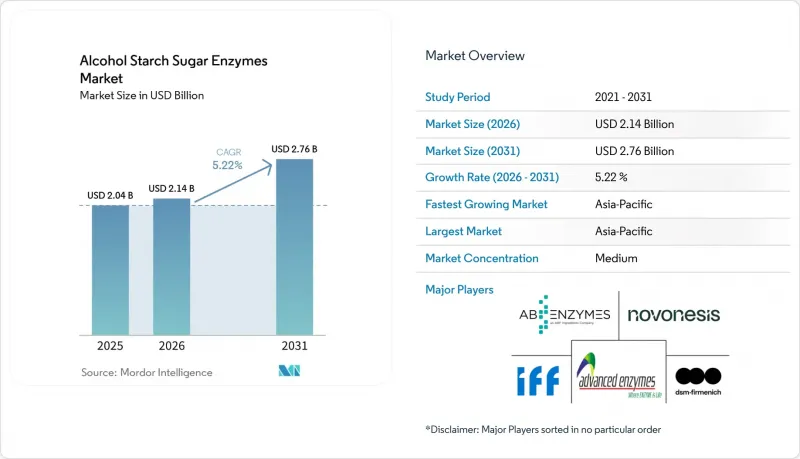
根據 Mordor Intelligence 預測,酒精、澱粉和糖酶的市場規模預計將從 2025 年的 20.4 億美元成長到 2026 年的 21.4 億美元,到 2031 年將進一步成長到 27.6 億美元,在 2026 年至 2031 年將進一步成長到 27.6 億美元,在 2026 年至 2031 年的預測期內,複合年成長率。
酒精、澱粉和糖酶市場的全球趨勢和洞察。
擴大生質乙醇生產與強制摻混
在政府主導的關鍵市場燃料摻混計畫的支持下,生質乙醇產量持續成長,帶動了對酒精、澱粉和醣類酵素的需求。澱粉酶和澱粉葡萄糖化酵素在乙醇生產中發揮著特別重要的作用,它們能夠促進澱粉液化和糖化,從而提高原料轉化為可發酵糖的效率。根據美國農業部(USDA)預測,印度的乙醇產量預計在2025年達到105億公升,比2024年增加46%,顯示該國生質燃料產能正在快速擴張。印度的E20摻混目標、巴西的E30強制摻混政策以及越南的E10實施,也都在鼓勵乙醇生產商擴大產能並提高製程效率。隨著乙醇產量的成長,生產商需要更多的酵素來維持高效的澱粉轉化、發酵和整體生產性能,這為酵素供應商創造了相對穩定且永續的需求基礎。
澱粉和糖加工中對酵素的需求不斷成長
全球糖產量的成長推動了對支持糖和澱粉轉化過程的酵素的需求。根據經濟合作暨發展組織(OECD)的數據,全球糖產量預計將從基準年的1.78億噸增加至2034年的2.05億噸。其中,亞洲預計將佔63%的成長,拉丁美洲將佔24%。這凸顯了這些地區在全球糖產量成長中的重要性。隨著產量的增加,糖加工商將需要更多的酶,例如澱粉酶、澱粉葡萄糖化酵素和葡萄糖異構酶,以最佳化澱粉水解、提高糖轉化率並提升整體加工效率。預計這一趨勢將顯著增加對酶解決方案的需求,尤其是在亞洲和拉丁美洲快速發展的糖加工業中。
工業用酵素和酵素法加工成本高成本
工業用酵素及其相關酵素加工系統的高成本可能會阻礙其應用,尤其對於中小型酒精、澱粉和糖加工企業而言更是如此。酵素的採購、儲存、處理和使用要求會增加整體生產成本,尤其是在工廠未達到最佳運作下。在這種情況下,儘管高品質或先進的酵素解決方案在提高產量、製程效率和產品品質方面具有潛在優勢,但加工企業可能認為投資此類解決方案並不經濟。這種限制在新興市場尤為突出,因為這些市場的加工企業通常利潤率較低、資金有限,且對投入成本更為敏感。為了應對這些挑戰,酵素生產商正在開發高活性配方,以減少用量,並簡化管理系統,從而降低操作複雜性。這些創新旨在提高酵素加工的成本效益,並為更廣泛的終端用戶創造經濟價值。
細分市場分析
按類型分類,澱粉酶在酒精、澱粉和醣類酶市場中佔據主導地位,預計到2025年將佔據47.13%的市場佔有率。這種酵素在澱粉的液化和水解過程中發揮著至關重要的作用,是酒精、澱粉和醣類加工的必需原料。澱粉酶將複雜的澱粉分子轉化為更簡單的醣類,這些醣類隨後可用於發酵和其他下游製程。對提高澱粉轉化效率、增加製程收率和縮短生產時間的日益成長的需求,持續推動加工設施對澱粉酶的應用。澱粉酶在穀物乙醇生產、釀造和甜味劑製造等領域的廣泛應用,進一步鞏固了其市場領先地位。
纖維素酶預計將成為成長最快的酵素類,到2031年複合年成長率將達到6.07%。富含纖維素的原料使用量的不斷成長,推動了生質能轉化和發酵過程中對纖維素酶的需求。這種酵素能夠將纖維素分解成可發酵糖,從而實現農業廢棄物和其他木質纖維素材料的高效利用。纖維素酶能夠提高原料利用效率,並支持低成本的下游生產,使其在工業應用中的用途日益廣泛。對生質燃料投資的增加以及對可再生原料日益成長的偏好,預計將進一步加速纖維素酶產業的成長。
從產品類型來看,預計到2025年,液體配方酵素將在酒精、澱粉和醣類酵素市場佔據主導地位,市佔率高達62.64%。液體酵素易於操作、分散迅速,且與自動化加藥系統相容,因此在工業生產中已廣泛應用。製造商可以直接在加工步驟中添加液體酶,從而實現精確加藥並縮短製備時間。此外,這些配方在酒精生產、澱粉轉化和糖加工過程中均能保持穩定的酵素活性。其易用性和廣泛的適用性進一步鞏固了其在該領域的領先地位。
預計到2031年,粉末製劑的複合年成長率將達到6.54%,成為成長最快的劑型。其更長的保存期限、更高的儲存穩定性以及便捷的運輸方式,使其成為尋求靈活酶製劑解決方案的製造商的理想選擇。粉末酶製劑能夠實現高效的儲存和分銷,尤其是在冷鏈基礎設施薄弱的地區。此外,它們還具有配方柔軟性,有助於降低物流和儲存成本。市場對經濟高效、穩定性好且易於操作的酵素製劑產品的需求不斷成長,預計將推動該細分市場的成長。
區域分析
預計到2025年,亞太地區將佔據全球酒精、澱粉和糖酶市場33.86%的佔有率,並將在2031年之前保持6.82%的複合年成長率,成為成長最快的區域市場。該地區受益於乙醇產量的擴大、澱粉加工能力的提升以及酶轉化技術的日益普及。印度生質乙醇產業的擴張和穀物乙醇產量的增加顯著推動了該地區對酵素的需求。此外,中國、印度和東南亞食品、飲料和發酵行業的蓬勃發展也促使人們更多地使用酵素來提高生產效率和產量。
北美和歐洲仍然是酒精、澱粉和糖酶的成熟市場,這要歸功於當地成熟的乙醇、食品加工、澱粉和糖業。這些地區的製造商廣泛利用酵素進行澱粉轉化、甜味劑生產、發酵和生質燃料應用。持續關注提高製程效率、產品均勻性和資源利用率也進一步支撐了整體需求。預計對永續加工技術的持續投資將維持這兩個地區對專用酵素解決方案的需求。
拉丁美洲在酒精、澱粉和糖酶市場的重要性日益凸顯,這得益於乙醇產量的擴大和包括玉米在內的農業原料使用量的增加。中東和非洲雖然規模相對小規模,但卻是新興市場,其食品加工、飲料和工業生物技術活動的發展正推動酵素的逐步應用。預計到2031年,該地區的成長仍將與生質燃料、農產品加工和工業生物技術基礎設施的投資密切相關。亞太地區預計將保持其成長優勢,而隨著當地生產和加工能力的提升,拉丁美洲以及中東和非洲地區將迎來更多機會。
其他好處:
- Excel格式的市場預測(ME)表
- 3個月的分析師支持
目錄
第1章:引言
- 研究假設和市場定義
- 調查範圍
第2章:調查方法
第3章執行摘要
第4章 市場狀況
- 市場概覽
- 市場促進因素
- 生質乙醇產量擴大和混合需求增加
- 澱粉和糖加工中對酵素的需求不斷成長
- 啤酒、烈酒和其他酒精飲料產量增加
- 擴大酵素法加工技術的應用,以提高生產效率。
- 對永續和生物基工業流程的傾向
- 酵素工程和微生物生物技術的進展
- 市場限制因素
- 工業用酵素和酵素法加工成本高成本
- 食品飲料業對酵素的使用有嚴格的監管要求。
- 替代化學和傳統加工技術的可用性
- 原料與發酵投入成本的波動
- 監理展望
- 供應鏈分析
- 波特五力模型
第5章 市場規模與成長預測
- 按類型
- 澱粉酶
- 澱粉葡萄糖化酵素
- 纖維素酶
- 蛋白酶
- 脂肪酶
- 其他
- 按形式
- 粉末
- 液體
- 來源
- 微生物來源
- 植物來源
- 動物源性
- 按最終用途
- 酒精生產
- 澱粉加工
- 糖加工
- 按地區
- 北美洲
- 美國
- 加拿大
- 墨西哥
- 其他北美國家
- 歐洲
- 德國
- 英國
- 義大利
- 法國
- 西班牙
- 其他歐洲國家
- 亞太地區
- 中國
- 日本
- 印度
- 澳洲
- 其他亞太國家
- 南美洲
- 巴西
- 阿根廷
- 其他南美國家
- 中東和非洲
- 南非
- 沙烏地阿拉伯
- 其他中東和非洲國家
- 北美洲
第6章 競爭情勢
- 市場集中度
- 策略趨勢
- 市場排名分析
- 公司簡介
- Novonesis A/S
- International Flavors & Fragrances Inc.(IFF)
- DSM-Firmenich AG
- Associated British Foods plc(AB Enzymes)
- Advanced Enzyme Technologies Limited
- Amano Enzyme Inc.
- Codexis, Inc.
- Dyadic International, Inc.
- Lesaffre
- Roquette Freres
- The Soufflet Group
- BASF SE
- Kerry Group plc
- Lallemand Inc.
- AEB Group
- Angel Yeast Co., Ltd.
- Biocatalysts Ltd.
- WeissBioTech GmbH
- Enzyme Development Corporation
- Aumgene Biosciences
第7章 市場機會與未來展望
According to Mordor Intelligence, the alcohol starch sugar enzymes market size is projected to grow from USD 2.04 billion in 2025 to USD 2.14 billion in 2026, and to USD 2.76 billion by 2031, registering a CAGR of 5.22% during the 2026-2031 forecast period.
Global Alcohol Starch Sugar Enzymes Market Trends and Insights
Expanding Bioethanol Production and Blending Mandates
The continued expansion of bioethanol production, supported by government-mandated fuel-blending programs in major markets, is increasing demand for enzymes for alcohol, starch and sugar. Amylase and glucoamylase are particularly important in ethanol manufacturing, as they facilitate starch liquefaction and saccharification, improving the conversion of feedstocks into fermentable sugars. According to the United States Department of Agriculture (USDA), India's ethanol production reached 10.5 billion liters in calendar year 2025, representing a 46% increase over 2024 and underscoring the country's rapidly expanding biofuel production capacity. India's E20 blending target, Brazil's E30 mandate, and Vietnam's E10 rollout are also prompting ethanol producers to expand capacity and improve process efficiency. As ethanol output rises, producers require larger volumes of enzymes to support efficient starch conversion, fermentation, and overall production performance, creating a relatively stable and sustained demand base for enzyme suppliers.
Growing Demand for Enzymes in Starch and Sugar Processing
Rising global sugar production is driving demand for enzymes that support sugar and starch conversion processes. According to the Organization for Economic Co-operation and Development (OECD), global sugar production is projected to increase from 178 million tonnes during the base period to 205 million tonnes by 2034. Asia is expected to account for 63% of this growth, while Latin America is projected to contribute 24%, underscoring the importance of these regions in the expansion of global sugar production. As production volumes increase, sugar processors are likely to require higher volumes of enzymes, including amylase, glucoamylase, and glucose isomerase, to optimize starch hydrolysis, improve sugar conversion rates, and enhance overall processing efficiency. This trend is expected to create significant demand for enzyme solutions, particularly in the rapidly expanding sugar-processing industries in Asia and Latin America.
High Cost of Industrial Enzymes and Enzyme-Based Processing
The high cost of industrial enzymes and associated enzyme-based processing systems can restrain their adoption, especially among small and mid-sized alcohol, starch, and sugar processors. Enzyme procurement, storage, handling, and dosing requirements can increase overall production costs, particularly when plants operate below optimal capacity. Under these conditions, processors may view investments in premium or advanced enzyme solutions as less financially viable, despite their potential benefits in terms of improved yields, process efficiency, and product quality. This constraint is particularly pronounced in emerging markets, where processors often operate with narrower margins, limited capital availability, and greater sensitivity to input costs. To address these challenges, enzyme manufacturers are developing higher-activity formulations that require lower application doses, along with simplified dosing systems that reduce operational complexity. These innovations aim to improve the cost-effectiveness of enzyme-based processing and enhance its economic value for a broader range of end users.
Other drivers and restraints analyzed in the detailed report include:
- Rising Production of Beer, Spirits, and Other Alcoholic Beverages
- Increasing Adoption of Enzyme-Based Processing for Higher Production Efficiency
- Strict Regulatory Requirements for Enzyme Use in Food And Beverage Applications
For complete list of drivers and restraints, kindly check the Table Of Contents.
Segment Analysis
Amylase dominated the alcohol starch sugar enzymes market by type, accounting for 47.13% of the market share in 2025. The enzyme plays a critical role in starch liquefaction and hydrolysis, making it essential for alcohol, starch, and sugar processing applications. It converts complex starch molecules into simpler sugars, which are subsequently used in fermentation and other downstream processing stages. The growing demand for higher starch-conversion efficiency, improved process yields, and reduced production time continues to drive amylase adoption across processing facilities. Its broad applicability across grain-based ethanol production, brewing, and sweetener manufacturing further strengthens its leading market position.
Cellulase is projected to be the fastest-growing enzyme type, registering a 6.07% CAGR through 2031. Increasing use of cellulose-rich feedstocks is driving demand for cellulase in biomass conversion and fermentation processes. The enzyme breaks down cellulose into fermentable sugars, enabling the efficient use of agricultural residues and other lignocellulosic materials. Its ability to improve feedstock utilization and support cost-effective downstream production is expanding its use in industrial applications. Rising investments in biofuels and the growing preference for renewable feedstocks are expected to further accelerate growth in the cellulase segment.
Liquid formulations dominated the alcohol starch sugar enzymes market by form, accounting for 62.64% of the market share in 2025. Their ease of handling, rapid dispersion, and compatibility with automated dosing systems support their extensive use in industrial operations. Manufacturers can directly add liquid enzymes to processing streams, enabling accurate dosing and reducing preparation time. These formulations also support consistent enzyme activity during alcohol production, starch conversion, and sugar processing. Their operational convenience and broad application base continue to reinforce the segment's leading position.
Powder formulations are projected to be the fastest-growing form segment, registering a 6.54% CAGR through 2031. Their extended shelf life, improved storage stability, and ease of transportation make them suitable for manufacturers seeking flexible enzyme solutions. Powder enzymes can be stored and distributed efficiently, particularly in regions where cold-chain infrastructure is limited. They also provide formulation flexibility and can help reduce logistics and storage costs. Growing demand for cost-effective, stable, and easily manageable enzyme products is expected to drive segment growth.
Complete Report Scope:
- By Type
- Amylase
- Glucoamylase
- Cellulase
- Protease
- Lipase
- Others
- By Form
- Powder
- Liquid
- By Source
- Microbial
- Plant-Derived
- Animal-Derived
- By End-Use Application
- Alcohol Production
- Starch Processing
- Sugar Processing
- By Geography
- North America
- United States
- Canada
- Mexico
- Rest of North America
- Europe
- Germany
- United Kingdom
- Italy
- France
- Spain
- Rest of Europe
- Asia-Pacific
- China
- Japan
- India
- Australia
- Rest of Asia-Pacific
- South America
- Brazil
- Argentina
- Rest of South America
- Middle East and Africa
- South Africa
- Saudi Arabia
- Rest of Middle East and Africa
- North America
Geography Analysis
Asia-Pacific accounted for 33.86% of the alcohol starch sugar enzymes market in 2025 and is projected to register a 6.82% CAGR through 2031, making it the fastest-growing regional market. The region benefits from expanding ethanol production, increasing starch-processing capacity, and the growing adoption of enzyme-based conversion technologies. India's expanding bioethanol industry and rising grain-based ethanol production are contributing significantly to regional demand for enzymes. Growing food, beverage, and fermentation activities across China, India, and Southeast Asia are also increasing the use of enzymes to improve production efficiency and yields.
North America and Europe remain established markets for alcohol starch sugar enzymes, supported by mature ethanol, food-processing, starch, and sugar industries. Manufacturers in these regions widely use enzymes for starch conversion, sweetener production, fermentation, and biofuel applications. Demand is further supported by the continued focus on improving process efficiency, product consistency, and resource utilization across industrial operations. Ongoing investments in sustainable processing technologies are expected to maintain demand for specialized enzyme solutions in both regions.
Latin America is gaining importance in the alcohol starch sugar enzymes market, supported by expanding ethanol production and increasing use of corn and other agricultural feedstocks. The Middle East and Africa represent comparatively smaller but emerging markets, where developing food-processing, beverage, and industrial biotechnology activities support gradual enzyme adoption. Regional growth through 2031 is expected to remain closely linked to investments in biofuels, agricultural processing, and industrial biotechnology infrastructure. While Asia-Pacific is likely to maintain its growth advantage, Latin America and the Middle East & Africa offer additional opportunities as local production and processing capacities expand.
List of Companies Covered in this Report:
- Novonesis A/S
- International Flavors & Fragrances Inc. (IFF)
- DSM-Firmenich AG
- Associated British Foods plc (AB Enzymes)
- Advanced Enzyme Technologies Limited
- Amano Enzyme Inc.
- Codexis, Inc.
- Dyadic International, Inc.
- Lesaffre
- Roquette Freres
- The Soufflet Group
- BASF SE
- Kerry Group plc
- Lallemand Inc.
- AEB Group
- Angel Yeast Co., Ltd.
- Biocatalysts Ltd.
- WeissBioTech GmbH
- Enzyme Development Corporation
- Aumgene Biosciences
Additional Benefits:
- The market estimate (ME) sheet in Excel format
- 3 months of analyst support
TABLE OF CONTENTS
1 INTRODUCTION
- 1.1 Study Assumptions and Market Definition
- 1.2 Scope of the Study
2 RESEARCH METHODOLOGY
3 EXECUTIVE SUMMARY
4 MARKET LANDSCAPE
- 4.1 Market Overview
- 4.2 Market Drivers
- 4.2.1 Expanding bioethanol production and blending mandates
- 4.2.2 Growing demand for enzymes in starch and sugar processing
- 4.2.3 Rising production of beer, spirits, and other alcoholic beverages
- 4.2.4 Increasing adoption of enzyme-based processing for higher production efficiency
- 4.2.5 Preference for sustainable and bio-based industrial processes
- 4.2.6 Advancements in enzyme engineering and microbial biotechnology
- 4.3 Market Restraints
- 4.3.1 High cost of industrial enzymes and enzyme-based processing
- 4.3.2 Strict regulatory requirements for enzyme use in food and beverage applications
- 4.3.3 Availability of alternative chemical and conventional processing technologies
- 4.3.4 Fluctuations in raw material and fermentation input costs
- 4.4 Regulatory Outlook
- 4.5 Supply Chain Analysis
- 4.6 Porter's Five Forces
- 4.6.1 Threat of New Entrants
- 4.6.2 Bargaining Power of Buyers
- 4.6.3 Bargaining Power of Suppliers
- 4.6.4 Threat of Substitute Products
- 4.6.5 Intensity of Competitive Rivalry
5 MARKET SIZE AND GROWTH FORECASTS (VALUE)
- 5.1 By Type
- 5.1.1 Amylase
- 5.1.2 Glucoamylase
- 5.1.3 Cellulase
- 5.1.4 Protease
- 5.1.5 Lipase
- 5.1.6 Others
- 5.2 By Form
- 5.2.1 Powder
- 5.2.2 Liquid
- 5.3 By Source
- 5.3.1 Microbial
- 5.3.2 Plant-Derived
- 5.3.3 Animal-Derived
- 5.4 By End-Use Application
- 5.4.1 Alcohol Production
- 5.4.2 Starch Processing
- 5.4.3 Sugar Processing
- 5.5 By Geography
- 5.5.1 North America
- 5.5.1.1 United States
- 5.5.1.2 Canada
- 5.5.1.3 Mexico
- 5.5.1.4 Rest of North America
- 5.5.2 Europe
- 5.5.2.1 Germany
- 5.5.2.2 United Kingdom
- 5.5.2.3 Italy
- 5.5.2.4 France
- 5.5.2.5 Spain
- 5.5.2.6 Rest of Europe
- 5.5.3 Asia-Pacific
- 5.5.3.1 China
- 5.5.3.2 Japan
- 5.5.3.3 India
- 5.5.3.4 Australia
- 5.5.3.5 Rest of Asia-Pacific
- 5.5.4 South America
- 5.5.4.1 Brazil
- 5.5.4.2 Argentina
- 5.5.4.3 Rest of South America
- 5.5.5 Middle East and Africa
- 5.5.5.1 South Africa
- 5.5.5.2 Saudi Arabia
- 5.5.5.3 Rest of Middle East and Africa
- 5.5.1 North America
6 COMPETITIVE LANDSCAPE
- 6.1 Market Concentration
- 6.2 Strategic Moves
- 6.3 Market Ranking Analysis
- 6.4 Company Profiles (includes Global-level Overview, Market-level Overview, Core Segments, Financials (if available), Strategic Information, Market Rank/Share, Products and Services, Recent Developments)
- 6.4.1 Novonesis A/S
- 6.4.2 International Flavors & Fragrances Inc. (IFF)
- 6.4.3 DSM-Firmenich AG
- 6.4.4 Associated British Foods plc (AB Enzymes)
- 6.4.5 Advanced Enzyme Technologies Limited
- 6.4.6 Amano Enzyme Inc.
- 6.4.7 Codexis, Inc.
- 6.4.8 Dyadic International, Inc.
- 6.4.9 Lesaffre
- 6.4.10 Roquette Freres
- 6.4.11 The Soufflet Group
- 6.4.12 BASF SE
- 6.4.13 Kerry Group plc
- 6.4.14 Lallemand Inc.
- 6.4.15 AEB Group
- 6.4.16 Angel Yeast Co., Ltd.
- 6.4.17 Biocatalysts Ltd.
- 6.4.18 WeissBioTech GmbH
- 6.4.19 Enzyme Development Corporation
- 6.4.20 Aumgene Biosciences

