

 |
市場調查報告書
商品編碼
2154835
塑化劑:市場佔有率分析、產業趨勢與統計、成長預測(2026-2031)Plasticizers - Market Share Analysis, Industry Trends & Statistics, Growth Forecasts (2026 - 2031) |
||||||

※ 本網頁內容可能與最新版本有所差異。詳細情況請與我們聯繫。
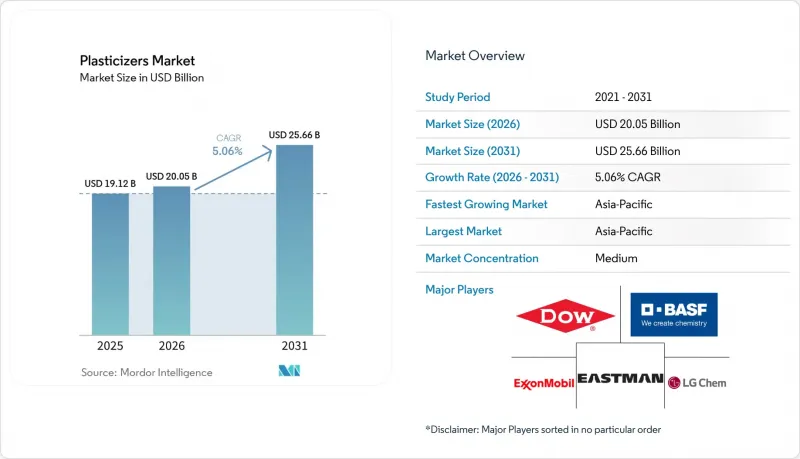
據 Mordor Intelligence 稱,2025 年塑化劑市值為 191.2 億美元,預計到 2031 年將達到 256.6 億美元,而 2026 年為 200.5 億美元,預測期(2026-2031 年)的複合年成長率為 5.06%。
全球塑化劑市場趨勢與洞察
電力系統現代化和可再生能源電纜對柔軟性PVC的需求日益成長。
2024年至2025年間,全球電網投資將達4,000億美元,主要用於可再生能源併網、離岸風力發電電纜和地下配電系統。這些系統採用軟性電纜材料,並透過塑化劑增強其絕緣和護套性能。專案業主越來越要求電纜在長期運作中,能夠經受反覆高溫高濕環境的考驗,並提供相應的性能證明。這些認證要求縮小了電纜專案供應商的選擇範圍,並提升了成熟應用案例的價值。此外,可再生能源電纜對即使在低溫下也能保持柔軟性的電纜的需求也在不斷成長。
監管驅動的向無鄰苯二甲酸酯配方轉變
歐盟繼續根據 REACH 法規框架對某些鄰苯二甲酸酯進行監管,包括對塑化劑的限制。遵守這些法規要求加工商評估配方方案、相關文件以及適用的使用條件。改用不含鄰苯二甲酸酯的配方可能需要為用於受監管應用的產品重新進行認證,而且一旦客戶批准了替代材料,就很難撤銷這項決定。化學品法規研究也強調了以類似替代品取代受監管物質的風險,因為這些替代品會帶來類似的問題。如果供應商能夠提供符合法規要求的方案,並輔以清晰的技術和法規支持,塑化劑市場將從中受益。
不含鄰苯二甲酸酯的替代品成本高昂
在對材料成本高度敏感的應用領域,不含鄰苯二甲酸酯的替代品仍會帶來成本負擔。地板材料、管道、塗層織物和標準電纜絕緣等產品通常以成品PVC產品的成本競爭。這影響了加工商在無需進行法規變更的領域採用對苯二甲酸二(2-乙基己基)酯 (DOTP)、二異壬基環己烷-1,2-二羧酸 (DINCH) 和其他符合法規的替代品的速度。加工商的流程還涉及配方變更、合格性測試和文件編制工作。這些工作可能會延遲利潤率有限的混煉商的收入。塑化劑市場仍存在兩極化:一方面是需要加工商流程的受監管應用,另一方面是仍偏好價格敏感、傳統使用的鄰苯二甲酸酯類塑化劑的應用。
細分市場分析
2025年,鄰苯二甲酸酯類塑化劑佔塑化劑市場銷售額的53.55%。這一地位反映了其在建築地板材料、通用電纜絕緣和PVC管材等領域長期存在的成本優勢。在尚未推出替代法規的市場中,這些產品仍然被廣泛使用。成熟的DOP和DINP供應鏈支持其在許多亞洲應用領域的持續使用。熟悉的加工特性使加工商能夠保持生產效率和材料一致性。在滿足性能和成本要求的市場,這些產品仍然擁有龐大的需求基礎。然而,通用級產品的競爭性定價正在阻礙產品差異化程度有限的生產商實現增值成長。這導致強勁的需求,同時也增加了供應商控制原料成本和運轉率的壓力。
預計2026年至2031年間,非鄰苯二甲酸酯類塑化劑的複合年成長率將達到5.65%。這一高成長率反映了歐洲和北美地區監管驅動的替代趨勢,以及符合監管要求的材料在敏感應用中的日益普及。 DOTP因其成本和性能的平衡性,正逐漸成為高生產率的選擇。 DINCH則應用於醫療領域(在這些領域,認證和低遷移特性會影響採購決策)以及敏感消費者導向的應用領域。因此,市場正從完全取代鄰苯二甲酸酯轉向更廣泛的產品組合。 2025年2月,BASF推出了「Ccycled Palatinol DOTP」牌號,此前該公司已推出生質能平衡的「Palatinol DOTP」和「TOTM」牌號,這些牌號均已獲得國際永續碳認證(ISCC)PLUS認證。這些產品旨在幫助客戶在不改變現有產品配方的情況下,獲得永續認證的材料。 2024 年 10 月,贏創擴大了在德國馬爾的 ELATUR CH 和 ELATUR DINCD 的生產能力。
區域分析
到2025年,亞太地區將佔全球塑化劑市場銷售額的43.54%,預計到2031年將以5.95%的複合年成長率成長。中國擁有大規模的軟性PVC市場,廣泛應用於建築、電纜和消費品領域。出口型製造商日益成長的環保要求和採購標準,推動了對不含鄰苯二甲酸酯替代品的需求。在印度,基礎設施、住宅、管道、地板材料和電纜鋪設項目對塑化劑的需求強勁。韓國和日本向區域和全球客戶供應高品質的不含鄰苯二甲酸酯的塑化劑和特殊偏苯三酸酯。
預計北美塑化劑市場將受益於電線電纜和醫療應用領域特種塑化劑的成長,同時建築業需求也將保持穩定。電網現代化和資料中心投資推動了對不易柔軟性聚氯乙烯(PVC) 需求影響的電纜的採購。在無鄰苯二甲酸酯配方開發方面,歐洲領先其他主要地區。歐洲塑化劑市場主要依賴二異壬基環己烷-1,2-二羧酸 (DINCH)、對苯二甲酸酯和生物基替代品,應用於醫療、食品接觸和敏感消費品領域。歐洲的監管要求正在提升已記錄產品系列和認證價值鏈的價值。
南美、中東和非洲的塑化劑市場由與建築週期和產業多元化相關的小規模需求點組成。巴西將於2026年對鄰苯二甲酸二異壬酯(DINP)的進口進行反傾銷調查,顯示人們對國內產能和區域間貿易流量的關注度日益提高。在中東和非洲,建設計畫和工業需求正在受益,其中包括與沙烏地阿拉伯「2030願景」相關的項目。住宅建設、基礎設施投資以及柔軟性PVC產品的日益普及都在推動市場成長。
其他好處:
- Excel格式的市場預測(ME)表
- 3個月的分析師支持
目錄
第1章:引言
- 研究假設和市場定義
- 調查範圍
第2章:調查方法
第3章執行摘要
第4章 市場狀況
- 市場概覽
- 市場促進因素
- 電網現代化以及可再生能源電纜對柔軟性PVC的需求。
- 監管驅動的向無鄰苯二甲酸酯配方過渡
- 汽車電氣化和充電基礎設施
- 醫療設備用低遷移塑化劑的合格評估
- 資料中心和電力電子產業對耐熱電纜的需求
- 市場限制因素
- 不含鄰苯二甲酸酯的替代品成本高昂
- 石油化學原料和酯化能力的變化
- 溫度、遷移和融合方面的效能權衡
- 價值鏈分析
- 波特五力分析
第5章 市場規模與成長預測
- 按產品等級
- 鄰苯二甲酸酯類塑化劑
- 不含鄰苯二甲酸酯的塑化劑
- 透過使用
- 電線電纜
- 地板材料和牆壁材料
- 薄膜
- 塗層織物
- 管道和管材
- 其他用途
- 按最終用戶行業分類
- 建築/施工
- 車
- 電氣和電子設備
- 包裝
- 衛生保健
- 其他終端用戶產業
- 按地區
- 亞太地區
- 中國
- 印度
- 日本
- 韓國
- 其他亞太國家
- 北美洲
- 美國
- 加拿大
- 墨西哥
- 歐洲
- 德國
- 英國
- 法國
- 義大利
- 俄羅斯
- 其他歐洲國家
- 南美洲
- 巴西
- 阿根廷
- 其他南美國家
- 中東和非洲
- 沙烏地阿拉伯
- 南非
- 其他中東和非洲國家
- 亞太地區
第6章 競爭情勢
- 市場集中度
- 策略趨勢
- 市佔率和排名分析
- 公司簡介
- Aekyung Chemical
- BASF
- Bluesail Chemical Group Co., Ltd.
- DIC CORPORATION
- Dow
- Eastman Chemical Company
- Evonik Industries AG
- Exxon Mobil Corporation
- LANXESS
- LG Chem
- NAN YA PLASTICS CORPORATION
- Perstorp
- Polynt SpA
- UPC Technology Corporation
- Velsicol Chemical LLC
第7章 市場機會與未來展望
According to Mordor Intelligence, the plasticizers market size was valued at USD 19.12 billion in 2025 and is estimated to grow from USD 20.05 billion in 2026 to reach USD 25.66 billion by 2031, at a CAGR of 5.06% during the forecast period (2026-2031).
Global Plasticizers Market Trends and Insights
Flexible PVC Demand in Grid Modernization and Renewable Energy Cabling
Global electricity grid investment reached USD 400 billion across 2024 and 2025, with spending directed toward renewable interconnections, offshore wind cables, and underground distribution systems. These systems use flexible cable compounds in which plasticizers enhance insulation and jacketing performance. Project owners increasingly require documented performance under repeated exposure to heat and moisture over long operating periods. These qualification requirements narrow the supplier base for cable projects and increase the value of established application documentation. Renewable energy wiring also increases demand for grades that retain flexibility at low temperatures.
Regulatory-Led Conversion to Non-Phthalate Formulations
The European Union continues to regulate specific phthalates under the REACH framework, including restrictions on plasticized articles. Compliance requires converters to assess formulation choices, documentation, and applicable use conditions. Switching to a non-phthalate formulation can require new qualification work for products used in regulated applications, making it difficult to reverse conversion decisions once customers approve a replacement material. Research on chemical regulation has also highlighted the risk of replacing a restricted substance with a closely related alternative that raises similar concerns. The plasticizers market benefits when suppliers can provide compliant options with clear technical and regulatory support.
Higher Cost of Non-Phthalate Alternatives
Non-phthalate alternatives continue to carry a cost burden in applications that are highly sensitive to material costs. Flooring, pipes, coated fabrics, and standard cable insulation often compete on the cost of finished PVC products. This affects the pace at which converters adopt di(2-ethylhexyl) terephthalate (DOTP), diisononyl cyclohexane-1,2-dicarboxylate (DINCH), and other compliant alternatives where regulation does not require a change. The conversion process also involves reformulation, qualification testing, and documentation work. These activities can delay revenue for compounders operating on limited margins. The plasticizers market remains split between regulated applications that require conversion and price-sensitive applications that continue to favor established phthalate grades.
Other drivers and restraints analyzed in the detailed report include:
- Electrification of Vehicles and Charging Infrastructure
- High-Temperature Cable Demand in Data Centers and Power Electronics
- Petrochemical Feedstock and Esterification-Capacity Volatility
For complete list of drivers and restraints, kindly check the Table Of Contents.
Segment Analysis
Phthalate plasticizers accounted for 53.55% of the plasticizers market revenue share in 2025. Their position reflects a long-established cost advantage in construction flooring, general cable insulation, and PVC pipe compounding. They remain widely used in markets where substitution regulations have not been imposed. Established DOP and DINP supply chains support continued use across many Asian applications. Familiar processing behavior helps converters maintain productivity and material consistency. A large base of demand persists where these products meet performance and cost requirements. Competitive pricing in commodity grades, however, limits value growth for producers with limited product differentiation. This keeps demand resilient while increasing pressure on suppliers to manage feedstock costs and operating rates.
Non-phthalate plasticizers are forecast to expand at a 5.65% CAGR from 2026 to 2031. Their higher growth reflects regulatory-driven conversion in Europe and North America, as well as increasing use of compliant materials in sensitive applications. DOTP has emerged as a high-output option due to its balance of cost and performance. DINCH is used in medical and sensitive consumer applications where certification and low-migration characteristics influence procurement decisions. The market is therefore moving toward a broader product mix rather than a complete replacement of phthalates. In February 2025, BASF launched International Sustainability and Carbon Certification (ISCC) PLUS-certified biomass-balanced Palatinol DOTP and TOTM grades, along with a Ccycled Palatinol DOTP grade. These products are intended to support customers seeking sustainability-certified materials without reformulating existing products. In October 2024, Evonik expanded production capacity for ELATUR CH and ELATUR DINCD at Marl, Germany.
Complete Report Scope:
- By Product Grade
- Phthalate Plasticizers
- Non-Phthalate Plasticizers
- By Application
- Wires and Cables
- Flooring and Wall Coverings
- Films and Sheets
- Coated Fabrics
- Pipes and Tubing
- Other Applications
- By End-User Industry
- Building and Construction
- Automotive
- Electrical and Electronics
- Packaging
- Healthcare
- Other End-Use Industries
- By Geography
- Asia-Pacific
- China
- India
- Japan
- South Korea
- Rest of Asia-Pacific
- North America
- United States
- Canada
- Mexico
- Europe
- Germany
- United Kingdom
- France
- Italy
- Russia
- Rest of Europe
- South America
- Brazil
- Argentina
- Rest of South America
- Middle East and Africa
- Saudi Arabia
- South Africa
- Rest of Middle East and Africa
- Asia-Pacific
Geography Analysis
Asia-Pacific accounted for 43.54% of the plasticizers market revenue in 2025 and is projected to expand at a 5.95% CAGR through 2031. China has a large flexible PVC base serving construction, cable, and consumer goods applications. Environmental requirements and procurement standards among export-oriented manufacturers are increasing interest in non-phthalate alternatives. India provides strong regional demand for infrastructure, housing, piping, flooring, and cabling projects. South Korea and Japan supply premium non-phthalate and specialty trimellitate products to regional and global customers.
The North American plasticizers market combines stable construction demand with growth in specialty plasticizers for wire and cable and medical applications. Grid modernization and data-center investment support cable procurement that is less tied to consumer-facing demand for flexible polyvinyl chloride (PVC). Europe has advanced further toward non-phthalate formulations than other major regions. The European plasticizers market relies on diisononyl cyclohexane-1,2-dicarboxylate (DINCH), terephthalates, and bio-based alternatives for medical, food-contact, and sensitive consumer applications. European regulatory requirements increase the value of documented product portfolios and qualified supply chains.
The plasticizers markets in South America, the Middle East, and Africa comprise smaller demand centers linked to construction cycles and industrial diversification. Brazil's 2026 anti-dumping investigation concerning dioctyl phthalate (DOP), dioctyl terephthalate (DOTP), and diisononyl phthalate (DINP) imports signals growing attention to domestic capacity and regional trade flows. The Middle East and Africa benefit from construction pipelines and industrial demand, including projects associated with Saudi Arabia's Vision 2030. Growth is supported by residential construction, infrastructure investment, and wider use of flexible PVC products.
- Aekyung Chemical
- BASF
- Bluesail Chemical Group Co., Ltd.
- DIC CORPORATION
- Dow
- Eastman Chemical Company
- Evonik Industries AG
- Exxon Mobil Corporation
- LANXESS
- LG Chem
- NAN YA PLASTICS CORPORATION
- Perstorp
- Polynt S.p.A.
- UPC Technology Corporation
- Velsicol Chemical LLC
Additional Benefits:
- The market estimate (ME) sheet in Excel format
- 3 months of analyst support
TABLE OF CONTENTS
1 Introduction
- 1.1 Study Assumptions and Market Definition
- 1.2 Scope of the Study
2 Research Methodology
3 Executive Summary
4 Market Landscape
- 4.1 Market Overview
- 4.2 Market Drivers
- 4.2.1 Flexible PVC Demand in Grid Modernization and Renewable-Energy Cabling
- 4.2.2 Regulatory-Led Conversion to Non-Phthalate Formulations
- 4.2.3 Electrification of Vehicles and Charging Infrastructure
- 4.2.4 Medical-Device Qualification of Low-Migration Plasticizers
- 4.2.5 High-Temperature Cable Demand in Data Centers and Power Electronics
- 4.3 Market Restraints
- 4.3.1 Higher Cost of Non-Phthalate Alternatives
- 4.3.2 Petrochemical Feedstock and Esterification-Capacity Volatility
- 4.3.3 Performance Trade-Offs Across Temperature, Migration, and Fusion
- 4.4 Value Chain Analysis
- 4.5 Porter's Five Forces Analysis
- 4.5.1 Bargaining Power of Suppliers
- 4.5.2 Bargaining Power of Buyers
- 4.5.3 Threat of New Entrants
- 4.5.4 Threat of Substitutes
- 4.5.5 Competitive Rivalry
5 Market Size and Growth Forecasts (Value)
- 5.1 By Product Grade
- 5.1.1 Phthalate Plasticizers
- 5.1.2 Non-Phthalate Plasticizers
- 5.2 By Application
- 5.2.1 Wires and Cables
- 5.2.2 Flooring and Wall Coverings
- 5.2.3 Films and Sheets
- 5.2.4 Coated Fabrics
- 5.2.5 Pipes and Tubing
- 5.2.6 Other Applications
- 5.3 By End-User Industry
- 5.3.1 Building and Construction
- 5.3.2 Automotive
- 5.3.3 Electrical and Electronics
- 5.3.4 Packaging
- 5.3.5 Healthcare
- 5.3.6 Other End-Use Industries
- 5.4 By Geography
- 5.4.1 Asia-Pacific
- 5.4.1.1 China
- 5.4.1.2 India
- 5.4.1.3 Japan
- 5.4.1.4 South Korea
- 5.4.1.5 Rest of Asia-Pacific
- 5.4.2 North America
- 5.4.2.1 United States
- 5.4.2.2 Canada
- 5.4.2.3 Mexico
- 5.4.3 Europe
- 5.4.3.1 Germany
- 5.4.3.2 United Kingdom
- 5.4.3.3 France
- 5.4.3.4 Italy
- 5.4.3.5 Russia
- 5.4.3.6 Rest of Europe
- 5.4.4 South America
- 5.4.4.1 Brazil
- 5.4.4.2 Argentina
- 5.4.4.3 Rest of South America
- 5.4.5 Middle East and Africa
- 5.4.5.1 Saudi Arabia
- 5.4.5.2 South Africa
- 5.4.5.3 Rest of Middle East and Africa
- 5.4.1 Asia-Pacific
6 Competitive Landscape
- 6.1 Market Concentration
- 6.2 Strategic Moves
- 6.3 Market Share (%)/Ranking Analysis
- 6.4 Company Profiles (includes Global Overview, Market Overview, Core Segments, Financials as available, Strategic Information, Products and Services, and Recent Developments)
- 6.4.1 Aekyung Chemical
- 6.4.2 BASF
- 6.4.3 Bluesail Chemical Group Co., Ltd.
- 6.4.4 DIC CORPORATION
- 6.4.5 Dow
- 6.4.6 Eastman Chemical Company
- 6.4.7 Evonik Industries AG
- 6.4.8 Exxon Mobil Corporation
- 6.4.9 LANXESS
- 6.4.10 LG Chem
- 6.4.11 NAN YA PLASTICS CORPORATION
- 6.4.12 Perstorp
- 6.4.13 Polynt S.p.A.
- 6.4.14 UPC Technology Corporation
- 6.4.15 Velsicol Chemical LLC
7 Market Opportunities and Future Outlook
- 7.1 White-Space and Unmet-Need Assessment

 快速固化塑化劑市場 - 全球市場預測(2026-2032年)單體基塑化劑市場:全球市場預測,2026-2032年
 混凝土用塑膠模板市場報告:趨勢、預測與競爭分析(至2035年)塑化劑市場:全球市場預測,2026-2032年塑化劑市場:依產品類型、產地、應用、最終用戶、國家及地區分類-全球產業分析、市場規模、市場佔有率及2026年至2033年預測
 塑化劑市場-全球產業規模、佔有率、趨勢、機會、預測:按類型、應用、區域和競爭格局分類,2021-2031年
 塑化劑市場規模、佔有率、成長及全球產業分析:按類型、應用和地區的洞察,2026-2034年的預測2026-2034年全球塑化劑市場規模、佔有率、趨勢和成長分析報告
 2026年全球塑化劑市場報告混凝土塑化劑及高效率減水劑市場-全球產業規模、佔有率、趨勢、機會及預測(依產品類型、應用、基材、終端用戶產業、區域及競爭格局分類,2021-2031年)