

 |
市場調查報告書
商品編碼
2154813
發電廠消音器:市場佔有率分析、行業趨勢和統計數據、成長預測(2026-2031 年)Power Plant Muffler - Market Share Analysis, Industry Trends & Statistics, Growth Forecasts (2026 - 2031) |
||||||

※ 本網頁內容可能與最新版本有所差異。詳細情況請與我們聯繫。
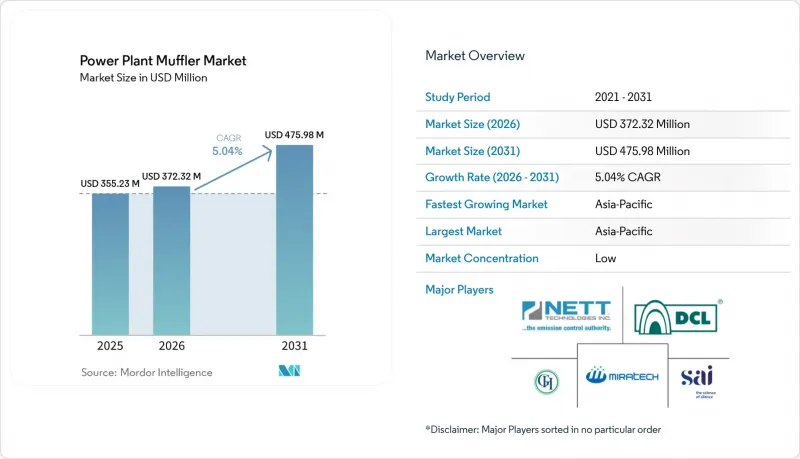
根據 Mordor Intelligence 預測,發電廠消音器的市場規模預計將從 2025 年的 3.5523 億美元和 2026 年的 3.7232 億美元成長到 2031 年的 4.7598 億美元,2026 年至 2031 年的年複合成長率(CAGR) 。
全球電廠消音器市場趨勢與洞察
擴展分散式和備用電源基礎設施
分散式能源網路和備用系統正在推動對工業排氣消音器的需求。貨櫃式燃氣發電機和電錶後的往復式引擎需要根據其特定安裝位置客製化排氣系統。由於當地的噪音法規和許可要求,符合規定的降噪裝置通常是初始設備包的一部分。在人口密集的都市區和靠近住宅的工業園區,通常需要達到關鍵級或醫院級的降噪性能。這些應用為聲學專業人員提供了提供更高價值設計方案的機會。當分散式發電設施部署在位置限制嚴格的地區時,發電廠消音器市場也將受益。
這項要求不僅限於新建項目。現有設施如果因用途變更、擴建或許可證條件修改而出現新的噪音問題,也可能需要升級改造。因此,供應商不僅在新安裝訂單擁有商機,在更換工程方面也存在商機。所需的降噪等級和安裝配置取決於現場條件。因此,能夠根據引擎尺寸、排氣溫度和可用空間量身設計的公司具有優勢。電廠消音器市場正是受益於這種對現場特定工程的持續需求。
更嚴格的噪音和廢氣排放法規
關於工作環境和環境的法規日益重視聲學性能的記錄。美國職業安全與健康管理局 (OSHA) 的職業噪音標準要求,如果工人暴露於超過規定限值的噪音中,雇主必須採取可行的工程或控制措施。歐洲環境噪音指令和工廠排放法規也日益關注固定噪音源。 2026 年 4 月,國際標準化組織 (ISO) 發布了 ISO 14001:2026 標準,更新了環境管理系統的要求。獲得認證的企業必須能夠證明其管理系統下的環境績效可衡量。這些因素推動了對具有清晰測試結果和材料文件的消音器的需求。
標準阻尼設計可能無法滿足面臨更嚴格審查的設施的需求。複合材料和多腔吸音產品比單腔產品能適應更寬的頻率範圍。採購團隊也可以根據檢驗的插入損耗資料來比較不同的設計方案。因此,在電廠消音器市場,測試記錄和一致的生產控制變得越來越重要。成熟的供應商可以在競標資格審查過程中利用其認證和產品文件。小規模的公司可能需要提升這些能力才能在受監管的專案中競爭。
不銹鋼、鎳合金和聲學填充材的價格波動
材料成本波動會對簽訂固定價格專案合約的製造商的利潤率帶來壓力。不銹鋼和鎳合金是高溫廢氣設備的關鍵材料。吸音填料也會影響產品成本和供貨。如果合約簽訂後原物料價格上漲,擁有大量專案訂單的供應商可能面臨更大的風險。因此,在電廠消音器市場,擁有大規模採購能力和嚴格合約管理的公司可能更具優勢。小規模的區域性製造商可能難以承受劇烈的成本波動。
大型供應商可以利用材料避險、雙重採購和價格調整條款(如合約允許)。此外,還可以從多個供應商採購礦物棉和陶瓷纖維。雖然這些措施不能完全消除成本風險,但可以降低對單一原料或供應商的依賴。材料必須滿足性能和溫度要求,這進一步增加了專案進度安排的複雜性。電廠消音器市場對認證材料的供應情況仍然十分敏感。在高溫和客製訂單中,這個問題尤其突出。
細分市場分析
截至2025年,吸音式消音器佔電廠消音器市場45.9%的佔有率。其悠久的應用歷史反映了其在天然氣往復式引擎和柴油發電機組中的廣泛應用。礦物棉和陶瓷纖維填充材可以衰減500 Hz以上的頻率。這種設計無需像反應式系統那樣進行共振腔調整。當需要使用常用材料進行寬頻控制時,它仍然是實用的選擇。在電廠消音器產業,吸音產品在成熟的引擎應用中仍被廣泛應用。
反應式消音器利用共振器和膨脹室將低頻聲音反射迴聲源。它們在具有明顯音調頻率的大型燃氣渦輪機排氣系統中仍然發揮著至關重要的作用。複合式消音器預計到2031年將以5.9%的複合年成長率成長,是所有消音器類型中成長最快的。這類消音器結合了反應室的低頻控制和吸音材料的寬頻衰減,使其適用於產生複雜聲學特性的燃氣渦輪機。在電廠消音器市場,對能夠在單一設計中滿足多種聲學要求的產品需求日益成長。
區域分析
到2025年,亞太地區將佔全球電廠消音器市場規模的39.6%,預計2031年將以6.2%的複合年成長率成長。該地區的需求成長受多種因素驅動:新增燃氣發電裝置容量增加、都市區噪音法規更加嚴格以及資料中心投資不斷擴大。中國和印度是重要的大眾市場,因為工業和基礎設施活動需要備用電源和分散式發電。越南、印尼、泰國和韓國也透過製造業成長和確保電網可靠性的需求推動了市場需求。在這些國家,由於發電機組包含符合標準的排氣系統,電廠消音器市場可望從中受益。更嚴格的監管要求也可能促使現有設施未來進行升級改造。
到2025年,北美將佔據第二大區域市場。該地區受益於對發電機、受監管的工作環境以及高優先級降噪設備的投資。美國職業安全與健康管理局 (OSHA) 強制要求雇主在相關的職業噪音環境中考慮採取工程措施。資料中心發電機組集群支援高額訂單,因為效能文件至關重要。 2026年7月,威廉斯公司宣布將在美國投資53億美元,用於五個「電錶後端」燃氣「電力創新」計畫。這些項目將滿足未來對客製化排氣系統的需求。
歐洲的需求受環境噪音法規、工業排放要求以及各國特定要求(例如德國的「TA Larm」)的影響。燃氣發電廠的現代化改造和運作工作可能會推動替換和維修訂單的成長。南美洲市場雖然規模較小,但偏遠工業和油氣設施安裝柴油和燃氣發電機的需求也隨之成長。在中東和非洲,基於各國能源多元化計劃,燃氣發電裝置容量正在擴張。隨著摩洛哥可再生能源的發展,可能需要燃氣尖峰發電能力來彌補間歇性發電的不足。對於能夠滿足熱帶、沙漠或波動性運作要求的供應商而言,這些地區的電廠消音器市場蘊藏著商機。
其他好處:
- Excel格式的市場預測(ME)表
- 3個月的分析師支持
目錄
第1章:引言
- 研究假設和市場定義
- 調查範圍
第2章:調查方法
第3章執行摘要
第4章 市場狀況
- 市場概覽
- 市場促進因素
- 擴展分散式和備用電源基礎設施
- 更嚴格的噪音和廢氣排放法規
- 資料中心和關鍵任務型發電機組集群的擴建
- 燃氣發電和熱電聯產的擴張
- 由於消音器和排放氣體控制系統的整合,售後市場需求增加。
- 針對可再生能源比例較高的電網進行場地特定的聲學設計。
- 市場限制因素
- 高阻尼設計中熱損失和壓力損失之間的權衡
- 在空間限制下維修現有工廠的複雜性
- 以電氣化和可再生能源發電取代固定式內燃機發電能力。
- 不銹鋼、鎳合金和聲學填料的價格波動。
- 供應鏈分析
- 波特五力分析
- 科技趨勢
- 監理情勢
- 投資分析
第5章 市場規模與成長預測
- 按消音器類型
- 反應型
- 吸收型
- 組合
- 按燃料類型
- 柴油引擎
- 氣體
- 其他
- 按地區
- 北美洲
- 美國
- 加拿大
- 墨西哥
- 歐洲
- 德國
- 法國
- 義大利
- 西班牙
- 英國
- 波蘭
- 俄羅斯
- 其他歐洲國家
- 亞太地區
- 中國
- 印度
- 日本
- 韓國
- 澳洲
- 印尼
- 越南
- 泰國
- 其他亞太國家
- 南美洲
- 巴西
- 阿根廷
- 智利
- 其他南美國家
- 中東和非洲
- 沙烏地阿拉伯
- 阿拉伯聯合大公國
- 埃及
- 南非
- 摩洛哥
- 其他中東和非洲國家
- 北美洲
第6章 競爭情勢
- 市場集中度
- 策略趨勢
- 市佔率分析
- 公司簡介
- Catalyst Products International
- Caterpillar Inc.
- Cummins Inc.
- DCL International Inc.
- Donaldson Company, Inc.
- Durr Universal, Inc.
- ECI-Exhaust & Emissions Control
- Ergil Group
- Fischer Abgastechnik GmbH & Co. KG
- G+H Group
- IAC Acoustics
- Jeremias Abgastechnik GmbH
- MIRATECH Corporation
- Nelson Global Products
- Nett Technologies Inc.
- SAI-Societe d'Acoustique Industrielle
- Schiedel GmbH & Co. KG
- STOPSON Italiana SRL
- Universal Silencer
- Wartsila Corporation
第7章 市場機會與未來展望
According to Mordor Intelligence, the power plant muffler market size is projected to expand from USD 355.23 million in 2025 and USD 372.32 million in 2026 to USD 475.98 million by 2031, at a CAGR of 5.04% between 2026 and 2031.
Global Power Plant Muffler Market Trends and Insights
Expansion of Distributed and Backup Power Infrastructure
Distributed energy networks and backup systems support demand for industrial exhaust silencers. Each containerized gas generator or behind-the-meter reciprocating engine requires an exhaust system suited to its site. Local noise limits and permit conditions make compliant attenuation equipment part of the initial equipment package. Dense urban districts and industrial parks near residential areas often require critical or hospital-grade attenuation. These applications give acoustic specialists opportunities to supply higher-value designs. The Power plant muffler market benefits when distributed generation is installed in locations with tighter siting limits.
The requirement is not limited to new capacity. Existing facilities can need upgrades when a change in use, an expansion, or a revised permit brings new noise conditions. Suppliers therefore have opportunities in replacement work as well as original equipment orders. The site setting determines the required attenuation level and installation configuration. This favors companies that can adapt designs to engine size, exhaust temperature, and available space. The Power plant muffler market is supported by this recurring need for site-specific engineering.
Tightening Noise and Exhaust-Emission Compliance Requirements
Occupational and environmental requirements are increasing the importance of documented acoustic performance. OSHA's occupational noise standard requires employers to use feasible engineering or administrative controls when workers are exposed above specified limits. The European Environmental Noise Directive and plant-level emissions rules also place more attention on stationary-source noise. ISO published ISO 14001:2026 in April 2026, which updates environmental management system requirements. Certified operators must be able to show measurable environmental performance under their management systems. These conditions support demand for mufflers with clear testing and material documentation.
Standard attenuation designs may not meet the needs of facilities facing stricter review. Combination and multichamber absorptive products can address a broader range of frequencies than single-mechanism products. Procurement teams can also compare designs based on verified insertion-loss data. The Power plant muffler market, therefore, places greater value on test records and consistent manufacturing controls. Established suppliers can use certification and product documentation during tender qualification. Smaller firms may need to strengthen those capabilities to compete for regulated projects.
Volatility in Stainless Steel, Nickel Alloys, and Acoustic Packing Materials
Material-cost changes can reduce margins for manufacturers working under fixed-price project contracts. Stainless steel and nickel alloys are important for equipment exposed to high exhaust temperatures. Acoustic packing materials also affect product cost and availability. Suppliers with long project backlogs may face greater risk when input prices rise after a contract is signed. The Power plant muffler market can therefore favor companies with purchasing scale and disciplined contract management. Smaller regional fabricators may have less room to absorb sudden cost changes.
Larger suppliers can use material hedging, dual sourcing, and escalation clauses where their contracts permit them. They can also source mineral wool or ceramic fiber from more than 1 supplier. These measures do not remove cost risk, but they can reduce exposure to a single input or supplier. Project schedules add another complication because material must meet performance and temperature requirements. The Power plant muffler market remains sensitive to the availability of qualified materials. The issue is most visible on high-temperature and custom-engineered orders.
Other drivers and restraints analyzed in the detailed report include:
- Growth of Data Centers and Mission-Critical Generator Fleets
- Expansion of Gas-Fired and Combined Heat and Power Generation
- Thermal and Pressure-Drop Trade-Offs in High-Attenuation Designs
For complete list of drivers and restraints, kindly check the Table Of Contents.
Segment Analysis
Absorptive mufflers held 45.9% of the Power plant muffler market size in 2025. Their long deployment history reflects their use on natural gas reciprocating engines and diesel generator sets. Mineral wool and ceramic fiber packing can attenuate frequencies above 500 Hz. This design does not require the tuned cavity work used in reactive systems. It remains a practical option where broadband control is needed with familiar materials. The Power plant muffler industry continues to use absorptive products across established engine applications.
Reactive mufflers use resonators and expansion chambers to reflect low-frequency sound toward its source. They remain relevant for large gas turbine exhaust systems with discrete tonal frequencies. Combination mufflers are forecast to grow at a 5.9% CAGR through 2031, the fastest rate among muffler types. They combine low-frequency control from reactive chambers with broadband attenuation from absorptive packing. This makes them suited to gas turbines that create complex acoustic profiles. The Power plant muffler market has a growing need for products that can meet several acoustic requirements in one design.
Complete Report Scope:
- By Muffler Type
- Reactive
- Absorptive
- Combination
- By Fuel Type
- Diesel
- Gas
- Others
- By Geography
- North America
- United States
- Canada
- Mexico
- Europe
- Germany
- France
- Italy
- Spain
- United Kingdom
- Poland
- Russia
- Rest of Europe
- Asia-Pacific
- China
- India
- Japan
- South Korea
- Australia
- Indonesia
- Vietnam
- Thailand
- Rest of Asia-Pacific
- South America
- Brazil
- Argentina
- Chile
- Rest of South America
- Middle East and Africa
- Saudi Arabia
- United Arab Emirates
- Egypt
- South Africa
- Morocco
- Rest of Middle East and Africa
- North America
Geography Analysis
Asia-Pacific held 39.6% of the Power plant muffler market size in 2025 and is forecast to grow at a 6.2% CAGR through 2031. The region combines new gas capacity, tighter urban noise controls, and expanding data center investment. China and India are important volume markets because industrial and infrastructure activity requires backup and distributed generation. Vietnam, Indonesia, Thailand, and South Korea also add demand through manufacturing growth and grid reliability needs. The Power plant muffler market can benefit as generator packages in these countries include compliant exhaust systems. Higher regulatory requirements can also create future upgrade demand across the installed base.
North America held the second-largest regional share in 2025. The region benefits from generator investment, regulated work environments, and demand for critical-grade acoustic equipment. OSHA requires employers to consider engineering controls in relevant occupational-noise situations. Data center generator fleets support premium orders where performance documentation is important. Williams announced USD 5.3 billion in committed capital for 5 behind-the-meter gas-fired Power Innovation projects in the United States in July 2026. These projects support a future demand base for engineered exhaust equipment.
Europe's demand is shaped by environmental noise rules, industrial emissions requirements, and national requirements such as Germany's TA Larm. Modernization and recommissioning work in gas capacity can support replacement and retrofit orders. South America is smaller but draws demand from diesel and gas generator installations at remote industrial and oil and gas facilities. The Middle East and Africa are adding gas-fired capacity under national diversification programs. Morocco's renewable development can require gas peaking capacity to support intermittent generation. The Power plant muffler market has opportunities in these locations where suppliers can meet tropical, desert, or variable operating requirements.
- Catalyst Products International
- Caterpillar Inc.
- Cummins Inc.
- DCL International Inc.
- Donaldson Company, Inc.
- Durr Universal, Inc.
- ECI - Exhaust & Emissions Control
- Ergil Group
- Fischer Abgastechnik GmbH & Co. KG
- G+H Group
- IAC Acoustics
- Jeremias Abgastechnik GmbH
- MIRATECH Corporation
- Nelson Global Products
- Nett Technologies Inc.
- SAI - Societe d'Acoustique Industrielle
- Schiedel GmbH & Co. KG
- STOPSON Italiana S.R.L.
- Universal Silencer
- Wartsila Corporation
Additional Benefits:
- The market estimate (ME) sheet in Excel format
- 3 months of analyst support
TABLE OF CONTENTS
1 INTRODUCTION
- 1.1 Study Assumptions and Market Definition
- 1.2 Scope of the Study
2 RESEARCH METHODOLOGY
3 EXECUTIVE SUMMARY
4 MARKET LANDSCAPE
- 4.1 Market Overview
- 4.2 Market Drivers
- 4.2.1 Expansion of Distributed and Backup Power Infrastructure
- 4.2.2 Tightening Noise and Exhaust-Emission Compliance Requirements
- 4.2.3 Growth of Data Centers and Mission-Critical Generator Fleets
- 4.2.4 Expansion of Gas-Fired and Combined Heat and Power Generation
- 4.2.5 Retrofit Demand from Integrated Muffler-Emission Control Systems
- 4.2.6 Site-Specific Acoustic Design for Renewable-Heavy Grids
- 4.3 Market Restraints
- 4.3.1 Thermal and Pressure-Drop Trade-Offs in High-Attenuation Designs
- 4.3.2 High Retrofit Complexity in Space-Constrained Existing Plants
- 4.3.3 Electrification and Renewable Generation Displacing Stationary Internal-Combustion Capacity
- 4.3.4 Volatility in Stainless Steel, Nickel Alloys, and Acoustic Packing Materials
- 4.4 Supply-Chain Analysis
- 4.5 Porter's Five Forces Analysis
- 4.5.1 Bargaining Power of Suppliers
- 4.5.2 Bargaining Power of Buyers
- 4.5.3 Threat of New Entrants
- 4.5.4 Threat of Substitutes
- 4.5.5 Competitive Rivalry
- 4.6 Technology Outlook
- 4.7 Regulatory Landscape
- 4.8 Investment Analysis
5 MARKET SIZE AND GROWTH FORECASTS
- 5.1 By Muffler Type
- 5.1.1 Reactive
- 5.1.2 Absorptive
- 5.1.3 Combination
- 5.2 By Fuel Type
- 5.2.1 Diesel
- 5.2.2 Gas
- 5.2.3 Others
- 5.3 By Geography
- 5.3.1 North America
- 5.3.1.1 United States
- 5.3.1.2 Canada
- 5.3.1.3 Mexico
- 5.3.2 Europe
- 5.3.2.1 Germany
- 5.3.2.2 France
- 5.3.2.3 Italy
- 5.3.2.4 Spain
- 5.3.2.5 United Kingdom
- 5.3.2.6 Poland
- 5.3.2.7 Russia
- 5.3.2.8 Rest of Europe
- 5.3.3 Asia-Pacific
- 5.3.3.1 China
- 5.3.3.2 India
- 5.3.3.3 Japan
- 5.3.3.4 South Korea
- 5.3.3.5 Australia
- 5.3.3.6 Indonesia
- 5.3.3.7 Vietnam
- 5.3.3.8 Thailand
- 5.3.3.9 Rest of Asia-Pacific
- 5.3.4 South America
- 5.3.4.1 Brazil
- 5.3.4.2 Argentina
- 5.3.4.3 Chile
- 5.3.4.4 Rest of South America
- 5.3.5 Middle East and Africa
- 5.3.5.1 Saudi Arabia
- 5.3.5.2 United Arab Emirates
- 5.3.5.3 Egypt
- 5.3.5.4 South Africa
- 5.3.5.5 Morocco
- 5.3.5.6 Rest of Middle East and Africa
- 5.3.1 North America
6 COMPETITIVE LANDSCAPE
- 6.1 Market Concentration
- 6.2 Strategic Moves
- 6.3 Market Share Analysis
- 6.4 Company Profiles (includes Global Level Overview, Market Level Overview, Core Segments, Financials as available, Strategic Information, Products and Services, Recent Developments)
- 6.4.1 Catalyst Products International
- 6.4.2 Caterpillar Inc.
- 6.4.3 Cummins Inc.
- 6.4.4 DCL International Inc.
- 6.4.5 Donaldson Company, Inc.
- 6.4.6 Durr Universal, Inc.
- 6.4.7 ECI - Exhaust & Emissions Control
- 6.4.8 Ergil Group
- 6.4.9 Fischer Abgastechnik GmbH & Co. KG
- 6.4.10 G+H Group
- 6.4.11 IAC Acoustics
- 6.4.12 Jeremias Abgastechnik GmbH
- 6.4.13 MIRATECH Corporation
- 6.4.14 Nelson Global Products
- 6.4.15 Nett Technologies Inc.
- 6.4.16 SAI - Societe d'Acoustique Industrielle
- 6.4.17 Schiedel GmbH & Co. KG
- 6.4.18 STOPSON Italiana S.R.L.
- 6.4.19 Universal Silencer
- 6.4.20 Wartsila Corporation
7 MARKET OPPORTUNITIES AND FUTURE OUTLOOK
- 7.1 White-Space and Unmet-Need Assessment

 集中式太陽能發電廠系統解決方案市場-2026-2032年全球預測
 全球重油和柴油發電廠市場規模、佔有率、趨勢和成長分析報告(2026-2034年)
 高爐煤氣淨化系統市場規模、佔有率及成長分析:依系統類型、組件、高爐產能、最終用戶及地區分類-2026-2033年產業預測
 2026 年至 2035 年重油和柴油發電廠的市場機會、成長要素、產業趨勢和預測。
 電廠維護市場規模、佔有率和成長分析:按服務類型、電廠類型、組件、服務供應商、銷售管道和地區分類-2026-2033年產業預測
 氣體淨化技術市場規模、佔有率和趨勢分析報告:按產品、最終用途、地區和細分市場分類(2026-2033 年)
 2026年全球氣體乾淨科技市場報告柴油發電廠市場:按組件、電廠類型、建造方式、燃料類型、應用和最終用戶分類-2026-2032年全球市場預測2026年全球電廠維護市場報告
 日本柴油發電廠市場規模、佔有率、趨勢和預測:按組件、容量範圍、應用和地區分類,2026-2034年