


 |
市場調查報告書
商品編碼
2154812
對苯二甲酸二辛酯:市場佔有率分析、行業趨勢和統計數據、成長預測(2026-2031)Dioctyl Terephthalate - Market Share Analysis, Industry Trends & Statistics, Growth Forecasts (2026 - 2031) |
||||||

※ 本網頁內容可能與最新版本有所差異。詳細情況請與我們聯繫。
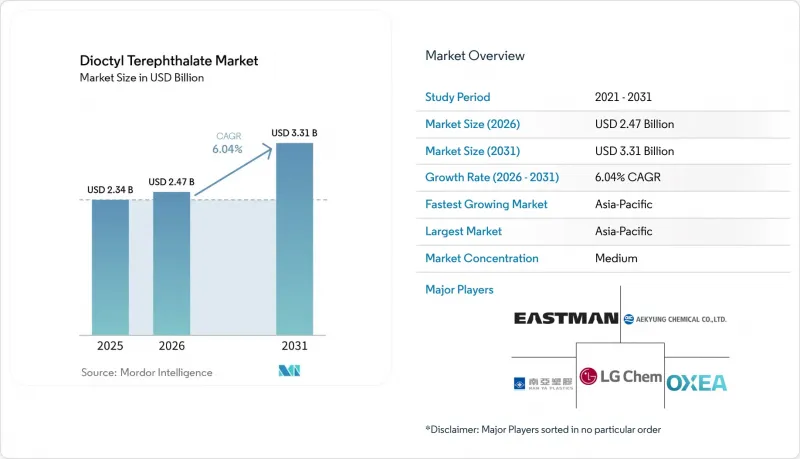
根據 Mordor Intelligence 估計,2025 年對苯二甲酸二辛酯市值為 23.4 億美元,預計從 2026 年的 24.7 億美元成長到 2031 年的 33.1 億美元,預測期(2026-2031 年)的複合年成長率為 6.04%。
全球對苯二甲酸二辛酯市場趨勢及洞察
由於鄰苯二甲酸酯的管製而進行的替代
針對鄰苯二甲酸二辛酯 (DEHP)、鄰苯二甲酸二丁酯 (DBP) 及相關鄰苯二甲酸酯的監管措施,使得無鄰苯二甲酸酯配方變更成為採購的持續性要求。歐洲化學品管理局 (ECHA) 已將 DEHP、DBP、鄰苯二甲酸丁酯 (BBP) 和鄰苯二甲酸二異丁酯 (DIBP) 列入 REACH法規環境附件十四,限制其在許多工業應用中的使用。由於加工商必須在持續的客戶和產品核准週期中保持配方合規,因此,這種監管環境推動了對鄰苯二甲酸二辛酯 (DT) 市場對無鄰苯二甲酸酯替代品的持續需求。 2024 年,美國食品藥物管理局(FDA) 根據其食品添加劑法規撤銷了 25 種鄰苯二甲酸酯的批准,縮短了食品接觸用聚氯乙烯 (PVC) 加工商的配方變更時間。 2025 年 5 月,美國發布命令,對來自馬來西亞、波蘭、台灣和土耳其的進口產品徵收反傾銷稅。此舉是為了因應需求基礎變化導致的國內供應擴張。關稅稅率設定在 7.50% 至 80.71% 的範圍內,改變了美國市場進口材料的成本。
建築和基礎設施領域對軟性PVC的需求
增塑聚氯乙烯(PVC)仍然是對苯二甲酸二辛酯(DOTP)在地板材料、牆壁材料、防水卷材和軟性型材領域的主要應用,其需求與住宅、商業和基礎設施項目中使用的建材密切相關。這些應用將對苯二甲酸二辛酯市場與建設活動和基礎設施更新聯繫起來,而非局限於狹隘的小眾市場。東南亞和南亞的都市化計畫正在推動住宅和公共計畫對地板材料、型材和防水卷材的需求。在這些領域,增塑PVC因其加工柔軟性和廣泛的最終產品形式而備受青睞。印度政府主導的低收入住宅計畫和巴西的基礎設施更新進一步促進了增塑PVC的消費。 LEED、WELL和歐洲建築產品排放標籤要求在高檔地板材料和隔音墊層系統中優先選擇低VOC含量的塑化劑。這使得DOTP在對苯二甲酸二辛酯市場中具有規格優勢。在這個市場中,VOC 資訊揭露會影響材料的選擇,建築商、設計師和製造商必須記錄高階地板材料和底層地板專案中的材料性能。
對苯二甲酸和2-乙基己醇原料價格波動
DOTP的生產依賴純對苯二甲酸(PTA)和2-乙基己醇,而這兩種原料的供應風險各不相同。 PTA的價格與對二甲苯和原油的價格波動密切相關,而2-乙基己醇的價格則取決於丙烯和Oxo合成產能。這種組合使得對苯二甲酸二辛酯市場面臨原料供應同時中斷的風險。這是因為與原油價格相關的中間體和丙烯衍生的Oxo醇的價格波動是獨立的,即使在同一生產週期內,也可能對成本產生影響。 2026年影響中東石腦油供應的地緣政治動盪進一步加劇了這些供應鏈的脆弱性。在此期間,Perstorp Oxo AB宣佈在全球上調2-乙基己醇及相關Oxo化學品的價格。原物料價格的波動會對生產商的利潤率帶來壓力,並使下游化合物生產商難以提供固定價格契約,尤其是在採購週期超出 PTA 和Oxo醇原料成本可見範圍的情況下。
細分市場分析
到2025年,98%含量的產品將佔銷售額的45.31%,成為對苯二甲酸二辛酯市場中最大的等級。這一地位反映了其在電線電纜、通用型軟性PVC和建築材料等廣泛工業應用領域的重要性,這些領域的客戶通常優先考慮穩定的加工性能、可靠的供應和成本績效。這些應用領域對成本和加工性能的重視,促進了可大規模生產的工業級產品的供應,使生產商能夠高效利用現有生產設施,服務於廣泛的基本客群。中國、韓國和台灣的生產商正透過成熟的酯化工藝大規模生產該等級的產品。這些製程優先考慮加工能力和穩定的供應,以滿足最大基本客群,而非像汽車、醫療或高要求電纜應用等特殊等級產品那樣進行嚴格的品質控制。雖然96%含量的等級產品仍然最具成本競爭力,但隨著客戶對更低的殘酸含量和更嚴格的顏色標準提出更高的要求,其市場佔有率正逐漸受到擠壓。由於歐洲地板材料和汽車供應鏈對產品規格的要求日益嚴格,它們發揮著尤為重要的作用。這種轉變推動了對符合更嚴格品質標準且無需額外製作流程的產品的需求,使加工商在與有詳細材料核准要求的客戶打交道時能夠避免額外的工序。
預計2026年至2031年間,純度為99%的產品將以7.15%的複合年成長率成長,成為對苯二甲酸二辛酯市場中成長率最高的產品類型。這主要得益於客戶對性能穩定性和產品品質記錄的日益重視。汽車OEM廠商、醫療設備製造商和電纜供應商等對可靠性要求極高的應用領域,由於其在核准流程中需要穩定的純度和可控的萃取物成分,因此推動了這項需求。純度為99%的產品無需二次加工即可滿足汽車U認證中的霧化需求。這為尋求內部裝潢建材性能穩定性的客戶省去了一道製作流程,簡化了加工商的工作,並能夠更嚴格地控制氣味、霧化和表面外觀。伊士曼化學公司位於金斯波特的甲醇分解裝置於2026年1月達到運作,其再生材料的產量是2024年的2.5倍。該裝置帶來了6000萬美元的利潤成長,並將再生對苯二甲酸(TPA)衍生材料定位在其產品線的高階領域。雖然99.5%純度等級仍然是最低等級,但醫療設備配製商正在將其用於對萃取物成分要求更高的應用。歐洲藥典建議在這些應用中使用具有最嚴格萃取物成分的產品,儘管其產量低於典型的工業級產品,但這種小規模、高純度等級產品的重要性正在日益凸顯。
區域分析
預計到2025年,亞太地區將佔全球銷售額的37.18%,並在2031年之前以6.89%的複合年成長率持續成長,這主要得益於中國、韓國和印度下游PVC行業的整合。中國仍然是全球最大的生產國和消費國,建築、汽車和消費品產業提供了廣泛的需求基礎。 2026年產能的提升將進一步擴大該地區的供應,並有可能降低出口型生產商的全球價格基準。韓國生產商繼續向日本、歐洲和北美出口高純度產品,但由於韓國公平交易委員會於2026年5月對LG化學、韓華解決方案、OCI和益均化學涉嫌操縱價格的卡特爾展開調查,市場前景存在不確定性。在印度,不斷擴大的建築和汽車製造業預計將成為該地區到2031年需求成長最強勁的動力。同時,日本OEM製造商對產品渾濁度和氣味的要求持續影響全球塑化劑的品質標準。由於該地區既是生產地又是消費地,其生產者既滿足國內需求又供應出口市場,因此對整個更廣泛的對苯二甲酸二辛酯市場中工業級和高純度級的價格、產能運轉率和供應狀況具有結構性影響。
2025年5月,美國對來自馬來西亞、波蘭、台灣和土耳其的DOTP進口產品徵收反傾銷稅,改變了北美地區的競爭格局。美國對建築相關增塑聚氯乙烯(PVC)的需求仍然依賴於資料中心建設、電動車充電網路和半導體製造地中使用的電線電纜,而這些都需要大量的標準化電纜化合物。巴西於2026年對來自智利、哥倫比亞和韓國的DOP、DOTP和DINP進口產品啟動了反傾銷調查。同時,包括阿根廷在內的其他南美國家仍然是規模相對小規模的基礎設施驅動需求中心,依賴區域建設週期。這些貿易措施提升了美洲地區對對苯二甲酸二辛酯本地供應、進口來源和客戶關係的重要性。在該地區,關稅的成本影響可能會影響供應商的選擇和長期商業合約。
歐洲是全球對苯二甲酸二辛酯市場的監管中心,其實施的《化學品註冊、評估、授權和限制法規》(REACH)對汽車內裝、工業電纜製造、高階地板材料及其他下游應用領域的產品選擇產生影響。該地區的買家對供應商提出了嚴格的品質要求。德國、法國和義大利佔據了該地區的大部分消費量,它們的供應鏈受到對渾濁度、氣味和揮發性有機化合物(VOC)的嚴格要求約束,這些要求往往也影響著歐洲以外地區的品質標準。根據歐盟醫療設備法規,鄰苯二甲酸二(2-乙基己基)酯(DEHP)被列為1B類生殖毒性物質,其在血袋中的主要用途的停用期限(2030年)仍在評估中。對苯二甲酸二辛酯 (DOTP) 和對苯二甲酸二(2-乙基己基)酯 (DEHT) 是歐洲藥典認可的合適替代品,並被支持用於需要有據可查的替代途徑的醫療設備應用。雖然中東和非洲是原料和前驅物的主要來源地,但南非仍是撒哈拉以南非洲地區聚氯乙烯(PVC) 化合物需求的重要中心。
其他好處:
- Excel格式的市場預測(ME)表
- 3個月的分析師支持
目錄
第1章:引言
- 研究假設和市場定義
- 調查範圍
第2章:調查方法
第3章執行摘要
第4章 市場狀況
- 市場概覽
- 市場促進因素
- 由於鄰苯二甲酸酯的管製而進行的替代
- 建築和基礎設施領域對增塑聚氯乙烯的需求
- 一種用於汽車內飾的化合物,可減輕重量並防止起霧。
- 電網、可再生能源和電信電纜擴建
- 醫用PVC配方變更,作為DEHP的替代品
- 市場限制因素
- 對苯二甲酸和2-乙基己醇原料價格的波動
- 能耗高的酯化反應與轉化成本
- 對過渡、毒理學和不良替代方案的考察
- 價值鏈分析
- 波特五力分析
第5章 市場規模與成長預測
- 依產品類型
- 內容含量99.5%
- 99%的內容
- 98%的內容
- 96%的內容
- 透過使用
- 電線電纜
- 地板材料和牆壁材料
- 薄膜和片材
- 汽車零件
- 醫療器材
- 其他
- 按地區
- 亞太地區
- 中國
- 印度
- 日本
- 韓國
- 其他亞太國家
- 北美洲
- 美國
- 加拿大
- 墨西哥
- 歐洲
- 德國
- 英國
- 法國
- 義大利
- 其他歐洲國家
- 南美洲
- 巴西
- 阿根廷
- 其他南美國家
- 中東和非洲
- 沙烏地阿拉伯
- 南非
- 其他中東和非洲國家
- 亞太地區
第6章 競爭情勢
- 市場集中度
- 策略趨勢
- 市佔率和排名分析
- 公司簡介
- Aekyung Chemical
- BASF
- Eastman Chemical Company
- Grupa Azoty ZAK SA
- Hanwha Group
- Jiangsu Raymond New Material Co., Ltd.
- LG Chem
- Lingchuang Chemical
- NAN YA PLASTICS CORPORATION
- Ningbo Kai Cheng
- Oxea GmbH
- Shandong Blue Sail Chemical Co., Ltd.
- UPC Technology Corporation
- Weifang Xinhohang Nmatl Technology Co., Ltd.
- Weifang Yuanli Chemical Co., Ltd.
第7章 市場機會與未來展望
According to Mordor Intelligence, the dioctyl terephthalate market size was estimated at USD 2.34 billion in 2025 and is estimated to grow from USD 2.47 billion in 2026 to USD 3.31 billion by 2031, at a CAGR of 6.04% during the forecast period (2026-2031).
Global Dioctyl Terephthalate Market Trends and Insights
Regulatory Replacement of Ortho-Phthalates
Regulatory action against DEHP, DBP, and related ortho-phthalates has made phthalate-free reformulation an ongoing procurement requirement. The European Chemicals Agency lists DEHP, DBP, BBP, and DIBP under REACH Annex XIV, restricting their use in many industrial applications. This regulatory environment supports recurring demand for non-phthalate alternatives in the Dioctyl Terephthalate market, as converters must maintain compliant formulations across repeated customer and product approval cycles. In 2024, the U.S. Food and Drug Administration revoked authorization for 25 ortho-phthalates in food additive regulations, shortening reformulation timelines for food-contact PVC converters. The May 2025 U.S. antidumping duty orders on imports from Malaysia, Poland, Taiwan, and the Republic of Turkiye followed the expansion of domestic supply for this shifting demand base. Duty margins ranged from 7.50% to 80.71%, altering the landed-cost position of imported material in the U.S. market.
Flexible PVC Demand in Construction and Infrastructure
Flexible PVC remains the primary medium for Dioctyl Terephthalate (DOTP) use in flooring, wall coverings, waterproofing membranes, and flexible profiles, linking demand to building materials used across residential, commercial, and infrastructure projects. These applications connect the Dioctyl Terephthalate market to construction activity and infrastructure renewal rather than to a narrow specialty segment. Urbanization programs in Southeast Asia and South Asia support demand for flooring, profiles, and membranes used in residential and public projects, where flexible PVC is selected for its processing flexibility and broad range of end-product formats. Government-led affordable housing activity in India and infrastructure renewal in Brazil provide additional support for flexible PVC consumption. LEED, WELL, and European construction product emission-labeling requirements favor lower-VOC plasticizers in premium flooring and acoustic underlay systems. This creates a specification advantage for DOTP in the Dioctyl Terephthalate market, where VOC declarations influence material selection and where builders, designers, and converters must document material performance for premium flooring or underlay projects.
Terephthalic Acid and 2-Ethylhexanol Feedstock Volatility
DOTP production depends on purified terephthalic acid (PTA) and 2-ethylhexanol, which face different supply risks. PTA tracks paraxylene and crude oil, while 2-ethylhexanol depends on propylene and oxo-synthesis capacity. This combination exposes the Dioctyl Terephthalate market to simultaneous feedstock disruptions, as separate movements in crude-linked intermediates and propylene-derived oxo alcohols can affect costs within the same production period. Geopolitical disruption to Middle Eastern naphtha flows in 2026 increased the vulnerability of these supply chains. Perstorp Oxo AB announced global price increases for 2-ethylhexanol and related oxo-chemicals during this period. Volatile input prices can compress producer margins and make fixed-price agreements harder for downstream compounders to offer, especially when procurement periods extend beyond the cost visibility available for PTA and oxo-alcohol inputs.
Other drivers and restraints analyzed in the detailed report include:
- Automotive Lightweighting and Low-Fogging Interior Formulations
- Electrical Grid, Renewable Energy, and Communication Cable Expansion
- Migration, Toxicology and Regrettable-Substitution Scrutiny
For complete list of drivers and restraints, kindly check the Table Of Contents.
Segment Analysis
Content 98% accounted for 45.31% of revenue in 2025, making it the largest grade in the Dioctyl Terephthalate market. Its position reflects broad industrial use in wire and cable, general-purpose flexible PVC, and construction products, where customers typically prioritize dependable processing, reliable supply, and cost-performance. These applications emphasize cost and processing performance, which support high-volume industrial-grade supply and allow producers to use established manufacturing assets efficiently across a wide customer base. Producers in China, South Korea, and Taiwan manufacture this tier at scale through established esterification processes. These processes favor throughput and consistent supply for the largest customer base, rather than the tighter controls required for specialized grades serving automotive, medical, or demanding cable applications. Content 96% remains the most cost-competitive grade, but it faces gradual pressure on share as customers require lower residual acid content and tighter color benchmarks. European flooring and automotive supply chains are particularly relevant because they impose more demanding product specifications. This shift moves more demand toward grades that meet narrower quality limits without additional converter processing, helping converters avoid additional steps when serving customers with detailed material approval requirements.
Content 99% is projected to grow at a CAGR of 7.15% between 2026 and 2031, the highest rate among product types in the Dioctyl Terephthalate market, as customers place greater value on performance stability and documented product quality. Automotive OEMs, medical-device manufacturers, and cable suppliers serving high-reliability applications support this demand because their approval processes require consistent purity and controlled extractable profiles. At 99% purity, the material can meet automotive U-certification fogging requirements without secondary processing by compounders. This reduces a processing step for customers who require consistent interior-material performance, simplifying converter operations while supporting tighter control of odor, fogging, and surface appearance. Eastman Chemical's Kingsport methanolysis facility reached full operational scale in January 2026 and produced 2.5 times more recycled-content feedstock than in 2024. The facility generated USD 60 million in incremental earnings and positioned recycled terephthalic acid (TPA)-derived material at the premium end of the product spectrum. The 99.5% content remains the smallest tier, but medical-device compounders are adopting it where tighter extractable profiles are required. European Pharmacopoeia requirements favor products with the tightest extractable profiles for those applications, making the smaller high-purity tier relevant even though its output remains below broader industrial grades.
Complete Report Scope:
- By Product Type
- Content 99.5%
- Content 99%
- Content 98%
- Content 96%
- By Application
- Wire and Cable
- Flooring and Wall Coverings
- Film and Sheet
- Automotive Components
- Medical Devices
- Others
- By Geography
- Asia-Pacific
- China
- India
- Japan
- South Korea
- Rest of Asia-Pacific
- North America
- United States
- Canada
- Mexico
- Europe
- Germany
- United Kingdom
- France
- Italy
- Rest of Europe
- South America
- Brazil
- Argentina
- Rest of South America
- Middle East and Africa
- Saudi Arabia
- South Africa
- Rest of Middle East and Africa
- Asia-Pacific
Geography Analysis
Asia-Pacific held 37.18% of revenue in 2025 and is projected to expand at a CAGR of 6.89% through 2031, supported by integrated PVC downstream industries in China, South Korea, and India. China remains the largest single-country producer and consumer, with construction, automotive, and consumer-goods sectors providing a broad base of demand. Capacity additions in 2026 are deepening regional supply and may lower global price benchmarks for export-oriented producers. South Korean producers maintain high-purity exports to Japan, Europe, and North America, although the Korea Fair Trade Commission's May 2026 investigation into alleged price coordination involving LG Chem, Hanwha Solutions, OCI, and Aekyung Chemical introduces uncertainty. India's expanding construction and automotive manufacturing base makes it the region's most dynamic source of demand growth through 2031, while Japanese OEM requirements for fogging and odor continue to influence plasticizer quality specifications globally. The region's combined producer and consumer role gives it structural influence over prices, capacity utilization, and the availability of industrial and higher-purity grades across the broader Dioctyl Terephthalate market, particularly because its producers serve both domestic demand and export markets.
North America's competitive structure has changed following the May 2025 U.S. antidumping duty orders covering DOTP imports from Malaysia, Poland, Taiwan, and the Republic of Turkiye. U.S. demand for construction-linked flexible PVC remains tied to wire and cable used in data-center construction, EV charging networks, and semiconductor fabrication sites, all of which require substantial quantities of compliant cable compounds. Brazil opened an antidumping investigation in 2026 into imports of DOP, DOTP, and DINP from Chile, Colombia, and South Korea, while Argentina and other South American countries remain smaller infrastructure-led demand centers shaped by regional construction cycles. These trade actions increase the importance of local supply, import sourcing, and customer relationships in the Americas portion of the Dioctyl Terephthalate market, where the cost impact of duties can influence supplier selection and long-term commercial agreements.
Europe serves as a regulatory center for the global Dioctyl Terephthalate market, where Registration, Evaluation, Authorisation and Restriction of Chemicals (REACH) enforcement influences product selection in automotive interiors, industrial cable production, premium flooring, and other downstream applications. Buyers in the region set demanding quality expectations for suppliers. Germany, France, and Italy account for much of the regional consumption, and their supply chains impose stringent requirements on fogging, odor, and VOCs that often shape quality expectations beyond Europe. The EU Medical Device Regulation identifies di(2-ethylhexyl) phthalate (DEHP) as a Category 1B reproductive toxicant, and the 2030 sunset date for its final major blood-bag application remains under evaluation. Dioctyl terephthalate (DOTP) and di(2-ethylhexyl) terephthalate (DEHT) are among the plasticizers recognized as compliant alternatives in the European Pharmacopeia, supporting their use in medical-device applications that require a documented replacement path. The Middle East and Africa primarily serve as feedstock and precursor supply regions, although South Africa remains a significant center of polyvinyl chloride (PVC) compounding demand in sub-Saharan Africa.
- Aekyung Chemical
- BASF
- Eastman Chemical Company
- Grupa Azoty ZAK S.A.
- Hanwha Group
- Jiangsu Raymond New Material Co., Ltd.
- LG Chem
- Lingchuang Chemical
- NAN YA PLASTICS CORPORATION
- Ningbo Kai Cheng
- Oxea GmbH
- Shandong Blue Sail Chemical Co., Ltd.
- UPC Technology Corporation
- Weifang Xinhohang Nmatl Technology Co., Ltd.
- Weifang Yuanli Chemical Co., Ltd.
Additional Benefits:
- The market estimate (ME) sheet in Excel format
- 3 months of analyst support
TABLE OF CONTENTS
1 Introduction
- 1.1 Study Assumptions and Market Definition
- 1.2 Scope of the Study
2 Research Methodology
3 Executive Summary
4 Market Landscape
- 4.1 Market Overview
- 4.2 Market Drivers
- 4.2.1 Regulatory Replacement of Ortho-Phthalates
- 4.2.2 Flexible PVC Demand in Construction and Infrastructure
- 4.2.3 Automotive Lightweighting and Low-Fogging Interior Formulations
- 4.2.4 Electrical Grid, Renewable-Energy and Communication-Cable Expansion
- 4.2.5 Medical-Grade PVC Reformulation Toward DEHP Alternatives
- 4.3 Market Restraints
- 4.3.1 Terephthalic Acid and 2-Ethylhexanol Feedstock Volatility
- 4.3.2 Energy-Intensive Esterification and Conversion Costs
- 4.3.3 Migration, Toxicology and Regrettable-Substitution Scrutiny
- 4.4 Value Chain Analysis
- 4.5 Porter's Five Forces Analysis
- 4.5.1 Bargaining Power of Suppliers
- 4.5.2 Bargaining Power of Buyers
- 4.5.3 Threat of New Entrants
- 4.5.4 Threat of Substitutes
- 4.5.5 Competitive Rivalry
5 Market Size and Growth Forecasts (Value)
- 5.1 By Product Type
- 5.1.1 Content 99.5%
- 5.1.2 Content 99%
- 5.1.3 Content 98%
- 5.1.4 Content 96%
- 5.2 By Application
- 5.2.1 Wire and Cable
- 5.2.2 Flooring and Wall Coverings
- 5.2.3 Film and Sheet
- 5.2.4 Automotive Components
- 5.2.5 Medical Devices
- 5.2.6 Others
- 5.3 By Geography
- 5.3.1 Asia-Pacific
- 5.3.1.1 China
- 5.3.1.2 India
- 5.3.1.3 Japan
- 5.3.1.4 South Korea
- 5.3.1.5 Rest of Asia-Pacific
- 5.3.2 North America
- 5.3.2.1 United States
- 5.3.2.2 Canada
- 5.3.2.3 Mexico
- 5.3.3 Europe
- 5.3.3.1 Germany
- 5.3.3.2 United Kingdom
- 5.3.3.3 France
- 5.3.3.4 Italy
- 5.3.3.5 Rest of Europe
- 5.3.4 South America
- 5.3.4.1 Brazil
- 5.3.4.2 Argentina
- 5.3.4.3 Rest of South America
- 5.3.5 Middle East and Africa
- 5.3.5.1 Saudi Arabia
- 5.3.5.2 South Africa
- 5.3.5.3 Rest of Middle East and Africa
- 5.3.1 Asia-Pacific
6 Competitive Landscape
- 6.1 Market Concentration
- 6.2 Strategic Moves
- 6.3 Market Share (%)/Ranking Analysis
- 6.4 Company Profiles (includes Global Overview, Market Overview, Core Segments, Financials as available, Strategic Information, Products and Services, and Recent Developments)
- 6.4.1 Aekyung Chemical
- 6.4.2 BASF
- 6.4.3 Eastman Chemical Company
- 6.4.4 Grupa Azoty ZAK S.A.
- 6.4.5 Hanwha Group
- 6.4.6 Jiangsu Raymond New Material Co., Ltd.
- 6.4.7 LG Chem
- 6.4.8 Lingchuang Chemical
- 6.4.9 NAN YA PLASTICS CORPORATION
- 6.4.10 Ningbo Kai Cheng
- 6.4.11 Oxea GmbH
- 6.4.12 Shandong Blue Sail Chemical Co., Ltd.
- 6.4.13 UPC Technology Corporation
- 6.4.14 Weifang Xinhohang Nmatl Technology Co., Ltd.
- 6.4.15 Weifang Yuanli Chemical Co., Ltd.
7 Market Opportunities and Future Outlook
- 7.1 White-Space and Unmet-Need Assessment


