


 |
市場調查報告書
商品編碼
2154761
核能發電發電機和馬達:市場佔有率分析、行業趨勢和統計數據以及成長預測(2026-2031 年)Nuclear Generators and Motors - Market Share Analysis, Industry Trends & Statistics, Growth Forecasts (2026 - 2031) |
||||||

※ 本網頁內容可能與最新版本有所差異。詳細情況請與我們聯繫。
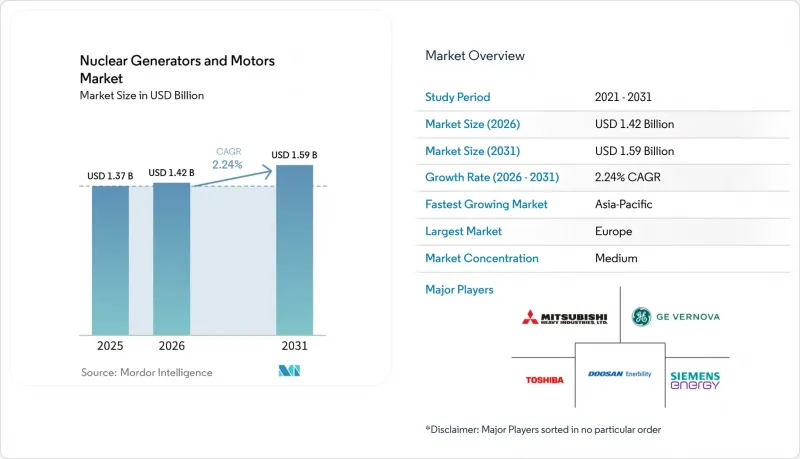
根據 Mordor Intelligence 預測,核能發電發電機和馬達市場規模將從 2025 年的 13.7 億美元和 2026 年的 14.2 億美元成長到 2031 年的 15.9 億美元,2026 年至 2031 年的年複合成長率(CAGR)為 2.24%。
全球核能發電發電機及電機市場趨勢及洞察
核能新建設及核子反應爐延壽計劃
核能發電廠建設正處於近30年來的最高水準。到2025年,將有10座核子反應爐開工建設,其中9座在中國,1座在俄羅斯,這將使全球規劃建設裝置容量增加12.2吉瓦。根據經合組織核能機構(NEA)的數據,全球在建核電裝置容量為70吉瓦,其中近80%的裝置容量來自非經合組織成員國。每個大型核子反應爐都需要一台汽輪發電機組和多台感應電動機,這些設備對安全至關重要。這項建設規模帶動了整個核能發電機和馬達市場的新設備訂單。此外,法國第四次定期安全審查計畫要求在2040年前對1300兆瓦級核子反應爐的汽輪島進行升級改造。
建設活動的規模並不一定與核子反應爐投入運作的地區相吻合。儘管中國和韓國的開發商主導許多新計畫,但已經過核准的設計仍然為歐洲和北美的設備製造商創造了供應機會。大型汽輪機和發電機合約通常在試運行前很早就下單,這使得供應商更容易規劃產能和技術資源。運行延期工作會產生另一批針對特定電廠的訂單,這些訂單較少依賴新廠址的批准。這些項目通常同時涵蓋旋轉設備、輔助系統和認證工作。當電力公司將安全改進與延長運轉許可證相結合時,核能發電機和馬達市場將從中受益。
更換舊渦輪機、發電機和1E級電機
歐洲和北美許多核能發電廠建於1970年至1990年間,這意味著它們的主要旋轉設備已接近或超過其原始設計壽命。 2025年7月,法國核能監管局(ASNR)批准法國20座1300兆瓦級核子反應爐運作超過40年。 2025年9月,Jumont Electric公司完成了法國電力公司(EDF)戈爾費克核電廠1300兆瓦交流發電機轉子的更換工作。這項工作表明,設備維護計劃如何帶來高價值的維修和更換訂單。 IEEE 334-2024標準要求1E級設備在其安裝後的使用壽命內保持性能。該標準支援對設備重新認證、有記錄的更換以及新馬達供應的需求。
在安全至關重要的馬達應用中,傳統文件具有重要的商業性價值。保留設計文件的供應商無需啟動完整的認證程序即可提供同等替代品。由於核能監管機構要求在安裝安全設備前提供正式證明,電力公司必須避免使用未經認證的替代品。因此,與一般工業電機市場相比,售後市場的競爭範圍較小。更換成本可以安排在計劃停電期間,使營運商有時間將設備維護工作與更廣泛的現代化改造計劃相協調。因此,除了對新核子反應爐的投資外,常規的更換週期也支撐著核能發電和馬達市場。
核能級鍛造、絕緣和測試方面的瓶頸
核能級部件的供應取決於專業的鍛造、機械加工、焊接、測試和檢驗能力。核能規模化計畫(核能 Scaling 舉措)指出,機械加工、焊接、精加工和無損檢測是供應鏈的關鍵阻礙因素,因為這些環節需要經過認證的設施和熟練的勞動力。 1E級應用也使用需要特定認證記錄的絕緣系統。 2026年6月,美國能源局宣布提供175億美元的有條件貸款,用於支持10座AP1000核子反應爐的前置作業時間採購。該計劃認知到,僅靠資金並不能立即建立經過認證的生產能力。即使專案已獲得資金,前置作業時間環節仍可能延誤發電機和馬達的採購。
核能品質法規使得訂單發出後難以替換材料。對已認證材料、工藝或部件的任何變更都可能需要正式審查和額外文件。因此,電力公司會在施工計畫最終確定後儘早鎖定生產檔期。這種做法使擁有成熟品質系統和可用產能的供應商佔據優勢。如果小規模供應商需要增加核能專用測試和檢驗能力,則會面臨壓力。由於大型核電設施依賴多個嚴格控制的供應環節,核能發電機和馬達市場持續受到這些限制的影響。
細分市場分析
到2025年,發電機將佔核能發電發電機和馬達市場佔有率的93.8%,預計到2031年將以2.4%的複合年成長率成長。該細分市場佔據領先地位,原因在於每個商業核子反應爐都需要汽輪發電機組,其價值遠超電廠的電機相關設備,且運營商在反應器的整個運行週期內都需要專業服務。 1000兆瓦核子反應爐的替換機組可能包含重量超過2000噸、長度達65公尺的組件,相關的專案工作包括安裝規劃、測試和長期服務支援。新建設合約、定子繞組重繞、轉子維修以及數位化勵磁系統的升級都推動了發電機的銷售,而這些都與運作中電廠的維護計劃和安全要求密切相關。額定輸出功率在 125 MW 至 345 MW 之間的小型模組化反應器發電機組需要與傳統的大型核子反應爐設備不同的設計方法,西門子能源為 Oklo 的“Aurora”項目選擇的 SGen-100A 機組清楚地表明了這些新的要求。
2025年,鼠籠式感應電動機佔剩餘的6.2%銷售量。儘管其價值基數較小,但由於其對核電廠安全系統至關重要,因此仍佔據重要地位。由於它們驅動主冷卻幫浦、給水系統和緊急堆芯冷卻系統,因此更換決策需要證明提案的馬達組能夠在適用的核能條件下可靠運作。 IEEE 334-2024標準提高了證明馬達在安裝後使用壽命期間持續性能的文件的重要性,使得技術文件成為採購決策的核心要素。哈爾濱電氣已獲得中國華龍1號、國和1號和CAP1400核電廠主冷卻水泵馬達設計的認證,而Jumont 核能發電廠保持其作為法國和韓國核電廠核子反應爐冷卻水泵馬達領先供應商的地位。因此,即使多家供應商符合類似的技術規範,國家認證體係也會限制跨境競爭。
區域分析
2025年,歐洲佔據核能發電和馬達市場42.1%的佔有率,並在銷售額方面位居榜首。法國擁有大規模運作中的核電廠,目前正在進行延壽改造,包括長期汽輪機維修、發電機維護和電機更換。法國核能安監理局(ASNR)於2025年7月決定啟動對法國20座運轉超過40年的1,300兆瓦級核子反應爐的第四次定期安全審查,審查內容包括汽輪機島和安全設備的維護。這些審查將採購工作分散到各個核電廠的停機檢修期間,從而支持穩定的售後市場,而不是單一的集中訂單週期。在匈牙利,帕克斯二期核電廠於2026年2月開工;與此同時,羅爾斯·羅伊斯小型模組化反應器公司於2026年4月簽署了一份捷克項目的初步建設契約,為該地區的汽輪機島相關服務新增了商機。
預計到2031年,亞太地區將以3.5%的複合年成長率成長,成為核能發電機和馬達市場成長最快的地區。中國正在推動全球最集中的核子反應爐建設項目,其自主研發的核子反應爐設計支撐著對發電機、核子反應爐冷卻劑泵馬達及相關旋轉設備的需求。美國能源資訊署(EIA)的報告顯示,自2016年以來,中國的核能發電裝置容量幾乎加倍,顯示了中國長期核電建設擴張的規模。國內企業受益於本地認證途徑以及與中國核子反應爐設計建立的合作關係;哈爾濱電氣於2025年完成了國和一號示範項目的主冷卻劑水泵電機交付。印度的Kaiga 5和Kaiga 6反應器專案正在擴大採購需求範圍,而日本的核子反應爐運作和核能業務的復甦也為設備和服務提供了另一個大需求基礎。
北美、南美以及中東和非洲構成了全球收入基礎的其餘部分。美國能源局提供的175億美元有條件融資承諾正在支持AP1000項目的早期和長期規劃,而加拿大BWRX-300項目的開工也促進了設計和採購活動。在中東和非洲地區,埃及的達巴計畫提供了最重要的短期機遇,而巴西的安格拉3號計畫和阿根廷的CAREM計畫預計在預測期內的區域活動將相對有限。國際安全要求和雙邊合作協議將決定哪些供應商可以進入這些專案市場,這可能會提高資格門檻,與其他地區的情況類似。
其他好處:
- Excel格式的市場預測(ME)表
- 3個月的分析師支持
目錄
第1章:引言
- 研究假設和市場定義
- 調查範圍
第2章:調查方法
第3章執行摘要
第4章 市場狀況
- 市場概覽
- 市場促進因素
- 新建核能發電廠和延長核子反應爐運作壽命的計劃
- 電網可靠性和低碳基本負載的要求
- 小型模組化反應器和先進核子反應爐部署計劃
- 更換舊渦輪機、發電機和1E級電機
- 利用核能發電滿足資料中心和工業負載需求的策略
- 標準化工廠製造的核能設備
- 市場限制因素
- 資本密集度高,專案前置作業時間長
- 核能、認證和採購的複雜性。
- 核能鍛造、絕緣材料和測試瓶頸
- 老舊馬達和發電機的認證記錄過期
- 供應鏈分析
- 波特五力分析
- 科技趨勢
- 監理情勢
- 投資分析
第5章 市場規模與成長預測
- 透過裝置
- 鼠籠式感應電動機
- 發電機
- 按地區
- 北美洲
- 美國
- 加拿大
- 墨西哥
- 歐洲
- 德國
- 法國
- 義大利
- 西班牙
- 英國
- 波蘭
- 俄羅斯
- 其他歐洲國家
- 亞太地區
- 中國
- 印度
- 日本
- 韓國
- 澳洲
- 印尼
- 越南
- 泰國
- 其他亞太國家
- 南美洲
- 巴西
- 阿根廷
- 智利
- 其他南美國家
- 中東和非洲
- 沙烏地阿拉伯
- 阿拉伯聯合大公國
- 埃及
- 南非
- 摩洛哥
- 其他中東和非洲國家
- 北美洲
第6章 競爭情勢
- 市場集中度
- 策略趨勢
- 市佔率分析
- 公司簡介
- Ansaldo Energia SpA
- Bharat Heavy Electricals Limited
- BWX Technologies, Inc.
- Dongfang Electric Corporation Limited
- Doosan Enerbility Co., Ltd.
- ELIN Motoren GmbH
- Framatome
- GE Vernova Inc.
- Harbin Electric Company Limited
- Hitachi GE Vernova Nuclear Energy, Ltd.
- Jeumont Electric SAS
- Larsen & Toubro Limited
- Mitsubishi Heavy Industries, Ltd.
- NIDEC CORPORATION
- Public Joint-Stock Company "Power Machines"
- Shanghai Electric Group Company Limited
- Siemens Energy AG
- The Babcock & Wilcox Company
- Toshiba Corporation
- Westinghouse Electric Company LLC
第7章 市場機會與未來展望
According to Mordor Intelligence, the nuclear generators and Motors Market size is projected to expand from USD 1.37 billion in 2025 and USD 1.42 billion in 2026 to USD 1.59 billion by 2031, registering a CAGR of 2.24% between 2026 and 2031.
Global Nuclear Generators and Motors Market Trends and Insights
Nuclear New-Build and Reactor Life-Extension Programs
Nuclear construction has reached its strongest level in 3 decades. Ten reactor construction starts took place in 2025, including 9 in China and 1 in Russia, adding 12.2 GW to the global pipeline. The OECD Nuclear Energy Agency reported 70 GWe under construction worldwide, with non-OECD countries accounting for nearly 80% of this capacity. Each large reactor requires a turbine-generator train and multiple safety-critical induction motors. This construction base supports new equipment orders across the nuclear generators and motors market. France's fourth periodic safety review program also requires turbine-island upgrades for 1,300 MW reactors through 2040.
The value of construction activity does not always follow the same geography as reactor starts. Chinese and South Korean developers lead many new projects, while licensed designs can still create supply roles for European and North American equipment makers. Large turbine-generator contracts are awarded well before commissioning, which helps suppliers plan capacity and engineering resources. Life-extension work adds a separate stream of plant-specific orders that is less dependent on new-site approvals. These programs often cover rotating equipment, auxiliary systems, and qualification work at the same time. The nuclear generators and motors market benefits when utilities combine safety upgrades with longer operating licenses.
Replacement of Aging Turbine-Generator and Class 1E Motor Fleets
Much of the Western nuclear fleet was built from 1970 to 1990, leaving major rotating assets near or beyond their original design lives. ASNR approved operation beyond 40 years for France's 20 reactors in the 1,300 MW series during July 2025. Jeumont Electric completed the replacement of a 1,300 MW alternator rotor at EDF's Golfech plant in September 2025. This work shows how fleet maintenance programs convert into high-value refurbishment and replacement orders. IEEE 334-2024 requires Class 1E equipment to demonstrate performance over its installed service life. The standard supports demand for requalification, documented replacement, and new motor supply.
Legacy documentation has substantial commercial value in safety-critical motor applications. A supplier that retains design files can offer a like-for-like replacement without starting a full qualification program. Utilities must avoid unqualified substitutes because nuclear regulators require formal evidence before safety equipment can be installed. This makes aftermarket competition narrower than in general industrial motor sales. Replacement spending can be scheduled during planned outages, which gives operators time to align equipment work with wider modernization programs. The nuclear generators and motors market is thus supported by a recurring replacement cycle alongside new reactor investment.
Nuclear-Grade Forging, Insulation and Testing Bottlenecks
Nuclear-grade component supply depends on specialized forging, machining, welding, testing, and inspection capacity. The Nuclear Scaling Initiative identified machining, welding, finishing, and non-destructive examination as important supply-chain constraints because they require qualified facilities and skilled labor. Class 1E applications also use insulation systems that require specific qualification records. The U.S. Department of Energy announced USD 17.5 billion in conditional loans during June 2026 to support long-lead procurement for 10 AP1000 reactors. The program recognizes that finance cannot immediately create qualified manufacturing throughput. Long lead items can delay generator and motor procurement even after a project receives financial backing.
Nuclear quality rules make material substitution difficult after an order has been placed. A change in a qualified material, process, or component can require formal review and additional documentation. Utilities, therefore, reserve manufacturing slots early when construction schedules are firm. This practice increases the advantage of suppliers with established quality systems and available capacity. It also places smaller suppliers under pressure when they need to add nuclear-specific testing or inspection capability. The nuclear generators and motors market remains exposed to these limits because large equipment depends on several tightly controlled supply stages.
Other drivers and restraints analyzed in the detailed report include:
- SMR and Advanced-Reactor Deployment Pipeline
- Nuclear-Powered Data Center and Industrial Load Strategies
- Nuclear Licensing, Qualification and Procurement Complexity
For complete list of drivers and restraints, kindly check the Table Of Contents.
Segment Analysis
Generators held 93.8% of the nuclear generators and motors market share in 2025 and are expected to grow at a 2.4% CAGR through 2031. The segment leads because every commercial reactor needs a turbine-generator train whose value substantially exceeds that of the plant's motor contingent, and because operators need specialist services throughout its operating life. Replacement sets for 1,000 MW-class reactors can involve assemblies above 2,000 tonnes and reaching 65 meters in length, while the related project work includes installation planning, testing, and long-term service support. New-build awards, stator-bar rewinding, rotor refurbishment, and digital excitation upgrades support generator revenue, with each activity tied to an operating plant's maintenance schedule and safety requirements. SMR generator sets rated from 125 MW to 345 MW require design approaches that differ from conventional large-reactor equipment, and Siemens Energy's selected SGen-100A unit for Oklo's Aurora project illustrates this developing requirement.
Squirrel cage induction motors accounted for the remaining 6.2% of revenue in 2025, a smaller value base that remains important because these motors serve plant safety systems. They operate main coolant pumps, feed-water systems, and emergency core cooling equipment, so replacement decisions require evidence that the proposed unit will perform under the applicable nuclear conditions. IEEE 334-2024 has increased the importance of records demonstrating continued performance over installed service life, which makes technical documentation a core part of the purchase decision. Harbin Electric has qualifications across Hualong One, Guohe One, and CAP1400 main coolant pump motor designs in China, while Jeumont Electric remains a reference supplier for reactor coolant pump motors in French and Korean fleets. National qualification regimes consequently limit cross-border competition even when several suppliers can meet similar technical specifications.
Complete Report Scope:
- By Equipment
- Squirrel Cage Induction Motors
- Generators
- By Geography
- North America
- United States
- Canada
- Mexico
- Europe
- Germany
- France
- Italy
- Spain
- United Kingdom
- Poland
- Russia
- Rest of Europe
- Asia-Pacific
- China
- India
- Japan
- South Korea
- Australia
- Indonesia
- Vietnam
- Thailand
- Rest of Asia-Pacific
- South America
- Brazil
- Argentina
- Chile
- Rest of South America
- Middle East and Africa
- Saudi Arabia
- United Arab Emirates
- Egypt
- South Africa
- Morocco
- Rest of Middle East and Africa
- North America
Geography Analysis
Europe held 42.1% of the nuclear generators and motors market share in 2025, giving the region the largest revenue position. France's large installed fleet and its continuing life-extension work support a long stream of turbine refurbishment, alternator work, and motor replacement. ASNR's July 2025 decision covered 20 French reactors in the 1,300 MW series beyond 40 years of operation, beginning fourth periodic safety reviews that require work on turbine islands and safety equipment. These reviews spread procurement over individual plant outages, which supports a stable aftermarket rather than a single concentrated order cycle. Hungary began construction at Paks II Unit 1 during February 2026, while Rolls-Royce SMR signed early works for a Czech project during April 2026, adding new conventional-island opportunities to the regional service base.
Asia-Pacific is forecast to grow at a 3.5% CAGR through 2031, making it the fastest-growing region in the nuclear generators and motors market. China has the world's most concentrated reactor construction program, and its local reactor designs sustain demand for generators, reactor coolant pump motors, and supporting rotating equipment. The U.S. Energy Information Administration reported that China's nuclear capacity had nearly doubled since 2016, showing the scale of the country's long-term buildout. Domestic companies benefit from local qualification routes and established links to Chinese reactor designs, with Harbin Electric completing delivery of main coolant pump motors for the Guohe One demonstration project in 2025. India's Kaiga 5 and 6 program adds procurement depth, while Japan's reactor restarts and recovering nuclear business provide a separate demand base for equipment and services.
North America, South America, the Middle East, and Africa represented the remaining global revenue base. The U.S. Department of Energy's USD 17.5 billion conditional loan commitment supports early long-lead planning for AP1000 projects, and Canada's BWRX-300 construction start has activated engineering and procurement work. Egypt's Dabaa project is the most significant near-term opportunity in the Middle East and Africa, whereas Brazil's Angra 3 and Argentina's CAREM project offer more limited regional activity during the forecast period. International safety requirements and bilateral cooperation arrangements determine which suppliers can access these project markets and can extend the qualification barriers seen elsewhere.
- Ansaldo Energia S.p.A.
- Bharat Heavy Electricals Limited
- BWX Technologies, Inc.
- Dongfang Electric Corporation Limited
- Doosan Enerbility Co., Ltd.
- ELIN Motoren GmbH
- Framatome
- GE Vernova Inc.
- Harbin Electric Company Limited
- Hitachi GE Vernova Nuclear Energy, Ltd.
- Jeumont Electric SAS
- Larsen & Toubro Limited
- Mitsubishi Heavy Industries, Ltd.
- NIDEC CORPORATION
- Public Joint-Stock Company "Power Machines"
- Shanghai Electric Group Company Limited
- Siemens Energy AG
- The Babcock & Wilcox Company
- Toshiba Corporation
- Westinghouse Electric Company LLC
Additional Benefits:
- The market estimate (ME) sheet in Excel format
- 3 months of analyst support
TABLE OF CONTENTS
1 INTRODUCTION
- 1.1 Study Assumptions and Market Definition
- 1.2 Scope of the Study
2 RESEARCH METHODOLOGY
3 EXECUTIVE SUMMARY
4 MARKET LANDSCAPE
- 4.1 Market Overview
- 4.2 Market Drivers
- 4.2.1 Nuclear New-Build and Reactor Life-Extension Programs
- 4.2.2 Grid Reliability and Low-Carbon Baseload Requirements
- 4.2.3 SMR and Advanced-Reactor Deployment Pipeline
- 4.2.4 Replacement of Aging Turbine-Generator and Class 1E Motor Fleets
- 4.2.5 Nuclear-Powered Data-Centre and Industrial Load Strategies
- 4.2.6 Standardized, Factory-Manufactured Nuclear Equipment
- 4.3 Market Restraints
- 4.3.1 High Capital Intensity and Long Project Lead Times
- 4.3.2 Nuclear Licensing, Qualification and Procurement Complexity
- 4.3.3 Nuclear-Grade Forging, Insulation and Testing Bottlenecks
- 4.3.4 Obsolescence of Qualification Records for Aging Motors and Generators
- 4.4 Supply-Chain Analysis
- 4.5 Porter's Five Forces Analysis
- 4.5.1 Bargaining Power of Suppliers
- 4.5.2 Bargaining Power of Buyers
- 4.5.3 Threat of New Entrants
- 4.5.4 Threat of Substitutes
- 4.5.5 Competitive Rivalry
- 4.6 Technology Outlook
- 4.7 Regulatory Landscape
- 4.8 Investment Analysis
5 MARKET SIZE AND GROWTH FORECASTS
- 5.1 By Equipment
- 5.1.1 Squirrel Cage Induction Motors
- 5.1.2 Generators
- 5.2 By Geography
- 5.2.1 North America
- 5.2.1.1 United States
- 5.2.1.2 Canada
- 5.2.1.3 Mexico
- 5.2.2 Europe
- 5.2.2.1 Germany
- 5.2.2.2 France
- 5.2.2.3 Italy
- 5.2.2.4 Spain
- 5.2.2.5 United Kingdom
- 5.2.2.6 Poland
- 5.2.2.7 Russia
- 5.2.2.8 Rest of Europe
- 5.2.3 Asia-Pacific
- 5.2.3.1 China
- 5.2.3.2 India
- 5.2.3.3 Japan
- 5.2.3.4 South Korea
- 5.2.3.5 Australia
- 5.2.3.6 Indonesia
- 5.2.3.7 Vietnam
- 5.2.3.8 Thailand
- 5.2.3.9 Rest of Asia-Pacific
- 5.2.4 South America
- 5.2.4.1 Brazil
- 5.2.4.2 Argentina
- 5.2.4.3 Chile
- 5.2.4.4 Rest of South America
- 5.2.5 Middle East and Africa
- 5.2.5.1 Saudi Arabia
- 5.2.5.2 United Arab Emirates
- 5.2.5.3 Egypt
- 5.2.5.4 South Africa
- 5.2.5.5 Morocco
- 5.2.5.6 Rest of Middle East and Africa
- 5.2.1 North America
6 COMPETITIVE LANDSCAPE
- 6.1 Market Concentration
- 6.2 Strategic Moves
- 6.3 Market Share Analysis
- 6.4 Company Profiles (includes Global Level Overview, Market Level Overview, Core Segments, Financials as available, Strategic Information, Products and Services, Recent Developments)
- 6.4.1 Ansaldo Energia S.p.A.
- 6.4.2 Bharat Heavy Electricals Limited
- 6.4.3 BWX Technologies, Inc.
- 6.4.4 Dongfang Electric Corporation Limited
- 6.4.5 Doosan Enerbility Co., Ltd.
- 6.4.6 ELIN Motoren GmbH
- 6.4.7 Framatome
- 6.4.8 GE Vernova Inc.
- 6.4.9 Harbin Electric Company Limited
- 6.4.10 Hitachi GE Vernova Nuclear Energy, Ltd.
- 6.4.11 Jeumont Electric SAS
- 6.4.12 Larsen & Toubro Limited
- 6.4.13 Mitsubishi Heavy Industries, Ltd.
- 6.4.14 NIDEC CORPORATION
- 6.4.15 Public Joint-Stock Company "Power Machines"
- 6.4.16 Shanghai Electric Group Company Limited
- 6.4.17 Siemens Energy AG
- 6.4.18 The Babcock & Wilcox Company
- 6.4.19 Toshiba Corporation
- 6.4.20 Westinghouse Electric Company LLC
7 MARKET OPPORTUNITIES AND FUTURE OUTLOOK
- 7.1 White-Space and Unmet-Need Assessment

 2026-2030年全球皮划艇設備市場
 AFPM發電機市場:全球市場預測,2026-2032年伺服馬達維修市場:全球市場預測,2026-2032年能源和電能品質測量儀器市場:全球市場預測,2026-2032年
 AC電動馬達市場規模、佔有率、成長、全球產業分析、區域趨勢及2026年至2034年預測
 交流數位伺服馬達及驅動器市場:市場機會、成長要素、產業趨勢分析及2026-2035年預測
 低壓NEMA馬達市場規模、佔有率和成長分析:按馬達類型、機殼類型、功率輸出、應用、最終用戶和地區分類-2026-2033年產業預測壓鑄銅轉子市場:全球市場預測(2026-2032年)
 中高功率馬達市場規模、佔有率及趨勢分析報告:按產品、電壓、應用、地區和細分市場預測(2026-2033 年)全球軸流式馬達市場規模、佔有率及成長預測(2026-2031年)