


 |
市場調查報告書
商品編碼
2154750
南美洲倉儲機器人:市場佔有率分析、產業趨勢與統計及成長預測(2026-2031 年)South America Warehouse Robotics - Market Share Analysis, Industry Trends & Statistics, Growth Forecasts (2026 - 2031) |
||||||

※ 本網頁內容可能與最新版本有所差異。詳細情況請與我們聯繫。
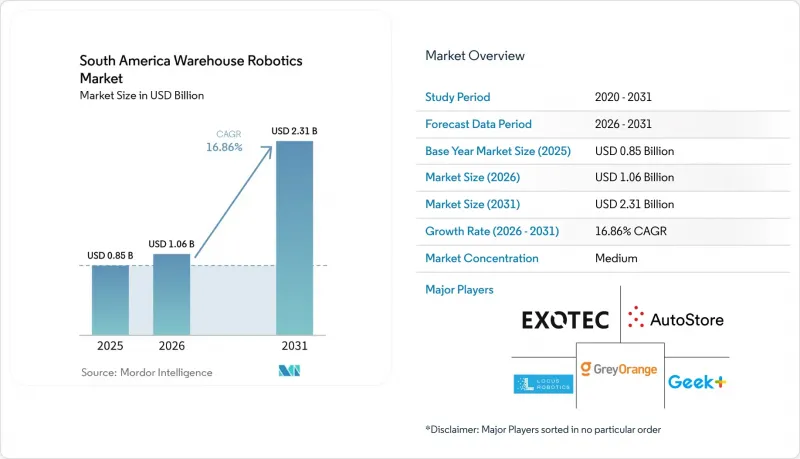
據 Mordor Intelligence 稱,2025 年南美倉庫機器人市場價值 8.5 億美元,預計到 2031 年將從 2026 年的 10.6 億美元成長到 23.1 億美元,預測期(2026-2031 年)的複合年成長率為 16.86%。
南美洲倉儲機器人市場趨勢與洞察
擴大電子商務履約
Mercado Libre宣布,到2026年,其區域投資將超過150億美元。其中包括在巴西投資570億巴西幣(109億美元),在阿根廷投資34億美元,在智利投資7.5億美元,在哥倫比亞投資6億美元。巴西的計畫包括新建14個物流中心,這將催生對分類、行動揀選和自動化倉儲系統的需求。隨著這些項目從建設計畫進入設備採購階段,南美倉儲機器人市場將從中受益。 Mercado Libre的倉儲軟體和執行系統將成為尋求履約合約的供應商的整合標竿。隨著Mercado Libre的擴張,其他零售商也積極推動自動化,以維持訂單處理速度和服務水準。對於擁有本地安裝和服務能力,並能支援多個地點的供應商而言,此投資週期尤其有利。
倉庫人事費用上升和人員招募受限
人事費用和勞動力短缺進一步凸顯了自動化對巴西、智利和阿根廷倉庫營運商的重要性。智利計劃於2026年4月過渡到每週42小時工作制,這使得勞動密集型物流運營的成本問題更加引人注目。在巴西,工業領域人事費用的不斷上漲進一步推動了製造和物流中心採用自主移動機器人(AMR)和自動化倉庫系統(ASRS)的必要性。阿根廷的情況則更為複雜,進口設備的成本限制了自動化的經濟吸引力。智利擁有光纖網路和不斷擴展的資料中心容量,為車輛管理提供了更佳的連接環境。因此,南美倉庫機器人市場更傾向於那些能夠減少重複性工作,同時又便於本地部署和維護的解決方案。
初始投資額高,投資回收期長
由於進口零件、運輸和現場安裝等額外費用,倉庫機器人實施專案的初始成本往往較高。對於處理量較小或需求受季節性波動影響的中型企業而言,這種成本負擔尤其沉重。即使自動化帶來的營運效益顯而易見,較長的投資回收期也會延誤專案實施。 「機器人即服務 (RaaS)」模式透過將機器人集群、軟體和維護整合到營運成本框架內,降低了資本投入。這種模式正逐漸被巴西的大型、信譽良好的物流公司所接受。南美倉庫機器人產業需要經營模式,讓小規模買家也能更輕鬆地獲得自動化服務,同時又不影響服務範圍。
細分市場分析
預計到2025年,包括AGV和AMR在內的移動機器人將佔產品細分市場的35.19%,因為它們無需進行大規模結構改造即可改裝到現有倉庫。工業機器人負責汽車和電子產品製造過程中的精密作業,而輸送機在食品和飲料的連續配送線中繼續發揮著至關重要的作用。分類系統在電子商務領域需求旺盛,Addverb位於聖保羅的工廠每小時可完成5,000次分類,準確率高達99.99%。堆垛機可幫助製造商在南美洲分散的公路和鐵路網路上運輸貨物時均勻裝載。在南美洲的倉庫機器人市場,當運作中設施需要柔軟性時,移動機器人是首選。
預計從2026年到2031年,自動化立體倉庫(ASRS)的複合年成長率將達到17.89%。 Stara公司位於巴西的AutoStore中心於2025年6月開業,在18,144個儲存位部署了7台機器人,每日處理量高達14,000件。這種立方體形狀的儲存系統最大限度地利用了現有建築空間,尤其適用於有高度限制的工業園區。 2026年4月,Danich公司為智利Empresas San Clemente公司的水果業務安裝了一座高密度自動化倉庫。這些項目表明,自動化儲存的應用範圍正在超越傳統的冷鏈和醫藥產業。
預計到2025年,倉儲業務將佔總銷售額的40.16%,這主要得益於巴西和智利的大型履約中心,以滿足不斷成長的SKU數量。 Emergent Cold Latin America在聖地牙哥開設了一座擁有33,000個托盤位的自動化冷凍食品倉庫,這顯示溫控和常溫儲存應用正在蓬勃發展。巴西、阿根廷和哥倫比亞的交叉轉運設施的擴張,推動了轉運作業自動化程度的提升。新建的交叉轉運設施擴大採用自主移動機器人(AMR)進行運輸,而不再僅依賴堆高機。隨著倉儲、分類和運輸功能的日益融合,南美洲倉儲機器人市場正從中受益。
受訂單單位縮小和混合SKU訂單增加導致運輸營運人力需求增加的推動,包裝產業預計將在2026年至2031年間以18.66%的複合年成長率成長。沃爾瑪智利Pudowell擴建計畫將在一個13萬平方公尺的設施內整合倉儲和包裝工作流程。該設施將使用約2,300台機器人,涵蓋四種不同型號,預計每日處理量超過31萬箱。 Info Brazil預測,到2025年,巴西物流技術投資將成長23%,其中自動化預計將成為該領域最大的投資方向。隨著入庫物流的數位化程度不斷提高,收貨流程和品質檢驗的自動化將進一步推動這一趨勢。
其他好處:
- Excel格式的市場預測(ME)表
- 3個月的分析師支持
目錄
第1章:引言
- 研究假設和市場定義
- 調查範圍
第2章:調查方法
第3章執行摘要
第4章 市場狀況
- 市場概覽
- 市場促進因素
- 擴大電子商務履約
- 倉庫人事費用上升和人員招募受限
- SKU數量的快速成長和全通路訂購的複雜性。
- 實施靈活的自主移動機器人和模組化自動化
- 巴西和阿根廷現有倉庫的現代化改造
- 藥品可追溯性及溫控處理
- 市場限制因素
- 初始投資額大,投資回收期長
- 與原有倉庫管理系統和設施基礎設施整合的複雜性。
- 機器人工程師短缺和地方服務提供能力不足
- 外匯波動風險及進口零件風險敞口
- 產業價值鏈分析
- 監理情勢
- 技術展望
- 波特五力分析
- 宏觀經濟因素對市場的影響
第5章 市場規模與成長預測
- 依產品類型
- 工業機器人
- 分類系統
- 輸送帶
- 堆垛機
- 自動化倉庫系統(ASRS)
- 移動機器人(AGV 和 AMR)
- 按功能
- 貯存
- 包裝
- 轉運
- 其他功能
- 按組件
- 硬體
- 軟體
- 服務
- 最終用戶
- 零售與電子商務
- 食品/飲料
- 車
- 藥品和醫療保健
- 電子電器設備
- 其他最終用戶
- 國家
- 巴西
- 阿根廷
- 智利
- 哥倫比亞
- 其他南美國家
第6章 競爭情勢
- 市場集中度
- 策略趨勢
- 市佔率分析
- 公司簡介
- Geekplus Technology Co., Ltd.
- Exotec SAS
- Locus Robotics Corporation
- GreyOrange, Inc.
- Symbotic Inc.
- AutoStore Holdings Ltd.
- Hai Robotics Co., Ltd.
- Shanghai Quicktron Intelligent Technology Co., Ltd.
- Scallog SAS
- inVia Robotics, Inc.
- Vecna Robotics, Inc.
- Berkshire Grey, Inc.
- Magazino GmbH
- Addverb Technologies Private Limited
- ForwardX Robotics, Inc.
- Syrius Technology(Shenzhen)Co., Ltd.
- Mujin, Inc.
- IAM Robotics, Inc.
- Brightpick Technologies, sro
- Dexterity, Inc.
第7章 市場機會與未來趨勢
- 評估閒置頻段和未滿足的需求
According to Mordor Intelligence, the South America warehouse robotics market size was valued at USD 0.85 billion in 2025 and estimated to grow from USD 1.06 billion in 2026 to reach USD 2.31 billion by 2031, at a CAGR of 16.86% during the forecast period (2026-2031).
South America Warehouse Robotics Market Trends and Insights
E-Commerce Fulfillment Expansion
Mercado Libre announced more than USD 15 billion in regional investment for 2026, including BRL 57 billion (USD 10.9 billion) in Brazil, USD 3.4 billion in Argentina, USD 750 million in Chile, and USD 600 million in Colombia. The Brazil program includes 14 new distribution centers, which creates demand for sortation, mobile picking, and automated storage systems. The South America warehouse robotics market benefits when these projects move from construction plans to equipment procurement. Mercado Libre's warehouse software and execution systems create an integration reference point for providers seeking fulfillment contracts. Other retailers are also advancing automation to maintain order speed and service levels as Mercado Libre expands. This investment cycle favors suppliers that can support multiple sites with local installation and service capacity.
Rising Warehouse Labor Costs and Availability Constraints
Labor costs and worker availability are making automation more relevant for warehouse operators in Brazil, Chile, and Argentina. Chile's move to a 42-hour workweek in April 2026 increased attention on the cost of labor-intensive logistics activities. In Brazil, rising industrial labor costs have strengthened the case for AMR and ASRS installations in manufacturing and logistics centers. Argentina presents a more challenging environment because the cost of imported equipment constrains the financial appeal of automation. Chile has broader connectivity readiness for fleet management, supported by its fiber network and growing data-center capacity. The South America warehouse robotics market, therefore, favors solutions that reduce repetitive work while remaining practical to implement and maintain locally.
High Upfront Investment and Extended Payback Periods
Warehouse robotics projects can carry high initial costs because imported components, freight, and local implementation work add to the equipment price. The cost burden is particularly important for mid-sized operators with lower throughput or seasonal demand. Longer payback periods can delay projects even where the operational case for automation is clear. Robotics-as-a-Service models can reduce capital requirements by combining robot fleets, software, and maintenance under an operating expense arrangement. These models have been more accessible to large Brazilian logistics operators with strong credit profiles. The South America warehouse robotics industry will need commercial models that make automation more attainable for smaller buyers without weakening service coverage.
Other drivers and restraints analyzed in the detailed report include:
- SKU Proliferation and Omnichannel Order Complexity
- Flexible AMR and Modular Automation Adoption
- Integration Complexity With Legacy WMS and Facility Infrastructure
For complete list of drivers and restraints, kindly check the Table Of Contents.
Segment Analysis
Mobile robots, including AGVs and AMRs, accounted for 35.19% of the product segment in 2025 because they can be retrofitted into existing warehouses without major structural work. Industrial robots serve precision tasks in automotive and electronics operations, while conveyors remain important in sustained food and beverage distribution lines. Sortation systems are seeing increased demand in e-commerce, and Addverb's Sao Paulo installation achieved 5,000 sorts per hour with 99.99% accuracy. Palletizers help manufacturers create consistent loads for transport across South America's fragmented road and rail network. The South America warehouse robotics market favors mobile robots when operators need flexibility inside active facilities.
ASRS is projected to grow at a 17.89% CAGR from 2026 to 2031. Stara's June 2025 AutoStore center in Brazil used 7 robots across 18,144 storage locations, dispatching up to 14,000 items daily. Cube storage can increase cubic utilization within existing building envelopes, which suits height-constrained industrial parks. Danich installed a high-density automated storage site for Empresas San Clemente's Chilean fruit operation in April 2026. These projects show adoption beyond traditional cold-chain and pharmaceutical applications.
Storage held 40.16% of revenue in 2025, supported by large fulfillment centers in Brazil and Chile that manage rising SKU counts. Emergent Cold LatAm opened a 33,000-pallet automated frozen-food storage facility in Santiago, showing growth in temperature-controlled and ambient applications. Trans-shipment automation is advancing alongside the cross-dock build-out in Brazil, Argentina, and Colombia. New cross-dock sites increasingly allow AMR movement rather than relying solely on forklift operations. The South America warehouse robotics market benefits as storage, staging, and dispatch functions become more connected.
Packaging is projected to grow at an 18.66% CAGR from 2026 to 2031 because smaller baskets and mixed-SKU orders increase outbound labor needs. Walmart Chile's Pudahuel expansion will integrate storage and packaging workflows at a 130,000 m2 facility. The site will use around 2,300 robots across 4 models and process more than 310,000 cases daily. Infor Brasil projected 23% growth in Brazilian logistics technology investment during 2025, with automation receiving the largest allocation. Receiving automation and quality inspection can extend this progression as inbound logistics becomes more digital.
Complete Report Scope:
- By Product Type
- Industrial Robots
- Sortation Systems
- Conveyors
- Palletizers
- Automated Storage and Retrieval System (ASRS)
- Mobile Robots (AGVs and AMRs)
- By Function
- Storage
- Packaging
- Trans-shipments
- Other Functions
- By Component
- Hardware
- Software
- Services
- By End-User
- Retail and E-Commerce
- Food and Beverage
- Automotive
- Pharmaceuticals and Healthcare
- Electronics and Electrical Equipment
- Other End-Users
- By Country
- Brazil
- Argentina
- Chile
- Colombia
- Rest of South America
List of Companies Covered in this Report:
- Geekplus Technology Co., Ltd.
- Exotec S.A.S.
- Locus Robotics Corporation
- GreyOrange, Inc.
- Symbotic Inc.
- AutoStore Holdings Ltd.
- Hai Robotics Co., Ltd.
- Shanghai Quicktron Intelligent Technology Co., Ltd.
- Scallog SAS
- inVia Robotics, Inc.
- Vecna Robotics, Inc.
- Berkshire Grey, Inc.
- Magazino GmbH
- Addverb Technologies Private Limited
- ForwardX Robotics, Inc.
- Syrius Technology (Shenzhen) Co., Ltd.
- Mujin, Inc.
- IAM Robotics, Inc.
- Brightpick Technologies, s.r.o.
- Dexterity, Inc.
Additional Benefits:
- The market estimate (ME) sheet in Excel format
- 3 months of analyst support
TABLE OF CONTENTS
1 INTRODUCTION
- 1.1 Study Assumptions and Market Definition
- 1.2 Scope of the Study
2 RESEARCH METHODOLOGY
3 EXECUTIVE SUMMARY
4 MARKET LANDSCAPE
- 4.1 Market Overview
- 4.2 Market Drivers
- 4.2.1 E-Commerce Fulfillment Expansion
- 4.2.2 Rising Warehouse Labor Costs and Availability Constraints
- 4.2.3 SKU Proliferation and Omnichannel Order Complexity
- 4.2.4 Adoption of Flexible AMRs and Modular Automation
- 4.2.5 Brownfield Warehouse Modernization in Brazil and Argentina
- 4.2.6 Pharmaceutical Traceability and Temperature-Controlled Handling
- 4.3 Market Restraints
- 4.3.1 High Upfront Investment and Extended Payback Periods
- 4.3.2 Integration Complexity With Legacy WMS and Facility Infrastructure
- 4.3.3 Shortage of Robotics Technicians and Local Service Capacity
- 4.3.4 Currency Volatility and Imported Component Exposure
- 4.4 Industry Value Chain Analysis
- 4.5 Regulatory Landscape
- 4.6 Technological Outlook
- 4.7 Porter's Five Forces Analysis
- 4.7.1 Bargaining Power of Suppliers
- 4.7.2 Bargaining Power of Buyers
- 4.7.3 Threat of New Entrants
- 4.7.4 Threat of Substitutes
- 4.7.5 Competitive Rivalry
- 4.8 Impact of Macroeconomic Factors on the Market
5 MARKET SIZE AND GROWTH FORECASTS (VALUE)
- 5.1 By Product Type
- 5.1.1 Industrial Robots
- 5.1.2 Sortation Systems
- 5.1.3 Conveyors
- 5.1.4 Palletizers
- 5.1.5 Automated Storage and Retrieval System (ASRS)
- 5.1.6 Mobile Robots (AGVs and AMRs)
- 5.2 By Function
- 5.2.1 Storage
- 5.2.2 Packaging
- 5.2.3 Trans-shipments
- 5.2.4 Other Functions
- 5.3 By Component
- 5.3.1 Hardware
- 5.3.2 Software
- 5.3.3 Services
- 5.4 By End-User
- 5.4.1 Retail and E-Commerce
- 5.4.2 Food and Beverage
- 5.4.3 Automotive
- 5.4.4 Pharmaceuticals and Healthcare
- 5.4.5 Electronics and Electrical Equipment
- 5.4.6 Other End-Users
- 5.5 By Country
- 5.5.1 Brazil
- 5.5.2 Argentina
- 5.5.3 Chile
- 5.5.4 Colombia
- 5.5.5 Rest of South America
6 COMPETITIVE LANDSCAPE
- 6.1 Market Concentration
- 6.2 Strategic Moves
- 6.3 Market Share Analysis
- 6.4 Company Profiles (includes Global Level Overview, Market Level Overview, Core Segments, Financials as available, Strategic Information, Market Rank/Share, Products and Services, Recent Developments)
- 6.4.1 Geekplus Technology Co., Ltd.
- 6.4.2 Exotec S.A.S.
- 6.4.3 Locus Robotics Corporation
- 6.4.4 GreyOrange, Inc.
- 6.4.5 Symbotic Inc.
- 6.4.6 AutoStore Holdings Ltd.
- 6.4.7 Hai Robotics Co., Ltd.
- 6.4.8 Shanghai Quicktron Intelligent Technology Co., Ltd.
- 6.4.9 Scallog SAS
- 6.4.10 inVia Robotics, Inc.
- 6.4.11 Vecna Robotics, Inc.
- 6.4.12 Berkshire Grey, Inc.
- 6.4.13 Magazino GmbH
- 6.4.14 Addverb Technologies Private Limited
- 6.4.15 ForwardX Robotics, Inc.
- 6.4.16 Syrius Technology (Shenzhen) Co., Ltd.
- 6.4.17 Mujin, Inc.
- 6.4.18 IAM Robotics, Inc.
- 6.4.19 Brightpick Technologies, s.r.o.
- 6.4.20 Dexterity, Inc.
7 MARKET OPPORTUNITIES AND FUTURE TRENDS
- 7.1 White-Space and Unmet-Need Assessment

 全球倉儲機器人市場
 2026年全球自動化揀貨系統市場報告
 自主倉儲機器人市場預測至2034年—全球機器人類型、導航方式、技術、應用、最終用戶和區域分析
 倉儲機器人:市場佔有率分析、產業趨勢與統計、成長預測(2026-2031)歐洲倉儲機器人:市場佔有率分析、產業趨勢與統計及成長預測(2026-2031 年)
 倉儲機器人市場:按組件、產品類型、引導技術、自動化程度、應用和最終用戶分類-2026-2032年全球市場預測
 倉庫機器人市場:按類型、功能、最終用戶和地區分類
 倉儲機器人市場分析及預測(至2035年):按類型、產品類型、服務、技術、組件、應用、部署類型、最終用戶和功能分類庫存管理機器人市場分析及預測(至2035年):按類型、產品類型、服務、技術、組件、應用、部署、最終用戶和功能分類
 全球倉儲機器人市場規模、佔有率、趨勢和成長分析報告(2026-2034)