


 |
市場調查報告書
商品編碼
2154743
電子溫度控管材料:市場佔有率分析、產業趨勢與統計、成長預測(2026-2031)Electronic Thermal Management Materials - Market Share Analysis, Industry Trends & Statistics, Growth Forecasts (2026 - 2031) |
||||||

※ 本網頁內容可能與最新版本有所差異。詳細情況請與我們聯繫。
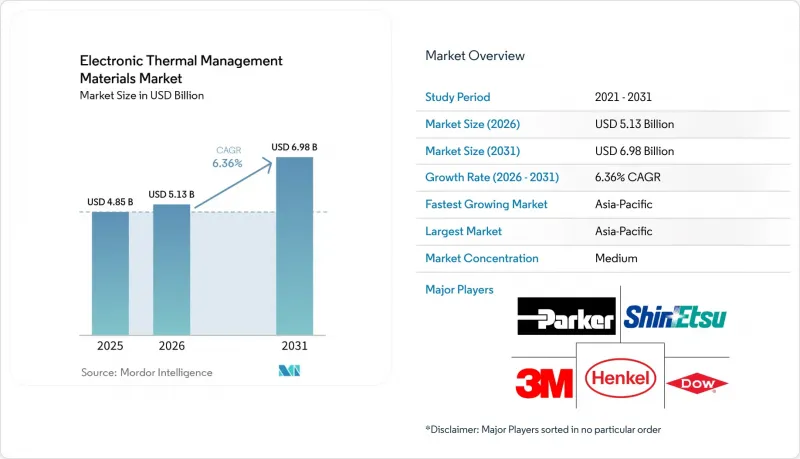
據 Mordor Intelligence 稱,電子設備溫度控管材料的市場規模在 2025 年估計為 48.5 億美元,預計從 2026 年的 51.3 億美元成長到 2031 年的 69.8 億美元,在預測期(2026-2031 年)內的複合年成長率為 6.36%。
全球電子設備溫度控管材料市場趨勢及洞察。
人工智慧驅動的運算和更高的晶片功率密度
人工智慧工作負載正在改變整個電子供應鏈的熱設計要求。人工智慧加速器封裝的熱設計功耗已接近或超過 1000 瓦,這限制了傳統空氣冷卻方式的應用。因此,晶片到蓋板 (D2D) 界面上液態金屬、銦箔和銀填充凝膠等材料的使用日益增加。每個界面都必須在保持低熱阻的同時,有效管理局部熱負載。 2026 年 5 月,SK 海力士發布了 iHBM,該產品將冷卻元件整合到 D2D PHY 區域,據稱可降低 30% 的熱阻。電子溫度控管材料市場需要能夠在不斷變化的工作條件和封裝負載下保持低熱阻的配方。
車輛電氣化和高壓電力電子
電動車 (EV) 電池組、車載充電器和電源逆變器需要多層導熱介面材料。碳化矽 (SiC) 和氮化鎵 (GaN) 元件的工作結溫較高,增加了整個動力總成堆的散熱需求。電池組到電池包 (Cell-to-pack) 和電池底盤)架構消除了模組層,將汽車級認證要求擴展到了電池與底盤的介面。 SAE International 2025 年的一項研究發現,在連續的全球輕型車輛測試程序 (WLTP) 駕駛循環中,使用某些相變材料可以將電動車電池的運作延長高達 80%,而無需主動冷卻。 2025 年的綜述發現,碳基奈米添加劑可將相變材料的導熱係數提高 40% 至 120%,而低溫加工製程與先前的實驗室配方相比,可將材料成本降低 20% 至 35%。 2026 年 5 月,漢高推出了 Bergquist TGF 2030APS 和 Loctite TLB 9270APS,電池到包裝和電池到底底盤的應用。
認證週期和可靠性測試成本
用於汽車和航太專案的新型導熱介面材料可能需要進行長達 18 至 36 個月的熱機械可靠性測試。 JESD22 熱循環測試規程要求在工程獲得批准前,在極端溫度下進行 250 至 1000 次循環檢驗。測試在認證過程中佔據了相當大的時間和成本。一旦獲得認證,成熟的供應商即可在整個平台生產生命週期內保持其地位。新的配方可能需要重新認證,這可能會延長產品被採用的時間。這可能會使材料創新延遲兩到三代,並延長研發回報期。中小型供應商在為汽車級和資料中心應用產品進行認證時面臨更高的成本,尤其是在需要 IATF 16949 以及特定應用的 JEDEC 和 IPC(互連電子工業協會)認證的情況下。
細分市場分析
至2025年,導熱界面材料將佔電子設備溫度控管材料市場44.74%的佔有率。這些材料用於晶片與散熱器之間、散熱器與散熱器之間以及電池單元與冷卻結構之間。經平台特定OEM(目的地設備製造商)檢驗後,配方通常會在整個專案生命週期內持續生產。相變材料因其在熱循環過程中能夠黏附於不規則表面而備受青睞,預計2026年至2031年間的複合年成長率將達到8.34%。這將推動其在電動車電池模組、車載充電器和人工智慧加速器組件中的應用。
石墨和石墨烯基材料因其橫向散熱性能優異,且Z軸方向厚度較薄,在家用電子電器和5G無線設備的應用日益廣泛。碳基奈米添加劑可將相變材料的導熱係數提高40%至120%,低溫加工製程相比傳統配方可降低20%至35%的成本。金屬材料,包括銦箔和燒結銀替代品,被用於3D電路(3D-IC)和HBM封裝的TIM1應用中。歐盟《化學品註冊、評估、授權和限制條例》(REACH)的合規性要求限制了含鉛和鉍合金的配方選擇。其他材料包括用於航太和醫療用電子設備的特殊薄膜、塗層和結構導熱黏合劑,這些材料的長期認證有助於提升單位價值。
區域分析
預計到2025年,亞太地區將佔據電子溫度控管材料市場41.39%的佔有率,並在2031年之前以7.63%的複合年成長率成長。該地區包括中國的家用電子電器生產、韓國和日本的電動車電池組裝,以及超大規模資料中心容量的擴張。 2025年,台灣的半導體材料消費額將達217億美元,其次是中國大陸(156億美元)和韓國(112億美元)。先進的封裝技術推動了對導熱界面材料(TIM)、相變材料和石墨擴散劑的需求,因為高頻寬記憶體(HBM)組件、晶片和中介層需要多層導熱層。印度、越南、泰國和印尼也透過對組裝和測試以及國內電動車生產的投資來支持需求。
北美在電子產品溫度控管材料市場佔據第二大佔有率。美國半導體產業正在設計人工智慧加速器,這些加速器的散熱規格正在影響全球供應鏈的材料開發。超大規模資料中心營運商已承諾在2025年和2026年進行大量基礎設施投資,而人工智慧機架則需要在多個傳熱點使用液冷系統和介面材料。加拿大憑藉其高效能運算基礎設施滿足了市場需求,而墨西哥則作為汽車級間隙填充材料和灌封材料的供應國發揮輔助作用。在歐洲,德國電動車動力傳動系統供應商和電池需求正在推動特定溫度範圍內溫度控管材料的研發。
南美洲蘊藏新興市場機遇,巴西對資料中心的投資將支撐整個拉丁美洲的數位需求。阿根廷在鋰三角地區的地位預計將在中期內推動該地區電動車電池組裝。沙烏地阿拉伯的「2030願景」數位基礎設施計畫以及南非的工業電子產業活動將為中東和非洲市場提供支撐。波灣合作理事會(GCC)成員國政府正在部署人工智慧基礎設施,一旦超大規模設施投入運作,這將創造對溫度控管材料的區域需求。儘管短期需求仍然有限,但長期成長取決於持續的基礎設施投資。
其他好處:
- Excel格式的市場預測(ME)表
- 3個月的分析師支持
目錄
第1章:引言
- 研究假設和市場定義
- 調查範圍
第2章:調查方法
第3章執行摘要
第4章 市場狀況
- 市場概覽
- 市場促進因素
- 人工智慧賦能的運算和更高的晶片功率密度
- 車輛電氣化和高壓電力電子
- 半導體封裝和先進互連技術的日益複雜化
- 5G、邊緣基礎設施和高密度資料中心
- 將熱材料合格納入OEM設計採納流程
- 市場限制因素
- 認證週期和可靠性測試成本
- 填料、矽酮和特殊聚合物的成本波動
- 熱膨脹係數不匹配與長期泵送損失的風險
- 價值鏈分析
- 波特五力分析
第5章 市場規模與成長預測
- 材料類型
- 熱界面材料
- 相變材料
- 石墨和石墨烯基材料
- 金屬熱材料
- 其他溫度控管材料
- 按外形規格
- 座位
- 貼上
- 液體
- 其他
- 透過使用
- 家用電子產品
- 車
- 航太
- 電訊
- 衛生保健
- 工業設備
- 其他用途
- 按地區
- 亞太地區
- 中國
- 印度
- 日本
- 韓國
- 東南亞國協
- 其他亞太國家
- 北美洲
- 美國
- 加拿大
- 墨西哥
- 歐洲
- 德國
- 英國
- 法國
- 義大利
- 北歐國家
- 其他歐洲國家
- 南美洲
- 巴西
- 阿根廷
- 其他南美國家
- 中東和非洲
- 沙烏地阿拉伯
- 南非
- 其他中東和非洲國家
- 亞太地區
第6章 競爭情勢
- 市場集中度
- 策略趨勢
- 市佔率和排名分析
- 公司簡介
- 3M
- AI Technology, Inc.
- Boyd
- Dow
- DuPont
- Fujipoly America Corp.
- HB Fuller Company
- Henkel AG & Co. KGaA
- Honeywell International Inc.
- Indium Corporation
- Master Bond
- Momentive
- Panasonic Industry
- PARKER HANNIFIN CORP
- Shin-Etsu Chemical Co., Ltd.
- Wacker Chemie AG
第7章 市場機會與未來展望
According to Mordor Intelligence, the electronic thermal management materials market size was estimated at USD 4.85 billion in 2025 and is estimated to grow from USD 5.13 billion in 2026 to USD 6.98 billion by 2031, at a CAGR of 6.36% during the forecast period (2026-2031).
Global Electronic Thermal Management Materials Market Trends and Insights
AI-Enabled Computing and Rising Chip Power Density
AI workloads are changing thermal design requirements across the electronics supply chain. AI accelerator packages approach or exceed 1,000 W of thermal design power, limiting the use of conventional air cooling. This is increasing the use of liquid metals, indium foils, and silver-filled gels across die-to-lid interfaces. Each interface must manage localized heat loads while maintaining low thermal resistance. SK hynix introduced iHBM in May 2026, incorporating cooling elements into the D2D PHY area, and reported a 30% reduction in thermal resistance. The electronic thermal management materials market requires formulations that maintain low resistance under changing operating conditions and package loads.
Electrification of Vehicles and High-Voltage Power Electronics
Electric vehicle (EV) battery packs, onboard chargers, and power inverters require multiple layers of thermal interface material. Silicon carbide (SiC) and gallium nitride (GaN) devices operate at higher junction temperatures, increasing thermal requirements across the drivetrain stack. Cell-to-pack and cell-to-chassis architectures eliminate the module layer and extend automotive-grade qualification requirements to the battery cell-to-chassis interface. SAE International research published in 2025 found that specified phase change materials can extend EV battery operation without active cooling by up to 80% across consecutive Worldwide Harmonized Light Vehicles Test Procedure (WLTP) drive cycles. A 2025 review found that carbon-based nano-additives increased the thermal conductivity of phase change material by 40-120%, while low-temperature processing reduced material costs by 20-35% compared with earlier laboratory formulations. Henkel launched Bergquist TGF 2030APS and Loctite TLB 9270APS in May 2026 for cell-to-pack and cell-to-chassis applications.
Qualification Cycles and Reliability Testing Costs
A new thermal interface material for automotive or aerospace programs may require 18-36 months of thermomechanical reliability testing. JESD22 thermal cycling protocols require verification across 250-1,000 cycles at extreme temperatures before program approval. Testing accounts for a significant share of qualification time and cost. After qualification, established suppliers can retain their position throughout a platform's production life. New formulations may require requalification, extending adoption timelines. This can delay material innovation by two or three design generations and lengthen the R&D payback period. Smaller suppliers face higher costs when qualifying products for automotive-grade and data center applications, particularly when IATF 16949 and application-specific JEDEC or IPC (Association Connecting Electronics Industries) approvals are required.
Other drivers and restraints analyzed in the detailed report include:
- Semiconductor Packaging Complexity and Advanced Interconnects
- 5G, Edge Infrastructure and High-Density Data Centers
- Filler, Silicone, and Specialty Polymer Cost Volatility
For complete list of drivers and restraints, kindly check the Table Of Contents.
Segment Analysis
Thermal interface materials accounted for 44.74% of the electronic thermal management materials market in 2025. They are used between the die and heat spreader, the heat spreader and heat sink, and the battery cell and cooling structure. After platform-specific original equipment manufacturer (OEM) validation, a formulation typically remains in production throughout the program lifecycle. Phase change materials are forecast to grow at a CAGR of 8.34% from 2026 to 2031, supported by their ability to conform to irregular surfaces during thermal cycling. This supports their use in EV battery modules, onboard chargers, and AI accelerator assemblies.
Graphite- and graphene-based materials are gaining adoption in consumer electronics and 5G radio units because they distribute heat laterally with limited z-axis thickness. Carbon-based nano-additives improve phase change material conductivity by 40-120%, while lower-temperature processing reduces costs by 20-35% compared with earlier formulations. Metal-based materials, including indium foils and sintered silver alternatives, are used in TIM1 applications for three-dimensional integrated circuit (3D-IC) and HBM packages. Registration, Evaluation, Authorization and Restriction of Chemicals (REACH) compliance requirements limit formulation options for lead- and bismuth-bearing alloys in Europe. Other materials include specialty films, coatings, and structural thermal adhesives for aerospace and medical electronics, where long-term certification supports higher unit values.
Complete Report Scope:
- By Material Type
- Thermal Interface Materials
- Phase Change Materials
- Graphite and Graphene-Based Materials
- Metal-Based Thermal Materials
- Other Thermal Management Materials
- By Form Factor
- Sheet
- Paste
- Liquid
- Others
- By Application
- Consumer Electronics
- Automotive
- Aerospace
- Telecommunications
- Healthcare
- Industrial Equipment
- Other Applications
- By Geography
- Asia-Pacific
- China
- India
- Japan
- South Korea
- ASEAN Countries
- Rest of Asia-Pacific
- North America
- United States
- Canada
- Mexico
- Europe
- Germany
- United Kingdom
- France
- Italy
- NORDIC Countries
- Rest of Europe
- South America
- Brazil
- Argentina
- Rest of South America
- Middle East and Africa
- Saudi Arabia
- South Africa
- Rest of Middle East and Africa
- Asia-Pacific
Geography Analysis
Asia-Pacific accounted for 41.39% of the electronic thermal management materials market in 2025 and is projected to grow at a CAGR of 7.63% through 2031. The region includes consumer electronics production in China, EV battery assembly in South Korea and Japan, and the expansion of hyperscale data center capacity. In 2025, Taiwan consumed USD 21.7 billion in semiconductor materials, followed by China at USD 15.6 billion and South Korea at USD 11.2 billion. Advanced packaging supports demand for thermal interface materials (TIMs), phase-change materials, and graphite spreaders, as high-bandwidth memory (HBM) assemblies, chiplets, and interposers require multiple thermal layers. India, Vietnam, Thailand, and Indonesia also support demand through investments in assembly and testing and through domestic EV production.
North America held the second-largest position in the electronic thermal management materials market. The United States semiconductor sector designs AI accelerators, and the thermal specifications of these accelerators influence material development across the global supply chain. Hyperscale operators committed significant infrastructure capital in 2025 and 2026, while AI-capable racks require liquid cooling systems and interface materials at multiple heat-transfer points. Canada supports demand through high-performance computing infrastructure, while Mexico serves as a secondary hub for automotive-grade gap fillers and potting materials. In Europe, Germany's EV powertrain suppliers and battery requirements support thermal material development across specified temperature ranges.
South America presents an emerging market opportunity, as data center investments in Brazil support digital demand across Latin America. Argentina's role in the lithium triangle could support regional EV battery assembly over the medium term. The Middle East and Africa market is supported by Saudi Arabia's Vision 2030 digital infrastructure program and industrial electronics activity in South Africa. Gulf Cooperation Council governments are deploying AI-capable infrastructure, which could generate localized demand for thermal materials after hyperscale facilities become operational. Near-term demand remains limited, while long-term growth depends on ongoing infrastructure commitments.
- 3M
- AI Technology, Inc.
- Boyd
- Dow
- DuPont
- Fujipoly America Corp.
- H.B. Fuller Company
- Henkel AG & Co. KGaA
- Honeywell International Inc.
- Indium Corporation
- Master Bond
- Momentive
- Panasonic Industry
- PARKER HANNIFIN CORP
- Shin-Etsu Chemical Co., Ltd.
- Wacker Chemie AG
Additional Benefits:
- The market estimate (ME) sheet in Excel format
- 3 months of analyst support
TABLE OF CONTENTS
1 Introduction
- 1.1 Study Assumptions and Market Definition
- 1.2 Scope of the Study
2 Research Methodology
3 Executive Summary
4 Market Landscape
- 4.1 Market Overview
- 4.2 Market Drivers
- 4.2.1 AI-Enabled Computing and Rising Chip Power Density
- 4.2.2 Electrification of Vehicles and High-Voltage Power Electronics
- 4.2.3 Semiconductor Packaging Complexity and Advanced Interconnects
- 4.2.4 5G, Edge Infrastructure and High-Density Data Centers
- 4.2.5 Thermal-Material Qualification Embedded in OEM Design Wins
- 4.3 Market Restraints
- 4.3.1 Qualification Cycles and Reliability Testing Costs
- 4.3.2 Filler, Silicone and Specialty Polymer Cost Volatility
- 4.3.3 Thermal Expansion Mismatch and Long-Term Pump-Out Risk
- 4.4 Value Chain Analysis
- 4.5 Porter's Five Forces Analysis
- 4.5.1 Competitive Rivalry
- 4.5.2 Threat of New Entrants
- 4.5.3 Bargaining Power of Suppliers
- 4.5.4 Bargaining Power of Buyers
- 4.5.5 Threat of Substitutes
5 Market Size and Growth Forecasts (Value)
- 5.1 By Material Type
- 5.1.1 Thermal Interface Materials
- 5.1.2 Phase Change Materials
- 5.1.3 Graphite and Graphene-Based Materials
- 5.1.4 Metal-Based Thermal Materials
- 5.1.5 Other Thermal Management Materials
- 5.2 By Form Factor
- 5.2.1 Sheet
- 5.2.2 Paste
- 5.2.3 Liquid
- 5.2.4 Others
- 5.3 By Application
- 5.3.1 Consumer Electronics
- 5.3.2 Automotive
- 5.3.3 Aerospace
- 5.3.4 Telecommunications
- 5.3.5 Healthcare
- 5.3.6 Industrial Equipment
- 5.3.7 Other Applications
- 5.4 By Geography
- 5.4.1 Asia-Pacific
- 5.4.1.1 China
- 5.4.1.2 India
- 5.4.1.3 Japan
- 5.4.1.4 South Korea
- 5.4.1.5 ASEAN Countries
- 5.4.1.6 Rest of Asia-Pacific
- 5.4.2 North America
- 5.4.2.1 United States
- 5.4.2.2 Canada
- 5.4.2.3 Mexico
- 5.4.3 Europe
- 5.4.3.1 Germany
- 5.4.3.2 United Kingdom
- 5.4.3.3 France
- 5.4.3.4 Italy
- 5.4.3.5 NORDIC Countries
- 5.4.3.6 Rest of Europe
- 5.4.4 South America
- 5.4.4.1 Brazil
- 5.4.4.2 Argentina
- 5.4.4.3 Rest of South America
- 5.4.5 Middle East and Africa
- 5.4.5.1 Saudi Arabia
- 5.4.5.2 South Africa
- 5.4.5.3 Rest of Middle East and Africa
- 5.4.1 Asia-Pacific
6 Competitive Landscape
- 6.1 Market Concentration
- 6.2 Strategic Moves
- 6.3 Market Share (%)/Ranking Analysis
- 6.4 Company Profiles (includes Global Overview, Market Overview, Core Segments, Financials as available, Strategic Information, Products and Services, and Recent Developments)
- 6.4.1 3M
- 6.4.2 AI Technology, Inc.
- 6.4.3 Boyd
- 6.4.4 Dow
- 6.4.5 DuPont
- 6.4.6 Fujipoly America Corp.
- 6.4.7 H.B. Fuller Company
- 6.4.8 Henkel AG & Co. KGaA
- 6.4.9 Honeywell International Inc.
- 6.4.10 Indium Corporation
- 6.4.11 Master Bond
- 6.4.12 Momentive
- 6.4.13 Panasonic Industry
- 6.4.14 PARKER HANNIFIN CORP
- 6.4.15 Shin-Etsu Chemical Co., Ltd.
- 6.4.16 Wacker Chemie AG
7 Market Opportunities and Future Outlook
- 7.1 White-Space and Unmet-Need Assessment

 半導體溫度控管材料市場預測至2034年-按材料類型、組件、封裝類型、溫度控管功能、最終用戶和地區分類的全球分析電子溫度控管材料市場預測至2034年-全球分析(依材料類型、材料成分、導電材料、形狀、導熱係數、封裝等級、動作溫度、最終用途產業及地區分類)2034年電子設備熱界面材料市場預測-按產品類型、材料成分、應用、最終用戶和地區分類的全球分析
 全球電子設備溫度控管材料市場
 2021-2031年亞太地區電子熱管理材料市場報告(範圍、細分、動態和競爭分析)
 2021-2031年北美電子熱管理材料市場報告(範圍、細分、動態和競爭分析)
 2021-2031年歐洲電子熱管理材料市場報告(範圍、細分、動態和競爭分析)