


 |
市場調查報告書
商品編碼
2154737
隔熱材料:市場佔有率分析、產業趨勢與統計、成長預測(2026-2031)Thermal Insulation Material - Market Share Analysis, Industry Trends & Statistics, Growth Forecasts (2026 - 2031) |
||||||

※ 本網頁內容可能與最新版本有所差異。詳細情況請與我們聯繫。
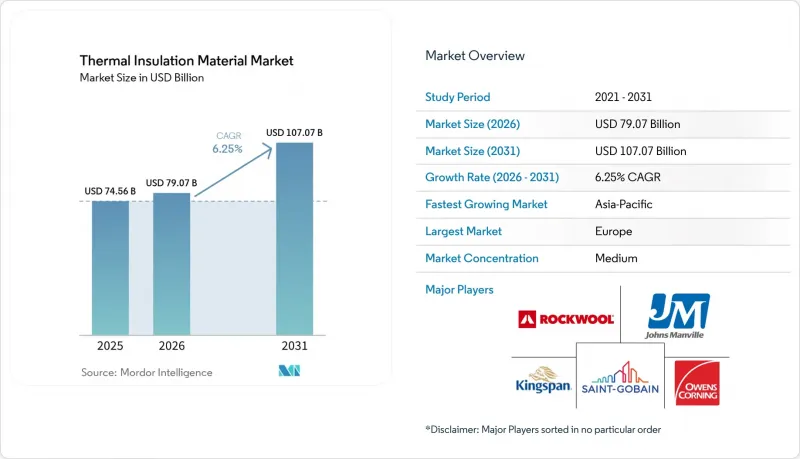
據 Mordor Intelligence 稱,2025 年隔熱材料市場規模估計為 745.6 億美元,預計在預測期(2026-2031 年)內將以 6.25% 的複合年成長率成長,從 2026 年的 790.7 億美元成長到 2031 年的 1070.7 億美元。
全球隔熱材料市場趨勢及洞察
更嚴格的建築能效標準
建築規範正在推動隔熱材料市場的需求。修訂後的歐盟建築能效指令 (EU) 2024/1275 將於 2024 年生效,成員國需在 2026 年 5 月前將其納入本國法律。該指令要求各國主管機關制定最低能效標準,並要求更高規格的隔熱材料符合這些標準。歐盟委員會授權條例 (EU) 2026/52 引入了一個歐盟框架,用於使用 EN 15978:2011 標準計算建築物在其生命週期內的全球暖化潛能值 (GWP)。該框架將採購標準從單一 U 值轉向經檢驗的環境效能。由擁有第三方機構所簽發的環境產品聲明 (EPD) 的供應商可以滿足產品選擇中的生命週期資料要求。
節能建築維修和改造的獎勵
維修工程正在支撐新建築週期以外的隔熱材料需求。德國聯邦經濟事務和出口管制局 (BAFA) 透過其「高效建築聯邦津貼——個人化措施 (BEG EM)」計畫支持建築圍護結構保溫。符合資格的家庭可使用個人化維修藍圖,預計從 2027 年第一季開始獲得「性能最差建築」的獎勵。該計劃支持整套認證住宅的維修計劃,而非單一的維修措施。東京 2026 年租賃住宅保溫和可再生能源計畫預算累計218 億日圓(約 1.3 億美元),申請時間為 2026 年 5 月至 2027 年 2 月。德國的節能維修率在 2025 年降至 0.67%,保溫複合材料系統的銷量在 2024 年下降了 15%,至 3,050 萬平方公尺。這些趨勢表明,計劃中斷可能會影響承包商的規劃和庫存投資。在政策實施過程中,持續且有效的獎勵仍然至關重要。
聚合物、礦物纖維和能源投入成本的變化
投入成本的波動仍是隔熱材料市場獲利能力所面臨的風險。礦物棉的生產需要將玄武岩和爐渣在超過1200度C的高溫下熔化,這使得生產商極易受到電力和天然氣價格波動的影響。能源成本佔礦物棉生產成本的20%至35%。 2026年6月美國礦物棉生產者物價指數為275.3,與2026年2月相比幾乎沒有變化。這是由於整體能源市場狀況持續對成本產生影響。發泡材供應商也依賴二苯基甲烷二異氰酸酯(MDI)及相關原料的供應。與規模小規模的區域性製造商相比,垂直整合的製造商以及那些簽訂了與能源價格掛鉤的長期合約的製造商更能應對成本波動。
細分市場分析
憑藉其成本競爭力以及在北美和歐洲住宅建築領域成熟的生產和分銷網路,預計到2025年,玻璃纖維將佔據36.67%的隔熱材料市場佔有率。岩絨預計將成為成長最快的材料,到2031年年複合成長率(CAGR)將達到6.79%。本產品單層即可實現防火和隔音性能,並符合基於EN 13501-1標準的歐洲A1級不燃性要求。這些特性對於歐洲的多用戶住宅和商業高層建築專案至關重要,因為這些專案對A2級或更高防火等級的需求日益成長。
發泡製品,包括聚氨酯、聚異氰脲酸酯(polyiso)和EPS,在地下結構和屋頂應用中仍然十分重要。然而,複合材料系統的報廢限制以及原物料價格的波動正在影響這些產品的未來前景。發表在《IOP地球與環境科學會議系列》上的一項研究預測,到2050年,外牆外保溫複合系統(ETICS)產生的EPS廢棄物年產量將增加四倍。雖然木纖維目前仍是小規模材料,但在德國、奧地利和瑞士(DACH)以及北歐地區優先考慮生物來源碳排放計算的項目中,木纖維正日益受到關注。發表在《資源》(Resources)雜誌上的一項研究發現,2019年,德國的隔熱材料需求中,聚合物發泡體佔48%,礦物棉佔43%,生物基材料佔9%。木纖維在生物基材料中佔比高達58%。在一些專案中,如果專案要求記錄材料的來源和生命週期,則會使用木纖維。然而,由於玻璃纖維、岩絨和發泡材的供應鏈已經成熟,其應用仍受到限制。在某些項目中,基於循環經濟的產品政策的重要性可能會增加。
2026年,ROCKWOOL公司在華盛頓州瓦盧拉破土動工,興建一座價值1.75億美元的工廠。這將是該公司在北美的第五家工廠。該工廠將滿足太平洋沿岸地區日益成長的岩棉需求,同時應對日益嚴格的能源法規。此外,Knauf Insulation公司也計劃在英國肖頓新建一座岩棉工廠,採用水下電弧爐電解技術。這些投資旨在集中產能生產具有隔熱、隔音、防火和環保性能的產品。在以生命週期報告指南材料選擇的項目中,能夠證明生產過程中低排放的供應商可能會被優先考慮。
區域分析
2025年,歐洲佔據了隔熱材料市場36.56%的佔有率。德國、法國、英國和北歐國家是該地區保溫材料需求的主要驅動力。修訂後的《建築能源性能指令》(EPBD)要求新建建築在2030年前實現零排放,並對大型維修設定了能源效率要求。歐洲龐大的建築存量持續支撐隔熱材料的需求。北歐國家的建築標準要求新建築外牆的U值較低,增加了對高性能保溫材料的需求。這種法規環境推動了基於規範的需求,並促使人們使用具有完善技術和環境標準的保溫材料。
在德國,政策的延續性對建築活動的影響正在顯現。 2024年,複合隔熱系統的銷售量下降了15%,至3,050萬平方公尺。 2025年的節能維修率降至0.67%,這主要是由於補貼計畫的不確定性,而非實際需求下降所致。計劃條件的變化導致承包商培訓和庫存方面的投資減少。這可能會限制長期目標向已完成專案的轉化,並延緩需要專業安裝技能的產品的推出。
預計到2031年,亞太地區的年複合成長率將達到7.03%,為所有地區中最高。中國、印度和東南亞國協正透過活性化的建設活動和更嚴格的能源性能要求來推動這一成長。日本的「未來環保住宅2026」計畫根據保溫性能等級,為結構隔熱材料維修提供每立方公尺13,000至62,000日圓的補貼。此類計劃有助於滿足新建和維修專案中對高規格建築材料的需求。
北美是全球第二大市場。在美國,雖然獨棟住宅開工速度放緩,但住宅維修、新商業建築、資料中心和電氣化設施的需求支撐了市場需求。南美、中東和非洲的市場佔有率相對較小。沙烏地阿拉伯的「2030願景」基礎設施規劃在公共建築競標中納入了隔熱性能標準。巴西的「我的家,我的生活」(Minha Casa Minha Vida)計畫正在推動低成本住宅對玻璃纖維和膨脹聚苯乙烯(EPS)的需求。儘管建設計畫正在積極推進,但由於承包商招募困難和供應鏈產能不足,工程竣工可能會延誤。
其他好處:
- Excel格式的市場預測(ME)表
- 3個月的分析師支持
目錄
第1章:引言
- 研究假設和市場定義
- 調查範圍
第2章:調查方法
第3章執行摘要
第4章 市場狀況
- 市場概覽
- 市場促進因素
- 更嚴格的建築能效標準
- 節能建築維修和改造的獎勵
- 亞太地區節能建築的擴張
- 電動車的普及與電池溫度控管
- 工業脫碳和製程能源最佳化
- 市場限制因素
- 聚合物、礦物纖維和能源投入成本的變化
- 安裝成本高且熟練安裝人員短缺。
- 廢舊複合隔熱系統的處置與回收的限制
- 價值鏈分析
- 波特五力分析
第5章 市場規模與成長預測
- 材料類型
- 玻璃纖維
- 岩棉
- 發泡體
- 木纖維
- 其他材料
- 按溫度範圍
- 0~100°C
- 100~500°C
- 超過 500 度C
- 按最終用戶行業分類
- 建造
- 車
- HVAC
- 產業
- 其他
- 按地區
- 亞太地區
- 中國
- 印度
- 日本
- 韓國
- 東南亞國協
- 其他亞太國家
- 北美洲
- 美國
- 加拿大
- 墨西哥
- 歐洲
- 德國
- 英國
- 法國
- 義大利
- 北歐國家
- 俄羅斯
- 其他歐洲國家
- 南美洲
- 巴西
- 阿根廷
- 其他南美國家
- 中東和非洲
- 沙烏地阿拉伯
- 南非
- 其他中東和非洲國家
- 亞太地區
第6章 競爭情勢
- 市場集中度
- 策略趨勢
- 市佔率和排名分析
- 公司簡介
- ARMACELL
- Asahi Kasei Corporation
- BASF
- Covestro AG
- Dow
- GAF Materials LLC
- Huntsman International LLC
- Johns Manville
- Kingspan
- Knauf Insulation
- Owens Corning
- Recticel NV/SA
- ROCKWOOL A/S
- Saint-Gobain
- Sika AG
第7章 市場機會與未來展望
According to Mordor Intelligence, the thermal insulation material market size was estimated at USD 74.56 billion in 2025 and is estimated to grow from USD 79.07 billion in 2026 to USD 107.07 billion by 2031, at a CAGR of 6.25% during the forecast period (2026-2031).
Global Thermal Insulation Material Market Trends and Insights
Tightening Building Energy-Performance Standards
Building codes are driving demand in the thermal insulation material market. The recast Energy Performance of Buildings Directive (EU) 2024/1275 entered into force in 2024, and member states must transpose it into national law by May 2026. The directive requires national authorities to establish minimum energy-performance thresholds, requiring higher-specification insulation for compliance. Commission Delegated Regulation (EU) 2026/52 introduces a Union framework for calculating building life-cycle global warming potential using EN 15978:2011. The framework shifts procurement criteria from standalone U-values to verified environmental performance. Suppliers with third-party Environmental Product Declarations can meet life-cycle data requirements in product selection.
Energy-Efficient Building Retrofits and Renovation Incentives
Renovation programs support demand for the thermal insulation material market beyond new-construction cycles. Germany's Federal Office for Economic Affairs and Export Control (BAFA) supports building-envelope insulation through the Federal Funding for Efficient Buildings - Individual Measures (BEG EM) program. A Worst-Performing Building bonus is expected to begin in Q1 2027 for eligible households using an Individual Refurbishment Roadmap. The program links support to a certified whole-house plan rather than a single improvement measure. Tokyo's FY2026 program for insulation and renewable energy in rental housing has a JPY 21.8 billion (~USD 0.13 billion) budget and accepts applications from May 2026 through February 2027. Germany's energy renovation rate declined to 0.67% in 2025, while sales of thermal composite insulation systems fell by 15% to 30.5 million m2 in 2024. These trends indicate that program discontinuity can affect contractor planning and inventory investment. Consistent incentives remain relevant to policy implementation.
Volatility in Polymer, Mineral Fiber, and Energy Input Costs
Input cost volatility remains a margin risk for the thermal insulation materials market. Mineral wool production requires melting basalt and slag at temperatures above 1,200°C, exposing producers to fluctuations in electricity and natural gas prices. Energy represents 20-35% of mineral wool production costs. The U.S. Producer Price Index for mineral wool stood at 275.3 in June 2026, largely unchanged from February 2026, as broader energy conditions continued to influence costs. Foam suppliers also depend on the availability of methylene diphenyl diisocyanate (MDI) and related feedstocks. Manufacturers with vertical integration or long-term, energy-indexed contracts have greater capacity to manage cost fluctuations than smaller regional producers.
Other drivers and restraints analyzed in the detailed report include:
- Growth of Electric Vehicles and Battery Thermal Management
- Industrial Decarbonization and Process-Energy Optimization
- High Installation Costs and Skilled-Installer Shortages
For complete list of drivers and restraints, kindly check the Table Of Contents.
Segment Analysis
Fiberglass held a 36.67% share of the thermal insulation material market in 2025, supported by its cost position and established manufacturing and distribution base in North American and European residential construction. Stone wool is expected to record the fastest growth, at a CAGR of 6.79% through 2031. It provides fire performance and acoustic control in a single product layer and can meet Euroclass A1 non-combustibility requirements under EN 13501-1. These characteristics are relevant for European multifamily buildings and commercial high-rise projects, where A2 or higher fire ratings are increasingly required.
Foam products, including polyurethane, polyiso, and EPS, remain important for below-grade and roof-deck applications. End-of-life constraints for composite systems and feedstock price exposure affect their outlook. Research published in IOP Conference Series: Earth and Environmental Science projects that annual EPS waste from External Thermal Insulation Composite Systems will increase fourfold by 2050. Wood fiber remains a smaller material category but is gaining attention in DACH and Nordic projects that prioritize biogenic carbon accounting. Research published in Resources reported that polymeric foams accounted for 48% of Germany's insulation demand in 2019, mineral wools for 43%, and bio-based materials for 9%. Wood fiber represented 58% of the bio-based share. It serves projects where material origin and lifecycle documentation are part of the project brief. Its use remains selective because fiberglass, stone wool, and foam supply chains are well established. Circular-economy product policies may become more relevant in selected projects.
ROCKWOOL broke ground in 2026 on a USD 175 million plant in Wallula, Washington, its fifth North American facility. The plant will address stone wool supply requirements on the Pacific Coast as energy code requirements tighten. Knauf Insulation has also planned a new rock mineral wool plant in Shotton, United Kingdom, using submerged arc furnace electric melting technology. These investments direct capacity toward products that provide thermal, acoustic, fire, and environmental performance. Suppliers that document lower manufacturing emissions may be considered in projects where lifecycle reporting guides material selection.
Complete Report Scope:
- By Material Type
- Fiberglass
- Stone Wool
- Foam
- Wood Fiber
- Other Materials
- By Temperature Range
- 0-100°C
- 100-500°C
- 500°C and Above
- By End-User Industry
- Construction
- Automotive
- HVAC
- Industrial
- Others
- By Geography
- Asia-Pacific
- China
- India
- Japan
- South Korea
- ASEAN Countries
- Rest of Asia-Pacific
- North America
- United States
- Canada
- Mexico
- Europe
- Germany
- United Kingdom
- France
- Italy
- NORDIC Countries
- Russia
- Rest of Europe
- South America
- Brazil
- Argentina
- Rest of South America
- Middle East and Africa
- Saudi Arabia
- South Africa
- Rest of Middle East and Africa
- Asia-Pacific
Geography Analysis
Europe held a 36.56% share of the thermal insulation material market in 2025. Germany, France, the United Kingdom, and the Nordic countries drove regional demand. The recast Energy Performance of Buildings Directive (EPBD) requires new buildings to be zero-emission by 2030 and sets energy-performance requirements for major renovations. Europe's large building stock continues to support demand for insulation. Nordic building codes require low U-values for new exterior walls, increasing demand for high-performance products. This regulatory environment supports specification-led demand and the use of products with technical and environmental documentation.
Germany reflects the impact of policy continuity on installation activity. Sales of thermal composite insulation systems declined by 15% to 30.5 million m2 in 2024. The energy renovation rate fell to 0.67% in 2025, primarily due to uncertainty around subsidy planning rather than underlying demand. Changes in program conditions reduce contractors' investment in training and inventory. This limits the conversion of long-term targets into completed projects and may delay the adoption of products requiring specialized installation skills.
Asia-Pacific is forecast to grow at a CAGR of 7.03% through 2031, the highest rate among regions. China, India, and ASEAN drive growth through increased construction activity and stricter energy-performance requirements. Japan's Mirai Eco Housing 2026 program provides JPY 13,000 to JPY 62,000 per m3 for structural insulation upgrades, based on thermal performance class. These programs support demand for higher-specification materials in new construction and renovation projects.
North America is the second-largest regional contributor. In the United States, residential retrofits, new commercial construction, data centers, and electrification-related facilities support demand despite softer single-family housing starts. South America, the Middle East, and Africa account for smaller shares. Saudi Arabia's Vision 2030 infrastructure program includes thermal-performance criteria in public-building tenders. Brazil's Minha Casa Minha Vida program supports demand for fiberglass and expanded polystyrene (EPS) in lower-cost housing. Limited installer availability and supply chain capacity may delay project completion despite active construction programs.
- ARMACELL
- Asahi Kasei Corporation
- BASF
- Covestro AG
- Dow
- GAF Materials LLC
- Huntsman International LLC
- Johns Manville
- Kingspan
- Knauf Insulation
- Owens Corning
- Recticel NV/SA
- ROCKWOOL A/S
- Saint-Gobain
- Sika AG
Additional Benefits:
- The market estimate (ME) sheet in Excel format
- 3 months of analyst support
TABLE OF CONTENTS
1 Introduction
- 1.1 Study Assumptions and Market Definition
- 1.2 Scope of the Study
2 Research Methodology
3 Executive Summary
4 Market Landscape
- 4.1 Market Overview
- 4.2 Market Drivers
- 4.2.1 Tightening Building Energy-Performance Standards
- 4.2.2 Energy-Efficient Building Retrofits and Renovation Incentives
- 4.2.3 Expansion of Energy-Efficient Construction in Asia-Pacific
- 4.2.4 Growth of Electric Vehicles and Battery Thermal Management
- 4.2.5 Industrial Decarbonization and Process-Energy Optimization
- 4.3 Market Restraints
- 4.3.1 Volatility in Polymer, Mineral Fiber, and Energy Input Costs
- 4.3.2 High Installation Costs and Skilled-Installer Shortages
- 4.3.3 End-of-Life and Recycling Constraints for Composite Insulation Systems
- 4.4 Value Chain Analysis
- 4.5 Porter's Five Forces Analysis
- 4.5.1 Bargaining Power of Suppliers
- 4.5.2 Bargaining Power of Buyers
- 4.5.3 Threat of New Entrants
- 4.5.4 Threat of Substitutes
- 4.5.5 Competitive Rivalry
5 Market Size and Growth Forecasts (Value)
- 5.1 By Material Type
- 5.1.1 Fiberglass
- 5.1.2 Stone Wool
- 5.1.3 Foam
- 5.1.4 Wood Fiber
- 5.1.5 Other Materials
- 5.2 By Temperature Range
- 5.2.1 0-100°C
- 5.2.2 100-500°C
- 5.2.3 500°C and Above
- 5.3 By End-User Industry
- 5.3.1 Construction
- 5.3.2 Automotive
- 5.3.3 HVAC
- 5.3.4 Industrial
- 5.3.5 Others
- 5.4 By Geography
- 5.4.1 Asia-Pacific
- 5.4.1.1 China
- 5.4.1.2 India
- 5.4.1.3 Japan
- 5.4.1.4 South Korea
- 5.4.1.5 ASEAN Countries
- 5.4.1.6 Rest of Asia-Pacific
- 5.4.2 North America
- 5.4.2.1 United States
- 5.4.2.2 Canada
- 5.4.2.3 Mexico
- 5.4.3 Europe
- 5.4.3.1 Germany
- 5.4.3.2 United Kingdom
- 5.4.3.3 France
- 5.4.3.4 Italy
- 5.4.3.5 NORDIC Countries
- 5.4.3.6 Russia
- 5.4.3.7 Rest of Europe
- 5.4.4 South America
- 5.4.4.1 Brazil
- 5.4.4.2 Argentina
- 5.4.4.3 Rest of South America
- 5.4.5 Middle East and Africa
- 5.4.5.1 Saudi Arabia
- 5.4.5.2 South Africa
- 5.4.5.3 Rest of Middle East and Africa
- 5.4.1 Asia-Pacific
6 Competitive Landscape
- 6.1 Market Concentration
- 6.2 Strategic Moves
- 6.3 Market Share (%)/Ranking Analysis
- 6.4 Company Profiles (includes Global Overview, Market Overview, Core Segments, Financials as available, Strategic Information, Products and Services, and Recent Developments)
- 6.4.1 ARMACELL
- 6.4.2 Asahi Kasei Corporation
- 6.4.3 BASF
- 6.4.4 Covestro AG
- 6.4.5 Dow
- 6.4.6 GAF Materials LLC
- 6.4.7 Huntsman International LLC
- 6.4.8 Johns Manville
- 6.4.9 Kingspan
- 6.4.10 Knauf Insulation
- 6.4.11 Owens Corning
- 6.4.12 Recticel NV/SA
- 6.4.13 ROCKWOOL A/S
- 6.4.14 Saint-Gobain
- 6.4.15 Sika AG
7 Market Opportunities and Future Outlook
- 7.1 White-Space and Unmet-Need Assessment

 保溫礦物纖維市場規模、佔有率和成長分析:按纖維類型、產品形式、應用、最終用途產業、功能和地區分類-2026-2033年產業預測
 全球隔熱材料市場:機會與策略展望(至2035年)
 隔熱材料市場-2026年至2032年全球市場預測
 隔熱材料市場:依材料、溫度範圍及地區分類隔熱材料市場:按類型、材料、應用和最終用戶分類-2026-2032年全球市場預測
 隔熱材料市場分析及預測(至2035年):類型、產品、應用、技術、材料類型、形式、最終用戶、安裝類型、解決方案和工藝
 全球隔熱材料市場規模、佔有率、趨勢和成長分析報告(2026-2034年)低溫運輸聚氨酯隔熱材料市場按產品類型、形狀、泡孔結構、密度、應用和最終用途產業分類-2026年至2032年全球預測工業隔熱塗料市場依產品類型、最終用途產業、技術、應用溫度範圍及銷售管道分類-2026年至2032年全球預測
 2032年全球隔熱材料市場預測:按材料類型、應用和地區分類的分析