


 |
市場調查報告書
商品編碼
2154733
機器身分管理平台:市場佔有率分析、產業趨勢與統計、成長預測(2026-2031)Machine Identity Management Platform - Market Share Analysis, Industry Trends & Statistics, Growth Forecasts (2026 - 2031) |
||||||

※ 本網頁內容可能與最新版本有所差異。詳細情況請與我們聯繫。
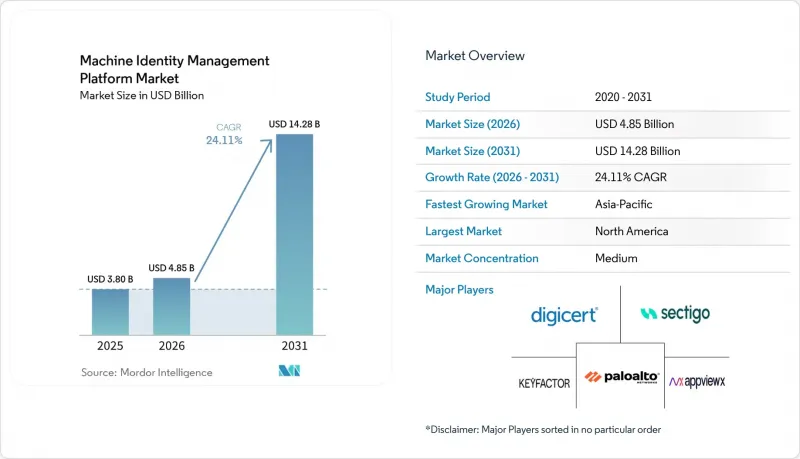
根據 Mordor Intelligence 預測,機器身分管理平台的市場規模預計將從 2025 年的 38 億美元和 2026 年的 48.5 億美元成長到 2031 年的 142.8 億美元,2026 年至 2031 年的年複合成長率(CAGR)為 24.11%。
全球機器身分管理平台市場趨勢與洞察
雲端原生工作負載和 API 的擴充功能正在推動對憑證的需求。
雲端原生設計產生機器身分的速度遠超傳統資料中心系統。每個微服務、容器、無伺服器函數和 API 端點都需要一個唯一的加密身分才能進行身份驗證通訊。在多重雲端環境中,由於每個環境可能使用不同的工具和策略,因此這項需求更加迫切。 2026 年,IBM 將機器身分管理作為其身分和存取管理產品組合中的一個專業領域推出,專注於自動化發現、頒發、續訂和撤銷。此外,隨著 API 的無序成長,如果開發團隊獨立建立 API 金鑰和 OAuth 令牌,則可能會脫離安全團隊的監管。因此,機器身分管理市場正受益於憑證數量的成長以及彌合由此產生的可見性差距的需求。
零信任的採用重新定義了機器對機器的身份驗證。
在零信任架構中,無論連線源自何處,每個連線都需要檢驗。這項原則直接適用於機器間流量,而機器間流量正是企業網路大部分活動的基礎。由雲端原生運算基金會 (CNCF) 管理的 SPIFFE 和 SPIRE 標準,透過臨時加密 SVID 和容器及虛擬機器的持續認證來支援工作負載身分。 2025 年,Corsha 贏得了美國國防後勤局 (DLA) 一份價值 5000 萬美元的獨立無限期交付/無限期數量 (IDIQ) 契約,用於在關鍵運營系統之間建立零信任連接。此舉表明,機器身分驗證在國防、公共產業和製造業等傳統上嚴重依賴網路分段的行業中日益重要,並將機器身分管理市場擴展到了傳統企業公鑰基礎設施 (PKI) 專案之外。
分散的傳統 PKI 和金鑰管理工具正在減緩平台部署速度。
根據 Palo Alto Networks 引用的 Ponemon Institute 2026 年的一項研究,超過三分之一的組織認為傳統 PKI 的成本和風險是保護機器憑證的主要障礙。大規模組織通常會結合使用 Microsoft Active Directory 憑證服務、HashiCorp Vault、雲端密鑰儲存以及來自不同供應商的硬體安全模組 (HSM)。這些工具需要連接到一個通用的管治層,才能讓自動化策略執行保持一致性。 Ponemon-Sullivan 的研究發現,53% 的組織仍然使用手動或臨時方法來評估其 PKI 的健康狀況。 NIST 於 2024 年 8 月最終確定了 FIPS 203、FIPS 204 和 FIPS 205,這為 PKI 營運現代化所需的工作增加了一個後量子時代的轉型。由於組織必須在維持穩定的日常證書運作的同時重新設計其傳統基礎設施,因此機器身分管理市場成長緩慢。
細分市場分析
截至2025年,解決方案在機器身分管理市場中佔據57.31%的佔有率。此類別包括憑證生命週期管理平台、金鑰管理庫、PKI即服務(PKI-as-a-Service)以及工作負載身分管理工具,這些工具構成了機器身分管治程序的核心技術層。預計從2026年到2031年,服務領域的複合年成長率將達到24.51%。平台部署通常需要實施、整合和維運管理方面的支持,企業才能獲得一致的成果。這一趨勢反映了許多企業安全團隊缺乏足夠的PKI專業知識的現實情況。
對專業服務的需求也反映了向後量子密碼學過渡所需的工作量。 Computers 2025 年的一項調查估計,中型企業需要 8-12 年才能完成過渡,而大型企業則需要 12-15 年甚至更長。如此長的時間意味著擁有密碼技術專業知識的供應商將擁有持續的諮詢和顧問機會。目前,一些沒有內部 PKI負責人的組織正在尋求託管服務;Ponemon-Sullivan 2026 年的一項調查發現,63% 的組織將基本的 PKI 作業外包。將託管證書生命週期管理與後量子密碼學準備評估相結合的供應商可以滿足營運和規劃方面的需求。
到2025年,應用和服務身分將佔機器身分管理市場的28.53%。此佔有率反映了應用程式和微服務使用服務帳戶、用戶端憑證和OAuth令牌進行身份驗證API通訊的成熟基礎。預計從2026年到2031年,AI代理身分將以25.51%的複合年成長率成長。這一成長反映了對持續身份驗證的需求,而非靜態的服務帳戶憑證。 IETF的代理身分框架草案概述了身分、授權、證明、證據和信任等層級。
工作負載和容器身份,以及 SSH 和加密金鑰,在 DevSecOps 管線中仍然至關重要。隨著證書有效期的縮短,這些流程自動化的潛力日益成長。諸如金鑰、密碼、存取權杖、API 金鑰和 OAuth 令牌等身分也構成了大規模部署基礎,而「影子憑證」的存在帶來了管治的挑戰。在單一基於代理的工作流程中,API 金鑰的使用、透過雙向 TLS 進行的呼叫以及對金鑰的存取都可能發生在單一事務中,從而在不同身分類別之間建立依賴關係。因此,機器身分管理產業需要一個能夠管理跨身分類型生命週期的平台,而不是各自獨立運作的工具。
區域分析
2025年,北美將佔據機器身分管理市場規模的43.77%。該地區受益於雲端規模技術買家的集中、成熟的零信任計劃以及CyberArk、Keyfactor、AppViewX和DigiCert等領先供應商的存在。基於美國管理和預算辦公室(OMB)M-22-09備忘錄的零信任政策不斷擴大其適用範圍,涵蓋私人機構和聯邦承包商。這不僅催生了大型私人企業的需求,也推動了機器身分管理市場向政府供應商和機構的拓展。加拿大和墨西哥正透過金融服務和跨境技術業務擴大其市場規模。 2026年8月,微軟在其「零信任研討會」中新增了DevSecOps支柱,進一步擴展了其人工智慧零信任策略,該研討會包含15個控制組和91項任務。
2025年,歐洲佔據第二大區域市場。德國、英國和法國構成主要需求基礎。 2025年1月,針對金融機構及其資訊通訊技術服務供應商的DORA法規正式生效。德國聯邦資訊安全局(BSI)和法國國家資訊安全局(ANSSI)已發布關於向後量子密碼學過渡的指導意見。根據可信任運算組織(Trusted Computing Group)2025年11月的一項調查,70%的德國安全專家預計到2026年至少會有一種後量子密碼學(PQC)演算法投入使用。英國在其網路彈性指導意見中推廣證書生命週期的自動化。同時,南美洲仍然是一個新興地區,巴西的需求成長主要得益於金融服務的數位化以及巴西中央銀行(Banco Central do Brasil)的要求。
預計亞太地區在2026年至2031年間將以25.09%的複合年成長率成長,隨著該地區身分系統的現代化,機器身分管理市場的重要性日益凸顯。 Palo Alto Networks報告稱,到2026年,該地區企業環境中的機器身份數量將超過人類員工數量111倍。在印度,金融科技、數位支付基礎設施的擴張以及大規模的開發者群體推動了市場需求,大量API應用催生了大量的憑證。日本和韓國正在推廣強調機器身份驗證中零信任原則的網路安全計畫。同時,Okta在澳洲、新加坡和日本進行的一項調查顯示,不到10%的受訪者認為他們的身分系統能夠充分管理非人類身分。在中國,隨著雲端基礎設施和國家主導的人工智慧發展,機器身分的數量正在不斷成長,資料本地化正在決定供應商的准入權限。同時,在中東和非洲,在金融部門監管和政府數位化計畫的支持下,該技術的採用仍處於早期階段。
其他好處:
- Excel格式的市場預測(ME)表
- 3個月的分析師支持
目錄
第1章:引言
- 研究假設和市場定義
- 調查範圍
第2章:調查方法
第3章執行摘要
第4章 市場狀況
- 市場概覽
- 宏觀經濟因素對市場的影響
- 市場促進因素
- 擴展雲端原生工作負載和 API
- 在M2M訪問中實施零信任
- 縮短證書有效期限和自動續約的要求。
- 人工智慧代理和自主工作流程的激增
- 軟體供應鏈中的機器身分管治
- 後量子密碼學和密碼敏捷性計劃的準備
- 市場限制因素
- 分散的傳統公鑰基礎設施 (PKI) 和機密資訊管理工具
- PKI 和機器 ID 專家短缺
- 平台工程團隊與安全團隊之間責任分類不明確。
- 因臨時和影子機器 ID 導致的誤報
- 產業價值鏈分析
- 監理情勢
- 技術展望
- 波特五力分析
第5章 市場規模與成長預測
- 按組件
- 解決方案
- 服務
- ID 類型
- 應用程式和服務 ID
- API金鑰和OAuth令牌ID
- 工作負載和容器標識符
- 機器證書
- 密鑰、密碼、存取令牌
- SSH金鑰和加密金鑰
- AI代理ID
- 其他 ID 類型
- 部署模式
- 基於雲端的
- 現場
- 混合
- 按組織規模
- 大公司
- 小型企業
- 按最終用戶行業分類
- BFSI
- 資訊科技/通訊
- 醫療保健和生命科學
- 政府/公共部門
- 製造業和工業
- 零售與電子商務
- 能源公用事業
- 運輸/物流
- 按地區
- 北美洲
- 美國
- 加拿大
- 墨西哥
- 南美洲
- 巴西
- 阿根廷
- 其他南美國家
- 歐洲
- 德國
- 英國
- 法國
- 義大利
- 西班牙
- 俄羅斯
- 其他歐洲國家
- 亞太地區
- 中國
- 印度
- 日本
- 韓國
- 澳洲
- 其他亞太國家
- 中東
- 沙烏地阿拉伯
- 阿拉伯聯合大公國
- 土耳其
- 其他中東國家
- 非洲
- 南非
- 奈及利亞
- 其他非洲國家
- 北美洲
第6章 競爭情勢
- 市場集中度
- 策略趨勢
- 市佔率分析
- 公司簡介
- Palo Alto Networks
- Keyfactor, Inc.
- AppViewX, Inc.
- DigiCert, Inc.
- Sectigo Limited
- Entrust Corporation
- GlobalSign, Inc.
- SSH Communications Security Corporation
- Akeyless Security Ltd.
- Aembit, Inc.
- Astrix Security, Inc.
- Clutch Security, Inc.
- GitGuardian SAS
- P0 Security, Inc.
- Oasis Security Ltd.
- Token Security Ltd.
- SPIRL, Inc.
- Smallstep Labs, Inc.
- Teleport, Inc.
- Corsha, Inc.
- Delinea, Inc.
- BeyondTrust Corporation
- Fortanix, Inc.
- One Identity LLC
第7章 市場機會與未來展望
According to Mordor Intelligence, the machine identity management platform market size is projected to expand from USD 3.80 billion in 2025 and USD 4.85 billion in 2026 to USD 14.28 billion by 2031, registering a CAGR of 24.11% between 2026 and 2031.
Global Machine Identity Management Platform Market Trends and Insights
Expansion of Cloud-Native Workloads and APIs Fuels Credential Demand
Cloud-native designs create machine identities at a much faster rate than traditional data center systems. Each microservice, container, serverless function, and API endpoint needs a distinct cryptographic identity for authenticated communication. Multi-cloud environments increase this requirement because each environment may use different tools and policies. IBM introduced machine identity management as a dedicated discipline within its identity and access management portfolio in 2026, with a focus on automated discovery, issuance, renewal, and revocation. API sprawl can also leave API keys and OAuth tokens outside the security team's visibility when development teams create them independently. The machine identity management market, therefore, benefits both from a higher credential volume and from the need to close the resulting visibility gap.
Zero-Trust Adoption Redefines Machine-to-Machine Authentication
Zero trust requires verification for every connection, regardless of where that connection begins. This principle applies directly to machine-to-machine traffic, which supports much of the activity in enterprise networks. The SPIFFE and SPIRE standard maintained by the Cloud Native Computing Foundation, support workload identities through short-lived cryptographic SVIDs and continuous attestation for containers and virtual machines. Corsha received a USD 50 million sole-source IDIQ contract from the US Defense Logistics Agency in 2025 for zero-trust connectivity across critical operational systems. This activity shows that machine authentication is becoming relevant in defense, utilities, and manufacturing settings that historically relied more heavily on network segmentation, extending the machine identity management market beyond traditional enterprise PKI projects.
Fragmented Legacy PKI and Secrets Tooling Delays Platform Adoption
More than one-third of organizations identified legacy PKI cost and risk as a primary barrier to securing machine credentials in a 2026 Ponemon study cited by Palo Alto Networks. Large organizations often operate Microsoft Active Directory Certificate Services, HashiCorp Vault, cloud secret stores, and hardware security modules from different vendors. These tools must be connected to a common governance layer before automated policy enforcement can work consistently. The Ponemon-Sullivan study found that 53% of organizations still used manual or ad hoc methods to assess PKI health. NIST finalized FIPS 203, FIPS 204, and FIPS 205 in August 2024, adding post-quantum migration to the work already required to modernize PKI operations. The machine identity management market is experiencing slower adoption, as organizations must redesign legacy infrastructure while maintaining stable daily certificate operations.
Other drivers and restraints analyzed in the detailed report include:
- Certificate Lifespan Compression Creates an Automation Imperative
- AI Agent and Autonomous Workflow Proliferation Opens an Ungoverned Identity Surface
- Shortage of Machine Identity Specialists Limits Program Scale
For complete list of drivers and restraints, kindly check the Table Of Contents.
Segment Analysis
Solutions held 57.31% of the machine identity management market share in 2025. This category includes certificate lifecycle management platforms, secrets management vaults, PKI-as-a-service offerings, and workload identity tools that provide the core technology layer for machine identity governance programs. Services are projected to expand at a 24.51% CAGR from 2026 to 2031. Platform deployments often require implementation, integration, and managed operations support before organizations can achieve consistent outcomes. The component pattern reflects the shortage of PKI talent across many enterprise security teams.
Professional services demand also reflects the work required to migrate to post-quantum cryptography. A 2025 study in Computers estimated migration timelines of 8 to 12 years for medium-sized enterprises and 12 to 15+ years for large enterprises. This duration supports ongoing consulting and advisory opportunities for vendors with cryptographic expertise. Managed services are serving organizations that lack internal PKI staffing, and the same 2026 Ponemon-Sullivan study found that 63% of organizations outsourced basic PKI operations. Vendors that combine managed certificate lifecycle management with post-quantum readiness assessments can address both operational and planning needs.
Application and service identities held 28.53% of the machine identity management market share in 2025. Their position reflects the established base of applications and microservices that use service accounts, client certificates, and OAuth tokens for authenticated API communication. AI agent identities are projected to expand at a 25.51% CAGR from 2026 to 2031. This growth reflects the need for continuous identity attestation rather than static service account credentials. The IETF Agent Identity Framework draft outlines layers for identity, authorization, attestation, evidence, and trust.
Workload and container identities, together with SSH keys and cryptographic keys, remain essential to DevSecOps pipelines. Their automation potential increases as the validity periods of certificates shorten. Secrets, passwords, access tokens, API keys, and OAuth token identities also represent large installed bases where shadow credentials create governance needs. A single agentic workflow may use API keys, invoke services via mutual TLS, and access secrets in a single transaction, creating dependencies across identity categories. The machine identity management industry, therefore, needs platforms that manage lifecycles across identity types rather than tools that operate in isolation.
Complete Report Scope:
- By Component
- Solutions
- Services
- By Identity Type
- Application and Service Identities
- API Keys and OAuth Token Identities
- Workload and Container Identities
- Machine Certificates
- Secrets, Passwords, and Access Tokens
- SSH Keys and Cryptographic Keys
- AI Agent Identities
- Other Identity Types
- By Deployment Mode
- Cloud-Based
- On-Premises
- Hybrid
- By Organization Size
- Large Enterprises
- Small and Medium-Sized Enterprises
- By End-User Industry
- BFSI
- Information Technology and Telecommunications
- Healthcare and Life Sciences
- Government and Public Sector
- Manufacturing and Industrial
- Retail and E-Commerce
- Energy and Utilities
- Transportation and Logistics
- By Geography
- North America
- United States
- Canada
- Mexico
- South America
- Brazil
- Argentina
- Rest of South America
- Europe
- Germany
- United Kingdom
- France
- Italy
- Spain
- Russia
- Rest of Europe
- Asia-Pacific
- China
- India
- Japan
- South Korea
- Australia
- Rest of Asia-Pacific
- Middle East
- Saudi Arabia
- United Arab Emirates
- Turkey
- Rest of Middle East
- Africa
- South Africa
- Nigeria
- Rest of Africa
- North America
Geography Analysis
North America accounted for 43.77% of the machine identity management market size in 2025. The region benefits from the concentration of cloud-scale technology buyers, established zero-trust programs, and leading vendors such as CyberArk, Keyfactor, AppViewX, and DigiCert. US federal zero-trust direction under the Office of Management and Budget memorandum M-22-09 continues to extend requirements across civilian agencies and federal contractors. This creates demand beyond the largest private enterprises and helps the machine identity management market reach government suppliers and agencies. Canada and Mexico add volume through financial services and cross-border technology operations, while Microsoft expanded its Zero Trust for AI strategy in August 2026 with a DevSecOps pillar in its Zero Trust Workshop that includes 15 control groups and 91 tasks.
Europe held the second-largest regional share in 2025. Germany, the United Kingdom, and France form the principal demand base, and DORA entered into force in January 2025 for financial entities and their ICT service providers. Germany's BSI and France's ANSSI have issued post-quantum cryptography transition guidance, while 70% of German security professionals expected at least 1 PQC algorithm to be in production by 2026, according to a November 2025 Trusted Computing Group survey. The United Kingdom promotes certificate lifecycle automation in its cyber resilience guidance, while South America remains an emerging region, with Brazil supported by financial services digitalization and the requirements of the Banco Central do Brasil.
Asia-Pacific is projected to expand at a 25.09% CAGR from 2026 to 2031, and the machine identity management market is gaining relevance as regional identity systems are modernized. In 2026, Palo Alto Networks reported that machine identities outnumbered human workers by 111 to 1 across enterprise environments in the region. India is seeing demand driven by fintech expansion, digital payment infrastructure, and a large developer base, where API-dense work creates large credential inventories. Japan and South Korea are advancing cybersecurity programs that emphasize zero-trust principles for machine authentication, while an Okta survey in 2026 across Australia, Singapore, and Japan found that fewer than 10% of respondents considered their identity systems fully equipped to manage non-human identities. China generates machine identity volumes through cloud infrastructure and state-led AI development, with data localization shaping vendor access, while the Middle East and Africa remain at earlier stages of adoption, supported by financial-sector rules and government digital programs.
- Palo Alto Networks
- Keyfactor, Inc.
- AppViewX, Inc.
- DigiCert, Inc.
- Sectigo Limited
- Entrust Corporation
- GlobalSign, Inc.
- SSH Communications Security Corporation
- Akeyless Security Ltd.
- Aembit, Inc.
- Astrix Security, Inc.
- Clutch Security, Inc.
- GitGuardian SAS
- P0 Security, Inc.
- Oasis Security Ltd.
- Token Security Ltd.
- SPIRL, Inc.
- Smallstep Labs, Inc.
- Teleport, Inc.
- Corsha, Inc.
- Delinea, Inc.
- BeyondTrust Corporation
- Fortanix, Inc.
- One Identity LLC
Additional Benefits:
- The market estimate (ME) sheet in Excel format
- 3 months of analyst support
TABLE OF CONTENTS
1 INTRODUCTION
- 1.1 Study Assumptions and Market Definition
- 1.2 Scope of the Study
2 RESEARCH METHODOLOGY
3 EXECUTIVE SUMMARY
4 MARKET LANDSCAPE
- 4.1 Market Overview
- 4.2 Impact of Macroeconomic Factors on the Market
- 4.3 Market Drivers
- 4.3.1 Expansion of Cloud-Native Workloads and APIs
- 4.3.2 Zero-Trust Adoption for Machine-to-Machine Access
- 4.3.3 Shortening Certificate Lifespans and Automated Renewal Requirements
- 4.3.4 AI Agent and Autonomous Workflow Proliferation
- 4.3.5 Machine Identity Governance for Software Supply Chains
- 4.3.6 Post-Quantum Cryptography Readiness and Crypto-Agility Programs
- 4.4 Market Restraints
- 4.4.1 Fragmented Legacy PKI and Secrets Tooling
- 4.4.2 Shortage of PKI and Machine Identity Specialists
- 4.4.3 Ownership Ambiguity Across Platform Engineering and Security Teams
- 4.4.4 False Positives from Ephemeral and Shadow Machine Identities
- 4.5 Industry Value Chain Analysis
- 4.6 Regulatory Landscape
- 4.7 Technological Outlook
- 4.8 Porter's Five Forces Analysis
- 4.8.1 Bargaining Power of Suppliers
- 4.8.2 Bargaining Power of Buyers
- 4.8.3 Threat of New Entrants
- 4.8.4 Threat of Substitutes
- 4.8.5 Intensity of Competitive Rivalry
5 MARKET SIZE AND GROWTH FORECASTS (VALUE)
- 5.1 By Component
- 5.1.1 Solutions
- 5.1.2 Services
- 5.2 By Identity Type
- 5.2.1 Application and Service Identities
- 5.2.2 API Keys and OAuth Token Identities
- 5.2.3 Workload and Container Identities
- 5.2.4 Machine Certificates
- 5.2.5 Secrets, Passwords, and Access Tokens
- 5.2.6 SSH Keys and Cryptographic Keys
- 5.2.7 AI Agent Identities
- 5.2.8 Other Identity Types
- 5.3 By Deployment Mode
- 5.3.1 Cloud-Based
- 5.3.2 On-Premises
- 5.3.3 Hybrid
- 5.4 By Organization Size
- 5.4.1 Large Enterprises
- 5.4.2 Small and Medium-Sized Enterprises
- 5.5 By End-User Industry
- 5.5.1 BFSI
- 5.5.2 Information Technology and Telecommunications
- 5.5.3 Healthcare and Life Sciences
- 5.5.4 Government and Public Sector
- 5.5.5 Manufacturing and Industrial
- 5.5.6 Retail and E-Commerce
- 5.5.7 Energy and Utilities
- 5.5.8 Transportation and Logistics
- 5.6 By Geography
- 5.6.1 North America
- 5.6.1.1 United States
- 5.6.1.2 Canada
- 5.6.1.3 Mexico
- 5.6.2 South America
- 5.6.2.1 Brazil
- 5.6.2.2 Argentina
- 5.6.2.3 Rest of South America
- 5.6.3 Europe
- 5.6.3.1 Germany
- 5.6.3.2 United Kingdom
- 5.6.3.3 France
- 5.6.3.4 Italy
- 5.6.3.5 Spain
- 5.6.3.6 Russia
- 5.6.3.7 Rest of Europe
- 5.6.4 Asia-Pacific
- 5.6.4.1 China
- 5.6.4.2 India
- 5.6.4.3 Japan
- 5.6.4.4 South Korea
- 5.6.4.5 Australia
- 5.6.4.6 Rest of Asia-Pacific
- 5.6.5 Middle East
- 5.6.5.1 Saudi Arabia
- 5.6.5.2 United Arab Emirates
- 5.6.5.3 Turkey
- 5.6.5.4 Rest of Middle East
- 5.6.6 Africa
- 5.6.6.1 South Africa
- 5.6.6.2 Nigeria
- 5.6.6.3 Rest of Africa
- 5.6.1 North America
6 COMPETITIVE LANDSCAPE
- 6.1 Market Concentration
- 6.2 Strategic Moves
- 6.3 Market Share Analysis
- 6.4 Company Profiles (includes Global Level Overview, Market Level Overview, Core Segments, Financials as available, Strategic Information, Market Rank/Share, Products and Services, Recent Developments)
- 6.4.1 Palo Alto Networks
- 6.4.2 Keyfactor, Inc.
- 6.4.3 AppViewX, Inc.
- 6.4.4 DigiCert, Inc.
- 6.4.5 Sectigo Limited
- 6.4.6 Entrust Corporation
- 6.4.7 GlobalSign, Inc.
- 6.4.8 SSH Communications Security Corporation
- 6.4.9 Akeyless Security Ltd.
- 6.4.10 Aembit, Inc.
- 6.4.11 Astrix Security, Inc.
- 6.4.12 Clutch Security, Inc.
- 6.4.13 GitGuardian SAS
- 6.4.14 P0 Security, Inc.
- 6.4.15 Oasis Security Ltd.
- 6.4.16 Token Security Ltd.
- 6.4.17 SPIRL, Inc.
- 6.4.18 Smallstep Labs, Inc.
- 6.4.19 Teleport, Inc.
- 6.4.20 Corsha, Inc.
- 6.4.21 Delinea, Inc.
- 6.4.22 BeyondTrust Corporation
- 6.4.23 Fortanix, Inc.
- 6.4.24 One Identity LLC
7 MARKET OPPORTUNITIES AND FUTURE OUTLOOK
- 7.1 White-Space and Unmet-Need Assessment


