


 |
市場調查報告書
商品編碼
2154513
音樂和節慶旅遊:市場佔有率分析、行業趨勢和統計數據、成長預測(2026-2031)Music and Festival Tourism - Market Share Analysis, Industry Trends & Statistics, Growth Forecasts (2026 - 2031) |
||||||

※ 本網頁內容可能與最新版本有所差異。詳細情況請與我們聯繫。
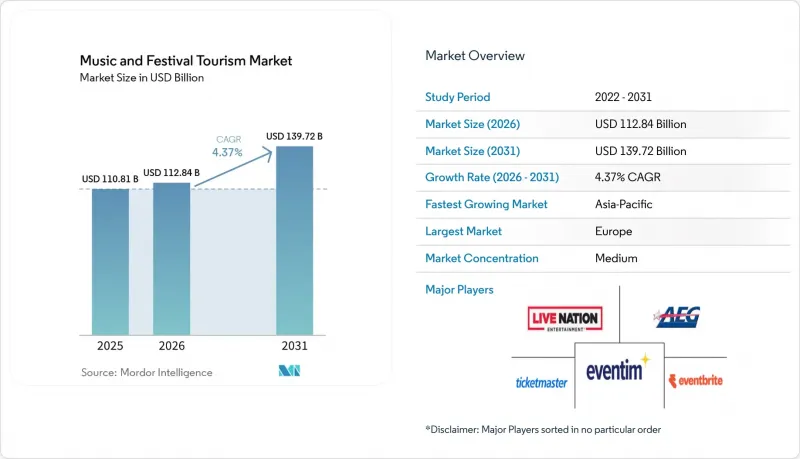
據 Mordor Intelligence 稱,2025 年全球音樂和節日旅遊市場價值 1108.1 億美元,預計到 2031 年將達到 1397.2 億美元,而 2026 年為 1128.4 億美元,預測期內(2026-2031 年)的複合年成長率為 4.37%。
全球音樂與節慶旅遊市場趨勢與洞察
目的地導向現場音樂巡迴的需求日益成長。
如今,現場音樂旅遊已成為許多消費者出行的主要動機,音樂節旅遊市場的需求群體也日益擴大,涵蓋各個年齡層。現場娛樂活動正成為推動旅行的重要動力,尤其是在年輕旅行者中,音樂會、音樂節和表演藝術體驗往往會對目的地選擇和旅行計劃產生重大影響。在印度,與大型音樂活動相關的城際旅行增加也反映了娛樂驅動型旅行日益成長的影響力。基礎設施建設和巡迴線的擴張進一步推動了這一趨勢,印度Z世代旅行者每次音樂活動旅行的平均支出約為570美元。這種轉變對音樂節旅遊市場意義重大,因為活動驅動型旅行能夠提升當地酒店需求,增加餐飲和交通方面的支出,並且一旦音樂節獲得認可,就能吸引遊客再次造訪舉辦城市。
高階節慶套裝行程和VIP旅遊套裝行程的成長
音樂節旅遊市場正從以門票為主的模式轉向融合旅行、住宿和高階服務的綜合套餐模式。 VIP和加值服務的提供在現場音樂場館和大型音樂節上呈現強勁成長勢頭,反映出人們對更優質的住宿、專屬通道、高級座位和差異化活動體驗的需求日益成長。 Live Nation正在其旗下所有露天劇場推廣加值服務策略。 Tomorrowland的「全球之旅」計畫也遵循類似的邏輯,為來自180個國家的參與者提供機票、飯店、接送和音樂節門票的打包服務,從而提高了每位遊客的收入,遠高於單獨售票的收入。這對於音樂節旅遊市場而言是一個關鍵促進因素,因為它提高了每位遊客的收入,提升了預訂的可見度,並使組織者能夠更精細地控制遊客從發現活動到現場消費的整個行程。
旅行總成本高昂,限制了對價格敏感的人參與。
音樂節旅遊市場持續面臨嚴峻的經濟限制。這是因為包括門票、住宿、交通、餐飲和周邊商品在內的旅行總成本相當可觀。個人消費成長放緩給家庭帶來越來越大的壓力,降低了可支配收入的柔軟性,導致人們在非必要旅行和休閒的支出更加謹慎。此外,人們注意到,雖然旅遊頻率保持不變,但每次旅行的支出卻在下降,因為旅行者傾向於選擇距離較近的目的地和價格較低的住宿設施。這個問題也影響著印度。儘管印度民眾對實況活動旅行的興趣日益濃厚,但年輕旅行者,尤其是在城際和國際旅行中,仍然需要控制成本。因此,音樂節旅遊市場中高階遊客和價格敏感型遊客之間的差距正在擴大,而小規模的音樂節也越來越難以維持價格親民的水平。
細分市場分析
到2025年,「音樂節旅遊」將佔音樂節旅遊市場的34.8%,成為領先的活動類型。這一地位反映了將音樂節目與社交、文化和目的地體驗相結合的多日活動模式的優勢。格拉斯頓伯里音樂節、科切拉音樂節、明日世界音樂節和里約搖滾音樂節等旗艦品牌透過比一日活動更長的預訂週期和更強的住宿需求,繼續鞏固這一領先地位。演唱會旅遊仍然是第二大支柱,因為體育館巡迴演出和藝術家駐場演出即使在較短的時間內也能帶來集中的住宿和交通需求。專注於文化和傳統音樂的音樂節也在擴大其影響力,吸引對文化遺產感興趣的旅客前往那些音樂活動與當地特色和深厚文化底蘊緊密相連的目的地。
預計到2031年,電子舞曲音樂節將以5.6%的複合年成長率成長,成為音樂節旅遊市場中成長最快的活動形式。這一成長勢頭與高度擴充性的品牌、年輕旅行者的需求以及將成熟模式推廣到新地點的能力密切相關。政府主導的擴張在亞太地區尤其顯著,泰國已成為全球公認的電子舞曲音樂節舉辦地,並成為推動活動旅遊長期成長的重要力量。這一模式對印度也至關重要,印度大都會圈對音樂節的需求不斷成長,在消費水平高的城市複製這種活動形式也變得更加可行。因此,整個音樂節旅遊業呈現出明顯的兩極化:多日目的地音樂節擁有最大的基本客群,而電子舞曲音樂節則在政策支持、年輕人需求和數位化推廣的推動下,發展速度更快。
預計到2025年,國內遊客將佔音樂節旅遊市場68.7%的市場佔有率,這意味著對於大多數音樂節而言,本地和城際遊客仍將構成其客群的核心。這一佔有率主要歸功於國內遊客出行門檻低、手續簡便,以及即使在音樂節日程安排緊湊的情況下,人們也能輕鬆重複參加。在印度等都市區音樂需求不斷成長的市場,國內旅遊尤其重要,因為價格敏感度仍然影響著人們的長途旅行決策。此外,國內遊客能夠提供更穩定的收入來源,使主辦單位更有信心規劃場地、人員配備和門票庫存。在音樂節旅遊市場中,國內市場的深度對於支撐基礎建設至關重要,而國際旅遊帶來的附加價值需求才能真正發揮作用。
預計到2031年,國際遊客將以5.3%的複合年成長率成長,成為音樂節旅遊市場中成長最快的遊客群。他們的貢獻意義重大,因為跨境遊客往往在機票、停留時間和旅行套餐等方面花費更多。歐洲憑藉其高頻率的活動和完善的交通網路,仍處於受益於此趨勢的有利地位。同時,由於年輕一代對海外旅行和入境旅遊的需求不斷成長,亞太地區也正在蓬勃發展。因此,儘管音樂節旅遊業仍依賴國內需求來實現規模擴張,但其對國際遊客的依賴程度越來越高,以提高每位遊客的盈利。
區域分析
預計到2025年,歐洲將佔據34.4%的市場佔有率,引領音樂節旅遊市場。這反映了該地區完善的音樂節基礎設施、豐富多樣的活動選擇以及便利的短途旅行。英國仍然是最突出的例子之一,2024年將有2350萬音樂遊客參與演出,創造100億英鎊的經濟效益。同時,國際音樂遊客數量較去年同期成長62%,達到160萬人次。德國也持續保持強勁勢頭,行業報告顯示,德國每年有超過500萬的常規音樂會觀眾,而德國音樂節協會(BDKV)的數據也始終表明,德國民眾仍然非常願意為了實況活動而旅行。儘管歐洲憑藉其龐大的規模仍然擁有最廣泛的音樂節受眾群體,但該地區對許可證壓力、噪音管制和交通堵塞的擔憂也日益加劇。簡而言之,歐洲仍然是音樂節旅遊市場最大的地區,但隨著市場的成熟,某些都市區場館的營運條件也變得更加嚴格。
北美憑藉大規模活動品牌、強大的購買力以及先進的推廣和售票系統,在音樂節旅遊市場中保持著強勁的地位。預計到2025年,光是奧斯汀城市極限音樂節(Austin City Limits Music Festival)一項就將帶來5.578億美元的直接經濟效益,其中8740萬美元來自酒店收入,這充分展現了該地區旗艦活動的持續影響力。 Live Nation預計2026年第一季的營收將達到37.9億美元(年增12%),儘管營運成本不斷上升,但仍超出分析師的預期。該公司也累計66億美元的遞延收入,反映出領先對2026年巡迴季的強勁需求。南美洲也日益受到關注,這得益於推廣商投資的增加以及粉絲對藝人主導的旅遊活動的需求不斷成長。該地區的粉絲群如今已具備在目的地層面創造巨大需求的能力,這意味著南美洲未來將在更廣泛的音樂節旅遊市場中扮演更重要的角色。
預計到2031年,亞太地區將以6.1%的複合年成長率成長,成為音樂節旅遊市場成長最快的區域叢集。該地區受益於年輕的人口結構、不斷擴大的中產階級消費以及公眾對現場娛樂的支持,這些都成為旅遊業發展的催化劑。印度在這一趨勢中表現突出,其城際活動旅遊已呈現蓬勃發展態勢,都市區對音樂的需求日益成長,並且更加注重在主要消費中心舉辦大規模音樂節。韓國正在建構以K-pop粉絲群為中心的跨國音樂節模式,而泰國則利用其全球知名的音樂節資源來鞏固其在入境旅遊中的地位。中東和非洲的規模仍小於以往。儘管如此,投資興趣正在成長,當地城市的音樂節旅遊已經產生了可觀的本地收益,烏干達的“Nyege Nyege”音樂節就是一個例證。
其他好處:
- Excel格式的市場預測(ME)表
- 3個月的分析師支持
目錄
第1章:引言
- 研究假設和市場定義
- 調查範圍
第2章:調查方法
第3章執行摘要
第4章 市場狀況
- 市場概覽
- 市場促進因素
- 目的地導向現場音樂巡迴的需求日益成長。
- 高階節慶套裝行程和VIP旅遊套裝行程的成長
- 活動旅遊帶來的消費會蔓延到住宿、餐飲和當地交通等領域。
- 藝術家帶領的粉絲朝聖之旅和多次訪問
- 區域城市和非主要旅遊目的地的節慶活動
- 線上搜尋、預訂和票務轉售生態系統的擴展
- 市場限制因素
- 高昂的旅行總成本限制了對價格敏感族群的參與。
- 活動取消、天氣變化和安全風險。
- 簽證辦理的複雜性以及跨境旅行的繁瑣細節。
- 當地社區對噪音、交通擁擠和過度旅遊的強烈反對
- 監理情勢
- 技術展望
- 波特五力分析
第5章 市場規模及成長預測(美元,金額)
- 按事件類型
- 音樂會旅遊
- 音樂節旅遊
- 文化傳統音樂節
- 電子舞曲(EDM)節
- 其他(宗教/靈性、古典/歌劇、爵士/藍調音樂節等)
- 按旅行者類型
- 國內的
- 國際的
- 透過預訂方式
- 線上旅行社
- 直接預訂
- 旅行社
- 支出類別
- 票
- 住宿
- 運輸
- 食品/飲料
- 產品和VIP體驗
- 按地區
- 北美洲
- 美國
- 加拿大
- 墨西哥
- 南美洲
- 巴西
- 秘魯
- 智利
- 阿根廷
- 其他南美國家
- 歐洲
- 英國
- 德國
- 法國
- 西班牙
- 義大利
- 比荷盧經濟聯盟(比利時、荷蘭、盧森堡)
- 北歐國家(丹麥、芬蘭、冰島、挪威、瑞典)
- 其他歐洲國家
- 亞太地區
- 印度
- 中國
- 日本
- 澳洲
- 韓國
- 東南亞(新加坡、馬來西亞、泰國、印尼、越南、菲律賓)
- 其他亞太國家
- 中東和非洲
- 阿拉伯聯合大公國
- 沙烏地阿拉伯
- 南非
- 奈及利亞
- 其他中東和非洲國家
- 北美洲
第6章 競爭情勢
- 市場集中度
- 策略趨勢
- 市佔率分析
- 公司簡介
- Live Nation Entertainment Inc.
- Anschutz Entertainment Group
- CTS Eventim AG & Co. KGaA
- TEG Pty Ltd
- DEAG Deutsche Entertainment AG
- HYBE Co., Ltd.
- MSG Entertainment Holdings, LLC
- Glastonbury Festival Events Limited
- WEAREONE.world BV
- Danny Wimmer Presents LLC
- Superstruct Entertainment Limited
- Percept Limited
- Nodwin Gaming Pvt. Ltd.
- Eventbrite, Inc.
- Viagogo Entertainment Inc.
- Vivid Seats LLC
- SeatGeek Inc.
- Fever Labs Inc.
- Bandsintown LLC
- ACFEA Tour Consultants Inc.
- Live Nation Entertainment Inc.
第7章 市場機會與未來展望
According to Mordor Intelligence, the global music and festival tourism market size was valued at USD 110.81 billion in 2025 and is estimated to grow from USD 112.84 billion in 2026 to reach USD 139.72 billion by 2031, at a CAGR of 4.37% during the forecast period (2026-2031).
Global Music and Festival Tourism Market Trends and Insights
Rising Demand for Destination-Led Live Music Travel
Live music travel is now a primary trip trigger for a meaningful share of consumers, giving the Music festival tourism market a broader demand base across age groups. Live entertainment is increasingly becoming a key driver of travel, particularly among younger travelers, with concerts, festivals, and performing arts experiences often shaping destination choices and trip planning. India is also witnessing growing intercity travel linked to major music events, reflecting the rising influence of entertainment-led travel, a trend supported by growing infrastructure and the expansion of touring circuits, with average per-trip spending among Gen Z indian travelers reaching approximately USD 570 per music-event trip. That shift matters for the Music festival tourism market because event-led travel strengthens local hotel demand, boosts food and mobility spending, and provides newer host cities with a repeat-visit pathway once festival awareness is established.
Growth of Premium Festival Packages and VIP Travel Bundles
The Music festival tourism market is moving away from a model centered solely on ticket sales toward a broader package model that combines travel, hospitality, and premium access. VIP and premium offerings are experiencing strong growth across live music venues and major festivals, reflecting increasing demand for enhanced hospitality, exclusive access, premium seating, and differentiated event experiences. Live Nation is expanding its premium offering strategy across amphitheaters. Tomorrowland's Global Journey program follows the same logic, packaging flights, hotels, transfers, and festival passes for attendees from 180 countries, thereby boosting revenue per traveler compared to a stand-alone ticket. This is a key driver for the Music festival tourism market because it increases yield per attendee, improves booking visibility, and gives operators more control over the traveler journey from discovery to on-site spending.
High Total Trip Cost Limits Price-Sensitive Participation
The Music festival tourism market still faces a clear affordability constraint because the total trip cost combines tickets, lodging, transport, food, and merchandise into one high outlay. Slowing consumer spending growth is creating greater pressure on household budgets, reducing disposable income flexibility and making non-essential travel and leisure spending more discretionary. It also notes that trip frequency is holding, but per-trip spend is falling as travelers shift to closer destinations and lower accommodation tiers. This issue affects India as well, because rising interest in live-event travel does not eliminate the need for cost discipline among younger travelers, especially for intercity or international trips. In the Music festival tourism market, the result is a wider gap between premium attendees and price-sensitive audiences, while smaller festivals face greater difficulty preserving accessible price points.
Other drivers and restraints analyzed in the detailed report include:
- Event Tourism Spending Spillover into Lodging, Food, and Local Mobility
- Artist-Driven Fan Pilgrimage Behavior and Repeat Attendance
- Event Cancellations, Weather Volatility, and Safety Risk
For complete list of drivers and restraints, kindly check the Table Of Contents.
Segment Analysis
Music Festival Tourism accounted for 34.8% of the Music festival tourism market size in 2025, making it the leading event type. This position reflects the strength of multi-day formats that combine music programming with social, cultural, and destination experiences. Flagship brands such as Glastonbury, Coachella, Tomorrowland, and Rock in Rio continue to support this leadership because they create long booking windows and stronger accommodation demand than single-day formats. Concert tourism remained the second major pillar because arena tours and artist residencies can still generate concentrated lodging and transportation demand over shorter timeframes. Cultural and traditional music festivals also widened their role by attracting heritage-focused travelers in destinations where music events are tied to local identity and established cultural settings.
EDM festivals are projected to grow at a 5.6% CAGR through 2031, making them the fastest-expanding event format in the Music festival tourism market. Their momentum is linked to scalable branding, younger traveler demand, and the ability to franchise proven concepts across new destinations. State-backed expansion is particularly evident in Asia-Pacific, where Thailand has positioned itself as a host market for globally recognized EDM properties and as a driver of long-term growth in event tourism. That model matters for India because festival demand in large urban centers is deepening and format replication is becoming more feasible in high-consumption cities. The wider Music festival tourism industry is therefore seeing a clear split, with multi-day destination festivals holding the largest base and EDM formats moving faster as policy support, youth demand, and digital discoverability converge.
Domestic travelers held a 68.7% share of the Music festival tourism market in 2025, indicating that local and intercity attendance still form the attendance base for most festivals. This share is grounded in lower travel friction, lower documentation barriers, and easier access to repeat attendance across dense festival calendars. In markets such as India, domestic movement is especially important because urban music demand is rising while price sensitivity still shapes long-haul decisions. Domestic attendance also provides a more stable revenue floor, which helps operators plan venues, staffing, and ticket inventory with greater confidence. In the Music festival tourism market, this domestic depth supports infrastructure development first, before international travel adds higher-value demand.
International travelers are projected to grow at a 5.3% CAGR through 2031, making them the fastest-growing traveler group in the Music festival tourism market. Their contribution is important because cross-border attendees tend to spend more per trip on flights, longer stays, and bundled experiences. Europe remains well-positioned to benefit from this trend because of its dense event calendar and strong intra-regional connectivity, while Asia-Pacific is building momentum through younger outbound and inbound demand. The Music festival tourism industry, therefore, continues to rely on domestic volume for scale, but it depends on international travelers for stronger per-visitor economics.
Complete Report Scope:
- By Event Type
- Concert Tourism
- Music Festival Tourism
- Cultural & Traditional Music Festivals
- Electronic Dance Music (EDM) Festivals
- Others (Religious & Spiritual,Classical & Opera,Jazz & Blues Festivals etc.)
- By Traveler Type
- Domestic
- International
- By Booking Mode
- Online Travel Agencies
- Direct Booking
- Travel Agents
- By Spending Category
- Tickets
- Accommodation
- Transportation
- Food & Beverage
- Merchandise & VIP Experiences
- By Geography
- North America
- United States
- Canada
- Mexico
- South America
- Brazil
- Peru
- Chile
- Argentina
- Rest of South America
- Europe
- United Kingdom
- Germany
- France
- Spain
- Italy
- BENELUX (Belgium, Netherlands, and Luxembourg)
- NORDICS (Denmark, Finland, Iceland, Norway, and Sweden)
- Rest of Europe
- Asia-Pacific
- India
- China
- Japan
- Australia
- South Korea
- South East Asia (Singapore, Malaysia, Thailand, Indonesia, Vietnam, and Philippines)
- Rest of Asia-Pacific
- Middle East and Africa
- United Arab Emirates
- Saudi Arabia
- South Africa
- Nigeria
- Rest of Middle East and Africa
- North America
Geography Analysis
Europe led the Music festival tourism market with 34.4% market share in 2025, reflecting the region's dense festival infrastructure, broad event mix, and strong short-haul travel connectivity. The United Kingdom remained one of the clearest examples, with 23.5 million music tourists attending shows in 2024 and generating GBP 10 billion in economic impact, while international music tourists rose to 1.6 million, up 62% year on year. Germany also continued to show resilience, with industry reports citing over 5 million regular concert attendees annually, as BDKV data consistently highlights a visitor base that remains highly willing to travel for live events. Europe's scale still gives it the broadest festival base, but the region is also where licensing pressure, noise rules, and congestion concerns are becoming more visible. That means Europe remains the largest region in the Music festival tourism market, even as its mature status brings tighter operating conditions in certain urban venues.
North America held a strong position in the Music festival tourism market because of its large event brands, high spending power, and advanced promoter-ticketing systems. Austin City Limits Music Festival alone generated USD 557.8 million in direct economic impact in 2025, including USD 87.4 million in hotel revenue, which shows the staying power of flagship events in the region. Live Nation reported Q1 2026 revenue of USD 3.79 billion (+12% year-on-year), beating analyst expectations despite higher operating costs, and recorded USD 6.6 billion in deferred revenue, reflecting robust forward demand for the 2026 touring season. South America is also gaining visibility as promoter investment expands and fan demand for artist-led travel events strengthens. Fan communities in the region can now generate destination-level demand at scale, which suggests a stronger role for South America within the wider Music festival tourism market over time.
Asia-Pacific is projected to grow at a 6.1% CAGR through 2031, making it the fastest-growing regional cluster in the Music festival tourism market. The region benefits from younger demographics, growing middle-class spending, and public support for live entertainment as a tourism catalyst. India stands out within this trend because intercity event travel has already moved up sharply, urban music demand is deepening, and large festival formats are being positioned more deliberately in major consumption centers. South Korea is building a cross-border festival model around K-pop fandom, while Thailand is using globally recognized festival properties to strengthen inbound tourism positioning. The Middle East and Africa remain smaller than they were. Still, investment interest is increasing, and Uganda's Nyege Nyege example shows that secondary-city festival tourism can already create measurable local returns.
- Live Nation Entertainment Inc.
Additional Benefits:
- The market estimate (ME) sheet in Excel format
- 3 months of analyst support
TABLE OF CONTENTS
1 Introduction
- 1.1 Study Assumptions and Market Definition
- 1.2 Scope of the Study
2 Research Methodology
3 Executive Summary
4 Market Landscape
- 4.1 Market Overview
- 4.2 Market Drivers
- 4.2.1 Rising Demand for Destination-Led Live Music Travel
- 4.2.2 Growth of Premium Festival Packages and VIP Travel Bundles
- 4.2.3 Event Tourism Spending Spillover Into Lodging, Food, and Local Mobility
- 4.2.4 Artist-Driven Fan Pilgrimage Behavior and Repeat Attendance
- 4.2.5 Festivalization of Secondary Cities and Non-Hub Destinations
- 4.2.6 Expansion of Online Discovery, Booking, and Ticket Resale Ecosystems
- 4.3 Market Restraints
- 4.3.1 High Total Trip Cost Limits Price-Sensitive Participation
- 4.3.2 Event Cancellations, Weather Volatility, and Safety Risk
- 4.3.3 Visa Friction and Cross-Border Travel Complexity
- 4.3.4 Local Community Pushback on Noise, Congestion, and Overtourism
- 4.4 Regulatory Landscape
- 4.5 Technological Outlook
- 4.6 Porter's Five Forces Analysis
- 4.6.1 Threat of New Entrants
- 4.6.2 Bargaining Power of Buyers
- 4.6.3 Bargaining Power of Suppliers
- 4.6.4 Threat of Substitutes
- 4.6.5 Competitive Rivalry
5 Market Size and Growth Forecasts (USD,Value)
- 5.1 By Event Type
- 5.1.1 Concert Tourism
- 5.1.2 Music Festival Tourism
- 5.1.3 Cultural & Traditional Music Festivals
- 5.1.4 Electronic Dance Music (EDM) Festivals
- 5.1.5 Others (Religious & Spiritual,Classical & Opera,Jazz & Blues Festivals etc.)
- 5.2 By Traveler Type
- 5.2.1 Domestic
- 5.2.2 International
- 5.3 By Booking Mode
- 5.3.1 Online Travel Agencies
- 5.3.2 Direct Booking
- 5.3.3 Travel Agents
- 5.4 By Spending Category
- 5.4.1 Tickets
- 5.4.2 Accommodation
- 5.4.3 Transportation
- 5.4.4 Food & Beverage
- 5.4.5 Merchandise & VIP Experiences
- 5.5 By Geography
- 5.5.1 North America
- 5.5.1.1 United States
- 5.5.1.2 Canada
- 5.5.1.3 Mexico
- 5.5.2 South America
- 5.5.2.1 Brazil
- 5.5.2.2 Peru
- 5.5.2.3 Chile
- 5.5.2.4 Argentina
- 5.5.2.5 Rest of South America
- 5.5.3 Europe
- 5.5.3.1 United Kingdom
- 5.5.3.2 Germany
- 5.5.3.3 France
- 5.5.3.4 Spain
- 5.5.3.5 Italy
- 5.5.3.6 BENELUX (Belgium, Netherlands, and Luxembourg)
- 5.5.3.7 NORDICS (Denmark, Finland, Iceland, Norway, and Sweden)
- 5.5.3.8 Rest of Europe
- 5.5.4 Asia-Pacific
- 5.5.4.1 India
- 5.5.4.2 China
- 5.5.4.3 Japan
- 5.5.4.4 Australia
- 5.5.4.5 South Korea
- 5.5.4.6 South East Asia (Singapore, Malaysia, Thailand, Indonesia, Vietnam, and Philippines)
- 5.5.4.7 Rest of Asia-Pacific
- 5.5.5 Middle East and Africa
- 5.5.5.1 United Arab Emirates
- 5.5.5.2 Saudi Arabia
- 5.5.5.3 South Africa
- 5.5.5.4 Nigeria
- 5.5.5.5 Rest of Middle East and Africa
- 5.5.1 North America
6 Competitive Landscape
- 6.1 Market Concentration
- 6.2 Strategic Moves
- 6.3 Market Share Analysis
- 6.4 Company Profiles (includes Global Level Overview, Market Level Overview, Core Segments, Financials as available, Strategic Information, Market Rank/Share, Products and Services, Recent Developments)
- 6.4.1 Live Nation Entertainment Inc.
- 6.4.1.1 Anschutz Entertainment Group
- 6.4.1.2 CTS Eventim AG & Co. KGaA
- 6.4.1.3 TEG Pty Ltd
- 6.4.1.4 DEAG Deutsche Entertainment AG
- 6.4.1.5 HYBE Co., Ltd.
- 6.4.1.6 MSG Entertainment Holdings, LLC
- 6.4.1.7 Glastonbury Festival Events Limited
- 6.4.1.8 WEAREONE.world BV
- 6.4.1.9 Danny Wimmer Presents LLC
- 6.4.1.10 Superstruct Entertainment Limited
- 6.4.1.11 Percept Limited
- 6.4.1.12 Nodwin Gaming Pvt. Ltd.
- 6.4.1.13 Eventbrite, Inc.
- 6.4.1.14 Viagogo Entertainment Inc.
- 6.4.1.15 Vivid Seats LLC
- 6.4.1.16 SeatGeek Inc.
- 6.4.1.17 Fever Labs Inc.
- 6.4.1.18 Bandsintown LLC
- 6.4.1.19 ACFEA Tour Consultants Inc.
- 6.4.1 Live Nation Entertainment Inc.
7 MARKET OPPORTUNITIES AND FUTURE OUTLOOK
- 7.1 Market Opportunities
- 7.1.1 Small-City Festival Circuit Packaging
- 7.1.2 Sustainable Low-Carbon Event Travel Bundles
- 7.2 White-Space and Unmet-Need Assessment

 汽車人工智慧軟體市場預測至2034年-全球分析(按人工智慧軟體類型、軟體層、部署模式、車輛類型、驅動系統、車輛互聯、銷售管道、人工智慧技術、應用、最終用戶和地區分類)
 全球車隊管理軟體市場規模、佔有率、趨勢和成長分析報告(2026-2034)
 印度車輛管理軟體:市場佔有率分析、產業趨勢與統計及成長預測(2026-2031)汽車人工智慧軟體開發市場預測至2034年:按軟體類型、技術、部署模式、車輛類型、應用、最終用戶和地區分類的全球分析
 音樂節市場規模、佔有率和成長分析:按收入來源、音樂節類型、參與人數、形式、觀眾人口統計、組織者類型和地區分類——2026-2033年行業預測
 2026年全球音樂節市場報告
 自主移動機器人(AMR)市場分析及預測(至2035年):按類型、產品類型、服務、技術、組件、應用、部署類型、最終用戶和功能分類
 全球車隊遠端資訊處理市場按車輛類型、軟體包類型、供應商類型、解決方案類型和地區分類-預測至2032年
 半導體市場自適應模組化電阻器(AMR)按產品類型、技術節點、封裝技術、經營模式、晶圓尺寸、材料和最終用途分類-2026年至2032年全球預測
 車隊管理軟體市場規模、佔有率和成長分析(按類型、車隊類型、部署類型和地區分類)-2026-2033年產業預測