

 |
市場調查報告書
商品編碼
2154509
網路數位孿生平台:市場佔有率分析、產業趨勢與統計、成長預測(2026-2031)Network Digital Twin Platforms - Market Share Analysis, Industry Trends & Statistics, Growth Forecasts (2026 - 2031) |
||||||

※ 本網頁內容可能與最新版本有所差異。詳細情況請與我們聯繫。
據 Mordor Intelligence 稱,網路數位孿生平台市場在 2025 年的價值為 12 億美元,預計到 2031 年將從 2026 年的 14 億美元成長到 34 億美元,在預測期(2026-2031 年)內的複合年成長率為 18.5%。
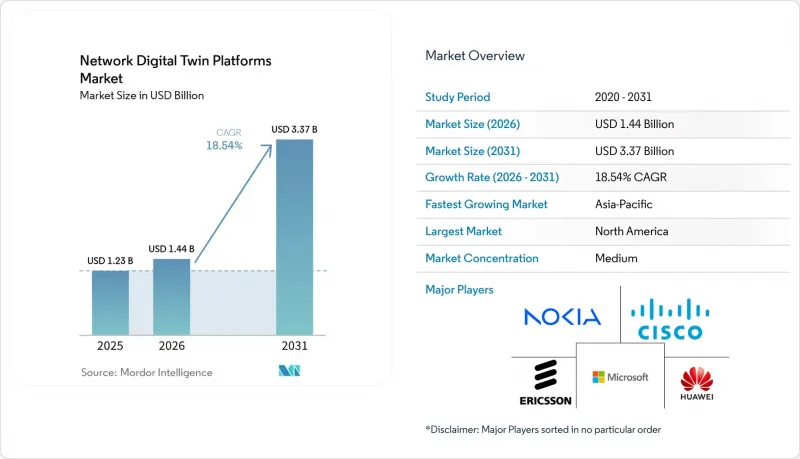
全球網路數位孿生平台市場趨勢與洞察
5G和開放式無線接取網路帶來的網路複雜性
隨著 5G 和 Open RAN 架構的解耦式發展,無線接取管理已從單一廠商的工程領域轉變為多廠商軟體協調任務,而這在傳統實驗室中難以大規模複製。 O-RAN 聯盟將高保真數位孿生定位為一種環境,用於在不中斷運作中營運的情況下訓練和檢驗xApp 和 rApp。同時,還需要同步物理測量數據、節點模型和 O1 遙測數據,以便在模型出現偏差時觸發重新同步。 2026 年 2 月,諾基亞在 NVIDIA 的 Aerial Omniverse 數位孿生平台上發布了其 RAN 數位孿生,該平台利用無線電波傳播模擬來評估波束成形、天線部署和切換性能在惡劣移動場景下的表現。 O-RAN 聯盟也支援東北大學的研究平台,可自動完成 xApp 和 rApp 的資料收集、訓練和測試。當電信業者在投資網路變更之前需要特定站點的證據時,網路數位孿生平台市場將從中受益。
封閉回路型自動化和基於代理的人工智慧的檢驗
隨著我們從基於規則的自動化轉向自主軟體代理,越來越需要一個安全的環境來測試提案的變更,然後再部署到生產系統。 ETSI 將數位孿生定義為用於試驗自癒和自最佳化網路的虛擬沙箱,其重點在於支援孿生輸出以支援閉合迴路自動化的介面。 NVIDIA 表示,在確定糾正措施的優先順序時,它會在自主通訊工作中結合使用營運支援系統、業務支援系統、遙測技術和數位孿生技術。該模型更加強調可靠的資料連接器和清晰的本體管理,因為同步不良的副本無法安全地指導自動化活動。供應商在校準、模型維護和整合方面也扮演著持續的角色,而不是像以往那樣僅在專案規劃中發揮有限作用。隨著電信業者開始將數位孿生視為營運層而非僅僅是設計工具,網路數位孿生平台市場迎來了成長機會。
高傳真射頻和GPU基礎設施的成本
高傳真射頻模擬需要專用運算資源、經過校準的真實世界資料以及持續的處理能力,這對於IT預算有限的二三線業者來說難以實現。據VIAVI稱,城市級無線接入網(RAN)模擬需要GPU加速和符合O-RAN標準的軟體,這些軟體是為檢驗人工智慧(AI)應用而建構的。雲端託管運算可以降低前期投資,但如果網路遙測資料受到監管或被視為高度敏感的營運訊息,則可能引發資料主權方面的擔憂。歐洲電信標準化協會(ETSI)也為網路運作中使用的AI系統制定了網路安全要求。運營商必須權衡準確性、安全性和營運成本,而不是孤立地評估運算能力。這種限制可能會減緩價格敏感的網路數位孿生平台市場的普及速度。
細分市場分析
預計到2025年,軟體將佔網路數位孿生平台市場的63.2%,並預計在2031年之前以20.12%的複合年成長率成長。這反映了市場採購模式從以硬體為中心的模式轉向基於訂閱和雲端交付的解決方案。此類別包括平台核心、模擬引擎、分析模組、資料和拓樸管理層,以及編配和保障工具。平台層聚合不同供應商的遙測數據,承載人工智慧推理,並為第三方自動化工具提供應用介面。由於該層連接營運商使用的資料、模型和營運應用程式,因此對該層的控制會影響整個技術堆疊的切換成本。因此,軟體將繼續是平台環境中的核心控制點。
服務內容包括諮詢、系統整合、部署、遷移和託管支持,旨在彌合軟體採購與營運部署之間的差距。電信業者在數位孿生技術方面經驗有限,通常需要外部支援來提高模型精度、轉換資料模式並將營運支援系統連接到新平台。系統整合在多廠商網路環境中尤其重要,因為可能需要客製化中間件來協調不同設備和效能等級的資料結構。 TM Forum 的「開放數位架構」提供了通用框架,可以推動對這些整合服務的需求。此外,利用託管服務可以將校準、模型重新訓練、同步監控和服務等級課責從一次性實施專案轉變為持續的合約。這種方法確保營運商在初始部署之後仍能持續獲得專家資源的支援。
預計到2025年,基於雲端的部署將佔網路數位孿生平台收入的56.77%,這主要得益於電信業者對可根據處理需求擴展的彈性運算資源的偏好。詳細的無線接入網(RAN)模擬和能源最佳化需要強大的運算能力,但這些需求並非全天恆定不變。雲端部署使電信業者能夠在無需維護同等規模的專用本地運算環境的情況下擴展工作負載。此外,雲端部署還支援在分散式營運環境中更快地部署分析、資料管理和應用程式更新。這些優勢凸顯了雲端解決方案目前處於領先地位的原因,尤其對於那些希望擴展模擬容量、更新分析功能以及在不取代本地基礎設施的情況下將平台擴展到分散式網路站點的電信業者而言更是如此。
混合部署將基於雲端的人工智慧和模擬功能與對延遲敏感且受監管資料的本地處理相結合,預計到 2031 年將以 19.87% 的複合年成長率成長。 Tech Mahindra 和微軟將於 2026 年 6 月合作,將 Azure 服務、Azure 數位孿生和人工智慧框架整合到複雜的多廠商通訊環境中。對於管理敏感配置、資料本地化要求或出口管制義務的電信業者而言,本地系統仍將繼續發揮至關重要的作用。 ETSI 關於人工智慧處理的可解釋性和透明度的指導可能會鼓勵營運商將敏感的訓練資料保留在本地,同時利用雲端容量處理其他工作負載。因此,混合部署既可以滿足資料管理需求,又能保持對可擴展運算資源的訪問,這在當地法規、商業合約或內部安全策略限制網路遙測資料傳輸時至關重要。
區域分析
預計到2025年,北美將佔據網路數位孿生平台市場27.87%的佔有率。該地區擁有眾多一級營運商、雲端服務供應商和獨立的5G部署機構,因此對即時模擬和運行測試的需求持續旺盛。美國是主要貢獻者,金融服務公司、政府機構和大型企業對該平台的採用率不斷提高。在加拿大,這些平台正被用於遍遠地區連接規劃,虛擬模型減少了現場勘測的需求。在墨西哥,類似的功能正被應用於5G頻段和多頻段無線電規劃。
歐洲在網路數位孿生平台市場佔據第二大區域叢集。德國、英國和法國憑藉其成熟的電信營運商基礎和專注於網路能源效率的政策,為市場活動提供了有力支持。歐洲電信概念驗證(PoC)。 ETSI 在零接觸服務管理方面的努力也為孿生平台與運作環境之間的介面整合奠定了基礎。在義大利和一些較小的歐洲國家,部署仍處於早期階段,光纖存取現代化和傳輸規劃是主要應用場景。在巴西和阿根廷,針對入門級 5G 容量規劃解決方案的試點計畫正在進行中,這些解決方案對模擬環境的要求較低,為在南美洲的更廣泛部署奠定了基礎。
預計到2031年,亞太地區網路數位孿生平台市場將以20.11%的複合年成長率成長,成為所有地區中成長最快的市場。中國的城市級項目、韓國先進的5G部署以及日本系統性的6G研究正在推動該地區的發展勢頭。 KDDI的一個聯合專案計劃於2026年6月啟動,該專案將結合無線電波傳播模擬、用戶設備模擬和GPU計算,預計於2028年3月完成原型開發。 KDDI印度公司正在推動農村寬頻計畫的數位孿生部署,而沙烏地阿拉伯和阿拉伯聯合大公國則正在利用這些平台支援智慧城市計畫和5G網路擴展。非洲仍然是該地區最小的市場,基礎設施成本的限制使得部署主要局限於已規劃的應用。然而,雲端運算的日益普及可能會在預測期的後半段推動部署規模的擴大。
其他好處:
- Excel格式的市場預測(ME)表
- 3個月的分析師支持
目錄
第1章:引言
- 研究假設和市場定義
- 調查範圍
第2章:調查方法
第3章執行摘要
第4章 市場狀況
- 市場概覽
- 市場促進因素
- 5G和開放式RAN網路的複雜性
- 封閉回路型自動化和基於代理的人工智慧的檢驗
- 網路強制性能源最佳化和碳排放減少
- 雲端原生、邊緣和多重雲端基礎設施的成長
- 人工智慧原生6G和高保真無線接入網的研究
- 利用數位孿生技術實現光纖和固定接入網路的現代化
- 市場限制因素
- 高精度射頻和GPU基礎設施的成本
- 多個供應商造成的資料、模式和本體碎片化
- 雙活網路連線相關的網路安全風險
- 電信業人工智慧和數位孿生人才短缺
- 宏觀經濟因素對市場的影響
- 產業價值鏈分析
- 監理情勢
- 技術展望
- 波特五力分析
第5章 市場規模與成長預測
- 按組件
- 軟體
- 網路數位孿生平台軟體
- 模擬和模擬軟體
- 分析、人工智慧和最佳化軟體
- 數據、庫存、拓樸軟體
- 編配與保障軟體
- 服務
- 諮詢和顧問服務
- 系統整合服務
- 實施和遷移服務
- 託管營運和支援服務
- 軟體
- 部署模式
- 基於雲端的
- 現場
- 混合
- 透過網路域
- 無線接取網路
- 核心網路
- 運輸和回程傳輸
- 邊緣運算和多接入邊緣運算
- 固定寬頻和光纖接取
- 其他網路網域
- 透過使用
- 網路設計與規劃
- 網路效能監控與保障
- 預測性維護和故障管理
- 容量規劃與交通最佳化
- 安全測試和合規性檢驗
- 其他用途
- 最終用戶
- 電信服務供應商
- 行動電信商
- 網際服務供應商
- 塔樓公司
- 網路設備製造商
- 其他最終用戶
- 按地區
- 北美洲
- 美國
- 加拿大
- 墨西哥
- 南美洲
- 巴西
- 阿根廷
- 其他南美國家
- 歐洲
- 德國
- 英國
- 法國
- 義大利
- 其他歐洲國家
- 亞太地區
- 中國
- 日本
- 韓國
- 印度
- 其他亞太國家
- 中東
- 沙烏地阿拉伯
- 阿拉伯聯合大公國
- 其他中東國家
- 非洲
- 南非
- 奈及利亞
- 其他非洲國家
- 北美洲
第6章 競爭情勢
- 市場集中度
- 策略趨勢
- 市佔率分析
- 公司簡介
- Nokia Corporation
- Telefonaktiebolaget LM Ericsson
- Huawei Technologies Co., Ltd.
- Microsoft Corporation
- VIAVI Solutions Inc.
- Cisco Systems, Inc.
- Juniper Networks, Inc.
- NEC Corporation
- Samsung Electronics Co., Ltd.
- Amazon Web Services, Inc.
- International Business Machines Corporation
- Keysight Technologies, Inc.
- Spirent Communications plc
- Ansys, Inc.
- Forward Networks, Inc.
- Mavenir Systems, Inc.
- Oracle Corporation
- Siemens AG
- Netcracker Technology Corporation
- Cohere Technologies, Inc.
第7章 市場機會與未來展望
According to Mordor Intelligence, the network digital twin platforms market size was valued at USD 1.2 billion in 2025 and is estimated to grow from USD 1.4 billion in 2026 to reach USD 3.4 billion by 2031, at a CAGR of 18.5% during the forecast period (2026-2031).
Global Network Digital Twin Platforms Market Trends and Insights
5G and Open RAN Network Complexity
Disaggregated 5G and Open RAN architectures have changed radio access management from a single-vendor engineering discipline into a multi-vendor software coordination task that conventional labs cannot reproduce at scale. The O-RAN Alliance identifies high-fidelity digital twins as an environment for training and validating xApps and rApps without interrupting live operations, while requiring synchronized physical measurements, node models, and O1 telemetry that can trigger resynchronization when a model drifts. Nokia launched its RAN Digital Twin on NVIDIA's Aerial Omniverse Digital Twin platform in February 2026, using radio propagation simulation to assess beamforming, antenna placement, and handover performance in demanding mobility scenarios. The O-RAN Alliance also supports a research platform at Northeastern University that automates data collection, training, and testing for xApps and rApps. The Network digital twin platforms market benefits when operators require site-specific evidence before committing capital to network changes.
Closed-Loop Automation and Agentic AI Validation
The move from rule-based automation to autonomous software agents raises the need for a safe environment to test proposed changes before they reach production systems. ETSI describes digital twins as a virtual sandbox for experimentation with self-healing and self-optimizing networks, and its work addresses interfaces that enable twin outputs to support closed-loop automation. NVIDIA states that its autonomous telecom work combines operational support systems, business support systems, telemetry, and digital twins when ranking remediation options. This model places greater importance on dependable data connectors and clearly governed ontology management, because a poorly synchronized replica cannot safely guide automated activity. It also gives suppliers a recurring role in calibration, model maintenance, and integration rather than a limited role in a planning project. The Network digital twin platforms market can gain as operators treat the twin as an operations layer rather than a design-only tool.
High-Fidelity RF and GPU Infrastructure Cost
High-fidelity radio-frequency simulation requires specialized compute resources, calibrated real-world data, and sustained processing capacity, which can be difficult for Tier 2 and Tier 3 operators with limited information technology budgets. VIAVI states that city-scale RAN simulations need GPU acceleration and O-RAN-compliant software built for AI application validation. Cloud-hosted compute can reduce upfront capital spending, but it can introduce data-sovereignty concerns where network telemetry is regulated or treated as sensitive operational information. ETSI has also established cybersecurity requirements for AI systems used in network operations. Operators must balance fidelity, security controls, and operating costs rather than evaluate compute capacity in isolation. This constraint can slow adoption in price-sensitive parts of the Network digital twin platforms market.
Other drivers and restraints analyzed in the detailed report include:
- Network Energy Optimization and Carbon-Reduction Mandates
- Cloud-Native, Edge, and Multi-Cloud Infrastructure Growth
- Multi-Vendor Data, Schema, and Ontology Fragmentation
For complete list of drivers and restraints, kindly check the Table Of Contents.
Segment Analysis
Software is projected to account for 63.2% of the network digital twin platforms market in 2025 and is projected to grow at a 20.12% CAGR through 2031, reflecting a shift toward subscription-based and cloud-delivered solutions rather than hardware-centric purchasing. The category includes platform cores, simulation and emulation engines, analytics modules, data and topology management layers, and orchestration and assurance tools. The platform layer aggregates telemetry across vendor domains, hosts AI inference, and provides application interfaces for third-party automation tools. Control of this layer can influence switching economics across the broader technology stack, as it connects the data, models, and operational applications operators use. Software, therefore, remains the central control point within the platform environment.
Services include advisory, systems integration, implementation, migration, and managed support, bridging the gap between software procurement and operational deployment. Operators with limited digital twin expertise often require external support to develop model fidelity, translate data schemas, and connect operational support systems to new platforms. Multi-vendor network estates make systems integration particularly important, as customized middleware may be required to reconcile different equipment and performance data structures. TM Forum's Open Digital Architecture provides a common framework that can increase demand for such integration services. Managed services can also transform calibration, model retraining, synchronization monitoring, and service-level accountability into recurring engagements rather than one-time implementation projects. This approach gives operators continued access to specialized resources after initial deployment.
Cloud-based deployment is projected to account for 56.77% of network digital twin platform revenue in 2025, driven by operators' preference for elastic computing resources that scale with processing requirements. Detailed RAN simulation and energy optimization require substantial computing capacity, although these requirements do not remain constant throughout the day. Cloud deployment allows operators to scale workloads without maintaining an equivalent dedicated on-premises computing estate. It also enables faster deployment of analytics, data management, and application updates across distributed operations. These advantages support the current leadership of cloud-based delivery, particularly among operators seeking to expand simulation capacity, update analytics capabilities, and extend platforms across dispersed network sites without replacing local infrastructure.
Hybrid deployment is forecast to grow at a 19.87% CAGR through 2031, as it combines cloud-based AI and simulation capabilities with local processing of latency-sensitive or regulated data. Tech Mahindra and Microsoft are expected to collaborate in June 2026 to combine Azure services, Azure Digital Twins, and AI frameworks for complex multi-vendor telecommunications environments. On-premises systems will remain relevant for operators managing classified configurations, data localization requirements, or export control obligations. ETSI guidance on the explainability and transparency of AI processing may encourage operators to retain sensitive training data locally while using cloud capacity for other workloads. Hybrid deployment can therefore address data control requirements while preserving access to scalable computing resources, which is important when local regulations, commercial contracts, or internal security policies restrict the movement of network telemetry.
Complete Report Scope:
- By Component
- Software
- Network Digital Twin Platform Software
- Simulation and Emulation Software
- Analytics, AI, and Optimization Software
- Data, Inventory, and Topology Software
- Orchestration and Assurance Software
- Services
- Consulting and Advisory Services
- Systems Integration Services
- Implementation and Migration Services
- Managed Operations and Support Services
- Software
- By Deployment Mode
- Cloud-Based
- On-Premise
- Hybrid
- By Network Domain
- Radio Access Network
- Core Network
- Transport and Backhaul
- Edge and Multi-Access Edge Computing
- Fixed Broadband and Fiber Access
- Other Network Domain
- By Application
- Network Design and Planning
- Network Performance Monitoring and Assurance
- Predictive Maintenance and Fault Management
- Capacity Planning and Traffic Optimization
- Security Testing and Compliance Validation
- Other Applications
- By End User
- Communication Service Providers
- Mobile Network Operators
- Internet Service Providers
- Tower Companies
- Network Equipment Manufacturers
- Other End Users
- By Geography
- North America
- United States
- Canada
- Mexico
- South America
- Brazil
- Argentina
- Rest of South America
- Europe
- Germany
- United Kingdom
- France
- Italy
- Rest of Europe
- Asia-Pacific
- China
- Japan
- South Korea
- India
- Rest of Asia-Pacific
- Middle East
- Saudi Arabia
- United Arab Emirates
- Rest of Middle East
- Africa
- South Africa
- Nigeria
- Rest of Africa
- North America
Geography Analysis
North America is expected to account for 27.87% of the Network Digital Twin Platforms Market in 2025. The region brings together tier-1 operators, cloud providers, and standalone 5G deployments, supporting sustained demand for real-time simulation and operational testing. The United States is the primary national contributor, with adoption across financial services firms, government agencies, and large enterprises. Canada uses these platforms for rural connectivity planning, where virtual models can reduce field survey requirements. Mexico applies similar capabilities to 5G spectrum and multiband radio planning.
Europe represents the second-largest geographic cluster in the Network Digital Twin Platforms Market. Germany, the United Kingdom, and France support market activity through established operator bases and policy focus on network energy efficiency. ETSI documented a Deutsche Telekom and Huawei proof of concept that used twin feedback loops for intent-driven RAN energy optimization. ETSI's work on zero-touch service management also establishes integration expectations for twin-to-live interfaces. Italy and smaller European countries remain in the early stages of adoption, with fiber access modernization and transport planning serving as the primary use cases. Brazil and Argentina are piloting entry-level 5G capacity planning solutions that require less complex simulation environments, creating a foundation for broader adoption across South America.
Asia-Pacific is forecast to grow at a CAGR of 20.11% through 2031, the highest regional growth rate in the Network Digital Twin Platforms Market. China's city-scale programs, South Korea's advanced 5G deployments, and Japan's structured 6G research are driving regional momentum. KDDI's planned June 2026 collaboration will combine radio propagation simulation, user equipment emulation, and GPU computing, with a prototype milestone scheduled for March 2028. KDDI India has promoted digital twins for rural broadband planning, while Saudi Arabia and the United Arab Emirates use these platforms to support smart city initiatives and 5G expansion. Africa remains the smallest regional market, as infrastructure costs limit adoption primarily to planning applications. However, broader availability of cloud computing could increase uptake later in the forecast period.
- Nokia Corporation
- Telefonaktiebolaget LM Ericsson
- Huawei Technologies Co., Ltd.
- Microsoft Corporation
- VIAVI Solutions Inc.
- Cisco Systems, Inc.
- Juniper Networks, Inc.
- NEC Corporation
- Samsung Electronics Co., Ltd.
- Amazon Web Services, Inc.
- International Business Machines Corporation
- Keysight Technologies, Inc.
- Spirent Communications plc
- Ansys, Inc.
- Forward Networks, Inc.
- Mavenir Systems, Inc.
- Oracle Corporation
- Siemens AG
- Netcracker Technology Corporation
- Cohere Technologies, Inc.
Additional Benefits:
- The market estimate (ME) sheet in Excel format
- 3 months of analyst support
TABLE OF CONTENTS
1 INTRODUCTION
- 1.1 Study Assumptions and Market Definition
- 1.2 Scope of the Study
2 RESEARCH METHODOLOGY
3 EXECUTIVE SUMMARY
4 MARKET LANDSCAPE
- 4.1 Market Overview
- 4.2 Market Drivers
- 4.2.1 5G and Open RAN Network Complexity
- 4.2.2 Closed-Loop Automation and Agentic AI Validation
- 4.2.3 Network Energy Optimization and Carbon-Reduction Mandates
- 4.2.4 Cloud-Native, Edge, and Multi-Cloud Infrastructure Growth
- 4.2.5 AI-Native 6G and High-Fidelity RAN Research
- 4.2.6 Digital Twin-Based Fiber and Fixed Access Modernization
- 4.3 Market Restraints
- 4.3.1 High-Fidelity RF and GPU Infrastructure Cost
- 4.3.2 Multi-Vendor Data, Schema, and Ontology Fragmentation
- 4.3.3 Cybersecurity Exposure From Twin-to-Live Network Connectivity
- 4.3.4 Scarcity of Telecom-Domain AI and Digital Twin Talent
- 4.4 Impact of Macroeconomic Factors on the Market
- 4.5 Industry Value Chain Analysis
- 4.6 Regulatory Landscape
- 4.7 Technological Outlook
- 4.8 Porter's Five Forces Analysis
- 4.8.1 Bargaining Power of Suppliers
- 4.8.2 Bargaining Power of Buyers
- 4.8.3 Threat of New Entrants
- 4.8.4 Threat of Substitutes
- 4.8.5 Competitive Rivalry
5 MARKET SIZE AND GROWTH FORECASTS (VALUE)
- 5.1 By Component
- 5.1.1 Software
- 5.1.1.1 Network Digital Twin Platform Software
- 5.1.1.2 Simulation and Emulation Software
- 5.1.1.3 Analytics, AI, and Optimization Software
- 5.1.1.4 Data, Inventory, and Topology Software
- 5.1.1.5 Orchestration and Assurance Software
- 5.1.2 Services
- 5.1.2.1 Consulting and Advisory Services
- 5.1.2.2 Systems Integration Services
- 5.1.2.3 Implementation and Migration Services
- 5.1.2.4 Managed Operations and Support Services
- 5.1.1 Software
- 5.2 By Deployment Mode
- 5.2.1 Cloud-Based
- 5.2.2 On-Premise
- 5.2.3 Hybrid
- 5.3 By Network Domain
- 5.3.1 Radio Access Network
- 5.3.2 Core Network
- 5.3.3 Transport and Backhaul
- 5.3.4 Edge and Multi-Access Edge Computing
- 5.3.5 Fixed Broadband and Fiber Access
- 5.3.6 Other Network Domain
- 5.4 By Application
- 5.4.1 Network Design and Planning
- 5.4.2 Network Performance Monitoring and Assurance
- 5.4.3 Predictive Maintenance and Fault Management
- 5.4.4 Capacity Planning and Traffic Optimization
- 5.4.5 Security Testing and Compliance Validation
- 5.4.6 Other Applications
- 5.5 By End User
- 5.5.1 Communication Service Providers
- 5.5.2 Mobile Network Operators
- 5.5.3 Internet Service Providers
- 5.5.4 Tower Companies
- 5.5.5 Network Equipment Manufacturers
- 5.5.6 Other End Users
- 5.6 By Geography
- 5.6.1 North America
- 5.6.1.1 United States
- 5.6.1.2 Canada
- 5.6.1.3 Mexico
- 5.6.2 South America
- 5.6.2.1 Brazil
- 5.6.2.2 Argentina
- 5.6.2.3 Rest of South America
- 5.6.3 Europe
- 5.6.3.1 Germany
- 5.6.3.2 United Kingdom
- 5.6.3.3 France
- 5.6.3.4 Italy
- 5.6.3.5 Rest of Europe
- 5.6.4 Asia-Pacific
- 5.6.4.1 China
- 5.6.4.2 Japan
- 5.6.4.3 South Korea
- 5.6.4.4 India
- 5.6.4.5 Rest of Asia-Pacific
- 5.6.5 Middle East
- 5.6.5.1 Saudi Arabia
- 5.6.5.2 United Arab Emirates
- 5.6.5.3 Rest of Middle East
- 5.6.6 Africa
- 5.6.6.1 South Africa
- 5.6.6.2 Nigeria
- 5.6.6.3 Rest of Africa
- 5.6.1 North America
6 COMPETITIVE LANDSCAPE
- 6.1 Market Concentration
- 6.2 Strategic Moves
- 6.3 Market Share Analysis
- 6.4 Company Profiles (includes Global Level Overview, Market Level Overview, Core Segments, Financials as available, Strategic Information, Market Rank/Share, Products and Services, Recent Developments)
- 6.4.1 Nokia Corporation
- 6.4.2 Telefonaktiebolaget LM Ericsson
- 6.4.3 Huawei Technologies Co., Ltd.
- 6.4.4 Microsoft Corporation
- 6.4.5 VIAVI Solutions Inc.
- 6.4.6 Cisco Systems, Inc.
- 6.4.7 Juniper Networks, Inc.
- 6.4.8 NEC Corporation
- 6.4.9 Samsung Electronics Co., Ltd.
- 6.4.10 Amazon Web Services, Inc.
- 6.4.11 International Business Machines Corporation
- 6.4.12 Keysight Technologies, Inc.
- 6.4.13 Spirent Communications plc
- 6.4.14 Ansys, Inc.
- 6.4.15 Forward Networks, Inc.
- 6.4.16 Mavenir Systems, Inc.
- 6.4.17 Oracle Corporation
- 6.4.18 Siemens AG
- 6.4.19 Netcracker Technology Corporation
- 6.4.20 Cohere Technologies, Inc.
7 MARKET OPPORTUNITIES AND FUTURE OUTLOOK
- 7.1 White-Space and Unmet-Need Assessment

 鐵路資產管理解決方案市場:全球市場預測,2026-2032年
 智慧工廠數位孿生市場預測至2034年—按孿生類型、技術、部署模式、應用、最終用戶和地區分類的全球分析
 2026年全球能源領域數位孿生市場報告
 資料中心數位孿生平台市場規模、市場佔有率及成長預測(2026-2032 年)2026年全球採礦業數位孿生市場報告2026年全球農業數位孿生市場報告2034年交通運輸業數位孿生市場預測-全球分析(依孿生範圍、實體資產、生命週期階段、同步等級、最終用戶及地區分類)
 商用車和車隊數位孿生的市場機會、成長動力、產業趨勢及 2026-2035 年預測。全球數位孿生市場規模、佔有率、趨勢和成長分析報告(2026-2034)
 數位孿生市場:按應用程式、最終用戶產業和地區分類