


 |
市場調查報告書
商品編碼
2154500
企業級人工智慧編碼代理:市場佔有率分析、產業趨勢與統計、成長預測(2026-2031)Enterprise AI Coding Agent - Market Share Analysis, Industry Trends & Statistics, Growth Forecasts (2026 - 2031) |
||||||

※ 本網頁內容可能與最新版本有所差異。詳細情況請與我們聯繫。
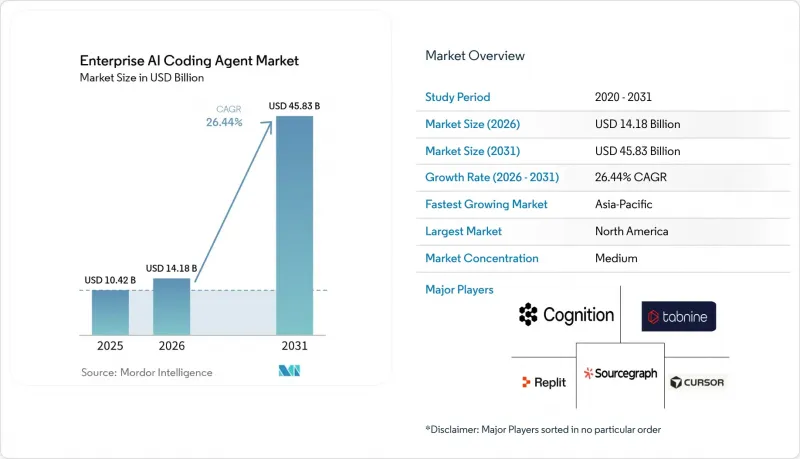
根據 Mordor Intelligence 預測,企業 AI 編碼代理市場規模將從 2025 年的 104.2 億美元成長到 2026 年的 141.8 億美元,到 2031 年將達到 458.3 億美元,2026 年至 2031 年的年複合成長率(CAGR)為 26.4%。
全球企業級人工智慧編碼代理市場趨勢與洞察
企業軟體工程中的容量限制
對於軟體密集型企業而言,工程能力是其營運的核心限制因素,這也推動了企業級人工智慧編碼代理市場的發展。一項於2025年針對微軟、Accenture和財富100強企業進行的實地研究發現,4,867名使用人工智慧編碼輔助工具的開發人員,其任務完成率提高了26.08%。微軟在2026年發布的一項研究發現,在工程師最常使用這些工具的幾週內,他們完成的拉取請求數量比未使用這些工具的幾週增加了40.5%。即使開發人員的個人生產力提高,大規模工程組織仍面臨日益成長的軟體需求。因此,自主任務執行變得比僅僅提供程式碼提案的工具更為重要,尤其是在團隊需要處理整個文件中一系列相關變更,而不是解決孤立的編碼問題時。企業級人工智慧編碼代理市場能夠幫助那些需要在不增加技術人員的情況下提升交付能力的企業。
擴展基於代理的軟體開發生命週期自動化
企業級AI編碼代理市場正從程式碼補全擴展到能夠在整個軟體開發生命週期中執行協同工作的系統。各組織正在部署代理商以支援多階段工作流程,到2026年,91%的公司將在生產代碼中部署AI編碼代理。代理驅動的工作流程可以將產品需求分解為各個任務,由專門的代理進行協調,並將輸出合併為統一的結果。 GitHub報告稱,遷移到多代理工作流程的組織,其拉取請求處理量增加了93.3%。這種營運模式正在改變採用AI編碼代理的理由,從輔助單一開發人員轉向自動化更廣泛的交付。此外,協同工作流程允許在需求定義、實現、檢驗和發布等活動之間轉移工作,最大限度地減少開發人員的直接干預,從而增加了對程式碼上線前測試、審查和批准的控制的必要性。
原始碼保密性和資料居住風險
當專有演算法、客戶資訊或關鍵基礎設施程式碼可能暴露於外部推理系統時,原始碼保密性仍然是一個重大障礙。歐盟委員會關於歐盟人工智慧法的指導意見規定了將於2026年8月2日生效的透明度要求。法律和安全團隊必須解讀這些要求如何應用於程式碼產生和高風險應用程式。此外,如果公共代碼或交叉許可義務在未被察覺的情況下添加到組織自身的程式碼庫中,則組織將面臨智慧財產權風險。 JFrog引入了人工智慧生成的程式碼檢驗功能,以在開發工作流程中識別惡意或不當的程式碼片段。 Tabnine將其企業情境引擎設計為在客戶的信任邊界內運行,除非另有規定。這些要求有利於企業人工智慧編碼代理市場受監管產業的私有雲端、本地部署和空氣間隙部署選項。在這些產業中,資訊處理方式的控制與實施速度同樣重要。
細分市場分析
2025年,人工智慧編碼助理佔據了產品細分市場的43.92%。這一佔有率反映了現有整合開發環境(IDE)工作流程中對人工智慧編碼助理的早期應用,以及即使在正式採購流程擴展之前,開發者個人也能夠輕鬆上手使用。此類別包括嵌入式輔助工具和獨立的編碼聊天介面。許多公司仍然將這些產品歸類為生產力工具,這影響了預算分配和部署速度,而必要的管治模式則由採購團隊負責制定。在企業級人工智慧編碼代理市場,編碼助理繼續被用作團隊獲取上下文相關提案和加速日常編碼任務的便捷入口。同時,開發者可以繼續沿用他們熟悉的編碼、測試和核准流程。
預計從2026年到2031年,自主軟體工程代理的複合年成長率將達到45.59%。這些系統能夠處理更廣泛的交付任務,只需極少的人工干預即可執行多步驟、多文件任務。 Cognition公司報告稱,2026年的企業年收入將達到4.92億美元,企業採用率已連續六個月環比成長超過50%。隨著程式碼產生量的成長和工程審查流程的日益繁重,人工智慧程式碼審查和管治平台的重要性也日益凸顯。長期的產品發展方向是將程式碼產生、測試、審查和配置的管治整合到一個更整合的套件中,從而支援團隊之間的交接,而無需將每個活動拆分到單獨的工具中。這種功能的擴展正在將企業級人工智慧編碼代理市場從一個狹義的助手類別轉變為一個託管軟體交付平台。
2025 年,程式碼補全功能佔比達 36.78%。這是最成熟的功能,並持續被企業開發團隊廣泛採用。其地位反映了開發者對程式碼補全功能的熟悉程度,他們已經在日常工作流程中使用此功能,此外,預測下一個標記以及對開發者介面的持續投入也功不可沒。 GitHub Copilot 和 Cursor 等工具協助建立了許多組織在啟動 AI 輔助開發時所採用的互動模型。程式碼補全仍然是一個實用的起點,因為開發者可以直接控制是否接受、編輯或拒絕提案的程式碼。
預計從 2026 年到 2031 年,自動化測試和檢驗將以 45.52% 的複合年成長率成長。程式碼產生和轉換、程式碼審查和最佳化以及測試正在協同工作,以支援整個交付週期中更廣泛的自動化模型。當開發團隊面臨發布期限的壓力時,測試往往不如功能開發那麼受到重視,但測試覆蓋率不足會增加發布後調查問題所需的時間。透過利用代理,可以在程式碼生成的同時創建測試套件,而無需等待實作完成。 Diffblue 於 2025 年發布了其“測試代理”,將測試生成定位為一個獨立的工程工作流程。 IBM 研究院的研究表明,使用編碼助理的企業團隊在其短期自動化計畫中優先考慮自動化測試覆蓋率,而不是程式碼審查。
區域分析
2025年,北美地區佔據了38.12%的區域市場。該地區擁有許多優勢,例如成熟的企業軟體買家群體、眾多超大規模資料中心業者和基礎設施模式供應商,以及大規模的開發人員群體。 Digital Applied在2026年第一季進行的一項調查顯示,北美地區71%的專業開發人員每天都會使用AI編碼代理。就區域需求而言,美國佔最大佔有率,金融服務公司和科技公司是推動AI編碼代理普及的主要力量。在加拿大和墨西哥,金融機構和公共部門組織的需求也隨之成長。 2026年,歐洲也是企業AI編碼代理市場的重要組成部分,德國、英國、法國、荷蘭和俄羅斯在其中扮演主導角色。 Adesso對500位德國企業高管進行的一項調查顯示,59%的公司使用基於代理的系統進行代碼生成和最佳化,而那些系統性地實施了這些系統的公司報告稱,其生產力提高了21%。調查還顯示,人工智慧成熟度較低的公司中有三分之一沒有報告可衡量的成果,這表明實施實踐會影響最終結果。此外,歐盟的透明度要求正在推動歐洲對管治和審計追蹤工具的需求。
預計亞太地區2026年至2031年的複合年成長率將達到45.57%。在日本,該國面臨工程人才短缺和遺留程式碼老化等挑戰,因此,人工智慧代理作為解決人才短缺問題的方案,其重要性日益凸顯。 2026年1月,瑞穗證券開始為70名工程師部署Cognition公司的「Devin」系統,目標是在2026會計年度下半年實現整個軟體生命週期的自動化。在中國,人工智慧編碼供應商的總收入在2025年達到3.99億元人民幣(約5,500萬美元),其中阿里巴巴旗下的Qoder佔據了47.6%的收入佔有率。根據同一資訊來源的數據,到2025年,中國將有30%的開發人員使用人工智慧編碼工具,而美國則高達91%。在OutSystems調查對象國家中,印度擁有專業人工智慧代理用戶比例最高的國家。澳洲和韓國在全面實施之前就已經建立了公司管治框架。
目前,中東、非洲和南美洲在企業級人工智慧編碼代理市場中所佔佔有率最小。阿拉伯聯合大公國和沙烏地阿拉伯正透過政府主導的人工智慧專案和公共部門軟體現代化推動市場需求。根據2026年的一項調查,中東和非洲的編碼代理生產部署率為16%,其中大部分集中在阿拉伯聯合大公國和沙烏地阿拉伯,且與政府主導的專案相關。同一項調查顯示,南美洲的生產部署率為19%。巴西在銀行業和金融科技領域引領該地區的AI編碼代理應用,例如伊塔烏聯合銀行(Itaú Unibanco)的代碼庫遷移。除南非和奈及利亞外,非洲其他地區的AI編碼代理應用仍處於起步階段。儘管透過發展開發團體和投資雲端基礎設施正在為未來的部署奠定基礎,但部署的成功取決於組織能力、本地採購慣例以及合適的部署模式。
其他好處:
- Excel格式的市場預測(ME)表
- 3個月的分析師支持
目錄
第1章:引言
- 研究假設和市場定義
- 調查範圍
第2章:調查方法
第3章執行摘要
第4章 市場狀況
- 市場概覽
- 市場促進因素
- 企業軟體工程中的容量限制
- 擴展基於代理的軟體開發生命週期自動化
- 企業對舊有系統現代化改造的需求
- IDE 與開發者工作流程的分佈
- 雲端信用和模型平台商品搭售
- 人工智慧驅動的安全合規性測試
- 市場限制因素
- 原始碼保密性和資料居住風險
- 對幻覺程式碼和漏洞的責任
- 推理成本與GPU容量波動
- 開發人員的信任度、課責和技能下降
- 產業價值鏈分析
- 監理情勢
- 技術展望
- 波特五力分析
第5章 市場規模與成長預測
- 報價
- 人工智慧編碼助手
- 自主軟體工程代理
- 人工智慧程式碼審查與管治平台
- 其他配送方式
- 功能性別
- 程式碼補全
- 程式碼產生和轉換
- 程式碼審查和最佳化
- 自動化測試和檢驗
- 其他功能
- 部署模式
- 基於雲端的
- 現場
- 按組織規模
- 大公司
- 小型企業
- 按最終用戶行業分類
- 軟體和技術供應商
- 資訊科技/通訊
- BFSI
- 醫療保健和生命科學
- 零售與電子商務
- 製造業/汽車
- 媒體與娛樂
- 政府/公共部門
- 能源公用事業
- 透過使用
- 企業軟體開發
- 雲端服務和DevOps
- 資料科學與機器學習
- 網站開發
- 行動應用開發
- 舊有系統的現代化與重構
- 其他用途
- 按地區
- 北美洲
- 美國
- 加拿大
- 墨西哥
- 歐洲
- 德國
- 英國
- 法國
- 荷蘭
- 俄羅斯
- 其他歐洲國家
- 亞太地區
- 中國
- 日本
- 印度
- 韓國
- 澳洲
- 其他亞太國家
- 中東
- 阿拉伯聯合大公國
- 沙烏地阿拉伯
- 土耳其
- 其他中東國家
- 非洲
- 南非
- 埃及
- 奈及利亞
- 其他非洲國家
- 南美洲
- 巴西
- 阿根廷
- 其他南美國家
- 北美洲
第6章 競爭情勢
- 市場集中度
- 策略趨勢
- 市佔率分析
- 公司簡介
- Anysphere, Inc.
- Cognition AI, Inc.
- Tabnine Ltd.
- Sourcegraph, Inc.
- Replit, Inc.
- Google LLC
- Augment Code, Inc.
- Factory AI, Inc.
- Qodo Ltd.
- CodeRabbit, Inc.
- Poolside AI, Inc.
- Magic AI, Inc.
- Blackbox AI, Inc.
- Mutable, Inc.
- Cosine Labs, Inc.
- Pythagora AI, Inc.
- Sweep AI, Inc.
- Codegen, Inc.
- Bito, Inc.
- Safurai, Inc.
- Refact AI, Inc.
- CodeStory, Inc.
第7章 市場機會與未來展望
According to Mordor Intelligence, the enterprise AI coding agent market size is projected to expand from USD 10.42 billion in 2025 to USD 14.18 billion in 2026, and to USD 45.83 billion by 2031, registering a CAGR of 26.44% between 2026 and 2031.
Global Enterprise AI Coding Agent Market Trends and Insights
Enterprise Software Engineering Capacity Constraints
Engineering capacity has become a central operating constraint for software-intensive organizations, which is supporting adoption in the enterprise AI coding agent market. A 2025 field experiment across Microsoft, Accenture, and a Fortune 100 company found a 26.08% increase in completed tasks among 4,867 developers who used AI coding assistance. A Microsoft study released in 2026 found that engineers completed 40.5% more pull requests during their highest-usage weeks than during weeks with no use of these tools. Large engineering organizations still face rising software demand even when individual developer output improves. This makes autonomous task execution more relevant than a tool that only suggests code, especially when teams must address a series of related changes across files rather than resolve isolated coding questions. The enterprise AI coding agent market benefits where organizations need to increase delivery capacity without matching increases in technical headcount.
Expansion of Agentic SDLC Automation
The enterprise AI coding agent market is extending from code completion toward systems that perform connected work across the software development life cycle. Organizations are deploying agents for multi-stage workflows, and 91% of enterprises had moved AI coding agents into production code in 2026. Agent workflows can divide a product requirement into separate tasks, coordinate specialized agents, and combine outputs into an integrated result. GitHub reported that organizations moving to multi-agent workflows recorded a 93.3% increase in pull request throughput. This operating model shifts the purchase case from individual developer assistance to broader delivery automation. It also raises the need for testing, review, and approval controls before code reaches production, since connected workflows can move work across requirements, implementation, validation, and release activities with less direct developer intervention.
Source-Code Confidentiality and Data-Residency Risk
Source-code confidentiality remains a major barrier when proprietary algorithms, customer information, or critical infrastructure code could be exposed to external inference systems. The European Commission's guidance on the EU AI Act set out transparency requirements that became enforceable on August 2, 2026. Legal and security teams must interpret how those requirements apply to code generation and high-risk uses. Organizations also face intellectual property risk if public code and reciprocal license obligations are added to proprietary repositories without detection. JFrog introduced AI-generated code validation to identify malicious or unsuitable code snippets during development workflows. Tabnine designed its Enterprise Context Engine to operate within a customer trust boundary unless configured otherwise. These requirements favor private-cloud, self-hosted, and air-gapped deployment options in regulated segments of the enterprise AI coding agent market, where control over how information is processed can be as important as implementation speed.
Other drivers and restraints analyzed in the detailed report include:
- Enterprise Demand for Legacy-System Modernization
- IDE and Developer-Workflow Distribution
- Hallucinated Code and Vulnerability Liability
For complete list of drivers and restraints, kindly check the Table Of Contents.
Segment Analysis
AI coding assistants held 43.92% of the offering segment in 2025. Their position reflects early adoption within existing integrated development environment workflows and ease of use by individual developers before formal procurement processes expanded. The category includes embedded copilots and standalone coding chat interfaces. Many enterprises still classify these products as productivity tools, which affects both budget ownership and adoption speed while leaving procurement teams to define the required governance model. The enterprise AI coding agent market continues to use assistants as an accessible entry point for teams that need contextual suggestions and faster routine coding work, while allowing developers to retain familiar coding, testing, and approval practices.
Autonomous software engineering agents are projected to expand at a 45.59% CAGR from 2026 to 2031. These systems can perform multi-step, multi-file work with limited human intervention, making them relevant to a broader range of delivery tasks. Cognition reported USD 492 million in annualized enterprise revenue in 2026, with enterprise usage expanding by more than 50% month over month for 6 consecutive months. AI code review and governance platforms are also becoming increasingly important as the volume of generated code puts pressure on engineering review processes. The longer-term product direction combines generation, testing, review, and deployment governance in more integrated suites that can support handoffs between teams without separating each activity into a different tool. This broadening of capability changes the enterprise AI coding agent market from a narrow assistant category into a controlled software delivery platform.
Code completion held 36.78% of the functionality segment in 2025. It is the most mature capability and remains widely deployed across enterprise development teams. Its position reflects sustained investment in next-token prediction and developer-facing interfaces, as well as familiarity among developers who already use completion features in their daily workflows. GitHub Copilot and Cursor helped establish the interaction model that many organizations use when beginning AI-assisted development. Code completion remains a practical starting point because developers retain direct control over whether to accept, edit, or reject suggested code.
Automated testing and validation are projected to expand at a 45.52% CAGR from 2026 to 2031. Together, code generation and transformation, code review and optimization, and testing support a broader automation model across the delivery cycle. Testing has often received less attention than feature work when development teams face release deadlines, even though incomplete coverage can increase the time required to investigate issues after a release. Agents can create test suites alongside code production rather than waiting until implementation is complete. Diffblue launched its Testing Agent in 2025 to treat test generation as a distinct engineering workflow. IBM Research found that enterprise teams using coding assistants were prioritizing automated testing coverage over code review in near-term automation plans
Complete Report Scope:
- By Offering
- AI Coding Assistants
- Autonomous Software Engineering Agents
- AI Code Review and Governance Platforms
- Other Offerings
- By Functionality
- Code Completion
- Code Generation and Transformation
- Code Review and Optimization
- Automated Testing and Validation
- Other Functionalities
- By Deployment Mode
- Cloud-Based
- On-Premises
- By Organization Size
- Large Enterprises
- Small and Medium-Sized Enterprises
- By End-User Industry
- Software and Technology Providers
- Information Technology and Telecommunications
- BFSI
- Healthcare and Life Sciences
- Retail and E-Commerce
- Manufacturing and Automotive
- Media and Entertainment
- Government and Public Sector
- Energy and Utilities
- By Application
- Enterprise Software Development
- Cloud Services and DevOps
- Data Science and Machine Learning
- Web Development
- Mobile Application Development
- Legacy Modernization and Refactoring
- Other Applications
- By Geography
- North America
- United States
- Canada
- Mexico
- Europe
- Germany
- United Kingdom
- France
- Netherlands
- Russia
- Rest of Europe
- Asia-Pacific
- China
- Japan
- India
- South Korea
- Australia
- Rest of Asia-Pacific
- Middle East
- United Arab Emirates
- Saudi Arabia
- Turkey
- Rest of Middle East
- Africa
- South Africa
- Egypt
- Nigeria
- Rest of Africa
- South America
- Brazil
- Argentina
- Rest of South America
- North America
Geography Analysis
North America held 38.12% of the geographic segment in 2025. The region benefits from a mature enterprise software buyer base, a concentration of hyperscalers and foundation-model providers, and a large developer population. A Q1 2026 Digital Applied survey found that 71% of professional developers in North America used an AI coding agent daily. The United States accounted for the largest share of regional demand, with financial services and technology firms leading adoption. Canada and Mexico added demand through financial institutions and public-sector organizations. Europe was also a significant component of the enterprise AI coding agent market in 2026, with Germany, the United Kingdom, France, the Netherlands, and Russia leading. An Adesso survey of 500 German executives found that 59% of companies used agent-based systems for code generation and optimization, and that structured adopters reported a 21% increase in productivity. The same survey found that 1-third of companies with low AI maturity reported no measurable return, showing that deployment practices influence outcomes. EU transparency requirements also support European demand for governance and audit-trail tools.
Asia-Pacific is projected to expand at a 45.57% CAGR from 2026 to 2031. Japan faces a shrinking engineering workforce and an aging legacy-code estate, making agents increasingly relevant in response to workforce constraints. Mizuho Securities began deploying Cognition's Devin with 70 engineers in January 2026 and targeted full software life cycle automation in the second half of fiscal year 2026. In China, AI coding vendor revenue totaled CNY 399 million (USD 55 million) in 2025, and Alibaba's Qoder held a 47.6% revenue share. The same source stated that 30% of Chinese developers used AI coding tools in 2025, compared with 91% in the United States. India recorded the highest concentration of expert agentic AI users among countries covered by the OutSystems survey. Australia and South Korea were building enterprise governance frameworks before wider deployments.
The Middle East, Africa, and South America held the smallest current shares of the enterprise AI coding agent market. The United Arab Emirates and Saudi Arabia are creating demand through sovereign AI programs and public-sector software modernization. A 2026 survey found a 16% production deployment rate for coding agents in the Middle East and Africa, concentrated in the United Arab Emirates and Saudi Arabia, with sovereign-linked projects. South America reported a 19% production deployment rate in the same survey. Brazil leads regional adoption through banking and fintech, including Itau Unibanco's codebase migration. Africa remains at an early stage, except for South Africa and Nigeria. Developer community development and cloud infrastructure investment are establishing conditions for later adoption, although adoption remains dependent on organizational skills, local procurement practices, and availability of suitable deployment models.
- Anysphere, Inc.
- Cognition AI, Inc.
- Tabnine Ltd.
- Sourcegraph, Inc.
- Replit, Inc.
- Google LLC
- Augment Code, Inc.
- Factory AI, Inc.
- Qodo Ltd.
- CodeRabbit, Inc.
- Poolside AI, Inc.
- Magic AI, Inc.
- Blackbox AI, Inc.
- Mutable, Inc.
- Cosine Labs, Inc.
- Pythagora AI, Inc.
- Sweep AI, Inc.
- Codegen, Inc.
- Bito, Inc.
- Safurai, Inc.
- Refact AI, Inc.
- CodeStory, Inc.
Additional Benefits:
- The market estimate (ME) sheet in Excel format
- 3 months of analyst support
TABLE OF CONTENTS
1 INTRODUCTION
- 1.1 Study Assumptions and Market Definition
- 1.2 Scope of the Study
2 RESEARCH METHODOLOGY
3 EXECUTIVE SUMMARY
4 MARKET LANDSCAPE
- 4.1 Market Overview
- 4.2 Market Drivers
- 4.2.1 Enterprise Software Engineering Capacity Constraints
- 4.2.2 Expansion of Agentic SDLC Automation
- 4.2.3 Enterprise Demand for Legacy-System Modernization
- 4.2.4 IDE and Developer-Workflow Distribution
- 4.2.5 Cloud Credits and Model-Platform Bundling
- 4.2.6 AI-Assisted Security and Compliance Testing
- 4.3 Market Restraints
- 4.3.1 Source-Code Confidentiality and Data-Residency Risk
- 4.3.2 Hallucinated Code and Vulnerability Liability
- 4.3.3 Inference Cost and GPU Capacity Volatility
- 4.3.4 Developer Trust, Accountability, and Skill Erosion
- 4.4 Industry Value Chain Analysis
- 4.5 Regulatory Landscape
- 4.6 Technological Outlook
- 4.7 Porter's Five Forces Analysis
- 4.7.1 Bargaining Power of Suppliers
- 4.7.2 Bargaining Power of Buyers
- 4.7.3 Threat of New Entrants
- 4.7.4 Threat of Substitutes
- 4.7.5 Intensity of Competitive Rivalry
5 MARKET SIZE AND GROWTH FORECASTS (VALUE)
- 5.1 By Offering
- 5.1.1 AI Coding Assistants
- 5.1.2 Autonomous Software Engineering Agents
- 5.1.3 AI Code Review and Governance Platforms
- 5.1.4 Other Offerings
- 5.2 By Functionality
- 5.2.1 Code Completion
- 5.2.2 Code Generation and Transformation
- 5.2.3 Code Review and Optimization
- 5.2.4 Automated Testing and Validation
- 5.2.5 Other Functionalities
- 5.3 By Deployment Mode
- 5.3.1 Cloud-Based
- 5.3.2 On-Premises
- 5.4 By Organization Size
- 5.4.1 Large Enterprises
- 5.4.2 Small and Medium-Sized Enterprises
- 5.5 By End-User Industry
- 5.5.1 Software and Technology Providers
- 5.5.2 Information Technology and Telecommunications
- 5.5.3 BFSI
- 5.5.4 Healthcare and Life Sciences
- 5.5.5 Retail and E-Commerce
- 5.5.6 Manufacturing and Automotive
- 5.5.7 Media and Entertainment
- 5.5.8 Government and Public Sector
- 5.5.9 Energy and Utilities
- 5.6 By Application
- 5.6.1 Enterprise Software Development
- 5.6.2 Cloud Services and DevOps
- 5.6.3 Data Science and Machine Learning
- 5.6.4 Web Development
- 5.6.5 Mobile Application Development
- 5.6.6 Legacy Modernization and Refactoring
- 5.6.7 Other Applications
- 5.7 By Geography
- 5.7.1 North America
- 5.7.1.1 United States
- 5.7.1.2 Canada
- 5.7.1.3 Mexico
- 5.7.2 Europe
- 5.7.2.1 Germany
- 5.7.2.2 United Kingdom
- 5.7.2.3 France
- 5.7.2.4 Netherlands
- 5.7.2.5 Russia
- 5.7.2.6 Rest of Europe
- 5.7.3 Asia-Pacific
- 5.7.3.1 China
- 5.7.3.2 Japan
- 5.7.3.3 India
- 5.7.3.4 South Korea
- 5.7.3.5 Australia
- 5.7.3.6 Rest of Asia-Pacific
- 5.7.4 Middle East
- 5.7.4.1 United Arab Emirates
- 5.7.4.2 Saudi Arabia
- 5.7.4.3 Turkey
- 5.7.4.4 Rest of Middle East
- 5.7.5 Africa
- 5.7.5.1 South Africa
- 5.7.5.2 Egypt
- 5.7.5.3 Nigeria
- 5.7.5.4 Rest of Africa
- 5.7.6 South America
- 5.7.6.1 Brazil
- 5.7.6.2 Argentina
- 5.7.6.3 Rest of South America
- 5.7.1 North America
6 COMPETITIVE LANDSCAPE
- 6.1 Market Concentration
- 6.2 Strategic Moves
- 6.3 Market Share Analysis
- 6.4 Company Profiles (includes Global Level Overview, Market Level Overview, Core Segments, Financials as available, Strategic Information, Market Rank/Share, Products and Services, Recent Developments)
- 6.4.1 Anysphere, Inc.
- 6.4.2 Cognition AI, Inc.
- 6.4.3 Tabnine Ltd.
- 6.4.4 Sourcegraph, Inc.
- 6.4.5 Replit, Inc.
- 6.4.6 Google LLC
- 6.4.7 Augment Code, Inc.
- 6.4.8 Factory AI, Inc.
- 6.4.9 Qodo Ltd.
- 6.4.10 CodeRabbit, Inc.
- 6.4.11 Poolside AI, Inc.
- 6.4.12 Magic AI, Inc.
- 6.4.13 Blackbox AI, Inc.
- 6.4.14 Mutable, Inc.
- 6.4.15 Cosine Labs, Inc.
- 6.4.16 Pythagora AI, Inc.
- 6.4.17 Sweep AI, Inc.
- 6.4.18 Codegen, Inc.
- 6.4.19 Bito, Inc.
- 6.4.20 Safurai, Inc.
- 6.4.21 Refact AI, Inc.
- 6.4.22 CodeStory, Inc.
7 MARKET OPPORTUNITIES AND FUTURE OUTLOOK
- 7.1 White-Space and Unmet-Need Assessment

 美國企業代理 AI 市場規模、佔有率和趨勢分析報告:按技術、代理系統、類型、應用和細分市場預測,2025 年至 2030 年企業代理人工智慧市場規模、佔有率、趨勢分析報告:按技術、代理系統、類型、應用、地區、細分預測,2025-2030 年