

 |
市場調查報告書
商品編碼
2154480
以人工智慧為基礎的模型風險管理軟體:市場佔有率分析、產業趨勢與統計及成長預測(2026-2031)Model Risk Management Software For AI - Market Share Analysis, Industry Trends & Statistics, Growth Forecasts (2026 - 2031) |
||||||

※ 本網頁內容可能與最新版本有所差異。詳細情況請與我們聯繫。
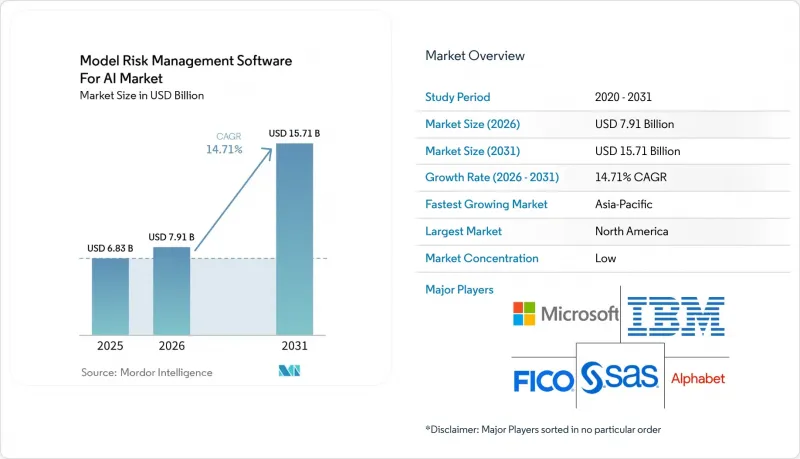
據 Mordor Intelligence 稱,2025 年人工智慧模型風險管理軟體市值為 68.3 億美元,預計到 2031 年將達到 157.1 億美元,而 2026 年為 79.1 億美元,預測期(2026-2031 年)的複合年成長率為 14.71%。
基於人工智慧的模型風險管理軟體的全球趨勢與洞察
企業採用生成式人工智慧和大規模語言模型
隨著生成式人工智慧從測試系統走向生產系統,人工智慧模型風險管理軟體市場正從中受益。儘管各組織擴大在其業務職能中利用人工智慧,但管治控制措施並非總是一致地應用。大型語言模型會根據提示和上下文變化產生不同的結果,因此在大多數情況下,單一的發布前核准並不足以應對。金融機構、醫療保健系統和其他受監管用戶需要文件來證明模型是如何進行測試、監控和修改的。如果輸出結果引發安全、公平或客戶服務方面的問題,團隊還需要明確的升級流程。這些需求正在推動整個人工智慧模型風險管理軟體市場對集中式清單、核准工作流程和運行時證據的需求不斷成長。
擴大監管要求
人工智慧模型風險管理軟體市場的發展動力源自於人工智慧管治規範從自願原則轉向正式規範的轉變。歐盟人工智慧法規提升了可追溯生命週期記錄對在歐洲運作的組織的重要性。跨境運作的組織通常需要將單一模型對應到多套控制要求,而不是為每個司法管轄區建立單獨的記錄。這有利於那些能夠將檢驗結果、核准和監控證據與各種要求關聯起來的平台。 ISO/IEC 42001 為採購團隊提供了一個系統化的人工智慧管理實務評估標準。由此產生的需求推動了相關產品的出現,這些產品允許團隊在無需重建底層模型記錄的情況下更新控制映射。
實施成本高且整合複雜。
完整的實施方案可能需要連接到開發工具、資料管道、檢驗流程、稽核系統和報告記錄。對於使用傳統電子表格、獨立資料庫和手動異常日誌的機構而言,這可能是一項挑戰。此外,可能還需要諮詢支援來明確所有權和管理要求,這可能會增加成本。對於中型金融機構而言,其模型組合規模較小,因此難以證明部署企業級平台的合理性。漫長的整合週期可能會延遲實現購買人工智慧市場模型風險管理軟體的預期價值。因此,購買者可能會選擇先從規模較小的流程入手,然後再將平台擴展到整個機構。
細分市場分析
2025年,軟體將佔據人工智慧模型風險管理軟體市場68.24%的佔有率。授權平台是集中管理模型清單、檢驗、文件和監控的主要入口。成熟的套件和專業供應商透過結構化的工作流程而非孤立的電子表格來提供這些功能。買家利用這些功能創建統一的模型記錄,這些模型通用應用於金融服務、醫療保健和受監管技術營運領域。此外,利用共用平台可以更輕鬆地識別人工智慧模型風險管理軟體市場中過時的審查和模糊之處。
預計2026年至2031年,服務市場將以16.83%的複合年成長率成長。許多組織在解讀需求、整合系統以及設計符合自身風險狀況的控制措施方面仍需要協助。諮詢團隊可以幫助將政策要求轉化為平台支援的流程。當公司需要將遺留記錄整合到新的管治工作流程中時,也需要實施服務。因此,服務是對軟體的補充,而不是替代,尤其是在組織為人工智慧市場建立正式的風險管理軟體模型專案時。
到2025年,模型管理將佔收入佔有率的32.17%。集中式庫存系統使組織能夠了解每個模型的用途、所有者、狀態、效能和風險分類。這種可視性有助於制定檢驗計劃,並更容易識別已更改或缺乏最新證據的模型。對於希望擺脫分散在各個業務部門的記錄的公司而言,它也提供了一個切實可行的起點。完整的庫存有助於人工智慧市場模型風險管理軟體團隊根據風險和應用進行優先排序。
預計到2031年,可解釋人工智慧工具市場將以17.62%的複合年成長率成長。這項需求主要源於在各種情況下向負責人、負責人和受影響人員解釋模型結果的需要。偏見檢測和公正性工具也為需要對自動化決策進行更嚴格審查的管治項目提供支援。風險評分和壓力測試工具持續滿足效能測試需求,而安全和隱私管理工具則致力於解決與推理活動和供應鏈相關的新興問題。監管報告的自動化進一步推動了人工智慧市場對模型風險管理軟體的需求,因為團隊需要為審計和內部委員會準備可重現的證據。
區域分析
到2025年,北美將佔據人工智慧模型風險管理軟體市場42.73%的佔有率。該地區受益於金融服務、醫療保健和科技公司對人工智慧的先進應用。美國國家標準與技術研究院(NIST)的人工智慧風險管理框架為系統化人工智慧風險活動和內部團隊間的溝通提供了指南。加拿大正透過金融服務和金融科技業擴大需求,而墨西哥則透過數位產業推動早期需求。
到2025年,歐洲將成為全球第二大區域市場。歐盟人工智慧立法日益重視相關人工智慧系統中的持續風險管理、透明度和人工監督。這推動了對能夠將模型背後的邏輯與整個生命週期中的合規要求連結起來的工具的需求。跨境營運的銀行可以從能夠避免因區域性要求而導致的文件重複的系統中獲益。
預計亞太地區2026年至2031年的複合年成長率將達到20.16%。在中國、印度、日本和韓國,企業人工智慧在金融服務、製造業和醫療保健領域的應用正在不斷擴展。印度的數位貸款活動推動了對人工智慧驅動的信貸決策偏差檢測和營運監控的需求。日本和韓國正透過金融服務和人工智慧醫療技術的應用來提升這項需求。澳洲的法規環境也是促使銀行正式建立人工智慧風險管理體系的另一個原因。儘管南美洲、中東和非洲的市場規模仍然小規模,但各國人工智慧專案和資料法規的發展正在為與當地企業建立夥伴關係關係的供應商創造長期機會。
其他好處:
- Excel格式的市場預測(ME)表
- 3個月的分析師支持
目錄
第1章:引言
- 研究假設和市場定義
- 調查範圍
第2章:調查方法
第3章執行摘要
第4章 市場狀況
- 市場概覽
- 市場促進因素
- 企業採用生成式人工智慧和大規模語言模型
- 擴大監管要求
- 對模型生命週期管理自動化的需求日益成長
- 網路攻擊增加以及接觸對抗性人工智慧的風險增加
- 自動化產生多框架合規性證據
- 基於代理的人工智慧和自主工作流程的管治要求
- 市場限制因素
- 實施成本高且整合複雜。
- 高階基礎模型的可解釋性局限性
- 人工智慧監管分散、跨境化
- 三道防線在模型風險責任上有差距
- 宏觀經濟因素對市場的影響
- 產業價值鏈分析
- 科技趨勢
- 監理情勢
- 波特五力分析
第5章 市場規模與成長預測
- 報價
- 軟體
- 服務
- 軟體類型
- 模型管理
- 偏見檢測與公平保證工具
- 可解釋人工智慧工具
- 風險評分和壓力測試工具
- 安全和隱私管理工具
- 其他類型的軟體
- 部署模式
- 雲
- 現場
- 混合
- 按風險類型分類
- 營運風險
- 合規風險
- 安全風險
- 其他風險類型
- 最終用戶
- 銀行業、金融服務業及保險業
- 資訊科技/通訊
- 醫療保健和生命科學
- 政府/公共部門
- 零售與電子商務
- 製造業
- 媒體與娛樂
- 其他最終用戶
- 按地區
- 北美洲
- 美國
- 加拿大
- 墨西哥
- 南美洲
- 巴西
- 阿根廷
- 智利
- 其他南美國家
- 歐洲
- 德國
- 英國
- 法國
- 義大利
- 西班牙
- 其他歐洲國家
- 亞太地區
- 中國
- 日本
- 印度
- 韓國
- 澳洲
- 其他亞太國家
- 中東
- 阿拉伯聯合大公國
- 沙烏地阿拉伯
- 卡達
- 其他中東國家
- 非洲
- 南非
- 埃及
- 奈及利亞
- 其他非洲國家
- 北美洲
第6章 競爭情勢
- 市場集中度
- 策略趨勢
- 市佔率分析
- 公司簡介
- International Business Machines Corporation
- Microsoft Corporation
- Alphabet Inc.
- SAS Institute Inc.
- Fair Isaac Corporation
- Amazon Web Services, Inc.
- Accenture plc
- Oracle Corporation
- Salesforce, Inc.
- ServiceNow, Inc.
- DataRobot, Inc.
- Databricks, Inc.
- H2O.ai, Inc.
- ModelOp, Inc.
- ValidMind Inc.
- Credo AI, Inc.
- Monitaur, Inc.
- Fiddler AI, Inc.
- Holistic AI
- OneTrust, LLC
- Collibra NV
- Domino Data Lab, Inc.
- ArthurAI
- Fairly AI
第7章 市場機會與未來展望
According to Mordor Intelligence, the model risk management software for AI Market size was valued at USD 6.83 billion in 2025 and is estimated to grow from USD 7.91 billion in 2026 to reach USD 15.71 billion by 2031, at a CAGR of 14.71% during the forecast period (2026-2031).
Global Model Risk Management Software For AI Market Trends and Insights
Enterprise Adoption of Generative AI and Large Language Models
The Model Risk Management Software for AI Market benefits as generative AI moves from tests into production systems. Organizations increasingly use AI in business functions, but governance controls are not always applied consistently. Large language models can produce different results under changing prompts and context, so a single approval before launch is rarely sufficient. Financial institutions, health systems, and other regulated users need records that show how a model was tested, monitored, and changed. Teams also need clear escalation paths when an output raises a safety, fairness, or customer service concern. That requirement increases demand for centralized inventories, approval workflows, and runtime evidence across the Model Risk Management Software for AI Market.
Expanding Regulatory and Supervisory Requirements
The Model Risk Management Software for AI Market is supported by the move from voluntary principles toward formal AI governance requirements. The EU AI Act makes traceable lifecycle records more important for organizations operating in Europe. Institutions working across borders often need to map 1 model to several control sets rather than create separate records for every jurisdiction. This favors platforms that can link validation results, approvals, and monitoring evidence to different requirements. ISO/IEC 42001 gives procurement teams a structured reference point for assessing AI management practices. The resulting demand favors products that can update control mappings without requiring teams to rebuild the underlying model record.
High Implementation Cost and Integration Complexity
A full deployment can require connections to development tools, data pipelines, validation processes, audit systems, and reporting records. That work is difficult for organizations with legacy spreadsheets, separate databases, and manual exception logs. Costs can also increase when teams need advisory support to define ownership and control requirements. Mid-market institutions may find it difficult to justify enterprise platforms when their model portfolios are smaller. Longer integration cycles can delay the value expected from a Model Risk Management Software for AI Market purchase. Buyers may therefore begin with a narrower workflow before extending the platform across their organization.
Other drivers and restraints analyzed in the detailed report include:
- Rising Demand for Automated Model Lifecycle Controls
- Increasing Cyberattacks and Adversarial AI Exposure
- Limited Explainability of Advanced Foundation Models
For complete list of drivers and restraints, kindly check the Table Of Contents.
Segment Analysis
Software accounted for 68.24% of the Model Risk Management Software for AI Market share in 2025. Licensed platforms are the primary entry point because they centralize model inventory, validation, documentation, and monitoring. Established suites and specialized vendors offer these functions through structured workflows instead of isolated spreadsheets. Buyers use them to create a common record for models used across financial services, healthcare, and regulated technology operations. A shared platform can also make overdue reviews and ownership gaps easier to identify in the Model Risk Management Software for AI Market.
Services are projected to grow at a 16.83% CAGR from 2026 to 2031. Many institutions still need help interpreting requirements, connecting systems, and designing controls for their own risk profile. Consulting teams can help translate policy expectations into procedures that the platform can support. Implementation services are also needed when firms must integrate legacy records into new governance workflows. Services, therefore, complement software rather than replace it, especially when an organization is establishing a formal Model Risk Management Software for AI Market program.
Model Management held 32.17% revenue share in 2025. Centralized inventory systems give organizations a record of each model's purpose, owner, status, performance, and risk classification. That visibility supports validation planning and makes it easier to identify models that have changed or lack current evidence. It also provides a practical starting point for firms that are moving beyond scattered business-unit records. A complete inventory helps Model Risk Management Software for AI Market teams set priorities according to risk and use.
Explainable AI Tools are forecast to expand at a 17.62% CAGR through 2031. Demand is driven by the need to explain model outcomes to reviewers, operators, and affected individuals across different circumstances. Bias Detection and Fairness Tools also support governance programs where automated decisions require closer review. Risk Scoring and Stress Testing Tools continue to meet performance testing needs, while Security and Privacy Management Tools address new concerns related to inference activity and supply chains. Regulatory reporting automation creates additional demand for Model Risk Management Software in the AI Market, where teams must prepare repeatable evidence for audits or internal committees.
Complete Report Scope:
- By Offering
- Software
- Services
- By Software Type
- Model Management
- Bias Detection and Fairness Tools
- Explainable AI Tools
- Risk Scoring and Stress Testing Tools
- Security and Privacy Management Tools
- Other Software Types
- By Deployment Mode
- Cloud
- On-Premises
- Hybrid
- By Risk Type
- Operational Risk
- Compliance Risk
- Security Risk
- Other Risk Types
- By End User
- Banking, Financial Services and Insurance
- IT and Telecommunications
- Healthcare and Life Sciences
- Government and Public Sector
- Retail and E-Commerce
- Manufacturing
- Media and Entertainment
- Other End Users
- By Geography
- North America
- United States
- Canada
- Mexico
- South America
- Brazil
- Argentina
- Chile
- Rest of South America
- Europe
- Germany
- United Kingdom
- France
- Italy
- Spain
- Rest of Europe
- Asia-Pacific
- China
- Japan
- India
- South Korea
- Australia
- Rest of Asia-Pacific
- Middle East
- United Arab Emirates
- Saudi Arabia
- Qatar
- Rest of Middle East
- Africa
- South Africa
- Egypt
- Nigeria
- Rest of Africa
- North America
Geography Analysis
North America held 42.73% of the Model Risk Management Software for AI Market share in 2025. The region benefits from high AI use across financial services, health care, and technology companies. The NIST AI Risk Management Framework provides a reference point for structuring AI risk activities and communication across internal teams. Canada adds demand through its financial services and fintech sectors, while Mexico is developing earlier-stage demand through digital.
Europe was the second-largest regional market in 2025. The EU AI Act raises the importance of ongoing risk management, transparency, and human oversight for relevant AI systems. This drives demand for tools that can connect model evidence to compliance requirements throughout the lifecycle. Cross-border banks can benefit from systems that avoid duplicate documentation across regional requirements.
Asia-Pacific is forecast to grow at a 20.16% CAGR from 2026 to 2031. China, India, Japan, and South Korea are expanding the use of enterprise AI across financial services, manufacturing, and health care. India's digital lending activity supports demand for bias detection and operational monitoring in AI credit decisions. Japan and South Korea add to demand through financial services and the use of AI-enabled medical technology. Australia's prudential environment provides another reason for banks to formalize AI risk controls. South America, the Middle East, and Africa remain smaller markets, but national AI programs and evolving data rules create longer-term opportunities for vendors that build local partnerships.
- International Business Machines Corporation
- Microsoft Corporation
- Alphabet Inc.
- SAS Institute Inc.
- Fair Isaac Corporation
- Amazon Web Services, Inc.
- Accenture plc
- Oracle Corporation
- Salesforce, Inc.
- ServiceNow, Inc.
- DataRobot, Inc.
- Databricks, Inc.
- H2O.ai, Inc.
- ModelOp, Inc.
- ValidMind Inc.
- Credo AI, Inc.
- Monitaur, Inc.
- Fiddler AI, Inc.
- Holistic AI
- OneTrust, LLC
- Collibra NV
- Domino Data Lab, Inc.
- ArthurAI
- Fairly AI
Additional Benefits:
- The market estimate (ME) sheet in Excel format
- 3 months of analyst support
TABLE OF CONTENTS
1 INTRODUCTION
- 1.1 Study Assumptions and Market Definition
- 1.2 Scope of the Study
2 RESEARCH METHODOLOGY
3 EXECUTIVE SUMMARY
4 MARKET LANDSCAPE
- 4.1 Market Overview
- 4.2 Market Drivers
- 4.2.1 Enterprise Adoption of Generative AI and Large Language Models
- 4.2.2 Expanding Regulatory and Supervisory Requirements
- 4.2.3 Rising Demand for Automated Model Lifecycle Controls
- 4.2.4 Increasing Cyberattacks and Adversarial AI Exposure
- 4.2.5 Automated Evidence Generation for Multi-Framework Compliance
- 4.2.6 Governance Requirements for Agentic AI and Autonomous Workflows
- 4.3 Market Restraints
- 4.3.1 High Implementation Cost and Integration Complexity
- 4.3.2 Limited Explainability of Advanced Foundation Models
- 4.3.3 Fragmented Cross-Border AI Regulation
- 4.3.4 Model Risk Ownership Gaps Across the Three Lines of Defense
- 4.4 Impact of Macroeconomic Factors on the Market
- 4.5 Industry Value-Chain Analysis
- 4.6 Technology Outlook
- 4.7 Regulatory Landscape
- 4.8 Porter's Five Forces Analysis
- 4.8.1 Threat of New Entrants
- 4.8.2 Bargaining Power of Suppliers
- 4.8.3 Bargaining Power of Buyers
- 4.8.4 Threat of Substitutes
- 4.8.5 Intensity of Competitive Rivalry
5 MARKET SIZE AND GROWTH FORECASTS (VALUE)
- 5.1 By Offering
- 5.1.1 Software
- 5.1.2 Services
- 5.2 By Software Type
- 5.2.1 Model Management
- 5.2.2 Bias Detection and Fairness Tools
- 5.2.3 Explainable AI Tools
- 5.2.4 Risk Scoring and Stress Testing Tools
- 5.2.5 Security and Privacy Management Tools
- 5.2.6 Other Software Types
- 5.3 By Deployment Mode
- 5.3.1 Cloud
- 5.3.2 On-Premises
- 5.3.3 Hybrid
- 5.4 By Risk Type
- 5.4.1 Operational Risk
- 5.4.2 Compliance Risk
- 5.4.3 Security Risk
- 5.4.4 Other Risk Types
- 5.5 By End User
- 5.5.1 Banking, Financial Services and Insurance
- 5.5.2 IT and Telecommunications
- 5.5.3 Healthcare and Life Sciences
- 5.5.4 Government and Public Sector
- 5.5.5 Retail and E-Commerce
- 5.5.6 Manufacturing
- 5.5.7 Media and Entertainment
- 5.5.8 Other End Users
- 5.6 By Geography
- 5.6.1 North America
- 5.6.1.1 United States
- 5.6.1.2 Canada
- 5.6.1.3 Mexico
- 5.6.2 South America
- 5.6.2.1 Brazil
- 5.6.2.2 Argentina
- 5.6.2.3 Chile
- 5.6.2.4 Rest of South America
- 5.6.3 Europe
- 5.6.3.1 Germany
- 5.6.3.2 United Kingdom
- 5.6.3.3 France
- 5.6.3.4 Italy
- 5.6.3.5 Spain
- 5.6.3.6 Rest of Europe
- 5.6.4 Asia-Pacific
- 5.6.4.1 China
- 5.6.4.2 Japan
- 5.6.4.3 India
- 5.6.4.4 South Korea
- 5.6.4.5 Australia
- 5.6.4.6 Rest of Asia-Pacific
- 5.6.5 Middle East
- 5.6.5.1 United Arab Emirates
- 5.6.5.2 Saudi Arabia
- 5.6.5.3 Qatar
- 5.6.5.4 Rest of Middle East
- 5.6.6 Africa
- 5.6.6.1 South Africa
- 5.6.6.2 Egypt
- 5.6.6.3 Nigeria
- 5.6.6.4 Rest of Africa
- 5.6.1 North America
6 COMPETITIVE LANDSCAPE
- 6.1 Market Concentration
- 6.2 Strategic Moves
- 6.3 Market Share Analysis
- 6.4 Company Profiles (includes Global Level Overview, Market Level Overview, Core Segments, Financials as available, Strategic Information, Market Rank/Share, Products and Services, Recent Developments)
- 6.4.1 International Business Machines Corporation
- 6.4.2 Microsoft Corporation
- 6.4.3 Alphabet Inc.
- 6.4.4 SAS Institute Inc.
- 6.4.5 Fair Isaac Corporation
- 6.4.6 Amazon Web Services, Inc.
- 6.4.7 Accenture plc
- 6.4.8 Oracle Corporation
- 6.4.9 Salesforce, Inc.
- 6.4.10 ServiceNow, Inc.
- 6.4.11 DataRobot, Inc.
- 6.4.12 Databricks, Inc.
- 6.4.13 H2O.ai, Inc.
- 6.4.14 ModelOp, Inc.
- 6.4.15 ValidMind Inc.
- 6.4.16 Credo AI, Inc.
- 6.4.17 Monitaur, Inc.
- 6.4.18 Fiddler AI, Inc.
- 6.4.19 Holistic AI
- 6.4.20 OneTrust, LLC
- 6.4.21 Collibra NV
- 6.4.22 Domino Data Lab, Inc.
- 6.4.23 ArthurAI
- 6.4.24 Fairly AI
7 MARKET OPPORTUNITIES AND FUTURE OUTLOOK
- 7.1 White-Space and Unmet-Need Assessment

 分包商管理軟體市場:全球市場預測,2026-2032年
 2026-2030年全球能源交易與風險管理(ETRM)市場
 企業風險管理市場規模、佔有率和成長分析:按組件、部署類型、組織規模、產業和地區分類-2026-2033年產業預測
 Frost Radar™:企業風險緩解與管理平台,2026 年
 風險管理市場機會、成長促進因素、產業趨勢分析及2026-2035年預測。
 2026年全球主動式終端風險管理市場報告2026年全球建築風險諮詢市場報告
 合規風險評分模型市場:預測至 2034 年-按組件、模型類型、風險類型、組織規模、應用、最終使用者和地區分類的全球分析2026年全球整合風險管理軟體市場報告2026年全球營運風險管理解決方案市場報告