


 |
市場調查報告書
商品編碼
2154465
氫氣生產催化劑:市場佔有率分析、產業趨勢與統計、成長預測(2026-2031)Hydrogen Production Catalysts - Market Share Analysis, Industry Trends & Statistics, Growth Forecasts (2026 - 2031) |
||||||

※ 本網頁內容可能與最新版本有所差異。詳細情況請與我們聯繫。
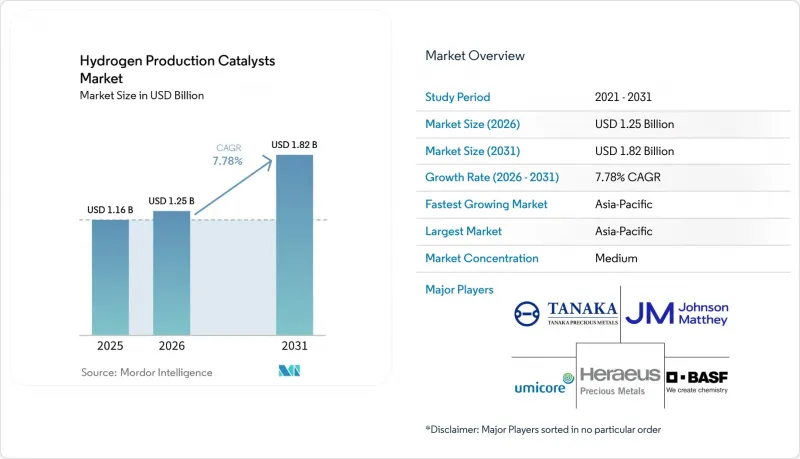
據 Mordor Intelligence 稱,2025 年氫氣生產催化劑的市場規模估計為 11.6 億美元,預計到 2031 年將從 2026 年的 12.5 億美元成長到 18.2 億美元,在預測期(2026-2031 年)內的複合年成長率為 7.78%。
全球氫氣產生催化劑市場趨勢及洞察
綠氫能和電解槽的引入
電解槽的普及應用是氫氣生產催化劑市場的主要需求促進因素。預計到2025年,全球整體電解裝置容量將翻倍,超過4吉瓦。此外,還有超過2.5吉瓦的電解槽正在建設中,計劃於2026年投入運作。中國是鹼金屬堆及其所用鎳銥催化劑的主要需求方。雖然這種擴張降低了鹼金屬堆的成本,但也給那些僅銷售催化劑材料而非提供整套電解槽的供應商帶來了壓力。 2024年,質子交換膜(PEM)系統佔歐洲水電電解裝置的66%,其中區域需求主要集中在銥基陽極催化劑。液化空氣集團位於荷蘭的200兆瓦「ELYgator」專案和雷普索爾公司位於荷蘭的100兆瓦「Cartagena」專案均於2025年做出最終投資決定,這為歐洲供應商帶來了明確的市場需求。歐盟的《可再生能源指令 III》為工業和運輸領域的氫能設定了更明確的目標,鼓勵在 2030 年前做出購買決定。
氫燃料電池在交通運輸和分散式發電領域的廣泛應用。
氫燃料電池在交通運輸和分散式發電領域的普及,帶動了除氫設施以外其他領域對催化劑的需求。 2025年中期,全球燃料電池汽車(FCV)數量將接近10萬輛,加氫站運作將超過1,300座。 2023年至2025年間,重型卡車的投產數量增加了72%,進一步推動了對鉑金催化劑塗層的需求。固定式電源也為燃料電池報廢後的催化劑回收提供了途徑。 2025年8月,本田公司與德山株式會社和三菱商事株式會社合作,啟動了一個示範項目,利用回收的汽車燃料電池,以各種產品產生的氫氣為燃料,為資料中心供電。豐田汽車北美公司於 2026 年 5 月宣布,計劃在 2027 年初之前在其商業物流車隊中引入燃料電池動力 8 級卡車,並且其第三代燃料電池堆已獲得美國國家標準協會 (ANSI) 和加拿大標準協會 (CSA) 的“燃料電池 1”認證。
鉑族金屬催化劑高成本
鉑族金屬催化劑的高成本是限制氫氣生產催化劑市場發展的一大阻礙因素。預計2025年鉑族金屬的總需求量將達到231.9公噸,而供應量僅180.6公噸。供不應求推高了催化劑的基準成本。 2025年鉑金均價為每公斤41,000美元,並在2026年1月創下每公斤91,176美元的歷史新高。由於貴金屬催化劑材料在質子交換膜電解槽的資本成本。當專案成本以美元支付而收入以該地貨幣結算時,成本敏感度尤為顯著。贏創工業集團表示,持有貴金屬儲備的客戶不會受到含鉑催化劑價格上漲的影響,但合成損失仍可能增加實際成本。歐洲對化學物質的註冊、評估、授權和限制 (REACH) 要求將增加鉑族金屬催化劑工作流程的合規成本。
細分市場分析
2025年,鉑基催化劑在氫氣生產催化劑市場中佔據50.12%的佔有率。這一地位反映了其在蒸汽甲烷重整(SMR)陰極應用、燃料電池膜電極組件以及烴類純化反應的長期應用。由於這些需求來源不太可能同時下降,因此鉑供應鏈的持續消耗將會得到支撐。因此,即使新的電解技術不斷湧現,鉑基催化劑在短期內仍將佔據重要的市場佔有率。預計到2031年,銥基催化劑的複合年成長率將達到8.23%。這一成長與質子交換膜電解(PEM電解)密切相關,在酸性和高氧化性條件下,氧化銥仍然是一種成熟的陽極催化劑。
田中貴金屬集團以其雙功能電極催化劑的研發與商業化,榮獲2025年日本催化劑產業協會技術獎。該設計將質子交換膜電解中的析氧和氣體複合功能相結合,解決了氫氣滲透問題,並可實現更薄的膜厚度。鎳基催化劑仍廣泛應用於鹼性電解和蒸氣甲烷重整,在這些應用中,成本和可用性通常比每克貴金屬的性能更為重要。其他類型的催化劑包括釕基催化劑、鈷基催化劑以及新興的非貴金屬配方。歐盟《關鍵材料法》將銥列為戰略材料,進一步獎勵了催化劑組合的多樣化。
區域分析
到2025年,亞太地區將佔據全球氫氣生產催化劑市場37.88%的佔有率,預計到2031年將以8.61%的複合年成長率持續成長。中國憑藉其氨和甲醇產業,正引領該地區的催化劑需求。據估計,中國每年消耗8,000至12,000噸二次重整催化劑,並運作全球約65%的電解產能。由於中國在其大型國內項目中高度重視鹼性電解,這一趨勢對鎳基催化劑十分有利。印度預計到2030年將氨產能每年增加400萬至600萬噸,將需要額外的催化劑供應。在日本和韓國,燃料電池汽車和氫能相關計畫的推廣,持續推動對高純度鉑族金屬催化劑的需求。
到2025年,韓國將佔全球燃料電池汽車保有量的36%,這將支撐對鉑基燃料電池催化劑的持續需求。 JERA和電裝公司於2025年9月在西名古屋發電廠啟動了固體氧化物電解示範實驗。本計畫採用汽車級固體氧化物電解池技術生產氫氣,與傳統電解方法相比,電力消耗量降低了10%。北美和歐洲佔據了全球市場的剩餘一半。在美國,煉油廠對氫氣的需求仍然強勁,現代汽車、豐田和康明斯等公司對燃料電池模組專案的私人投資仍在繼續。加拿大對油砂的需求以及墨西哥煉油廠的需求也進一步推動了對改質催化劑的需求。
歐洲的政策框架正在塑造氫氣生產催化劑市場的技術格局。 《可再生能源指令III》規定,到2030年,42%的工業氫氣必須來自再生能源來源,這推動了對質子交換膜電解的需求。根據《關鍵材料法》,銥被列為策略性材料,也影響採購政策。 2025年3月,BASF運作最大的質子交換膜電解工廠,工廠裝置容量為54兆瓦,每小時可生產高達1噸的氫氣。儘管南美、中東和非洲地區的需求仍然相對較小,但透過綠色氫氣的出口和提煉,正在形成一個專案儲備。沙烏地阿拉伯的NEOM綠色氫氣計畫包括一座2.2吉瓦的電解工廠,這將為未來帶來對催化劑材料的集中需求。 2025 年 4 月,Axens 擴建了其在沙烏地阿拉伯的工廠“Axens Catalyst Arabia Limited”,以建立廢氣處理催化劑的本地化生產系統。
其他好處:
- Excel格式的市場預測(ME)表
- 3個月的分析師支持
目錄
第1章:引言
- 研究假設和市場定義
- 調查範圍
第2章:調查方法
第3章執行摘要
第4章 市場狀況
- 市場概覽
- 市場促進因素
- 綠氫能和電解槽的引入
- 氫燃料電池在移動出行和分散式發電領域的應用
- 降低觸媒用量並利用貴金屬
- 催化劑塗層薄膜與催化劑回收的整合
- 提高催化劑活性、耐久性和能源效率
- 市場限制因素
- 鉑族金屬催化劑高成本
- 銥和高純度鈦的供應受限
- 非貴金屬催化劑的耐久性和認證方面所面臨的挑戰
- 價值鏈分析
- 波特五力分析
第5章 市場規模與成長預測
- 按類型
- 鉑催化劑
- 鎳基催化劑
- 銥基催化劑
- 其他類型的催化劑
- 透過生產技術
- 蒸汽甲烷重整(SMR)
- 鹼性水電電解
- 質子交換膜(PEM)水電電解
- 其他生產技術
- 按最終用途
- 氨的生產
- 煉油
- 甲醇生產
- 其他最終用途
- 按地區
- 亞太地區
- 中國
- 印度
- 日本
- 韓國
- 其他亞太國家
- 北美洲
- 美國
- 加拿大
- 墨西哥
- 歐洲
- 德國
- 英國
- 法國
- 義大利
- 其他歐洲國家
- 南美洲
- 巴西
- 阿根廷
- 其他南美國家
- 中東和非洲
- 沙烏地阿拉伯
- 南非
- 其他中東和非洲國家
- 亞太地區
第6章 競爭情勢
- 市場集中度
- 策略趨勢
- 市佔率和排名分析
- 公司簡介
- 3M
- Axens
- BASF
- CLARIANT
- De Nora SpA
- Evonik Industries AG
- Heraeus Precious Metals
- Honeywell International Inc.
- Johnson Matthey
- Shell plc
- TANAKA PRECIOUS METAL GROUP Co., Ltd.
- Topsoe A/S
- Umicore
第7章 市場機會與未來展望
According to Mordor Intelligence, the hydrogen production catalysts market size was valued at USD 1.16 billion in 2025 and is estimated to grow from USD 1.25 billion in 2026 to reach USD 1.82 billion by 2031, at a CAGR of 7.78% during the forecast period (2026-2031).
Global Hydrogen Production Catalysts Market Trends and Insights
Green Hydrogen and Electrolyzer Deployment
Electrolyzer deployment is a major demand driver for the hydrogen production catalysts market. Installed electrolysis capacity doubled in 2025 and surpassed 4 gigawatts globally, while more than 2.5 gigawatts were under construction for commissioning in 2026. China supports demand for alkaline stacks and the nickel and iridium catalysts used within them. This scale lowers alkaline stack costs, but it also puts pressure on suppliers that sell catalyst materials without supplying the wider stack. Proton exchange membrane systems represented 66% of installed water electrolysis in Europe in 2024, concentrating regional demand on iridium-based anode catalysts. Air Liquide's 200-megawatt ELYgator project in the Netherlands and Repsol's 100-megawatt Cartagena project reached a final investment decision in 2025, providing visible demand anchors for European suppliers. The European Union Renewable Energy Directive III provides clearer hydrogen targets for industry and transport, which support purchasing decisions through 2030.
Hydrogen Fuel-Cell Adoption in Mobility and Distributed Power
Hydrogen fuel-cell adoption in transport and distributed power supports catalyst demand beyond hydrogen generation assets. The global fuel cell vehicle fleet approached 100,000 units by mid-2025, and more than 1,300 hydrogen refueling stations were operating. Heavy-duty truck deployments grew 72% from 2023 to 2025, increasing demand for platinum catalyst coatings. Stationary power also creates a route for catalyst recovery when fuel cells reach the end of their vehicle life. Honda began a joint demonstration with Tokuyama Corporation and Mitsubishi Corporation in August 2025 that used by-product hydrogen to power a data center through repurposed automotive fuel cells. Toyota Motor North America stated in May 2026 that it planned to deploy fuel-cell-powered Class 8 trucks in commercial logistics fleets by early 2027, and its third-generation fuel cell stacks achieved American National Standards Institute and Canadian Standards Association Fuel Cell 1 certification.
High Cost of Platinum-Group-Metal Catalysts
High costs for platinum-group-metal catalysts are an immediate restraint on the hydrogen production catalysts market. Total platinum-group-metal demand in 2025 was projected at 231.9 metric tons, compared with a supply of 180.6 metric tons, creating a deficit that raised baseline catalyst costs. Platinum reached an intraday high of USD 91,176 per kilogram in January 2026, compared with an average of USD 41,000 per kilogram in 2025. This price movement increases the capital cost of proton exchange membrane electrolyzer stacks because precious-metal catalyst materials account for a meaningful share of the stack bill of materials. Cost sensitivity is particularly high where project costs are paid in US dollars, but revenue is earned in local currencies. Evonik Industries AG has stated that customers who own their precious metal do not face higher platinum-containing catalyst prices, although synthesis losses can still raise effective costs. Registration, Evaluation, Authorisation and Restriction of Chemicals (REACH) requirements in Europe add compliance costs for platinum-group-metal catalyst workflows.
Other drivers and restraints analyzed in the detailed report include:
- Catalyst Loading Reduction and Precious-Metal Utilization
- Advancement in Catalyst Activity, Durability, and Energy Efficiency
- Iridium and High-Purity Titanium Supply Constraints
For complete list of drivers and restraints, kindly check the Table Of Contents.
Segment Analysis
Platinum-based catalysts accounted for 50.12% of the hydrogen production catalysts market size in 2025. This position reflected long-standing use in steam methane reforming cathode applications, fuel cell membrane electrode assemblies, and hydrocarbon refining reactions. These demand pools are unlikely to contract at the same time, which supports recurring consumption through the platinum supply chain. Platinum-based catalysts, therefore, remain important to near-term revenue even as new electrolysis technologies scale. Iridium-based catalysts are projected to advance at an 8.23% CAGR through 2031. Their growth is tied to proton exchange membrane electrolysis, where iridium oxide remains the established anode catalyst under acidic and highly oxidative conditions.
TANAKA PRECIOUS METAL GROUP Co., Ltd. received Japan's 2025 Catalyst Manufacturers Association Technology Award for developing and commercializing a dual-function electrode catalyst. The design combines oxygen evolution reaction and gas recombination functions in proton exchange membrane water electrolysis. It addresses hydrogen crossover while enabling thinner membranes. Nickel-based catalysts continue to serve alkaline electrolysis and steam methane reforming, where cost and availability often matter more than precious-metal performance per gram. Other catalyst types include ruthenium-based, cobalt-based, and emerging non-precious formulations. The European Union Critical Raw Materials Act classifies iridium as a strategic raw material, strengthening the incentive to diversify catalyst portfolios.
Complete Report Scope:
- By Type
- Platinum-Based Catalysts
- Nickel-Based Catalysts
- Iridium-Based Catalysts
- Other Catalyst Types
- By Production Technology
- Steam Methane Reforming (SMR)
- Alkaline Water Electrolysis
- Proton Exchange Membrane (PEM) Water Electrolysis
- Other Production Technologies
- By End-Use
- Ammonia Production
- Petroleum Refining
- Methanol Production
- Other End-Uses
- By Geography
- Asia-Pacific
- China
- India
- Japan
- South Korea
- Rest of Asia-Pacific
- North America
- United States
- Canada
- Mexico
- Europe
- Germany
- United Kingdom
- France
- Italy
- Rest of Europe
- South America
- Brazil
- Argentina
- Rest of South America
- Middle-East and Africa
- Saudi Arabia
- South Africa
- Rest of Middle-East and Africa
- Asia-Pacific
Geography Analysis
Asia-Pacific accounted for 37.88% of the hydrogen production catalysts market in 2025 and is projected to advance at an 8.61% CAGR through 2031. China supports regional catalyst demand through its ammonia and methanol base. It consumed an estimated 8,000 to 12,000 metric tons of secondary reforming catalysts annually and commissioned nearly 65% of global installed electrolysis capacity. This pattern favors nickel-based catalysts because China emphasizes alkaline electrolysis for large domestic projects. India is expanding planned ammonia capacity by 4 to 6 million metric tons per year through 2030, which will require additional catalyst supply. Japan and South Korea retain demand for high-purity platinum-group-metal formulations through fuel cell vehicle fleets and hydrogen programs.
South Korea held 36% of the global fuel cell vehicle fleet in 2025, supporting continued demand for platinum-based fuel cell catalysts. JERA and Denso began a solid oxide electrolysis demonstration in September 2025 at Nishi-Nagoya Power Plant. The project used vehicle-derived solid oxide electrolyzer cell technology to produce hydrogen with 10% lower electricity consumption than conventional electrolysis methods. North America and Europe represented half of the remaining global market. The United States retains refinery hydrogen demand and private investment from Hyundai, Toyota, and Cummins in fuel cell module programs. Canada's oil sands requirements and Mexico's refinery base provide additional demand for reforming catalysts.
Europe's policy framework is shaping the technology mix for the hydrogen production catalysts market. Renewable Energy Directive III requires 42% of industrial hydrogen to come from renewable sources by 2030, which supports proton exchange membrane electrolysis demand. The Critical Raw Materials Act's strategic designation of iridium is influencing procurement approaches. BASF commissioned Germany's largest 54-megawatt proton exchange membrane electrolyzer in Ludwigshafen in March 2025, with the capacity to produce up to 1 metric ton of hydrogen per hour. South America, and Middle-East and Africa remain smaller demand pools, but green hydrogen exports and refining create project pipelines. Saudi Arabia's NEOM Green Hydrogen Project includes a 2.2-gigawatt electrolyzer, creating a concentrated future demand event for catalyst materials. Axens expanded its Axens Catalyst Arabia Limited site in Saudi Arabia in April 2025 to produce tail gas treatment catalysts locally.
- 3M
- Axens
- BASF
- CLARIANT
- De Nora S.p.A.
- Evonik Industries AG
- Heraeus Precious Metals
- Honeywell International Inc.
- Johnson Matthey
- Shell plc
- TANAKA PRECIOUS METAL GROUP Co., Ltd.
- Topsoe A/S
- Umicore
Additional Benefits:
- The market estimate (ME) sheet in Excel format
- 3 months of analyst support
TABLE OF CONTENTS
1 Introduction
- 1.1 Study Assumptions and Market Definition
- 1.2 Scope of the Study
2 Research Methodology
3 Executive Summary
4 Market Landscape
- 4.1 Market Overview
- 4.2 Market Drivers
- 4.2.1 Green Hydrogen and Electrolyzer Deployment
- 4.2.2 Hydrogen Fuel-Cell Adoption in Mobility and Distributed Power
- 4.2.3 Catalyst Loading Reduction and Precious-Metal Utilization
- 4.2.4 Catalyst-Coated Membrane and Catalyst Recycling Integration
- 4.2.5 Advancement in Catalyst Activity, Durability, and Energy Efficiency
- 4.3 Market Restraints
- 4.3.1 High Cost of Platinum-Group-Metal Catalysts
- 4.3.2 Iridium and High-Purity Titanium Supply Constraints
- 4.3.3 Durability and Qualification Challenges for Non-Precious Catalysts
- 4.4 Value Chain Analysis
- 4.5 Porter's Five Forces Analysis
- 4.5.1 Bargaining Power of Suppliers
- 4.5.2 Bargaining Power of Buyers
- 4.5.3 Threat of New Entrants
- 4.5.4 Threat of Substitutes
- 4.5.5 Competitive Rivalry
5 Market Size and Growth Forecasts (Value)
- 5.1 By Type
- 5.1.1 Platinum-Based Catalysts
- 5.1.2 Nickel-Based Catalysts
- 5.1.3 Iridium-Based Catalysts
- 5.1.4 Other Catalyst Types
- 5.2 By Production Technology
- 5.2.1 Steam Methane Reforming (SMR)
- 5.2.2 Alkaline Water Electrolysis
- 5.2.3 Proton Exchange Membrane (PEM) Water Electrolysis
- 5.2.4 Other Production Technologies
- 5.3 By End-Use
- 5.3.1 Ammonia Production
- 5.3.2 Petroleum Refining
- 5.3.3 Methanol Production
- 5.3.4 Other End-Uses
- 5.4 By Geography
- 5.4.1 Asia-Pacific
- 5.4.1.1 China
- 5.4.1.2 India
- 5.4.1.3 Japan
- 5.4.1.4 South Korea
- 5.4.1.5 Rest of Asia-Pacific
- 5.4.2 North America
- 5.4.2.1 United States
- 5.4.2.2 Canada
- 5.4.2.3 Mexico
- 5.4.3 Europe
- 5.4.3.1 Germany
- 5.4.3.2 United Kingdom
- 5.4.3.3 France
- 5.4.3.4 Italy
- 5.4.3.5 Rest of Europe
- 5.4.4 South America
- 5.4.4.1 Brazil
- 5.4.4.2 Argentina
- 5.4.4.3 Rest of South America
- 5.4.5 Middle-East and Africa
- 5.4.5.1 Saudi Arabia
- 5.4.5.2 South Africa
- 5.4.5.3 Rest of Middle-East and Africa
- 5.4.1 Asia-Pacific
6 Competitive Landscape
- 6.1 Market Concentration
- 6.2 Strategic Moves
- 6.3 Market Share (%)/Ranking Analysis
- 6.4 Company Profiles (includes Global Overview, Market Overview, Core Segments, Financials as available, Strategic Information, Products and Services, and Recent Developments)
- 6.4.1 3M
- 6.4.2 Axens
- 6.4.3 BASF
- 6.4.4 CLARIANT
- 6.4.5 De Nora S.p.A.
- 6.4.6 Evonik Industries AG
- 6.4.7 Heraeus Precious Metals
- 6.4.8 Honeywell International Inc.
- 6.4.9 Johnson Matthey
- 6.4.10 Shell plc
- 6.4.11 TANAKA PRECIOUS METAL GROUP Co., Ltd.
- 6.4.12 Topsoe A/S
- 6.4.13 Umicore
7 Market Opportunities and Future Outlook
- 7.1 White-Space and Unmet-Need Assessment

 ROPAC催化劑市場:全球市場預測,2026-2032年
 Lindlar催化劑市場報告:趨勢、預測與競爭分析(至2035年)
 氫氣生產催化劑市場預測至2034年-按催化劑類型、製造流程、催化劑形態、催化劑功能、最終用戶和地區分類的全球分析
 加氫反應器市場規模、佔有率和成長分析:按反應器類型、催化劑類型、操作規模、操作條件、應用和地區分類-2026-2033年產業預測
 半導體廢棄物氫氣提取市場分析及預測(至2035年):按類型、產品類型、服務、技術、組件、應用、材料類型、製程、最終用戶、階段分類
 氫氣生產催化劑市場規模、佔有率和成長分析(按類型、應用和地區分類)—2026-2033年產業預測加氫裂解催化劑市場(按原始類型、催化劑類型、反應器技術和最終用戶產業分類)—2025-2030 年全球預測
 全球加氫催化劑市場:績效及預測(2020-2031)
 ROPAC 催化劑全球市場分析與預測(至 2030 年)