

 |
市場調查報告書
商品編碼
2154430
電信網路體驗情報:面向投資者:市場佔有率分析、行業趨勢和統計數據、成長預測(2026-2031 年)Telecom Network Experience Intelligence For Investors - Market Share Analysis, Industry Trends & Statistics, Growth Forecasts (2026 - 2031) |
||||||

※ 本網頁內容可能與最新版本有所差異。詳細情況請與我們聯繫。
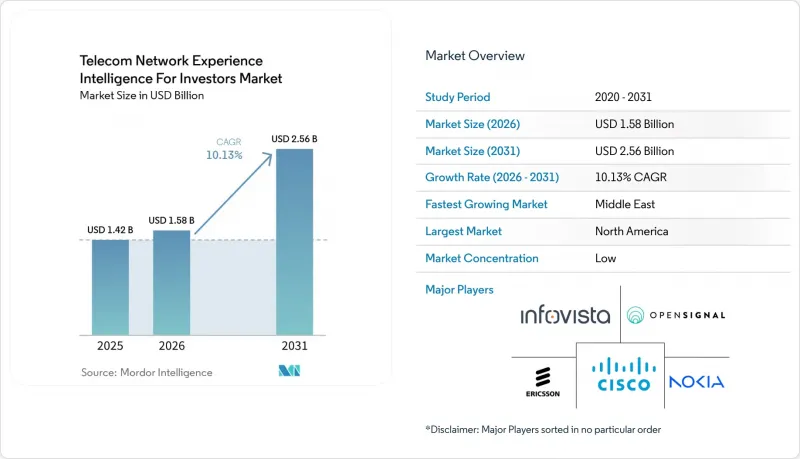
根據 Mordor Intelligence 預測,投資者網路體驗情報市場規模將從 2025 年的 14.2 億美元和 2026 年的 15.8 億美元成長到 2031 年的 25.6 億美元,2026 年至 2031 年的年複合成長率(CAGR)為 10.13%。
面向投資者的全球電信網路體驗智慧市場趨勢與洞察
對 5G 獨立組網和網路切片保障的需求
隨著商用 5G 獨立組網服務的推出,網路切片不再只是一項技術特性,而是一項可銷售的企業級服務。因此,營運商需要可審計的記錄來證明每個切片都達到了其承諾的服務等級。一項針對 2025 年營運商的調查顯示,26% 的營運商已經實施或開始試點網路切片,這意味著相關的保障需求將進一步成長。 3GPP 將保障封閉式控制定義為一種跨多個切片管理服務等級協定 (SLA) 的機制。 NETSCOUT 提供每個切片的服務等級審計追蹤,這反映了利用監控作為差異化服務定價基礎的必要性。這種需求正在推動面向投資者的電信網路體驗智慧市場更廣泛地採用網路切片,因為服務品質的證據對營運團隊和財務負責人都大有裨益。
人工智慧驅動的預測性保障和封閉回路型自動化
人工智慧驅動的安全保障正在將網路營運從「問題檢測」轉變為「自動修復」。 2026年6月,諾基亞和Google雲端宣布將多個基於Gemini技術的AI代理整合到諾基亞安全保障中心,諾基亞表示這將顯著縮短問題解決時間。歐洲電信標準化協會(ETSI)將數位孿生和網路封閉回路型自動化視為邁向更高階自主網路的關鍵步驟。隨著基礎異常檢測的普及,供應商越來越依賴多供應商遙測資料的品質、連續性和管治。擁有長期營運記錄的平台可以利用這些資訊來改善模型訓練和工作流程的可靠性。這使得數據管理成為面向投資者的通訊網路體驗智慧市場中的關鍵競爭因素。
傳統開源軟體中存在資料孤島和KPI定義不一致的問題。
傳統的開源架構是為靜態網路和較為有限的供應商環境而設計的。因此,它們往往無法提供基於人工智慧的保障系統所需的統一、即時服務視圖。電信業者必須不斷改造各個資料模型,才能應用跨域分析。西班牙電信的現代化改造工作就充分體現了這項營運挑戰。這種情況會導致銷售週期延長、客戶獲取成本上升以及專業服務工作量增加。此外,它還會延遲供應商在面向投資者的電信網路體驗智慧市場中期望實現的「軟體規模」經濟效益的實現。
細分市場分析
到2025年,軟體將佔據「面向投資者的通訊網路體驗智慧」市場佔有率的33.42%,這表明電信業者仍在使用基於許可的平台來建立其內部保障能力。預計2026年至2031年,服務業將以10.44%的複合年成長率成長。電信業者越來越需要專家支持,以大規模建構人工智慧驅動的保障系統。根據RADCOM的一份報告,網路產業的許多領導者都指出,AIOps人才短缺是一項挑戰。這種技能缺口正在將營運連續性需求轉化為對託管保障服務的需求。
Amdocs、埃森哲和IBM提供的託管保障合約超越了基本的監控功能。這些合約越來越注重服務水準成果,而非軟體平台存取權限。當供應商能夠證明可衡量的業務成果時,他們就能提升每位客戶的收入。此外,供應商需要證明其持續價值,從而降低對合約鎖定的依賴。因此,在面向投資者的通訊網路體驗智慧產業,我們看到服務需求源自於營運技能的不足,而不僅僅是軟體替換。
預計到 2025 年,基於雲端的採用率將達到 23.76%,並在 2026 年至 2031 年間以 10.68% 的複合年成長率 (CAGR) 成長。雲端原生保障目前處於領先地位,且發展迅速,使其成為新部署的首選架構。 2025 年 6 月,諾基亞發布了“自主網路架構 (Autonomous Network Fabric)”,該架構利用 Vertex AI 和 BigQuery 來實現 AI 驅動的操作。此外,該設計還保留了一些本地處理,以滿足某些司法管轄區的資料居住要求。
當國家安全和資料本地化法規要求進行本地處理時,本地部署系統仍然至關重要。混合配置為電信業者提供了一種切實可行的選擇,既能滿足他們對雲端功能的需求,又能確保對敏感資料的控制。 RADCOM ACE 可作為雲端原生功能應用於公有雲和私有雲端環境,包括 5G 核心網路環境。這拓展了企業和政府專用網路營運商使用雲端架構的潛在範圍。在面向投資者的電信網路體驗智慧市場中,完全本地部署可能仍僅限於那些具有明確本地處理需求的電信業者。
網路體驗基準測試預計在2025年將佔22.27%的市場佔有率,為監管報告、競爭性行銷和資本支出規劃提供支援。客戶體驗與解約率分析預計將在2026年至2031年間以10.59%的複合年成長率成長。營運商正在將即時訊號品質與用戶行為模型關聯起來。 Opensignal的網路體驗套件能夠近乎即時地將網路效能與本地用戶轉換行為關聯起來。這使得營運商能夠在用戶流失徵兆反映定期報告之前就做出回應。
服務品質和體驗 (QoE) 的保障,結合效能、故障和事件分析,仍然是更高階分析的基礎。電信業者通常需要在新增客戶維繫模型之前具備這些能力。這一系列事件構成了現有客戶帳戶的升級路徑。 2026 年 5 月,國際電信聯盟 (ITU) 舉辦的研討會重點介紹了服務品質 (QoS) 和體驗品質 (QoE) 基準測試的新測量方法。持續的標準變更催生了更新需求,並提高了投資者導向的電信網路體驗智慧市場供應商的進入門檻。
區域分析
預計到2025年,北美將佔據31.77%的市場佔有率,這主要得益於5G的快速商業化和強大的機構投資者基礎。美國營運商正在實質審查和基礎設施審查過程中利用獨立的品質基準。 AT&T、T-Mobile和保障之間的競爭正在推動對能夠提供有力品質證據的系統進行投資。 Opensignal在其2026年7月發布的《美國行動網路體驗調查》中對這些業者進行了報告。在加拿大,市場對託管式品質保證服務的需求旺盛;而在墨西哥,人們正從被動監控轉向預測性智慧。
歐洲是第二大市場叢集,德國、英國、法國和北歐國家對基準測試和品質報告的需求日益成熟。沃達豐德國的EXFO Context支援其行動和固網業務的零接觸自動化。亞太地區擁有最多的營運商,是新型自主網路能力的試驗場。諾基亞與NTT Docomo在2026年的DTW26大會上合作進行了自主網路測試。印度提案的5G切片品質框架表明,在全面商用服務推出之前,需要合規性驅動的性能證據。
預計2026年至2031年間,中東地區的複合年成長率將達到10.56%,成為以投資者為中心的電信網路體驗智慧市場中成長最快的地區。儘管波灣合作理事會成員國的電信業者正在積極推動5G獨立組網(SA)項目,但主權財富投資者在評估電信基礎設施時仍需要檢驗的證據。 2026年2月,Ooredoo與Polystar簽署了一項框架協議,旨在為投資5G獨立組網的網路提供行動和固定寬頻分析服務。南美和非洲市場規模仍然小規模,但巴西的品質框架以及在南非和埃及的部署活動正在支撐市場需求。高昂的部署成本和AIOps技能的缺乏仍然是阻礙5G在非洲和南美更廣泛應用的主要因素。
其他好處:
- Excel格式的市場預測(ME)表
- 3個月的分析師支持
目錄
第1章:引言
- 研究假設和市場定義
- 調查範圍
第2章:調查方法
第3章執行摘要
第4章 市場狀況
- 市場概覽
- 市場促進因素
- 對 5G 獨立組網和網路切片保障的需求
- 人工智慧驅動的預測性擔保和封閉回路型自動化
- 多廠商、多域網路的複雜性
- 私有網路和邊緣服務的企業級服務等級協定概念驗證案例
- 群眾外包數據和真實世界經驗數據的價值日益成長。
- 基於經驗的網路投資和解約率降低
- 市場限制因素
- 由於沿用舊的開源軟體,導致資料孤島和KPI定義不一致。
- 高昂的整合和遷移成本
- 缺乏電信AIOps和網路數據工程的技能。
- 資料主權、隱私和網路安全限制
- 宏觀經濟因素對市場的影響
- 產業價值鏈分析
- 監理情勢
- 技術展望
- 波特五力分析
第5章 市場規模與成長預測
- 按組件
- 軟體
- 服務
- 部署模式
- 基於雲端的
- 現場
- 混合
- 函數求解
- 網路體驗基準測試
- 服務和品質保證
- 效能、故障和事件分析
- 客戶經驗與客戶流失分析
- 其他解決方案特性
- 透過網路域
- 無線接取網路
- 核心網路
- 交通網路
- 固定接取和寬頻網路
- 其他網路網域
- 透過連接技術
- 2G、3G、4G、5G
- 5G獨立組網和網路切片
- 其他連接技術
- 最終用戶
- 行動電信商
- 固定線路電信業者和網際服務供應商
- 行動虛擬網路營運商 (MVNO) 和行動虛擬網路工程師 (MVNE)
- 託管服務供應商和中立主機
- 私人網路營運商和公司
- 通訊監管機構及公共機構
- 基礎建設投資者、貸款機構、股票分析師
- 按組織規模
- 大型企業和一級企業
- 中小企業
- 按地區
- 北美洲
- 美國
- 加拿大
- 墨西哥
- 南美洲
- 巴西
- 阿根廷
- 其他南美國家
- 歐洲
- 德國
- 英國
- 法國
- 義大利
- 西班牙
- 俄羅斯
- 其他歐洲國家
- 亞太地區
- 中國
- 日本
- 印度
- 韓國
- 澳洲
- 其他亞太國家
- 中東
- 沙烏地阿拉伯
- 阿拉伯聯合大公國
- 土耳其
- 其他中東國家
- 非洲
- 南非
- 埃及
- 其他非洲國家
- 北美洲
第6章 競爭情勢
- 市場集中度
- 策略趨勢
- 市佔率分析
- 公司簡介
- Cisco Systems, Inc.
- Telefonaktiebolaget LM Ericsson
- Nokia Corporation
- Huawei Technologies Co., Ltd.
- Infovista SAS
- Opensignal, Inc.
- Ookla LLC
- Accenture plc
- RADCOM Ltd.
- VIAVI Solutions Inc.
- NETSCOUT SYSTEMS, INC.
- Amdocs Limited
- International Business Machines Corporation
- Oracle Corporation
- Juniper Networks, Inc.
- Ciena Corporation
- Spirent Communications plc
- EXFO Inc.
- Mycom OSI Limited
第7章 市場機會與未來展望
According to Mordor Intelligence, the telecom network experience intelligence for investors market size is projected to expand from USD 1.42 billion in 2025 and USD 1.58 billion in 2026 to USD 2.56 billion by 2031, registering a CAGR of 10.13% between 2026 to 2031.
Global Telecom Network Experience Intelligence For Investors Market Trends and Insights
5G Standalone and Network Slicing Assurance Demand
Commercial 5G standalone services make network slicing a sellable enterprise service rather than a technical capability. Operators therefore need auditable records that show whether each slice meets its promised service level. A 2025 operator survey found that 26% of operators had deployed or begun testing network slicing, indicating that much of the related assurance demand remains ahead. 3GPP identifies assurance closed control loops as a mechanism for managing multiple slice service-level agreements. NETSCOUT offers per-slice service-level audit trails, reflecting the need to use monitoring as support for differentiated service pricing. This need supports wider adoption in the telecom network experience intelligence for investors market because service quality evidence can serve both operating teams and financial reviewers.
AI-Driven Predictive Assurance and Closed-Loop Automation
AI-enabled assurance is changing network operations from issue detection to automated correction. Nokia and Google Cloud announced in June 2026 that multiple Gemini-powered AI agents would be embedded in Nokia Assurance Center, and Nokia said the deployment can significantly reduce problem-solving time. ETSI describes network digital twins and closed-loop automation as steps toward higher levels of autonomous networks. As basic anomaly detection becomes more common, vendors depend more on the quality, continuity, and governance of their multi-vendor telemetry data. Platforms with longer operational histories can use that information to improve model training and workflow reliability. This makes data stewardship an important competitive factor in the telecom network experience intelligence for investors market.
Legacy OSS Data Silos and Inconsistent KPI Semantics
Legacy OSS architectures were designed for static networks and narrower supplier environments. They often cannot provide the unified, real-time service view that AI-based assurance systems require. Separate data models need ongoing transformation before operators can apply cross-domain analytics. Telefonica's modernization work illustrates this operating challenge. These conditions lengthen sales cycles, raise customer acquisition costs, and increase professional-services work. They can delay the software-scale economics expected by vendors in the telecom network experience intelligence for investors market.
Other drivers and restraints analyzed in the detailed report include:
- Multi-Vendor, Multi-Domain Network Complexity
- Enterprise SLA Evidence for Private Networks and Edge Services
- High Integration and Migration Costs
For complete list of drivers and restraints, kindly check the Table Of Contents.
Segment Analysis
Software held 33.42% of the telecom network experience intelligence for investors market share in 2025, showing that operators still use licensed platforms to build internal assurance capabilities. Services are expected to expand at a CAGR of 10.44% from 2026 to 2031. Operators increasingly need specialist support to configure AI-driven assurance systems at scale. RADCOM reported that a significant share of network leaders cited a shortage of AIOps talent as a challenge. The skills gap converts a need for operational continuity into demand for managed assurance services.
Amdocs, Accenture, and IBM offer managed assurance arrangements that extend beyond basic monitoring. These arrangements increasingly focus on service-level results rather than access to a software platform. This can increase revenue per customer when suppliers can demonstrate measured business outcomes. It also reduces reliance on contract lock-in because vendors must show continuing value. The telecom network experience intelligence for investors industry is therefore seeing services demand tied to the shortage of operational skills rather than to a simple replacement of software.
Cloud-based deployment held 23.76% in 2025 and is expected to expand at a CAGR of 10.68% from 2026 to 2031. This combination of current leadership and fastest expansion makes cloud-native assurance the preferred architecture for new deployments. Nokia introduced Autonomous Network Fabric in June 2025 using Vertex AI and BigQuery for AI-supported operations. The design also retained selected on-premises processing for jurisdictions with data residency limits.
On-premises systems remain important where national security or data localization rules require local processing. Hybrid configurations offer a practical option for operators that need cloud capabilities while retaining sensitive data controls. RADCOM ACE is available as a cloud-native function for public and private cloud settings, including 5G core environments. This broadens the potential use of cloud architecture among enterprise and government private-network operators. In the telecom network experience intelligence for investors market, fully on-premises deployment is likely to remain concentrated among operators subject to explicit local processing requirements.
Network experience benchmarking held 22.27% in 2025 because it supports regulatory reporting, competitive marketing, and capital expenditure planning. Customer experience and churn analytics is projected to expand at a CAGR of 10.59% from 2026 to 2031. Operators are linking real-time signal quality with subscriber behavior models. Opensignal's Network Experience Suite connects network performance with local subscriber switching behavior in near real time. This allows operators to respond to early churn signals before they are visible in periodic reports.
Service and quality-of-experience assurance, together with performance, fault, and event analytics, remains the operating base for more advanced analytics. Operators generally need these functions before they can add customer retention models. This sequence creates an upgrade path within existing customer accounts. An ITU workshop in May 2026 highlighted the movement toward new measurement methods for quality-of-service and quality-of-experience benchmarking. Continued standards change creates replacement demand and raises entry requirements for suppliers in the telecom network experience intelligence for investors market.
Complete Report Scope:
- By Component
- Software
- Services
- By Deployment Mode
- Cloud-Based
- On-Premises
- Hybrid
- By Solution Function
- Network Experience Benchmarking
- Service and QoE Assurance
- Performance, Fault, and Event Analytics
- Customer Experience and Churn Analytics
- Other Solution Functions
- By Network Domain
- Radio Access Network
- Core Network
- Transport Network
- Fixed Access and Broadband Network
- Other Network Domains
- By Connectivity Technology
- 2G, 3G, 4G, and 5G
- 5G Standalone and Network Slicing
- Other Connectivity Technologies
- By End User
- Mobile Network Operators
- Fixed-Line Operators and Internet Service Providers
- MVNOs and MVNEs
- Managed Service Providers and Neutral Hosts
- Private Network Operators and Enterprises
- Telecom Regulators and Public Authorities
- Infrastructure Investors, Lenders, and Equity Analysts
- By Organization Size
- Large Enterprises and Tier-1 Operators
- Small and Medium-Sized Operators and Enterprises
- By Geography
- North America
- United States
- Canada
- Mexico
- South America
- Brazil
- Argentina
- Rest of South America
- Europe
- Germany
- United Kingdom
- France
- Italy
- Spain
- Russia
- Rest of Europe
- Asia-Pacific
- China
- Japan
- India
- South Korea
- Australia
- Rest of Asia-Pacific
- Middle East
- Saudi Arabia
- United Arab Emirates
- Turkey
- Rest of Middle East
- Africa
- South Africa
- Egypt
- Rest of Africa
- North America
Geography Analysis
North America held 31.77% in 2025, supported by advanced 5G commercialization and a strong institutional investor base. U.S. operators use independent quality benchmarks in due diligence and infrastructure review processes. Competition among AT&T, T-Mobile, and Verizon encourages investment in systems that generate defensible quality evidence. Opensignal reported on these operators in its July 2026 U.S. mobile network experience study. Canada has demand for managed assurance services, while Mexico is moving from reactive monitoring toward predictive intelligence.
Europe is the second-largest cluster, with Germany, the United Kingdom, France, and the Nordic countries supporting mature benchmarking and quality-reporting demand. EXFO Context at Vodafone Germany supports zero-touch automation across mobile and fixed operations. Asia-Pacific has the highest operator count and acts as a testing ground for new autonomous-network capabilities. Nokia conducted autonomous-network trials with NTT DOCOMO at DTW26 in 2026. India's proposed 5G slicing quality framework points to compliance-led demand for performance evidence before wider commercial service launches.
The Middle East is expected to expand at a CAGR of 10.56% from 2026 to 2031, making it the fastest-growing geographic area in the telecom network experience intelligence for investors market. Gulf Cooperation Council operators are advancing 5G standalone programs, while sovereign wealth investors need verified evidence for telecommunications infrastructure reviews. Ooredoo signed a February 2026 framework agreement with Polystar for mobile and fixed broadband analytics across networks with 5G standalone investment. South America and Africa remain smaller markets, although Brazil's quality framework and deployment activity in South Africa and Egypt support demand. High integration costs and limited AIOps skills continue to limit wider adoption across Africa and South America.
- Cisco Systems, Inc.
- Telefonaktiebolaget LM Ericsson
- Nokia Corporation
- Huawei Technologies Co., Ltd.
- Infovista SAS
- Opensignal, Inc.
- Ookla LLC
- Accenture plc
- RADCOM Ltd.
- VIAVI Solutions Inc.
- NETSCOUT SYSTEMS, INC.
- Amdocs Limited
- International Business Machines Corporation
- Oracle Corporation
- Juniper Networks, Inc.
- Ciena Corporation
- Spirent Communications plc
- EXFO Inc.
- Mycom OSI Limited
Additional Benefits:
- The market estimate (ME) sheet in Excel format
- 3 months of analyst support
TABLE OF CONTENTS
1 INTRODUCTION
- 1.1 Study Assumptions and Market Definition
- 1.2 Scope of the Study
2 RESEARCH METHODOLOGY
3 EXECUTIVE SUMMARY
4 MARKET LANDSCAPE
- 4.1 Market Overview
- 4.2 Market Drivers
- 4.2.1 5G Standalone and Network Slicing Assurance Demand
- 4.2.2 AI-Driven Predictive Assurance and Closed-Loop Automation
- 4.2.3 Multi-Vendor, Multi-Domain Network Complexity
- 4.2.4 Enterprise SLA Evidence for Private Networks and Edge Services
- 4.2.5 Rising Value of Crowdsourced and Real-World Experience Data
- 4.2.6 Experience-Led Network Investment and Churn Reduction
- 4.3 Market Restraints
- 4.3.1 Legacy OSS Data Silos and Inconsistent KPI Semantics
- 4.3.2 High Integration and Migration Costs
- 4.3.3 Scarcity of Telecom-AIOps and Network-Data Engineering Skills
- 4.3.4 Data Sovereignty, Privacy, and Cybersecurity Constraints
- 4.4 Impact of Macroeconomic Factors on the Market
- 4.5 Industry Value Chain Analysis
- 4.6 Regulatory Landscape
- 4.7 Technological Outlook
- 4.8 Porter's Five Forces Analysis
- 4.8.1 Threat of New Entrants
- 4.8.2 Bargaining Power of Suppliers
- 4.8.3 Bargaining Power of Buyers
- 4.8.4 Threat of Substitutes
- 4.8.5 Competitive Rivalry
5 MARKET SIZE AND GROWTH FORECASTS (VALUE)
- 5.1 By Component
- 5.1.1 Software
- 5.1.2 Services
- 5.2 By Deployment Mode
- 5.2.1 Cloud-Based
- 5.2.2 On-Premises
- 5.2.3 Hybrid
- 5.3 By Solution Function
- 5.3.1 Network Experience Benchmarking
- 5.3.2 Service and QoE Assurance
- 5.3.3 Performance, Fault, and Event Analytics
- 5.3.4 Customer Experience and Churn Analytics
- 5.3.5 Other Solution Functions
- 5.4 By Network Domain
- 5.4.1 Radio Access Network
- 5.4.2 Core Network
- 5.4.3 Transport Network
- 5.4.4 Fixed Access and Broadband Network
- 5.4.5 Other Network Domains
- 5.5 By Connectivity Technology
- 5.5.1 2G, 3G, 4G, and 5G
- 5.5.2 5G Standalone and Network Slicing
- 5.5.3 Other Connectivity Technologies
- 5.6 By End User
- 5.6.1 Mobile Network Operators
- 5.6.2 Fixed-Line Operators and Internet Service Providers
- 5.6.3 MVNOs and MVNEs
- 5.6.4 Managed Service Providers and Neutral Hosts
- 5.6.5 Private Network Operators and Enterprises
- 5.6.6 Telecom Regulators and Public Authorities
- 5.6.7 Infrastructure Investors, Lenders, and Equity Analysts
- 5.7 By Organization Size
- 5.7.1 Large Enterprises and Tier-1 Operators
- 5.7.2 Small and Medium-Sized Operators and Enterprises
- 5.8 By Geography
- 5.8.1 North America
- 5.8.1.1 United States
- 5.8.1.2 Canada
- 5.8.1.3 Mexico
- 5.8.2 South America
- 5.8.2.1 Brazil
- 5.8.2.2 Argentina
- 5.8.2.3 Rest of South America
- 5.8.3 Europe
- 5.8.3.1 Germany
- 5.8.3.2 United Kingdom
- 5.8.3.3 France
- 5.8.3.4 Italy
- 5.8.3.5 Spain
- 5.8.3.6 Russia
- 5.8.3.7 Rest of Europe
- 5.8.4 Asia-Pacific
- 5.8.4.1 China
- 5.8.4.2 Japan
- 5.8.4.3 India
- 5.8.4.4 South Korea
- 5.8.4.5 Australia
- 5.8.4.6 Rest of Asia-Pacific
- 5.8.5 Middle East
- 5.8.5.1 Saudi Arabia
- 5.8.5.2 United Arab Emirates
- 5.8.5.3 Turkey
- 5.8.5.4 Rest of Middle East
- 5.8.6 Africa
- 5.8.6.1 South Africa
- 5.8.6.2 Egypt
- 5.8.6.3 Rest of Africa
- 5.8.1 North America
6 COMPETITIVE LANDSCAPE
- 6.1 Market Concentration
- 6.2 Strategic Moves
- 6.3 Market Share Analysis
- 6.4 Company Profiles (includes Global Level Overview, Market Level Overview, Core Segments, Financials as available, Strategic Information, Market Rank/Share, Products and Services, Recent Developments)
- 6.4.1 Cisco Systems, Inc.
- 6.4.2 Telefonaktiebolaget LM Ericsson
- 6.4.3 Nokia Corporation
- 6.4.4 Huawei Technologies Co., Ltd.
- 6.4.5 Infovista SAS
- 6.4.6 Opensignal, Inc.
- 6.4.7 Ookla LLC
- 6.4.8 Accenture plc
- 6.4.9 RADCOM Ltd.
- 6.4.10 VIAVI Solutions Inc.
- 6.4.11 NETSCOUT SYSTEMS, INC.
- 6.4.12 Amdocs Limited
- 6.4.13 International Business Machines Corporation
- 6.4.14 Oracle Corporation
- 6.4.15 Juniper Networks, Inc.
- 6.4.16 Ciena Corporation
- 6.4.17 Spirent Communications plc
- 6.4.18 EXFO Inc.
- 6.4.19 Mycom OSI Limited
7 MARKET OPPORTUNITIES AND FUTURE OUTLOOK
- 7.1 White-Space and Unmet-Need Assessment

 2026-2034年通訊產業人工智慧(AI)全球市場規模、佔有率、趨勢和成長分析報告
 人工智慧原生通訊市場(2026-2032 年):按技術、基礎設施、解決方案、網路和使用者類型分類
 AI-RAN:全球市場預測(2025-2031)
 通訊領域人工智慧(AI)市場:按組件、技術、部署模式、企業規模和應用分類-2026-2032年全球市場預測
 印度電信公司Indosat Ooredoo Hutchison (IOH):通訊業自動化、人工智慧和高階網路案例研究
 RIC平台市場預測-全球分析(按組件、部署模式、功能、應用、最終用戶和地區分類)——2034年
 通訊產業人工智慧(AI)市場規模、佔有率和成長分析:按組件、部署模式、應用和地區分類-2026-2033年產業預測2034年通訊產業人工智慧市場預測-按組件、部署模式、組織規模、技術、應用、最終用戶和地區分類的全球分析印尼電信:通訊業自動化、人工智慧和高階網路案例研究
 2026年全球通訊領域生成式人工智慧市場報告