


 |
市場調查報告書
商品編碼
2154421
鎳鈷鋁(NCA)氧化物:市場佔有率分析、產業趨勢與統計、成長預測(2026-2031)Nickel Cobalt Aluminum (NCA) Oxide - Market Share Analysis, Industry Trends & Statistics, Growth Forecasts (2026 - 2031) |
||||||

※ 本網頁內容可能與最新版本有所差異。詳細情況請與我們聯繫。
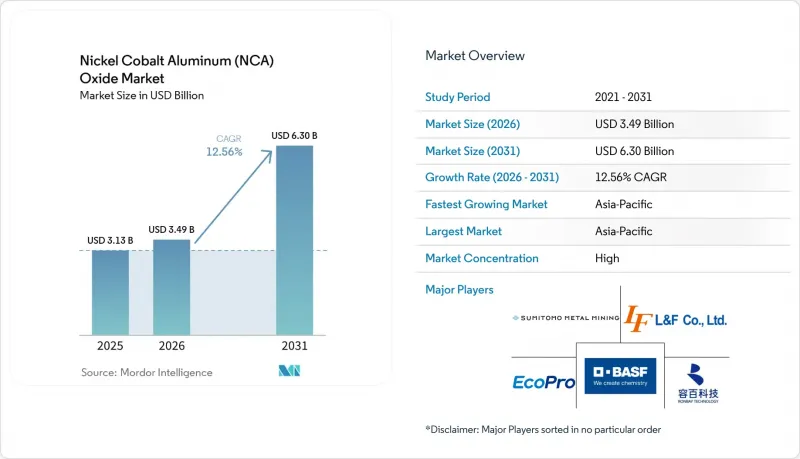
據 Mordor Intelligence 稱,2025 年鎳鈷鋁 (NCA) 氧化物市場價值為 31.3 億美元,預計到 2031 年將達到 63 億美元,而 2026 年為 34.9 億美元,預測期(2026-2031 年)的複合年成長率為 12.56%。
全球鎳鈷鋁(NCA)氧化物市場趨勢及洞察
高階電動車的續航里程要求支持了NCA在動力傳動系統等級體系中的地位。
續航里程問題仍然是電動車普及的一大障礙,而面向高階客戶的汽車製造商仍然優先考慮能量密度,因為能量密度能夠延長續航里程,而無需相應增加電池組的重量。高鎳NCA正極材料的能量密度比標準的鎳鈷錳化合物高出20%至30%,在合適的應用情境下能夠實現更長的續航里程。鎳鈷鋁氧化物(NCA)市場與那些將續航里程性能作為產品核心的車型項目密切相關,尤其是在售價超過5萬美元的車型中。到2025年,NCA將佔全球電動車含鈷電池化合物的15%,其應用主要集中在中國以外的高階車型領域。 NCA並非適用於所有電動車項目,因為價格較低的車型通常採用能量密度較低的化合物,或使用更大或設計不同的電池組。豪華汽車製造商對包裝和性能提出了更嚴格的要求,導致能夠持續供應高品質、高鎳陰極材料的製造商的需求範圍縮小,同時也提出了更先進的技術要求。
高性能汽車的電氣化擴大了NCA的潛在市場。
電氣化正擴展到高功率跑車、高性能SUV以及其他對高比能量和持續放電能力要求極高的應用領域。這些應用需要既能支援性能又能減輕車輛重量的電池設計。 BMW在其下一代電動車中採用46毫米圓柱形電池,正是轉向更大尺寸圓柱形電池架構的體現。當製造商選擇滿足這些要求的正極材料,而目前低成本化學材料的替代方案有限時,鎳鈷鋁氧化物(NCA)市場將從中受益。這項機會也延伸至航太應用、無人機和電動垂直起降(eVTOL)平台,在這些領域,重量直接影響運作能力。北京東方電池表示,其用於全固態電池的正極材料,其能量密度目標超過400 Wh/kg,已在無人機和eVTOL平台商業化。儘管這些特殊應用創造了高價值的需求,但由於需要進行全面的材料檢驗和安全測試,因此獲得認證的供應商數量有限。
LFP 的成本和規模優勢限制了 NCA 的潛在市場。
預計到2025年,磷酸鋰鐵(LFP)電池組的每千瓦時成本將比鎳磷酸鋰鐵鈷電池低40%以上,在全球電動車電池部署中佔比將超過55%。這個價格優勢,加上中國成熟的生產規模,推動了磷酸鋰鐵在大眾市場電動車領域的應用。鎳鈷鋁氧化物(NCA)市場以鎳和鈷為原料,且生產控制要求更為嚴格,難以匹敵磷酸鐵鋰的成本競爭力。儘管包括NCA和鎳鈷錳(NCM)在內的三元正極材料在2025年僅成長了12%,但鋰鐵基正極材料實現了58%的成長,到2025年底,磷酸鋰鐵將佔正極材料總需求的70%以上。因此,NCA仍然主要面向高階應用領域,在這些領域,緊湊的電池組尺寸、高比能量和優異的續航里程能夠帶來明顯的商業性價值。與更廣泛的電動車電池市場相比,這創造了意義重大但又具有選擇性的機會。生產商必須在性能和認證方面保持優勢,而不能僅僅在成本上競爭。
細分市場分析
鎳含量達到98%或以上的高純度鎳鈷鋁氧化物(NCA)正極材料,預計到2025年將佔據鎳鈷鋁氧化物(NCA)市場61.23%的佔有率,並預計到2031年將以13.52%的複合年成長率成長,成為各規格細分市場中成長最快的產品。由於鎳含量的提升能夠提升比容量,高純度配方能夠進一步提升高階電動車所需的續航里程。鎳鈷鋁氧化物產業正是依賴性能、電池組重量和車輛續航里程之間的這種關係。高純度正極材料可以獲得認證溢價,因為汽車製造商需要性能可靠且製造品質穩定的材料。
這項認證要求構成了准入壁壘,並有助於現有供應商維持價格穩定。浦項製鐵未來M公司於2025年進行的超高鎳單晶正極材料試點計畫表明,鎳含量高於98%的類別正朝著更高鎳含量的方向發展。標準純度NCA和其他低於98%的牌號滿足了剩餘的需求,包括一些對高純度NCA性能要求不高的領域,例如對成本敏感的家用電子電器和通用電動工具。鎳鈷鋁氧化物(NCA)市場仍分為高價值的汽車級和低需求應用兩部分,汽車認證採用IEC 62133和IATF 16949標準。
區域分析
預計到2025年,亞太地區將佔全球NCA需求的45.62%,並在2031年之前以13.13%的複合年成長率成長。該地區是規模最大且成長最快的區域市場,其中中國仍然是正極前驅體和成品NCA的主要生產中心。韓國製造商,如EcoPro、POSCO Future M、LG Chem和L&F,透過其國內生產基地向全球汽車製造商(OEM)供應優質正極材料。日本憑藉其材料製造商和技術基礎,在NCA市場仍佔有重要地位。住友金屬礦業正在將其中端產品從NCA轉向鎳錳鈷氧化物(NMC),這反映了不同電池應用對化學成分的不同偏好。
在印度、東南亞國協和其他亞太市場,隨著國內電動車(EV)製造業的擴張,中期需求潛力預計將會提升。儘管這些國家在正極材料生產規模上仍落後於中國、韓國和日本,但隨著該地區汽車組裝和電池供應鏈的發展,它們的作用可能日益增強。亞太地區的鎳陰極材料(NCA)市場也受益於集中的電池製造專業知識和專業的供應商網路。這促進了材料開發、生產規模擴張和客戶認證,但區域生產商也面臨來自中國不斷變化的需求和磷酸鋰鐵競爭的挑戰。對高品質、高鎳材料的需求與對低成本電池化學成分的需求之間的平衡將繼續推動該地區的投資。
在北美和歐洲,由於供應商努力滿足美國和歐洲的採購需求,每個計畫生產單元的投資金額都很高。 LG化學位於田納西州的陰極材料工廠計劃於2026年投產,年產能為6萬噸;而EcoPro BM位於德布勒森的工廠也於2026年6月開始向歐洲汽車OEM廠商供貨,年產能為5.4萬噸。南美洲作為原料供應地,具有重要的戰略地位,這得益於浦項鋼鐵在阿根廷的鋰鹵水資產以及從菲律賓採購的鎳。中東和非洲仍處於消費的早期階段,儘管摩洛哥已有一些與電池材料相關的活動。在這些地區,由於電動車的應用僅限於小眾的工業和商業領域,目前對NCA的需求有限。
其他好處:
- Excel格式的市場預測(ME)表
- 3個月的分析師支持
目錄
第1章:引言
- 研究假設和市場定義
- 調查範圍
第2章:調查方法
第3章執行摘要
第4章 市場狀況
- 市場概覽
- 市場促進因素
- 高階電動車的續航里程要求
- 高性能車輛的電氣化
- 高鎳含量帶來的能量密度優勢
- 電池供應鏈本地化
- 鎳鈷的閉合迴路回收
- NCA認證適用於高功率圓柱形電池
- 市場限制因素
- 磷酸鐵鋰電池的成本和供應優勢
- 鎳和鈷價格波動
- 高鎳材料中熱失控的風險
- 認證和製程控制的負擔
- 價值鏈分析
- 波特五力分析
第5章 市場規模與成長預測
- 按規定
- 高純度(98%或以上)
- 標準純度(低於98%)
- 其他
- 透過使用
- 電動車
- 能源儲存系統
- 家用電子產品
- 其他(電動工具、醫療設備、航太和國防)
- 按地區
- 亞太地區
- 中國
- 印度
- 日本
- 韓國
- 東南亞國協
- 其他亞太國家
- 北美洲
- 美國
- 加拿大
- 墨西哥
- 歐洲
- 德國
- 英國
- 法國
- 義大利
- 北歐國家
- 其他歐洲國家
- 南美洲
- 巴西
- 阿根廷
- 其他南美國家
- 中東和非洲
- 沙烏地阿拉伯
- 南非
- 其他中東和非洲國家
- 亞太地區
第6章 競爭情勢
- 市場集中度
- 策略趨勢
- 市佔率和排名分析
- 公司簡介
- BASF
- Beijing Easpring Material Technology Co., Ltd.
- Changyuan Lico Co., Ltd.
- CNGR Advanced Material Co., Ltd.
- ECOPRO
- GEM Co., Ltd.
- L&F Co., Ltd.
- LG Chem
- Nihon Kagaku Sangyo Co., Ltd.
- Ningbo Ronbay New Energy Technology Co., Ltd.
- Ningbo Shanshan Co., Ltd.
- POSCO FUTURE M
- Redwood Materials, Inc.
- Sumitomo Metal Mining Co., Ltd.
- Tesla, Inc.
- Umicore
第7章 市場機會與未來展望
According to Mordor Intelligence, the nickel cobalt aluminum (NCA) oxide market size was valued at USD 3.13 billion in 2025 and is estimated to grow from USD 3.49 billion in 2026 to reach USD 6.30 billion by 2031, at a CAGR of 12.56% during the forecast period (2026-2031).
Global Nickel Cobalt Aluminum (NCA) Oxide Market Trends and Insights
Premium EV Range Requirements Sustain NCA's Position in the Powertrain Hierarchy
Range concerns remain a barrier to wider electric vehicle adoption, and automakers serving premium buyers continue to prioritize energy density as it can extend range without a proportionate increase in battery pack weight. High-nickel NCA cathodes have demonstrated 20-30% higher energy density than standard nickel-cobalt-manganese chemistries, supporting longer driving range in suitable applications. The Nickel Cobalt Aluminum Oxide market is tied to vehicle programs where range performance is a core part of the offering, including vehicles priced above USD 50,000. NCA accounted for 15% of cobalt-containing battery chemistry deployed in electric vehicles globally in 2025, with its role more concentrated in premium applications outside China. Lower-cost vehicles can often use lower-energy-density chemistries and larger or differently designed battery packs, making NCA unsuitable for every electric vehicle program. Premium manufacturers face tighter packaging and performance constraints, leaving a narrower yet more technically demanding demand base for producers capable of delivering consistent high-nickel cathode quality.
Electrification of High-Performance Vehicles Expands the NCA Addressable Market
Electrification is extending into high-power sports cars, performance sport utility vehicles, and other applications where high specific energy and sustained discharge capability are important. These applications require battery designs that support performance while limiting vehicle weight. BMW's use of 46 mm cylindrical cells for its next-generation electric vehicles reflects this shift toward large-format cylindrical architectures. The Nickel Cobalt Aluminum Oxide market can benefit when manufacturers select cathodes that meet these requirements and when lower-cost chemistries offer limited alternatives. The opportunity also extends to aerospace-related uses, drones, and electric vertical takeoff and landing platforms, where weight directly affects operating capability. Beijing Easpring stated that cathode materials for solid-state batteries with energy density targets exceeding 400 Wh/kg had been used commercially in drones and eVTOL platforms. These specialized applications create high-value demand but require extensive material validation and safety testing, which limits the number of qualified suppliers.
LFP's Cost and Scale Advantages Limit NCA's Addressable Market
Lithium iron phosphate battery packs were more than 40% cheaper per kWh than nickel-manganese-cobalt alternatives in 2025, and lithium iron phosphate accounted for more than 55% of global electric vehicle battery deployment. This price advantage and established Chinese production scale have supported the adoption of lithium iron phosphate in mass-market electric vehicle segments. The nickel cobalt aluminum oxide market cannot readily match that cost position, as it relies on nickel and cobalt inputs and more demanding production controls. Ternary cathodes, including NCA and nickel-cobalt-manganese (NCM), grew 12% in 2025, while lithium iron cathodes grew 58%, and lithium iron phosphate exceeded 70% of total cathode demand by the end of 2025. NCA consequently remains concentrated in premium applications where compact pack size, high specific energy, and range performance carry clear commercial value. This creates a meaningful but selective opportunity compared to the broader electric vehicle battery market, requiring producers to maintain their performance and qualification advantages rather than compete on cost alone.
Other drivers and restraints analyzed in the detailed report include:
- Regionalization of Battery Supply Chains Redirects Capital Toward Non-China NCA Production
- High-Nickel Energy Density Advantage Compounds Through Ongoing Cathode Innovation
- Nickel and Cobalt Price Volatility Introduces Margin Risk and Qualification Disruption
For complete list of drivers and restraints, kindly check the Table Of Contents.
Segment Analysis
High-purity NCA with a nickel content of at least 98% accounted for 61.23% of the Nickel Cobalt Aluminum Oxide market in 2025 and is projected to expand at a 13.52% CAGR through 2031, representing the fastest growth rate within the specification segment. Higher-purity formulations deliver the incremental range gains sought in premium electric vehicles, as increasing nickel content raises specific capacity. The Nickel Cobalt Aluminum Oxide industry relies on this relationship between performance, pack weight, and vehicle range. High-purity cathodes can command a qualification premium because automotive customers require proven material performance and stable manufacturing quality.
This qualification requirement creates a barrier to entry and supports pricing discipline among established suppliers. POSCO Future M's pilot work on ultra-high-nickel single-crystal cathodes in 2025 illustrates how the at-least-98% category is evolving toward even higher-nickel formulations. Standard-purity NCA below 98% and other grades meet the remaining demand, including cost-sensitive consumer electronics and commodity power tools, where the full performance range of high-purity NCA is not always necessary. The Nickel Cobalt Aluminum Oxide market remains divided between high-value automotive grades and lower-demand applications, with IEC 62133 and IATF 16949 standards governing automotive qualifications.
Complete Report Scope:
- By Specification
- High Purity (greater than or equal to 98%)
- Standard Purity (less-than 98%)
- Others
- By Application
- Electric Vehicles
- Energy Storage Systems
- Consumer Electronics
- Others (Power Tools, Medical Devices, Aerospace, and Defense)
- By Geography
- Asia-Pacific
- China
- India
- Japan
- South Korea
- ASEAN Countries
- Rest of Asia-Pacific
- North America
- United States
- Canada
- Mexico
- Europe
- Germany
- United Kingdom
- France
- Italy
- NORDIC Countries
- Rest of Europe
- South America
- Brazil
- Argentina
- Rest of South America
- Middle-East and Africa
- Saudi Arabia
- South Africa
- Rest of Middle-East and Africa
- Asia-Pacific
Geography Analysis
Asia-Pacific held 45.62% of global NCA demand in 2025 and is forecast to expand at a 13.13% CAGR through 2031. The region was both the largest and fastest-growing regional market, with China remaining a major location for cathode precursor production and finished NCA output. South Korean producers, including EcoPro, POSCO Future M, LG Chem, and L&F, supply premium-grade cathode materials to global original equipment manufacturers from domestic facilities. Japan remains important to the NCA market through its material producers and technology base. Sumitomo Metal Mining has been shifting from NCA toward Nickel Manganese Cobalt Oxide (NMC) for mid-market products, reflecting differing chemistry preferences across battery applications.
India, ASEAN countries, and other Asia-Pacific markets offer medium-term demand potential as domestic electric vehicle manufacturing expands. These countries do not yet match the scale of China, South Korea, or Japan in cathode production, but their roles may grow as regional vehicle assembly and battery supply chains develop. The NCA market in Asia-Pacific also benefits from concentrated battery manufacturing expertise and specialized supplier networks. This supports material development, production scaling, and customer qualification, while exposing regional producers to shifting Chinese demand and competition from lithium iron phosphate. The balance between premium high-nickel demand and lower-cost battery chemistry demand will continue to guide regional investment.
North America and Europe attract high investment per unit of planned output as suppliers work to meet U.S. and European sourcing requirements. LG Chem's Tennessee cathode plant is scheduled to begin operations in 2026 with an annual capacity of 60,000 tons, while EcoPro BM began shipments from its 54,000-ton-per-year Debrecen plant to European automotive original equipment manufacturers in June 2026. South America is strategically relevant as a raw material source through POSCO's lithium brine assets in Argentina and nickel procurement from the Philippines. The Middle-East and Africa remain early-stage consumption regions, with battery material activity present in Morocco. The NCA market has limited current demand in these regions, where electric vehicle adoption remains focused on niche industrial and commercial uses.
- BASF
- Beijing Easpring Material Technology Co., Ltd.
- Changyuan Lico Co., Ltd.
- CNGR Advanced Material Co., Ltd.
- ECOPRO
- GEM Co., Ltd.
- L&F Co., Ltd.
- LG Chem
- Nihon Kagaku Sangyo Co., Ltd.
- Ningbo Ronbay New Energy Technology Co., Ltd.
- Ningbo Shanshan Co., Ltd.
- POSCO FUTURE M
- Redwood Materials, Inc.
- Sumitomo Metal Mining Co., Ltd.
- Tesla, Inc.
- Umicore
Additional Benefits:
- The market estimate (ME) sheet in Excel format
- 3 months of analyst support
TABLE OF CONTENTS
1 Introduction
- 1.1 Study Assumptions and Market Definition
- 1.2 Scope of the Study
2 Research Methodology
3 Executive Summary
4 Market Landscape
- 4.1 Market Overview
- 4.2 Market Drivers
- 4.2.1 Premium EV Range Requirements
- 4.2.2 Electrification of High-Performance Vehicles
- 4.2.3 High-Nickel Energy Density Advantage
- 4.2.4 Regionalization of Battery Supply Chains
- 4.2.5 Closed-Loop Nickel and Cobalt Recovery
- 4.2.6 NCA Qualification for High-Power Cylindrical Cells
- 4.3 Market Restraints
- 4.3.1 LFP Cost and Availability Advantage
- 4.3.2 Nickel and Cobalt Price Volatility
- 4.3.3 High-Nickel Thermal-Runaway Exposure
- 4.3.4 Qualification and Process-Control Burden
- 4.4 Value Chain Analysis
- 4.5 Porter's Five Forces Analysis
- 4.5.1 Bargaining Power of Suppliers
- 4.5.2 Bargaining Power of Buyers
- 4.5.3 Threat of New Entrants
- 4.5.4 Threat of Substitutes
- 4.5.5 Competitive Rivalry
5 Market Size and Growth Forecasts (Value)
- 5.1 By Specification
- 5.1.1 High Purity (greater than or equal to 98%)
- 5.1.2 Standard Purity (less-than 98%)
- 5.1.3 Others
- 5.2 By Application
- 5.2.1 Electric Vehicles
- 5.2.2 Energy Storage Systems
- 5.2.3 Consumer Electronics
- 5.2.4 Others (Power Tools, Medical Devices, Aerospace, and Defense)
- 5.3 By Geography
- 5.3.1 Asia-Pacific
- 5.3.1.1 China
- 5.3.1.2 India
- 5.3.1.3 Japan
- 5.3.1.4 South Korea
- 5.3.1.5 ASEAN Countries
- 5.3.1.6 Rest of Asia-Pacific
- 5.3.2 North America
- 5.3.2.1 United States
- 5.3.2.2 Canada
- 5.3.2.3 Mexico
- 5.3.3 Europe
- 5.3.3.1 Germany
- 5.3.3.2 United Kingdom
- 5.3.3.3 France
- 5.3.3.4 Italy
- 5.3.3.5 NORDIC Countries
- 5.3.3.6 Rest of Europe
- 5.3.4 South America
- 5.3.4.1 Brazil
- 5.3.4.2 Argentina
- 5.3.4.3 Rest of South America
- 5.3.5 Middle-East and Africa
- 5.3.5.1 Saudi Arabia
- 5.3.5.2 South Africa
- 5.3.5.3 Rest of Middle-East and Africa
- 5.3.1 Asia-Pacific
6 Competitive Landscape
- 6.1 Market Concentration
- 6.2 Strategic Moves
- 6.3 Market Share (%)/Ranking Analysis
- 6.4 Company Profiles (includes Global Overview, Market Overview, Core Segments, Financials as available, Strategic Information, Products and Services, and Recent Developments)
- 6.4.1 BASF
- 6.4.2 Beijing Easpring Material Technology Co., Ltd.
- 6.4.3 Changyuan Lico Co., Ltd.
- 6.4.4 CNGR Advanced Material Co., Ltd.
- 6.4.5 ECOPRO
- 6.4.6 GEM Co., Ltd.
- 6.4.7 L&F Co., Ltd.
- 6.4.8 LG Chem
- 6.4.9 Nihon Kagaku Sangyo Co., Ltd.
- 6.4.10 Ningbo Ronbay New Energy Technology Co., Ltd.
- 6.4.11 Ningbo Shanshan Co., Ltd.
- 6.4.12 POSCO FUTURE M
- 6.4.13 Redwood Materials, Inc.
- 6.4.14 Sumitomo Metal Mining Co., Ltd.
- 6.4.15 Tesla, Inc.
- 6.4.16 Umicore
7 Market Opportunities and Future Outlook
- 7.1 White-Space and Unmet-Need Assessment


