


 |
市場調查報告書
商品編碼
2154414
鋅合金材料:市場佔有率分析、產業趨勢與統計、成長預測(2026-2031)Zamak Material - Market Share Analysis, Industry Trends & Statistics, Growth Forecasts (2026 - 2031) |
||||||

※ 本網頁內容可能與最新版本有所差異。詳細情況請與我們聯繫。
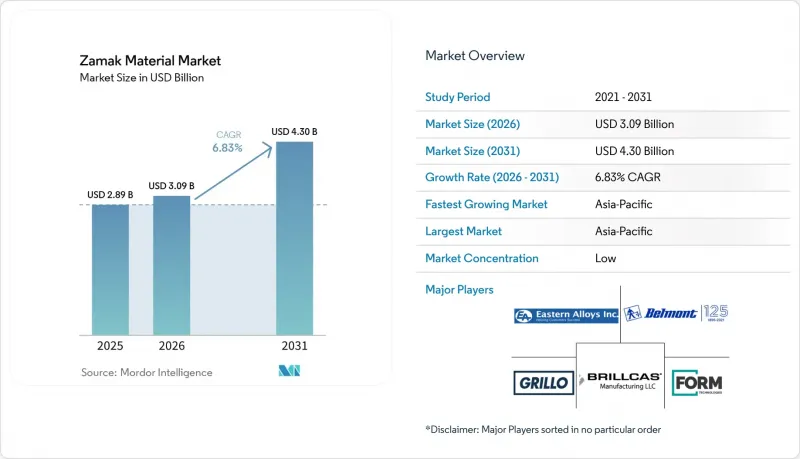
據 Mordor Intelligence 稱,2025 年 Zamac 材料市值為 28.9 億美元,預計到 2031 年將達到 43 億美元,而 2026 年為 30.9 億美元,預測期(2026-2031 年)的複合年成長率為 6.83%。
全球鋅合金材料市場趨勢與洞察
汽車和電動汽車零件的輕量化
隨著汽車電氣化的發展,對兼具尺寸穩定性、密封性能和精確形狀的小型零件的需求日益成長。鋅壓鑄市場正受益於電動車電池連接器、高級駕駛輔助系統 (ADAS) 感測器外殼和控制單元機殼等對這些特性的需求。鋅壓鑄能夠生產鋁冷室鑄造難以製造的薄壁零件。國際鋅協會預測,未來十年,鋅合金在電動車電纜連接器、引擎零件和感測器外殼的應用將持續成長。預計在此期間,印度和東南亞的鋅壓鑄需求成長率將最高。此外,隨著每輛車上 ADAS 感測器數量的增加,對具有穩定尺寸精度的緊湊型外殼的需求也在不斷成長。
電子設備的微型化和對電磁干擾屏蔽的需求
鋅合金(Zammak)材料市場主要受電子應用領域對緊湊型機殼和電磁干擾(EMI)屏蔽的需求驅動。鋅合金在一次鑄造中即可實現屏蔽功能和薄壁成型,從而減少了某些設計中對單獨屏蔽層的需求。這對於5G網路相關設備、連網型設備、汽車電子產品和工業控制設備尤其重要。預計到2031年,電氣和電子產業將以8.09%的複合年成長率成長,這反映了硬體需求的不斷成長以及最終產品中電子元件數量的增加。與使用獨立屏蔽元件的設計相比,一體式壓鑄機殼減少了組裝步驟。因此,這提高了需要緊湊型、高品質金屬外殼的原始設備製造商(OEM)的製造流程一致性。
鋅價及初級金屬供應波動
由於鋅是重要的合金材料,鋅價波動會影響整個鋅合金(Zammak)材料市場的獲利能力。國際鉛鋅研究小組(ILZSG)的報告顯示,2025年精煉鋅市場將出現3.3萬噸的供不應求。倫敦金屬交易所(LME)的倉庫庫存到2025年底將減少7.7萬噸,降至73.9萬噸。 LME現貨結算價在2025年4月17日跌至每噸2521美元的2025年低點,隨後在2025年12月2日回升至每噸3351美元。透過現貨交易或短期合約購買鋅的生產商可能會面臨劇烈的成本波動。小規模的壓鑄製造商可能難以承受這些波動,或難以將其轉嫁給汽車和電子產品客戶。
細分市場分析
截至2025年,Zamak 3佔據了Zamak材料市場41.26%的佔有率,而Zamak 7預計到2031年將以7.78%的複合年成長率成長。 Zamak 3因其均衡的機械性能、尺寸穩定性、鑄造性能和表面處理相容性而持續廣泛應用。此合金的抗張強度為283兆帕(MPa),可透過電鍍或粉末塗層進行表面處理。其在汽車裝飾件、電子設備機殼和工業硬體領域的成熟應用鞏固了其在北美市場的地位。 Zamak 7適用於需要更高流動性和表面拋光性的薄壁外部組件和電子設備應用。穿戴式裝置機殼、5G天線外殼和精密鎖具等應用對這些性能要求極高。
Zamac 5 鋅合金因其銅含量高,適用於需要高強度的精密裝飾件和功能性支架。根據國際鋅協會的數據,Zamac 5 的抗張強度為 331 MPa。 Zamac 2 鋅合金則用於高負荷機械零件和齒輪,這些零件對硬度和抗尺寸膨脹性能要求較高。其他合金類型包括 Zamac 8 鋅合金、鋅鋁合金 8 (ZA-8) 以及用於高溫和精密應用的特殊合金。鋅合金產業也透過回收成分認證來區分合金產品。隨著鋅合金被納入 ecoInvent 2025,買家現在可以使用經認證的方法來評估再生鋅合金的生命週期資訊。這不僅有利於高性能特種合金市場的發展,也有利於經認證的再生合金市場的發展。
區域分析
預計到2025年,亞太地區將佔鋅合金材料市場43.34%的佔有率,並將在2031年之前以7.85%的複合年成長率成長。中國正集中其鋅壓鑄產能,以滿足國內和出口需求。印度正在擴大其在鋅壓鑄領域的地位,並日益成為多元化的OEM供應商。國際鋅業協會預測,未來十年印度的鋅壓鑄需求將增加49%。該協會也預計,同期中國的需求將成長11%。日本和韓國在汽車精密零件領域繼續發揮重要作用。因此,亞太地區兼具規模優勢、不斷成長的產能以及來自汽車和電子製造業的需求。
汽車供應鏈以及該地區對精密鑄造能力的需求支撐著北美市場。在歐洲,義大利、德國和比利時均已建立鋅合金生產和壓鑄業務。歐洲還有一些供應商提供使用回收材料的產品,並擁有永續性文件體系。截至2025年6月,歐洲化學品管理局 (ECHA) 維護一份包含250種高度關注物質 (SVHC) 的清單。這種法規環境凸顯了記錄合金成分和揭露供應鏈資訊的重要性。印度斯坦鋅業公司於2025年6月批准在拉賈斯坦邦建造一座價值13.9億美元的金屬複合材料工廠。該項目旨在每年增加25萬噸的產能,並降低對進口的依賴。供應穩定性、能源成本和合規能力是影響這些地區鋅合金市場的關鍵因素。
在南美洲,巴西的汽車生產和阿根廷的建築相關金屬製品應用是推動鋅需求的主要因素。該地區的許多買家依賴進口鋅合金,這可能會增加他們受鋅價波動的影響。國際鉛鋅研究小組(ILZS)報告稱,2025年精煉鋅的供應將持續緊張。在中東和非洲,沙烏地阿拉伯的基礎設施建設和南非金屬資源的多元化預計將支撐未來的需求。在這些地區的某些地方,當地的加工能力仍然不足。上游供應商正在考慮在當地再生鋅產能擴大之前建立經銷夥伴。這些地區的鋅合金材料市場仍有進入空間,但隨著當地產能的提高,這一空間可能會逐漸縮小。
其他好處:
- Excel格式的市場預測(ME)表
- 3個月的分析師支持
目錄
第1章:引言
- 研究假設和市場定義
- 調查範圍
第2章:調查方法
第3章執行摘要
第4章 市場狀況
- 市場概覽
- 市場促進因素
- 汽車和電動汽車零件的輕量化
- 電子設備的微型化和對電磁干擾屏蔽的需求
- 薄壁高精度壓鑄件的發展
- 再生鋅和低碳合金的供應狀況
- 精密零件供應鏈的近岸外包
- 市場限制因素
- 鋅價及初級金屬供應波動
- 使用鋁、鎂和工程塑膠進行替代。
- 對能源、排放氣體和重金屬的監管要求更加嚴格。
- 價值鏈分析
- 波特五力分析
第5章 市場規模與成長預測
- 按合金類型
- 札馬克3號
- Zamac 5
- 札馬克 2
- Zamac 7
- 其他合金類型(ZA-8、特殊ZA-8合金)
- 透過製造程序
- 熱室壓鑄
- 壓力壓鑄
- 多滑塊壓鑄
- 其他製造程序
- 按最終用途行業分類
- 車
- 建築/施工
- 電氣和電子設備
- 其他終端用戶產業(消費品/家用電器、工業設備、醫療、航太/國防)
- 按地區
- 亞太地區
- 中國
- 印度
- 日本
- 韓國
- 東南亞國協
- 其他亞太國家
- 北美洲
- 美國
- 加拿大
- 墨西哥
- 歐洲
- 德國
- 英國
- 法國
- 義大利
- 北歐國家
- 其他歐洲國家
- 南美洲
- 巴西
- 阿根廷
- 其他南美國家
- 中東和非洲
- 沙烏地阿拉伯
- 南非
- 其他中東和非洲國家
- 亞太地區
第6章 競爭情勢
- 市場集中度
- 策略趨勢
- 市佔率和排名分析
- 公司簡介
- Belmont Metals
- BN Industries
- Brillcast Manufacturing LLC
- Bruschi Srl
- Chem Zinc Die Casting Alloys
- Eastern Alloys Inc.
- Form Technologies
- GRILLO-Werke AG
- Hindustan Zinc
- Ital Leghe Srl
- KOREAZINC
- Nyrstar
- Phoenix Industries Ltd.
- Radiant Metals & Alloys Pvt. Ltd.
- REAZN SA
第7章 市場機會與未來展望
According to Mordor Intelligence, the zamak material market size was valued at USD 2.89 billion in 2025 and is estimated to grow from USD 3.09 billion in 2026 to reach USD 4.30 billion by 2031, at a CAGR of 6.83% during the forecast period (2026-2031).
Global Zamak Material Market Trends and Insights
Automotive and EV Component Lightweighting
Vehicle electrification increases the need for small components that combine dimensional stability, sealing performance, and accurate geometry. The Zamak material market benefits where EV battery connectors, advanced driver assistance system (ADAS) sensor housings, and control-unit enclosures need these characteristics. Zinc die casting can make thin-walled parts that are difficult to produce through aluminum cold-chamber casting. The International Zinc Association expects zinc alloy use in EV cable connections, engine parts, and sensor housings to increase during the next decade. India and Southeast Asia are expected to record the strongest regional gains in zinc die-casting demand over that period. A higher number of ADAS sensors per vehicle also increases the need for compact housings with repeatable dimensions.
Electronics Miniaturization and EMI Shielding Demand
The Zamak material market is supported by electronics applications that need compact enclosures and shielding against EMI. Zinc alloys can provide shielding and form thin walls in one cast part, reducing the need for separate shielding layers in certain designs. This is relevant to equipment associated with 5G networks, connected devices, automotive electronics, and industrial controls. Electrical and electronics are projected to advance at an 8.09% CAGR through 2031, reflecting greater hardware demand and more electronics within end products. One-piece die-cast enclosures can reduce the number of assembly stages compared with designs that use separate shielding elements. The resulting manufacturing approach can improve consistency for OEMs that require compact, finished metal housings.
Zinc Price and Primary-Metal Supply Volatility
Zinc price movements can affect margins across the Zamak material market because zinc is the principal alloy input. The International Lead and Zinc Study Group reported a 33,000 metric ton refined-zinc market deficit in 2025. London Metal Exchange warehouse stocks declined by 77,000 metric tons to 739,000 metric tons at the end of 2025. The London Metal Exchange cash settlement price reached USD 3,351 per metric ton on December 2, 2025, after reaching a 2025 low of USD 2,521 per metric ton on April 17. Producers who buy zinc on spot terms or short-term contracts can face abrupt cost changes. Smaller die casters may have less ability to absorb those changes or pass them through to automotive and electronics customers.
Other drivers and restraints analyzed in the detailed report include:
- Growth of Thin-Wall, High-Precision Die Casting
- Recycled Zinc and Lower-Carbon Alloy Availability
- Tightening Energy, Emissions, and Heavy-Metal Compliance Requirements
For complete list of drivers and restraints, kindly check the Table Of Contents.
Segment Analysis
Zamak 3 held 41.26% of the Zamak material market in 2025, while Zamak 7 is projected to advance at a 7.78% CAGR through 2031. Zamak 3 remained widely used because it balanced mechanical performance, dimensional stability, castability, and finishing compatibility. The alloy has a tensile strength of 283 megapascals (MPa) and supports electroplating and powder-coating finishes. Its established use across automotive trim, electronics housings, and industrial hardware supports its position in North America. Zamak 7 is suited to thin-wall cosmetic and electronics applications where improved fluidity and surface polishability matter. Wearable housings, 5G antenna enclosures, and precision locks are examples of applications where those properties are relevant.
Zamak 5 supports precision trim and functional brackets that need greater strength from its copper content. The International Zinc Association reports a tensile strength of 331 MPa for Zamak 5. Zamak 2 is used in heavy-duty mechanical parts and gears where hardness and resistance to dimensional growth are important. Other alloy types include Zamak 8, zinc-aluminum 8 (ZA-8), and specialty grades for elevated-temperature or precision applications. The Zamak material industry is also differentiating alloy offerings through recycled-content documentation. The 2025 ecoinvent inclusion gives purchasers a recognized method to assess secondary Zamak life cycle information. This supports a market for certified recycled alloy alongside performance-oriented specialty grades.
Complete Report Scope:
- By Alloy Type
- Zamak 3
- Zamak 5
- Zamak 2
- Zamak 7
- Other Alloy Types (Zamak 8/ZA-8, Specialty Zamak Alloys)
- By Manufacturing Process
- Hot-Chamber Die Casting
- Pressure Die Casting
- Multi-Slide Die Casting
- Other Manufacturing Processes
- By End-Use Industry
- Automotive
- Building and Construction
- Electrical and Electronics
- Other End-Use Industries (Consumer Goods and Appliances, Industrial Equipment, Healthcare, Aerospace and Defense)
- By Geography
- Asia-Pacific
- China
- India
- Japan
- South Korea
- ASEAN Countries
- Rest of Asia-Pacific
- North America
- United States
- Canada
- Mexico
- Europe
- Germany
- United Kingdom
- France
- Italy
- NORDIC Countries
- Rest of Europe
- South America
- Brazil
- Argentina
- Rest of South America
- Middle-East and Africa
- Saudi Arabia
- South Africa
- Rest of Middle-East and Africa
- Asia-Pacific
Geography Analysis
Asia-Pacific held 43.34% of the Zamak material market in 2025 and is projected to advance at a 7.85% CAGR through 2031. China has a large concentration of zinc die-casting capacity for domestic and export programs. India is expanding its position in zinc die casting and is becoming more relevant to diversified OEM sourcing. The International Zinc Association projects a 49% increase in zinc die-casting demand in India during the next decade. It expects China to contribute an additional 11% during the same period. Japan and South Korea remain important for precision automotive components. Asia-Pacific, therefore, combines scale, expanding capacity, and demand from automotive and electronics manufacturing.
Automotive supply chains and the need for regional precision-casting capacity support North America. Europe has established zinc-alloy production and die-casting activity in Italy, Germany, and Belgium. Europe also has suppliers with recycled-content offerings and established sustainability documentation. The European Chemicals Agency maintained a candidate list of 250 Substances of Very High Concern as of June 2025. This regulatory setting increases the importance of alloy composition records and supply-chain disclosures. Hindustan Zinc approved a USD 1.39 billion metals complex in Rajasthan in June 2025. The project is intended to add 250,000 metric tons per annum of operational capacity and reduce import dependence. Supply security, energy costs, and compliance capability shape the Zamak material market in these regions.
South America has demand led by Brazil's automotive production and by construction-linked hardware applications in Argentina. Many buyers in the region depend on imported Zamak alloy, which can increase exposure to zinc price movements. The International Lead and Zinc Study Group reported tight refined-zinc conditions during 2025. In the Middle-East and Africa, infrastructure development in Saudi Arabia and metals diversification in South Africa is expected to support future demand. Local fabrication capacity is still developing across parts of these regions. Upstream suppliers are considering distribution partnerships before local secondary-zinc capacity expands. The Zamak material market has an opening in these areas, but local capability could narrow it over time.
- Belmont Metals
- BN Industries
- Brillcast Manufacturing LLC
- Bruschi Srl
- Chem Zinc Die Casting Alloys
- Eastern Alloys Inc.
- Form Technologies
- GRILLO-Werke AG
- Hindustan Zinc
- Ital Leghe S.r.l.
- KOREAZINC
- Nyrstar
- Phoenix Industries Ltd.
- Radiant Metals & Alloys Pvt. Ltd.
- REAZN S.A.
Additional Benefits:
- The market estimate (ME) sheet in Excel format
- 3 months of analyst support
TABLE OF CONTENTS
1 Introduction
- 1.1 Study Assumptions and Market Definition
- 1.2 Scope of the Study
2 Research Methodology
3 Executive Summary
4 Market Landscape
- 4.1 Market Overview
- 4.2 Market Drivers
- 4.2.1 Automotive and EV Component Lightweighting
- 4.2.2 Electronics Miniaturization and EMI Shielding Demand
- 4.2.3 Growth of Thin-Wall, High-Precision Die Casting
- 4.2.4 Recycled Zinc and Lower-Carbon Alloy Availability
- 4.2.5 Nearshoring of Precision Component Supply Chains
- 4.3 Market Restraints
- 4.3.1 Zinc Price and Primary-Metal Supply Volatility
- 4.3.2 Substitution by Aluminum, Magnesium, and Engineering Plastics
- 4.3.3 Tightening Energy, Emissions, and Heavy-Metal Compliance Requirements
- 4.4 Value Chain Analysis
- 4.5 Porter's Five Forces Analysis
- 4.5.1 Threat of New Entrants
- 4.5.2 Bargaining Power of Suppliers
- 4.5.3 Bargaining Power of Buyers
- 4.5.4 Threat of Substitutes
- 4.5.5 Competitive Rivalry
5 Market Size and Growth Forecasts (Value)
- 5.1 By Alloy Type
- 5.1.1 Zamak 3
- 5.1.2 Zamak 5
- 5.1.3 Zamak 2
- 5.1.4 Zamak 7
- 5.1.5 Other Alloy Types (Zamak 8/ZA-8, Specialty Zamak Alloys)
- 5.2 By Manufacturing Process
- 5.2.1 Hot-Chamber Die Casting
- 5.2.2 Pressure Die Casting
- 5.2.3 Multi-Slide Die Casting
- 5.2.4 Other Manufacturing Processes
- 5.3 By End-Use Industry
- 5.3.1 Automotive
- 5.3.2 Building and Construction
- 5.3.3 Electrical and Electronics
- 5.3.4 Other End-Use Industries (Consumer Goods and Appliances, Industrial Equipment, Healthcare, Aerospace and Defense)
- 5.4 By Geography
- 5.4.1 Asia-Pacific
- 5.4.1.1 China
- 5.4.1.2 India
- 5.4.1.3 Japan
- 5.4.1.4 South Korea
- 5.4.1.5 ASEAN Countries
- 5.4.1.6 Rest of Asia-Pacific
- 5.4.2 North America
- 5.4.2.1 United States
- 5.4.2.2 Canada
- 5.4.2.3 Mexico
- 5.4.3 Europe
- 5.4.3.1 Germany
- 5.4.3.2 United Kingdom
- 5.4.3.3 France
- 5.4.3.4 Italy
- 5.4.3.5 NORDIC Countries
- 5.4.3.6 Rest of Europe
- 5.4.4 South America
- 5.4.4.1 Brazil
- 5.4.4.2 Argentina
- 5.4.4.3 Rest of South America
- 5.4.5 Middle-East and Africa
- 5.4.5.1 Saudi Arabia
- 5.4.5.2 South Africa
- 5.4.5.3 Rest of Middle-East and Africa
- 5.4.1 Asia-Pacific
6 Competitive Landscape
- 6.1 Market Concentration
- 6.2 Strategic Moves
- 6.3 Market Share (%)/Ranking Analysis
- 6.4 Company Profiles (includes Global Overview, Market Overview, Core Segments, Financials as available, Strategic Information, Products and Services, and Recent Developments)
- 6.4.1 Belmont Metals
- 6.4.2 BN Industries
- 6.4.3 Brillcast Manufacturing LLC
- 6.4.4 Bruschi Srl
- 6.4.5 Chem Zinc Die Casting Alloys
- 6.4.6 Eastern Alloys Inc.
- 6.4.7 Form Technologies
- 6.4.8 GRILLO-Werke AG
- 6.4.9 Hindustan Zinc
- 6.4.10 Ital Leghe S.r.l.
- 6.4.11 KOREAZINC
- 6.4.12 Nyrstar
- 6.4.13 Phoenix Industries Ltd.
- 6.4.14 Radiant Metals & Alloys Pvt. Ltd.
- 6.4.15 REAZN S.A.
7 Market Opportunities and Future Outlook
- 7.1 White-Space and Unmet-Need Assessment

 溫度補償合金市場報告:趨勢、預測與競爭分析(至2035年)錫鋅合金市場報告:趨勢、預測及競爭分析(至2035年)
 5級Ti-6Al-4V合金市場規模、佔有率和成長分析:按產品形式、製造流程、應用、最終用戶和地區分類-2026-2033年產業預測
 矽合金市場:2026-2032年全球市場預測(依合金成分、形狀、等級、製造流程、終端應用產業及通路分類)
 2026年全球銀基焊料合金市場報告
 全球聚亞苯醚(PPE)合金市場規模、佔有率、趨勢和成長分析報告(2026-2034)特種合金鑄件市場:依合金類型、鑄造製程、產品類型、最終用途產業和應用分類-全球預測,2026-2032年微處理器熔點儀市場按操作模式、最終用戶和應用分類-全球預測,2026-2032年銅鎢合金市場按應用、終端用戶產業、形態、製造流程和等級分類,全球預測(2026-2032年)
 熔點測定設備市場分析及預測(至2035年):依類型、產品類型、技術、應用、組件、最終用戶、功能、設備及模式分類