


 |
市場調查報告書
商品編碼
2154381
水下混凝土:市場佔有率分析、產業趨勢與統計、成長預測(2026-2031)Underwater Concrete - Market Share Analysis, Industry Trends & Statistics, Growth Forecasts (2026 - 2031) |
||||||

※ 本網頁內容可能與最新版本有所差異。詳細情況請與我們聯繫。
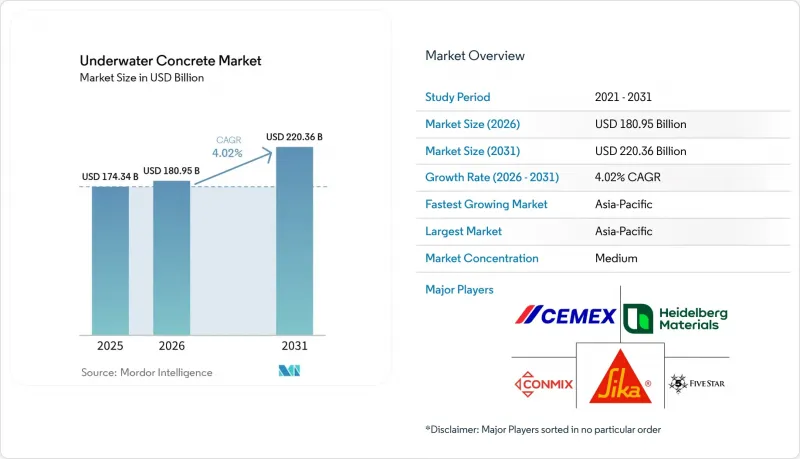
據 Mordor Intelligence 稱,水下混凝土市場預計在 2025 年價值 1,743.4 億美元,預計在預測期(2026-2031 年)內將以 4.02% 的複合年成長率成長,從 2026 年的 1809.5 億美元成長到 2031 年的 2203.620 億美元。
全球水下混凝土市場趨勢及洞察
沿海基礎設施擴建與港口現代化
港口營運商正在維修碼頭、泊位和航道,以適應吃水深度超過16公尺的船舶。這些項目可能需要建造新的沉箱、碼頭牆、防波堤和樁基,並採用專門的水下施工技術。由於東南亞和西非一些老舊港口需要對碼頭進行徹底重組而非小規模維修,水下混凝土市場正從中受益。根據聯合國貿易和發展會議(貿發會議)的報告,未來十年計劃開展300多個大型港口開發或現代化項目,總投資額超過2500億美元。 2024年4月,美國政府決定撥款200億美元用於加強海事基礎設施,包括船廠維修和港口現代化。採購法規擴大參考經認證的海洋工程施工標準,優先考慮能夠提供混合設計、測試和施工性能證明的供應商。
離岸風電和海底能源建設的成長
儘管傳統海上基礎在用量上仍佔據重要地位,但離岸風力發電正在推動對高性能水泥漿的需求。根據世界風力發電理事會(GWEC)的數據,2023年新增離岸風力發電裝置容量為11吉瓦。美國能源局報告稱,到2024年,美國離岸風力發電的潛在裝置容量將成長53%,達到80,523兆瓦。水泥漿填充的導管架和單樁接頭需要使用性能標準高於標準導管混凝土的水泥基材料。 2026年6月,西卡公司為日本石∆灣新港離岸風力發電電場(112兆瓦)提供了支持,使用SikaGrout-9500灌漿材料對14台導管架式風力發電機水泥漿。此類項目正在擴大先進水泥漿材料在海上建設的應用範圍。
結構高度複雜,需專用設備
水下混凝土澆築需要許多當地承包商不具備的設備和操作流程。專案需要經過校準的導管、檢驗的防沖蝕混凝土配比、適當的泵浦以及足夠的混凝土壓力。在深水區和潮間帶作業會帶來傳統施工中不常見的後勤限制。海德堡材料義大利公司利用浮體式駁船進行海上混凝土攪拌作業,協助建造了熱那亞防波堤,展示了某些海上項目所需的專業生產模式。此類系統使得大規模合約集中在成熟的海洋工程承包商和供應商手中。因此,在設備、測試能力和熟練工人有限的地區,水下混凝地工程的進展可能會比較緩慢。
細分市場分析
截至2025年,骨材將佔原料總量的54.07%,這反映了其在重量和體積上均佔據最大材料投入量的地位。骨材是防波堤沉箱、橋墩基礎、碼頭和其他海上工程成本的基礎。當地可取得的骨材骨材混合物有助於承包商控制沿海工程的每立方公尺成本。這在亞太地區和中東的建築業尤其重要,因為這些地區的大規模基礎設施項目需要大量的骨材。水泥是第二重要的材料成分,用於傳統的導管灌漿和專業的地基水泥漿作業。材料配方根據所需的施工性能、強度、耐久性和耐環境性而有所不同。水泥基外加劑,例如礦渣、飛灰和偏高嶺土,屬於「其他材料」類別。採用水泥基外加劑的耐海水混合料可以在保持結構性能的同時,減少整個生命週期的二氧化碳排放。水下混凝土市場仍然依賴骨材,因為即使是需要高度複雜規格的項目也需要穩定的供應。
預計到2031年,外加劑的複合年成長率將達到4.88%,成為成長最快的原料類別。抗沖刷劑和黏度調節劑正從潮間帶修復、深水基礎和離岸風力發電的可選添加劑轉變為必不可少的添加劑。由於其單價高昂,即使是少量使用也會改變其商業性構成比。高精度聚合物系統的單價遠高於骨材,因為它們直接影響混凝土的抗沖刷性、流動性和施工穩定性。這使得外加劑供應商能夠在水下混凝土市場獲得更高的利潤率。當專案規範要求提供材料測試和現場支援的文件時,這種影響會進一步增強。自密實水下混凝土的研究為設計即使在水質條件波動的情況下也能重複的混凝土混合料提供了技術基礎。對碎高爐礦渣(GGBS)和抗沖刷外加劑的了解也支持了它們在提高抗氯離子侵蝕性能方面的作用。因此,水下混凝土市場正在向更高附加價值的混合料成分轉變,同時保持骨材驅動的規模經濟。
區域分析
預計到2025年,亞太地區將佔據區域市場佔有率的33.19%,並在2031年之前以5.06%的複合年成長率成長。該地區的需求主要受沿海基礎設施建設、海上能源開發以及港口、水壩和航道維修活動的驅動。中國的港口建設活動,包括洋山深水港和其他沿海基礎設施項目,都依賴高耐久性的海洋混凝土。國家調查計畫也正在研究港口資產水泥建築物的維修技術和損傷識別方法。 2026年7月,日本的遙控系統「AquaMarionette」在32公尺深的水域中展示了厘米級精度的水下施工。這表明該地區對在深海和渾濁水域進行更可靠的混凝土澆築的需求。此外,中國、日本和台灣的離岸風力發電專案也為亞太地區的水下混凝土市場帶來了成長。
儘管北美和歐洲的需求趨勢有所不同,但兩者都需要高品質的建築。在北美,由於橋樑和水下海上設施的劣化,維修需求日益成長。 2024年4月宣布的200億美元美國海上基礎設施投資計畫將支持港口設施、造船廠及相關資產的維修。此外,美國一個80,523兆瓦的離岸風力發電計畫進一步增加了對水泥漿和基礎材料的需求。在歐洲,海上基礎設施正在積極開發,低碳建築材料也越來越受到關注。 Webuild和海德堡材料義大利公司正在為熱那亞防波堤營運一套海上混凝土生產系統,這展示了地中海大型專案中使用的專業物流系統的範例。 2026年7月,CEMEX公司為法國塞納河畔里夫的一個河岸修復計畫供應了1000立方公尺的低碳混凝土「Vertua」。這些地區的水下混凝土市場受到維修標準、海上能源需求和對低碳材料的需求的影響。
中東和非洲地區對用於鹽鹼沿海環境的高性能混凝土的需求正在不斷成長。沿岸地區的大規模基礎設施項目正在推動對水泥基材料和預拌混凝土解決方案的需求。西非也正在崛起為專業海上應用市場,例如西卡公司在埃尼剛果(Eni Congo)的錨碇系統專案中,對17根錨樁進行了高性能水泥漿。南美洲的需求與巴西和阿根廷的港口現代化和海上能源項目密切相關,智利和秘魯的太平洋貿易航線沿線基礎設施投資也推動了這項需求。承包商的可用性和品管能力將決定這些項目轉化為實際施工量的速度。儘管這些地區的水下混凝土市場仍有成長空間,但確保施工能力仍然是至關重要的。
其他好處:
- Excel格式的市場預測(ME)表
- 3個月的分析師支持
目錄
第1章:引言
- 研究假設和市場定義
- 調查範圍
第2章:調查方法
第3章執行摘要
第4章 市場狀況
- 市場概覽
- 市場促進因素
- 沿海基礎設施擴建與港口現代化
- 離岸風電和海底能源建設的成長
- 老舊水壩、橋樑和海洋設施的維修
- 採用防沖刷和自密實複合材料設計。
- 海洋應用領域對低碳耐用混凝土的需求
- 水下安裝可取代混凝土壩和排水工程。
- 市場限制因素
- 佈置複雜,需專用設備
- 沖洗、隔離和品管風險
- 合格的水下混凝土施工承包商短缺
- 水泥、外加劑和骨材價格的波動
- 價值鏈分析
- 波特五力分析
第5章 市場規模與成長預測
- 按成分
- 水泥
- 骨材的
- 混合物
- 其他(水泥基輔助材料、纖維、特殊添加劑)
- 透過使用
- 橋樑和海洋基礎
- 港口
- 海上油氣結構
- 離岸風力發電
- 其他(水壩、水力發電廠、隧道、水下修復、海岸防護和水庫結構)
- 按地區
- 亞太地區
- 中國
- 印度
- 日本
- 韓國
- 東南亞國協
- 其他亞太國家
- 北美洲
- 美國
- 加拿大
- 墨西哥
- 歐洲
- 德國
- 英國
- 法國
- 義大利
- 北歐國家
- 其他歐洲國家
- 南美洲
- 巴西
- 阿根廷
- 其他南美國家
- 中東和非洲
- 沙烏地阿拉伯
- 南非
- 其他中東和非洲國家
- 亞太地區
第6章 競爭情勢
- 市場集中度
- 策略趨勢
- 市佔率和排名分析
- 公司簡介
- Buzzi SpA
- Cemex SAB DE CV
- China National Building Material Co., Ltd.
- Conmix
- CRH
- Five Star Products, Inc.
- Heidelberg Materials AG
- Mapei SpA
- MUHU(China)Construction Materials Co., Ltd.
- Rockbond SCP
- Saint-Gobain
- Sika AG
- Taiheiyo Cement Corporation
- Tarmac
- UltraTech Cement Ltd.
- Unibeton Ready Mix
第7章 市場機會與未來展望
According to Mordor Intelligence, the underwater concrete market size is estimated at USD 174.34 billion in 2025 and is estimated to grow from USD 180.95 billion in 2026 to USD 220.36 billion by 2031, at a CAGR of 4.02% during the forecast period (2026-2031).
Global Underwater Concrete Market Trends and Insights
Expansion of Coastal Infrastructure and Port Modernization
Port operators are adapting quays, aprons, and channels for vessels with drafts above 16 meters. This work may require new caissons, quay walls, breakwaters, and pile foundations that use specialized underwater placement techniques. The underwater concrete market benefits because several older ports in Southeast Asia and West Africa need full quay reconstruction rather than minor upgrades. The United Nations Conference on Trade and Development (UNCTAD) reported more than 300 major port development or modernization projects with a combined planned capital expenditure above USD 250 billion over the next decade. In April 2024, the U.S. government committed USD 20 billion to strengthen maritime infrastructure, including shipyard upgrades and port modernization. Procurement rules increasingly refer to recognized marine construction standards, which favor suppliers that can document mix design, testing, and placement performance.
Growth of Offshore Wind and Subsea Energy Construction
Offshore wind is increasing demand for high-performance grouting, even while conventional marine foundations remain important in quantity. The Global Wind Energy Council recorded 11 GW of new offshore wind capacity in 2023. The U.S. Department of Energy reported that the potential U.S. offshore wind pipeline expanded 53% to 80,523 MW in 2024. Grouted jacket and monopile connections require cementitious materials with performance standards that exceed those of standard tremie concrete. In June 2026, Sika supported the 112 MW Ishikari Bay New Port Offshore Wind Farm in Japan by grouting 14 jacket-based turbines with SikaGrout-9500. These projects expand the role of advanced grouting materials in offshore construction.
High Placement Complexity and Specialized Equipment Requirements
Underwater concrete placement requires equipment and procedures that many regional contractors do not maintain. Projects require calibrated tremie pipes, verified anti-washout mixes, suitable pumps, and adequate concrete head pressure. Deep-water and tidal-zone work imposes logistical constraints not present in standard construction. Heidelberg Materials Italy supported the Genoa Breakwater through an offshore batching operation on a floating barge, demonstrating the specialized production model required for some open-sea projects. Such systems concentrate large contracts among established marine contractors and suppliers. The underwater concrete market may therefore face slower project delivery where equipment, testing capacity, and trained crews are limited.
Other drivers and restraints analyzed in the detailed report include:
- Rehabilitation of Aging Dams, Bridges, and Marine Assets
- Adoption of Anti-Washout and Self-Compacting Mix Designs
- Washout, Segregation, and Quality-Control Risk
For complete list of drivers and restraints, kindly check the Table Of Contents.
Segment Analysis
Aggregates accounted for 54.07% of the raw material share in 2025, reflecting their role as the largest material input by both weight and quantity. They form the cost base for breakwater caissons, bridge pier foundations, quay walls, and other marine placements. Locally available coarse- and fine-aggregate blends help contractors manage per-cubic-meter costs in coastal projects. This is particularly relevant in APAC and the Middle-East construction sectors, where large infrastructure programs require substantial quantities. Cement is the next significant material component, used in both conventional tremie pours and specialized foundation grouting. The material mix varies with the required workability, strength, durability, and exposure resistance. Supplementary cementitious materials, including slag, fly ash, and metakaolin, fall within the other materials category. Seawater-compatible blends incorporating supplementary cementitious materials can maintain structural performance while reducing lifecycle carbon emissions. The underwater concrete market continues to rely on aggregates, as even highly specified projects require a stable quantity base.
Admixtures are projected to be the fastest-growing raw material category, with a 4.88% CAGR through 2031. Anti-washout and viscosity-modifying agents are moving from optional materials to required inputs for tidal-zone repairs, deep-water foundations, and offshore wind grouting. Their higher unit value shifts the commercial mix even when their physical quantity remains low. A precision polymer system can command a significantly higher unit value than aggregate because it directly affects washout resistance, flow, and placement stability. This gives admixture suppliers a stronger margin position within the underwater concrete market. This effect is reinforced when project specifications require documented material testing and site support. Research on self-compacting underwater concrete provides a technical basis for repeatable mix designs under variable water conditions. Evidence on Ground Granulated Blast-furnace Slag (GGBS) and anti-washout admixtures also supports their role in improving chloride resistance. The underwater concrete market is therefore moving toward higher-value formulation content while retaining aggregate-led quantity economics.
Complete Report Scope:
- By Raw Material
- Cement
- Aggregates
- Admixtures
- Others (Supplementary Cementitious Materials, Fibers, and Specialty Additives)
- By Application
- Bridge and Marine Foundations
- Ports and Harbors
- Offshore Oil and Gas Structures
- Offshore Wind Power Generation
- Others (Dams and Hydropower, Tunnels, Underwater Repair, Shore Protection, and Water-Retaining Structures)
- By Geography
- Asia-Pacific
- China
- India
- Japan
- South Korea
- ASEAN Countries
- Rest of Asia-Pacific
- North America
- United States
- Canada
- Mexico
- Europe
- Germany
- United Kingdom
- France
- Italy
- NORDIC Countries
- Rest of Europe
- South America
- Brazil
- Argentina
- Rest of South America
- Middle-East and Africa
- Saudi Arabia
- South Africa
- Rest of Middle-East and Africa
- Asia-Pacific
Geography Analysis
Asia-Pacific accounted for 33.19% of the regional market share in 2025 and is projected to grow at a CAGR of 5.06% through 2031. The region's demand is driven by coastal infrastructure construction, offshore energy development, and repair activity across ports, dams, and waterways. China's port construction activity, including the Yangshan Deep Water Port and other coastal infrastructure programs, relies on durable marine concrete. National research programs also address repair technologies and damage identification in concrete structures for port assets. In July 2026, Japan's AquaMarionette remote-operation system demonstrated centimeter-level underwater construction at a depth of 32 m, indicating a regional need for more reliable concrete placement in deep or turbid waters. The Asia-Pacific underwater concrete market also benefits from offshore wind activity in China, Japan, and Taiwan.
North America and Europe have different demand profiles, but both support high-specification work. North America has a strong rehabilitation need, as its bridges and marine assets are experiencing underwater deterioration. The April 2024 USD 20 billion U.S. maritime infrastructure commitment supports upgrades to port facilities, shipyards, and related assets. The U.S. offshore wind pipeline of 80,523 MW adds demand for grouting and foundation materials. Europe has an active marine infrastructure base and a growing focus on lower-carbon construction materials. Webuild and Heidelberg Materials Italy have operated an offshore concrete production system for the Genoa Breakwater, illustrating the specialized logistics used in large Mediterranean projects. In July 2026, CEMEX supplied 1,000 cubic meters of lower-carbon Vertua concrete for riverbank rehabilitation in Rives-en-Seine, France. The underwater concrete market in these regions is shaped by rehabilitation standards, offshore energy requirements, and demand for lower-carbon materials.
The Middle-East and Africa represent an expanding opportunity for high-performance concrete in saline coastal conditions. Large infrastructure programs in the Gulf support demand for cementitious materials and ready-mix concrete solutions. West Africa is also emerging as a market for offshore specialty applications, as demonstrated by Sika's work on the Eni Congo mooring system, which required high-performance grouting across 17 anchor piles. South America's demand is tied to port modernization and offshore energy activity in Brazil and Argentina, with Chile and Peru adding infrastructure investment along Pacific trade routes. Contractor availability and quality-control capacity will affect how quickly these projects translate into placed output. The underwater concrete market in these regions has growth potential, but execution capability remains a key requirement.
- Buzzi S.p.A.
- Cemex S.A.B DE C.V.
- China National Building Material Co., Ltd.
- Conmix
- CRH
- Five Star Products, Inc.
- Heidelberg Materials AG
- Mapei S.p.A.
- MUHU (China) Construction Materials Co., Ltd.
- Rockbond SCP
- Saint-Gobain
- Sika AG
- Taiheiyo Cement Corporation
- Tarmac
- UltraTech Cement Ltd.
- Unibeton Ready Mix
Additional Benefits:
- The market estimate (ME) sheet in Excel format
- 3 months of analyst support
TABLE OF CONTENTS
1 Introduction
- 1.1 Study Assumptions and Market Definition
- 1.2 Scope of the Study
2 Research Methodology
3 Executive Summary
4 Market Landscape
- 4.1 Market Overview
- 4.2 Market Drivers
- 4.2.1 Expansion of Coastal Infrastructure and Port Modernization
- 4.2.2 Growth of Offshore Wind and Subsea Energy Construction
- 4.2.3 Rehabilitation of Aging Dams, Bridges, and Marine Assets
- 4.2.4 Adoption of Anti-Washout and Self-Compacting Mix Designs
- 4.2.5 Demand for Low-Carbon and Longer-Life Marine Concrete
- 4.2.6 Underwater Placement as an Alternative to Cofferdams and Dewatering
- 4.3 Market Restraints
- 4.3.1 High Placement Complexity and Specialized Equipment Requirements
- 4.3.2 Washout, Segregation, and Quality-Control Risk
- 4.3.3 Shortage of Qualified Underwater Concrete Contractors
- 4.3.4 Volatility in Cement, Admixture, and Aggregate Costs
- 4.4 Value Chain Analysis
- 4.5 Porter's Five Forces Analysis
- 4.5.1 Bargaining Power of Suppliers
- 4.5.2 Bargaining Power of Buyers
- 4.5.3 Threat of New Entrants
- 4.5.4 Threat of Substitutes
- 4.5.5 Competitive Rivalry
5 Market Size and Growth Forecasts (Value)
- 5.1 By Raw Material
- 5.1.1 Cement
- 5.1.2 Aggregates
- 5.1.3 Admixtures
- 5.1.4 Others (Supplementary Cementitious Materials, Fibers, and Specialty Additives)
- 5.2 By Application
- 5.2.1 Bridge and Marine Foundations
- 5.2.2 Ports and Harbors
- 5.2.3 Offshore Oil and Gas Structures
- 5.2.4 Offshore Wind Power Generation
- 5.2.5 Others (Dams and Hydropower, Tunnels, Underwater Repair, Shore Protection, and Water-Retaining Structures)
- 5.3 By Geography
- 5.3.1 Asia-Pacific
- 5.3.1.1 China
- 5.3.1.2 India
- 5.3.1.3 Japan
- 5.3.1.4 South Korea
- 5.3.1.5 ASEAN Countries
- 5.3.1.6 Rest of Asia-Pacific
- 5.3.2 North America
- 5.3.2.1 United States
- 5.3.2.2 Canada
- 5.3.2.3 Mexico
- 5.3.3 Europe
- 5.3.3.1 Germany
- 5.3.3.2 United Kingdom
- 5.3.3.3 France
- 5.3.3.4 Italy
- 5.3.3.5 NORDIC Countries
- 5.3.3.6 Rest of Europe
- 5.3.4 South America
- 5.3.4.1 Brazil
- 5.3.4.2 Argentina
- 5.3.4.3 Rest of South America
- 5.3.5 Middle-East and Africa
- 5.3.5.1 Saudi Arabia
- 5.3.5.2 South Africa
- 5.3.5.3 Rest of Middle-East and Africa
- 5.3.1 Asia-Pacific
6 Competitive Landscape
- 6.1 Market Concentration
- 6.2 Strategic Moves
- 6.3 Market Share (%)/Ranking Analysis
- 6.4 Company Profiles (includes Global Overview, Market Overview, Core Segments, Financials as available, Strategic Information, Products and Services, and Recent Developments)
- 6.4.1 Buzzi S.p.A.
- 6.4.2 Cemex S.A.B DE C.V.
- 6.4.3 China National Building Material Co., Ltd.
- 6.4.4 Conmix
- 6.4.5 CRH
- 6.4.6 Five Star Products, Inc.
- 6.4.7 Heidelberg Materials AG
- 6.4.8 Mapei S.p.A.
- 6.4.9 MUHU (China) Construction Materials Co., Ltd.
- 6.4.10 Rockbond SCP
- 6.4.11 Saint-Gobain
- 6.4.12 Sika AG
- 6.4.13 Taiheiyo Cement Corporation
- 6.4.14 Tarmac
- 6.4.15 UltraTech Cement Ltd.
- 6.4.16 Unibeton Ready Mix
7 Market Opportunities and Future Outlook
- 7.1 White-Space and Unmet-Need Assessment

 水下黏合劑市場:全球市場預測,2026-2032年
 耐熱混凝土市場到 2035 年的分析和預測:按類型、產品、技術、組件、應用、材料類型、最終用戶和功能分類。
 水下混凝土市場報告:按原料、應用和地區分類(2026-2034 年)
 2026年全球水下混凝土市場報告
 全球水下混凝土市場規模、佔有率、趨勢和成長分析報告(2026-2034年)
 水下混凝土市場-全球產業規模、佔有率、趨勢、機會及預測(依材料、應用、區域及競爭格局分類,2021-2031年)
 水下混凝土市場規模、佔有率及成長分析(依施工技術、應用、原料及地區分類)-2026-2033年產業預測
 水下混凝土模板市場規模、佔有率及成長分析(按原料、施工技術、應用及地區分類)-2026-2033年產業預測
 2030 年水下混凝土市場預測:按產品、類型、原料、技術、應用和地區進行的全球分析