


 |
市場調查報告書
商品編碼
2154343
電池外殼材料:市場佔有率分析、產業趨勢與統計、成長預測(2026-2031)Battery Casing Materials - Market Share Analysis, Industry Trends & Statistics, Growth Forecasts (2026 - 2031) |
||||||

※ 本網頁內容可能與最新版本有所差異。詳細情況請與我們聯繫。
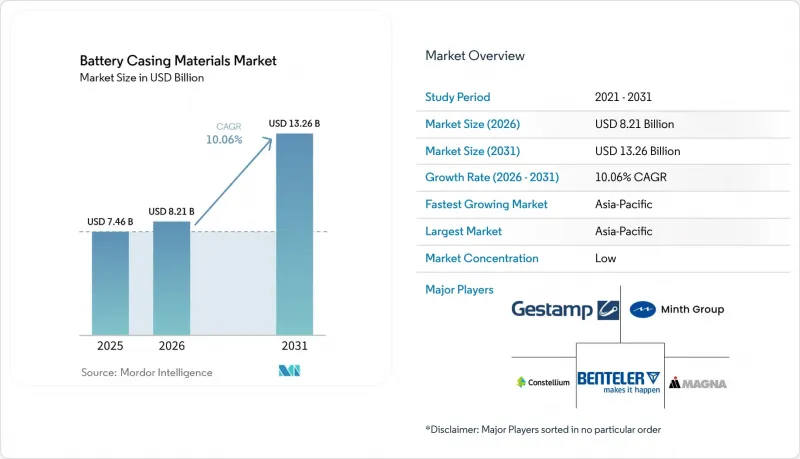
根據 Mordor Intelligence 預測,電池機殼材料市場規模預計將在 2025 年達到 74.6 億美元,2026 年達到 82.1 億美元,到 2031 年達到 132.6 億美元,在預測期(2026-2031 年)內複合年成長率為 10.06%。
全球電池機殼材料市場趨勢與洞察
加速電動車(EV)生產
預計到2025年,全球電動車(EV)銷量將超過2,000萬輛,並在2026年達到2,330萬輛,主要成長動力來自中國、歐洲、東南亞、印度和拉丁美洲。由於鋁材被廣泛應用於電池式電動車的電池機殼、結構框架和溫度控管組件,產量的增加將帶動材料需求的成長。預計到2025年,電動卡車銷量將成長一倍以上,佔全球卡車銷量的9%,這主要得益於市場對配備更大容量電池組的車輛的需求。到2025年,中國製造商將供應全球近75%的電動車產量,這將使供應鏈更加集中,並促使供應商擴大在北美和歐洲的產能。這種生產規模支撐著電池機殼材料市場,因為所有電池組都需要結構封裝、密封和熱界面。此外,本地化生產計劃還能降低服務區域汽車專案的機殼供應商的物流風險。
對輕型電池結構的需求日益成長
由於減輕機殼的品質可以提高車輛的續航里程效率,因此人們對多材料電池外殼的興趣日益濃厚。一項發表於2026年的研究表明,採用碳纖維、玻璃纖維、石墨烯奈米微片和生物基環氧樹脂的混合奈米複合材料,與同等金屬部件相比,重量最多可減輕45%。 Constellium公司的ALIVE計畫於2024年完成,該計畫在滿足側柱衝擊、底部穿透和振動要求的同時,實現了12%至35%的重量減輕。發表在《國際汽車科學與技術雜誌》上的一項研究發現,在時速超過100公里時,碳纖維增強聚合物的比能量吸收率高於鋁。因此,在電池機殼材料市場,當鋁材無法滿足重量、安全性和製造要求時,混合設計仍有發展空間。汽車製造商在選擇材料時,不僅會考慮重量,還會考慮碰撞性能和易於維修性。
高級機殼的材料成本和認證成本都很高。
與同等規格的沖壓成型鋁製外殼相比,先進聚合物複合材料和多材料機殼在批量生產中的單價可能高出 30% 至 60%。這種成本差異限制了它們在無法承擔較高材料成本的專案中的應用。 SGL Carbon 公司報告稱,由於汽車需求疲軟,其 2026 年 7 月的銷售額大幅下降,並表示短期內不太可能出現實質復甦。基於聯合國標準 38.3、國際電工委員會 (IEC) 標準 62619 和 OEM 碰撞測試規程的認證過程通常需要 18 至 36 個月。這些時間節點增加了採用不熟悉的材料體系的供應商的資本風險。在電池機殼材料市場,在生產訂單狀況不確定的情況下,這種成本負擔主要由材料製造商和一級供應商承擔。
細分市場分析
到2025年,鋁材將佔據電池機殼材料市場52.38%的佔有率,這主要得益於其優異的強度重量比、導熱性、耐腐蝕性以及成熟的全球供應鏈。康斯坦鋁製(Constellium)、諾貝麗斯(Novelis)、挪威海德魯公司(Norsk Hydro ASA)和UACJ株式會社等公司均供應用於電池機殼系統的鋁製品。康斯坦鋁業的「ALIVE」計畫在滿足衝擊、振動和洩漏測試要求的同時,實現了比基準設計輕12%至35%的減重。由於製造商可以大規模地進行成型、連接和採購,鋁合金仍被廣泛應用於量產電動車平台。蒂森克虜伯(ThyssenKrupp)則將其「selectrify」鋼製外殼定位為一種重量幾乎與鋁材相當,但材料成本更低的產品。
預計到2031年,聚合物複合材料的複合年成長率將達到12.80%,成為電池機殼材料市場中成長最快的材料。熱塑性樹脂解決方案兼具可回收性和射出成型的經濟性,有望推動其在複雜組件設計中得到更廣泛的應用。 2026年5月,Trinseo推出了基於熱塑性聚碳酸酯單向膠帶的電池頂蓋,其薄壁規格分別為1.0毫米和1.5毫米。採用Tepex的「dynalite」玻璃纖維片材和阻燃聚丙烯(PP)「STAMAX」托盤芯的混合複合材料電池外殼,與傳統設計相比,重量減輕了10%至20%,成本降低了46%。自2027年起,歐盟電池法規2023/1542(該法規強制要求電池單元級可維修性和可回收性)建議採用可無損拆卸的解決方案。
到2025年,鋰離子電池將佔據70.16%的市場佔有率,這反映了其在電動車和固定用系統中的成熟應用。 2025年,寧德時代(CATL)將供應中國80%的電動卡車電池,引領商用CTP電池組的推出。每種鋰離子電池組架構都需要根據電芯形狀和熱特性來客製化機殼。首批1000伏特車型將於2025年在中國上市,這將推動高壓電池系統材料品質的提升。雖然鉛酸電池在工業備用電源領域仍發揮重要作用,但鋰基化學品正在電池機殼材料市場拓展低成本應用。
預計到2031年,鈉離子電池將以11.15%的複合年成長率成長,成為成長最快的電池領域。查爾姆斯理工大學估計,2025年全球鈉離子電池產量將達到70吉瓦時,並預計2030年將達到250吉瓦。鈉離子電池系統具有獨特的機殼規格,其中防火安全性和材料相容性至關重要。這項機會促使供應商開發不限於鋰離子電池要求的機殼。
區域分析
預計到2025年,亞太地區將佔據37.09%的市場佔有率,並在2031年之前以11.22%的複合年成長率持續成長。 2025年,中國將生產全球近75%的電動車,並佔全球電池總產量的80%以上。這種垂直整合的生產模式正在創造從活性材料到電池組組裝的整個市場需求。印度電動二輪車和三輪車市場在2026年第一季實現了超過30%的年成長。 LG能源解決方案公司和SK安公司正在韓國將軟包CTP電池架構商業化,而UACJ株式會社則從日本向國內外電池製造商供應精密冷軋鋁。
在北美,美國電池能源儲存系統的部署量預計將從2025年的57吉瓦時增加到2026年的70吉瓦時和35吉瓦時。這項擴張將涉及252億美元的資本投資,並將滿足防火戶外外殼系統的需求。 2026年3月,明斯集團宣佈在阿拉巴馬州加茲登投資4.3億美元,以擴大在製造地。儘管2026年第一季歐洲電池式電動車(BEV)產量增加了36%,但歐盟的電池法規正促使開發人員轉向模組化和可拆卸電池設計。
南美洲、中東和非洲仍是電池機殼材料市場的新興地區。預計到2025年,拉丁美洲的電動車銷量將成長75%,2026年將再成長45%,其中巴西和阿根廷將成為推動區域需求的主要力量。沙烏地阿拉伯的產業策略包含發展電動車製造業的雄心,而南非的採礦和公共產業部門正在部署大規模電池能源儲存系統以穩定電網。這兩個地區目前都依賴進口機殼組件,但在地採購需求可能會逐步推動生產向最終組裝地點靠攏。
其他好處:
- Excel格式的市場預測(ME)表
- 3個月的分析師支持
目錄
第1章:引言
- 研究假設和市場定義
- 調查範圍
第2章:調查方法
第3章執行摘要
第4章 市場狀況
- 市場概覽
- 市場促進因素
- 擴大電動車生產
- 對輕型電池結構的需求日益成長
- 對快速充電和溫度控管的需求日益成長
- 固定式能源儲存系統系統的擴展
- 電池組架構轉型:向電芯到電池組的過渡
- 對可維修和可回收機殼的需求日益成長
- 市場限制因素
- 先進機殼的材料成本和認證成本都很高。
- 複雜熱失控和碰撞安全檢驗
- 多材料外殼的回收基礎設施有限。
- 由於單元格式和封裝架構的快速變化而導致的設計鎖定
- 價值和供應鏈分析
- 波特五力分析
第5章 市場規模與成長預測
- 材料
- 鋁
- 鋼
- 工程塑膠
- 聚合物複合材料
- 其他材料(不銹鋼、鎂合金、金屬-聚合物複合結構)
- 依電池類型
- 鋰離子電池
- 鈉離子電池
- 鉛酸電池
- 其他電池種類(鎳基電池、固態固態電池、液流電池)
- 按單元格格式
- 棱柱形細胞
- 圓柱形單元格
- 袋式電池
- 其他電池類型(紐扣電池和硬幣電池)
- 透過使用
- 電動車
- 能源儲存系統
- 家用電子產品
- 其他應用領域(工業電池、航太與國防、船舶、醫療設備)
- 按地區
- 亞太地區
- 中國
- 印度
- 日本
- 韓國
- 其他亞太國家
- 北美洲
- 美國
- 加拿大
- 墨西哥
- 歐洲
- 德國
- 英國
- 法國
- 義大利
- 其他歐洲國家
- 南美洲
- 巴西
- 阿根廷
- 其他南美國家
- 中東和非洲
- 沙烏地阿拉伯
- 南非
- 其他中東和非洲國家
- 亞太地區
第6章 競爭情勢
- 市場集中度
- 策略趨勢
- 市佔率和排名分析
- 公司簡介
- BENTELER International Austria GmbH
- Constellium
- Covestro AG
- Gestamp Automocion, SA
- Granges
- Kautex
- LANXESS
- Magna International Inc.
- Minth Group
- Nemak
- Norsk Hydro ASA
- Novelis
- SABIC
- SGL Carbon
- Teijin Limited
- thyssenkrupp AG
- Trinseo
- UACJ Corporation
第7章 市場機會與未來展望
According to Mordor Intelligence, the battery casing materials market was valued at USD 7.46 billion in 2025 and is estimated to grow from USD 8.21 billion in 2026 to reach USD 13.26 billion by 2031, at a CAGR of 10.06% during the forecast period (2026-2031).
Global Battery Casing Materials Market Trends and Insights
Accelerating Electric Vehicle Production
Global electric vehicle sales exceeded 20 million units in 2025 and are projected to reach 23.3 million in 2026, supported by China, Europe, Southeast Asia, India, and Latin America. Battery electric vehicles use aluminum across battery enclosures, structural frames, and thermal-management components, making production growth relevant to material demand. Electric truck sales more than doubled in 2025 and represented 9% of worldwide truck sales, adding demand from vehicles with larger battery packs. Chinese producers supplied nearly 75% of global electric car production in 2025, concentrating sourcing while encouraging suppliers to build capacity in North America and Europe. This production scale supports the battery casing materials market because every pack requires structural containment, sealing, and thermal interfaces. Local manufacturing programs can also reduce logistics exposure for enclosure suppliers serving regional vehicle programs.
Rising Demand for Lightweight Battery Structures
Lower casing mass can improve vehicle range efficiency, which is increasing interest in multi-material battery housings. Hybrid nanocomposites using carbon fiber, glass fiber, graphene nanoplatelets, and bio-based epoxy achieved up to 45% lower weight than metallic equivalents in research published in 2026. Constellium's ALIVE project, concluded in 2024, demonstrated 12%-35% weight savings while meeting side-pole crash, bottom-intrusion, and vibration requirements. Research in the International Journal of Automotive Science and Technology found that carbon-fiber-reinforced polymer provided higher specific energy absorption than aluminum above 100 kilometers per hour. The battery casing materials market, therefore, has scope for hybrid designs where aluminum alone cannot meet weight, safety, and manufacturing needs. Original equipment manufacturers are likely to assess material choice alongside crash performance and repairability rather than weight alone.
High Material and Qualification Costs for Advanced Enclosures
Advanced polymer composite and multi-material enclosures can cost 30%-60% more per unit than comparable stamped aluminum designs in high-volume production. This cost difference limits their use in programs that cannot support a premium material bill. SGL Carbon reported a significant revenue decline from weak automotive demand in July 2026 and did not expect a meaningful near-term recovery. Qualification processes under United Nations 38.3, International Electrotechnical Commission 62619, and original equipment manufacturer crash protocols typically take 18-36 months. Those timelines raise capital at risk for suppliers introducing unfamiliar material systems. The battery casing materials market faces this cost burden mainly among material producers and Tier 1 suppliers, while a production award remains uncertain.
Other drivers and restraints analyzed in the detailed report include:
- Higher Fast-Charging and Thermal-Management Requirements
- Expansion of Stationary Energy Storage Systems
- Complex Thermal-Runaway and Crash-Safety Validation
For complete list of drivers and restraints, kindly check the Table Of Contents.
Segment Analysis
Aluminum held 52.38% of the battery casing materials market share in 2025, supported by its strength-to-weight ratio, thermal conductivity, corrosion resistance, and established global supply chain. Constellium, Novelis, Norsk Hydro ASA, and UACJ Corporation supply aluminum products used in battery enclosure systems. Constellium's ALIVE project showed 12%-35% weight savings over baseline designs while meeting crash, vibration, and leak-test requirements. Aluminum alloys remain embedded in high-volume electric vehicle platforms because manufacturers can form, join, and source them at scale. The thyssenKrupp AG has positioned its selectrify steel housing as nearly weight-neutral against aluminum at a lower material cost.
Polymer composites are projected to advance at a 12.80% CAGR through 2031, the fastest rate among materials in the battery casing materials market. Thermoplastic solutions combine recyclability with injection-molding economics, which can support broader use in complex part designs. Trinseo launched a thermoplastic polycarbonate unidirectional tape-based battery top cover in May 2026 in 1.0 mm and 1.5 mm thin-wall configurations. A hybrid composite battery housing that used Tepex dynalite glass-fiber sheets and a flame-retardant polypropylene (PP) STAMAX tray core delivered 10%-20% weight reduction and 46% lower cost than traditional designs. The EU Battery Regulation 2023/1542, which requires cell-level repairability and recyclability from 2027, favors solutions that can be disassembled without damage.
Lithium-ion batteries held 70.16% share in 2025, reflecting their established use in electric vehicles and stationary deployments. CATL supplied 80% of electric truck batteries in China in 2025 and led commercial CTP pack deployment. Each lithium-ion pack architecture requires an enclosure matched to its cell geometry and thermal profile. The first 1,000-volt vehicle models in China appeared in 2025, supporting material-quality upgrades within high-voltage battery systems. Lead-acid batteries remain relevant in industrial backup power, though lithium chemistries have been extending into lower-cost uses in the battery casing materials market.
Sodium-ion batteries are projected to advance at an 11.15% CAGR through 2031, making them the fastest-growing battery-type segment. Chalmers University of Technology estimated global sodium-ion production at 70 gigawatt-hours in 2025 and projected it to reach 250 gigawatt-hours by 2030. Sodium-ion systems present a separate enclosure specification where fire safety and material compatibility can be important. This opening gives suppliers a reason to develop housings that are not limited to lithium-ion battery requirements.
Complete Report Scope:
- By Material
- Aluminum
- Steel
- Engineering Plastics
- Polymer Composites
- Other Materials (Stainless Steel, Magnesium Alloys, Hybrid Metal-Polymer Structures)
- By Battery Type
- Lithium-Ion Batteries
- Sodium-Ion Batteries
- Lead-Acid Batteries
- Other Battery Types (Nickel-Based Batteries, Solid-State Batteries, Flow Batteries)
- By Cell Format
- Prismatic Cells
- Cylindrical Cells
- Pouch Cells
- Other Cell Formats (Coin and Button Cells)
- By Application
- Electric Vehicles
- Energy Storage Systems
- Consumer Electronics
- Other Applications (Industrial Batteries, Aerospace and Defense, Marine, Medical Devices)
- By Geography
- Asia-Pacific
- China
- India
- Japan
- South Korea
- Rest of Asia-Pacific
- North America
- United States
- Canada
- Mexico
- Europe
- Germany
- United Kingdom
- France
- Italy
- Rest of Europe
- South America
- Brazil
- Argentina
- Rest of South America
- Middle-East and Africa
- Saudi Arabia
- South Africa
- Rest of Middle-East and Africa
- Asia-Pacific
Geography Analysis
Asia-Pacific held 37.09% share in 2025 and is projected to advance at an 11.22% CAGR through 2031. China produced nearly 75% of the world's electric cars in 2025 and accounted for more than 80% of global battery cell production. This vertically integrated base creates demand from active materials through pack assembly. India's electric two-wheeler and three-wheeler segment grew more than 30% year over year in the first quarter of 2026. LG Energy Solution and SK On are commercializing pouch CTP architectures in South Korea, while UACJ Corporation supplies precision cold-rolled aluminum to domestic and international battery manufacturers from Japan.
In North America, U.S. battery energy storage deployments are projected to rise to 70 gigawatt-hours and 35 gigawatts in 2026 from 57 gigawatt-hours in 2025. This buildout represented USD 25.2 billion in capital investment and supports demand for fire-rated outdoor enclosure systems. Minth Group announced a USD 430 million investment in Gadsden, Alabama, in March 2026 to expand its U.S. manufacturing footprint. Europe's battery electric vehicle production grew 36% in the first quarter of 2026, while the EU Battery Regulation is steering developers toward modular and reversibly fastened battery designs.
South America, and Middle-East and Africa remain emerging geographies for the battery casing materials market. Latin American electric vehicle sales rose 75% in 2025 and are projected to grow a further 45% in 2026, with Brazil and Argentina supporting regional demand. Saudi Arabia's industrial strategy includes electric vehicle manufacturing ambitions, while South Africa's mining and utility sectors are deploying large-format battery energy storage systems for grid stabilization. Both regions rely on imported enclosure assemblies, but local-content requirements can gradually support production closer to end-use assembly.
- BENTELER International Austria GmbH
- Constellium
- Covestro AG
- Gestamp Automocion, S.A.
- Granges
- Kautex
- LANXESS
- Magna International Inc.
- Minth Group
- Nemak
- Norsk Hydro ASA
- Novelis
- SABIC
- SGL Carbon
- Teijin Limited
- thyssenkrupp AG
- Trinseo
- UACJ Corporation
Additional Benefits:
- The market estimate (ME) sheet in Excel format
- 3 months of analyst support
TABLE OF CONTENTS
1 Introduction
- 1.1 Study Assumptions and Market Definition
- 1.2 Scope of the Study
2 Research Methodology
3 Executive Summary
4 Market Landscape
- 4.1 Market Overview
- 4.2 Market Drivers
- 4.2.1 Accelerating Electric Vehicle Production
- 4.2.2 Rising Demand for Lightweight Battery Structures
- 4.2.3 Higher Fast-Charging and Thermal-Management Requirements
- 4.2.4 Expansion of Stationary Energy Storage Systems
- 4.2.5 Battery-Pack Architecture Migration to Cell-to-Pack Designs
- 4.2.6 Increasing Demand for Repairable, Recyclable Enclosures
- 4.3 Market Restraints
- 4.3.1 High Material and Qualification Costs for Advanced Enclosures
- 4.3.2 Complex Thermal-Runaway and Crash-Safety Validation
- 4.3.3 Limited Recycling Infrastructure for Multi-Material Casings
- 4.3.4 Design Lock-In From Rapidly Changing Cell Formats and Pack Architectures
- 4.4 Value and Supply-Chain Analysis
- 4.5 Porter's Five Forces Analysis
- 4.5.1 Threat of New Entrants
- 4.5.2 Bargaining Power of Suppliers
- 4.5.3 Bargaining Power of Buyers
- 4.5.4 Threat of Substitutes
- 4.5.5 Competitive Rivalry
5 Market Size and Growth Forecasts (Value)
- 5.1 By Material
- 5.1.1 Aluminum
- 5.1.2 Steel
- 5.1.3 Engineering Plastics
- 5.1.4 Polymer Composites
- 5.1.5 Other Materials (Stainless Steel, Magnesium Alloys, Hybrid Metal-Polymer Structures)
- 5.2 By Battery Type
- 5.2.1 Lithium-Ion Batteries
- 5.2.2 Sodium-Ion Batteries
- 5.2.3 Lead-Acid Batteries
- 5.2.4 Other Battery Types (Nickel-Based Batteries, Solid-State Batteries, Flow Batteries)
- 5.3 By Cell Format
- 5.3.1 Prismatic Cells
- 5.3.2 Cylindrical Cells
- 5.3.3 Pouch Cells
- 5.3.4 Other Cell Formats (Coin and Button Cells)
- 5.4 By Application
- 5.4.1 Electric Vehicles
- 5.4.2 Energy Storage Systems
- 5.4.3 Consumer Electronics
- 5.4.4 Other Applications (Industrial Batteries, Aerospace and Defense, Marine, Medical Devices)
- 5.5 By Geography
- 5.5.1 Asia-Pacific
- 5.5.1.1 China
- 5.5.1.2 India
- 5.5.1.3 Japan
- 5.5.1.4 South Korea
- 5.5.1.5 Rest of Asia-Pacific
- 5.5.2 North America
- 5.5.2.1 United States
- 5.5.2.2 Canada
- 5.5.2.3 Mexico
- 5.5.3 Europe
- 5.5.3.1 Germany
- 5.5.3.2 United Kingdom
- 5.5.3.3 France
- 5.5.3.4 Italy
- 5.5.3.5 Rest of Europe
- 5.5.4 South America
- 5.5.4.1 Brazil
- 5.5.4.2 Argentina
- 5.5.4.3 Rest of South America
- 5.5.5 Middle-East and Africa
- 5.5.5.1 Saudi Arabia
- 5.5.5.2 South Africa
- 5.5.5.3 Rest of Middle-East and Africa
- 5.5.1 Asia-Pacific
6 Competitive Landscape
- 6.1 Market Concentration
- 6.2 Strategic Moves
- 6.3 Market Share (%)/Ranking Analysis
- 6.4 Company Profiles (includes Global Overview, Market Overview, Core Segments, Financials as available, Strategic Information, Products and Services, and Recent Developments)
- 6.4.1 BENTELER International Austria GmbH
- 6.4.2 Constellium
- 6.4.3 Covestro AG
- 6.4.4 Gestamp Automocion, S.A.
- 6.4.5 Granges
- 6.4.6 Kautex
- 6.4.7 LANXESS
- 6.4.8 Magna International Inc.
- 6.4.9 Minth Group
- 6.4.10 Nemak
- 6.4.11 Norsk Hydro ASA
- 6.4.12 Novelis
- 6.4.13 SABIC
- 6.4.14 SGL Carbon
- 6.4.15 Teijin Limited
- 6.4.16 thyssenkrupp AG
- 6.4.17 Trinseo
- 6.4.18 UACJ Corporation
7 Market Opportunities and Future Outlook
- 7.1 White-Space and Unmet-Need Assessment

 行動配件市場機會、成長促進因素、產業趨勢分析及2026-2035年預測。
 穿戴式和行動配件市場佔有率及預測:市場概覽(2026 年第三季)穿戴式裝置和行動配件的市場佔有率和預測
 全球行動電話光學鏡頭市場:機會與策略展望至2035年
 行動電話揚聲器市場:按類型、產品類型和地區分類行動電話配件市場:依產品類型、通路、最終用戶和地區分類。
 行動配件市場規模、佔有率和趨勢分析報告:按產品、銷售管道、地區和細分市場預測(2026-2033 年)
 行動電話配件市場規模、佔有率、趨勢和預測:按產品類型、價格範圍、銷售管道和地區分類,2026-2034年
 實驗室千斤頂市場:依產品類型、負載能力、材料、操作模式、最終用途產業和通路分類,全球預測,2026-2032年智慧型手機長焦距鏡頭市場:按鏡頭卡口類型、焦距類型、通路、最終用戶類型和應用案例分類-全球預測,2026-2032年