


 |
市場調查報告書
商品編碼
2154319
機器人組件:市場佔有率分析、產業趨勢與統計、成長預測(2026-2031)Robotics Components - Market Share Analysis, Industry Trends & Statistics, Growth Forecasts (2026 - 2031) |
||||||

※ 本網頁內容可能與最新版本有所差異。詳細情況請與我們聯繫。
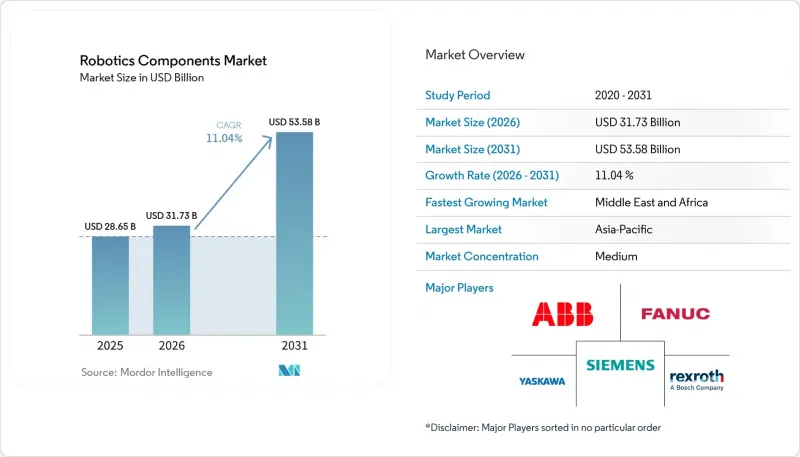
根據 Mordor Intelligence 預測,機器人組件市場規模將從 2025 年的 286.5 億美元成長到 2026 年的 317.3 億美元,到 2031 年將達到 535.8 億美元,2026 年至 2031 年的複合年成長率為 11.04%。
全球機器人組件市場趨勢及洞察
製造業勞動力短缺和工資上漲
人口下降導致多個主要製造業國家對自動化技術的需求持續成長。韓國、日本、德國和中國在面臨勞動力萎縮的同時,仍是工業機器人的主要使用者。韓國擁有全球最高的機器人密度,而美國預計到2025年將部署38,000台工業機器人,這將是有史以來第三高的年度部署量。在這種情況下,用機器人取代重複性的體力勞動是一項更具長期性的商業決策,而非週期性的採購。機器人部署數量的增加帶動了機器人零件市場的發展,馬達、執行器、驅動器和控制電子設備的需求不斷成長。因此,自動化供應商可以更好地滿足來自更廣泛類型工廠的需求,包括那些難以招募和留住生產工人的工廠。
人工智慧驅動的感知和邊緣運動控制
人工智慧正透過嵌入式視覺、控制和運動硬體,日益拉近人機互動的距離。 NVIDIA宣布,其Cosmos 3 Edge策略模型在Jetson Thor硬體上,每次推理可產生32個機器人運動,頻率高達15Hz。博世力士樂在其ctrlX COREplus平台中新增了可選的Hailo-8加速器,以應對本地機器視覺和偵測工作負載。 Fest於2026年6月發布了GripperAI,該技術無需預先編程或模板即可識別陌生或隨機放置物體的抓取點。對於機器人組件市場的供應商而言,這些功能正在推動對整合感測器、處理器、控制器和末端執行器的需求,並提升專為本地處理而設計的系統的價值。它們也促使供應商之間的競爭轉向那些能夠在本地處理資料並即使在非結構化環境中也能快速回應的組件包。
自動化投資的初始成本高,且投資回收期長。
資本成本仍然是機器人零件市場的主要障礙,尤其對於規劃週期較短的中小型製造商更是如此。一套包含視覺系統、末端執行器和安全防護罩的六軸工業機器人單元通常需要10萬至30萬美元的初始投資。投資回收期可能需要3至7年,具體取決於運轉率和人事費用。機器人即服務 (RaaS) 模式透過將支出轉移到經常性營運成本來降低此障礙。 2026年第一季,倉儲和物流業者佔北美機器人訂單的60%,這部分反映了基於訂閱的部署模式。專用齒輪箱、客製化致動器和客製化感測器仍然不太適合基於服務的模式,這繼續阻礙了其在成本敏感型應用中的普及。
細分市場分析
到2025年,馬達將佔機器人零件市場19.75%的佔有率。這是因為所有類型的機器人都需要動力源為其關節提供扭矩和速度。伺服和無刷直流馬達廣泛應用於工業機器人、協作機器人和服務機器人。隨著檢測方式從基於規則的光學方法轉向人工智慧驅動的3D分析,機器視覺系統預計到2031年將以13.51%的複合年成長率成長。 2026年6月,SICK推出了「Triton Floor-LOC」定位系統,該系統將攝影機位置資料和雷射雷達資料整合到單一輸出中,適用於動態物流環境。這種向感測器融合的轉變正在提升視覺系統的技術價值。此外,隨著協作機器人和人形機器人部署中對力回饋和靈活抓取的需求日益成長,感測器和末端執行器的重要性也隨之提升。
在機器人零件市場,執行器、驅動器和控制器、動力傳輸組件、控制電子設備、通訊組件和電源構成了剩餘的收入基礎。在2026年自動化展(Automate 2026)上,Nidec Drive Technology重點展示了其FLEXWAVE應變波機構和KINEX擺線齒輪機構,以滿足多樣化的承重能力需求。據博世力士樂(Bosch Rexroth)稱,ctrlX OS支援根據應用直接在控制器上運行人工智慧(AI)視覺和運動控制工作負載。工業IoT(IIoT)架構需要可靠的網路和不間斷電源,供應商正擴大將馬達、齒輪、編碼器和感測功能整合到單一執行器封裝中。這種整合增加了單位成本,使得在時間緊迫的情況下購買單一組件的吸引力降低。
區域分析
亞太地區是精密齒輪箱、伺服馬達和工業感測器的最大市場佔有率持有者和關鍵生產基地,預計到2025年將佔全球銷售額的59.14%。到2025年,亞洲將佔全球工業機器人裝置量的79%,增幅達13%。中國、日本和韓國將是該全部區域銷售額的主要貢獻者。中國在標準馬達和驅動電子方面具有成本優勢,而日本則在精密應變波齒輪箱和RV減速器方面保持著強勁勢頭。印度的電子組裝和汽車生產需求不斷成長,而韓國的自動化電子產業則需要視覺系統、感測器和精密執行器。
北美和歐洲是機器人零件的第二大需求地區,但目前的情況有所不同。預計到2025年,美國部署的機器人數量將達到38,000台,比2024年增加11%。 2026年第一季,北美60%的訂單來自倉儲和物流業者。加拿大2025年的機器人部署量成長了6%,而墨西哥則連續第三年下滑。同時,由於投資疲軟、能源成本上升以及充滿挑戰的經濟環境,歐洲的工業機器人部署量下降了14%。由於機器升級和更嚴格的網路安全要求,供應商成本不斷上漲,但這些更高的標準也保護了歐洲老牌供應商免受低規格進口產品的衝擊。
預計到2031年,中東和非洲地區的複合年成長率將達到13.73%,成為機器人零件市場成長最快的地區。這主要歸功於供應商尋求開拓先前服務不足地區的需求。產業多元化、對電子商務物流的投資以及本地製造業的發展都在支撐著需求,而沙烏地阿拉伯的「2030願景」和阿拉伯聯合大公國的「杜拜機器人與自動化計畫」則刺激了對石化、食品加工和物流行業的資本投資。南美洲是一個相對小規模的發展中地區,以巴西和阿根廷為主導,其機器人應用主要集中在汽車和食品加工行業。機器人即服務(RaaS)也為中型食品製造商提供了降低初始成本的途徑。然而,基礎設施差異和外匯波動仍然是該地區許多地區採購決策的阻礙因素。
其他好處:
- Excel格式的市場預測(ME)表
- 3個月的分析師支持
目錄
第1章:引言
- 研究假設和市場定義
- 調查範圍
第2章:調查方法
第3章執行摘要
第4章 市場狀況
- 市場概覽
- 市場促進因素
- 製造業勞動力短缺和工資上漲
- 人工智慧驅動的感知和邊緣運動控制
- 鼓勵製造業回流、近岸外包和工廠自動化
- 擴大各種電子設備和半導體的生產規模。
- 協作機器人和人形機器人的商業化
- 用於自主物流和檢測的感測器融合
- 市場限制因素
- 自動化投資的初始成本高,投資回收期長。
- 機器人整合和檢驗人員短缺
- 精密齒輪箱、執行器和稀土元素的供應受限。
- 功能安全、網路安全和法律責任的合規負擔。
- 產業價值鏈分析
- 監理情勢
- 技術展望
- 宏觀經濟因素對市場的影響
- 波特五力分析
第5章 市場規模與成長預測
- 按組件
- 執行器
- 引擎
- 驅動器和控制器
- 感應器
- 機器視覺系統
- 末端執行器
- 動力傳輸部件
- 控制電子設備
- 電源組件
- 通訊組件
- 按機器人類型
- 工業機器人
- 服務機器人
- 協作機器人
- 按最終用戶行業分類
- 車
- 電子和半導體
- 醫療保健和醫療設備
- 航太/國防
- 食品/飲料
- 物流和倉儲
- 其他終端用戶產業
- 按地區
- 北美洲
- 美國
- 加拿大
- 墨西哥
- 南美洲
- 巴西
- 阿根廷
- 其他南美國家
- 歐洲
- 德國
- 英國
- 法國
- 義大利
- 西班牙
- 其他歐洲國家
- 亞太地區
- 中國
- 日本
- 印度
- 韓國
- 其他亞太國家
- 中東和非洲
- 中東
- 沙烏地阿拉伯
- 阿拉伯聯合大公國
- 土耳其
- 其他中東國家
- 非洲
- 南非
- 奈及利亞
- 其他非洲國家
- 中東
- 北美洲
第6章 競爭情勢
- 市場集中度
- 策略趨勢
- 市佔率分析
- 公司簡介
- ABB Ltd.
- FANUC Corporation
- Yaskawa Electric Corporation
- Siemens AG
- Bosch Rexroth AG
- Harmonic Drive Systems Inc.
- Nabtesco Corporation
- Kollmorgen Corporation
- Maxon International AG
- Nidec Corporation
- SCHUNK SE & Co. KG
- ATI Industrial Automation, Inc.
- Festo SE & Co. KG
- SMC Corporation
- THK Co., Ltd.
- SICK AG
- Staubli International AG
- Parker Hannifin Corporation
- Rockwell Automation, Inc.
- OnRobot A/S
第7章 市場機會與未來展望
According to Mordor Intelligence, the robotics components market size is projected to expand from USD 28.65 billion in 2025 to USD 31.73 billion in 2026, and to USD 53.58 billion by 2031, registering a CAGR of 11.04% between 2026 and 2031.
Global Robotics Components Market Trends and Insights
Labor Shortages and Rising Manufacturing Wages
Demographic decline is creating durable demand for automation in several major manufacturing economies. South Korea, Japan, Germany, and China are facing smaller working-age populations while remaining major users of industrial robots. South Korea had the highest robot density worldwide, and the United States recorded 38,000 industrial robot installations in 2025, its third-highest annual total. These conditions make replacement of repetitive manual work a longer-term operating decision rather than a cyclical purchase. The Robotics components market benefits as more robots are installed, requiring motors, actuators, drives, and control electronics. Automation suppliers can therefore plan around demand from a wider group of plants, including facilities that have struggled to recruit and retain production workers.
AI-Enabled Perception and Edge Motion Control
Artificial intelligence is moving closer to the robot through embedded vision, control, and motion hardware. NVIDIA stated that its Cosmos 3 Edge policy model produces 32 robotic actions per inference at 15 Hz on Jetson Thor hardware. Bosch Rexroth added an optional Hailo-8 accelerator to its ctrlX COREplus platform for local machine vision and inspection workloads. Festo introduced GripperAI in June 2026 to identify gripping points for unfamiliar and randomly positioned items without prior programming or templates. For robotics components market suppliers, these capabilities raise demand for integrated sensors, processors, controllers, and end effectors, and they increase the value of systems designed for local processing. They also shift supplier competition toward component packages that can process data locally and respond quickly in unstructured settings.
High Upfront Cost and Lengthy Automation Payback
Capital costs remain a major obstacle for the robotics components market, particularly among small- and mid-sized manufacturers with shorter planning horizons. A six-axis industrial robot cell with vision, end effectors, and safety enclosures commonly requires USD 100,000 to USD 300,000 upfront. Payback can take 3 to 7 years, depending on utilization and labor savings. Robotics-as-a-service models reduce this barrier by shifting spending toward recurring operating payments. Warehousing and logistics providers represented 60% of North American robotics orders in the first quarter of 2026, partly reflecting subscription-based deployments. Specialized gearboxes, custom actuators, and tailored sensors remain less suited to service-based models, which continues to slow adoption in cost-sensitive applications.
Other drivers and restraints analyzed in the detailed report include:
- Reshoring, Nearshoring, and Factory Automation Incentives
- Expansion of High-Mix Electronics and Semiconductor Production
- Scarcity of Robotics Integration and Validation Talent
For complete list of drivers and restraints, kindly check the Table Of Contents.
Segment Analysis
Motors accounted for 19.75% of the Robotics components market share in 2025 because every robot type requires a source of joint torque and velocity. Servo motors and brushless direct-current motors are widely used across industrial, collaborative, and service robots. Machine vision systems are projected to expand at a 13.51% CAGR through 2031 as inspection moves from rule-based optics toward artificial intelligence-enabled 3D analysis. SICK released its Triton Floor-LOC localization system in June 2026, which combines camera position data and LiDAR into a single output for dynamic logistics environments. This move toward sensor fusion raises the technical content and value of vision systems. Sensors and end effectors also gain importance as collaborative and humanoid deployments require force feedback and flexible gripping.
Within the robotics components market, actuators, drives and controllers, power transmission components, control electronics, communication components, and power supplies account for the remaining revenue base. Nidec Drive Technology highlighted FLEXWAVE strain-wave and KINEX cycloidal gear architectures at Automate 2026 to address different payload needs. Bosch Rexroth said ctrlX OS supports application-based deployment of artificial intelligence vision and motion control workloads directly on the controller. Industrial Internet of Things architectures require dependable networking and uninterrupted power, while suppliers increasingly combine motor, gear, encoder, and sensing functions into a single actuator package. This integration increases unit value and makes separate component purchases less attractive for integrators working under time constraints.
Complete Report Scope:
- By Component
- Actuators
- Motors
- Drives and Controllers
- Sensors
- Machine Vision Systems
- End Effectors
- Power Transmission Components
- Control Electronics
- Power Supply Components
- Communication Components
- By Robot Type
- Industrial Robots
- Service Robots
- Collaborative Robots
- By End-user Industry
- Automotive
- Electronics and Semiconductors
- Healthcare and Medical Devices
- Aerospace and Defense
- Food and Beverage
- Logistics and Warehousing
- Other End-user Industries
- By Geography
- North America
- United States
- Canada
- Mexico
- South America
- Brazil
- Argentina
- Rest of South America
- Europe
- Germany
- United Kingdom
- France
- Italy
- Spain
- Rest of Europe
- Asia-Pacific
- China
- Japan
- India
- South Korea
- Rest of Asia-Pacific
- Middle East and Africa
- Middle East
- Saudi Arabia
- United Arab Emirates
- Turkey
- Rest of the Middle East
- Africa
- South Africa
- Nigeria
- Rest of Africa
- Middle East
- North America
Geography Analysis
Asia-Pacific accounted for 59.14% of revenue in 2025 because it is the largest installation region and an important production base for precision gearboxes, servo motors, and industrial sensors. Asia accounted for 79% of global industrial robot installations in 2025, and installations across the region increased 13%. China, Japan, and South Korea contributed the most to regional volumes. China has a cost advantage in standard motors and drive electronics, while Japan retains strength in precision strain-wave gearboxes and RV reducers. India is adding demand through electronics assembly and automotive production, while South Korea's automated electronics sector requires vision systems, sensors, and precision actuators.
North America and Europe are the next-largest demand areas in the robotics components market, but their current conditions differ. United States robot installations reached 38,000 units in 2025, up 11% from 2024. Warehousing and logistics providers represented 60% of North American orders in the first quarter of 2026. Canada recorded 6% growth in installations in 2025, while Mexico saw its third consecutive annual decline, and Europe's industrial robot installations fell 14% amid weaker investment, high energy costs, and challenging economic conditions. Updated machinery and cybersecurity requirements add costs for suppliers, although higher standards can protect established European vendors from lower-specification imports.
The Middle East and Africa are projected to expand at a 13.73% CAGR through 2031, the fastest regional pace in the robotics components market, as suppliers seek to capture demand in previously underserved geographies. Industrial diversification, e-commerce logistics investment, and local manufacturing development support demand, while Saudi Arabia's Vision 2030 and the United Arab Emirates' Dubai Robotics and Automation Program direct capital toward petrochemicals, food processing, and logistics. South America remains a smaller developing region led by Brazil and Argentina, where adoption is concentrated in automotive and food processing, and robotics-as-a-service can reduce initial costs for mid-sized food manufacturers. Infrastructure gaps and foreign exchange volatility still constrain purchasing decisions across much of the region.
- ABB Ltd.
- FANUC Corporation
- Yaskawa Electric Corporation
- Siemens AG
- Bosch Rexroth AG
- Harmonic Drive Systems Inc.
- Nabtesco Corporation
- Kollmorgen Corporation
- Maxon International AG
- Nidec Corporation
- SCHUNK SE & Co. KG
- ATI Industrial Automation, Inc.
- Festo SE & Co. KG
- SMC Corporation
- THK Co., Ltd.
- SICK AG
- Staubli International AG
- Parker Hannifin Corporation
- Rockwell Automation, Inc.
- OnRobot A/S
Additional Benefits:
- The market estimate (ME) sheet in Excel format
- 3 months of analyst support
TABLE OF CONTENTS
1 INTRODUCTION
- 1.1 Study Assumptions and Market Definition
- 1.2 Scope of the Study
2 RESEARCH METHODOLOGY
3 EXECUTIVE SUMMARY
4 MARKET LANDSCAPE
- 4.1 Market Overview
- 4.2 Market Drivers
- 4.2.1 Labor Shortages and Rising Manufacturing Wages
- 4.2.2 AI-Enabled Perception and Edge Motion Control
- 4.2.3 Reshoring, Nearshoring, and Factory Automation Incentives
- 4.2.4 Expansion of High-Mix Electronics and Semiconductor Production
- 4.2.5 Collaborative and Humanoid Robot Commercialization
- 4.2.6 Sensor Fusion for Autonomous Logistics and Inspection
- 4.3 Market Restraints
- 4.3.1 High Upfront Cost and Lengthy Automation Payback
- 4.3.2 Scarcity of Robotics Integration and Validation Talent
- 4.3.3 Precision Gearbox, Actuator, and Rare-Earth Supply Constraints
- 4.3.4 Functional Safety, Cybersecurity, and Liability Compliance Burden
- 4.4 Industry Value-Chain Analysis
- 4.5 Regulatory Landscape
- 4.6 Technological Outlook
- 4.7 Impact of Macroeconomic Factors on the Market
- 4.8 Porter's Five Forces Analysis
- 4.8.1 Threat of New Entrants
- 4.8.2 Bargaining Power of Suppliers
- 4.8.3 Bargaining Power of Buyers
- 4.8.4 Threat of Substitutes
- 4.8.5 Competitive Rivalry
5 MARKET SIZE AND GROWTH FORECASTS (VALUE)
- 5.1 By Component
- 5.1.1 Actuators
- 5.1.2 Motors
- 5.1.3 Drives and Controllers
- 5.1.4 Sensors
- 5.1.5 Machine Vision Systems
- 5.1.6 End Effectors
- 5.1.7 Power Transmission Components
- 5.1.8 Control Electronics
- 5.1.9 Power Supply Components
- 5.1.10 Communication Components
- 5.2 By Robot Type
- 5.2.1 Industrial Robots
- 5.2.2 Service Robots
- 5.2.3 Collaborative Robots
- 5.3 By End-user Industry
- 5.3.1 Automotive
- 5.3.2 Electronics and Semiconductors
- 5.3.3 Healthcare and Medical Devices
- 5.3.4 Aerospace and Defense
- 5.3.5 Food and Beverage
- 5.3.6 Logistics and Warehousing
- 5.3.7 Other End-user Industries
- 5.4 By Geography
- 5.4.1 North America
- 5.4.1.1 United States
- 5.4.1.2 Canada
- 5.4.1.3 Mexico
- 5.4.2 South America
- 5.4.2.1 Brazil
- 5.4.2.2 Argentina
- 5.4.2.3 Rest of South America
- 5.4.3 Europe
- 5.4.3.1 Germany
- 5.4.3.2 United Kingdom
- 5.4.3.3 France
- 5.4.3.4 Italy
- 5.4.3.5 Spain
- 5.4.3.6 Rest of Europe
- 5.4.4 Asia-Pacific
- 5.4.4.1 China
- 5.4.4.2 Japan
- 5.4.4.3 India
- 5.4.4.4 South Korea
- 5.4.4.5 Rest of Asia-Pacific
- 5.4.5 Middle East and Africa
- 5.4.5.1 Middle East
- 5.4.5.1.1 Saudi Arabia
- 5.4.5.1.2 United Arab Emirates
- 5.4.5.1.3 Turkey
- 5.4.5.1.4 Rest of the Middle East
- 5.4.5.2 Africa
- 5.4.5.2.1 South Africa
- 5.4.5.2.2 Nigeria
- 5.4.5.2.3 Rest of Africa
- 5.4.5.1 Middle East
- 5.4.1 North America
6 COMPETITIVE LANDSCAPE
- 6.1 Market Concentration
- 6.2 Strategic Moves
- 6.3 Market Share Analysis
- 6.4 Company Profiles (includes Global Level Overview, Market Level Overview, Core Segments, Financials as available, Strategic Information, Market Rank/Share, Products and Services, Recent Developments)
- 6.4.1 ABB Ltd.
- 6.4.2 FANUC Corporation
- 6.4.3 Yaskawa Electric Corporation
- 6.4.4 Siemens AG
- 6.4.5 Bosch Rexroth AG
- 6.4.6 Harmonic Drive Systems Inc.
- 6.4.7 Nabtesco Corporation
- 6.4.8 Kollmorgen Corporation
- 6.4.9 Maxon International AG
- 6.4.10 Nidec Corporation
- 6.4.11 SCHUNK SE & Co. KG
- 6.4.12 ATI Industrial Automation, Inc.
- 6.4.13 Festo SE & Co. KG
- 6.4.14 SMC Corporation
- 6.4.15 THK Co., Ltd.
- 6.4.16 SICK AG
- 6.4.17 Staubli International AG
- 6.4.18 Parker Hannifin Corporation
- 6.4.19 Rockwell Automation, Inc.
- 6.4.20 OnRobot A/S
7 MARKET OPPORTUNITIES AND FUTURE OUTLOOK
- 7.1 White-Space and Unmet-Need Assessment

 LCD終端切割機市場:全球市場預測,2026-2032年機器人高壓水柱去毛邊單元市場:全球市場預測,2026-2032年機器人高壓水柱去毛邊系統市場:全球市場預測,2026-2032年
 工業機器人單元系統市場預測至2034年—按工作單元、機器人類型、配置、整合程度、最終用戶和地區分類的全球分析往復式蛋托製造機市場:全球市場預測,2026-2032年自動收線機器人市場:全球市場預測,2026-2032年圓週焊接機市場:全球市場預測(2026-2032年)
 機器人焊接槍襯套市場規模、佔有率和成長分析:按材料、焊接工藝、焊絲直徑、終端用戶產業、分銷管道和地區分類-2026-2033年產業預測
 2026年全球機器人縫邊系統市場報告機器人零件市場預測至2034年——按零件、機器人類型、最終用戶和地區分類的全球分析