


 |
市場調查報告書
商品編碼
2154318
智慧燈泡:市場佔有率分析、產業趨勢與統計及成長預測(2026-2031)Smart Bulbs - Market Share Analysis, Industry Trends & Statistics, Growth Forecasts (2026 - 2031) |
||||||

※ 本網頁內容可能與最新版本有所差異。詳細情況請與我們聯繫。
據 Mordor Intelligence 稱,2025 年智慧燈泡市場價值 43.1 億美元,預計將從 2026 年的 48.6 億美元成長到 2031 年的 93.7 億美元。
預計 2026 年至 2031 年的預測期內複合年成長率將達到 14.04%。
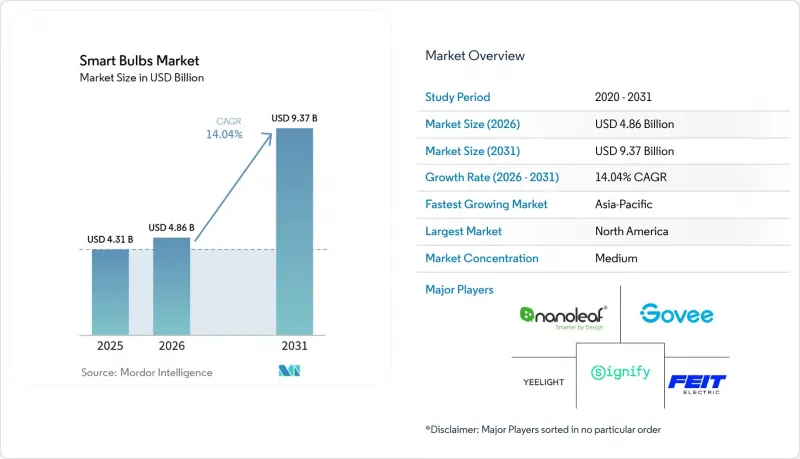
全球智慧燈泡市場趨勢及洞察
智慧家庭的普及率不斷提高
預計2025年,美國和加拿大受訪家庭中智慧家庭科技的普及率將達到59%,高於2024年的49%。價格親民的智慧家庭設備和更簡單的自動化功能,使得智慧家庭產品更容易被一般家庭所接受。智慧燈泡可適配標準的E26和E27燈座,無需佈線,並可透過現有的智慧型手機應用程式進行控制。每安裝一個智慧燈泡,就有助於養成使用應用程式的習慣,從而降低未來購買恆溫器、攝影機和感測器的門檻。因此,智慧燈泡市場正受益於語音助理平台和連網家庭設備的日益普及。隨著這些平台的廣泛應用,照明不再只是一種節能選擇,而逐漸成為家庭自動化的入門級產品。
能源效率法規和LED照明的普及
美國能源局最終確定了一項通用燈具標準,強制規定自2028年7月起,所有新生產或進口的燈泡的光通量效率必須達到120 lm/W或更高。該部門預計,這項標準將在30年的出貨量內節省40千兆英國單位的能源。 DesignLights聯盟的SSL V6.0和LUNA V2.0標準已於2026年1月5日生效,對非住宅LED照明的光通量效率、可控性文件和生命週期報告提出了更嚴格的要求。歐洲也已實施光源生態設計法規,EN 15193-1:2026標準支援對建築能源性能進行系統級評估。這些法規正在加速以符合高光通量效率要求的LED產品取代舊式燈具。連網LED產品將惠及智慧燈泡市場,因為它們既能滿足能源效率要求,又能為維修和新建專案提供更高的可控性。
網路安全和隱私風險
2025年6月,美國網路安全與基礎設施安全局 (CISA) 發布了 ICSA-25-177-02建議,指出 TrendMakers Sight Bulb Pro 燈泡存在兩個嚴重性漏洞。該建議指出,其中一個漏洞涉及在設定過程中以明文形式傳輸 AES 加密金鑰,另一個漏洞則存在命令注入漏洞,攻擊者可以利用該漏洞在相鄰網路上執行任意命令。美國國家標準與技術研究院 (NIST) 記錄了飛利浦照明設備中的一個漏洞 (CVE-2024-9991),該漏洞將 Wi-Fi 憑證以明文形式儲存在設備韌體中。在 2026 年安全技術資訊大會 (SSTIC 2026) 上發表的一項研究表明,攻擊者可以透過 Zigbee 攻擊向量遠端無線取得飛利浦 Hue 橋接器的 root 權限。這些案例可能會促使飯店、企業和消費者在評估雲端連接燈泡時更加謹慎。歐盟的《網路彈性法案》將於 2027 年引入「安全設計」強制要求,從而加強對製造商的認證和合規性要求。
細分市場分析
預計到2025年,支援Wi-Fi的智慧燈泡將佔智慧燈泡銷量的53.23%,這主要得益於路由器的普及以及無需專用閘道器的便利設定。 Wi-Fi智慧燈泡在智慧燈泡市場佔據的這一地位意味著,它已在尋求簡單易用、基於應用程式控制的家庭用戶中建立了廣泛的基本客群。支援藍牙的智慧燈泡則具有本地控制、低延遲以及對雲端基礎設施依賴性較低等優點。這些特性吸引了那些希望在特定房間或房屋內進行基本控制的使用者。 Zigbee和Z-Wave在商用應用中繼續發揮重要作用,因為在這些應用中,網狀網路的可靠性以及與建築管理系統的整合至關重要。
其他連接協議,主要是支援Thread原生協議和Matter over Thread的產品,預計將在2026年至2031年間以16.45%的複合年成長率成長。這一前景反映了製造商對開放標準和架構的興趣,這些標準和架構可以減少對專有集線器的依賴。 Aqara的T2 LED燈泡同時支援Zigbee和Thread協議,使用戶無需更換燈泡即可切換協議。 Matter 1.6提供共用的網路和性能驗證功能,簡化了多平台安裝和管理。在智慧燈泡市場,兼具易於設定和可靠的本地及跨平台運行的產品預計將受到青睞。
到2025年,LED智慧燈泡將佔據智慧燈泡市場97.57%的佔有率,預計到2031年將以16.32%的複合年成長率成長。這些因素共同促成了LED成為消費級智慧燈泡市場的核心技術。根據昕諾飛(Signify)的報告,2026年第一季全球聯網照明點數量達到1.71億,高於2025年底的1.67億。這一成長反映了市場對基於LED的聯網照明的持續需求。不斷提高的燈具能源效率標準進一步推動了LED技術的發展,因為它既滿足了性能要求,也符合消費者的成本預期。
OLED智慧燈泡目前仍主要應用於飯店和零售等高階場所,這些場所對漫射、低眩光照明的要求極高。其每流明成本仍高於LED陣列,限制了其在普通替換燈泡領域的廣泛應用。其他光源類型仍處於次要地位,因為在同等價位下,效率要求優先考慮LED的性能。在LED領域,產品差異化主要體現在顏色調節、顯色指數、調光特性和色溫選項等。因此,在智慧燈泡產業,照明品質和控制功能的競爭空間遠大於光源技術的革新。
區域分析
2025年,北美市場佔全球銷售額的35.21%,這得益於成熟的寬頻家庭網路、語音助理以及完善的能源法規。 2025年,美國和加拿大受訪家庭中智慧家庭科技的普及率達到59%。 Signify公司2025年在美國消費者業務的銷售額實現了兩位數成長,其中連網家庭業務表現尤為強勁。 2025年12月,AT&T推出了「互聯生活」(Connected Life)服務,將Google Home設備和Abode監控服務與無線和寬頻合約結合。在加拿大,公共產業支持的LED照明維修專案正在推動市場擴張;而在墨西哥,隨著都市化進程的加快,區域智慧燈泡市場也在蓬勃發展。
預計亞太地區2026年至2031年複合年成長率將達17.46%,在所有區域市場中成長最高。中國擁有大規模的智慧燈泡製造地和消費群,並透過平台型零售管道提供服務。印度受益於都市化、智慧城市建設以及不斷成長的連網家庭產品消費群。韓國的特色是消費者注重品質、寬頻普及率高,以及家電與智慧家庭平台的緊密融合。
在歐洲、中東和非洲以及南美洲,智慧照明的進展因政策、基礎設施和收入水準的差異而有所不同。沙烏地阿拉伯是中東的主要市場,其大規模基礎設施項目已將智慧照明納入規範。同時,阿拉伯聯合大公國擁有智慧城區,為飯店業和商業需求提供支援。在南美洲,智慧照明的普及仍處於起步階段,巴西和阿根廷是主要的消費市場,但進口成本和缺乏本地語言的生態系統支持限制了其短期內的普及。該地區的需求將取決於監管設備的更新周期、都市化以及寬頻接入的發展。
其他好處:
- Excel格式的市場預測(ME)表
- 3個月的分析師支持
目錄
第1章:引言
- 研究假設和市場定義
- 調查範圍
第2章:調查方法
第3章執行摘要
第4章 市場狀況
- 市場概覽
- 市場促進因素
- 智慧家庭的普及率不斷提高
- 節能法規和LED的普及
- 擴展物質庫互通性
- 出租住宅和多用戶住宅對智慧照明的需求
- 「App控制照明」是家庭自動化的切入點。
- 零售商主導的智慧燈泡和家庭網路保全服務。
- 市場限制因素
- 網路安全和隱私風險
- 生態系間互通性的碎片化
- 透過整合式電子設備縮短產品更換週期
- 消費者對高階功能的付費意願較低。
- 產業價值鏈分析
- 監理情勢
- 技術展望
- 宏觀經濟因素對市場的影響
- 波特五力分析
第5章 市場規模與成長預測
- 透過技術/連接協議
- 支援 Wi-Fi 的智慧燈泡
- 藍牙智慧燈泡
- 相容於 Zigbee 的智慧燈泡
- Z-Wave智慧燈泡
- 其他連線協定(Thread原生/Matter-over-Thread、自訂網格)
- 依光源類型
- LED智慧燈泡
- OLED智慧燈泡
- 其他光源類型
- 透過分銷管道
- 直銷
- 批發/零售
- 電子商務
- 按最終用戶行業分類
- 住宅
- 商業的
- 飯店業
- 辦公室和商業地產
- 零售空間
- 工業和公共機構
- 按地區
- 北美洲
- 美國
- 加拿大
- 墨西哥
- 南美洲
- 巴西
- 阿根廷
- 其他南美國家
- 歐洲
- 德國
- 英國
- 法國
- 義大利
- 西班牙
- 其他歐洲國家
- 亞太地區
- 中國
- 日本
- 印度
- 韓國
- 其他亞太國家
- 中東和非洲
- 中東
- 沙烏地阿拉伯
- 阿拉伯聯合大公國
- 土耳其
- 其他中東國家
- 非洲
- 南非
- 奈及利亞
- 其他非洲國家
- 中東
- 北美洲
第6章 競爭情勢
- 市場集中度
- 策略趨勢
- 市佔率分析
- 公司簡介
- Nanoleaf Inc.
- Govee Home Appliance Co., Ltd.
- Shenzhen Yeelight Technology Co., Ltd.
- Signify NV
- Feit Electric Company, Inc.
- Sengled Co., Ltd.
- LEDVANCE GmbH
- Leedarson IoT Technology Inc.
- TP-Link Systems Inc.
- SATCO Products, Inc.
- Lutron Electronics Co., Inc.
- Xiaomi Communications Co., Ltd.
- Lumi United Technology Co., Ltd.(Aqara)
- IKEA Supply AG
- Shenzhen Opple Lighting Co., Ltd.(OPPLE Lighting)
- Tuya Smart Inc.
- Miboxer(FUTLIGHT OPTOELECTRONICS CO., LTD.)
- AiDot Inc.(Linkind)
- Shenzhen Homa Technology Co., Ltd.
第7章 市場機會與未來展望
According to Mordor Intelligence, the smart bulbs market size was valued at USD 4.31 billion in 2025 and is estimated to expand from USD 4.86 billion in 2026 to reach USD 9.37 billion by 2031, at a CAGR of 14.04% during the forecast period 2026-2031.
Global Smart Bulbs Market Trends and Insights
Rising Smart-Home Penetration
Smart home technology adoption reached 59% among surveyed households in the United States and Canada in 2025, compared with 49% in 2024. Affordable Matter-compatible devices and simpler automation are making connected products more accessible to households. Smart bulbs fit standard E26 and E27 sockets, need no rewiring, and can be controlled through existing smartphone applications. Each installed bulb can establish an application habit that lowers the barrier to purchasing thermostats, cameras, and sensors later. The smart bulbs market, therefore, gains from the larger installed base of voice assistant platforms and connected home devices. As these platforms spread, lighting is becoming a routine entry product for home automation rather than an optional efficiency upgrade.
Energy-Efficiency Regulation and LED Replacement
The U.S. Department of Energy finalized general service lamp standards that require more than 120 lm/W for newly manufactured or imported bulbs from July 2028. The Department expects the standards to save 4 quadrillion British thermal units over 30 years of shipments. DesignLights Consortium SSL V6.0 and LUNA V2.0 requirements took effect on January 5, 2026, with tighter efficacy, controllability documentation, and lifecycle reporting requirements for nonresidential LED lighting. Europe also applies the Ecodesign Regulation for light sources, while EN 15193-1:2026 supports system-level assessment of building energy performance. These rules encourage the replacement of legacy lamps with LED products that meet higher-efficacy requirements. The smart bulbs market can benefit because connected LED products meet efficiency needs while adding controllability in retrofit and new-build settings.
Cybersecurity and Privacy Exposure
CISA issued advisory ICSA-25-177-02 in June 2025 on 2 high-severity vulnerabilities in the TrendMakers Sight Bulb Pro. The advisory identified clear-text transmission of AES encryption keys during setup and a command injection vulnerability that could allow adjacent-network attackers to execute arbitrary commands. NIST documented CVE-2024-9991, which involved Philips lighting devices storing Wi-Fi credentials in plain text in device firmware. Research presented at SSTIC 2026 showed remote and wireless root access to a Philips Hue Bridge through Zigbee attack surfaces. These cases can make hotels, enterprises, and consumers more cautious when assessing cloud-connected bulbs. The EU Cyber Resilience Act will introduce security-by-design obligations through 2027, increasing certification and compliance demands for manufacturers.
Other drivers and restraints analyzed in the detailed report include:
- Matter-Based Interoperability Expansion
- Connected Lighting Demand in Rental and Multifamily Housing
- Interoperability Fragmentation Across Ecosystems
For complete list of drivers and restraints, kindly check the Table Of Contents.
Segment Analysis
Wi-Fi smart bulbs held 53.23% of revenue in 2025, supported by near-universal router availability and a setup process that does not require a dedicated hub. This position in the smart bulb market gives Wi-Fi products a broad consumer base among households seeking simple app-based control. Bluetooth smart bulbs offer local control, low latency, and less reliance on cloud infrastructure. These features appeal to buyers who prefer basic control within a defined room or home. Zigbee and Z-Wave remain relevant in professional installations where mesh reliability and integration with building control systems matter.
Other connectivity protocols, mainly Thread-native and Matter-over-Thread products, are projected to expand at a 16.45% CAGR from 2026 to 2031. This outlook reflects manufacturer interest in open standards and architectures that can reduce dependence on a proprietary hub. Aqara's LED Bulb T2 supports both Zigbee and Thread, giving buyers the option to switch protocols without replacing the bulb. Matter 1.6 provides shared-network and commissioning functions that can make multi-platform installations easier to manage. The smart bulbs market is likely to reward products that combine simple setup with reliable local and cross-platform operation.
LED smart bulbs accounted for 97.57% of the smart bulb market in 2025 and are projected to grow at a 16.32% CAGR through 2031. The combination makes LED the central technology in the smart bulbs market at consumer price points. Signify reported 171 million connected light points globally in Q1 2026, compared with 167 million at the end of 2025. This installed base reflects continuing demand for LED-based connected lighting. Higher lamp-efficiency standards further support LED technology because it meets both performance requirements and consumer cost expectations.
OLED smart bulbs remain limited to premium applications where diffuse and low-glare illumination is valued in hospitality and retail spaces. Their cost per lumen remains higher than that of LED arrays, limiting wider adoption in common retrofit bulb formats. Other light source types remain marginal as efficiency requirements favor LED performance at comparable prices. Within the LED category, product differentiation now depends more on color tuning, color rendering index, dimming behavior, and color temperature options. The smart bulbs industry, therefore, has more scope to compete on lighting quality and control functions than on changes in light-source technology.
Complete Report Scope:
- By Technology / Connectivity Protocol
- Wi-Fi Smart Bulbs
- Bluetooth Smart Bulbs
- Zigbee Smart Bulbs
- Z-Wave Smart Bulbs
- Other Connectivity Protocols (Thread-native/Matter-over-Thread, Proprietary Mesh)
- By Light Source Type
- LED Smart Bulbs
- OLED Smart Bulbs
- Other Light Source Types
- By Distribution Channel
- Direct Sales
- Wholesale / Retail
- E-commerce
- By End-user Industry
- Residential
- Commercial
- Hospitality
- Offices and Commercial Real Estate
- Retail Spaces
- Industrial and Institutional
- By Geography
- North America
- United States
- Canada
- Mexico
- South America
- Brazil
- Argentina
- Rest of South America
- Europe
- Germany
- United Kingdom
- France
- Italy
- Spain
- Rest of Europe
- Asia-Pacific
- China
- Japan
- India
- South Korea
- Rest of Asia-Pacific
- Middle East and Africa
- Middle East
- Saudi Arabia
- United Arab Emirates
- Turkey
- Rest of the Middle East
- Africa
- South Africa
- Nigeria
- Rest of Africa
- Middle East
- North America
Geography Analysis
North America held 35.21% of revenue in 2025, supported by a mature base of broadband-connected households, voice assistants, and energy rules. Smart home technology adoption reached 59% among surveyed households in the United States and Canada in 2025. Signify reported double-digit revenue expansion in its U.S. consumer business during 2025, with strong connected home performance during peak periods. AT&T launched Connected Life in December 2025, combining Google Home devices and Abode monitoring with wireless and broadband subscriptions. Canada contributes through utility-backed LED retrofit programs, while Mexico expands the regional smart-bulb market amid urbanization.
Asia-Pacific is projected to expand at a 17.46% CAGR from 2026 to 2031, the fastest rate among the geographic segments. China combines a major manufacturing base with a large consumer base for the smart bulbs market, which is served through platform-based retail channels. India benefits from urbanization, smart city activity, and a growing consumer base for connected home products. South Korea adds a quality-focused consumer base, high broadband density, and close links between consumer electronics and home platforms.
Europe, the Middle East and Africa, and South America show different stages of adoption because their policy, infrastructure, and income conditions vary. Saudi Arabia is a major Middle Eastern market because large infrastructure projects include connected lighting in their specifications, while the UAE has smart city districts that support hospitality and commercial demand. South America remains earlier in adoption, with Brazil and Argentina as major consumer markets and import costs and local-language ecosystem support limiting near-term penetration. Regional demand will depend on how regulatory replacement cycles, urbanization, and broadband availability develop.
- Nanoleaf Inc.
- Govee Home Appliance Co., Ltd.
- Shenzhen Yeelight Technology Co., Ltd.
- Signify N.V.
- Feit Electric Company, Inc.
- Sengled Co., Ltd.
- LEDVANCE GmbH
- Leedarson IoT Technology Inc.
- TP-Link Systems Inc.
- SATCO Products, Inc.
- Lutron Electronics Co., Inc.
- Xiaomi Communications Co., Ltd.
- Lumi United Technology Co., Ltd. (Aqara)
- IKEA Supply AG
- Shenzhen Opple Lighting Co., Ltd. (OPPLE Lighting)
- Tuya Smart Inc.
- Miboxer (FUTLIGHT OPTOELECTRONICS CO., LTD.)
- AiDot Inc. (Linkind)
- Shenzhen Homa Technology Co., Ltd.
Additional Benefits:
- The market estimate (ME) sheet in Excel format
- 3 months of analyst support
TABLE OF CONTENTS
1 INTRODUCTION
- 1.1 Study Assumptions and Market Definition
- 1.2 Scope of the Study
2 RESEARCH METHODOLOGY
3 EXECUTIVE SUMMARY
4 MARKET LANDSCAPE
- 4.1 Market Overview
- 4.2 Market Drivers
- 4.2.1 Rising Smart-Home Penetration
- 4.2.2 Energy-Efficiency Regulation and LED Replacement
- 4.2.3 Matter-Based Interoperability Expansion
- 4.2.4 Connected Lighting Demand in Rental and Multifamily Housing
- 4.2.5 App-Visible Lighting as a Gateway to Home Automation
- 4.2.6 Retailer-Led Bundling of Smart Bulbs With Home-Internet and Security Services
- 4.3 Market Restraints
- 4.3.1 Cybersecurity and Privacy Exposure
- 4.3.2 Interoperability Fragmentation Across Ecosystems
- 4.3.3 Shorter Product Replacement Cycles From Integrated Electronics
- 4.3.4 Low Consumer Willingness to Pay for Advanced Features
- 4.4 Industry Value-Chain Analysis
- 4.5 Regulatory Landscape
- 4.6 Technological Outlook
- 4.7 Impact of Macroeconomic Factors on the Market
- 4.8 Porter's Five Forces Analysis
- 4.8.1 Threat of New Entrants
- 4.8.2 Bargaining Power of Suppliers
- 4.8.3 Bargaining Power of Buyers
- 4.8.4 Threat of Substitutes
- 4.8.5 Competitive Rivalry
5 MARKET SIZE AND GROWTH FORECASTS (VALUE)
- 5.1 By Technology / Connectivity Protocol
- 5.1.1 Wi-Fi Smart Bulbs
- 5.1.2 Bluetooth Smart Bulbs
- 5.1.3 Zigbee Smart Bulbs
- 5.1.4 Z-Wave Smart Bulbs
- 5.1.5 Other Connectivity Protocols (Thread-native/Matter-over-Thread, Proprietary Mesh)
- 5.2 By Light Source Type
- 5.2.1 LED Smart Bulbs
- 5.2.2 OLED Smart Bulbs
- 5.2.3 Other Light Source Types
- 5.3 By Distribution Channel
- 5.3.1 Direct Sales
- 5.3.2 Wholesale / Retail
- 5.3.3 E-commerce
- 5.4 By End-user Industry
- 5.4.1 Residential
- 5.4.2 Commercial
- 5.4.2.1 Hospitality
- 5.4.2.2 Offices and Commercial Real Estate
- 5.4.2.3 Retail Spaces
- 5.4.3 Industrial and Institutional
- 5.5 By Geography
- 5.5.1 North America
- 5.5.1.1 United States
- 5.5.1.2 Canada
- 5.5.1.3 Mexico
- 5.5.2 South America
- 5.5.2.1 Brazil
- 5.5.2.2 Argentina
- 5.5.2.3 Rest of South America
- 5.5.3 Europe
- 5.5.3.1 Germany
- 5.5.3.2 United Kingdom
- 5.5.3.3 France
- 5.5.3.4 Italy
- 5.5.3.5 Spain
- 5.5.3.6 Rest of Europe
- 5.5.4 Asia-Pacific
- 5.5.4.1 China
- 5.5.4.2 Japan
- 5.5.4.3 India
- 5.5.4.4 South Korea
- 5.5.4.5 Rest of Asia-Pacific
- 5.5.5 Middle East and Africa
- 5.5.5.1 Middle East
- 5.5.5.1.1 Saudi Arabia
- 5.5.5.1.2 United Arab Emirates
- 5.5.5.1.3 Turkey
- 5.5.5.1.4 Rest of the Middle East
- 5.5.5.2 Africa
- 5.5.5.2.1 South Africa
- 5.5.5.2.2 Nigeria
- 5.5.5.2.3 Rest of Africa
- 5.5.5.1 Middle East
- 5.5.1 North America
6 COMPETITIVE LANDSCAPE
- 6.1 Market Concentration
- 6.2 Strategic Moves
- 6.3 Market Share Analysis
- 6.4 Company Profiles (includes Global Level Overview, Market Level Overview, Core Segments, Financials as available, Strategic Information, Market Rank/Share, Products and Services, Recent Developments)
- 6.4.1 Nanoleaf Inc.
- 6.4.2 Govee Home Appliance Co., Ltd.
- 6.4.3 Shenzhen Yeelight Technology Co., Ltd.
- 6.4.4 Signify N.V.
- 6.4.5 Feit Electric Company, Inc.
- 6.4.6 Sengled Co., Ltd.
- 6.4.7 LEDVANCE GmbH
- 6.4.8 Leedarson IoT Technology Inc.
- 6.4.9 TP-Link Systems Inc.
- 6.4.10 SATCO Products, Inc.
- 6.4.11 Lutron Electronics Co., Inc.
- 6.4.12 Xiaomi Communications Co., Ltd.
- 6.4.13 Lumi United Technology Co., Ltd. (Aqara)
- 6.4.14 IKEA Supply AG
- 6.4.15 Shenzhen Opple Lighting Co., Ltd. (OPPLE Lighting)
- 6.4.16 Tuya Smart Inc.
- 6.4.17 Miboxer (FUTLIGHT OPTOELECTRONICS CO., LTD.)
- 6.4.18 AiDot Inc. (Linkind)
- 6.4.19 Shenzhen Homa Technology Co., Ltd.
7 MARKET OPPORTUNITIES AND FUTURE OUTLOOK
- 7.1 White-Space and Unmet-Need Assessment

 智慧照明控制玻璃市場:全球市場預測,2026-2032年
 智慧路燈市場預測至2034年-全球分析(按組件、光源、通訊技術、應用、部署模式、最終用戶和地區分類)LED原色照明市場:全球市場預測,2026-2032年三原色光源市場:全球市場預測,2026-2032年三原色柔光燈市場:全球市場預測,2026-2032年
 手勢控制照明市場規模、佔有率和成長分析:按產品類型、技術、應用、連接方式、分銷管道和地區分類 - 產業預測,2026-2033 年
 氣體氚光源(GTLS)市場規模、佔有率和成長分析:按產品類型、應用、外形規格、最終用戶和地區分類 - 2026-2033 年產業預測家用LED照明市場:全球市場預測,2026-2032年智慧照明市場預測至2034年-按產品類型、連接技術、安裝類型、應用和地區分類的分析智慧照明解決方案市場預測至2034年—全球產品、通訊技術、安裝類型、控制方法、應用、最終用戶和區域分析