


 |
市場調查報告書
商品編碼
2154302
自動駕駛軟體:市場佔有率分析、產業趨勢與統計、成長預測(2026-2031)Autonomous Driving Software - Market Share Analysis, Industry Trends & Statistics, Growth Forecasts (2026 - 2031) |
||||||

※ 本網頁內容可能與最新版本有所差異。詳細情況請與我們聯繫。
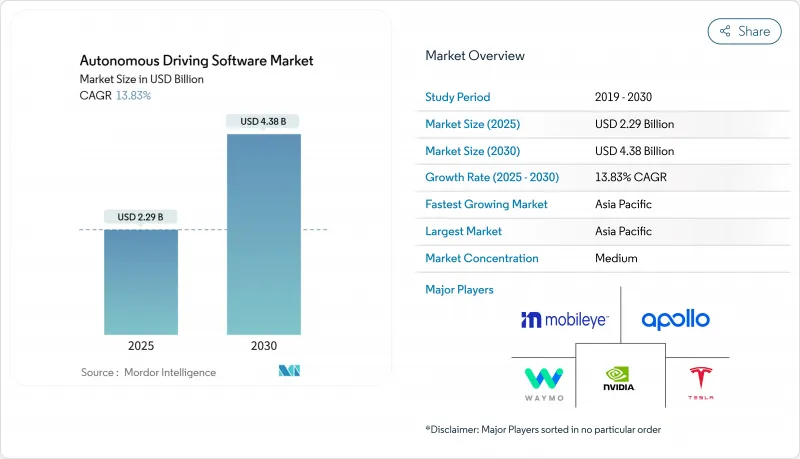
據 Mordor Intelligence 稱,2025 年自動駕駛軟體市場價值為 116.3 億美元,預計到 2031 年將達到 502.5 億美元,而 2026 年為 147.5 億美元,預測期(2026-2031 年)的複合年成長率為 27.78%。
全球自動駕駛軟體市場趨勢與洞察
原始設備製造商向「軟體定義汽車」轉型
全球汽車製造商正圍繞空中下載 (OTA) 功能推送和訂閱收入重組業務。通用汽車 (GM) 已完成對 Cruise 的完全子公司收購,而大眾汽車則與共乘平台合作,加速自動駕駛計程車的部署。特斯拉透過其「完全自動駕駛」套件在 2024 年實現了可觀的收入,展現了大規模盈利的潛力。據該公司稱,該軟體的最新版本擁有「增強的資料處理和訓練運算能力、五倍的參數數量以及多項架構改進」。與公共雲端供應商的合作支援持續整合管道,從而能夠每週發佈軟體,以比傳統車型年度週期更快的速度迭代和改進感知和規劃演算法。因此,競爭壓力正促使資本投資從機械工程轉向資料管道、合成模擬工具和安全案例自動化。
歐洲、中國和美國ADAS法規的擴展
歐盟的《通用安全法規》現已強制要求所有新車配備緊急煞車和車道維持功能,這實際上保證了對感知軟體的最低需求。中國的C-NCAP 2024協議也施加了類似的壓力,它將五星級評級與一套全面的駕駛輔助功能掛鉤。在美國,各州的測試項目和NHTSA的安全指南共同構成了一個聯邦框架,該框架既支持商業試驗計畫,也保障了消費者權益。核心ADAS功能的標準化將為更高級的自動駕駛鋪平道路,因為它將使供應商能夠將研發支出分散到多個區域項目中,從而降低單車成本並加快功能藍圖的開發。
符合 ISO 26262 和 SOTIF 標準的功能安全人員短缺
業界對擁有 ISO 26262 和 SOTIF 認證的工程師的需求遠超供應。這些認證要求工程師在汽車安全和機器學習檢驗方面具備深厚的專業知識,而這些技能需要多年的專案經驗累積。據主要供應商稱,職位空缺可能長達一年無人填補,導致項目延期和人事費用增加。儘管大學相關課程正在不斷擴充,但預計未來十年人才短缺的情況仍將持續。人才短缺導致安全案例的製定進程放緩,進而造成 L3 級及以上功能的監管批准延遲。
細分市場分析
到2025年,L2級自動駕駛軟體將佔據47.15%的市場。這主要得益於主動式車距維持定速系統和車道居中維持功能在量產乘用車平台上的應用。收入主要來自於提升駕駛便利性的訂閱套餐,這不僅創造了穩定的現金流,也讓駕駛者熟悉了受監管的自動駕駛功能。歐洲和中國的法規正迫使汽車製造商將這些功能作為標準配置,從而確保了最低銷售量和可預測的整合藍圖。
隨著商用無人駕駛計程車和樞紐間貨運服務從試點規模擴展到更廣泛的領域,預計在預測期(2026-2031年)內,用於更高級自動駕駛(L4和L5)的軟體將以30.45%的複合年成長率成長。將地理圍欄技術用於限制運行區域,並結合遠端輔助安全協議,即使沒有駕駛人在車上,也能實現盈利運作。儘管監管路徑依然嚴格,但一些城市成功的安全案例申請表明,核准速度正在加快。投資重點在於感知系統的冗餘性、行為預測的準確性以及即時容錯移轉機制,以滿足功能安全目標。
至2025年,內燃機平台將佔據自動駕駛軟體市場63.01%的佔有率。這是因為傳統車輛架構仍然主導著全球銷售。混合動力系統面臨複雜的電源管理問題,這使得自動駕駛軟體的實施變得困難。儘管原始設備製造商(OEM)正在透過分散式電控系統(DECU)對車輛進行高級駕駛輔助系統(ADAS)功能的改造,但熱設計框架和12伏線路限制了運算能力的擴充性。因此,軟體升級存在實體瓶頸,限制了藍圖的靈活性。
預計在預測期(2026-2031年)內,電動車將以31.48%的複合年成長率成長,這得益於高壓電氣系統和集中式運算,它們能夠支援多感測器陣列和GPU級處理器。最初為電池組設計的冷卻迴路現在也用於散發人工智慧工作負載產生的熱量,從而解決了關鍵的熱設計難題。空中下載(OTA)韌體透過整合軟體堆疊調整電池管理和自動駕駛功能,支援持續的功能擴展並提升客戶生命週期價值(CLV)。
區域分析
預計到2025年,亞太地區將以36.72%的市佔率引領自動駕駛軟體市場,並在預測期(2026-2031年)內維持28.11%的複合年成長率。中國決策者正在批准建造大規模測試區域,涵蓋與傳統車輛混合的交通路況、夜間駕駛以及惡劣天氣條件。國內領先的科技公司正在爭取優先進入許可權公共道路測試里程,並累積獨特的資料集,以增強其感知模型的差異化優勢。日本正在推廣自動駕駛班車作為農村地區的出行方式,而韓國則正在整合基於5G的車對車(V2V)和車對萬物(V2X)骨幹網路,以提升車輛的情境察覺。該地區不斷擴大的製造業規模正在降低硬體成本,並加速下一代感測器堆疊在全球的普及應用。
預計未來幾年北美將迎來顯著成長。矽谷的新創公司正利用大量創業投資投資,探索自動駕駛領域的各種細分市場,例如人行道機器人和自動駕駛中程物流。加州和亞利桑那州的監管沙盒允許將自動駕駛技術與公共道路客運服務和共乘服務相結合,有助於驗證其商業性可行性。加拿大透過在寒冷氣候下開發測試路線,進一步支持該生態系統的發展,不僅提高了數據覆蓋率,還能對冰雪條件下的感知堆疊進行壓力檢驗。
歐洲擁有協調良好的法規環境,預計在預測期內將顯著成長。通用安全法規 (GSR) 強制要求統一部署高階駕駛輔助系統 (ADAS),使供應商能夠將開發成本分攤到該地區龐大的乘用車群體中。德國的一級供應商叢集在硬體和軟體整合方面擁有豐富的專業知識,而斯堪地那維亞國家正在進行自動駕駛公共交通試點項目,並將營運經驗反饋到市場中。統一的隱私法明確了資料處理義務,並促進了跨境車輛運作。
其他好處:
- Excel格式的市場預測(ME)表
- 3個月的分析師支持
目錄
第1章:引言
- 研究假設和市場定義
- 調查範圍
第2章:調查方法
第3章執行摘要
第4章 市場狀況
- 市場概覽
- 市場促進因素
- 原始設備製造商向軟體定義汽車 (SDV) 的轉型
- 歐洲、中國和美國強制推行ADAS的計畫正在擴大。
- 從 2025 年開始,雷射雷達和計算單元的成本預計將迅速下降。
- 一項先進的交通管理試點項目,實現了 L4 級地理圍欄無人計程車。
- 雲原生模擬平台縮短開發週期
- 中國引進無高清地圖感知棧
- 市場限制因素
- 具備符合 ISO 26262 和 SOTIF 標準的功能安全人員短缺。
- 美國各州監理核准存在差異
- 電動汽車高性能運算的溫度控管局限性
- 關於空中下載 (OTA) 更新的網路安全責任
- 價值供應鏈分析
- 監理情勢
- 技術展望
- 波特五力分析
第5章 市場規模與成長預測
- 依自主程度
- 一級
- 二級
- 3級
- 4級和5級
- 依推進類型
- 內燃機
- 電的
- 車輛類型
- 搭乘用車
- 商用車輛
- 軟體類型
- 感知與規劃軟體
- 駕駛人程式
- 車載感測軟體
- 監控軟體
- 按地區
- 北美洲
- 美國
- 加拿大
- 其他北美國家
- 南美洲
- 巴西
- 阿根廷
- 其他南美國家
- 歐洲
- 英國
- 德國
- 西班牙
- 義大利
- 法國
- 俄羅斯
- 其他歐洲國家
- 亞太地區
- 印度
- 中國
- 日本
- 韓國
- 其他亞太國家
- 中東和非洲
- 阿拉伯聯合大公國
- 沙烏地阿拉伯
- 土耳其
- 埃及
- 南非
- 其他中東和非洲國家
- 北美洲
第6章 競爭情勢
- 市場集中度
- 策略趨勢
- 市佔率分析
- 公司簡介
- NVIDIA Corporation
- Mobileye(Intel Corporation)
- Waymo LLC
- Tesla, Inc.
- Baidu, Inc.
- Continental AG
- Robert Bosch GmbH
- Aptiv PLC
- ZF Friedrichshafen AG
- Huawei Technologies Co., Ltd.
- Cruise LLC(General Motor Company)
- Oxa Autonomy Limited
- Qualcomm Technologies, Inc.
- Valeo SA
第7章 市場機會與未來展望
According to Mordor Intelligence, the autonomous driving software market size was valued at USD 11.63 billion in 2025 and is estimated to grow from USD 14.75 billion in 2026 to reach USD 50.25 billion by 2031, at a CAGR of 27.78% during the forecast period (2026-2031).
Global Autonomous Driving Software Market Trends and Insights
OEM Pivot To Software-Defined Vehicles
Global automakers are reorganizing around over-the-air feature delivery and subscription revenue. General Motors finalized full ownership of Cruise, while Volkswagen aligned with a ride-hailing platform to accelerate robotaxi rollout. Tesla gained significantly from its Full Self-Driving package in 2024, proving out monetization at scale. As per the company, the software's latest version boasts "enhanced data and training compute, a fivefold boost in parameter count, and various architectural enhancements". Partnerships with public cloud providers support continuous integration pipelines, allowing weekly software releases that iterate perception and planning algorithms faster than traditional model-year cycles. Competitive pressure is therefore shifting capital expenditure from mechanical engineering toward data pipelines, synthetic-simulation tooling, and safety-case automation.
Expanding ADAS Mandates in Europe, China and United States
The European Union's General Safety Regulation now requires emergency braking and lane-keeping on every new vehicle, effectively guaranteeing baseline demand for perception software. China's C-NCAP 2024 protocol applies similar pressure by tying five-star ratings to comprehensive driver-assist suites. In the United States, a mix of state-level testing programs and NHTSA safety guidelines supplies a federal framework that supports commercial pilots while maintaining consumer protection. The harmonization of core ADAS functions establishes a stepping-stone toward higher autonomy because suppliers can amortize R&D across multiple geographic programs, shaving cost per vehicle and accelerating feature road-maps.
Scarcity Of Functional-Safety Talent For ISO 26262 And SOTIF
Industry demand for engineers qualified under ISO 26262 and SOTIF outstrips supply. Certification combines deep automotive safety know-how with machine-learning validation skills, a profile cultivated over multiple years of project experience. Leading suppliers report open positions unfilled for up to one year, stretching project timelines and raising salary costs. University programs are expanding, yet the talent gap will persist through the decade. Limited staffing slows safety-case preparation, which in turn delays regulatory clearance for Level 3-plus functions.
Other drivers and restraints analyzed in the detailed report include:
- Rapid Decline In LiDAR And Compute-Unit Costs Post-2025
- Advanced Traffic-Management Pilots Enabling L4 Geo-Fenced Robo-Taxis
- Fragmented Regulatory Approval Across U.S. States
For complete list of drivers and restraints, kindly check the Table Of Contents.
Segment Analysis
Level 2 held a 47.15% share in 2025 within the autonomous driving software market, anchored by adaptive cruise control and lane-centering functions rolled out across high-volume passenger platforms. Revenue flows from subscription packages that unlock enhanced driving convenience, creating steady cash flows while accustoming drivers to supervised automation features. Mandates in Europe and China force OEMs to embed these capabilities as standard equipment, ensuring baseline volume and predictable integration roadmaps.
Higher-autonomy Level 4 and 5 software is set to grow at a 30.45% CAGR during the forecast period (2026-2031), as commercial robotaxi and hub-to-hub freight services scale beyond pilot volume. Geo-fenced operating domains, combined with remote-assistance safety protocols, allow revenue operations without an in-vehicle driver. Regulatory pathways remain stringent, yet successful safety-case filings in select cities signal accelerating approvals. Investment funnels toward perception redundancy, behavioral prediction fidelity, and real-time fail-over mechanisms that meet functional safety targets.
Internal-combustion platforms held a 63.01% share of the autonomous driving software market in 2025, as legacy fleet architectures continue to dominate global sales. Hybrid systems face power management complexities that complicate the implementation of autonomous driving software. OEMs retrofit ADAS features via distributed electronic-control units, but thermal envelopes and 12-volt wiring constrain compute scalability. Software upgrades, therefore, face physical bottlenecks that limit roadmap agility.
Electric vehicles will advance at a 31.48% CAGR during the forecast period (2026-2031), leveraging high-voltage electrics and centralized compute to accommodate multi-sensor arrays and GPU-class processors. Cooling loops originally designed for battery packs now dissipate heat from AI workloads, solving a critical thermal hurdle. Over-the-air firmware orchestrates battery management and autonomous functions through a unified software stack, supporting continuous feature extension and heightening customer lifetime value.
Complete Report Scope:
- By Level of Autonomy
- Level 1
- Level 2
- Level 3
- Level 4 and 5
- By Propulsion Type
- Internal Combustion Engine
- Electric
- By Vehicle Type
- Passenger Vehicle
- Commercial Vehicle
- By Software Type
- Perception and Planning Software
- Chauffeur Software
- Interior Sensing Software
- Supervision / Monitoring Software
- By Geography
- North America
- United States
- Canada
- Rest of North America
- South America
- Brazil
- Argentina
- Rest of South America
- Europe
- United Kingdom
- Germany
- Spain
- Italy
- France
- Russia
- Rest of Europe
- Asia-Pacific
- India
- China
- Japan
- South Korea
- Rest of Asia-Pacific
- Middle East and Africa
- United Arab Emirates
- Saudi Arabia
- Turkey
- Egypt
- South Africa
- Rest of Middle East and Africa
- North America
Geography Analysis
Asia-Pacific led with a 36.72% share of the autonomous driving software market in 2025 and is projected to grow at a 28.11% CAGR during the forecast period (2026-2031). Policymakers in China authorize large-scale pilot zones that cover mixed traffic, night conditions, and adverse weather. Domestic technology champions secure preferential access to public road-test mileage, amassing proprietary datasets that differentiate their perception models. Japan targets autonomous shuttles for rural mobility, while South Korea integrates 5G cellular vehicle-to-everything backbones to enhance situational awareness. Manufacturing scale in the region reduces hardware costs and accelerates the global diffusion of next-generation sensor stacks.
North America is expected to experience significant growth over the years. Silicon Valley start-ups leverage substantial venture capital to explore diverse autonomy niches, including sidewalk robots and autonomous middle-mile logistics. Regulatory sandboxes in California and Arizona allow public-road passenger services and ride-hailing integrations, helping validate commercial viability. Canada further supports the ecosystem through cold-weather testing corridors, which diversify data coverage and stress-test perception stacks under snow and ice conditions.
Europe maintains a coordinated regulatory environment and is set to witness significant growth during the forecast period. The General Safety Regulation requires uniform ADAS deployment, enabling suppliers to amortize development costs across the region's large passenger-car base. Germany's tier-one supplier cluster provides hardware-software integration expertise, while Scandinavian countries experiment with autonomous public transit pilots that feed operational insights back to the broader market. Harmonized privacy laws clarify data-handling obligations, smoothing cross-border fleet operations.
- NVIDIA Corporation
- Mobileye (Intel Corporation)
- Waymo LLC
- Tesla, Inc.
- Baidu, Inc.
- Continental AG
- Robert Bosch GmbH
- Aptiv PLC
- ZF Friedrichshafen AG
- Huawei Technologies Co., Ltd.
- Cruise LLC (General Motor Company)
- Oxa Autonomy Limited
- Qualcomm Technologies, Inc.
- Valeo SA
Additional Benefits:
- The market estimate (ME) sheet in Excel format
- 3 months of analyst support
TABLE OF CONTENTS
1 Introduction
- 1.1 Study Assumptions and Market Definition
- 1.2 Scope of the Study
2 Research Methodology
3 Executive Summary
4 Market Landscape
- 4.1 Market Overview
- 4.2 Market Drivers
- 4.2.1 OEM Pivot to Software-Defined Vehicles (SDVs)
- 4.2.2 Expanding ADAS Mandates in Europe, China and United States
- 4.2.3 Rapid Decline in LiDAR and Compute-Unit Costs Post-2025
- 4.2.4 Advanced Traffic-Management Pilots Enabling L4 Geo-Fenced Robo-Taxis
- 4.2.5 Cloud-Native Simulation Platforms Shortening Dev Cycles
- 4.2.6 Deployment of HD-Map-Free Perception Stacks in China
- 4.3 Market Restraints
- 4.3.1 Scarcity of Functional-Safety Talent for ISO 26262 and SOTIF
- 4.3.2 Fragmented Regulatory Approval Across U.S. States
- 4.3.3 High-Performance Computing Thermal-Management Limits in EVs
- 4.3.4 Cyber-Security Liability for Over-The-Air (OTA) Updates
- 4.4 Value / Supply-Chain Analysis
- 4.5 Regulatory Landscape
- 4.6 Technological Outlook
- 4.7 Porter's Five Forces Analysis
- 4.7.1 Threat of New Entrants
- 4.7.2 Bargaining Power of Suppliers
- 4.7.3 Bargaining Power of Buyers
- 4.7.4 Threat of Substitutes
- 4.7.5 Intensity of Competitive Rivalry
5 Market Size and Growth Forecasts (Value (USD))
- 5.1 By Level of Autonomy
- 5.1.1 Level 1
- 5.1.2 Level 2
- 5.1.3 Level 3
- 5.1.4 Level 4 and 5
- 5.2 By Propulsion Type
- 5.2.1 Internal Combustion Engine
- 5.2.2 Electric
- 5.3 By Vehicle Type
- 5.3.1 Passenger Vehicle
- 5.3.2 Commercial Vehicle
- 5.4 By Software Type
- 5.4.1 Perception and Planning Software
- 5.4.2 Chauffeur Software
- 5.4.3 Interior Sensing Software
- 5.4.4 Supervision / Monitoring Software
- 5.5 By Geography
- 5.5.1 North America
- 5.5.1.1 United States
- 5.5.1.2 Canada
- 5.5.1.3 Rest of North America
- 5.5.2 South America
- 5.5.2.1 Brazil
- 5.5.2.2 Argentina
- 5.5.2.3 Rest of South America
- 5.5.3 Europe
- 5.5.3.1 United Kingdom
- 5.5.3.2 Germany
- 5.5.3.3 Spain
- 5.5.3.4 Italy
- 5.5.3.5 France
- 5.5.3.6 Russia
- 5.5.3.7 Rest of Europe
- 5.5.4 Asia-Pacific
- 5.5.4.1 India
- 5.5.4.2 China
- 5.5.4.3 Japan
- 5.5.4.4 South Korea
- 5.5.4.5 Rest of Asia-Pacific
- 5.5.5 Middle East and Africa
- 5.5.5.1 United Arab Emirates
- 5.5.5.2 Saudi Arabia
- 5.5.5.3 Turkey
- 5.5.5.4 Egypt
- 5.5.5.5 South Africa
- 5.5.5.6 Rest of Middle East and Africa
- 5.5.1 North America
6 Competitive Landscape
- 6.1 Market Concentration
- 6.2 Strategic Moves
- 6.3 Market Share Analysis
- 6.4 Company Profiles (Includes Global Level Overview, Market Level Overview, Core Segments, Financials as Available, Strategic Information, Market Rank/Share for Key Companies, Products and Services, SWOT Analysis, and Recent Developments)
- 6.4.1 NVIDIA Corporation
- 6.4.2 Mobileye (Intel Corporation)
- 6.4.3 Waymo LLC
- 6.4.4 Tesla, Inc.
- 6.4.5 Baidu, Inc.
- 6.4.6 Continental AG
- 6.4.7 Robert Bosch GmbH
- 6.4.8 Aptiv PLC
- 6.4.9 ZF Friedrichshafen AG
- 6.4.10 Huawei Technologies Co., Ltd.
- 6.4.11 Cruise LLC (General Motor Company)
- 6.4.12 Oxa Autonomy Limited
- 6.4.13 Qualcomm Technologies, Inc.
- 6.4.14 Valeo SA
7 Market Opportunities and Future Outlook
- 7.1 White-space and Unmet-Need Assessment


