


 |
市場調查報告書
商品編碼
2154301
汽車底盤:市場佔有率分析、產業趨勢與統計、成長預測(2026-2031)Automotive Chassis - Market Share Analysis, Industry Trends & Statistics, Growth Forecasts (2026 - 2031) |
||||||

※ 本網頁內容可能與最新版本有所差異。詳細情況請與我們聯繫。
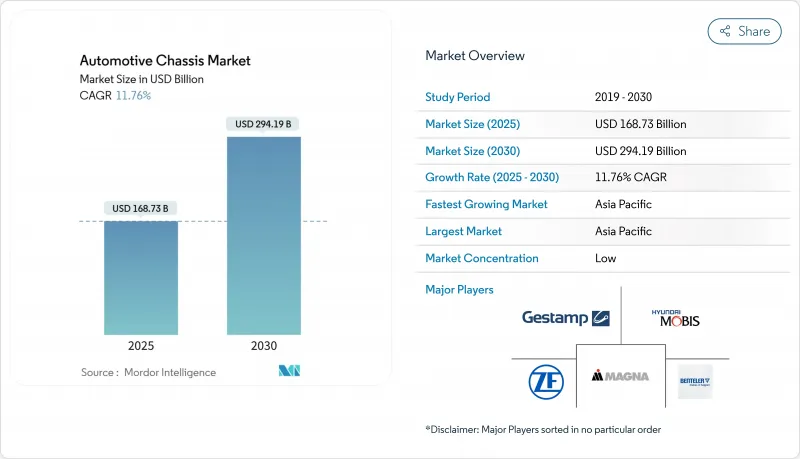
據 Mordor Intelligence 稱,2025 年汽車底盤市場價值 1,612.5 億美元,2026 年預計為 1,802.1 億美元,預計到 2031 年將達到 2,786.5 億美元。
預計從 2026 年到 2031 年,其複合年成長率將達到 9.11%。
全球汽車底盤市場趨勢與洞察
電動車產量的激增正在推動滑板/平台底盤底盤。
在電池式電動車架構領域,滑板式車架的應用日益普及。在這種車架中,電池、馬達、電力電子設備和冷卻迴路都位於平坦的底板下方。這項創新不僅擴大了內部空間,也簡化了不同衍生車型之間的模具更換流程。 Rivian巧妙地設計了一種碳纖維電池外殼,它兼具扭力盒的功能,與傳統的鋼製外殼相比,顯著減輕了重量。同時,現代摩比斯展示了一種高度靈活的軸距,可以在同一條生產線上生產乘用車和跨界車。結構性黏著劑和間隙填充膏的供應商正在獲得新的訂單。然而,除非傳統沖壓製造商掌握高壓絕緣的專業技術,否則它們將面臨被市場淘汰的風險。
減輕重量以實現燃油效率和電動車續航里程目標
歐盟將2025年至2029年間註冊的新乘用車二氧化碳排放上限收緊至93.6克/公里,迫使汽車製造商用鋁和碳纖維取代鋼材,儘管原料成本不斷上漲。通用汽車的Ultium電池托盤採用諾貝麗斯公司的Advanz 7系列合金,顯著減輕了重量並提升了續航里程。福特F-150 Lightning皮卡也因使用鋁材而大幅減輕重量,但由於關稅,採購成本飆升。 SGL Carbon公司的熱塑性複合材料如今可快速成型,但其高昂的價格限制了其應用,使其主要局限於高階車型。
複合材料與多材料製造領域的高額資本投入
新建複合材料生產線需要大量投資,且其營運僅限於高階市場。 SGL Carbon 指出,推出一條碳纖維增強複合材料 (CFRP) 生產線的成本相當高昂。同時,儘管 Benteler 已追加投資用於設備維修,但其新項目的推出仍遭遇延誤。根據 ISO 14125 標準,複合材料的破壞性測試認證週期比鋼材更長。此外,新興地區的觀點(二級)製造商在獲得長期融資方面也面臨挑戰。
細分市場分析
到2025年,單體式車身結構將佔據汽車底盤市場68.15%的佔有率,凸顯其在乘用車碰撞能量效率和輕量化方面的優勢。儘管梯形車架重量較大,但由於電動貨車和4-6級卡車採用螺栓固定在橫樑之間的模組化電池托盤,預計到2031年,梯形車架的年複合成長率將達到12.56%。隨著共乘接駁車對平整地板和快速更換電池的需求,梯形車架汽車底盤市場預計將快速擴張。
熱沖壓技術的進步使得在維持側面碰撞性能的前提下,降低單體式車身B柱的厚度成為可能,從而顯著減輕了車身本體重量。 Rivian的亞馬遜送貨車證明,採用複合材料橫樑可以減輕梯形車架的重量,與鋼製車架相比,重量顯著降低。這兩項技術的進步確保了汽車底盤市場模具的運轉率,使供應商能夠有效地將沖壓成本分攤到SUV和中型底盤駕駛室的生產中。
2025年,由於鋼材成本遠低於鋁和碳纖維增強複合材料(CFRP),鋼材仍將佔據汽車底盤市場66.33%的佔有率。然而,受電動車輕量化需求日益成長的推動,預計2026年至2031年間,碳纖維複合材料的複合年成長率將達到14.38%。鋁合金則扮演中間角色,尤其是在電池外殼領域,其優異的散熱性能可減少對主動冷卻系統的需求。
SGL Carbon 的熱塑性碳纖維增強複合材料 (CFRP) 底盤面板可顯著減輕重量並縮短生產週期,但其高昂的成本限制了其廣泛應用。強度和延展性更佳的先進高抗張強度鋼正在縮小重量差距,為注重成本的汽車製造商提供了一種無需大量資本投入即可滿足 Euro NCAP 2026 標準的實用解決方案。預計這些材料技術的進步將使汽車底盤產業在 2031 年以後保持多元化發展。
區域分析
預計到2025年,亞太地區將佔據全球汽車底盤市場49.28%的佔有率,並在2031年之前以9.76%的複合年成長率持續成長。這主要得益於中國超過950萬輛純電動車的產量,以及大量外商直接投資湧入印度以鋁材為主的單體式車身結構領域。日本和韓國憑藉其在高抗張強度鋼和碳纖維方面的專業技術,由於國內市場停滯不前,其產量已趨於穩定,導致豐田紡織和愛信等供應商將重心轉向混合動力底盤套件的出口。
在北美,232條款關稅推高了鋁材的溢價,迫使汽車製造商要麼從國內冶煉廠採購,要麼自行承擔額外成本。在美國汽車市場,8級電動牽引車的引進正推動車輛總重接近極限,刺激了鋁製梯形車架的使用。這些車架比鋼製車架成本高得多,並縮短了投資回報期。歐洲也面臨類似的趨勢。更嚴格的二氧化碳排放目標促使德國汽車製造商對平台進行了大量資本投資,包括大眾的MEB平台和PPE的滑板式底盤,這些平台大幅減少了零件的數量。
儘管南美洲和中東/非洲地區在整體汽車底盤市場中所佔佔有率不大,但它們正呈現出局部成長的態勢。巴西的「Rota 2030」稅收優惠政策正推動Stellantis和通用汽車公司部署採用輕量化鋼製底盤的靈活燃料混合動力汽車。同時,儘管國內市場波動,阿根廷面向出口的梯形車架工廠的皮卡副車架出貨量仍在成長。南非正向英國和澳洲等目標市場出口採用鍍鋅車架的汽車,這些車架專為腐蝕性沿海環境而設計。
其他好處:
- Excel格式的市場預測(ME)表
- 3個月的分析師支持
目錄
第1章:引言
- 研究假設和市場定義
- 調查範圍
第2章:調查方法
第3章執行摘要
第4章 市場狀況
- 市場概覽
- 市場促進因素
- 電動車產量的激增正在推動滑板/平台底盤。
- 減輕車重以實現燃油效率和電動車續航里程目標。
- 大型廣播和結構化電池組創造了新的價值來源。
- 材料日益複雜化是由於碰撞安全標準日益嚴格所致。
- 塗層框架滿足沿海地區對耐腐蝕性的需求。
- 「Pod」的設計,這是一款需要平坦底盤的自主底盤。
- 市場限制因素
- 對複合材料和多材料製造的大量資本投入。
- 原料價格波動(鋼材、鋁材、碳纖維強化複合材料)
- 電動車的重量正接近車輛總重的上限,這損害了車隊的經濟效益。
- 先進連接和粘合技術領域的技術純熟勞工短缺
- 價值供應鏈分析
- 監理情勢
- 技術展望
- 波特五力分析
第5章 市場規模與成長預測
- 依底盤類型
- 梯架
- 單體殼
- 材料類型
- 鋼
- 鋁合金
- 碳纖維複合材料
- 其他
- 車輛類型
- 搭乘用車
- 輕型商用車(LCV)
- 中型和重型商用車輛(MHCV)
- 巴士和長途汽車
- 依推進類型
- 內燃機
- 電池式電動車(BEV)
- 插電式混合動力汽車(PHEV)
- 混合動力電動車(HEV)
- 燃料電池汽車(FCEV)
- 按銷售管道
- OEM
- 售後市場
- 按地區
- 北美洲
- 美國
- 加拿大
- 其他北美國家
- 南美洲
- 巴西
- 阿根廷
- 其他南美國家
- 歐洲
- 英國
- 德國
- 西班牙
- 義大利
- 法國
- 俄羅斯
- 其他歐洲國家
- 亞太地區
- 印度
- 中國
- 日本
- 韓國
- 其他亞太國家
- 中東和非洲
- 阿拉伯聯合大公國
- 沙烏地阿拉伯
- 土耳其
- 埃及
- 南非
- 其他中東和非洲國家
- 北美洲
第6章 競爭情勢
- 市場集中度
- 策略趨勢
- 市佔率分析
- 公司簡介
- ZF Friedrichshafen AG
- Magna International Inc.
- Benteler International AG
- Hyundai Mobis Co., Ltd.
- Gestamp Automocion SA
- E&E Manufacturing
- Press Kogyo Co., Ltd.
- Tenneco Inc.
- Autocomp Corporation Panse Pvt Ltd(ACPPL)
- F&P America Mfg., Inc.
- ALF Engineering Pvt Ltd
- CIE Automotive
第7章 市場機會與未來展望
According to Mordor Intelligence, the automotive chassis market size was valued at USD 161.25 billion in 2025, is estimated at USD 180.21 billion in 2026, and is projected to reach USD 278.65 billion by 2031, growing at a CAGR of 9.11% between 2026 and 2031.
Global Automotive Chassis Market Trends and Insights
Surging EV Production Driving Skateboard/Platform Chassis
Battery electric architectures are increasingly adopting skateboard frames. These frames position batteries, e-motors, power electronics, and cooling circuits beneath flat floors. This innovation enhances cabin space and streamlines tool changeovers across derivative models. Rivian has ingeniously designed its carbon-fiber battery enclosure to serve as a torsion box, achieving significant weight reduction compared to traditional steel enclosures. Meanwhile, Hyundai Mobis showcased adaptable wheelbases, enabling a single production line to cater to both cars and crossovers. Suppliers specializing in structural adhesives and gap-filler pastes are securing new contracts. However, traditional stampers face potential displacement unless they acquire expertise in high-voltage isolation.
Lightweighting to Meet Fuel-Economy and EV-Range Targets
Stricter EU CO2 emission caps of 93.6 g/km for new passenger cars registered between 2025 and 2029 are compelling automakers to replace steel with aluminum and carbon fiber, despite rising raw material costs. GM's Ultium battery trays achieved significant weight reduction due to Novelis' Advanz 7-series alloy, resulting in improved range. Ford's F-150 Lightning benefited from substantial weight savings through the use of aluminum but faced higher procurement costs due to tariffs. SGL Carbon's thermoplastic composites can now be formed rapidly, but their premium price tag restricts their use to mainly premium trims.
High Capex for Composite and Multi-Material Manufacturing
Establishing greenfield composite lines involves significant investment, limiting operations to premium market segments. SGL Carbon highlights the substantial costs associated with setting up a single CFRP line. Meanwhile, Benteler faced delays in launching new programs despite additional investments in retrofits. Qualification cycles for composites subjected to ISO 14125 destructive testing are longer than those for steel. Furthermore, smaller tier-two players in emerging regions face challenges in securing patient capital.
Other drivers and restraints analyzed in the detailed report include:
- Megacasting and Structural Battery Packs Creating New Value Pools
- Tightening Crash-Safety Norms Elevating Material Complexity
- Raw-Material Price Volatility (Steel, Aluminum, CFRP)
For complete list of drivers and restraints, kindly check the Table Of Contents.
Segment Analysis
Monocoque designs accounted for 68.15% of the automotive chassis market share in 2025, underscoring their crash energy efficiency and mass advantage for passenger cars. Ladder frames, though heavier, are forecast to grow at a 12.56% CAGR through 2031 as electric vans and Class 4-6 trucks adopt modular battery trays that bolt between longitudinal rails. The automotive chassis market size for ladder frames is projected to rise sharply as ride-hailing shuttles demand flat floors and quick battery swaps.
Advances in hot-stamping have enabled monocoques to reduce B-pillar thickness while maintaining side-impact performance, achieving significant weight savings per body-in-white. Rivian's Amazon delivery van has shown that ladder frames can be made lighter by incorporating composite cross-members, offering a substantial reduction compared to steel. This dual-track evolution has ensured high tooling utilization in the automotive chassis market, enabling suppliers to efficiently amortize press costs across SUVs and medium-duty chassis cabs.
Steel retained 66.33% of the automotive chassis market size in 2025 due to its significantly lower cost compared to aluminum and CFRP. However, carbon-fiber composite is expected to grow at a 14.38% CAGR between 2026 and 2031, driven by the increasing focus on weight reduction in EV programs. Aluminum alloys serve as a middle-ground material, particularly in battery enclosures, where they offer superior heat dissipation and reduce the need for active cooling systems.
SGL Carbon's thermoplastic CFRP under-body panels provide substantial weight savings and faster production times, although their higher cost limits widespread adoption. Advanced high-strength steels with improved strength and elongation properties are narrowing the weight gap, offering cost-conscious OEMs a practical solution to meet Euro NCAP 2026 standards without significant capital investments. These material advancements are expected to keep the automotive chassis industry diversified well into 2031.
Complete Report Scope:
- By Chassis Type
- Ladder Frame
- Monocoque
- By Material Type
- Steel
- Aluminum Alloy
- Carbon Fiber Composite
- Others
- By Vehicle Type
- Passenger Cars
- Light Commercial Vehicles (LCVs)
- Medium and Heavy Commercial Vehicles (MHCVs)
- Buses and Coaches
- By Propulsion Type
- Internal Combustion Engine
- Battery Electric Vehicle (BEV)
- Plug-in Hybrid EV (PHEV)
- Hybrid Electric Vehicle (HEV)
- Fuel-Cell Electric Vehicle (FCEV)
- By Sales Channel
- OEM
- Aftermarket
- By Geography
- North America
- United States
- Canada
- Rest of North America
- South America
- Brazil
- Argentina
- Rest of South America
- Europe
- United Kingdom
- Germany
- Spain
- Italy
- France
- Russia
- Rest of Europe
- Asia-Pacific
- India
- China
- Japan
- South Korea
- Rest of Asia-Pacific
- Middle East and Africa
- United Arab Emirates
- Saudi Arabia
- Turkey
- Egypt
- South Africa
- Rest of Middle-East and Africa
- North America
Geography Analysis
Asia-Pacific accounted for 49.28% of the automotive chassis market share in 2025 and is forecast to expand at a CAGR of 9.76% through 2031, driven by China's production of more than 9.5 million BEV units and foreign direct investment inflows into India's aluminum-intensive monocoque segment . Japan and South Korea leverage high-strength steel and carbon-fiber know-how, yet home-market stagnation caps output, pushing suppliers such as Toyota Boshoku and Aisin to export hybrid chassis kits.
North America faces Section 232 tariffs that have increased aluminum premiums, prompting OEMs to source from domestic smelters or absorb the additional costs. As fleets in the United States adopt electric Class 8 tractors, they are reaching gross-weight ceilings, driving the use of aluminum ladder frames. These frames cost significantly more than steel alternatives and compress ROI timelines. Europe faces similar dynamics. Stricter CO2 fleet targets have already driven substantial platform capital expenditure among German OEMs, including investments in Volkswagen's MEB and PPE skateboard chassis, which reduce part counts considerably.
South America and the Middle East & Africa collectively hold a modest slice of the automotive chassis market but post pockets of growth. Brazil's Rota 2030 tax credits are prompting Stellantis and GM to deploy flex-fuel hybrids with lightweight steel chassis, while Argentina's export-oriented ladder-frame plants are increasing pickup subframe shipments despite domestic volatility. South Africa exports vehicles equipped with galvanized frames designed for corrosive coastal conditions in target markets, including the United Kingdom and Australia.
- ZF Friedrichshafen AG
- Magna International Inc.
- Benteler International AG
- Hyundai Mobis Co., Ltd.
- Gestamp Automocion S.A.
- E&E Manufacturing
- Press Kogyo Co., Ltd.
- Tenneco Inc.
- Autocomp Corporation Panse Pvt Ltd (ACPPL)
- F&P America Mfg., Inc.
- ALF Engineering Pvt Ltd
- CIE Automotive
Additional Benefits:
- The market estimate (ME) sheet in Excel format
- 3 months of analyst support
TABLE OF CONTENTS
1 Introduction
- 1.1 Study Assumptions & Market Definition
- 1.2 Scope of the Study
2 Research Methodology
3 Executive Summary
4 Market Landscape
- 4.1 Market Overview
- 4.2 Market Drivers
- 4.2.1 Surging EV Production Driving Skateboard/Platform Chassis
- 4.2.2 Lightweighting to Meet Fuel-Economy and EV-Range Targets
- 4.2.3 Megacasting and Structural Battery Packs Creating New Value Pools
- 4.2.4 Tightening Crash-Safety Norms Elevating Material Complexity
- 4.2.5 Coastal-Region Corrosion-Resistance Demand-Boosting Coated Frames
- 4.2.6 Autonomous Shuttle "Pod" Designs Requiring Flat-Floor Chassis
- 4.3 Market Restraints
- 4.3.1 High Capex for Composite and Multi-Material Manufacturing
- 4.3.2 Raw-Material Price Volatility (Steel, Aluminum, CFRP)
- 4.3.3 EV Weight Pushing GVWR Limits, Hurting Fleet Economics
- 4.3.4 Skilled-Labor Shortages in Advanced Joining and Bonding
- 4.4 Value / Supply-Chain Analysis
- 4.5 Regulatory Landscape
- 4.6 Technological Outlook
- 4.7 Porter's Five Forces Analysis
- 4.7.1 Threat of New Entrants
- 4.7.2 Bargaining Power of Suppliers
- 4.7.3 Bargaining Power of Buyers
- 4.7.4 Threat of Substitutes
- 4.7.5 Industry Rivalry
5 Market Size & Growth Forecasts (Value (USD))
- 5.1 By Chassis Type
- 5.1.1 Ladder Frame
- 5.1.2 Monocoque
- 5.2 By Material Type
- 5.2.1 Steel
- 5.2.2 Aluminum Alloy
- 5.2.3 Carbon Fiber Composite
- 5.2.4 Others
- 5.3 By Vehicle Type
- 5.3.1 Passenger Cars
- 5.3.2 Light Commercial Vehicles (LCVs)
- 5.3.3 Medium and Heavy Commercial Vehicles (MHCVs)
- 5.3.4 Buses and Coaches
- 5.4 By Propulsion Type
- 5.4.1 Internal Combustion Engine
- 5.4.2 Battery Electric Vehicle (BEV)
- 5.4.3 Plug-in Hybrid EV (PHEV)
- 5.4.4 Hybrid Electric Vehicle (HEV)
- 5.4.5 Fuel-Cell Electric Vehicle (FCEV)
- 5.5 By Sales Channel
- 5.5.1 OEM
- 5.5.2 Aftermarket
- 5.6 By Geography
- 5.6.1 North America
- 5.6.1.1 United States
- 5.6.1.2 Canada
- 5.6.1.3 Rest of North America
- 5.6.2 South America
- 5.6.2.1 Brazil
- 5.6.2.2 Argentina
- 5.6.2.3 Rest of South America
- 5.6.3 Europe
- 5.6.3.1 United Kingdom
- 5.6.3.2 Germany
- 5.6.3.3 Spain
- 5.6.3.4 Italy
- 5.6.3.5 France
- 5.6.3.6 Russia
- 5.6.3.7 Rest of Europe
- 5.6.4 Asia-Pacific
- 5.6.4.1 India
- 5.6.4.2 China
- 5.6.4.3 Japan
- 5.6.4.4 South Korea
- 5.6.4.5 Rest of Asia-Pacific
- 5.6.5 Middle East and Africa
- 5.6.5.1 United Arab Emirates
- 5.6.5.2 Saudi Arabia
- 5.6.5.3 Turkey
- 5.6.5.4 Egypt
- 5.6.5.5 South Africa
- 5.6.5.6 Rest of Middle-East and Africa
- 5.6.1 North America
6 Competitive Landscape
- 6.1 Market Concentration
- 6.2 Strategic Moves
- 6.3 Market Share Analysis
- 6.4 Company Profiles (includes Global Level Overview, Market Level Overview, Core Segments, Financials as Available, Strategic Information, Market Rank/Share for Key Companies, Products and Services, SWOT Analysis, and Recent Developments)
- 6.4.1 ZF Friedrichshafen AG
- 6.4.2 Magna International Inc.
- 6.4.3 Benteler International AG
- 6.4.4 Hyundai Mobis Co., Ltd.
- 6.4.5 Gestamp Automocion S.A.
- 6.4.6 E&E Manufacturing
- 6.4.7 Press Kogyo Co., Ltd.
- 6.4.8 Tenneco Inc.
- 6.4.9 Autocomp Corporation Panse Pvt Ltd (ACPPL)
- 6.4.10 F&P America Mfg., Inc.
- 6.4.11 ALF Engineering Pvt Ltd
- 6.4.12 CIE Automotive
7 Market Opportunities & Future Outlook

 汽車底盤市場規模、佔有率和趨勢分析報告:按底盤類型、車輛類型、銷售管道、材料、地區和細分市場預測(2026-2033 年)
 2026年全球汽車底盤系統市場報告
 汽車底盤系統市場報告:按組件、底盤系統、車輛類型和地區分類(2026-2034 年)
 汽車底盤市場:全球產業分析、市場規模、市場佔有率及預測(按底盤系統、底盤類型、車輛類型、材料、零件、國家和地區分類),2025年至2032年
 全球汽車底盤市場規模、佔有率、趨勢和成長分析報告(2026-2034年)
 2025-2029年全球汽車底盤市場
 汽車底盤市場 - 全球產業規模、佔有率、趨勢、機會及預測(按車輛類型、電動車類型、底盤類型、材料、地區和競爭格局分類,2021-2031)
 汽車底盤市場規模、佔有率和成長分析(按車輛類型、底盤類型、銷售管道和地區分類)-2026-2033年產業預測
 汽車底盤系統市場規模、佔有率和成長分析(按組件、底盤系統、底盤材質、電動車類型、車輛類型和地區分類)-2026-2033年產業預測
 智慧底盤:全球市場佔有率和排名、總銷量和需求預測(2025-2031 年)