


 |
市場調查報告書
商品編碼
2154293
乘用車座椅:市場佔有率分析、行業趨勢和統計數據、成長預測(2026-2031 年)Passenger Car Seat - Market Share Analysis, Industry Trends & Statistics, Growth Forecasts (2026 - 2031) |
||||||

※ 本網頁內容可能與最新版本有所差異。詳細情況請與我們聯繫。
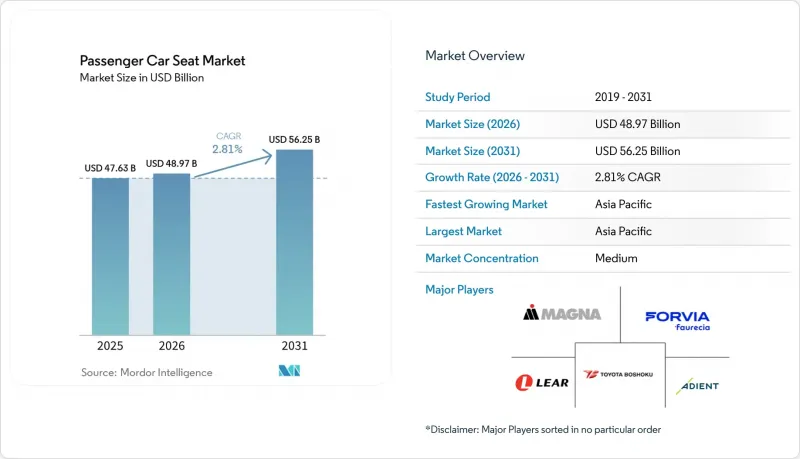
據 Mordor Intelligence 稱,2025 年乘用車座椅市值為 476.3 億美元,預計到 2031 年將達到 562.5 億美元,而 2026 年為 489.7 億美元,預測期(2026-2031 年)的複合年成長率為 2.81%。
全球乘用車座椅市場趨勢及洞察
高級舒適性和電動座椅的廣泛普及
汽車製造商正將按摩、加熱、通風和零重力傾斜功能融入其中端車型,以打造差異化的內飾,並透過軟體開發永續的收入來源。 2025年7月,安道拓(Adient)為廣汽傳祺插電式混合動力車型M8推出了一款機械按摩解決方案,該方案結合了3D揉捏功能模組、軟性安全結構和OTA升級功能,旨在降低三排座椅佈局下的乘員疲勞。 2026年1月,現代Transys發布了其“循環出行系統”,該系統採用BASF的“Elastollan”TPU材料打造模組化座椅,並透過超臨界流體發泡技術實現了可回收性和輕量化設計。在2025年上海車展上,Pholbia的「變壓器座椅」利用演算法調節功能實現了零重力姿勢,將舒適性定義為軟體定義的功能,而非固定的硬體規格。這一趨勢正在加速汽車製造商採用「座椅即服務」(Seat-as-a-Service)模式。在這種模式下,客戶每月支付一定的費用,即可透過應用程式停用按摩模式和調節力度,從而為供應商和汽車製造商創造類似退休金的收入來源。
電動車推動座椅架構的重新設計
電池式電動車(BEV) 平台無需傳動軸通道,從而實現了平坦的地板,同時,輕量化要求也變得更加重要。底置電池迫使座椅設計師重新思考車架幾何、重量分佈和溫度控管整合。麥格納的「電池到座椅」概念將電池單元直接整合到座椅結構中,使座艙容積增加高達 20%,並提高了碰撞時的能量吸收能力。 Pholbia 在泰國新建的工廠專門用於生產輕量化車架和整合式電子元件,以滿足該地區電動車的出口需求。這些趨勢凸顯了供應商如何策略性地重新分配產能,以配合 OEM 的電氣化策略。該工廠專注於先進輕量化材料和整合電子系統,顯示創新和效率對於滿足不斷變化的電動車市場需求的重要性日益凸顯。
先進系統的高成本和重量
將按摩功能、乘員監控和自適應安全功能整合到座椅結構中,會使每套座椅的成本增加 200 至 500 美元,這使得在材料清單(BOM) 目標受到嚴格控制的大規模生產領域,這些先進功能的應用變得困難。安道拓 (Adient) 的 ModuGo 平台可使組裝效率提高 36.3%,生產線長度縮短 72%,但初始模具投資和設計複雜性限制了其應用,使其僅適用於投資回收期長達數年的大規模生產項目。在慕尼黑舉行的 2025 年汽車座椅創新大會上,與會者指出,採用生物基泡沫、純素飾面和回收框架的全永續座椅,其成本是傳統設計的四到五倍,這給目標價格低於 3 萬美元的原始設備製造商 (OEM) 構成了障礙。電動座椅機構會使每套座椅增加 8 至 12 公斤的重量,預計將導致電動車續航里程減少 0.5% 至 1.0%。為了抵消這種影響,供應商被迫投資研發輕量化致動器和碳纖維複合材料框架。
細分市場分析
到2025年,標準座椅將佔據乘用車座椅市場65.18%的佔有率,這主要得益於其價格實惠且易於維修。標準座椅在成本敏感地區、公共交通車輛採購以及基本調整功能即可滿足需求的入門車型中仍佔據主導地位。大規模生產將單位成本降至最低,而諸如更輕的框架和更薄的泡沫襯墊等持續改進措施,即使在原料價格波動的情況下也能維持利潤率。此外,標準設計支援模組化升級,使原始設備製造商(OEM)無需徹底重新設計即可整合加熱器、坐墊和感測器等功能。
預計2026年至2031年間,電動座椅的複合年成長率將達到4.54%,其記憶功能、腰部按摩和快速加熱等特性顯著提升了車內功能。精簡的馬達組件和整合式電控系統降低了成本,使其應用範圍擴展到豪華車以外的領域。隨著軟體驅動架構的不斷發展,電動模組將預先安裝韌體,並透過未來的升級提升其使用壽命價值。這使得電動座椅有望在2030年後縮小與傳統座椅的銷售差距,尤其是在SUV領域,其價值與更高的價格相符。
到2025年,凹背單人座椅將佔據乘用車座椅市場60.21%的佔有率,這得益於其符合人體工學的造型、側向支撐以及與整合式安全氣囊的兼容性。這些設計融合了透氣坐墊、主動式側翼支撐和生物識別感測器,最大限度地減少了對車輛平台的干擾。雖然這些功能主要應用於跑車和高性能車輛,但為了提升乘坐舒適性和品牌形象,它們正被推廣到主流跨界車型。整合式通風口可減少坐墊內的水分,滿足舒適性和衛生要求。
預計在預測期(2026-2031年)內,凹背單人座椅市場將以4.79%的複合年成長率成長,這主要得益於汽車製造商(OEM)對提升乘客健康舒適度以減少通勤疲勞的重視。在新興市場,長條座椅在商用貨車和小型轎車中仍然佔據主導地位,其主要考慮因素是乘客容量和成本效益。混合式設計在長條座椅的三分之二處採用雕塑般的輪廓造型,兼具多功能性和人體工學,同時以經濟實惠的價格滿足家庭用車的需求。
區域分析
到2025年,亞太地區將佔據乘用車座椅市場48.42%的佔有率,預計2026年至2031年將以3.37%的複合年成長率成長。中國對電動車的重視推動了對輕量化、軟體控制座椅的需求。東南亞各國政府正透過稅收優惠和免稅出口通道吸引外資。福威亞在泰國的工廠體現了該地區作為生產和創新中心的地位。日本一級供應商正利用區域貿易協定免稅運輸鋁製框架,在商品價格波動的情況下保持成本競爭力。
在北美,供應商利用高昂的交易價格,將座椅生物識別監控等高階功能融入產品中。潛在的金屬關稅限制造成了成本的不確定性,促使供應商實現零件本地化在地採購並拓展其沖壓成型合作夥伴。美國日益嚴格的安全法規,包括後座安全帶提醒功能,正在加速安全帶扣狀態感測器和兒童存在檢測演算法的普及。這些要求增加了每個座椅所需的電子元件數量,使擁有內建軟體專業知識的供應商更具優勢。
在歐洲,隨著強制性生命週期評估和再生材料使用標準的訂定,對永續性的關注度日益提高,合成皮革的使用率也隨之上升。德國和瑞典的豪華汽車製造商在自動駕駛汽車內部空間相關法規訂定之前,就已推出了旋轉座椅和躺椅等配置,預計未來會有更多此類配置得到應用。歐盟對淨零排放供應鏈的津貼正在支持先導計畫旨在將座椅泡棉回收製成無黏合劑的隔音墊,從而推動循環經濟目標的實現。在中東、非洲和南美等新興市場,當地的組裝廠正在擴張,雖然目前經濟實惠的標準座椅需求旺盛,但隨著可支配收入的成長,電動調節座椅的需求預計將會上升。
其他好處:
- Excel格式的市場預測(ME)表
- 3個月的分析師支持
目錄
第1章:引言
- 研究假設和市場定義
- 調查範圍
第2章:調查方法
第3章執行摘要
第4章 市場狀況
- 市場概覽
- 市場促進因素
- 高級舒適性和電動座椅的廣泛普及
- 電動車時代背景下的座椅架構重新設計
- 一種配備感測器的床單,用於監測健康狀況。
- 安全氣囊和安全帶安全法規的整合
- 對永續/純素家具的需求
- 透過OTA按需功能實現獲利
- 市場限制因素
- 先進座椅系統的高成本和重量
- 原物料價格波動
- 與連網座椅相關的網路安全和隱私風險
- 由於耐久性提高,更換週期延長
- 價值供應鏈分析
- 監理情勢
- 技術展望
- 波特五力分析
第5章 市場規模、成長預測與數量(單位)
- 透過技術
- 標準座位
- 電動座椅
- 依座位類型
- 凹背單人座椅
- 長椅
- 按類型分類的裝飾材料
- 織物
- 真皮
- 合成皮革
- 按組件
- 扶手
- 座椅框架和結構
- 躺椅
- 氣壓系統
- 頭枕
- 座椅導軌
- 安全帶
- 高度調整裝置
- 側邊氣囊/簾式氣囊
- 其他
- 依推進類型
- 內燃機
- 電池式電動車(BEV)
- 混合動力電動車(HEV)
- 插電式混合動力車(PHEV)
- 燃料電池電動車(FCEV)
- 車輛類型
- 掀背車
- 轎車
- 運動型多用途車(SUV)
- 多用途汽車(MPV)
- 按地區
- 北美洲
- 美國
- 加拿大
- 其他北美國家
- 南美洲
- 巴西
- 阿根廷
- 其他南美國家
- 歐洲
- 英國
- 德國
- 法國
- 義大利
- 西班牙
- 其他歐洲國家
- 亞太地區
- 中國
- 印度
- 日本
- 韓國
- 其他亞太國家
- 中東和非洲
- 阿拉伯聯合大公國
- 沙烏地阿拉伯
- 土耳其
- 埃及
- 南非
- 其他中東和非洲國家
- 北美洲
第6章 競爭情勢
- 市場集中度
- 策略趨勢
- 市佔率分析
- 公司簡介
- Adient plc
- Toyota Boshoku
- NHK Spring
- Grammer AG
- Brose Group
- Martur Fompak
- Lear Corporation
- Magna International
- Hyundai Transys
- Tachi-S
- Continental AG
- Katzkin Leather
- Fisher and Company
- Faurecia(FORVIA)
- TS Tech
- AISIN Corporation
- Ningbo Jifeng
第7章 市場機會與未來展望
According to Mordor Intelligence, the passenger car seat market size was valued at USD 47.63 billion in 2025 and is estimated to grow from USD 48.97 billion in 2026 to reach USD 56.25 billion by 2031, at a CAGR of 2.81% during the forecast period (2026-2031).
Global Passenger Car Seat Market Trends and Insights
Premium Comfort and Powered-Seat Adoption
Automakers are embedding massage, heating, ventilation, and zero-gravity recline into mid-tier models to differentiate interiors and unlock recurring software revenue. Adient launched a mechanical massage solution in July 2025 for GAC-Trumpchi's PHEV M8, combining 3D kneading modules with flexible safety structures and OTA update capability, targeting fatigue relief in three-row configurations. Hyundai Transys unveiled its Circular Mobility System in January 2026, featuring modular seats with BASF Elastollan TPU that enable recyclability and supercritical-fluid foaming for weight reduction. FORVIA's Transformer Seat, showcased at Auto Shanghai 2025, uses algorithm-driven adjustments to create zero-gravity postures, positioning comfort as a software-defined feature rather than a fixed hardware specification. This trend is accelerating OEM adoption of seat-as-a-service models, where buyers pay monthly fees to unlock massage modes or adjust firmness via an app, creating annuity-like revenue streams for suppliers and automakers.
EV-Driven Seat-Architecture Redesign
Battery electric platforms eliminate the need for transmission tunnels, provide flat floors, and place greater emphasis on weight reduction requirements. Battery packaging beneath the floor is forcing seat designers to rethink frame geometry, weight distribution, and thermal integration. Magna's Cell-to-Seat concept integrates battery cells directly into the seat structure, freeing up to 20% more cabin volume and improving crash-energy absorption. FORVIA's newly established manufacturing facility in Thailand has been specifically designed to produce lightweight frames and integrated electronics intended for regional electric vehicle exports. These developments highlight how suppliers are strategically repositioning their production capacities to align with the electrification strategies outlined by original equipment manufacturers (OEMs).The facility's focus on advanced lightweight materials and embedded electronic systems underscores the growing importance of innovation and efficiency in meeting the evolving demands of the electric vehicle market.
High Cost and Weight of Advanced Systems
Integrating massage, occupant monitoring, and adaptive safety into seat structures adds USD 200 to USD 500 per unit, pricing advanced features out of volume segments where bill-of-materials (BOM) targets are tightly controlled. Adient's ModuGo platform claims a 36.3% assembly-efficiency gain and 72% reduction in production-line length, yet the upfront tooling investment and engineering complexity limit adoption to high-volume programs with multi-year amortization horizons. The Automotive Seating Innovation 2025 conference in Munich highlighted that fully sustainable seats-using bio-based foams, vegan trim, and recycled frames-currently cost 4 to 5 times more than conventional designs, creating a barrier for OEMs targeting sub-USD 30,000 price points. Powered-seat mechanisms add 8 to 12 kilograms per unit, eroding EV range by an estimated 0.5% to 1.0% and forcing suppliers to invest in lightweight actuators and carbon-composite frames to offset the penalty.
Other drivers and restraints analyzed in the detailed report include:
- Health-Monitoring Sensor Seats
- Safety-Regulation Integration of Airbags and Seat Belts
- Raw-Material Price Volatility
For complete list of drivers and restraints, kindly check the Table Of Contents.
Segment Analysis
In 2025, standard seats accounted for 65.18% of the passenger car seat market, driven by affordability and ease of repair. Their prominence persists in cost-sensitive regions, public fleet acquisitions, and entry-level trims, where basic adjustability meets functional requirements. Large-scale manufacturing minimizes unit costs, while ongoing improvements, such as lighter frames and thinner foam pads, maintain profit margins despite commodity price fluctuations. Standard designs also support modular upgrades, enabling OEMs to incorporate features like heaters, cushions, or sensors without requiring a complete redesign.
Powered seats, with a 4.54% CAGR during 2026-2031, enhance cabin functionality through memory profiles, lumbar massage, and rapid warming. Streamlined motor assemblies and integrated electronic control units reduce costs, facilitating adoption beyond luxury segments. As software-driven architectures advance, powered modules are shipped firmware-ready, allowing future upgrades that increase lifetime value. This positions powered seats to narrow the volume gap post-2030, particularly in SUVs, where their value aligns with higher price points.
In 2025, bucket seat configurations accounted for 60.21% of the passenger car seat market share due to their ergonomic contouring, lateral support, and compatibility with integrated airbags. These designs incorporate ventilated cushions, active bolsters, and biometric sensors with minimal platform intrusion. Sports and performance vehicles primarily utilize these features, while mainstream crossovers increasingly adopt them to improve ride quality and brand perception. Integrated air vents reduce cushion humidity, addressing comfort and hygiene requirements.
The bucket seats segment is projected to grow at a 4.79% CAGR during the forecast period (2026-2031), driven by OEMs focusing on wellness features to mitigate fatigue during commutes. Bench seats remain prevalent in commercial vans and compact cars in emerging markets, prioritizing passenger capacity and cost efficiency. Hybrid designs with sculpted contours on two-thirds of a bench combine versatility and ergonomics, catering to family vehicles while maintaining affordability.
Complete Report Scope:
- By Technology
- Standard Seats
- Powered Seats
- By Seat Type
- Bucket Seats
- Bench Seats
- By Trim Material
- Fabric
- Genuine Leather
- Synthetic Leather
- By Component
- Armrest
- Seat Frame and Structure
- Recliner
- Pneumatic System
- Headrest
- Seat Track
- Seat Belt
- Height Adjuster
- Side/Curtain Airbag
- Others
- By Propulsion Type
- Internal Combustion Engine
- Battery Electric Vehicle (BEV)
- Hybrid Electric Vehicle (HEV)
- Plug-In Hybrid Electric Vehicle (PHEV)
- Fuel Cell Electric Vehicle (FCEV)
- By Vehicle Type
- Hatchbacks
- Sedans
- Sport-Utility Vehicles (SUVs)
- Multi-Purpose Vehicles (MPVs)
- By Geography
- North America
- United States
- Canada
- Rest of North America
- South America
- Brazil
- Argentina
- Rest of South America
- Europe
- United Kingdom
- Germany
- France
- Italy
- Spain
- Rest of Europe
- Asia-Pacific
- China
- India
- Japan
- South Korea
- Rest of Asia-Pacific
- Middle East and Africa
- United Arab Emirates
- Saudi Arabia
- Turkey
- Egypt
- South Africa
- Rest of Middle East and Africa
- North America
Geography Analysis
In 2025, the Asia-Pacific region accounted for 48.42% of the passenger car seat market share and is projected to grow at a 3.37% CAGR from 2026 to 2031. China's focus on electric vehicles is driving demand for lightweight, software-enabled seating. Southeast Asian governments are attracting foreign investments through tax incentives and tariff-free export corridors. FORVIA's Thailand facility highlights the region's role as a production and innovation center. Japanese tier-one suppliers utilize regional trade agreements to transport aluminum frames tariff-free, maintaining cost competitiveness despite fluctuating commodity prices.
North America benefits from high transaction prices to incorporate premium features like seat-based biometric monitoring. Potential tariff regulations on metals create cost uncertainties, prompting suppliers to localize content and diversify stamping partnerships. Stricter U.S. safety regulations, including rear-seat belt reminders, are accelerating the adoption of buckle-status sensors and child-presence detection algorithms. These requirements increase electronics content per seat and favor suppliers with embedded software expertise.
Europe focuses on sustainability by enforcing life-cycle assessments and recycled-material thresholds, boosting synthetic leather adoption. Premium OEMs in Germany and Sweden are introducing swivel and lounge seat configurations, anticipating broader adoption with regulatory clarity on autonomous interiors. EU grants for net-zero supply chains support pilot projects recycling seat foam into binder-free acoustic pads, advancing circular economy goals. Emerging markets in the Middle East, Africa, and South America are expanding local assembly plants, currently demanding cost-effective standard seats but showing potential for powered variants as disposable incomes rise.
- Adient plc
- Toyota Boshoku
- NHK Spring
- Grammer AG
- Brose Group
- Martur Fompak
- Lear Corporation
- Magna International
- Hyundai Transys
- Tachi-S
- Continental AG
- Katzkin Leather
- Fisher and Company
- Faurecia (FORVIA)
- TS Tech
- AISIN Corporation
- Ningbo Jifeng
Additional Benefits:
- The market estimate (ME) sheet in Excel format
- 3 months of analyst support
TABLE OF CONTENTS
1 Introduction
- 1.1 Study Assumptions and Market Definition
- 1.2 Scope of the Study
2 Research Methodology
3 Executive Summary
4 Market Landscape
- 4.1 Market Overview
- 4.2 Market Drivers
- 4.2.1 Premium Comfort and Powered-Seat Adoption
- 4.2.2 EV-Driven Seat Architecture Redesign
- 4.2.3 Health-Monitoring Sensor Seats
- 4.2.4 Safety-Regulation Integration of Airbags and Seat-Belts
- 4.2.5 Sustainable/Vegan Upholstery Demand
- 4.2.6 OTA Feature-on-Demand Monetization
- 4.3 Market Restraints
- 4.3.1 High Cost and Weight of Advanced Seat Systems
- 4.3.2 Raw-Material Price Volatility
- 4.3.3 Cyber-Security and Privacy Risks from Connected Seats
- 4.3.4 Longer Replacement Cycles from Durability Gains
- 4.4 Value/Supply-Chain Analysis
- 4.5 Regulatory Landscape
- 4.6 Technological Outlook
- 4.7 Porter's Five Forces Analysis
- 4.7.1 Threat of New Entrants
- 4.7.2 Bargaining Power of Suppliers
- 4.7.3 Bargaining Power of Buyers
- 4.7.4 Threat of Substitutes
- 4.7.5 Intensity of Competitive Rivalry
5 Market Size and Growth Forecasts (Value (USD)) and Volume in Units
- 5.1 By Technology
- 5.1.1 Standard Seats
- 5.1.2 Powered Seats
- 5.2 By Seat Type
- 5.2.1 Bucket Seats
- 5.2.2 Bench Seats
- 5.3 By Trim Material
- 5.3.1 Fabric
- 5.3.2 Genuine Leather
- 5.3.3 Synthetic Leather
- 5.4 By Component
- 5.4.1 Armrest
- 5.4.2 Seat Frame and Structure
- 5.4.3 Recliner
- 5.4.4 Pneumatic System
- 5.4.5 Headrest
- 5.4.6 Seat Track
- 5.4.7 Seat Belt
- 5.4.8 Height Adjuster
- 5.4.9 Side/Curtain Airbag
- 5.4.10 Others
- 5.5 By Propulsion Type
- 5.5.1 Internal Combustion Engine
- 5.5.2 Battery Electric Vehicle (BEV)
- 5.5.3 Hybrid Electric Vehicle (HEV)
- 5.5.4 Plug-In Hybrid Electric Vehicle (PHEV)
- 5.5.5 Fuel Cell Electric Vehicle (FCEV)
- 5.6 By Vehicle Type
- 5.6.1 Hatchbacks
- 5.6.2 Sedans
- 5.6.3 Sport-Utility Vehicles (SUVs)
- 5.6.4 Multi-Purpose Vehicles (MPVs)
- 5.7 By Geography
- 5.7.1 North America
- 5.7.1.1 United States
- 5.7.1.2 Canada
- 5.7.1.3 Rest of North America
- 5.7.2 South America
- 5.7.2.1 Brazil
- 5.7.2.2 Argentina
- 5.7.2.3 Rest of South America
- 5.7.3 Europe
- 5.7.3.1 United Kingdom
- 5.7.3.2 Germany
- 5.7.3.3 France
- 5.7.3.4 Italy
- 5.7.3.5 Spain
- 5.7.3.6 Rest of Europe
- 5.7.4 Asia-Pacific
- 5.7.4.1 China
- 5.7.4.2 India
- 5.7.4.3 Japan
- 5.7.4.4 South Korea
- 5.7.4.5 Rest of Asia-Pacific
- 5.7.5 Middle East and Africa
- 5.7.5.1 United Arab Emirates
- 5.7.5.2 Saudi Arabia
- 5.7.5.3 Turkey
- 5.7.5.4 Egypt
- 5.7.5.5 South Africa
- 5.7.5.6 Rest of Middle East and Africa
- 5.7.1 North America
6 Competitive Landscape
- 6.1 Market Concentration
- 6.2 Strategic Moves
- 6.3 Market Share Analysis
- 6.4 Company Profiles (Includes Global level Overview, Market level overview, Core Segments, Financials as available, Strategic Information, Market Rank/Share for key companies, Products and Services, and Recent Developments)
- 6.4.1 Adient plc
- 6.4.2 Toyota Boshoku
- 6.4.3 NHK Spring
- 6.4.4 Grammer AG
- 6.4.5 Brose Group
- 6.4.6 Martur Fompak
- 6.4.7 Lear Corporation
- 6.4.8 Magna International
- 6.4.9 Hyundai Transys
- 6.4.10 Tachi-S
- 6.4.11 Continental AG
- 6.4.12 Katzkin Leather
- 6.4.13 Fisher and Company
- 6.4.14 Faurecia (FORVIA)
- 6.4.15 TS Tech
- 6.4.16 AISIN Corporation
- 6.4.17 Ningbo Jifeng
7 Market Opportunities and Future Outlook
- 7.1 White-space and Unmet-need Assessment

 自行車寵物座椅市場規模、佔有率和成長分析:按產品類型、材料、寵物類型、自行車類型、分銷管道、最終用戶和地區分類-2026-2033年產業預測
 2026 年至 2035 年乘用車座椅的市場機會、成長要素、產業趨勢與預測。
 汽車座椅套市場:按類型、材料、座椅配置、車輛類型、最終用戶和分銷管道分類-2026-2032年全球市場預測
 座椅套市場分析及預測(至2035年):類型、產品、技術、應用、材料類型、最終用戶、功能、安裝方式
 2026年全球乘用車座椅市場報告寵物汽車座椅市場按產品類型、通路、價格範圍、車輛類型、寵物體型、材料類型和安裝方式分類-2026-2032年全球預測
 全球汽車運動座椅市場:依座椅類型、材質、車型、安裝方式、銷售通路、價格區間和最終用戶劃分(至2035年)
 北美汽車座椅套材料市場規模及預測(2021-2031年)、區域佔有率、趨勢和成長機會分析報告涵蓋範圍:按材料、車輛類型和國家分類
 2030 年乘用車座椅市場預測:按類型、組件、材料、車輛、技術和地區進行的全球分析