


 |
市場調查報告書
商品編碼
2154219
印度殺菌劑市場:市場佔有率分析、產業趨勢與統計及成長預測(2026-2031)India Fungicide - Market Share Analysis, Industry Trends & Statistics, Growth Forecasts (2026 - 2031) |
||||||

※ 本網頁內容可能與最新版本有所差異。詳細情況請與我們聯繫。
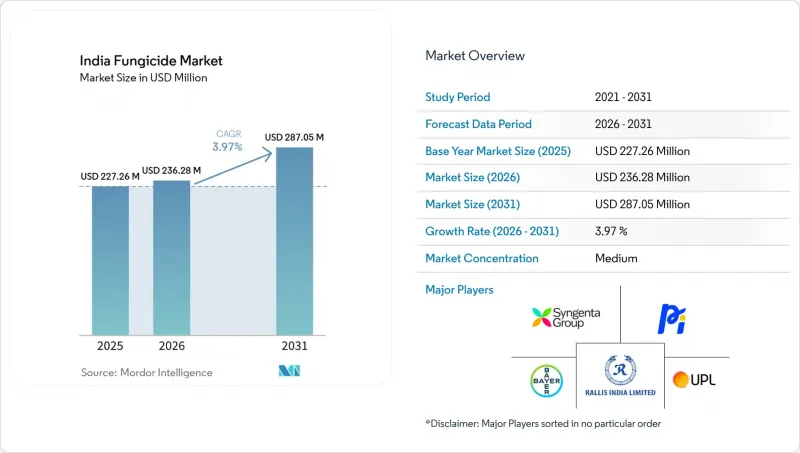
據 Mordor Intelligence 稱,2025 年印度殺菌劑市值為 2.2726 億美元,預計將從 2026 年的 2.3628 億美元成長到 2031 年的 2.8705 億美元,2026 年至 2031 年的複合年成長率為 3.97%。
印度殺菌劑市場趨勢及洞察
氣候誘發真菌病的威脅
由於印度各地生長條件各異,不同地區的作物都面臨多種真菌病害的威脅。稻瘟病主要影響東部和南部產區,而小麥銹病則是北部農業區的主要問題。在馬哈拉斯特拉邦的葡萄種植區,霜霉病需要反覆防治。預計2025-2026年度園藝作物產量將達到3.709億噸,高於2024-2025年度的3.707億噸,凸顯了作物生產規模龐大且生長條件波動的影響。隨著氣溫、濕度和降雨量的波動日益加劇,病害爆發模式也在發生變化,可能擴大對以往風險較低的作物和地區的威脅。因此,印度殺菌劑市場對能夠在一個種植週期內應對多種病原體風險的複配製劑的需求日益成長。
擴大已註冊品牌殺菌劑製劑的使用
隨著分銷網路在主要農業邦的擴張,已註冊並標籤檢視的殺菌劑製劑的重要性日益凸顯。農民對產品品質、劑量一致性和作物特定建議的認知不斷提高,從而減少了對無品牌和本地配方產品的依賴。發表於《當代國際研究檔案》(Archives of Current Research International)的一項針對古吉拉突邦180名孜然種植戶的2025年調查顯示,品牌形象、農業服務中心的推薦以及產品性能是影響殺菌劑購買決策的關鍵因素。田間示範和農民互動透過提高農民對病害識別和合理使用殺菌劑的認知,進一步促進了產品的普及。這種轉變有利於那些能夠提供穩定產品品質、農業指導和可靠分銷網路的成熟生產商。因此,印度殺菌劑市場,尤其是在商業性種植集中的作物種植區,正日益受益於消費者向已註冊品牌製劑的轉變。
細分市場分析
預計到2025年,葉面噴布將佔印度殺菌劑市場60.4%的佔有率,並在2026年至2031年間以4.1%的複合年成長率成長。由於葉面噴灑可以直接覆蓋樹冠,因此仍然是水稻、小麥、葡萄和蔬菜等主要作物的主要病害防治技術。精準噴灑技術(包括農業無人機)的引進,也有助於提高人手不足和農田作業受限地區的噴灑效率。
種子處理對於豆類和油籽作物日益重要,因為殺菌劑處理可以保護種子和新發芽的幼苗免受土壤傳播和種子傳播病害的侵害。 2026年8月,印度種子註冊委員會批准了印度種子有限公司(Seedlings India Private Limited)的「Fluxapyroxad 333 g/L FS」用於高粱、大豆、棉花、花生和馬鈴薯,從而促進了印度註冊種子處理解決方案的推廣。化學灌溉主要應用於馬哈拉斯特拉邦的滴灌石榴園和喜馬偕爾邦的蔬菜農場,在這些成本高昂的種植系統中,精準施藥最大限度地減少了活性成分的浪費。燻蒸則主要應用於蘑菇溫室和育苗設施。在德干高原的集約化蔬菜種植區,土壤處理的作用雖然不大,但不斷擴大。
其他好處:
- Excel格式的市場預測(ME)表
- 3個月的分析師支持
目錄
第1章:引言
- 研究假設和市場定義
- 調查範圍
第2章:調查方法
第3章執行摘要
第4章 市場狀況
- 市場概覽
- 市場促進因素
- 氣候變遷導致真菌病害爆發的壓力
- 擴大註冊品牌消毒劑配方的使用範圍
- 高附加價值園藝作物和出口作物的成長
- 擴大預防性消毒方案的實施範圍
- 利用無人機進行噴灑,並縮短最佳噴灑時間。
- 本地配方和生產出口產品具有成本優勢。
- 市場限制因素
- 對唑類藥物和特異性殺菌劑的抗藥性
- 遵守殘留標準和產品註冊的負擔。
- 小規模農戶的現金流以及天氣造成的採購量波動。
- 假冒仿冒品產品和未註冊產品的流出
- 監理情勢
- 技術展望
- 波特五力分析
第5章 市場規模與成長預測
- 透過應用方法
- 化學
- 葉片表面
- 燻蒸
- 種子處理
- 土壤處理
- 按作物類型
- 經濟作物
- 水果和蔬菜
- 穀物和穀類
- 豆類和油籽
- 草坪和觀賞植物
第6章 競爭情勢
- 市場集中度
- 策略趨勢
- 市佔率分析
- 公司簡介
- BASF SE
- Bayer AG
- Bharat Certis AgriScience Ltd.(Mitsui & Co., Ltd.)
- Best Agrolife Limited
- Corteva Agriscience
- Dhanuka Agritech Limited
- FMC Corporation
- Gharda Chemicals Limited
- Godrej Agrovet Limited
- Indofil Industries Limited
- PI Industries Limited
- Rallis India Limited(Tata Chemicals Limited)
- Sumitomo Chemical Co., Ltd.
- Syngenta Group
- UPL Limited
第7章 作物保護化學品產業執行長面臨的關鍵策略挑戰
According to Mordor Intelligence, the India fungicide market size was valued at USD 227.26 million in 2025 and is forecast to grow from USD 236.28 million in 2026 to USD 287.05 million by 2031, at a CAGR of 3.97% from 2026 to 2031.
India Fungicide Market Trends and Insights
Climate-Driven Fungal Disease Pressure
India's diverse growing conditions expose crops to several fungal diseases across regions. Rice blast affects eastern and southern production areas, while wheat rust remains a concern in northern farming belts. Downy mildew creates recurring disease-management needs in Maharashtra's grape-growing areas. Horticulture output reached 370.9 million metric tons in 2025-26, compared with 370.7 million metric tons in 2024-25, highlighting the scale of crop production exposed to variable growing conditions. Increasing variability in temperature, humidity, and rainfall can alter disease development and expand disease pressure into crops or regions that previously faced lower risk. As a result, the India fungicide market sees demand for combination products that address more than one pathogen risk within a crop cycle.
Growing Adoption of Registered and Branded Fungicide Formulations
Registered and labeled fungicide formulations are gaining relevance as dealer networks deepen across key agricultural states. Increasing farmer awareness of product quality, dosage consistency, and crop-specific recommendations is reducing reliance on unbranded or locally blended products. A 2025 study published in Archives of Current Research International, covering 180 cumin farmers in Gujarat, identified brand image, agro-service-center recommendations, and product performance as key factors influencing fungicide purchase decisions. Field demonstrations and farmer engagement further support adoption by improving awareness of disease identification and appropriate fungicide use. This shift favors established manufacturers that can provide consistent product quality alongside agronomic guidance and reliable distribution. As a result, the India fungicide market is increasingly supported by the transition toward registered, branded formulations, particularly in commercially intensive crop-growing regions.
Other drivers and restraints analyzed in the detailed report include:
- Growth of High-Value Horticulture and Export Crops
- Increasing Adoption of Preventive Fungicide Programs
- Resistance to Azoles and Site-Specific Fungicides
- Residue Compliance and Product Registration Burden
For complete list of drivers and restraints, kindly check the Table Of Contents.
Segment Analysis
Foliar application accounted for 60.4% of the India fungicide market share in 2025 and is forecast to grow at a CAGR of 4.1% from 2026 to 2031. This application mode remains the primary disease-management method across major crops, including rice, wheat, grapes, and vegetables, due to its ability to provide direct canopy coverage. The adoption of precision spraying technologies, including agricultural drones, is also improving application efficiency in regions facing labor shortages and field-access constraints.
Seed treatment is gaining importance in pulses and oilseeds, where fungicidal treatment can protect seeds and emerging plants from soil- and seed-borne diseases. In August 2026, the Registration Committee approved Fluxapyroxad 333 g/L FS from Seedlings India Private Limited for use across sorghum, soybean, cotton, groundnut, and potato, supporting the expansion of registered seed-treatment solutions in India. Chemigation remains concentrated in drip-irrigated pomegranate orchards in Maharashtra and vegetable farms in Himachal Pradesh, where precision delivery can limit active-ingredient waste in these higher-spending crop systems. Fumigation remains concentrated in mushroom houses and nursery operations. Soil treatment has a smaller but growing role in intensive vegetable areas of the Deccan plateau.
Complete Report Scope:
- By Application Mode
- Chemigation
- Foliar
- Fumigation
- Seed Treatment
- Soil Treatment
- By Crop Type
- Commercial Crops
- Fruits and Vegetables
- Grains and Cereals
- Pulses and Oilseeds
- Turf and Ornamental
List of Companies Covered in this Report:
- BASF SE
- Bayer AG
- Bharat Certis AgriScience Ltd. (Mitsui & Co., Ltd.)
- Best Agrolife Limited
- Corteva Agriscience
- Dhanuka Agritech Limited
- FMC Corporation
- Gharda Chemicals Limited
- Godrej Agrovet Limited
- Indofil Industries Limited
- PI Industries Limited
- Rallis India Limited (Tata Chemicals Limited)
- Sumitomo Chemical Co., Ltd.
- Syngenta Group
- UPL Limited
Additional Benefits:
- The market estimate (ME) sheet in Excel format
- 3 months of analyst support
TABLE OF CONTENTS
1 INTRODUCTION
- 1.1 Study Assumptions and Market Definition
- 1.2 Scope of the Study
2 RESEARCH METHODOLOGY
3 EXECUTIVE SUMMARY
4 MARKET LANDSCAPE
- 4.1 Market Overview
- 4.2 Market Drivers
- 4.2.1 Climate-Driven Fungal Disease Pressure
- 4.2.2 Growing adoption of registered and branded fungicide formulations
- 4.2.3 Growth of High-Value Horticulture and Export Crops
- 4.2.4 Increasing adoption of preventive fungicide programs
- 4.2.5 Drone Spraying and Application-Window Compression
- 4.2.6 Local formulation and export manufacturing economies
- 4.3 Market Restraints
- 4.3.1 Resistance to Azoles and Site-Specific Fungicides
- 4.3.2 Residue Compliance and Product Registration Burden
- 4.3.3 Smallholder Cash-Flow and Weather-Linked Purchase Volatility
- 4.3.4 Counterfeit and Unregistered Product Leakage
- 4.4 Regulatory Landscape
- 4.5 Technological Outlook
- 4.6 Porter's Five Forces Analysis
- 4.6.1 Threat of New Entrants
- 4.6.2 Bargaining Power of Suppliers
- 4.6.3 Bargaining Power of Buyers
- 4.6.4 Threat of Substitutes
- 4.6.5 Competitive Rivalry
5 MARKET SIZE AND GROWTH FORECASTS (VALUE AND VOLUME)
- 5.1 By Application Mode
- 5.1.1 Chemigation
- 5.1.2 Foliar
- 5.1.3 Fumigation
- 5.1.4 Seed Treatment
- 5.1.5 Soil Treatment
- 5.2 By Crop Type
- 5.2.1 Commercial Crops
- 5.2.2 Fruits and Vegetables
- 5.2.3 Grains and Cereals
- 5.2.4 Pulses and Oilseeds
- 5.2.5 Turf and Ornamental
6 COMPETITIVE LANDSCAPE
- 6.1 Market Concentration
- 6.2 Strategic Moves
- 6.3 Market Share Analysis
- 6.4 Company Profiles (Includes Global Level Overview, Market Level Overview, Core Segments, Financials as Available, Strategic Information, Market Rank/Share, Products and Services, Recent Developments)
- 6.4.1 BASF SE
- 6.4.2 Bayer AG
- 6.4.3 Bharat Certis AgriScience Ltd. (Mitsui & Co., Ltd.)
- 6.4.4 Best Agrolife Limited
- 6.4.5 Corteva Agriscience
- 6.4.6 Dhanuka Agritech Limited
- 6.4.7 FMC Corporation
- 6.4.8 Gharda Chemicals Limited
- 6.4.9 Godrej Agrovet Limited
- 6.4.10 Indofil Industries Limited
- 6.4.11 PI Industries Limited
- 6.4.12 Rallis India Limited (Tata Chemicals Limited)
- 6.4.13 Sumitomo Chemical Co., Ltd.
- 6.4.14 Syngenta Group
- 6.4.15 UPL Limited
7 KEY STRATEGIC QUESTIONS FOR CROP PROTECTION CHEMICALS CEOS

 2026-2030年全球Bactesid市場
 有機溴化殺菌劑市場:全球市場預測(2026-2032年)
 殺菌劑市場報告:趨勢、預測與競爭分析(至2035年)
 2026 年至 2035 年殺菌劑活性成分市場的商業機會、成長要素、產業趨勢分析與預測。
 雙向殺菌劑市場規模、佔有率和成長分析:按活性成分、製劑形式、施用方法、作物類型、目標病害、分銷管道和地區分類-2026-2033年產業預測氯化亞銅市場:2026-2032年全球市場預測(依應用、形態、通路、純度及生產流程分類)農業殺菌劑市場:依配方、作物類型、有效成分、應用和通路管道分類-2026-2032年全球預測殺菌劑市場:依產品類型、劑型、應用、終端用戶產業及通路分類-2026-2032年全球預測溴基殺菌劑市場按用途、化合物類型、物理形態、應用方法和最終用戶分類,全球預測(2026-2032年)
 2026年全球三唑類殺菌劑市場報告