


 |
市場調查報告書
商品編碼
2154210
聚合物輔料:市場佔有率分析、產業趨勢與統計、成長預測(2026-2031)Polymer Excipients - Market Share Analysis, Industry Trends & Statistics, Growth Forecasts (2026 - 2031) |
||||||

※ 本網頁內容可能與最新版本有所差異。詳細情況請與我們聯繫。
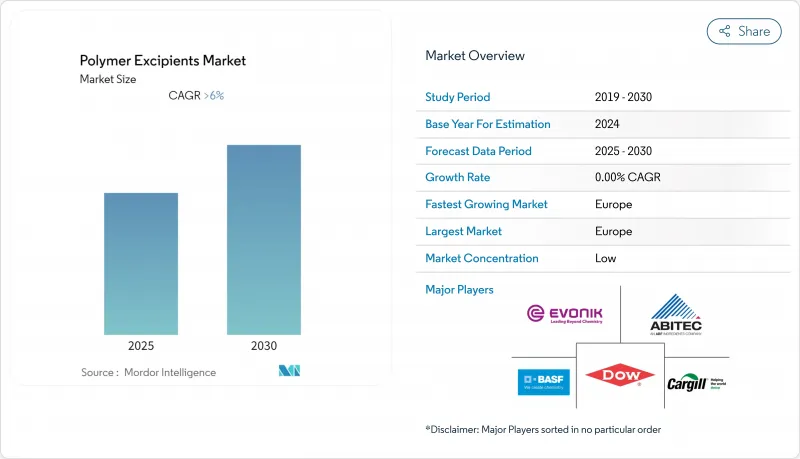
據 Mordor Intelligence 稱,2025 年聚合物輔料市場規模為 476.67 千噸,但預計將從 2026 年的 495.02 千噸成長到 2031 年的 606.92 千噸,預測期(2026-2031 年)的複合年成長率為 4.16%。
全球聚合物輔料市場趨勢及洞察
擴大學名藥和複方藥物的生產
學名藥的生產正在推動聚合物輔料市場的需求。印度和中國仍然是主要的製造地,因為兩國擁有眾多製藥企業,為國內和出口市場供應產品。在中國,「健康中國2030」框架正在推動從學名藥轉向差異化製劑的轉變。這些製劑需要純度標準更高、功能特性更特殊的聚合物。片劑和膠囊劑佔人類用藥劑型的80%以上,並且仍然是聚合物粘合劑和包衣的主要應用領域。隨著學名藥產量的擴大,這種固態口服製劑為聚合物輔料提供了穩定的需求來源。
緩釋和標靶給藥製劑的廣泛應用
緩釋製劑正在推動聚合物輔料市場對羥丙基甲基纖維素 (HPMC) 和乙基纖維素的需求。這些聚合物可形成片劑基質,從而延長給藥間隔並定向給藥。緩釋製劑中的輔料含量可佔片劑總重量的 60% 至 70%,這增加了每個核准產品的聚合物消耗量。據贏創稱,其 EUDRAGIT 平台已被 23,000 多項專利引用,並在 80 個國家/地區得到應用。包括 HPMC 在內的纖維素衍生物在口腔黏膜吸收和高分子量化合物的緩釋製劑中用作基質形成劑。聚合物輔料市場正朝著用於緩釋和標靶給藥製劑的高規格等級產品轉型。
嚴格的監管和品質合規要求
藥用聚合物輔料必須符合藥典標準、國家監管要求和國際人用藥品註冊技術協調會 (ICH) 指南。這種多層次的合規框架對於小規模的供應商而言可能是一項營運要求。供應商必須在產品生命週期內持續進行合格認證、變更控制和聚合物特性分析。與新型材料相比,處方集美國藥典/國家處方集 (USP/NF)、歐洲藥典 (EPP) 和日本藥典 (JP) 標準的資料通常面臨的監管審查較為寬鬆。BASF已宣布,Soluplus 將於 2025 年被列入歐洲藥典,這將減輕其在歐洲申請中因新穎性而面臨的監管負擔。這些要求可能會限制聚合物輔料市場中供應商的選擇,並擴大能夠滿足多個藥典合規要求的製造商的市場地位。
細分市場分析
截至2025年,微晶纖維素(MCC)將佔據聚合物輔料市場34.74%的佔有率,預計2026年至2031年將以4.87%的複合年成長率成長。由於其完善的監管體係以及PH-101、PH-102和矽酸鹽等級的供應,MCC被廣泛應用於直接壓片製劑。一項發表於2024年的同行評審研究表明,MCC在直接壓片填充劑中具有較高的稀釋性和可壓縮性。該研究也將MCC歸類為粘合劑、崩壞、潤滑劑和穩定劑。當與羥丙甲纖維素(HPMC)和乙基纖維素聯合用於緩釋基質系統時,MCC的應用範圍正在從速釋片擴展到其他領域。
以銷量計算,羥丙基甲基纖維素(HPMC)是第二大產品類別,可用作緩釋基質形態發生劑和素食膠囊包衣材料。聚乙烯吡咯烷酮(PVP)繼續用作濕法粘合劑和無定形固體分散體中的黏合劑和增溶劑。聚乙二醇(PEG)的需求與注射劑和生物製藥的生產趨勢密切相關,因為它可用作冷凍保護劑、表面活性劑和黏度調節劑。澱粉基材料在成本敏感的市場中,可用於速釋製劑和崩壞。乙基纖維素和甲基纖維素在聚合物輔料市場中,可用於顆粒、膠囊和多單元製劑的緩釋包衣系統。
區域分析
預計到2025年,亞太地區將佔據聚合物輔料市場38.17%的佔有率,並在2031年之前以5.03%的複合年成長率成長。印度和中國透過日益重視學名藥和複雜製劑的生產,鞏固了這一市場地位。中國的「健康中國2030」計畫正在推動產品轉向高性能聚合物材料的需求。日本則為符合日本藥典品質要求的優質纖維素聚合物和特殊聚合物的需求做出了貢獻。 2026年,贏創和樋口在橫濱開設了“開放製藥實驗室”,為製劑開發人員提供EUDRAGIT平台和製劑方面的專業知識。
北美是全球第二大聚合物輔料需求地區。美國佔該地區消費量的90%以上,需求主要集中在用於複雜口服和注射製劑的特殊聚合物等級。加拿大透過其國內生產和在北美的合約研發生產(CDMO)活動做出貢獻,而墨西哥則受益於美國的學名藥生產網路。歐洲的需求受《歐洲藥典》的要求和歐洲藥品管理局(EMA)的指導方針的影響。德國是BASFKollidon和Soluplus平台以及贏創EUDRAGIT業務的創新中心,而法國則是羅蓋特兄弟(Roquette Frères)和蓋特福斯(Gatfoss)等公司的所在地。
巴西在南美洲聚合物輔料市場佔據領先地位,學名藥生產推動了對粘合劑和包衣聚合物的需求。阿根廷的需求也在成長,但外匯波動和監管差異可能更有利於本地採購或國內混合的材料。沙烏地阿拉伯和南非是中東和非洲的主要需求中心。沙烏地阿拉伯的疫苗和特藥生產能力推動了對注射級聚合物的需求,而埃及和奈及利亞正在建造製造地以滿足不斷成長的進口需求。
其他好處:
- Excel格式的市場預測(ME)表
- 3個月的分析師支持
目錄
第1章:引言
- 研究假設和市場定義
- 調查範圍
第2章:調查方法
第3章執行摘要
第4章 市場狀況
- 市場概覽
- 市場促進因素
- 擴大學名藥和複方藥物的生產
- 緩釋和標靶給藥製劑的廣泛應用
- 生物製藥、生物相似藥和長效注射劑的成長
- 對多功能和以病人為中心的輔料的需求
- 連續製造和直接成型技術的引入
- 市場限制因素
- 嚴格的監管和品質合規要求
- 特殊等級產品的高昂研發與製造成本
- 亞硝酸鹽添加劑的變化與亞硝胺形成的風險。
- 價值鏈分析
- 波特五力分析
- 技術展望
第5章 市場規模與成長預測
- 依產品類型
- 聚乙烯吡咯烷酮
- 聚乙二醇
- 澱粉
- 微晶纖維素
- 乙基纖維素和甲基纖維素
- 羥丙基甲基纖維素
- 其他產品類型
- 透過使用
- 活頁夾
- 黏度調節劑
- 塗層
- 味道
- 防腐劑
- 著色劑
- 甜味劑
- 其他用途
- 按地區
- 亞太地區
- 中國
- 印度
- 日本
- 韓國
- 東南亞國協
- 其他亞太國家
- 北美洲
- 美國
- 加拿大
- 墨西哥
- 歐洲
- 德國
- 英國
- 法國
- 義大利
- 北歐國家
- 其他歐洲國家
- 南美洲
- 巴西
- 阿根廷
- 其他南美國家
- 中東和非洲
- 沙烏地阿拉伯
- 南非
- 其他中東和非洲國家
- 亞太地區
第6章 競爭情勢
- 市場集中度
- 策略趨勢
- 市佔率和排名分析
- 公司簡介
- Ashland
- BASF
- Colorcon, Inc.
- Croda International Plc
- DFE Pharma
- Dow
- DuPont
- Evonik Industries AG
- Gattefosse SAS
- JRS PHARMA
- Lubrizol
- Merck KGaA
- Roquette Freres
- Shin-Etsu Chemical Co., Ltd.
- Wacker Chemie AG
第7章 市場機會與未來展望
According to Mordor Intelligence, the polymer excipients market size was 476.67 kilotons in 2025 and is projected to grow from 495.02 kilotons in 2026 to 606.92 kilotons by 2031, at a CAGR of 4.16% during the forecast period (2026-2031).
Global Polymer Excipients Market Trends and Insights
Expansion of Generic and Complex Drug Manufacturing
Generic and complex drug manufacturing drives demand in the polymer excipients market. India and China remain major manufacturing hubs, as their pharmaceutical producers serve domestic and export markets. In China, the Healthy China 2030 framework supports a shift from commodity generics toward differentiated formulations. These formulations require polymers with stricter purity specifications and specialized functional performance. Tablets and capsules account for more than 80% of pharmaceutical dosage forms administered to humans and remain the primary application for polymer binders and coating materials. This base of solid oral products provides the polymer excipients market with a stable source of demand as generic drug production expands.
Rising Adoption of Controlled-Release and Targeted-Delivery Formulations
Controlled-release products support demand for hydroxypropyl methylcellulose (HPMC) and ethyl cellulose in the polymer excipients market. These polymers form tablet matrices that enable extended dosing intervals and targeted drug release. The excipient content in controlled-release products can account for 60-70% of total tablet weight, increasing polymer consumption per approved product. Evonik reports that its EUDRAGIT platform is cited in more than 23,000 patents and is used across 80 countries. Cellulose derivatives, including HPMC, serve as matrix formers for the oral transmucosal and extended-release delivery of large molecules. The polymer excipients market is shifting toward higher-specification grades for controlled-release and targeted-delivery formulations.
Stringent Regulatory and Quality-Compliance Requirements
Pharmaceutical polymer excipients must comply with pharmacopeial standards, national regulatory requirements, and International Council for Harmonization (ICH) guidance. This multilayered compliance framework can create operational requirements for smaller suppliers. Suppliers must maintain qualification processes, change management, and polymer characterization throughout the product life cycle. Materials included in the United States Pharmacopeia/National Formulary (USP/NF), European Pharmacopeia, and Japanese Pharmacopeia monographs generally undergo less regulatory review than novel materials. BASF reported that Soluplus was monographed in the European Pharmacopeia in 2025, reducing its novelty-related regulatory burden in European submissions. These requirements can limit the supplier base in the polymer excipients market and increase the role of producers with multi-compendial compliance capabilities.
Other drivers and restraints analyzed in the detailed report include:
- Demand for Multifunctional and Patient-Centric Excipients
- Continuous Manufacturing and Direct-Compression Adoption
- Excipient Nitrite Variability and Nitrosamine-Formation Risk
For complete list of drivers and restraints, kindly check the Table Of Contents.
Segment Analysis
Microcrystalline cellulose (MCC) accounted for a 34.74% share of the polymer excipients market in 2025 and is projected to grow at a CAGR of 4.87% during 2026-2031. MCC is used in direct-compression formulations due to its established regulatory profile and availability in PH-101, PH-102, and silicified grades. A peer-reviewed study published in 2024 identified MCC as offering high dilution potential and compaction capacity among direct-compression fillers. The study also classified MCC as a binder, disintegrant, glidant, and stabilizer. Its use with HPMC or ethyl cellulose in sustained-release matrix systems extends its application beyond immediate-release tablets.
HPMC is the second-largest product segment by volume and serves as a controlled-release matrix former and a vegetarian capsule shell material. PVP remains a binder and solubilizer in wet granulation and amorphous solid dispersions. PEG demand aligns with that of parenteral and biologic manufacturing, as it can serve as a cryoprotectant, surfactant, and viscosity modifier. Starch-based materials support immediate-release and disintegrant applications in cost-sensitive markets. Ethyl cellulose and methyl cellulose support sustained-release coating systems for pellets, capsules, and multi-unit dosage forms in the polymer excipients market.
Complete Report Scope:
- By Product Type
- Polyvinylpyrrolidone
- Polyethylene Glycol
- Starch
- Microcrystalline Cellulose
- Ethyl and Methyl Cellulose
- Hydroxypropyl Methylcellulose
- Other Product Types
- By Application
- Binders
- Viscosity Modifiers
- Coatings
- Flavors
- Preservatives
- Colorants
- Sweeteners
- Other Applications
- By Geography
- Asia-Pacific
- China
- India
- Japan
- South Korea
- ASEAN Countries
- Rest of Asia-Pacific
- North America
- United States
- Canada
- Mexico
- Europe
- Germany
- United Kingdom
- France
- Italy
- NORDIC Countries
- Rest of Europe
- South America
- Brazil
- Argentina
- Rest of South America
- Middle East and Africa
- Saudi Arabia
- South Africa
- Rest of Middle East and Africa
- Asia-Pacific
Geography Analysis
Asia-Pacific held 38.17% of the polymer excipients market share in 2025 and is forecast to grow at a CAGR of 5.03% through 2031. India and China support this position through generic drug manufacturing and an increasing focus on complex formulations. China's Healthy China 2030 framework supports a shift toward products requiring higher-performance polymer materials. Japan contributes to the demand for high-grade cellulosic and specialty polymers that meet Japanese Pharmacopeia-aligned quality requirements. In 2026, Evonik and Higuchi opened the Open Pharma Lab in Yokohama, providing formulators with access to the EUDRAGIT platforms and formulation expertise.
North America is the second-largest demand region in the polymer excipients market. The United States accounts for more than 90% of regional consumption, with demand concentrated in specialty polymer grades for complex oral and injectable products. Canada contributes through domestic production and North American CDMO activity, while Mexico benefits from US generic drug manufacturing networks. European demand is shaped by European Pharmacopeia requirements and European Medicines Agency (EMA) guidance. Germany is an innovation center for BASF's Kollidon and Soluplus platforms and Evonik's EUDRAGIT business, while France hosts Roquette Freres and Gattefosse.
Brazil leads South American demand in the polymer excipients market, as generic drug production drives demand for binder and coating polymers. Argentina contributes additional demand, although currency volatility and regulatory variation may favor local or domestically blended materials. Saudi Arabia and South Africa are key demand centers in the Middle East and Africa. Saudi Arabia's vaccine and specialty drug capacity drives demand for injectable-grade polymers, while Egypt and Nigeria are developing manufacturing hubs that support import growth.
- Ashland
- BASF
- Colorcon, Inc.
- Croda International Plc
- DFE Pharma
- Dow
- DuPont
- Evonik Industries AG
- Gattefosse SAS
- JRS PHARMA
- Lubrizol
- Merck KGaA
- Roquette Freres
- Shin-Etsu Chemical Co., Ltd.
- Wacker Chemie AG
Additional Benefits:
- The market estimate (ME) sheet in Excel format
- 3 months of analyst support
TABLE OF CONTENTS
1 Introduction
- 1.1 Study Assumptions and Market Definition
- 1.2 Scope of the Study
2 Research Methodology
3 Executive Summary
4 Market Landscape
- 4.1 Market Overview
- 4.2 Market Drivers
- 4.2.1 Expansion of Generic and Complex Drug Manufacturing
- 4.2.2 Rising Adoption of Controlled-Release and Targeted-Delivery Formulations
- 4.2.3 Growth of Biologics, Biosimilars, and Long-Acting Injectables
- 4.2.4 Demand for Multifunctional and Patient-Centric Excipients
- 4.2.5 Continuous Manufacturing and Direct-Compression Adoption
- 4.3 Market Restraints
- 4.3.1 Stringent Regulatory and Quality-Compliance Requirements
- 4.3.2 High Development and Manufacturing Costs for Specialty Grades
- 4.3.3 Excipient Nitrite Variability and Nitrosamine-Formation Risk
- 4.4 Value Chain Analysis
- 4.5 Porter's Five Forces Analysis
- 4.5.1 Bargaining Power of Suppliers
- 4.5.2 Bargaining Power of Buyers
- 4.5.3 Threat of New Entrants
- 4.5.4 Threat of Substitutes
- 4.5.5 Competitive Rivalry
- 4.6 Technological Outlook
5 Market Size and Growth Forecasts
- 5.1 By Product Type
- 5.1.1 Polyvinylpyrrolidone
- 5.1.2 Polyethylene Glycol
- 5.1.3 Starch
- 5.1.4 Microcrystalline Cellulose
- 5.1.5 Ethyl and Methyl Cellulose
- 5.1.6 Hydroxypropyl Methylcellulose
- 5.1.7 Other Product Types
- 5.2 By Application
- 5.2.1 Binders
- 5.2.2 Viscosity Modifiers
- 5.2.3 Coatings
- 5.2.4 Flavors
- 5.2.5 Preservatives
- 5.2.6 Colorants
- 5.2.7 Sweeteners
- 5.2.8 Other Applications
- 5.3 By Geography
- 5.3.1 Asia-Pacific
- 5.3.1.1 China
- 5.3.1.2 India
- 5.3.1.3 Japan
- 5.3.1.4 South Korea
- 5.3.1.5 ASEAN Countries
- 5.3.1.6 Rest of Asia-Pacific
- 5.3.2 North America
- 5.3.2.1 United States
- 5.3.2.2 Canada
- 5.3.2.3 Mexico
- 5.3.3 Europe
- 5.3.3.1 Germany
- 5.3.3.2 United Kingdom
- 5.3.3.3 France
- 5.3.3.4 Italy
- 5.3.3.5 NORDIC Countries
- 5.3.3.6 Rest of Europe
- 5.3.4 South America
- 5.3.4.1 Brazil
- 5.3.4.2 Argentina
- 5.3.4.3 Rest of South America
- 5.3.5 Middle East and Africa
- 5.3.5.1 Saudi Arabia
- 5.3.5.2 South Africa
- 5.3.5.3 Rest of Middle East and Africa
- 5.3.1 Asia-Pacific
6 Competitive Landscape
- 6.1 Market Concentration
- 6.2 Strategic Moves
- 6.3 Market Share (%)/Ranking Analysis
- 6.4 Company Profiles (includes Global Overview, Market Overview, Core Segments, Financials as available, Strategic Information, Products and Services, and Recent Developments)
- 6.4.1 Ashland
- 6.4.2 BASF
- 6.4.3 Colorcon, Inc.
- 6.4.4 Croda International Plc
- 6.4.5 DFE Pharma
- 6.4.6 Dow
- 6.4.7 DuPont
- 6.4.8 Evonik Industries AG
- 6.4.9 Gattefosse SAS
- 6.4.10 JRS PHARMA
- 6.4.11 Lubrizol
- 6.4.12 Merck KGaA
- 6.4.13 Roquette Freres
- 6.4.14 Shin-Etsu Chemical Co., Ltd.
- 6.4.15 Wacker Chemie AG
7 Market Opportunities and Future Outlook
- 7.1 White-Space and Unmet-Need Assessment


