


 |
市場調查報告書
商品編碼
2125750
照片沖印:市佔率分析、產業趨勢與統計、成長預測(2026-2031)Photo Printing - Market Share Analysis, Industry Trends & Statistics, Growth Forecasts (2026 - 2031) |
||||||

※ 本網頁內容可能與最新版本有所差異。詳細情況請與我們聯繫。
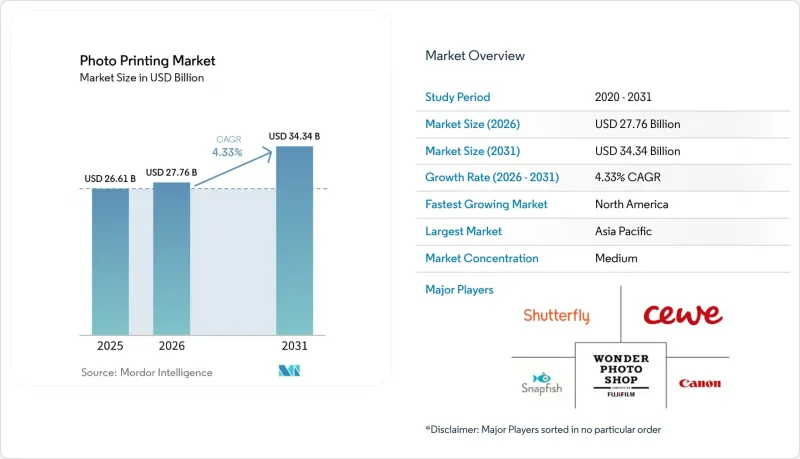
據 Mordor Intelligence 稱,2025 年照片印刷市場價值為 266.1 億美元,預計到 2031 年將達到 343.4 億美元,而 2026 年為 277.6 億美元,預測期(2026-2031 年)的複合年成長率為 4.33%。
本報告按產品類型(照片印刷、相簿等)、列印技術(噴墨、熱昇華、其他)、分銷管道(線上平台、零售照相館、其他)、最終用戶(個人/消費者、專業攝影師、其他)、印刷材料(紙張、畫布、其他)和地區(北美、南美、其他)進行分類。
全球照片列印市場趨勢與洞察
北美照片列印市場的成長
近年來,北美照片印刷市場持續穩定成長。行動攝影的興起和社群媒體上圖片共用的廣泛使用,促使消費者將數位照片印成紙本照片。這一趨勢,加上家用和小規模辦公室照片印表機的日益普及,以及自助沖印亭和線上列印服務的日益普及,共同推動了市場成長。
美國在該地區的照片印刷市場佔據主導地位,銷售額超過80%。同時,加拿大憑藉其科技普及率高的人口,成為第二大市場,對個人化照片產品的需求日益成長。專注於照片列印服務的電商和行動電商平台正在蓬勃發展。此外,用於室內設計和專業用途的大幅面、高品質照片列印的需求也顯著增加。同時,將人工智慧和機器學習技術應用於照片編輯和個人化功能也成為一種趨勢。
智慧型手機主導的攝影熱潮
如今,智慧型手機主導日常攝影,累積了大量的高解析度照片,而消費者越來越渴望擁有這些照片的實體版本。日本一項疫情後的調查顯示,近40%的青少年和超過30%的20至30歲成年人比以往任何時候都更渴望用照片記錄他們的外出和社交活動,這推動了照片列印的需求。專業攝影工作室也透過混合套餐將智慧型手機照片變現,從而提高了平均訂單金額。強大的行動應用程式縮短了從拍攝到付款的流程,而跨裝置的雲端同步功能則允許用戶根據需要在大螢幕上完成訂單。父母仍然是重要的客戶群體,他們經常以相簿、日曆和牆面藝術品的形式保存生活中的重要時刻。
數位共用正在取代實體印刷。
社交平臺提供即時滿足感、無限的傳播範圍和零額外成本,這使得年輕一代更傾向於放棄列印。雲端存檔提供永久備份,進一步降低了對實體產品的需求。然而,兩者之間仍然存在重疊,許多用戶仍然會訂購印刷品用於送禮、室內裝飾或長期保存。商家正努力透過強調實體照片的觸感、色彩還原度和持久性來客戶流失,而這些是僅僅瀏覽資訊流無法獲得的。
細分市場分析
預計到2025年,照片印刷仍將保持54.02%的最大市場佔有率,而金屬和壓克力牆面裝飾品的年成長率為10.74%,這表明市場正向高衝擊力展示產品轉變。隨著消費者越來越將個人照片視為室內設計元素,牆面裝飾照片印刷的市場規模預計將迅速成長。金屬印刷具有更佳的色彩鮮豔度和耐刮擦性,而壓克力列印則能增添紙質列印無法實現的深度和光澤。供應商正利用這些差異化優勢來提高平均售價,以抵消同質化列印產業的影響力。照片書保持著穩定的成長勢頭,因為敘事性的照片集滿足了人們對系統性故事敘述的需求。賀卡的需求呈現季節性高峰,而日曆的需求則趨於平穩,因為行動日曆正在取代桌面日曆。整體而言,該品類的組成仍偏向於高階、情感豐富的產品,這些產品能夠保護利潤免受標準列印產品價格競爭的影響。
這種策略在成熟市場已被證明行之有效,這些市場消費者自由裁量權支出較高,且追求獨特的美學。同時,主流產品形式仍是銷售的基礎,為製造商帶來規模經濟效益。多角化發展至室內設計和禮品領域有助於分散風險、穩定利潤率,並迎合追求獨特實體表達方式的數位原生代不斷變化的偏好。
預計到2025年,噴墨列印將佔總銷售額的46.20%,並繼續在實驗室和家用印表機領域佔據主導地位。然而,染料昇華列印9.05%的複合年成長率反映了其在耐用性、色彩一致性和速乾輸出方面的優勢。隨著自助印表機亭營運商和活動攝影師越來越重視防污列印效果,染料昇華印在照片列印市場的佔有率預計將會上升。
銀鹽濕式顯影法以其長期保存照片的卓越性能而聞名,至今在藝術領域仍佔有一席之地。數位碳粉印刷機則面向大批量商業印刷,在這些印刷品中,單頁成本比印刷材料的柔軟性更為重要。噴墨印表機廠商正透過高密度噴嘴和環保溶劑墨水展開競爭。Epson新建的印表機頭工廠已將其產能提高了四倍,以滿足全球需求。目前,技術選擇的重點並非追求單一的主導工藝,而是根據具體應用場景調整解析度、媒體相容性和處理能力。
區域分析
預計到2025年,北美將佔全球銷售額的31.95%,主要得益於消費者根深蒂固的列印習慣、較高的家庭收入以及成熟的電商物流網路。儘管由於市場飽和以及「數位優先」的千禧世代的影響,該地區的成長率低於全球平均水平,但高階室內裝飾品類和人工智慧帶來的便利性仍推動著該地區保持正成長。對永續化學品的更嚴格監管迫使供應商轉向水性油墨和可回收包裝,從而推動了產品創新。
歐洲在成熟度方面與北美相似,但更重視環保。來自有害化學品和一次性塑膠的法律法規的壓力正促使供應商轉向環保材料和塗料。相簿和節日賀卡的需求依然強勁,其中德國、法國和英國是主要的銷售量驅動力。訂閱模式在忙碌的家庭中越來越受歡迎,他們希望實現記憶的自動化存檔。
亞太地區是成長的關鍵驅動力,預計到2031年將維持6.94%的複合年成長率,這主要得益於中產階級收入的成長、智慧型手機普及率的提高以及快速發展的送禮文化。中國消費者在不斷擴大的住宅整修支出中,越來越傾向於個人化家居用品;而在印度,優質化趨勢正在推高客製化禮品的平均訂單價值。在日本,年輕人對攝影的熱情復興正在推動國內需求的逐步成長。當地企業通常將行動支付方式與本地語言介面結合,降低了首次使用印刷服務的客戶的門檻。因此,這種地域佈局在成熟市場提升高階產品提升銷售和新興市場擴大銷售量之間取得了平衡。
其他好處:
- Excel格式的市場預測(ME)表
- 3個月的分析師支持
目錄
第1章:引言
- 研究假設和市場定義
- 調查範圍
第2章:調查方法
第3章執行摘要
第4章 市場狀況
- 市場概覽
- 市場促進因素
- 智慧型手機推動了攝影熱潮。
- 相簿和照片禮品的需求
- 電子商務和應用程式訂購
- 人工智慧產生的圖像篩選功能正在促進印刷品的銷售。
- 定期訂閱「記憶盒」列印服務
- 區塊鏈檢驗的限量版畫
- 市場限制因素
- 數位共用正在取代實體印刷。
- 對價格和商品化高度敏感
- 加強攝影化學品的永續性法規
- 特種紙供應鏈瓶頸
- 價值供應鏈分析
- 監理情勢
- 技術展望
- 波特五力模型
第5章 市場規模與成長預測
- 依產品類型
- 照片列印
- 寫真集
- 照片卡
- 日曆
- 牆面裝飾(帆布、金屬等)
- 個人化照片禮物
- 透過印刷技術
- 噴墨
- 熱昇華
- 鹵化銀(濕實驗室)
- 數位印刷機/墨粉
- 透過分銷管道
- 線上平台
- 零售照片沖印店
- 即時自助服務亭
- 郵購服務
- 最終用戶
- 個人/消費者
- 專業攝影師
- 公司/企業
- 印刷品
- 紙
- Canvas
- 金屬
- 丙烯酸纖維
- 木材和織物
- 按地區
- 北美洲
- 加拿大
- 美國
- 墨西哥
- 南美洲
- 巴西
- 秘魯
- 智利
- 阿根廷
- 其他南美國家
- 亞太地區
- 印度
- 中國
- 日本
- 澳洲
- 韓國
- 東南亞(新加坡、馬來西亞、泰國、印尼、越南、菲律賓)
- 其他亞太國家
- 歐洲
- 英國
- 德國
- 法國
- 西班牙
- 義大利
- 比荷盧經濟聯盟(比利時、荷蘭、盧森堡)
- 北歐國家(丹麥、芬蘭、冰島、挪威、瑞典)
- 其他歐洲國家
- 中東和非洲
- 阿拉伯聯合大公國
- 沙烏地阿拉伯
- 南非
- 奈及利亞
- 其他中東和非洲國家
- 北美洲
第6章 競爭情勢
- 市場集中度
- 策略趨勢
- 市佔率分析
- 公司簡介
- Shutterfly
- CEWE
- Fujifilm
- Snapfish
- Canon
- HP
- Epson
- Walgreens Photo
- Costco Photo Center
- Mixbook
- Kodak Moments
- Amazon Prints
- Vistaprint
- Printique(AdoramaPix)
- Mpix
- Bay Photo
- Nations Photo Lab
- Photobox
- Blurb
- Chatbooks
- Artifact Uprising
- Persnickety Prints*
第7章 市場機會與未來展望
According to Mordor Intelligence, the photo printing market size was valued at USD 26.61 billion in 2025 and estimated to grow from USD 27.76 billion in 2026 to reach USD 34.34 billion by 2031, at a CAGR of 4.33% during the forecast period (2026-2031).
This report is Segmented by Product Type (Photo Prints, Photobooks, and More), by Print Technology (Inkjet, Dye-Sublimation, and More), by Distribution Channel (Online Platforms, Retail Photo Labs, and More), by End User (Individual / Consumer, Professional Photographers, and More), by Print Material (Paper, Canvas, and More), by Geography (North America, South America, and More).
Global Photo Printing Market Trends and Insights
Growth of Photo Printing Market in North America
The North American photo printing market has experienced consistent growth in recent years. The surge in mobile photography and the widespread sharing of images on social media are driving consumers to transform their digital snapshots into physical prints. This trend, along with the rising popularity of home and small office photo printers, as well as the increased use of photo kiosks and online printing services, is fueling the market's growth.
The United States dominates the region's photo printing landscape, accounting for over 80% of the revenue. Meanwhile, Canada, with its tech-savvy populace, is the second-largest market, witnessing a rising appetite for personalized photo merchandise. The industry is witnessing a surge in e-commerce and m-commerce platforms tailored for photo printing services. Moreover, there is a notable uptick in adopting large-format, high-quality photo printing for home decor and professional applications. Additionally, the sector is witnessing a trend toward integrating AI and machine learning to elevate photo editing and personalization capabilities.
Smartphone-led photo explosion
Smartphones now dominate everyday imaging, creating a reservoir of high-resolution content that consumers increasingly want in physical form. Post-pandemic surveys in Japan show nearly 40% of teenagers and more than 30% of adults in their twenties and thirties feeling a stronger urge to photograph outings and social occasions, reinforcing demand for prints. Professional studios also monetize mobile shots through hybrid packages that raise average order value. Enhanced mobile apps shorten the path from capture to checkout, and cross-device cloud sync ensures users can finish orders on larger screens when preferred. Parents remain a key cohort, routinely translating milestone moments into photobooks, calendars, and wall decor.
Digital sharing replaces physical prints
Social platforms offer instant gratification, unlimited reach, and zero incremental cost, tempting younger cohorts to bypass printing. Cloud archives supply perpetual backups, further eroding the perceived need for physical products. Yet overlap persists; many users still order prints for gifting, decor, or archival integrity. Vendors fight attrition by emphasizing tactile value, color fidelity, and permanence beyond scrolling feeds.
Other drivers and restraints analyzed in the detailed report include:
- Demand for photobooks and photo gifts
- E-commerce and app-based ordering
- High price sensitivity and commoditization
For complete list of drivers and restraints, kindly check the Table Of Contents.
Segment Analysis
In 2025, Photo Prints retained the largest slice at 54.02%, but Wall Decor on metal and acrylic is expanding 10.74% annually, signaling a shift toward high-impact display pieces. The photo printing market size for wall decor is forecast to widen rapidly as consumers treat personal images as interior design elements. Metal prints deliver superior vibrancy and scratch resistance, while acrylic adds depth and gloss that paper cannot replicate. Suppliers leverage these differentiators to lift average selling prices and offset commoditized print segments. Photobooks keep steady momentum because narrative collections satisfy the desire for organized storytelling. Cards spike seasonally, and calendars plateau as mobile planners supplant desk formats. Overall, category mix continues to favor premium, emotion-laden products that buffer revenue against price wars in standard prints.
The strategy pays dividends in mature markets where discretionary spending is high and buyers chase unique aesthetics. Meanwhile, mainstream formats still underpin volume, granting producers scale efficiencies. Diversifying into decor and giftable thus balances risk, stabilizes margins, and meets the evolving tastes of digitally native buyers seeking distinctive physical expressions.
Inkjet accounted for 46.20% revenue in 2025 and remains the workhorse across labs and at-home units, yet dye-sublimation's 9.05% CAGR reflects its edge in durability, color consistency, and instant-dry output. The photo printing market share held by dye-sublimation is expected to rise as kiosk operators and event photographers prioritise smudge-proof finishes.
Silver-halide wet labs keep a foothold in fine-art circles, prized for archival longevity. Digital toner presses cater to bulk commercial runs where per-page cost trumps substrate flexibility. Inkjet vendors are countering with higher-density nozzles and eco-solvent inks; Epson's new printhead factory quadruples capacity to sustain global demand. Technology selection now revolves around matching resolution, media compatibility, and throughput to specific use cases rather than pursuing a single dominant process.
Complete Report Scope:
- By Product Type
- Photo Prints
- Photobooks
- Photo Cards
- Calendars
- Wall Decor (Canvas, Metal, etc.)
- Personalized Photo Gifts
- By Print Technology
- Inkjet
- Dye-sublimation
- Silver-Halide (Wet Lab)
- Digital Press / Toner
- By Distribution Channel
- Online Platforms
- Retail Photo Labs
- Instant Kiosks
- Mail-order Services
- By End User
- Individual / Consumer
- Professional Photographers
- Corporate / Enterprise
- By Print Material
- Paper
- Canvas
- Metal
- Acrylic
- Wood and Fabric
- By Geography
- North America
- Canada
- United States
- Mexico
- South America
- Brazil
- Peru
- Chile
- Argentina
- Rest of South America
- Asia-Pacific
- India
- China
- Japan
- Australia
- South Korea
- South East Asia (Singapore, Malaysia, Thailand, Indonesia, Vietnam, and Philippines)
- Rest of Asia-Pacific
- Europe
- United Kingdom
- Germany
- France
- Spain
- Italy
- BENELUX (Belgium, Netherlands, and Luxembourg)
- NORDICS (Denmark, Finland, Iceland, Norway, and Sweden)
- Rest of Europe
- Middle East and Africa
- United Arab Emirates
- Saudi Arabia
- South Africa
- Nigeria
- Rest of Middle East and Africa
- North America
Geography Analysis
North America generated 31.95% of 2025 revenue on the back of entrenched consumer print habits, high household incomes, and mature e-commerce logistics. Growth is slower than global averages because of market saturation and digital-first millennials, yet premium decor categories and AI-driven convenience are keeping the region in positive territory. Regulatory focus on sustainable chemistry is pushing suppliers toward water-based inks and recyclable packaging, fueling product innovation.
Europe mirrors North America in maturity but places sharper emphasis on eco-credentials. Legislative pressure around hazardous chemicals and single-use plastics encourages vendors to upscale to environmentally preferable substrates and coatings. Demand remains steady for photobooks and seasonal cards, with Germany, France, and the United Kingdom anchoring volume. Subscription models resonate with time-pressed families seeking automated memory archiving.
Asia-Pacific is the headline growth story, posting 6.94% CAGR through 2031 as rising middle-class incomes, prolific smartphone usage, and a burgeoning gifting culture converge. Consumers in China gravitate toward personalized decor as part of home-improvement spending waves, while India's premiumization trend lifts average order value for customized gifts. Japan's youth photography resurgence supports incremental domestic demand. Local players often pair mobile payment methods with vernacular interfaces, lowering barriers for first-time print buyers. The geographic mix therefore balances mature-market premium upselling with emerging-market volume gains.
- Shutterfly
- CEWE
- Fujifilm
- Snapfish
- Canon
- HP
- Epson
- Walgreens Photo
- Costco Photo Center
- Mixbook
- Kodak Moments
- Amazon Prints
- Vistaprint
- Printique (AdoramaPix)
- Mpix
- Bay Photo
- Nations Photo Lab
- Photobox
- Blurb
- Chatbooks
- Artifact Uprising
- Persnickety Prints*
Additional Benefits:
- The market estimate (ME) sheet in Excel format
- 3 months of analyst support
TABLE OF CONTENTS
1 Introduction
- 1.1 Study Assumptions & Market Definition
- 1.2 Scope of the Study
2 Research Methodology
3 Executive Summary
4 Market Landscape
- 4.1 Market Overview
- 4.2 Market Drivers
- 4.2.1 Smartphone-Led Photo Explosion
- 4.2.2 Demand For Photobooks And Photo Gifts
- 4.2.3 E-Commerce And App-Based Ordering
- 4.2.4 AI-Generated Image Curation Boosts Print Volumes
- 4.2.5 Subscription "Memory-Box" Print Services
- 4.2.6 Blockchain-Verified Limited-Edition Prints
- 4.3 Market Restraints
- 4.3.1 Digital Sharing Replaces Physical Prints
- 4.3.2 High Price Sensitivity And Commoditization
- 4.3.3 Tightening Sustainability Rules On Photo Chemicals
- 4.3.4 Specialty Paper Supply-Chain Bottlenecks
- 4.4 Value / Supply-Chain Analysis
- 4.5 Regulatory Landscape
- 4.6 Technological Outlook
- 4.7 Porter's Five Forces
- 4.7.1 Threat of New Entrants
- 4.7.2 Bargaining Power of Suppliers
- 4.7.3 Bargaining Power of Buyers
- 4.7.4 Threat of Substitutes
- 4.7.5 Competitive Rivalry
5 Market Size & Growth Forecasts
- 5.1 By Product Type
- 5.1.1 Photo Prints
- 5.1.2 Photobooks
- 5.1.3 Photo Cards
- 5.1.4 Calendars
- 5.1.5 Wall Decor (Canvas, Metal, etc.)
- 5.1.6 Personalized Photo Gifts
- 5.2 By Print Technology
- 5.2.1 Inkjet
- 5.2.2 Dye-sublimation
- 5.2.3 Silver-Halide (Wet Lab)
- 5.2.4 Digital Press / Toner
- 5.3 By Distribution Channel
- 5.3.1 Online Platforms
- 5.3.2 Retail Photo Labs
- 5.3.3 Instant Kiosks
- 5.3.4 Mail-order Services
- 5.4 By End User
- 5.4.1 Individual / Consumer
- 5.4.2 Professional Photographers
- 5.4.3 Corporate / Enterprise
- 5.5 By Print Material
- 5.5.1 Paper
- 5.5.2 Canvas
- 5.5.3 Metal
- 5.5.4 Acrylic
- 5.5.5 Wood and Fabric
- 5.6 By Geography
- 5.6.1 North America
- 5.6.1.1 Canada
- 5.6.1.2 United States
- 5.6.1.3 Mexico
- 5.6.2 South America
- 5.6.2.1 Brazil
- 5.6.2.2 Peru
- 5.6.2.3 Chile
- 5.6.2.4 Argentina
- 5.6.2.5 Rest of South America
- 5.6.3 Asia-Pacific
- 5.6.3.1 India
- 5.6.3.2 China
- 5.6.3.3 Japan
- 5.6.3.4 Australia
- 5.6.3.5 South Korea
- 5.6.3.6 South East Asia (Singapore, Malaysia, Thailand, Indonesia, Vietnam, and Philippines)
- 5.6.3.7 Rest of Asia-Pacific
- 5.6.4 Europe
- 5.6.4.1 United Kingdom
- 5.6.4.2 Germany
- 5.6.4.3 France
- 5.6.4.4 Spain
- 5.6.4.5 Italy
- 5.6.4.6 BENELUX (Belgium, Netherlands, and Luxembourg)
- 5.6.4.7 NORDICS (Denmark, Finland, Iceland, Norway, and Sweden)
- 5.6.4.8 Rest of Europe
- 5.6.5 Middle East and Africa
- 5.6.5.1 United Arab Emirates
- 5.6.5.2 Saudi Arabia
- 5.6.5.3 South Africa
- 5.6.5.4 Nigeria
- 5.6.5.5 Rest of Middle East and Africa
- 5.6.1 North America
6 Competitive Landscape
- 6.1 Market Concentration
- 6.2 Strategic Moves
- 6.3 Market Share Analysis
- 6.4 Company Profiles (includes Global level Overview, Market level overview, Core Segments, Financials as available, Strategic Information, Market Rank/Share for key companies, Products & Services, and Recent Developments)
- 6.4.1 Shutterfly
- 6.4.2 CEWE
- 6.4.3 Fujifilm
- 6.4.4 Snapfish
- 6.4.5 Canon
- 6.4.6 HP
- 6.4.7 Epson
- 6.4.8 Walgreens Photo
- 6.4.9 Costco Photo Center
- 6.4.10 Mixbook
- 6.4.11 Kodak Moments
- 6.4.12 Amazon Prints
- 6.4.13 Vistaprint
- 6.4.14 Printique (AdoramaPix)
- 6.4.15 Mpix
- 6.4.16 Bay Photo
- 6.4.17 Nations Photo Lab
- 6.4.18 Photobox
- 6.4.19 Blurb
- 6.4.20 Chatbooks
- 6.4.21 Artifact Uprising
- 6.4.22 Persnickety Prints*
7 Market Opportunities & Future Outlook
- 7.1 White-space & Unmet-need Assessment

 照片印刷及相關產品市場:2026-2032年全球市場預測(依產品類型、列印尺寸、最終用戶及通路分類)
 照片列印及相關產品市場:按類型、列印方式、通路、產品類型及地區分類
 攝影印刷產品市場-全球產業規模、佔有率、趨勢、機會、預測:按類型、印刷類型、設備、地區和競爭格局分類,2021-2031年照片列印市場:按類型、應用程式、分銷管道和地區分類
 2026年全球線上照片列印市場報告
 照片列印及相關產品市場報告:依產品類型、列印方式、使用設備、通路及地區分類(2026-2034 年)2026年全球相片印刷及周邊產品市場報告
 2025-2029年全球相片印刷及相關產品市場攝影印刷市場 - 全球產業規模、佔有率、趨勢、機會、預測:按類型、印刷設備類型、最終用戶、地區和競爭格局分類,2021-2031年
 照片列印市場規模、佔有率和成長分析(按產品類型、列印技術、分銷管道、最終用戶、列印資料和地區分類)-2026-2033年產業預測