


 |
市場調查報告書
商品編碼
2125745
安全物流:市場佔有率分析、產業趨勢與統計、成長預測(2026-2031)Secure Logistics - Market Share Analysis, Industry Trends & Statistics, Growth Forecasts (2026 - 2031) |
||||||

※ 本網頁內容可能與最新版本有所差異。詳細情況請與我們聯繫。
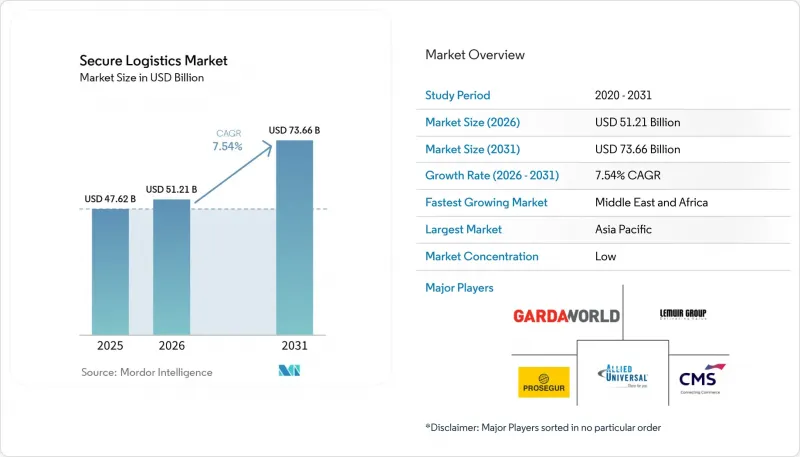
據 Mordor Intelligence 稱,2025 年安全物流市場價值 476.2 億美元,預計到 2031 年將達到 736.6 億美元,而 2026 年為 512.1 億美元,預測期(2026-2031 年)複合年成長率為 7.54%。
本報告按應用領域(現金管理、鑽石、珠寶飾品和貴金屬、其他)、類型(固定式和移動式)、物流功能(運輸、倉儲和配送、其他)、終端用戶行業(銀行和金融機構、零售和電子商務、其他)以及地區(北美、歐洲、其他)進行細分。市場預測以美元計價。
全球安全物流市場趨勢與洞察
新興經濟體自動櫃員機安裝數量增加
隨著世界各國政府大力推廣依賴現金流通網路的普惠金融項目,亞太地區和非洲的ATM基礎設施持續擴張。每台新安裝的ATM都需要裝甲車定期補給,從而為安全物流市場創造了穩定的需求。雖然成熟經濟體的ATM密度有所下降,但新興地區的成長彌補了這一缺口,維持了車輛的運轉率,並支持了多年服務合約的簽訂。營運商也正在為中型銀行部署白牌ATM,以提高成本效益並擴大網路覆蓋範圍。這些設施為可預測的現金處理收入奠定了基礎,並與供應商在保險箱容量和電子監控系統方面的投資相輔相成。對長期現金週期的更清晰了解使運輸商能夠最佳化路線規劃並降低每盒現金的成本,從而提高盈利。
電子商務中貨到付款模式的快速成長。
在許多新興電商市場,由於銀行卡普及率低或人們對數位管道的信任度尚未建立,貨到付款仍然是主要的支付方式。因此,安全物流供應商需要建立逆向物流循環,以便每天從數千個配送點收回現金收入。提高配送路線的密度,尤其是在大都會圈,有助於縮短週期時間並提高服務盈利。營運商正在將手持計數終端與數位匹配平台整合,以加快線上經銷商的支付流程。儘管行動錢包的普及正逐漸挑戰這種模式,但由於電子商務保持著兩位數的成長率,現金交易的絕對金額仍然很高。因此,安全物流市場繼續受益於實體交易和電子交易相結合的平衡混合環境。
成熟經濟體繼續推行「現金優先」政策
斯堪的斯堪地那維亞和澳洲的中央銀行正積極推廣數位支付以遏制現金流通,這導致支撐安全物流市場的貨物運輸量減少。零售商正透過減少每日現金收款次數來應對,而各國政府也在討論限制現金交易。企業則透過將業務轉向貴金屬物流、加密貨幣硬體錢包的安全儲存以及ATM Second Life管理服務來應對這一趨勢。儘管現金處理量正在下降,但高價值商品在一定程度上彌補了現金短缺,使承運商能夠在已開發市場維持配送路線的密度。與監管機構就央行數位貨幣(CBDC)進行的對話也鼓勵企業探索將實體保險箱儲存與數位代幣儲存結合的混合服務,從而拓展未來的收入來源。
細分市場分析
2025年,現金管理在安全物流市場規模中佔比將達到49.22%,主要得益於ATM機的定期現金補充和零售商的現金收款。銀行正將大量紙幣處理和對帳業務外包,以便專注於數位化管道。零售商正在採用智慧保險箱,實現存款金額的即時傳輸,從而減少每日前往分店的次數。同時,由於地緣政治動盪,投資者尋求安全資產,預計2026年至2031年間,珠寶飾品和貴金屬產業的複合年成長率將達到9.52%。承運商正透過提供溫控倉儲、保稅倉庫容量以及裸金屬運輸的當日清關服務來滿足這一不斷成長的需求。奢侈品牌也正在使用防篡改包裝和GPS信標來保護運輸途中的高價值商品。因此,貴金屬運輸路線如今正顯著推動安全物流市場收入的多元化。
製造業和製藥業透過高價值零件的運輸和合規的醫療物流,確保了穩定的基準量。 CEIV Pharma認證吸引了對溫度控制要求嚴格的疫苗生產商,而半導體公司則需要防靜電包裝和透明的儲存歷史。像Tracr這樣的鑽石溯源平台正在區塊鏈上註冊數百萬顆毛坯鑽石,提高了承運商數位化文件管理的標準。這些趨勢共同推動了服務組合的擴展,並降低了對現金處理量的依賴。因此,安全物流市場正持續從單一品類的現金處理業務轉向多品類、專業化的營運模式。
至2025年,智慧保險箱和現金處理中心等固定設施將佔安全物流市場規模的60.35%。這些樞紐為銀行和零售商提供隔夜紙幣分類和硬幣包裝服務。為了滿足保險承保標準,供應商正在投資生物識別門禁系統、多級滅火系統和專用LTE網路。同時,隨著客戶對運輸路線柔軟性和即時追蹤的需求不斷成長,行動服務正以8.55%的複合年成長率成長。電動裝甲車透過降低燃料和維護成本來降低整體擁有成本(TCO),而貨物遙測平台則提供精確到分鐘的位置資訊。路線最佳化軟體透過最佳化停靠點,減少運輸時間和溫室氣體排放,進而加強ESG(環境、社會和管治)措施。
硬體和軟體升級的融合使運輸公司能夠將車輛轉變為“移動資料中心”,為預測分析引擎提供數據。管理人員可以分析車輛停留時間的異常情況,最佳化調度,並最大限度地提高資產利用率。由遠端監控支援的單駕駛員系統可在不影響安全性的前提下降低人事費用。由此帶來的效率提升增強了技術主導營運商在安全物流市場的競爭力。
區域分析
預計到2025年,亞太地區將佔全球安全物流市場規模的31.60%,這主要得益於經濟的快速成長、強勁的匯款流動以及電子商務中較高的貨到付款交易比例。印尼、菲律賓和越南政府持續發放需要定期補充現金的新型私人ATM執照。運輸公司正在擴大裝甲運輸能力,並與當地銀行建立合資企業,以滿足監管機構規定的持股上限。在當前動盪的投資環境下,香港和新加坡之間跨境貴金屬貿易的加速成長推動了該地區預計的複合年成長率,其表現優於其他所有地區。
北美位居第二,這得益於其成熟的現金管理外包市場、高價商品的大額交易量以及有利於成熟營運商的健全合規體系。服務供應商正在部署整合POS數據的分析平台,使零售連鎖店能夠最佳化取貨頻率。歐洲市場呈現穩定成長態勢,但由於北歐國家推行無現金政策,交易量下降。歐盟關於車輛遙測和跨境貴重物品運輸的法規,正為技術型營運商創造新的服務機會。
在南美洲,普惠金融項目、礦產出口以及零售業日益成長的安全需求正在推動市場發展。裝甲車的設計也不斷改進,以適應山區地形;巴西和哥倫比亞則在現金處理中心部署高速鈔票分類機,以支援新興的私人銀行。中東和非洲地區仍充滿發展潛力,這主要得益於基礎建設項目以及杜拜等貴金屬交易中心的推動。日益緊張的地緣政治局勢加劇了風險管理的複雜性,從而推動了對衛星追蹤和貨物護送服務的需求,進而刺激了安全物流市場的發展。
其他好處:
- Excel格式的市場預測(ME)表
- 3個月的分析師支持
目錄
第1章:引言
- 研究假設和市場定義
- 調查範圍
第2章:調查方法
第3章執行摘要
第4章 市場狀況
- 市場概覽
- 市場促進因素
- 新興國家自動櫃員機安裝數量的增加
- 電子商務中貨到付款模式的快速成長。
- 銀行分店現金運輸(CIT)服務的外包
- 依相關規定對裝甲車輛遙測系統進行升級
- 供應鏈中的網路竊盜正在迫使企業實施綜合性的實體和數位安全措施。
- 用於高價值鑽石和裸金屬的代幣化區塊鏈追蹤。
- 市場限制因素
- “在成熟經濟體中,’現金優先’政策一直在不斷推行。”
- 持證武裝保全人員短缺
- 途經衝突地區的路線上的保險費正在飆升。
- 使用虛擬/加密貨幣匯款正在日益取代實體運輸。
- 價值供應鏈分析
- 監理情勢
- 技術展望
- 波特五力模型
- 關於運費需要注意的幾點
第5章 市場規模及成長預測(價值,十億美元)
- 透過使用
- 現金管理
- 鑽石
- 珠寶飾品和貴金屬
- 製造業
- 其他
- 按類型
- 靜止的
- 移動的
- 按職能分類的物流
- 運輸
- 路
- 航空
- 海路和內河航道
- 鐵路
- 倉儲/物流
- 附加價值服務(貼標籤、套件組裝、諮詢)
- 運輸
- 按最終用戶行業分類
- 銀行和金融機構
- 政府/公共部門
- 零售與電子商務
- 採礦和金屬
- 奢侈品
- 藥品和醫療保健
- 其他
- 地區
- 北美洲
- 美國
- 加拿大
- 墨西哥
- 南美洲
- 巴西
- 秘魯
- 智利
- 阿根廷
- 其他南美國家
- 亞太地區
- 印度
- 中國
- 日本
- 澳洲
- 韓國
- 東南亞(新加坡、馬來西亞、泰國、印尼、越南、菲律賓)
- 其他亞太國家
- 歐洲
- 英國
- 德國
- 法國
- 西班牙
- 義大利
- 比荷盧經濟聯盟(比利時、荷蘭、盧森堡)
- 北歐國家(丹麥、芬蘭、冰島、挪威、瑞典)
- 其他歐洲國家
- 中東和非洲
- 阿拉伯聯合大公國
- 沙烏地阿拉伯
- 南非
- 奈及利亞
- 其他中東和非洲國家
- 北美洲
第6章 競爭情勢
- 市場集中度
- 策略趨勢
- 市佔率分析
- 公司簡介
- Brinks
- GardaWorld
- Loomis
- Prosegur
- G4S
- Securitas AB
- Allied Universal
- CMS Info Systems
- Lemuir Group
- Secure Logistics LLC
- Malca-Amit
- Cash Connect
- Empyreal Logistics
- Tri-State Secured Trucking
- Parcel Pro
- Loomis Schweiz AG
- Armaguard
- General Secure Logistic Services(GSLS)
- Cash Logistik Security AG
- Radiant Cash Management Services*
第7章 市場機會與未來展望
According to Mordor Intelligence, the secure logistics market size was valued at USD 47.62 billion in 2025 and estimated to grow from USD 51.21 billion in 2026 to reach USD 73.66 billion by 2031, at a CAGR of 7.54% during the forecast period (2026-2031).
This report is Segmented by Application (Cash Management, Diamonds, Jewelry and Precious Metal, and More), by Type (Static and Mobile), by Logistics Function(Transportation, Warehousing & Distribution, and More), by End-User Industry (Banking & Financial Institutions, Retail & E-Commerce and More), by Geography (North America, Europe, and More ). The Market Forecasts are Provided in Terms of Value (USD).
Global Secure Logistics Market Trends and Insights
Rising ATM Deployments in Emerging Economies
ATM infrastructure continues to expand in Asia-Pacific and Africa as governments pursue financial-inclusion programs that rely on cash distribution networks. Each new device requires recurring armored-car replenishment, adding stable volumes to the secure logistics market. While ATM density in mature economies is shrinking, the offsetting growth in emerging regions sustains fleet utilization rates and supports multi-year service contracts. Operators also deploy white-label ATMs for mid-tier banks, improving cost efficiency and extending network reach. Such installations underpin predictable cash-handling revenue that complement providers' investments in vault capacity and electronic monitoring. The clear visibility of long-term cash cycles helps carriers optimize route planning and lower per-cassette costs, thereby reinforcing profitability.
Rapid Growth of E-commerce Cash-on-Delivery Models
Cash-on-delivery remains a dominant payment mode in many emerging e-commerce markets where card penetration lags or trust in digital channels is still developing economictimes. Secure logistics carriers must therefore orchestrate reverse-logistics loops that collect fragmented cash receipts from thousands of deliveries points each day. Route densification around metropolitan clusters helps compress cycle times and enhances service profitability. Providers integrate handheld counting devices and digital reconciliation platforms to accelerate deposit timelines for online merchants. The model faces gradual erosion as mobile wallets gain popularity, yet high double-digit e-commerce growth keeps absolute cash volumes elevated. Consequently, the secure logistics market continues to benefit from a hybrid landscape that balances physical and electronic transactions.
Persistent Cash-Lite Policy Pushes in Mature Economies
Central banks in Scandinavia and Australia actively promote digital payments to curb cash circulation, trimming shipment volumes that feed the secure logistics market . Retailers respond by reducing daily cash pickups, while governments discuss upper cash-transaction limits. Providers counter this trend by pivoting toward precious-metals logistics, secure storage for cryptocurrency hardware wallets, and ATM second-life management services. Although cash volumes dip, high-value commodities partially fill the gap, ensuring that carriers retain route density in developed markets. Regulatory dialogues around central-bank digital currencies also encourage operators to explore hybrid services that combine physical vaulting with digital token custody, broadening future revenue streams.
Other drivers and restraints analyzed in the detailed report include:
- Bank Branch Outsourcing of Cash-in-Transit Services
- Regulation-Driven Upgrades to Armored Fleet Telemetry
- Labor Shortages of Certified Armored-Car Guards
For complete list of drivers and restraints, kindly check the Table Of Contents.
Segment Analysis
Cash management generated 49.22% of the secure logistics market size in 2025, buoyed by regular ATM replenishments and retail cash pickups. Banks outsource bulk note processing and reconciliation to focus on digital channels. Retailers employ smart safes that transmit deposit values in real time and reduce daily branch visits. Conversely, jewelry & precious metals is projected to post a 9.52% CAGR between 2026-2031 as investors seek safe-haven assets during geopolitical turbulence. Carriers support this uptick by offering temperature-controlled vaults, bonded warehouse capacity, and same-day customs clearance for bullion shipments. Luxury brands also use tamper-evident packaging and GPS beacons to safeguard high-value pieces in transit. As a result, precious-metal lanes now contribute materially to revenue diversification within the secure logistics market.
The manufacturing and pharmaceutical verticals add stable baseline volumes through high-value component deliveries and regulatory-compliant medical logistics. CEIV Pharma certification attracts vaccine producers that demand temperature integrity, while semiconductor firms require antistatic packaging and chain-of-custody transparency. Diamond traceability platforms such as Tracr register millions of stones on blockchain, a development that elevates digital paperwork standards for carriers. Together these trends broaden the service portfolio and reduce dependence on cash volumes. Consequently, the secure logistics market continues to shift from mono-line cash operations toward multi-commodity expertise.
Static facilities, including smart vaults and cash-processing centers, controlled 60.35% of the secure logistics market size in 2025. Such hubs underpin overnight note sorting and coin wrapping for banks and retailers. Providers invest in biometric access, multilevel fire suppression, and private LTE networks to meet insurance underwriting standards. Simultaneously, mobile services record an 8.55% CAGR as clients demand on-route flexibility and real-time tracking. Electric armored vehicles lower total cost of ownership by cutting fuel and maintenance spend, while cargo telemetry platforms deliver minute-by-minute location data. Route optimization software clusters stops shaving drive-time and greenhouse-gas emissions, enhancing ESG credentials.
Converging hardware and software upgrades allow carriers to convert vehicles into rolling data hubs that feed predictive analytics engines. Managers analyze dwell-time anomalies to refine schedules and maximize asset utilization. One-person crew configurations supported by remote monitoring reduce labor requirements without compromising security. The resulting efficiencies strengthen the competitive position of technology-driven operators in the secure logistics market.
Complete Report Scope:
- By Application
- Cash Management
- Diamonds
- Jewelry & Precious Metals
- Manufacturing
- Others
- By Type
- Static
- Mobile
- By Logistics Function
- Transportation
- Road
- Air
- Sea and Inland Waterways
- Rail
- Warehousing & Distribution
- Value-added Services (Labelling, Kitting, Consulting)
- Transportation
- By End-User Industry
- Banking & Financial Institutions
- Government & Public Sector
- Retail & E-commerce
- Mining & Metals
- Luxury Goods
- Pharmaceuticals & Healthcare
- Others
- Geography
- North America
- United States
- Canada
- Mexico
- South America
- Brazil
- Peru
- Chile
- Argentina
- Rest of South America
- Asia Pacific
- India
- China
- Japan
- Australia
- South Korea
- South East Asia (Singapore, Malaysia, Thailand, Indonesia, Vietnam, and Philippines)
- Rest of Asia-Pacific
- Europe
- United Kingdom
- Germany
- France
- Spain
- Italy
- BENELUX (Belgium, Netherlands, and Luxembourg)
- NORDICS (Denmark, Finland, Iceland, Norway, and Sweden)
- Rest of Europe
- Middle East And Africa
- United Arab of Emirates
- Saudi Arabia
- South Africa
- Nigeria
- Rest of Middle East And Africa
- North America
Geography Analysis
Asia-Pacific held 31.60% of the secure logistics market size in 2025, supported by rapid economic expansion, robust remittance flows, and high e-commerce cash-on-delivery ratios. Governments in Indonesia, the Philippines, and Vietnam continue to license new private ATMs that need recurring cash replenishment. Carriers expand armoring capacity and establish joint ventures with local banks to meet regulatory ownership caps. The region's forecast CAGR outpaces all others as cross-border precious-metal trade between Hong Kong and Singapore accelerates in a volatile investment climate.
North America ranks second because of mature cash management outsourcing, sizable high-value-goods trade, and strict compliance regimes that favor established carriers . Providers deploy analytics platforms that integrate point-of-sale data, enabling retail chains to fine-tune pickup frequencies. Europe posts steady growth although cash-lite policies in the Nordics reduce volume. EU rules around fleet telemetry and cross-border valuables transit create service opportunities for technology-oriented operators.
South America benefits from financial-inclusion programs, mining exports, and rising retail security needs. Armored-car design evolves to manage mountainous terrain, while cash centers introduce high-speed note sorters to support new private banks in Brazil and Colombia. Middle East and Africa remain opportunity regions, driven by infrastructure projects and precious-metal trading hubs such as Dubai. Risk management complexity rises amid geopolitical tensions, prompting demand for satellite tracking and cargo escort services that enrich the secure logistics market.
- Brinks
- GardaWorld
- Loomis
- Prosegur
- G4S
- Securitas AB
- Allied Universal
- CMS Info Systems
- Lemuir Group
- Secure Logistics LLC
- Malca-Amit
- Cash Connect
- Empyreal Logistics
- Tri-State Secured Trucking
- Parcel Pro
- Loomis Schweiz AG
- Armaguard
- General Secure Logistic Services (GSLS)
- Cash Logistik Security AG
- Radiant Cash Management Services*
Additional Benefits:
- The market estimate (ME) sheet in Excel format
- 3 months of analyst support
TABLE OF CONTENTS
1 Introduction
- 1.1 Study Assumptions & Market Definition
- 1.2 Scope of the Study
2 Research Methodology
3 Executive Summary
4 Market Landscape
- 4.1 Market Overview
- 4.2 Market Drivers
- 4.2.1 Rising ATM deployments in emerging economies
- 4.2.2 Rapid growth of e-commerce cash-on-delivery models
- 4.2.3 Bank branch outsourcing of cash-in-transit (CIT) services
- 4.2.4 Regulation-driven upgrades to armored fleet telemetry
- 4.2.5 Supply-chain cyber-theft forcing integrated physical-digital security
- 4.2.6 Tokenized blockchain tracking for high-value diamonds & bullion
- 4.3 Market Restraints
- 4.3.1 Persistent cash-lite" policy pushes in mature economies"
- 4.3.2 Labor shortages of certified armored-car guards
- 4.3.3 Escalating insurance premiums for conflict-zone routes
- 4.3.4 Growing adoption of virtual/crypto asset transfer replacing physical shipment
- 4.4 Value / Supply-Chain Analysis
- 4.5 Regulatory Landscape
- 4.6 Technological Outlook
- 4.7 Porter's Five Forces
- 4.7.1 Threat of New Entrants
- 4.7.2 Bargaining Power of Suppliers
- 4.7.3 Bargaining Power of Buyers
- 4.7.4 Threat of Substitutes
- 4.7.5 Competitive Rivalry
- 4.8 Spotlight on Transport Rates
5 Market Size & Growth Forecasts (Value, USD Bn)
- 5.1 By Application
- 5.1.1 Cash Management
- 5.1.2 Diamonds
- 5.1.3 Jewelry & Precious Metals
- 5.1.4 Manufacturing
- 5.1.5 Others
- 5.2 By Type
- 5.2.1 Static
- 5.2.2 Mobile
- 5.3 By Logistics Function
- 5.3.1 Transportation
- 5.3.1.1 Road
- 5.3.1.2 Air
- 5.3.1.3 Sea and Inland Waterways
- 5.3.1.4 Rail
- 5.3.2 Warehousing & Distribution
- 5.3.3 Value-added Services (Labelling, Kitting, Consulting)
- 5.3.1 Transportation
- 5.4 By End-User Industry
- 5.4.1 Banking & Financial Institutions
- 5.4.2 Government & Public Sector
- 5.4.3 Retail & E-commerce
- 5.4.4 Mining & Metals
- 5.4.5 Luxury Goods
- 5.4.6 Pharmaceuticals & Healthcare
- 5.4.7 Others
- 5.5 Geography
- 5.5.1 North America
- 5.5.1.1 United States
- 5.5.1.2 Canada
- 5.5.1.3 Mexico
- 5.5.2 South America
- 5.5.2.1 Brazil
- 5.5.2.2 Peru
- 5.5.2.3 Chile
- 5.5.2.4 Argentina
- 5.5.2.5 Rest of South America
- 5.5.3 Asia Pacific
- 5.5.3.1 India
- 5.5.3.2 China
- 5.5.3.3 Japan
- 5.5.3.4 Australia
- 5.5.3.5 South Korea
- 5.5.3.6 South East Asia (Singapore, Malaysia, Thailand, Indonesia, Vietnam, and Philippines)
- 5.5.3.7 Rest of Asia-Pacific
- 5.5.4 Europe
- 5.5.4.1 United Kingdom
- 5.5.4.2 Germany
- 5.5.4.3 France
- 5.5.4.4 Spain
- 5.5.4.5 Italy
- 5.5.4.6 BENELUX (Belgium, Netherlands, and Luxembourg)
- 5.5.4.7 NORDICS (Denmark, Finland, Iceland, Norway, and Sweden)
- 5.5.4.8 Rest of Europe
- 5.5.5 Middle East And Africa
- 5.5.5.1 United Arab of Emirates
- 5.5.5.2 Saudi Arabia
- 5.5.5.3 South Africa
- 5.5.5.4 Nigeria
- 5.5.5.5 Rest of Middle East And Africa
- 5.5.1 North America
6 Competitive Landscape
- 6.1 Market Concentration
- 6.2 Strategic Moves
- 6.3 Market Share Analysis
- 6.4 Company Profiles (includes Global level Overview, Market level overview, Core Segments, Financials, Strategic Info, Market Rank/Share, Products & Services, Recent Developments)
- 6.4.1 Brinks
- 6.4.2 GardaWorld
- 6.4.3 Loomis
- 6.4.4 Prosegur
- 6.4.5 G4S
- 6.4.6 Securitas AB
- 6.4.7 Allied Universal
- 6.4.8 CMS Info Systems
- 6.4.9 Lemuir Group
- 6.4.10 Secure Logistics LLC
- 6.4.11 Malca-Amit
- 6.4.12 Cash Connect
- 6.4.13 Empyreal Logistics
- 6.4.14 Tri-State Secured Trucking
- 6.4.15 Parcel Pro
- 6.4.16 Loomis Schweiz AG
- 6.4.17 Armaguard
- 6.4.18 General Secure Logistic Services (GSLS)
- 6.4.19 Cash Logistik Security AG
- 6.4.20 Radiant Cash Management Services*
7 Market Opportunities & Future Outlook
- 7.1 White-space & Unmet-Need Assessment

 安全物流市場規模、佔有率、趨勢和預測:按類型、服務類型、應用程式、最終用戶和地區分類,2026-2034 年
 2026年全球安全物流市場報告
 安全物流市場:按服務類型、最終用戶和地區分類
 安全物流市場規模、佔有率、成長及全球產業分析:按類型、應用和地區分類的洞察,2026-2034 年預測
 安全物流市場機會、成長要素、產業趨勢分析及預測(2026-2035年)
 安全物流市場規模、佔有率和成長分析(按類型、運輸方式、應用、最終用戶和地區分類)—產業預測(2026-2033 年)
 安全物流市場規模、佔有率和趨勢分析報告:按類型、運輸方式、應用、最終用途、地區和細分市場預測(2025-2030 年)