


 |
市場調查報告書
商品編碼
2125721
歐洲室內LED照明:市場佔有率分析、產業趨勢與統計及成長預測(2026-2031年)Europe Indoor LED Lighting - Market Share Analysis, Industry Trends & Statistics, Growth Forecasts (2026 - 2031) |
||||||

※ 本網頁內容可能與最新版本有所差異。詳細情況請與我們聯繫。
根據 Mordor Intelligence 估計,到 2026 年,歐洲室內 LED 照明市值將達到 169.5 億美元,從 2025 年的 160.6 億美元成長到 2031 年的 222.3 億美元。
預計 2026 年至 2031 年的複合年成長率為 5.57%。
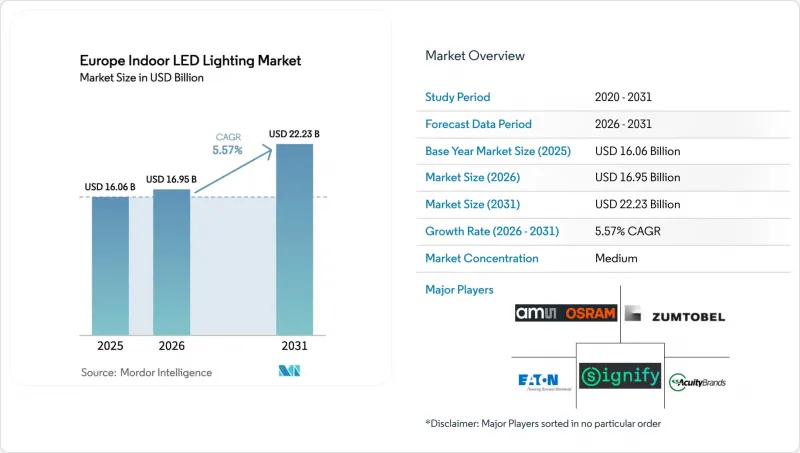
本報告按產品類型(燈具、照明設備)、應用領域(住宅、商業辦公室、零售商店等)、安裝類型(新安裝、維修)、分銷管道(直銷、批發/零售、電子商務)和地區(德國、法國等)進行細分。市場預測以美元計價。
歐洲室內LED照明市場趨勢與洞察
加速淘汰螢光(歐盟RoHS指令)
歐盟逐步淘汰T8、T5和緊湊型螢光,迫使建築業主更換約5億盞燈具,加速了歐洲LED照明產業的更新換代需求。這形成了一個強勁的更新周期,同時也推動了燈具、燈泡和控制設備的銷售成長。安裝項目通常包括感測器升級和緊急照明相容性檢查,這增加了平均維修成本,但也使提供承包解決方案和強大的承包商支援網路的供應商受益。
為「翻新浪潮」邁向淨零建築資金籌措
歐盟委員會斥資1500億歐元的「節能改造浪潮」計畫正在推動節能維修的全面補貼,其中照明改造佔符合條件支出的15%至20%。低利率貸款和直接津貼縮短了先進LED系統的投資回收期,進而推動了對可與建築能源管理儀錶板配合使用的智慧照明設備的需求。由於各國計畫與歐盟資金流向保持一致,北歐國家受益最大,瑞典和丹麥的LED照明普及率已接近80%。
稀土元素磷光體供應鏈中的價格衝擊
2024年銪價飆漲40%將擠壓LED磷光體的利潤空間。這是由於中國的出口限制暴露了對歐洲原料的依賴。磷光體佔晶片成本的12%之多,而對色彩還原要求極高的應用領域首當其衝受到影響。由於量子點和鈣鈦礦等替代技術距離量產仍需3-5年時間,高階照明產品線的短期脆弱性預計將持續存在。
細分市場分析
2025年,照明燈具銷售額佔總銷售額的59.48%,主要受單價上漲和許多維修工程中強制更換燈具的推動。歐洲室內LED照明市場照明燈具的市場規模預計將從2025年的95.5億美元成長到2031年的130.5億美元。內建感測器的建築照明燈具推高了平均售價,並增強了產品差異化。 LEDVANCE的無框吸頂燈面板正是這一優質化趨勢的典型代表,其零售價比基本的托弗式照明燈具高出40%,同時還能縮短安裝時間。
儘管燈具市場規模相對較小,但預計到2031年將以7.10%的複合年成長率成長,這主要得益於螢光禁令引發的大規模更換需求。即插即用的智慧燈管,如今整合了調光和人體感應等功能,模糊了不同產品類別之間的界線。較低的初始成本吸引了那些推遲大規模維修的設施管理人員的關注,但預計在2026年更換需求達到高峰後,其市場佔有率將趨於平緩。擁有豐富燈具產品系列和靈活物流系統的供應商將更能掌握此限時需求。
至2025年,住宅應用將佔室內LED照明銷售額的40.88%。隨著智慧音箱生態系統的普及,語音控制照明成為可能,以及年輕住宅對節能的日益重視,歐洲室內LED照明市場佔有率預計將會擴大。較低的入門價格和便利的DIY套件正在縮短引進週期。初期購買主要以連網燈泡和軟性燈帶為主,但隨後會升級至全屋照明燈具,從而推高平均交易額。
儘管商業辦公室和零售業的銷售量依然可觀,但各行業的成長趨勢卻呈現分化趨勢。辦公室優先考慮與員工健康和空間利用效率相關的數據,而零售業則專注於能夠影響顧客停留時間的可調色溫聚光燈。醫療機構正在病房層面試點使用可調色溫照明系統,因為該系統已被證實能夠有效調節晝夜節律。工業用戶則越來越傾向於選擇配備預測性維護感測器的高棚照明燈具,這些燈具能夠在造成代價高昂的停機之前發出溫度異常預警。
其他好處:
- Excel格式的市場預測(ME)表
- 3個月的分析師支持
目錄
第1章:引言
- 研究假設和市場定義
- 調查範圍
第2章:調查方法
第3章執行摘要
第4章 市場狀況
- 市場概覽
- 市場促進因素
- 加速淘汰螢光(歐盟RoHS指令)
- 為實現淨零排放建築標準而進行的「改造浪潮」資金籌措。
- 企業ESG政策正在推動智慧照明的普及。
- 投資方向轉變,轉向以人為本、考慮晝夜節律的照明方式
- 利用SiC/GaN功率IC來降低LED驅動器和光學元件的成本。
- 對數據豐富的照明(室內定位、資產追蹤)的需求
- 市場限制因素
- 稀土元素磷光體供應鏈中的價格衝擊
- PoE和無線控制系統安裝人員技能不足
- 儘管有獎勵,但中小企業維修的初始資本投資障礙仍然存在。
- 物聯網安全和資料隱私(GDPR)方面的合規負擔
- 宏觀經濟因素對市場的影響
- 產業價值鏈分析
- 監理情勢
- 技術展望
- 波特五力分析
第5章 市場規模與成長預測
- 依產品類型
- 燈
- 照明設備
- 透過使用
- 住宅
- 商業辦公
- 零售店
- 飯店業
- 工業設施
- 醫療保健和教育
- 其他用途
- 按安裝類型
- 新推出
- 改裝安裝
- 透過分銷管道
- 直銷
- 批發和零售
- 電子商務
- 國家
- 德國
- 英國
- 法國
- 義大利
- 西班牙
- 荷蘭
- 瑞典
- 挪威
- 丹麥
- 芬蘭
- 比利時
- 奧地利
- 瑞士
- 波蘭
- 捷克共和國
- 其他歐洲國家
第6章 競爭情勢
- 市場集中度
- 策略趨勢
- 市佔率分析
- 公司簡介
- Signify NV
- ams-OSRAM AG
- Zumtobel Group AG
- Acuity Brands, Inc.
- Eaton Corporation plc
- Legrand SA
- Hubbell Incorporated
- Dialight plc
- LEDVANCE GmbH
- Fagerhult Group AB
- Trilux GmbH & Co. KG
- ERCO GmbH
- Glamox AS
- Cree, Inc.
- Lutron Electronics Co., Inc.
- Schneider Electric SE
- Panasonic Holdings Corporation
- GE Current Lighting Solutions, LLC
- Opple Lighting Co., Ltd.
- LEDiL Oy
第7章 市場機會與未來展望
According to Mordor Intelligence, Europe indoor LED lighting market size in 2026 is estimated at USD 16.95 billion, growing from 2025 value of USD 16.06 billion with 2031 projections showing USD 22.23 billion, growing at 5.57% CAGR over 2026-2031.
This report is Segmented by Product Type (Lamps, and Luminaires/Fixtures), Application (Residential, Commercial Offices, Retail Stores, and More), Installation Type (New Installation, and Retrofit Installation), Distribution Channel (Direct Sales, Wholesale Retail, E-Commerce), and Geography (Germany, France, and More). The Market Forecasts are Provided in Terms of Value (USD).
Europe Indoor LED Lighting Market Trends and Insights
Accelerated Phase-Out of Fluorescent Lamps (EU RoHS)
The EU-wide withdrawal of T8, T5, and compact fluorescent lamps forces building owners to convert an estimated 500 million fixtures, accelerating replacement demand across the Europe LED lighting industry and creating a captive replacement cycle that drives up volumes of luminaires, lamps, and control gear in tandem. Installation projects frequently bundle sensor upgrades and emergency-lighting compliance checks, raising average retrofit values and rewarding suppliers with turnkey solutions and robust contractor support networks.
Renovation-Wave Funding for Net-Zero Buildings
The European Commission's EUR 150 billion Renovation Wave steers subsidies toward deep-energy refurbishments, and lighting can claim 15-20% of eligible spend. Low-interest loans and direct grants reduce the payback periods for advanced LED systems, thereby spurring demand for connected fixtures that interface with building energy dashboards. Northern Europe benefits most as national programs align with EU capital flows, yielding LED penetration rates approaching 80% in Sweden and Denmark.
Supply-Chain Price Shocks for Rare-Earth Phosphors
A 40% price spike for europium in 2024 tightened LED phosphor margins, as Chinese export curbs exposed Europe's raw-material dependency. Phosphors account for up to 12% of chip costs, and color-critical applications are the first to feel the pinch. Quantum-dot and perovskite substitutes remain three to five years from scale, sustaining near-term vulnerability for premium fixture lines.
Other drivers and restraints analyzed in the detailed report include:
- Corporate ESG Mandates Driving Connected-Lighting Retrofits
- CAPEX Shift to Human-Centric and Circadian-Tuned Lighting
- Installers' Skills Gap for PoE / Wireless Controls
For complete list of drivers and restraints, kindly check the Table Of Contents.
Segment Analysis
Luminaires captured 59.48% of 2025 revenue thanks to higher unit pricing and mandatory fixture swaps in many retrofit scenarios. Europe indoor LED lighting market size for luminaires is set to expand from USD 9.55 billion in 2025 to USD 13.05 billion by 2031. Architectural models with embedded sensors raise average selling prices and support differentiation. LEDVANCE's frameless ceiling panels exemplify this premium trend, retailing 40% above basic troffers while cutting installation time.
The lamps segment, although smaller, is projected to grow at a 7.10% CAGR through 2031, driven by bans on fluorescent bulbs, which are prompting bulk replacements. Plug-and-play smart tubes now integrate dimming and occupancy sensing, blurring the lines between categories. Upfront cost advantages appeal to facility managers, who are delaying deeper renovations, but the revenue share is forecast to plateau once replacement peaks in 2026. Vendors with broad lamp portfolios and logistics agility are best positioned to harvest this time-sensitive demand.
Residential use already accounts for 40.88% of 2025 sales. The Europe indoor LED lighting market share in homes is expected to increase as smart-speaker ecosystems become more prevalent, enabling voice-based lighting control, and as younger homeowners prioritize energy rating upgrades. Falling entry prices and DIY-friendly kits shorten adoption cycles. Connected bulbs and flexible strip lights dominate early purchases, later segueing into whole-room fixture upgrades that bolster ticket size.
Commercial offices and retail maintain significant volumes, but growth splits by specialization. Offices prioritize wellness and space-utilization data, while retail focuses on color-tunable spotlights that influence shopper dwell time. Healthcare facilities, spurred by the demonstrated benefits of circadian rhythms, are trialing tunable systems at the ward level. Industrial buyers tend to favor high-bay luminaires equipped with predictive-maintenance sensors that alert to temperature anomalies before costly downtime occurs.
Complete Report Scope:
- By Product Type
- Lamps
- Luminaires/Fixtures
- By Application
- Residential
- Commercial Offices
- Retail Stores
- Hospitality
- Industrial Facilities
- Healthcare and Education
- Other Applications
- By Installation Type
- New Installation
- Retrofit Installation
- By Distribution Channel
- Direct Sales
- Wholesale Retail
- E-commerce
- By Country
- Germany
- United Kingdom
- France
- Italy
- Spain
- Netherlands
- Sweden
- Norway
- Denmark
- Finland
- Belgium
- Austria
- Switzerland
- Poland
- Czech Republic
- Rest of Europe
List of Companies Covered in this Report:
- Signify N.V.
- ams-OSRAM AG
- Zumtobel Group AG
- Acuity Brands, Inc.
- Eaton Corporation plc
- Legrand SA
- Hubbell Incorporated
- Dialight plc
- LEDVANCE GmbH
- Fagerhult Group AB
- Trilux GmbH & Co. KG
- ERCO GmbH
- Glamox AS
- Cree, Inc.
- Lutron Electronics Co., Inc.
- Schneider Electric SE
- Panasonic Holdings Corporation
- GE Current Lighting Solutions, LLC
- Opple Lighting Co., Ltd.
- LEDiL Oy
Additional Benefits:
- The market estimate (ME) sheet in Excel format
- 3 months of analyst support
TABLE OF CONTENTS
1 INTRODUCTION
- 1.1 Study Assumptions and Market Definition
- 1.2 Scope of the Study
2 RESEARCH METHODOLOGY
3 EXECUTIVE SUMMARY
4 MARKET LANDSCAPE
- 4.1 Market Overview
- 4.2 Market Drivers
- 4.2.1 Accelerated Phase-Out of Fluorescent Lamps (EU RoHS)
- 4.2.2 Renovation-Wave Funding for Net-Zero Buildings
- 4.2.3 Corporate ESG Mandates Driving Connected-Lighting Retrofits
- 4.2.4 CAPEX Shift to Human-Centric and Circadian-Tuned Lighting
- 4.2.5 Cost-Down of LED Drivers and Optics via SiC/GaN Power ICs
- 4.2.6 Demand for Data-Rich Lighting (Indoor Positioning, Asset-Tracking)
- 4.3 Market Restraints
- 4.3.1 Supply-Chain Price Shocks for Rare-Earth Phosphors
- 4.3.2 Installers' Skills Gap for PoE / Wireless Controls
- 4.3.3 Up-Front CAPEX Hurdle in SME Retrofits Despite Incentives
- 4.3.4 IoT-Security and Data-Privacy Compliance Burdens (GDPR)
- 4.4 Impact of Macroeconomic Factors on the Market
- 4.5 Industry Value Chain Analysis
- 4.6 Regulatory Landscape
- 4.7 Technological Outlook
- 4.8 Porter's Five Forces Analysis
- 4.8.1 Threat of New Entrants
- 4.8.2 Bargaining Power of Suppliers
- 4.8.3 Bargaining Power of Buyers
- 4.8.4 Threat of Substitutes
- 4.8.5 Intensity of Competitive Rivalry
5 MARKET SIZE AND GROWTH FORECASTS (VALUE)
- 5.1 By Product Type
- 5.1.1 Lamps
- 5.1.2 Luminaires/Fixtures
- 5.2 By Application
- 5.2.1 Residential
- 5.2.2 Commercial Offices
- 5.2.3 Retail Stores
- 5.2.4 Hospitality
- 5.2.5 Industrial Facilities
- 5.2.6 Healthcare and Education
- 5.2.7 Other Applications
- 5.3 By Installation Type
- 5.3.1 New Installation
- 5.3.2 Retrofit Installation
- 5.4 By Distribution Channel
- 5.4.1 Direct Sales
- 5.4.2 Wholesale Retail
- 5.4.3 E-commerce
- 5.5 By Country
- 5.5.1 Germany
- 5.5.2 United Kingdom
- 5.5.3 France
- 5.5.4 Italy
- 5.5.5 Spain
- 5.5.6 Netherlands
- 5.5.7 Sweden
- 5.5.8 Norway
- 5.5.9 Denmark
- 5.5.10 Finland
- 5.5.11 Belgium
- 5.5.12 Austria
- 5.5.13 Switzerland
- 5.5.14 Poland
- 5.5.15 Czech Republic
- 5.5.16 Rest of Europe
6 COMPETITIVE LANDSCAPE
- 6.1 Market Concentration
- 6.2 Strategic Moves
- 6.3 Market Share Analysis
- 6.4 Company Profiles
- 6.4.1 Signify N.V.
- 6.4.2 ams-OSRAM AG
- 6.4.3 Zumtobel Group AG
- 6.4.4 Acuity Brands, Inc.
- 6.4.5 Eaton Corporation plc
- 6.4.6 Legrand SA
- 6.4.7 Hubbell Incorporated
- 6.4.8 Dialight plc
- 6.4.9 LEDVANCE GmbH
- 6.4.10 Fagerhult Group AB
- 6.4.11 Trilux GmbH & Co. KG
- 6.4.12 ERCO GmbH
- 6.4.13 Glamox AS
- 6.4.14 Cree, Inc.
- 6.4.15 Lutron Electronics Co., Inc.
- 6.4.16 Schneider Electric SE
- 6.4.17 Panasonic Holdings Corporation
- 6.4.18 GE Current Lighting Solutions, LLC
- 6.4.19 Opple Lighting Co., Ltd.
- 6.4.20 LEDiL Oy
7 MARKET OPPORTUNITIES AND FUTURE OUTLOOK
- 7.1 White-space and Unmet-Need Assessment

 2026年全球室內發光二極體(LED)照明市場報告
 可調光LED軌道燈具市場按類型、光源、安裝方式、功率、應用和最終用戶分類-全球預測,2026-2032年
 中國室內 LED 照明:市場佔有率分析、產業趨勢與統計、成長預測(2025-2030 年)中東和非洲室內 LED 照明:市場佔有率分析、行業趨勢和統計、成長預測(2025-2030 年)亞太室內 LED 照明:市場佔有率分析、產業趨勢與統計、成長預測(2025-2030 年)北美室內 LED 照明:市場佔有率分析、行業趨勢和統計、成長預測(2025-2030 年)南美室內 LED 照明:市場佔有率分析、行業趨勢和統計、成長預測(2025-2030 年)印度室內 LED 照明:市場佔有率分析、行業趨勢和統計、成長預測(2025-2030 年)室內 LED 照明:市場佔有率分析、行業趨勢和統計、成長預測(2025-2030 年)德國室內 LED 照明:市場佔有率分析、行業趨勢和統計、成長預測(2025-2030 年)