


 |
市場調查報告書
商品編碼
2125717
廣告技術:市場佔有率分析、產業趨勢與統計、成長預測(2026-2031)Ad Tech - Market Share Analysis, Industry Trends & Statistics, Growth Forecasts (2026 - 2031) |
||||||

※ 本網頁內容可能與最新版本有所差異。詳細情況請與我們聯繫。
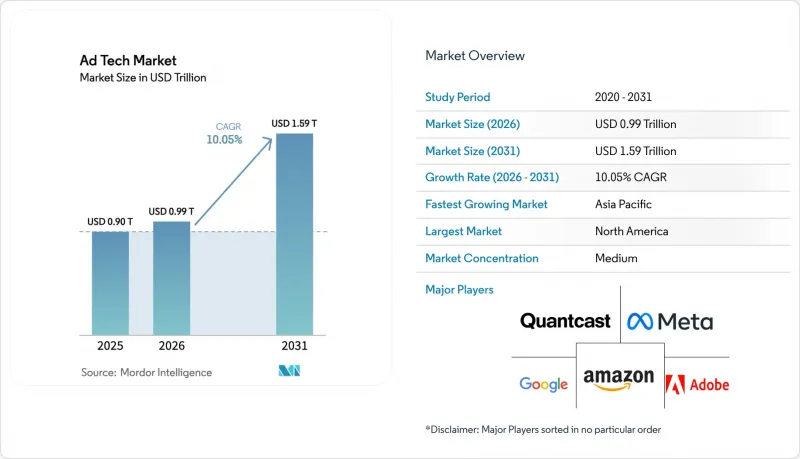
據 Mordor Intelligence 稱,2025 年廣告科技市場價值為 8,980 億美元,預計到 2031 年將達到 1.59 兆美元,而 2026 年為 9,900 億美元,預測期(2026-2031 年)的複合年成長率為 10.05%。
本報告按平台(DSP、SSP、廣告交易平臺、DMP 等)、廣告格式(搜尋廣告、展示橫幅廣告、影片廣告、社群媒體廣告、電子郵件廣告等)、裝置平台(行動裝置/智慧型手機、桌上型電腦/筆記型電腦、聯網電視/OTT 裝置等)、終端使用者產業(零售/電子商務、銀行、金融服務和筆記型電腦、智慧電視/OTT 裝置等)、終端使用者產業(零售/電子商務、銀行、金融服務和電信 (BFSI)、醫療保健/電信地區教育、金融/電信市場預測以美元 (USD) 計價。
全球廣告科技市場趨勢與洞察
CTV主導的程式化廣告激增
串流媒體發行商正將廣告庫存從直接插播訂單轉向公開競標,程式化連網電視廣告 (CTV) 目前已佔品牌總預算的 17%。 The Trade Desk 的 Ventura 作業系統可協助買家提升頻次控制和受眾覆蓋率,同時降低發行商的技術相關成本。與零售媒體資料集的整合實現了確定性歸因,將觀看行為與購買行為關聯起來。超過 95% 的受訪廣告主計畫維持或增加其 CTV 預算分配,顯示在經濟波動的情況下,市場需求依然強勁。擁有統一 ID 框架的平台正在獲得優質影片廣告庫存的優先進入許可權,從而加速整個廣告技術市場供應路徑的最佳化。
停止使用第三方 Cookie
Chrome逐步淘汰Cookie以及歐盟關於同意字串的規定正在加速向第一方識別碼的轉變。谷歌的「隱私沙盒」在初始測試階段就導致發布商收入下降高達33%。因此,行銷人員正在增加情境定向的預算,並採用「潔淨室」整合方案,以便在不使用個人識別識別碼的情況下保持定向能力。擁有已驗證交易資料的零售商正受益於廣告商日益成長的興趣,而小規模發布商則利用語義訊號模型來維持CPM。對於旨在建立面向未來的激活工作流程的全通路品牌而言,實施客戶資料平台(CDP)已成為標準做法。
世界各地限制跨裝置身分圖譜的隱私權法
歐洲法院2024年3月的一項裁決將同意字串歸類為個人數據,使IAB Europe成為共同管理者,並加重了整個供應鏈的合規負擔。 《數位市場法案》的新義務要求所有資料使用都必須獲得明確的選擇加入,而跨裝置識別碼的效能正在下降。安全隔離網閘平台必須提供點擊層級的透明度,競爭優勢正在轉移到注重隱私的上下文解決方案中。許多大型廣告商正在限制其在歐盟的重新導向廣告支出,並將更多資金投入特定市場,這降低了廣告科技市場的短期成長潛力。
細分市場分析
到2025年,廣告交易平臺將佔廣告支出的63.62%,進而支撐公開競標的流動性。需求端平台(DSP)雖然規模較小,但由於買家傾向於使用自動化最佳化來降低營運成本,其年成長率也達到了12.08%。隨著企業廣告商將大部分預算轉向自助式工作流程,廣告科技市場,尤其是DSP市場,預計將在2031年之前大幅擴張。亞馬遜的DSP收入已佔其廣告收入的近三分之一,凸顯了電商數據與程序化競標之間的協同效應。
為了應對這項挑戰,供應端平台 (SSP) 正在透過進一步最佳化供應路徑來解決問題。例如,PubMatic 將其超過一半的交易展示量透過佣金率較低的優選管道進行路由。隨著第三方 Cookie 的消失,小規模的資料管理平台 (DMP) 供應商將失去市場地位,要麼倒閉,要麼被大規模平台收購。微軟計劃退出其獨立的 DSP 業務,這表明要跟上機器學習創新步伐需要大量的資本投入。隨著競爭的加劇,平台整合勢在必行,廣告科技市場的長尾供應商數量將會減少。
預計到2025年,搜尋將佔總收入的38.15%,並持續以11.92%的複合年成長率成長,這主要得益於人工智慧驅動的多模態查詢解讀技術,該技術能夠展示與商業相關的搜尋結果。在連網電視和行動應用程式的支援下,視訊格式正逐步蠶食品牌廣告預算,使其從靜態展示廣告轉向其他管道。社群媒體的成長速度正在放緩,尤其是在健康和金融等敏感領域,由於內容政策更加嚴格,社群媒體的成長速度明顯放緩。
遊戲內廣告和擴增實境(AR) 廣告雖然仍處於早期階段,但已展現出極高的用戶參與度,並吸引了許多消費性電子品牌的試點預算。電子郵件廣告依然強勁,這得益於可繞過識別碼限制的認證資料集。谷歌的 Gemini 平台預計將原生搜尋廣告整合到對話式回覆中,從而在不干擾用戶意圖的前提下,創造新的廣告資源。廣告科技市場正持續從橫幅廣告展示向以體驗為中心的廣告形式演變,這些形式有望在身臨其境型環境中帶來可衡量的效果。
區域分析
預計到2025年,北美將佔全球收入的40.12%,這得益於成熟的基礎設施、經驗豐富的廣告商以及CTV的強勁普及,後者已推動串流媒體支出達到301億美元。大規模零售媒體網路和完善的識別框架鞏固了該地區的領先地位,但各州頒布的隱私法規也帶來了一些合規方面的摩擦。總部位於美國的科技供應商透過佔據大部分智慧財產權申請並吸引大部分創業投資資金,進一步鞏固了其在廣告技術市場的領導地位。
亞太地區是成長最快的地區,複合年成長率高達12.16%,這主要得益於行動優先的消費行為、5G覆蓋範圍的擴大以及電子商務活動的蓬勃發展。根據GSMA估計,2023年行動科技為該地區GDP貢獻了8,800億美元,預計到2030年將達到1兆美元。中國整合支付、社群媒體和內容的超級應用生態系統,目前正被印度、印尼和越南的廣告商所效仿。儘管監管方式仍有差異,但大多數地區仍鼓勵外商投資數位媒體,維持了廣告科技市場的長期發展動能。
在歐洲,儘管全面的隱私法限制了跨裝置定向,但基於情境和基於用戶群的模型創新正在蓬勃發展,並推動了適度成長。受衡量協議標準化的推動,預計到2026年,零售媒體支出將達到250億歐元。南美洲和中東及非洲地區正處於成長初期,其特點是寬頻普及率不斷提高和本地內容製作蓬勃發展。南美洲的程序化廣告支出從2017年的52億美元增加到2023年的168億美元。同時,中東和北非地區的數位廣告支出預計將在2022年至2025年間增加五倍。這些趨勢凸顯了廣告科技市場在全球的快速擴張。
其他好處
- Excel格式的市場預測(ME)表
- 3個月的分析師支持
目錄
第1章:引言
- 研究假設和市場定義
- 調查範圍
第2章:調查方法
第3章執行摘要
第4章 市場狀況
- 市場概覽
- 市場促進因素
- 北美地區 CTV主導的程式化廣告激增
- 逐步淘汰第三方 Cookie 將加速第一方資料解決方案的普及。
- 透過人工智慧驅動的動態創新最佳化提升廣告支出報酬率
- 零售媒體網路如何利用第一方購物者資料獲利
- GDPR 之類的法規正在推動歐洲的上下文定向技術發展。
- 5G部署將為亞洲地區的行動影片廣告帶來豐富體驗。
- 市場限制因素
- 世界各地限制跨裝置身分圖譜的隱私權法
- 新興市場廣告詐騙策略的複雜性
- 供應鏈管道日益複雜,推高了確保透明度的成本。
- 數據工程人才嚴重短缺
- 技術展望
- 廣告平台數位轉型
- 基於位置的上下文廣告的發展
- 監理展望
- 波特五力分析
- 宏觀經濟逆風對數位廣告支出的影響
第5章 市場規模與成長預測
- 按平台
- 需求端平台(DSP)
- 供應端平台(SSP)
- 廣告交易平臺
- 資料管理平台(DMP)
- 其他
- 廣告格式
- 搜尋廣告
- 全橫幅
- 影片廣告
- 社群媒體
- 電子郵件
- 其他
- 按設備平台
- 行動裝置和智慧型手機
- 桌上型筆記型電腦
- 聯網電視和OTT設備
- 其他設備(智慧音箱、穿戴式裝置)
- 按最終用戶行業分類
- 零售與電子商務
- BFSI
- 醫療和藥品
- 媒體與娛樂
- IT/通訊
- 服務
- 車
- 教育
- 其他
- 按地區
- 北美洲
- 美國
- 加拿大
- 墨西哥
- 南美洲
- 巴西
- 阿根廷
- 其他南美國家
- 歐洲
- 德國
- 英國
- 法國
- 義大利
- 西班牙
- 其他歐洲國家
- 亞太地區
- 中國
- 日本
- 韓國
- 印度
- 澳洲
- 其他亞太國家
- 中東
- 阿拉伯聯合大公國
- 沙烏地阿拉伯
- 其他中東國家
- 非洲
- 南非
- 其他非洲地區
- 北美洲
第6章 競爭情勢
- 策略性舉措(併購、合作、資金籌措)
- 市佔率分析
- 公司簡介
- Alphabet Inc.
- Meta Platforms, Inc.
- Amazon.com, Inc.
- The Trade Desk, Inc.
- Microsoft Corporation
- Adobe Inc.
- 雅虎公司(隸屬於阿波羅全球管理公司)
- Magnite, Inc.
- PubMatic, Inc.
- Criteo SA
- Oracle Corporation
- Index Exchange Inc.
- MediaMath Inc.
- InMobi Pte. Ltd.
- AppLovin Corporation
- Zeta Global Holdings Corp.
- Adform A/S
- Quantcast Corporation
- Rakuten Group, Inc.
- IronSource有限公司(與Unity Software Inc.合併)
- StackAdapt Inc.
- Xandr公司(已被微軟收購)
- Mediaocean LLC
- OpenX
第7章 市場機會與未來展望
According to Mordor Intelligence, the advertising tech market size was valued at USD 0.898 trillion in 2025 and estimated to grow from USD 0.99 trillion in 2026 to reach USD 1.59 trillion by 2031, at a CAGR of 10.05% during the forecast period (2026-2031).
This report is Segmented by Platform (DSP, SSP, Ad Exchanges, DMP, and More), Ad Format (Search, Display, Video, Social Media, Email, and More), Device Platform (Mobile, Desktop, CTV and OTT, and More), End-User Industry (Retail, BFSI, Healthcare, Media, IT, Automotive, Education, and More), and Geography (North America, and More). The Market Forecasts are Provided in Terms of Value (USD).
Global Ad Tech Market Trends and Insights
CTV-led programmatic surge
Streaming publishers are shifting inventory from direct insertion orders to open auctions, and programmatic CTV now attracts 17% of total brand budgets. The Trade Desk's Ventura operating system improves frequency capping and audience reach for buyers while lowering publisher tech spend. Convergence with retail-media datasets delivers deterministic attribution that ties viewership to purchases. Over 95% of surveyed advertisers plan to maintain or expand CTV allocations, highlighting resilient demand even amid economic volatility. Platforms with unified ID frameworks gain priority access to premium video placements, which in turn accelerates supply-path optimisation across the advertising tech market.
Third-party-cookie deprecation
Chrome's phased withdrawal of cookies and the EU's consent string ruling are accelerating migration to first-party identifiers. Google's Privacy Sandbox faces yield gaps of up to 33% for publishers during early testing phases. Marketers are therefore increasing contextual targeting budgets and adopting clean-room integrations that retain addressability without personal identifiers. Retailers with authenticated transaction data benefit from surging advertiser interest, while smaller publishers exploit semantic-signal models to preserve CPMs. Customer-data-platform deployments have become standard practice for omni-channel brands aiming to future-proof activation workflows.
Global privacy laws limiting cross-device graphs
The March 2024 Court of Justice ruling classifies consent strings as personal data, making IAB Europe a joint controller and raising compliance burdens across the supply chain. New obligations under the Digital Markets Act demand clear opt-ins for every data use, eroding performance of cross-device identifiers. Gatekeeper platforms must provide click-level transparency, shifting competitive advantage toward privacy-native contextual solutions. Many large advertisers have capped EU retargeting spend and diverted incremental funds to curated marketplaces, diminishing short-term growth potential in the advertising tech market.
Other drivers and restraints analyzed in the detailed report include:
- AI-driven dynamic creative optimisation
- Retail-media monetisation of first-party data
- Rising sophistication of ad-fraud
For complete list of drivers and restraints, kindly check the Table Of Contents.
Segment Analysis
Ad Exchanges delivered 63.62% of 2025 spend, anchoring liquidity across open auctions. Demand-Side Platforms, while smaller, are growing at 12.08% annually as buyers prefer automated optimisations that cut operational overheads. The advertising tech market size captured by DSPs is projected to widen materially through 2031 as enterprise advertisers migrate bulk budgets into self-serve workflows. Amazon's DSP already accounts for almost one-third of the retailer's ad turnovers, underscoring the synergies of commerce data with programmatic bidding.
Supply-Side Platforms respond by deepening supply-path optimisation, with PubMatic funnelling more than half of traded impressions through preferential pipes that carry reduced take-rates. Smaller data-management-platform vendors lose relevance when third-party cookies vanish and are either shuttered or absorbed by larger stacks. Microsoft's planned exit from stand-alone DSP operations illustrates the capital intensity required to keep pace with machine-learning innovation. As competitive barriers climb, platform consolidation is expected, compressing the long-tail provider base inside the advertising tech market.
Search captured 38.15% of revenue in 2025 and is still expanding at a 11.92% CAGR, leveraging AI-driven multimodal query interpretation to surface commerce-adjacent results. Video formats, buoyed by CTV and mobile apps, siphon incremental brand dollars away from static display. Social media growth is flattening due to tighter content policies, particularly within sensitive health and financial categories.
In-game and augmented-reality placements are embryonic yet show high engagement, attracting exploratory budgets from consumer-electronics brands. Email remains resilient thanks to authenticated data sets that circumvent identifier restrictions. Google's Gemini platform is expected to embed native search ads into conversational responses, creating fresh inventory pools without disrupting user intent. The advertising tech market continues to evolve from banner impressions toward experience-centric formats that promise measurable outcomes across immersive environments.
Complete Report Scope:
- By Platform
- Demand-Side Platforms (DSP)
- Supply-Side Platforms (SSP)
- Ad Exchanges
- Data Management Platforms (DMP)
- Others
- By Ad Format
- Search Advertising
- Display/Banner
- Video Advertising
- Social Media
- Others
- By Device Platform
- Mobile Devices and Smartphones
- Desktop and Laptop
- Connected TV and OTT Devices
- Other Devices (Smart Speakers, Wearables)
- By End-user Industry
- Retail and E-commerce
- BFSI
- Healthcare and Pharmaceuticals
- Media and Entertainment
- IT and Telecommunications
- Services
- Automotive
- Education
- Others
- By Geography
- North America
- United States
- Canada
- Mexico
- South America
- Brazil
- Argentina
- Rest of South America
- Europe
- Germany
- United Kingdom
- France
- Italy
- Spain
- Rest of Europe
- Asia-Pacific
- China
- Japan
- South Korea
- India
- Australia
- Rest of Asia-Pacific
- Middle East
- United Arab Emirates
- Saudi Arabia
- Rest of Middle East
- Africa
- South Africa
- Rest of Africa
- North America
Geography Analysis
North America retained 40.12% of 2025 turnover, supported by mature infrastructure, deep advertiser sophistication, and robust CTV adoption that lifted streaming spend to USD 30.1 billion. Large retail-media networks and advanced identity frameworks reinforce the region's primacy, even as emerging state privacy statutes add compliance friction. Technology vendors headquartered in the United States account for the majority of intellectual-property filings and attract the bulk of venture funding, further entrenching leadership within the advertising tech market.
Asia-Pacific is the fastest-growing territory at a 12.16% CAGR, propelled by mobile-first consumer behaviour, accelerated 5G coverage, and surging e-commerce activity. GSMA estimates mobile technology contributed USD 880 billion to regional GDP in 2023, with a USD 1 trillion forecast for 2030. China's super-app ecosystems integrate payments, social, and content, creating blueprints that advertisers in India, Indonesia, and Vietnam are now adopting. Regulatory approaches remain heterogeneous, but most jurisdictions continue to encourage foreign investment in digital media, sustaining long-term momentum for the advertising tech market.
Europe shows moderate growth as comprehensive privacy laws squeeze cross-device targeting but encourage innovation in contextual and cohort-based models. Retail-media spending is projected to reach EUR 25 billion by 2026 on the back of harmonised measurement protocols. South America and the Middle East and Africa represent early-stage adoption curves characterised by improving broadband penetration and rising local content production. Programmatic spend in South America climbed from USD 5.2 billion in 2017 to USD 16.8 billion in 2023, while the MENA region's digital advertising outlay is on track to quintuple between 2022 and 2025. These trends confirm a broadening global footprint for the advertising tech market.
- Alphabet Inc.
- Meta Platforms, Inc.
- Amazon.com, Inc.
- The Trade Desk, Inc.
- Microsoft Corporation
- Adobe Inc.
- Yahoo Inc. (Owned by Apollo Global Management)
- Magnite, Inc.
- PubMatic, Inc.
- Criteo S.A.
- Oracle Corporation
- Index Exchange Inc.
- MediaMath Inc.
- InMobi Pte. Ltd.
- AppLovin Corporation
- Zeta Global Holdings Corp.
- Adform A/S
- Quantcast Corporation
- Rakuten Group, Inc.
- IronSource Ltd. (Merged with Unity Software Inc.)
- StackAdapt Inc.
- Xandr Inc. (Acquired by Microsoft)
- Mediaocean LLC
- OpenX
Additional Benefits:
- The market estimate (ME) sheet in Excel format
- 3 months of analyst support
TABLE OF CONTENTS
1 Introduction
- 1.1 Study Assumptions and Market Definition
- 1.2 Scope of the Study
2 Research Methodology
3 Executive Summary
4 Market Landscape
- 4.1 Market Overview
- 4.2 Market Drivers
- 4.2.1 CTV-Led Programmatic Surge in North America
- 4.2.2 Deprecation of Third-Party Cookies Accelerating First-Party Data Solutions
- 4.2.3 AI-Driven Dynamic Creative Optimisation Uplifting ROAS
- 4.2.4 Retail Media Networks Monetising First-Party Shopper Data
- 4.2.5 GDPR-Style Regulations Fueling Contextual Targeting in Europe
- 4.2.6 5G Roll-outs Enabling Rich Mobile Video Ads Across Asia
- 4.3 Market Restraints
- 4.3.1 Global Privacy Laws Constraining Cross-Device Identity Graphs
- 4.3.2 Rising Sophistication of Ad-Fraud in Emerging Markets
- 4.3.3 Supply-Path Complexity Elevating Transparency Costs
- 4.3.4 Acute Data-Engineering Talent Shortages
- 4.4 Technological Outlook
- 4.4.1 Digital Transformation in Advertising Platforms
- 4.4.2 Location-Based and Contextual Advertising Advances
- 4.5 Regulatory Outlook
- 4.6 Porter's Five Forces Analysis
- 4.6.1 Threat of New Entrants
- 4.6.2 Bargaining Power of Buyers
- 4.6.3 Bargaining Power of Suppliers
- 4.6.4 Threat of Substitutes
- 4.6.5 Competitive Rivalry
- 4.7 Impact of Macroeconomic Headwinds on Digital Ad Spend
5 Market Size and Growth Forecasts (Value)
- 5.1 By Platform
- 5.1.1 Demand-Side Platforms (DSP)
- 5.1.2 Supply-Side Platforms (SSP)
- 5.1.3 Ad Exchanges
- 5.1.4 Data Management Platforms (DMP)
- 5.1.5 Others
- 5.2 By Ad Format
- 5.2.1 Search Advertising
- 5.2.2 Display/Banner
- 5.2.3 Video Advertising
- 5.2.4 Social Media
- 5.2.5 Email
- 5.2.6 Others
- 5.3 By Device Platform
- 5.3.1 Mobile Devices and Smartphones
- 5.3.2 Desktop and Laptop
- 5.3.3 Connected TV and OTT Devices
- 5.3.4 Other Devices (Smart Speakers, Wearables)
- 5.4 By End-user Industry
- 5.4.1 Retail and E-commerce
- 5.4.2 BFSI
- 5.4.3 Healthcare and Pharmaceuticals
- 5.4.4 Media and Entertainment
- 5.4.5 IT and Telecommunications
- 5.4.6 Services
- 5.4.7 Automotive
- 5.4.8 Education
- 5.4.9 Others
- 5.5 By Geography
- 5.5.1 North America
- 5.5.1.1 United States
- 5.5.1.2 Canada
- 5.5.1.3 Mexico
- 5.5.2 South America
- 5.5.2.1 Brazil
- 5.5.2.2 Argentina
- 5.5.2.3 Rest of South America
- 5.5.3 Europe
- 5.5.3.1 Germany
- 5.5.3.2 United Kingdom
- 5.5.3.3 France
- 5.5.3.4 Italy
- 5.5.3.5 Spain
- 5.5.3.6 Rest of Europe
- 5.5.4 Asia-Pacific
- 5.5.4.1 China
- 5.5.4.2 Japan
- 5.5.4.3 South Korea
- 5.5.4.4 India
- 5.5.4.5 Australia
- 5.5.4.6 Rest of Asia-Pacific
- 5.5.5 Middle East
- 5.5.5.1 United Arab Emirates
- 5.5.5.2 Saudi Arabia
- 5.5.5.3 Rest of Middle East
- 5.5.6 Africa
- 5.5.6.1 South Africa
- 5.5.6.2 Rest of Africa
- 5.5.1 North America
6 Competitive Landscape
- 6.1 Strategic Moves (M&A, Partnerships, Funding)
- 6.2 Market Share Analysis
- 6.3 Company Profiles (includes Global-level Overview, Market-level Overview, Core Segments, Financials, Strategic Information, Products and Services, Recent Developments)
- 6.3.1 Alphabet Inc.
- 6.3.2 Meta Platforms, Inc.
- 6.3.3 Amazon.com, Inc.
- 6.3.4 The Trade Desk, Inc.
- 6.3.5 Microsoft Corporation
- 6.3.6 Adobe Inc.
- 6.3.7 Yahoo Inc. (Owned by Apollo Global Management)
- 6.3.8 Magnite, Inc.
- 6.3.9 PubMatic, Inc.
- 6.3.10 Criteo S.A.
- 6.3.11 Oracle Corporation
- 6.3.12 Index Exchange Inc.
- 6.3.13 MediaMath Inc.
- 6.3.14 InMobi Pte. Ltd.
- 6.3.15 AppLovin Corporation
- 6.3.16 Zeta Global Holdings Corp.
- 6.3.17 Adform A/S
- 6.3.18 Quantcast Corporation
- 6.3.19 Rakuten Group, Inc.
- 6.3.20 IronSource Ltd. (Merged with Unity Software Inc.)
- 6.3.21 StackAdapt Inc.
- 6.3.22 Xandr Inc. (Acquired by Microsoft)
- 6.3.23 Mediaocean LLC
- 6.3.24 OpenX
7 Market Opportunities and Future Outlook
- 7.1 White-Space and Unmet-Need Assessment

 全球廣告科技市場 2026-2030
 廣告科技市場規模、佔有率和成長分析:按技術、廣告格式、部署類型、組織規模、最終用戶和地區分類-2026-2033年產業預測
 廣告科技市場:2026-2032年全球市場預測(按組件、廣告管道、部署模式和最終用戶分類)
 廣告科技市場分析及預測(至2035年):按類型、產品、服務、技術、組件、應用、部署、最終用戶及解決方案分類
 2026 年 AdTech 全球市場報告
 廣告技術市場規模、佔有率、成長及全球產業分析:依類型、應用和地區劃分的洞察與預測(2026-2034)
 廣告科技市場-全球產業規模、佔有率、趨勢、機會與預測:按類型、組織規模、定價類型、最終用戶、通路類型、地區和競爭格局分類,2021-2031年
 廣告科技市場規模、佔有率和成長分析(按產品、廣告類型、廣告管道、廣告格式、平台、公司規模、垂直產業和地區分類)—產業預測(2026-2033 年)
 廣告科技的全球市場:提供區分·部署模型·組織規模·廣告類型·終端用戶產業·各地區的機會及預測 (2018-2032年)
 廣告科技市場規模、佔有率和趨勢分析報告:按平台、解決方案、廣告類型、公司規模、行業、地區和細分市場預測,2025-2030 年