


 |
市場調查報告書
商品編碼
2125697
檯燈與落地燈:市佔率分析、產業趨勢與統計及成長預測(2026-2031 年)Table And Floor Lamps - Market Share Analysis, Industry Trends & Statistics, Growth Forecasts (2026 - 2031) |
||||||

※ 本網頁內容可能與最新版本有所差異。詳細情況請與我們聯繫。
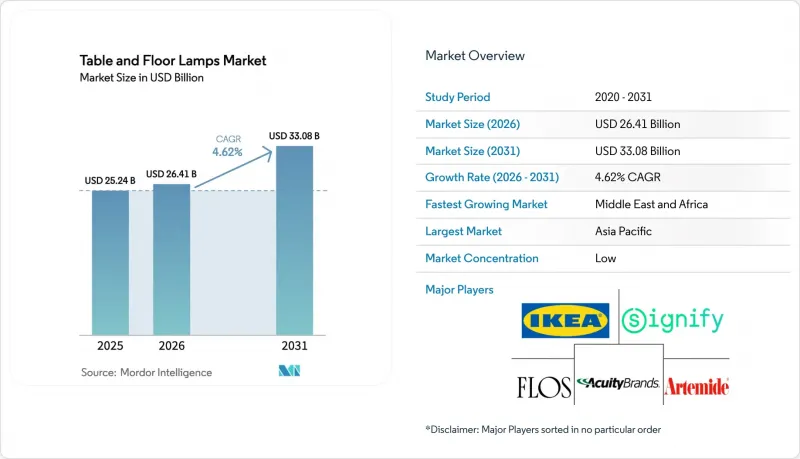
據 Mordor Intelligence 稱,檯燈和落地燈的市場規模預計在 2026 年達到 264.1 億美元,高於 2025 年的 252.4 億美元,預計到 2031 年將達到 330.8 億美元。
預計 2026 年至 2031 年的複合年成長率為 4.62%。
本報告按產品類型(檯燈、落地燈、其他)、材質(金屬、木材、其他)、最終用戶(住宅、商業、其他)、分銷管道(線下、線上)和地區(北美、南美、亞太、歐洲、中東和非洲)進行細分。市場預測以美元(USD)為單位。
全球檯燈及落地燈市場趨勢及洞察
智慧家庭生態系統的普及推動了對連網燈具需求的成長。
智慧照明設備處於照明與物聯網融合的前沿,正將檯燈和落地燈市場從單純的裝飾品轉變為能夠回應語音、佔用和安全訊號的互動式節點。消費者期望與語音助理和行動儀表板無縫整合,互通性不再是錦上添花,而是基本需求。其價值遠不止於簡單的開關和調光,還包括與晝夜節律同步的色溫調節、基於環境感測器資訊的自適應照明控制以及能夠實現節能的預測性使用分析。這些功能使得更高的平均售價和基於雲端的場景庫和遠端診斷服務的訂閱收入物有所值,從而在提高利潤率的同時,將客戶留在品牌生態系統中。檯燈類別尤其受益匪淺,因為知識工作者需要精細的控制來減少眼睛疲勞並延長專注工作時間。如今,各大品牌正在採用面向未來、可升級的無線晶片和開放API,將燈具從一次性電器轉變為持久耐用的平台。
內建LED的裝飾燈具已廣泛應用
隨著LED技術的成熟,傳統的「效率-價格權衡」已被打破,檯燈和落地燈市場正無一例外地轉型為LED標準。 LED燈具佔全球燈具銷售的70%,儘管產品壽命延長,但銷售仍保持穩定,這主要得益於即將到來的第二波換代需求,預計到2024年,更換需求將達到58億台。發光元件的小型化使得創新造型和超薄設計成為可能,可尋址RGB陣列只需輕觸螢幕即可在工作照明和休閒照明之間切換。更低的製造成本使得產品能夠以主流價格銷售,裝飾性LED產品如今已廣泛應用於量販店和酒店業。對於設計師而言,嵌入有機材料和半透明基板的LED基板提供了創新表達的空間;對於消費者而言,最高水準的色彩還原度和5萬小時的使用壽命延長了用戶滿意度,並降低了維護成本。
自有品牌對DIY家具店利潤率構成壓力
大型零售商正利用整合的供應鏈,以比品牌產品低兩位數百分比的價格推出自有品牌燈具,同時維持可接受的製造品質。宜家位列市場佔有率前五,這清楚地表明,銷售整套家具的策略正在疏遠消費者對專業品牌的關注。中型製造商感受到壓力,紛紛採取精簡產品系列、退出某些地區或與取得私募股權資金籌措的下游公司合併等措施。金斯伍德資本斥資2.56億美元將Kichler和Progress Lighting合併為Coleto Brands,顯示透過規模整合是首選的防禦策略。如今,老牌企業透過整合自身的應用程式生態系統和與設計師的合作,來證明其價格溢價的合理性並維持利潤率。
細分市場分析
到2025年,檯燈和工作燈將佔據檯燈和落地燈市場最大的佔有率,銷售額佔比高達48.62%。這主要歸功於雇主和在家工作對能夠適應晝夜節律的照明設備的重視。預計到2025年,該細分市場的銷售額將達到122.7億美元,分析師預測,隨著混合辦公模式的日益普及,到2031年,該細分市場將以3.82%的複合年成長率穩步成長。落地燈仍然是一個快速成長的細分市場,預計複合年成長率將達到14.02%。這主要得益於旅館業和短租屋業主對兼具雕塑感設計與室內裝潢元素的照明設備的強勁需求。傳統檯燈的需求依然旺盛,尤其是在可以加裝Wi-Fi驅動器和語音控制模組以實現自動化場景設定的情況下。裝飾燈、手電筒和特色閱讀燈雖然銷量不高,但由於採用了針對老齡化視力衰退和獨特設計需求的特殊光學技術和材料,依然保持著可觀的利潤率。不斷變化的市場競爭格局正在推動多功能混合型設計(例如帶有工作燈頭的環境燈)的興起,使得單一產品即可滿足客廳氛圍和專注辦公桌的需求。這種多功能性即使在極簡主義趨勢影響家具面積的情況下,仍保持著提升銷售的潛力。
第二代智慧工作燈整合了人體感應器、防眩光百葉窗和 USB-C 充電底座,有效減少桌面雜亂。雇主正透過健康審計量化照明效果,並將頻譜變化與穿戴式裝置的生物辨識數據回饋關聯起來,將燈具轉變為提升員工福祉的參與式資產。此品類的高階產品價格彈性較低,企業負責人的預算分配較多基於生產力提升而非單價。同時,透過大規模電商平台銷售的入門級桌面照明燈具採用通用 LED 和塑膠外殼,導致利潤率較低,但銷售潛力巨大。預計到 2031 年,檯燈、工作燈、落地燈市場規模將達到 153.6 億美元,凸顯了該細分市場即使在新品類湧現的情況下仍保持著持久的主導地位。
到2025年,金屬仍將是主要材料,佔銷售額的35.78%。這主要歸功於鋼和鋁結構,它們具有耐用性、LED溫度控管優異以及豐富的美學選擇。強大的供應鏈和CNC加工的靈活性簡化了設計迭代流程,使品牌能夠透過結合拉絲飾面和粉末塗層顏色等工藝快速適應潮流。然而,木材預計將以14.28%的複合年成長率(CAGR)成為成長最快的材料,這主要得益於其永續性優勢以及針對透明磷光木板的新研究。這些木板能夠凸顯天然木紋,同時散發出柔和的餘輝。這類複合材料兼顧了環保性和功能性發光特性,吸引了注重環保的千禧世代,他們重視透過FSC認證的原料來講述簡潔的碳排放故事。
玻璃作為高階燈具材料,憑藉其光學透明度和手工吹製工藝,依然保持著其雕塑般造型的卓越地位,並以此打造出高階產品系列。此外,LED燈發熱量低,也使得玻璃燈具可以做得更纖薄,而無需擔心熱裂問題。陶瓷在精品工作室中重新受到關注,觸感豐富的釉藥營造出獨特的飾面效果。小批量生產的陶瓷產品沿襲了當地的陶土傳統,並與迅速發展的「慢裝飾」運動相得益彰。再生塑膠合金和麻纖維衍生的生物聚合物被廣泛應用於價格親民的產品系列中,其高度的色彩靈活性使其能夠適應不同的季節色彩搭配。在通用金屬價格波動的情況下,設計團隊正在採用複合材料策略,例如將金屬框架與木質燈臂或藤製簾子相結合,以降低成本並透過精湛的工藝提升產品的附加價值。行業領導企業現在公佈生命週期評估 (LCA) 結果,提高了透明度,並對具有 ESG 意識的企業買家的採購決策產生了重大影響。
區域分析
亞太地區預計將引領檯燈和落地燈市場,到2025年將佔全球銷售額的34.11%,主要得益於該地區集中的製造地、具有競爭力的人事費用以及不斷壯大的都市區。中國將於2024年1月推出八項照明標準,凸顯了其在提升品質和安全的同時,致力於推動國內創新的監管措施。在日本和韓國,早期用戶對支援語音助理功能的照明設備和適合小戶型生活空間的超緊湊型檯燈有著顯著的需求。在印度,隨著「智慧城市計畫」的推進和可支配收入的增加,對高級產品的需求不斷成長,但由於分銷網路的細分化,向主要大都會圈以外的地區擴張仍然面臨挑戰。包括越南和印尼在內的東南亞國家,酒店業和住宅高層建築項目正在加速發展,為國內外品牌帶來了新的合作機會。
預計中東和非洲將實現年複合成長率(CAGR)將達到9.21%,這主要得益於海灣國家的大型企劃、能源多元化戰略以及旨在促進旅遊業多元化的強勁酒店業項目儲備。阿拉伯聯合大公國照明產業市場規模達3.36億美元,目標是實現15%的成長。杜拜的太陽能園區計畫與眾多需要採用智慧LED照明的建築傑作相輔相成。沙烏地阿拉伯的「2030願景」正在資助文化中心、娛樂區和豪華度假村的建設,這些項目需要高性能的照明設備用於客房和公共休息室。從內羅畢到拉各斯,非洲各大城市正在對飯店設施和豪華住宅進行現代化改造,而電力供應的不穩定性也增加了對節能LED燈和整合電池備用電源的需求。
在北美,互聯解決方案的普及依然活躍。美國能源局將於2024年7月實施更嚴格的照明設備能源效率法規,將加速整合式LED照明的轉型。消費者積極擁抱智慧音箱生態系統中的語音整合功能,企業負責人也正在拓展以數據為中心的健康試點計畫。歐洲市場的成熟度與北美相近,但其循環經濟標準更為嚴格,因此更青睞提供可維修模組和經認證的再生材料的品牌。在德國和北歐國家,報廢後的可回收性如今已成為公共採購框架的關鍵因素,引導競標傾向於模組化設計。儘管銷量成長緩慢,但這兩個地區的平均售價都很高,並且正在率先採用Matter等新興控制協議,從而增強了它們對全球標準的影響力。
其他好處
- Excel格式的市場預測(ME)表
- 3個月的分析師支持
目錄
第1章:引言
- 研究假設和市場定義
- 調查範圍
第2章:調查方法
第3章執行摘要
第4章 市場狀況
- 市場概覽
- 市場促進因素
- 智慧家庭生態系統的普及推動了對連網燈具需求的成長。
- 內建LED的裝飾燈具已廣泛應用
- 生活風格精品飯店客房整修週期快速加快。
- 職場健康計劃,其中包括使用與晝夜節律同步照明的工作燈。
- 短租房東對時尚照明的需求激增。
- 人工智慧驅動的設計到製造平台,支援微品牌化。
- 市場限制因素
- 自有品牌對DIY家具店利潤率構成壓力
- 加強攜帶式照明設備(防火和防傾倒)的安全標準。
- 金屬和玻璃製品價格波動
- 利用超長壽命LED延長更換週期
- 價值供應鏈分析
- 監理情勢
- 技術展望
- 波特五力模型
第5章 市場規模與成長預測
- 依產品類型
- 檯燈
- 落地燈
- 檯燈/工作燈
- 裝飾燈
- 直立式火炬
- 其他
- 材料
- 金屬
- 木頭
- 玻璃
- 陶瓷製品
- 塑膠和其他
- 最終用戶
- 住宅
- 商業的
- 飯店業
- 辦公室和共享辦公空間
- 零售和餐飲
- 醫療機構
- 教育機構
- 其他(商業)
- 公共/組織
- 工業及其他
- 透過分銷管道
- 離線
- 燈具專賣店
- 家具和家居裝修連鎖店
- 大賣場百貨公司
- 線上
- 品牌官方網店
- 電商平台(亞馬遜、Wayfair 等)
- 離線
- 按地區
- 北美洲
- 加拿大
- 美國
- 墨西哥
- 南美洲
- 巴西
- 秘魯
- 智利
- 阿根廷
- 其他南美國家
- 亞太地區
- 印度
- 中國
- 日本
- 澳洲
- 韓國
- 東南亞(新加坡、馬來西亞、泰國、印尼、越南、菲律賓)
- 其他亞太國家
- 歐洲
- 英國
- 德國
- 法國
- 西班牙
- 義大利
- 比荷盧經濟聯盟(比利時、荷蘭、盧森堡)
- 北歐國家(丹麥、芬蘭、冰島、挪威、瑞典)
- 其他歐洲國家
- 中東和非洲
- 阿拉伯聯合大公國
- 沙烏地阿拉伯
- 南非
- 奈及利亞
- 其他中東和非洲國家
- 北美洲
第6章 競爭情勢
- 市場集中度
- 策略趨勢
- 市佔率分析
- 公司簡介
- Signify(Philips Lighting)
- IKEA Group
- Acuity Brands Lighting
- FLOS
- Artemide
- Hudson Valley Lighting
- Generation Lighting(Visual Comfort)
- Kichler Lighting
- Eglo Leuchten
- Foscarini
- Lutron Electronics
- Ralph Lauren Home
- Quoizel
- House of Troy
- Adesso Inc.
- Zumtobel Group
- NVC Lighting
- Osram GmbH
- Zaozuo
- Targetti Sankey*
第7章 市場機會與未來展望
According to Mordor Intelligence, the table and floor lamps market size in 2026 is estimated at USD 26.41 billion, growing from 2025 value of USD 25.24 billion with 2031 projections showing USD 33.08 billion, growing at 4.62% CAGR over 2026-2031.
This report is Segmented by Product Type (Table Lamps, Floor Lamps and More), by Material (Metal, Wood, and More), by End-User (Residential, Commercial, and More), by Distribution Channel (Offline and Online) and by Geography (North America, Europe, Asia-Pacific, Latin America, and Middle-East and Africa). The Market Forecasts are Provided in Terms of Value (USD).
Global Table And Floor Lamps Market Trends and Insights
Proliferation of Smart-Home Ecosystems Boosting Connected Lamps
Connected fixtures stand at the forefront where illumination converges with IoT, transforming the table and floor lamps market from commodity decor pieces into interactive nodes that respond to voice, occupancy, and security cues. Consumers expect seamless pairing with voice assistants and mobile dashboards, making interoperability a baseline rather than a luxury. The value comes not just from switching or dimming but from color-temperature tuning that syncs to circadian rhythms, adaptive light levels informed by ambient sensors, and predictive usage analytics that conserve energy. These functions justify higher average selling prices and subscription revenues for cloud-based scene libraries and remote diagnostics, lifting margins while binding customers to brand ecosystems. The desk-lamp category benefits disproportionately, as knowledge workers demand granular control to reduce eye strain and extend productive focus windows. Brands now embed upgradeable wireless chips and open APIs to future-proof purchases, turning lamps into long-life platforms rather than disposable appliances.
Growing Penetration of LED-Integrated Decorative Lamps
LED maturity has erased the historical efficiency-price trade-off, pushing the table and floor lamps market toward unqualified LED standardization. LEDs cover 70% of global lamp sales, and the looming secondary replacement wave-5.8 billion units in 2024-sustains volume even as lifetimes lengthen. Miniaturized emitter footprints unleash daring shapes and ultra-thin profiles, while addressable RGB arrays let one lamp toggle between task brightness and lounge mood at the swipe of a screen. Manufacturing cost curves now allow mainstream price points, making decorative LED pieces accessible in mass retail and hospitality alike. For designers, LED boards embedded in organic or translucent substrates enable fresh narratives; for consumers, top-tier color rendering and 50,000-hour lifespans translate to longer satisfaction cycles and reduced maintenance costs.
Margin Pressure from DIY Furniture-Store Private Labels
Mega-retailers exploit integrated supply chains to debut private-label lamps that undercut branded rivals by double-digit percentages while offering acceptable build quality. IKEA's top-five market status exemplifies how bundled home-furnishing assortments steer shoppers away from specialist brands. Mid-tier producers feel the squeeze, prompting portfolio rationalization, regional exit strategies, or downstream mergers financed by private equity. Kingswood Capital's USD 256 million sweep of Kichler and Progress Lighting into Coleto Brands illustrates that scale consolidation is a preferred defense. Legacy names now couple proprietary app ecosystems and designer collaborations to justify price premiums and shield margin integrity.
Other drivers and restraints analyzed in the detailed report include:
- Rapid Hotel-Room Refurb Cycles in Lifestyle and Boutique Segments
- Workplace Wellness Programs Embracing Circadian-Lighting Task Lamps
- Safety-Code Tightening on Portable Luminaires
For complete list of drivers and restraints, kindly check the Table Of Contents.
Segment Analysis
Desk/task lamps generated the largest slice of the table and floor lamps market in 2025, seizing 48.62% revenue as employers and home workers converge on circadian-aligned illumination. Segment revenue reached USD 12.27 billion in 2025, and analysts project a steady 3.82% CAGR through 2031 as hybrid workflows persist. Floor lamps remain the breakout star, poised for a 14.02% CAGR, because hospitality operators and short-term landlords crave sculptural pieces that double as statement art. Traditional table lamps stay relevant, particularly when retrofitted with Wi-Fi drivers or voice-control modules that enable automation scenes. Accent, torchiere, and niche reading formats maintain modest volume, yet achieve healthy margins thanks to specialized optics and materials that address aging eyesight and design eccentricities. Competitive dynamics encourage multipurpose hybrids-task heads mounted on ambient towers-allowing a single SKU to satisfy living-room ambiance and focused worktop duties. Such versatility sustains upselling potential even as minimalism trends influence furniture footprints.
Second-generation smart task lamps integrate occupancy sensors, glare-control louvers, and USB-C charging docks, streamlining desktop clutter. Employers quantify lighting efficacy via wellness audits, correlating spectrum shifts with biometric feedback from wearables, thereby turning lamps into participatory wellbeing assets. The segment's premium tier enjoys lower price elasticity: corporate buyers allocate budget based on productivity gains rather than unit cost. Conversely, entry-level desk fixtures sold through mass e-commerce lean on commodity LEDs and plastic housings, showing thin margins yet vast unit potential. The table and floor lamps market size for desk/task lamps is set to approach USD 15.36 billion by 2031, underscoring persistent dominance even as newer categories accelerate.
Metal remained the material of choice in 2025, holding 35.78% revenue, primarily through steel and aluminum constructions that grant durability, thermal management for LEDs, and broad aesthetic range. Robust supply chains and CNC versatility streamline design iterations, letting brands combine brushed finishes with powder-coat colors for rapid trend response. Nonetheless, wood posts the highest 14.28% CAGR outlook thanks to sustainability appeal and emerging research on transparent, phosphorescent wood panels that emit soft afterglow while showcasing natural grain. Such composites ally eco-credentials with functional luminosity, attractive to eco-conscious millennials who value carbon narratives simplified through FSC-certified sourcing.
Glass persists as the premium medium for sculptural statement lamps, leveraging optical clarity and hand-blown craftsmanship to tap luxury price bands. Glass also benefits from LED's low heat output, allowing thinner profiles without thermal cracks. Ceramic resurges in boutique studios where tactile glazes produce individualistic finishes; small-batch ceramic runs exploit local clay traditions and align with the burgeoning "slow decor" movement. Recycled plastic alloys and hemp-fiber biopolymers populate budget-friendly lines, their color flexibility supporting seasonal palettes. As commodity metals face price unpredictability, design teams adopt mixed-material strategies-metal frames with wooden arms or rattan shades-to hedge costs and lift perceived artisanal value. Segment leaders now disclose life-cycle assessments, reinforcing transparency and tipping procurement decisions among contract buyers weighing ESG metrics.
Complete Report Scope:
- By Product Type
- Table Lamps
- Floor Lamps
- Desk/Task Lamps
- Accent and Decorative Lamps
- Torchieres and Uplights
- Others
- By Material
- Metal
- Wood
- Glass
- Ceramic
- Plastic and Others
- By End-user
- Residential
- Commercial
- Hospitality
- Offices and Co-working Spaces
- Retail and Restaurants
- Healthcare Facilities
- Educational Institutions
- Others (Commercial)
- Institutional
- Industrial and Others
- By Distribution Channel
- Offline
- Specialty Lighting Stores
- Furniture and Home-center Chains
- Hypermarkets / Department Stores
- Online
- Brand-owned Webstores
- Marketplaces (Amazon, Wayfair, etc.)
- Offline
- By Geography
- North America
- Canada
- United States
- Mexico
- South America
- Brazil
- Peru
- Chile
- Argentina
- Rest of South America
- Asia-Pacific
- India
- China
- Japan
- Australia
- South Korea
- South East Asia (Singapore, Malaysia, Thailand, Indonesia, Vietnam, and Philippines)
- Rest of Asia Pacific
- Europe
- United Kingdom
- Germany
- France
- Spain
- Italy
- BENELUX (Belgium, Netherlands, and Luxembourg)
- NORDICS (Denmark, Finland, Iceland, Norway, and Sweden)
- Rest of Europe
- Middle East and Africa
- United Arab of Emirates
- Saudi Arabia
- South Africa
- Nigeria
- Rest of Middle East And Africa
- North America
Geography Analysis
Asia-Pacific led the table and floor lamps market with 34.11% revenue in 2025 on the back of concentrated manufacturing clusters, competitive labor costs, and expanding urban middle-class consumption. China's introduction of eight lighting standards in January 2024 underscores regulatory drive to elevate quality and safety while encouraging domestic innovation. Japan and South Korea showcase early-adopter appetite for voice-assistant lighting scenes and ultra-compact desk lamps suited to dense living spaces. India's Smart Cities Mission and rising disposable incomes spur premium demand, although fragmented distribution networks pose reach challenges beyond tier-one metros. Southeast Asian economies, including Vietnam and Indonesia, see accelerating project pipelines in hospitality and residential high-rises, generating contract volumes for both domestic and foreign brands.
Middle East & Africa posts the fastest 9.21% CAGR forecast to 2031, propelled by mega-projects in Gulf states, energy diversification strategies, and robust hospitality pipelines targeting tourism diversification. The UAE lighting sector, valued at USD 336 million, targets 15% growth as Dubai's solar-park initiatives dovetail with architectural showpieces that specify smart LED installations. Saudi Arabia's Vision 2030 funds cultural hubs, entertainment districts, and luxury resorts that demand high-spec lamps for guest rooms and public lounges. African metros from Nairobi to Lagos modernize hotel stock and upscale residences, though erratic power supply pushes appetite for LED efficiency and integrated battery backup.
North America continues to display strong adoption of connected solutions; the U.S. Department of Energy's tightened lamp efficiency rules effective July 2024 accelerate the shift toward integrated LED fixtures. Consumers embrace voice synchronization across smart-speaker ecosystems, and corporate buyers scale datacentric wellness pilots. European markets mirror North America in maturity but intensify circular-economy criteria, rewarding brands that offer repairable modules and certified recycled content. In Germany and the Nordics, public procurement frameworks now award points for end-of-life recyclability, steering tenders toward modular designs. Despite slower unit growth, both regions offer high average selling prices and early adoption for emerging control protocols such as Matter, reinforcing their influence on global standards.
- Signify (Philips Lighting)
- IKEA Group
- Acuity Brands Lighting
- FLOS
- Artemide
- Hudson Valley Lighting
- Generation Lighting (Visual Comfort)
- Kichler Lighting
- Eglo Leuchten
- Foscarini
- Lutron Electronics
- Ralph Lauren Home
- Quoizel
- House of Troy
- Adesso Inc.
- Zumtobel Group
- NVC Lighting
- Osram GmbH
- Zaozuo
- Targetti Sankey*
Additional Benefits:
- The market estimate (ME) sheet in Excel format
- 3 months of analyst support
TABLE OF CONTENTS
1 Introduction
- 1.1 Study Assumptions and Market Definition
- 1.2 Scope of the Study
2 Research Methodology
3 Executive Summary
4 Market Landscape
- 4.1 Market Overview
- 4.2 Market Drivers
- 4.2.1 Proliferation of smart-home ecosystems boosting connected lamps
- 4.2.2 Growing penetration of LED-integrated decorative lamps
- 4.2.3 Rapid hotel-room refurb cycles in lifestyle and boutique segments
- 4.2.4 Workplace wellness programs embracing circadian-lighting task lamps
- 4.2.5 Surge in short-term rental hosts demanding statement lighting
- 4.2.6 AI-driven design-to-manufacture platforms enabling micro-brands
- 4.3 Market Restraints
- 4.3.1 Margin pressure from DIY furniture-store private labels
- 4.3.2 Safety-code tightening on portable luminaires (fire and tip-over)
- 4.3.3 Volatility in metal and glass commodity prices
- 4.3.4 Lengthening replacement cycles due to ultra-long-life LEDs
- 4.4 Value / Supply-Chain Analysis
- 4.5 Regulatory Landscape
- 4.6 Technological Outlook
- 4.7 Porter's Five Forces
- 4.7.1 Threat of New Entrants
- 4.7.2 Bargaining Power of Buyers
- 4.7.3 Bargaining Power of Suppliers
- 4.7.4 Threat of Substitutes
- 4.7.5 Competitive Rivalry
5 Market Size and Growth Forecasts
- 5.1 By Product Type
- 5.1.1 Table Lamps
- 5.1.2 Floor Lamps
- 5.1.3 Desk/Task Lamps
- 5.1.4 Accent and Decorative Lamps
- 5.1.5 Torchieres and Uplights
- 5.1.6 Others
- 5.2 By Material
- 5.2.1 Metal
- 5.2.2 Wood
- 5.2.3 Glass
- 5.2.4 Ceramic
- 5.2.5 Plastic and Others
- 5.3 By End-user
- 5.3.1 Residential
- 5.3.2 Commercial
- 5.3.2.1 Hospitality
- 5.3.2.2 Offices and Co-working Spaces
- 5.3.2.3 Retail and Restaurants
- 5.3.2.4 Healthcare Facilities
- 5.3.2.5 Educational Institutions
- 5.3.2.6 Others (Commercial)
- 5.3.3 Institutional
- 5.3.4 Industrial and Others
- 5.4 By Distribution Channel
- 5.4.1 Offline
- 5.4.1.1 Specialty Lighting Stores
- 5.4.1.2 Furniture and Home-center Chains
- 5.4.1.3 Hypermarkets / Department Stores
- 5.4.2 Online
- 5.4.2.1 Brand-owned Webstores
- 5.4.2.2 Marketplaces (Amazon, Wayfair, etc.)
- 5.4.1 Offline
- 5.5 By Geography
- 5.5.1 North America
- 5.5.1.1 Canada
- 5.5.1.2 United States
- 5.5.1.3 Mexico
- 5.5.2 South America
- 5.5.2.1 Brazil
- 5.5.2.2 Peru
- 5.5.2.3 Chile
- 5.5.2.4 Argentina
- 5.5.2.5 Rest of South America
- 5.5.3 Asia-Pacific
- 5.5.3.1 India
- 5.5.3.2 China
- 5.5.3.3 Japan
- 5.5.3.4 Australia
- 5.5.3.5 South Korea
- 5.5.3.6 South East Asia (Singapore, Malaysia, Thailand, Indonesia, Vietnam, and Philippines)
- 5.5.3.7 Rest of Asia Pacific
- 5.5.4 Europe
- 5.5.4.1 United Kingdom
- 5.5.4.2 Germany
- 5.5.4.3 France
- 5.5.4.4 Spain
- 5.5.4.5 Italy
- 5.5.4.6 BENELUX (Belgium, Netherlands, and Luxembourg)
- 5.5.4.7 NORDICS (Denmark, Finland, Iceland, Norway, and Sweden)
- 5.5.4.8 Rest of Europe
- 5.5.5 Middle East and Africa
- 5.5.5.1 United Arab of Emirates
- 5.5.5.2 Saudi Arabia
- 5.5.5.3 South Africa
- 5.5.5.4 Nigeria
- 5.5.5.5 Rest of Middle East And Africa
- 5.5.1 North America
6 Competitive Landscape
- 6.1 Market Concentration
- 6.2 Strategic Moves
- 6.3 Market Share Analysis
- 6.4 Company Profiles (includes Global level Overview, Market level overview, Core Segments, Financials as available, Strategic Information, Market Rank/Share, Products and Services, Recent Developments)
- 6.4.1 Signify (Philips Lighting)
- 6.4.2 IKEA Group
- 6.4.3 Acuity Brands Lighting
- 6.4.4 FLOS
- 6.4.5 Artemide
- 6.4.6 Hudson Valley Lighting
- 6.4.7 Generation Lighting (Visual Comfort)
- 6.4.8 Kichler Lighting
- 6.4.9 Eglo Leuchten
- 6.4.10 Foscarini
- 6.4.11 Lutron Electronics
- 6.4.12 Ralph Lauren Home
- 6.4.13 Quoizel
- 6.4.14 House of Troy
- 6.4.15 Adesso Inc.
- 6.4.16 Zumtobel Group
- 6.4.17 NVC Lighting
- 6.4.18 Osram GmbH
- 6.4.19 Zaozuo
- 6.4.20 Targetti Sankey*
7 Market Opportunities & Future Outlook
- 7.1 White-space & Unmet-need Assessment

 全球無電極感應燈市場:策略性洞察與預測(2026-2031 年)
 簾子市場規模、佔有率和成長分析:按產品類型、形狀、分銷管道、最終用戶、價格範圍和地區分類-2026-2033年產業預測
 檯燈和落地燈市場-全球產業規模、佔有率、趨勢、機會和預測:按類型、最終用戶、分銷管道、地區和競爭格局分類,2021-2031年
 2026-2030年全球等離子燈市場
 IPL石英燈市場報告:趨勢、預測和競爭分析(至2035年)氪閃光燈市場報告:趨勢、預測和競爭分析(至2035年)耐腐蝕燈具市場報告:趨勢、預測及競爭分析(至2035年)鹵素紅外線燈市場報告:趨勢、預測和競爭分析(至2035年)全球短波紅外線燈市場規模、佔有率、趨勢和成長分析報告(2026-2034)
 燈具和燈泡市場:按產品類型、應用和分銷管道分類的全球市場預測,2026-2032年