


 |
市場調查報告書
商品編碼
2125681
電池極板:市場佔有率分析、產業趨勢與統計、成長預測(2026-2031)Battery Plate - Market Share Analysis, Industry Trends & Statistics, Growth Forecasts (2026 - 2031) |
||||||

※ 本網頁內容可能與最新版本有所差異。詳細情況請與我們聯繫。
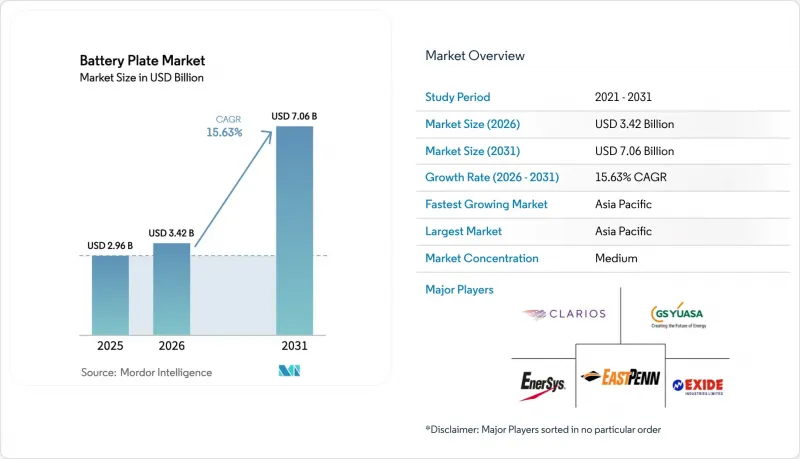
根據 Mordor Intelligence 預測,電池電極市場規模將從 2025 年的 29.6 億美元成長到 2026 年的 34.2 億美元,然後在 2031 年達到 70.6 億美元,2026 年至 2031 年的複合年成長率為 15.63%。
本報告按電池類型(鉛酸電池、鋰離子電池、鎳基電池、其他電池)、電極材料(鉛銻合金、鉛鈣合金、先進複合材料、其他材料)、製造技術(重力鑄造、連續糊狀成型、雙極/3D列印、其他技術)、最終用戶(汽車、工業、能源儲存系統等)和地區(北美、歐洲、亞太地區等)進行分類。
全球電池極板市場趨勢及洞察
電動車主導氧化鉛SLI需求激增
在電動車中,12V鉛酸電池被用作關鍵功能的備用電源。儘管鋰離子驅動電池佔據主導地位,但對SLI極板的需求仍然強勁。預計到2024年,全球電動車銷量將達到1,400萬輛。內燃機汽車的啟動停止系統由於充放電循環頻率更高、耐久性要求更嚴格,因此需要更高品質的極板設計。在輕度混合動力車中,採用雙電池配置,因此鉛酸電池極板與高壓電池組之間仍有互補關係,而非競爭關係。因此,汽車製造商與成熟的極板供應商簽訂了長期契約,用於輔助系統。這種合作關係有助於緩解鉛酸電池快速淘汰對電池極板市場的影響,並穩定各地區的基準銷售量。
新興市場公用事業規模儲能系統部署
2024年,新興經濟體新增電網儲能容量42吉瓦,其中35%的裝置容量來自成熟的經合組織市場以外的地區。對耐久性要求極高的項目採用液流電池、鈉離子電池和其他化學電池,每種電池都需要客製化形狀的極板以適應持續數小時的放電。全球最大的鈉離子電池儲能系統(BESS)於2024年投入運作,證明了其在鋰採購成本高昂的地區具有成本效益。各國政府正在將可再生能源與社區儲能計畫結合,拓展了採購選擇,不再局限於傳統的鋰離子電池極板。隨著電力公司尋求承包解決方案,能夠針對每種化學系統設計特定極板的供應商正在獲得先發優勢。
精煉鉛價格波動
2024年,受供應中斷和電池持續需求的雙重影響,鉛價劇烈波動。由於原物料成本佔電池極板製造成本的70%之多,價格飆升會迅速擠壓利潤空間。雖然回收利用可以緩解部分問題,但高純度合金標準限制了高檔極板中再生材料的含量。製造商透過長期合約和期貨交易來規避風險,但中小企業缺乏維持穩定投入成本的財力。因此,價格不穩定抑制了新鉛板生產線的投資,並促使採購策略轉向化學成分多樣化。
細分市場分析
到2025年,鉛酸電池技術將佔據電池板市場56.60%的佔有率,這主要得益於其在汽車SLI(啟動和照明電池)以及對成本敏感的工業細分市場的成熟應用。然而,隨著電動車和高性能儲能系統的普及,鋰離子板正以17.15%的複合年成長率快速成長,這正在重新調整電池板市場的採購預算。液態鉛酸電池仍然是通訊行業備用電源的主力軍,因為安裝人員信賴其良好的現場性能和成本效益。 VRLA(密閉式鉛酸電池)的衍生產品正在滿足汽車產業的高階需求,同時,鈉離子電池和鋅空氣電池的引入也旨在應對供應鏈風險和安全性問題。 2025年6月,寧德時代開始量產其「Naxtra」鈉離子電池,該電池具有免維護設計和快速充電功能。鎳基系統正被航太和國防領域的微型細分市場所採用,其極高的耐溫性彌補了其較高的價格。
隨著鈉離子電池和鋅空氣電池的加入,電池市場持續多元化發展,這些電池有助於應對供應鏈風險和安全挑戰。 2025年6月,寧德時代開始量產其「Naxtra」鈉離子電池,該電池採用鋁製電極集電極而非銅製集電極。目前,電極製造商採用多種冶金製程來匹配不同化學成分的腐蝕特性。這種專業化增加了製造設計的複雜性,但同時也拓展了整個電池電極市場的商機。
預計到2025年,鉛鈣合金極板將佔電池極板材料需求的47.05%,兼具耐腐蝕性和優異的機械性能,尤其適用於密封電池。然而,電池極板市場的發展主要受創新驅動,石墨塗層和碳泡沫複合材料預計將以每年19.52%的速度成長至2031年,這主要得益於對輕量化和溫度控管的需求。鉛銻合金因其在過放電過程中具有卓越的抗機械應力能力,仍被廣泛應用於深迴圈堆高機。在一些特殊應用中,鉛錫合金因其優異的導電性而備受青睞,但錫價飆升限制了其應用範圍,使其僅限於一些特殊產品。
複合材料日益受到關注,源自於整個產業對更高能量密度的強勁需求。例如,Group14公司富矽SCC55負極材料使電池容量提高了50%,如果富碳基體能夠降低內阻,預計也能達到類似的效果。能夠大規模生產複合柵格且成本不顯著增加的極板製造商,將能夠在電池極板市場建立差異化的產品系列。
區域分析
預計到2025年,亞太地區將佔據電池電極市場58.90%的佔有率,並以16.28%的複合年成長率保持主導地位直至2031年。中國動力電池產量在2024年上半年激增176%,但對產能過剩的擔憂正在推動產業重組和效率提升項目。韓國透過LG能源解決方案和SK安科技維持全球37%的電池產能,政府津貼主要集中在預商用固體電池平台。日本在生產向亞洲大陸轉移的同時,正利用其在材料技術方面的專長,在航太和豪華車領域爭取利基訂單。印度的生產連結獎勵計畫(PLI)計畫正在吸引大量投資,阿瑪拉·拉賈集團計劃投資950億印度盧比建設的超級工廠正是該國本土化努力的典型例證。
北美和歐洲共同代表電池極板市場的下一個前線。在美國,預計到2030年,電池極板產能將達到1,200吉瓦時,這得益於計畫於2025年運作的10座新廠。聯邦稅額扣抵促使採購集中於國內極板製造商,供應商也不斷擴大規模。歐洲計畫的目標是到2030年實現1.5太瓦時的產能,但資金籌措延遲導致已公佈計畫的一半面臨風險。德國擁有Northvolt公司60吉瓦時的工廠,法國正在支持位於敦克爾克的Vercors公司,歐盟綠色交易也正在投資回收業,以滿足未來對電極合金的需求。
南美洲、中東和非洲地區為電池電極市場提供了新的成長前景。巴西和阿根廷正在利用其豐富的鋰和鉛蘊藏量,但基礎設施的挑戰暫時限制了它們的擴張規模。海灣國家的電網太陽能普及率高,且對大規模儲能設施的需求旺盛,因此啟動了鈉離子電池和鉛碳電池系統的競標。非洲豐富的礦產資源蘊藏著垂直整合的潛力,但政治穩定和物流網路的完善仍是超級工廠獲利能力的先決條件。
其他好處:
- Excel格式的市場預測(ME)表
- 3個月的分析師支持
目錄
第1章:引言
- 研究假設和市場定義
- 調查範圍
第2章:調查方法
第3章執行摘要
第4章 市場狀況
- 市場概覽
- 市場促進因素
- 電動車推動了鉛酸電池(SLI)需求的激增。
- 新興市場公用事業規模儲能系統的部署
- 採用耐腐蝕的鉛鈣錫柵格
- 3D列印雙極板的結構
- 市場限制因素
- 精煉鉛價格波動
- 嚴格的危險廢棄物指令(RoHS、ELV)
- 高純度再生鉛的供應有限。
- 供應鏈分析
- 監理情勢
- 技術展望
- 波特五力模型
第5章 市場規模與成長預測
- 依電池類型
- 鉛酸蓄電池(液態,閥控式鉛酸蓄電池)
- 鋰離子
- 鎳基
- 其他物質(鋅-空氣、鈉離子等)
- 按類型分類的板材
- 鉛銻合金
- 鉛鈣合金
- 鉛錫合金
- 先進複合材料(石墨塗層、碳泡沫)
- 透過製造技術
- 重力鑄造
- 連續糊狀物
- 拉伸金屬
- 雙極/3D列印
- 最終用戶
- 汽車(SLI,啟動/停止)
- 工業(堆高機、通訊、UPS)
- 能源儲存系統
- 家用電子產品
- 航太/國防
- 按地區
- 北美洲
- 美國
- 加拿大
- 墨西哥
- 歐洲
- 德國
- 英國
- 法國
- 義大利
- 北歐國家
- 俄羅斯
- 其他歐洲國家
- 亞太地區
- 中國
- 印度
- 日本
- 韓國
- 東南亞國協
- 其他亞太國家
- 南美洲
- 巴西
- 阿根廷
- 其他南美國家
- 中東和非洲
- 沙烏地阿拉伯
- 阿拉伯聯合大公國
- 南非
- 埃及
- 其他中東和非洲國家
- 北美洲
第6章 競爭情勢
- 市場集中度
- 策略趨勢(併購、聯盟、購電協議)
- 市場佔有率分析(主要公司的市場排名和佔有率)
- 公司簡介
- Clarios, LLC
- Exide Industries Ltd.
- GS Yuasa Corporation
- East Penn Manufacturing Co.
- Enersys
- Amara Raja Energy & Mobility Ltd.
- Narada Power Source Co., Ltd.
- Camel Group Co., Ltd.
- Chaowei Power Holdings Ltd.
- Leoch International Technology Ltd.
- Crown Battery Manufacturing Co.
- Tianneng Power International Ltd.
- Hitachi Chemical Energy Technology
- Fiamm Energy Technology SpA
- Panasonic Energy Co., Ltd.
- Toshiba Corporation
- BYD Co., Ltd.
- Contemporary Amperex Technology Co., Ltd.(CATL)
- SVOLT Energy Technology
- Envision AESC Group
第7章 市場機會與未來展望
According to Mordor Intelligence, the battery plate market size is expected to grow from USD 2.96 billion in 2025 to USD 3.42 billion in 2026 and is forecast to reach USD 7.06 billion by 2031 at 15.63% CAGR over 2026-2031.
This report is Segmented by Battery Type (Lead-Acid, Lithium-Ion, Nickel-Based, and Others), Plate Material (Lead-Antimony Alloy, Lead-calcium Alloy, Advanced Composites, and More), Manufacturing Technology (Gravity Casting, Continuous Pasting, Bipolar/3-D Printing, and More), End-User (Automotive, Industria, Energy Storage Systems, and More), and Geography (North America, Europe, Asia-Pacific, and More).
Global Battery Plate Market Trends and Insights
EV-led Surge in Lead-acid SLI Demand
Electric vehicles utilize 12 V lead-acid batteries for fail-safe power to critical functions, leaving a sizable floor for SLI plates despite the dominance of lithium-ion traction. Global EV sales touched 14 million units in 2024. Start-stop systems within internal-combustion cars extend cycling frequency and heighten durability requirements, spurring higher-grade grid designs. Mild hybrids employ dual-battery setups, so lead-acid plates remain complementary rather than competitive to high-voltage packs. OEMs, therefore, maintain long-term contracts with established plate suppliers for auxiliary systems. This linkage cushions the battery plate market against abrupt lead-acid displacement and stabilizes baseline volumes across regions.
Utility-scale ESS Roll-outs in Emerging Markets
Emerging economies added 42 GW of grid storage in 2024, with 35% of the installations located outside mature OECD markets. Duration-driven projects select iron-flow, sodium-ion, and other chemistries, each needing bespoke plate geometry for multi-hour discharge. The world's largest sodium-ion BESS entered service in 2024, proving cost-effectiveness where lithium sourcing remains pricey. Governments couple renewables with localized storage mandates, broadening procurement beyond conventional lithium-ion plates. Suppliers capable of engineering chemistry-specific plates gain a first-mover advantage as utilities solicit turnkey solutions.
Volatility in Refined-lead Prices
Lead prices fluctuated sharply in 2024, driven by supply disruptions and sustained demand for batteries. Raw materials account for up to 70% of plate production cost, so pricing spikes compress margins in short order. Recycling offers partial relief, yet high-purity alloy grades limit secondary content ratios in premium plates. Manufacturers hedge through long-term contracts and futures positions, but smaller firms lack the financial firepower to maintain stable input costs. Price instability, therefore, discourages capital investment in new plate lines and tilts procurement decisions toward chemistry diversification.
Other drivers and restraints analyzed in the detailed report include:
- Adoption of Corrosion-resistant Pb-Ca-Sn Grids
- 3-D Printed Bipolar Plate Architectures
- Stringent Hazardous-waste Directives (RoHS, ELV)
For complete list of drivers and restraints, kindly check the Table Of Contents.
Segment Analysis
Lead-acid technology controlled 56.60% of the battery plate market share in 2025, primarily due to its entrenched use in automotive SLI and cost-sensitive industrial niches. Lithium-ion plates, however, are scaling at 17.15% CAGR as EV and high-performance storage proliferate, thereby re-balancing procurement budgets within the battery plate market. Flooded lead-acid units still anchor telecom backup because installers trust their field heritage and cost profile. VRLA derivatives meet the premium automotive demand for the introduction of sodium-ion and zinc-air entrants that address supply-chain risk and safety. CATL placed Naxtra sodium-ion batteries into mass production in June 2025, utilizing maintenance-free designs and rapid charge acceptance. Nickel-based systems fill aerospace and defense micro-segments, where extreme temperature tolerance offsets higher price points.
Diversification continues with sodium-ion and zinc-air entrants that address supply-chain risk and safety. CATL placed Naxtra sodium-ion batteries into mass production in June 2025, requiring aluminum rather than copper current collectors. Plate manufacturers now juggle multiple metallurgical toolkits to align with each chemistry's corrosion profile. This fragmentation elevates design-for-manufacture complexity but also widens addressable opportunity across the battery plate market.
Lead-calcium grids owned a 47.05% share of plate material demand in 2025, combining corrosion resistance with robust mechanical properties in sealed batteries. The battery plate market, nevertheless, rewards innovation; graphite-coated and carbon-foam composites are predicted to grow at a rate of 19.52% annually through 2031, driven by lightweighting and thermal-management agendas. Lead-antimony alloys persist in deep-cycle forklifts because they better withstand mechanical stress during heavy discharge. Niche applications turn to lead-tin mixes for superior conductivity, though elevated tin costs confine uptake to specialty products.
Composite momentum mirrors wider industry appetite for energy density gains. Group14's silicon-rich SCC55 anode, for instance, lifts cell capacity by 50%, signalling comparable payoffs when carbon-rich matrices reduce internal resistance. Plate makers able to scale composite grids without cost blow-outs secure a differentiated portfolio within the battery plate market.
Complete Report Scope:
- By Battery Type
- Lead-acid (Flooded, VRLA)
- Lithium-ion
- Nickel-based
- Others (Zn-Air, Na-Ion, etc.)
- By Plate Material
- Lead-Antimony Alloy
- Lead-Calcium Alloy
- Lead-Tin Alloy
- Advanced Composites (Graphite-coated, Carbon Foam)
- By Manufacturing Technology
- Gravity Casting
- Continuous Pasting
- Expanded Metal
- Bipolar/3-D Printing
- By End-user
- Automotive (SLI, Start-Stop)
- Industrial (Forklifts, Telecom, UPS)
- Energy Storage Systems
- Consumer Electronics
- Aerospace and Defense
- By Geography
- North America
- United States
- Canada
- Mexico
- Europe
- Germany
- United Kingdom
- France
- Italy
- NORDIC Countries
- Russia
- Rest of Europe
- Asia-Pacific
- China
- India
- Japan
- South Korea
- ASEAN Countries
- Rest of Asia-Pacific
- South America
- Brazil
- Argentina
- Rest of South America
- Middle East and Africa
- Saudi Arabia
- United Arab Emirates
- South Africa
- Egypt
- Rest of Middle East and Africa
- North America
Geography Analysis
Asia-Pacific controlled 58.90% of the battery plate market in 2025 and will maintain leadership at a 16.28% CAGR through 2031. China's power battery output surged 176% in the first half of 2024, yet looming oversupply drives consolidation and efficiency projects. South Korea retains 37% of global battery cell capacity through LG Energy Solution and SK On, while government grants focus on pre-commercial solid-state platforms. Japan secures niche aerospace and premium-vehicle contracts, leveraging materials expertise even as volume shifts to mainland Asia. India's Production-Linked Incentive program has attracted substantial investment; Amara Raja's INR 95 billion gigafactory exemplifies the country's localization push.
North America and Europe together represent the next frontier for the battery plate market. United States capacity is slated to hit 1,200 GWh by 2030, aided by 10 new factories commencing in 2025. Federal tax credits tilt procurement toward domestic plates, prompting supplier footprint expansion. European projects aim for 1.5 TWh by 2030, though financing delays imperil half the announced pipeline. Germany hosts Northvolt's 60 GWh facility, France backs Verkor at Dunkirk, and the EU Green Deal channels funds into recycling streams that will feed future plate alloy demand.
South America and the Middle East & Africa add emerging prospects for the battery plate market. Brazil and Argentina exploit lithium and lead reserves, yet infrastructure hurdles moderate immediate scale-up. Gulf states deploy high-solar-penetration grids that require large energy storage buffers, opening tenders for sodium-ion and lead-carbon systems. Africa's mineral wealth promises vertical integration possibilities, although political stability and logistics build-out remain prerequisites before gigafactory economics align.
- Clarios, LLC
- Exide Industries Ltd.
- GS Yuasa Corporation
- East Penn Manufacturing Co.
- Enersys
- Amara Raja Energy & Mobility Ltd.
- Narada Power Source Co., Ltd.
- Camel Group Co., Ltd.
- Chaowei Power Holdings Ltd.
- Leoch International Technology Ltd.
- Crown Battery Manufacturing Co.
- Tianneng Power International Ltd.
- Hitachi Chemical Energy Technology
- Fiamm Energy Technology S.p.A.
- Panasonic Energy Co., Ltd.
- Toshiba Corporation
- BYD Co., Ltd.
- Contemporary Amperex Technology Co., Ltd. (CATL)
- SVOLT Energy Technology
- Envision AESC Group
Additional Benefits:
- The market estimate (ME) sheet in Excel format
- 3 months of analyst support
TABLE OF CONTENTS
1 Introduction
- 1.1 Study Assumptions & Market Definition
- 1.2 Scope of the Study
2 Research Methodology
3 Executive Summary
4 Market Landscape
- 4.1 Market Overview
- 4.2 Market Drivers
- 4.2.1 EV-led surge in lead-acid SLI demand
- 4.2.2 Utility-scale ESS roll-outs in emerging markets
- 4.2.3 Adoption of corrosion-resistant Pb-Ca-Sn grids
- 4.2.4 3-D printed bipolar plate architectures
- 4.3 Market Restraints
- 4.3.1 Volatility in refined-lead prices
- 4.3.2 Stringent hazardous-waste directives (RoHS, ELV)
- 4.3.3 Limited availability of high-purity recycled lead
- 4.4 Supply-Chain Analysis
- 4.5 Regulatory Landscape
- 4.6 Technological Outlook
- 4.7 Porter's Five Forces
- 4.7.1 Bargaining Power of Suppliers
- 4.7.2 Bargaining Power of Buyers
- 4.7.3 Threat of New Entrants
- 4.7.4 Threat of Substitutes
- 4.7.5 Intensity of Competitive Rivalry
5 Market Size & Growth Forecasts
- 5.1 By Battery Type
- 5.1.1 Lead-acid (Flooded, VRLA)
- 5.1.2 Lithium-ion
- 5.1.3 Nickel-based
- 5.1.4 Others (Zn-Air, Na-Ion, etc.)
- 5.2 By Plate Material
- 5.2.1 Lead-Antimony Alloy
- 5.2.2 Lead-Calcium Alloy
- 5.2.3 Lead-Tin Alloy
- 5.2.4 Advanced Composites (Graphite-coated, Carbon Foam)
- 5.3 By Manufacturing Technology
- 5.3.1 Gravity Casting
- 5.3.2 Continuous Pasting
- 5.3.3 Expanded Metal
- 5.3.4 Bipolar/3-D Printing
- 5.4 By End-user
- 5.4.1 Automotive (SLI, Start-Stop)
- 5.4.2 Industrial (Forklifts, Telecom, UPS)
- 5.4.3 Energy Storage Systems
- 5.4.4 Consumer Electronics
- 5.4.5 Aerospace and Defense
- 5.5 By Geography
- 5.5.1 North America
- 5.5.1.1 United States
- 5.5.1.2 Canada
- 5.5.1.3 Mexico
- 5.5.2 Europe
- 5.5.2.1 Germany
- 5.5.2.2 United Kingdom
- 5.5.2.3 France
- 5.5.2.4 Italy
- 5.5.2.5 NORDIC Countries
- 5.5.2.6 Russia
- 5.5.2.7 Rest of Europe
- 5.5.3 Asia-Pacific
- 5.5.3.1 China
- 5.5.3.2 India
- 5.5.3.3 Japan
- 5.5.3.4 South Korea
- 5.5.3.5 ASEAN Countries
- 5.5.3.6 Rest of Asia-Pacific
- 5.5.4 South America
- 5.5.4.1 Brazil
- 5.5.4.2 Argentina
- 5.5.4.3 Rest of South America
- 5.5.5 Middle East and Africa
- 5.5.5.1 Saudi Arabia
- 5.5.5.2 United Arab Emirates
- 5.5.5.3 South Africa
- 5.5.5.4 Egypt
- 5.5.5.5 Rest of Middle East and Africa
- 5.5.1 North America
6 Competitive Landscape
- 6.1 Market Concentration
- 6.2 Strategic Moves (M&A, Partnerships, PPAs)
- 6.3 Market Share Analysis (Market Rank/Share for key companies)
- 6.4 Company Profiles (includes Global level Overview, Market level overview, Core Segments, Financials as available, Strategic Information, Products & Services, and Recent Developments)
- 6.4.1 Clarios, LLC
- 6.4.2 Exide Industries Ltd.
- 6.4.3 GS Yuasa Corporation
- 6.4.4 East Penn Manufacturing Co.
- 6.4.5 Enersys
- 6.4.6 Amara Raja Energy & Mobility Ltd.
- 6.4.7 Narada Power Source Co., Ltd.
- 6.4.8 Camel Group Co., Ltd.
- 6.4.9 Chaowei Power Holdings Ltd.
- 6.4.10 Leoch International Technology Ltd.
- 6.4.11 Crown Battery Manufacturing Co.
- 6.4.12 Tianneng Power International Ltd.
- 6.4.13 Hitachi Chemical Energy Technology
- 6.4.14 Fiamm Energy Technology S.p.A.
- 6.4.15 Panasonic Energy Co., Ltd.
- 6.4.16 Toshiba Corporation
- 6.4.17 BYD Co., Ltd.
- 6.4.18 Contemporary Amperex Technology Co., Ltd. (CATL)
- 6.4.19 SVOLT Energy Technology
- 6.4.20 Envision AESC Group
7 Market Opportunities & Future Outlook
- 7.1 White-space & Unmet-Need Assessment


