


 |
市場調查報告書
商品編碼
2125677
Wi-Fi路由器:市佔率分析、產業趨勢與統計、成長預測(2026-2031年)Wi-Fi Router - Market Share Analysis, Industry Trends & Statistics, Growth Forecasts (2026 - 2031) |
||||||

※ 本網頁內容可能與最新版本有所差異。詳細情況請與我們聯繫。
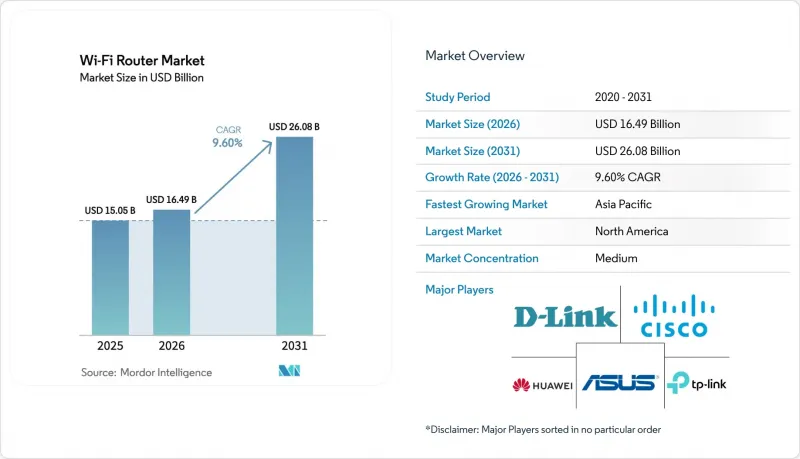
據 Mordor Intelligence 稱,2025 年 Wi-Fi 路由器市值為 150.5 億美元,預計到 2031 年將達到 260.8 億美元,而 2026 年為 164.9 億美元,預測期(2026-2031 年)的複合年成長率為 9.60%。
本報告按路由器類型(邊緣路由器、核心路由器、網狀路由器、SOHO路由器)、頻段(單頻段、雙頻、三頻、四頻)、Wi-Fi標準(Wi-Fi 4、Wi-Fi 5等)、最終用戶(住宅、中小企業用戶、大型企業用戶、公共部門用戶、工業用戶、零售用戶)和地區進行細分。市場預測以美元計價。
全球Wi-Fi路由器市場趨勢與洞察
FTTH(光纖到府)部署的激增正在推動對多千兆廣域網路連接埠的需求。
各國寬頻補貼和極具競爭力的Gigabit服務套餐正在推動配備 2.5 GbE 和 10 GbE 上行鏈路的路由器的大規模銷售。服務供應商將高階硬體捆綁到訂閱計劃中,以確保穩定的設備租賃收入,而供應商則在重新設計電源和溫度控管子系統,以適應速度更快的 ASIC 晶片。因此,功能豐富的閘道器應運而生,用於連接傳統乙太網路介面和下一代被動光纖網路,從而保持 Wi-Fi 路由器市場的成長動能。
Wi-Fi 6 和 6E 網狀網路系統在住宅中的快速普及
目前,平均每個家庭的連網設備數量超過 20 台,這推動了從單點路由器到多節點網狀網路套件的轉變。 Wi-Fi 6E 引入了不受客戶端干擾的 6 GHz回程傳輸,從而提高了多層住宅的吞吐量並降低了延遲。政府宣傳活動和店內展示強調了消除訊號盲區的重要性,而晶片組的規模經濟效應也使入門級產品的價格降至大眾市場水平。透過應用程式輕鬆設定進一步加速了 Wi-Fi 路由器的普及,並促進了其銷售成長。
與郊區5G FWA CPE設備的競爭
行動電信商正利用現有基地台提供固定無線寬頻服務,透過將內建Wi-Fi的蜂巢式數據機與獨立路由器捆綁銷售,取代傳統的獨立路由器。在光纖尚未覆蓋的郊區,這種模式的經濟效益顯著,推高了零售硬體的價格彈性。供應商則以混合設計方案應對,這些方案可在必要時切換到蜂巢式網路,但這迫使他們承擔不斷上漲的組件成本,從而減緩了Wi-Fi路由器市場的擴張速度。
細分市場分析
邊緣設備保持領先地位,預計2025年將佔總銷售額的42.35%。它們能夠聚合多接入流量、支援安全疊加網路並承載邊緣運算工作負載,因此對營運商和大型企業至關重要。隨著5G回程傳輸和城域光纖密度的增加,邊緣Wi-Fi路由器的市場規模預計將進一步擴大。網狀網路設備是成長最快的細分市場,這主要得益於消費者對無縫漫遊和節點擴充性的需求。服務供應商將三件套設備納入高級套餐,推動了到2031年9.62%的高速成長。核心路由器市場保持穩定,但由於其在Tier 1骨幹網路中的折舊免稅額週期較長,升級速度較慢。 SOHO設備吸引了對價格敏感的小規模企業,但正面臨來自ISP閘道器的市場佔有率侵蝕。競爭對手正專注於軟體定義網路(SDN)、人工智慧驅動的診斷和零接觸配置,而企業則優先考慮分析功能以縮短平均修復時間(MTTR)。將遠端監控整合到 IT 服務管理套件中的生態系統 API 正在成為採購標準,與以平台為中心的供應商相比,這提高了客戶留存率。
新興市場的二線營運商對整合用戶管理、服務品質 (QoS) 和安全功能於一體的邊緣路由器表現出越來越濃厚的興趣。硬體升級與監管壓力不謀而合,監管壓力要求竊聽IPv6 並遵守合法攔截規定。供應商正在利用網路功能虛擬化 (NFV) 技術實現基於訂閱的功能許可,從而在 Wi-Fi 路由器市場創造新的收入來源。邊緣平台也向容器化運算節點演進,這些節點託管 CDN 卸載和物聯網閘道器,在提高單次部署收費密度的同時,透過降低功耗和節省空間,協助營運商實現永續性目標。
預計到2025年,雙頻路由器將佔據47.55%的市場佔有率,繼續成為2.4 GHz和5 GHz頻寬經濟高效覆蓋的主流選擇。然而,隨著設備多樣化和串流媒體的日益普及,頻寬日益嚴格,加速了向三頻解決方案的升級。具備6 GHz無線功能的三頻設備預計將以10.18%的複合年成長率成長,並在Wi-Fi路由器市場佔據越來越大的佔有率。高階用戶需要專用的回程傳輸吞吐量和更低的干擾,尤其是在傳統頻段經常被鄰近網路擁塞的高密度住宅環境中。單頻段路由器繼續用於超低成本應用和工業遙測,而四頻Wi-Fi 7路由器則在業餘愛好者和中小企業(SMB)專業用戶等細分市場中嶄露頭角。
消費者意識仍然至關重要。如果沒有正確的客戶指導和節點部署,使用者往往無法充分利用第三頻寬。零售商和網路服務供應商 (ISP) 正在透過互動式設定應用程式和擴增實境(AR) 部署工具來加強用戶教育。成本方面的挑戰包括由於增加了射頻鏈路、天線和屏蔽層而導致的熱負載增加,這需要創新的散熱器設計來維持消費級聲學特性。多頻段 SKU 的監管認證,包括輻射、DFS 合規性和特定區域的頻譜掩碼,會延長產品上市時間。儘管如此,規模經濟正在降低三頻產品的價格範圍,縮小整體擁有成本 (TCO) 的差距,並加速 Wi-Fi 路由器市場的更換需求。
區域分析
北美仍是高階硬體普及的中心,預計到2025年將佔據56.30%的市場。 6GHz頻寬(FWA)的湧入。各公司正在美國園區內積極開展Wi-Fi 7試點部署,由此產生的參考設計方案也將推廣到全球各地的子公司辦公室。
亞太地區持續維持成長勢頭,複合年成長率高達11.62%。中國正透過政府支持的「Gigabit城市計畫」擴大網路規模,而印度的BharatNet和私人光纖聯盟則在農村地區拓展網路連接。本土路由器OEM廠商受惠於優惠的採購政策,但全球品牌在高階市場仍佔據主導地位。新加坡、首爾和東京的智慧城市試點計畫對高密度公共Wi-Fi和邊緣運算提出了更高的要求,為功能豐富的平台創造了機會。深圳和檳城的製造群正在加速設計迭代,縮短從概念到零售的週期,從而推動Wi-Fi路由器市場的發展。
在歐洲,隨著企業對老舊園區進行現代化改造,以及家庭用戶遷移到網狀網路,預計將保持穩定的個位數中段成長。語言和監管環境的多樣性迫使供應商針對不同地區進行韌體本地化,並投資於符合GDPR的資料處理。在德國和法國的多用戶住宅中,向ISP管理的閘道器的過渡正在推進,這略微抑制了零售銷售。同時,在中東和非洲,新興都會地區的電子政府終端和金融科技POS終端正在使用Wi-Fi。在拉丁美洲,宏觀經濟狀況的改善釋放了對路由器從Wi-Fi 4升級到Wi-Fi 6的需求。由於外匯波動和進口關稅影響當地價格,OEM廠商正在採用本地最終組裝,以避免關稅並刺激Wi-Fi路由器市場。
其他好處:
- Excel格式的市場預測(ME)表
- 3個月的分析師支持
目錄
第1章:引言
- 研究假設和市場定義
- 調查範圍
第2章:調查方法
第3章執行摘要
第4章 市場狀況
- 市場概覽
- 市場促進因素
- FTTH(光纖到府)部署的快速成長推高了對多千兆廣域網路連接埠的需求。
- Wi-Fi 6/6E 網狀系統在住宅中的快速普及
- 企業園區已升級至 Wi-Fi 7,以支援 AR/VR 協作套件。
- 政府主導的頻段(6 GHz 和 7 GHz)放鬆管制正在加速高階頻寬路由器的銷售。
- 智慧城市公共 Wi-Fi 招標,包括路由器競標。
- 透過利用邊緣人工智慧進行流量控制,網路服務供應商可以提高使用者體驗品質 (QoE) 並降低客戶流失率。
- 市場限制因素
- 與郊區5G FWA CPE終端機的競爭
- Wi-Fi 7 三頻 SKU 的晶片組短缺問題依然存在。
- 網路攻擊範圍的擴大導致身份驗證週期延長。
- 轉向由網路服務供應商提供的閘道器導致個人消費者的需求下降。
- 價值供應鏈分析
- 監理情勢
- 技術展望
- 波特五力分析
第5章 市場規模與成長預測
- 路由器類型
- 邊緣路由器
- 核心路由器
- 網狀路由器
- SOHO路由器
- 按頻段
- 單頻段(2.4 GHz)
- 雙頻(2.4 GHz 和 5 GHz)
- 三頻段(2.4、5、6 GHz)
- 四頻(Wi-Fi 7)
- 按 Wi-Fi 標準
- Wi-Fi 4(802.11n)
- Wi-Fi 5(802.11ac)
- Wi-Fi 6(802.11ax)
- Wi-Fi 6E
- Wi-Fi 7(802.11be)
- 最終用戶
- 住宅
- 小型企業
- 大公司
- 公共部門和政府
- 工業和製造業
- 零售與電子商務
- 按地區
- 北美洲
- 美國
- 加拿大
- 墨西哥
- 南美洲
- 巴西
- 阿根廷
- 其他南美國家
- 歐洲
- 德國
- 英國
- 法國
- 義大利
- 西班牙
- 俄羅斯
- 其他歐洲國家
- 亞太地區
- 中國
- 日本
- 印度
- 韓國
- 東南亞
- 其他亞太國家
- 中東和非洲
- 中東
- 沙烏地阿拉伯
- 阿拉伯聯合大公國
- 土耳其
- 其他中東國家
- 非洲
- 南非
- 奈及利亞
- 其他非洲國家
- 中東
- 北美洲
第6章 競爭情勢
- 市場集中度
- 策略趨勢
- 市佔率分析
- 公司簡介
- Cisco Systems, Inc.
- Huawei Technologies Co., Ltd.
- TP-Link Technologies Co., Ltd.
- Netgear, Inc.
- ASUSTeK Computer Inc.
- D-Link Corporation
- Juniper Networks, Inc.
- Hewlett Packard Enterprise Company(Aruba Networking)
- Xiaomi Corporation
- Linksys Holdings, Inc.
- CommScope Holding Company, Inc.(ARRIS)
- Ubiquiti Inc.
- Amazon.com, Inc.(eero LLC)
- Google LLC(Nest Wi-Fi)
- Fortinet, Inc.
- ZTE Corporation
- Zyxel Communications Corporation
- MikroTik SIA
- Extreme Networks, Inc.
- Arista Networks, Inc.
- Belkin International, Inc.
第7章 市場機會與未來展望
According to Mordor Intelligence, the wi-Fi router market size was valued at USD 15.05 billion in 2025 and estimated to grow from USD 16.49 billion in 2026 to reach USD 26.08 billion by 2031, at a CAGR of 9.60% during the forecast period (2026-2031).
This report is Segmented by Router Type (Edge Router, Core Router, Mesh Router, SOHO Router), Frequency Band (Single-Band, Dual-Band, Tri-Band, Quad-Band), Wi-Fi Standard (Wi-Fi 4, Wi-Fi 5, and More), End-User (Residential, SME, Large Enterprises, Public Sector, Industrial, Retail), and Geography. Market Forecasts are Provided in Terms of Value (USD).
Global Wi-Fi Router Market Trends and Insights
Surge in fiber-to-home rollouts lifting demand for multi-gig WAN ports
National broadband subsidies and competitive gigabit service packages are driving volume purchases of routers with 2.5 GbE and 10 GbE uplinks. Service providers bundle premium hardware with subscription tiers to secure recurring equipment rentals, while vendors redesign power and thermal subsystems around higher-speed ASICs. The result is a pipeline of feature-rich gateways that bridge legacy Ethernet outlets and next-generation passive optical networks, sustaining momentum for the Wi-Fi router market.
Rapid residential adoption of Wi-Fi 6 and 6E mesh systems
Households now average more than 20 connected devices, prompting a shift from single-point routers to multi-node mesh kits. Wi-Fi 6E introduces a 6 GHz backhaul free from client interference, raising throughput and lowering latency in multistory homes. Government outreach and retailer demonstrations highlight dead-zone elimination, and chipset economies of scale have pulled entry pricing into mass-market ranges. Easy app-based onboarding further accelerates adoption, reinforcing volume growth for the Wi-Fi router market.
Competition from 5G FWA CPE devices in suburban areas
Mobile network operators leverage existing towers to deliver fixed-wireless broadband, bundling a cellular modem with integrated Wi-Fi, thereby displacing standalone routers. Attractive economics in fiber-scarce suburbs tighten price elasticity for retail hardware. Vendors counter with hybrid designs that fall back to cellular networks yet must absorb higher bill-of-materials costs, tempering the Wi-Fi router market expansion.
Other drivers and restraints analyzed in the detailed report include:
- Corporate campus upgrades to Wi-Fi 7 to enable AR/VR collaboration suites
- Government spectrum releases accelerating premium-band router sales
- Persistent chipset shortages for Wi-Fi 7 tri-band SKUs
For complete list of drivers and restraints, kindly check the Table Of Contents.
Segment Analysis
Edge units held the top spot with 42.35% of 2025 revenue. Their ability to aggregate multi-access traffic, support security overlays, and host edge-computing workloads keeps them indispensable to carriers and large enterprises. The Wi-Fi router market size for edge models is projected to widen in step with 5G backhaul and metro fiber densification. Mesh devices form the fastest-growing cohort, benefiting from consumer demand for seamless roaming and scalable node counts. Their 9.62% CAGR through 2031 stands out as service providers bundle three-pack kits into premium tiers. Core routers log steady but slower upgrades owing to longer depreciation cycles within tier-1 backbones. SOHO units attract price-sensitive micro-businesses yet face cannibalization from ISP gateways. The competitive field centers on software-defined networking, AI-powered diagnostics, and zero-touch provisioning, with enterprises valuing analytics that cut mean time to repair. Ecosystem APIs that integrate remote monitoring into IT service-management suites are becoming purchasing criteria, reinforcing stickiness for platform-centric vendors.
Second-tier telcos in emerging markets exhibit growing appetite for edge routers that consolidate subscriber management, quality-of-service, and security at a single touchpoint. Hardware refreshes coincide with regulatory pushes for IPv6 readiness and lawful-intercept compliance. Vendors leverage network-function virtualization to unlock subscription-based feature licensing, creating new monetization streams inside the Wi-Fi router market. Edge platforms are also evolving into containerized compute nodes that host CDN offloads and IoT gateways, increasing billable density per installation while aligning with operator sustainability targets through reduced power draw and space savings.
Dual-band designs held 47.55% share in 2025 and remain the mainstream choice for cost-balanced coverage across 2.4 GHz and 5 GHz. Ongoing device diversification and streaming adoption, however, strain bandwidth ceilings, catalyzing upgrade cycles toward tri-band solutions. Tri-band units, adding a 6 GHz radio, are forecast for a 10.18% CAGR and stand to capture a growing portion of the Wi-Fi router market size. Premium buyers seek dedicated backhaul throughput and reduced interference, especially in dense dwellings where neighbor networks congest legacy bands. Single-band routers linger in ultra-low-cost and industrial telemetry roles, while quad-band Wi-Fi 7 models debut in the enthusiast and SMB prosumer niches.
Consumer awareness remains pivotal: users often underutilize a third band without proper client steering or node placement. Retailers and ISPs are boosting education through interactive setup apps and augmented reality alignment tools. Cost headwinds include additional RF chains, antennas, and shielding that raise thermal loads, demanding novel heatsink designs to maintain consumer-grade acoustics. Regulatory certification in multi-band SKUs spans emissions, DFS compliance, and region-specific spectral masks, prolonging time to market. Nonetheless, economies of scale are funneling tri-band price points downward, narrowing the total cost of ownership delta and accelerating replacement demand inside the Wi-Fi router market.
Complete Report Scope:
- By Router Type
- Edge Router
- Core Router
- Mesh Router
- SOHO Router
- By Frequency Band
- Single-Band (2.4 GHz)
- Dual-Band (2.4 and 5 GHz)
- Tri-Band (2.4 , 5 and 6 GHz)
- Quad-Band (Wi-Fi 7)
- By Wi-Fi Standard
- Wi-Fi 4 (802.11n)
- Wi-Fi 5 (802.11ac)
- Wi-Fi 6 (802.11ax)
- Wi-Fi 6E
- Wi-Fi 7 (802.11be)
- By End-User
- Residential
- Small and Medium Enterprises
- Large Enterprises
- Public Sector and Government
- Industrial and Manufacturing
- Retail and E-commerce
- By Geography
- North America
- United States
- Canada
- Mexico
- South America
- Brazil
- Argentina
- Rest of South America
- Europe
- Germany
- United Kingdom
- France
- Italy
- Spain
- Russia
- Rest of Europe
- Asia Pacific
- China
- Japan
- India
- South Korea
- Southeast Asia
- Rest of Asia Pacific
- Middle East and Africa
- Middle East
- Saudi Arabia
- United Arab Emirates
- Turkey
- Rest of Middle East
- Africa
- South Africa
- Nigeria
- Rest of Africa
- Middle East
- North America
Geography Analysis
North America, with 56.30% 2025 share, remains the hub of premium hardware adoption. Early availability of 6 GHz spectrum, aggressive fiber competition, and enterprise technology budgets accelerate refresh cycles. Consumers routinely upgrade on three-year cadences, and cable MSOs subsidize gateway swaps to defend against 5G FWA encroachment. Enterprises anchor Wi-Fi 7 pilots in U.S. campuses, generating reference designs that ripple through subsidiary offices worldwide.
Asia-Pacific remains the growth epicenter at a 11.62% CAGR. China drives scale through state-backed gigabit-city mandates, while India's BharatNet and private fiber consortia expand rural connectivity. Local router OEMs benefit from favorable procurement policies, yet global brands retain share in premium tiers. Smart-city proofs in Singapore, Seoul, and Tokyo require high-density public Wi-Fi coupled with edge compute, widening opportunities for feature-rich platforms. Manufacturing clusters in Shenzhen and Penang expedite design iterations, shortening the time from concept to retail and benefiting the Wi-Fi router market.
Europe posts steady mid-single-digit expansion as enterprises modernize medieval campuses and households migrate to mesh. Fragmented language and regulatory landscapes compel vendors to invest in regional firmware localization and GDPR-aligned data handling. Multi-dwelling units across Germany and France shift toward ISP-managed gateways, slightly dampening retail turnover. Meanwhile, the Middle East and Africa see emerging urban corridors leveraging Wi-Fi for e-government kiosks and fintech POS terminals, while Latin America's improving macroeconomic climate unlocks pent-up consumer router upgrades from Wi-Fi 4 to Wi-Fi 6. Currency volatility and import duties shape local pricing, leading OEMs to adopt in-region final assembly to sidestep tariffs and bolster the Wi-Fi router market.
- Cisco Systems, Inc.
- Huawei Technologies Co., Ltd.
- TP-Link Technologies Co., Ltd.
- Netgear, Inc.
- ASUSTeK Computer Inc.
- D-Link Corporation
- Juniper Networks, Inc.
- Hewlett Packard Enterprise Company (Aruba Networking)
- Xiaomi Corporation
- Linksys Holdings, Inc.
- CommScope Holding Company, Inc. (ARRIS)
- Ubiquiti Inc.
- Amazon.com, Inc. (eero LLC)
- Google LLC (Nest Wi-Fi)
- Fortinet, Inc.
- ZTE Corporation
- Zyxel Communications Corporation
- MikroTik SIA
- Extreme Networks, Inc.
- Arista Networks, Inc.
- Belkin International, Inc.
Additional Benefits:
- The market estimate (ME) sheet in Excel format
- 3 months of analyst support
TABLE OF CONTENTS
1 INTRODUCTION
- 1.1 Study Assumptions and Market Definition
- 1.2 Scope of the Study
2 RESEARCH METHODOLOGY
3 EXECUTIVE SUMMARY
4 MARKET LANDSCAPE
- 4.1 Market Overview
- 4.2 Market Drivers
- 4.2.1 Surge in fiber-to-home (FTTH) roll-outs lifting demand for multi-gig WAN ports
- 4.2.2 Rapid residential adoption of Wi-Fi 6/6E mesh systems
- 4.2.3 Corporate campus upgrades to Wi-Fi 7 to enable AR/VR collaboration suites
- 4.2.4 Government spectrum releases (6 GHz and 7 GHz) accelerating premium-band router sales
- 4.2.5 Smart-city public-Wi-Fi tenders bundling router procurement
- 4.2.6 Edge-AI-enabled traffic steering improving QoE and reducing churn for ISPs
- 4.3 Market Restraints
- 4.3.1 Competition from 5G FWA CPE devices in suburban areas
- 4.3.2 Persistent chipset shortages for Wi-Fi 7 tri-band SKUs
- 4.3.3 Rising cyber-attack surface forcing longer certification cycles
- 4.3.4 Home-renter's shift toward ISP-leased gateways lowering retail demand
- 4.4 Value / Supply-Chain Analysis
- 4.5 Regulatory Landscape
- 4.6 Technological Outlook
- 4.7 Porter's Five Forces Analysis
- 4.7.1 Bargaining Power of Buyers
- 4.7.2 Bargaining Power of Suppliers
- 4.7.3 Threat of New Entrants
- 4.7.4 Threat of Substitutes
- 4.7.5 Intensity of Competitive Rivalry
5 MARKET SIZE AND GROWTH FORECASTS (VALUE)
- 5.1 By Router Type
- 5.1.1 Edge Router
- 5.1.2 Core Router
- 5.1.3 Mesh Router
- 5.1.4 SOHO Router
- 5.2 By Frequency Band
- 5.2.1 Single-Band (2.4 GHz)
- 5.2.2 Dual-Band (2.4 and 5 GHz)
- 5.2.3 Tri-Band (2.4 , 5 and 6 GHz)
- 5.2.4 Quad-Band (Wi-Fi 7)
- 5.3 By Wi-Fi Standard
- 5.3.1 Wi-Fi 4 (802.11n)
- 5.3.2 Wi-Fi 5 (802.11ac)
- 5.3.3 Wi-Fi 6 (802.11ax)
- 5.3.4 Wi-Fi 6E
- 5.3.5 Wi-Fi 7 (802.11be)
- 5.4 By End-User
- 5.4.1 Residential
- 5.4.2 Small and Medium Enterprises
- 5.4.3 Large Enterprises
- 5.4.4 Public Sector and Government
- 5.4.5 Industrial and Manufacturing
- 5.4.6 Retail and E-commerce
- 5.5 By Geography
- 5.5.1 North America
- 5.5.1.1 United States
- 5.5.1.2 Canada
- 5.5.1.3 Mexico
- 5.5.2 South America
- 5.5.2.1 Brazil
- 5.5.2.2 Argentina
- 5.5.2.3 Rest of South America
- 5.5.3 Europe
- 5.5.3.1 Germany
- 5.5.3.2 United Kingdom
- 5.5.3.3 France
- 5.5.3.4 Italy
- 5.5.3.5 Spain
- 5.5.3.6 Russia
- 5.5.3.7 Rest of Europe
- 5.5.4 Asia Pacific
- 5.5.4.1 China
- 5.5.4.2 Japan
- 5.5.4.3 India
- 5.5.4.4 South Korea
- 5.5.4.5 Southeast Asia
- 5.5.4.6 Rest of Asia Pacific
- 5.5.5 Middle East and Africa
- 5.5.5.1 Middle East
- 5.5.5.1.1 Saudi Arabia
- 5.5.5.1.2 United Arab Emirates
- 5.5.5.1.3 Turkey
- 5.5.5.1.4 Rest of Middle East
- 5.5.5.2 Africa
- 5.5.5.2.1 South Africa
- 5.5.5.2.2 Nigeria
- 5.5.5.2.3 Rest of Africa
- 5.5.5.1 Middle East
- 5.5.1 North America
6 COMPETITIVE LANDSCAPE
- 6.1 Market Concentration
- 6.2 Strategic Moves
- 6.3 Market Share Analysis
- 6.4 Company Profiles (includes Global level Overview, Market level overview, Core Segments, Financials as available, Strategic Information, Market Rank/Share for key companies, Products and Services, and Recent Developments)
- 6.4.1 Cisco Systems, Inc.
- 6.4.2 Huawei Technologies Co., Ltd.
- 6.4.3 TP-Link Technologies Co., Ltd.
- 6.4.4 Netgear, Inc.
- 6.4.5 ASUSTeK Computer Inc.
- 6.4.6 D-Link Corporation
- 6.4.7 Juniper Networks, Inc.
- 6.4.8 Hewlett Packard Enterprise Company (Aruba Networking)
- 6.4.9 Xiaomi Corporation
- 6.4.10 Linksys Holdings, Inc.
- 6.4.11 CommScope Holding Company, Inc. (ARRIS)
- 6.4.12 Ubiquiti Inc.
- 6.4.13 Amazon.com, Inc. (eero LLC)
- 6.4.14 Google LLC (Nest Wi-Fi)
- 6.4.15 Fortinet, Inc.
- 6.4.16 ZTE Corporation
- 6.4.17 Zyxel Communications Corporation
- 6.4.18 MikroTik SIA
- 6.4.19 Extreme Networks, Inc.
- 6.4.20 Arista Networks, Inc.
- 6.4.21 Belkin International, Inc.
7 MARKET OPPORTUNITIES AND FUTURE OUTLOOK
- 7.1 White-space and Unmet-Need Assessment

 全球行動Wi-Fi(MiFi)市場:機會與策略展望(至2035年)
 行動Wi-Fi(MiFi)市場規模、佔有率和趨勢分析報告:按設備類型、技術、連接方式、最終用途和細分市場預測(2026-2033年)2026年全球家用Wi-Fi路由器市場報告
 2026-2030年全球家用Wi-Fi路由器市場
 Wi-Fi適配器卡市場 - 全球產業規模、佔有率、趨勢、機會、預測:按作業系統支援、應用、速度、地區和競爭格局分類,2021-2031年家用 Wi-Fi 路由器全球市場:2033 年的機會與策略
 家用無線路由器的全球市場:市場佔有率與排行榜,整體銷售額與需求預測(2024年~2030年)
 全球消費級 Wi-Fi 路由器市場:未來預測(2025-2030 年)