


 |
市場調查報告書
商品編碼
2125676
塑膠托盤:市場佔有率分析、產業趨勢與統計、成長預測(2026-2031)Plastic Pallets - Market Share Analysis, Industry Trends & Statistics, Growth Forecasts (2026 - 2031) |
||||||

※ 本網頁內容可能與最新版本有所差異。詳細情況請與我們聯繫。
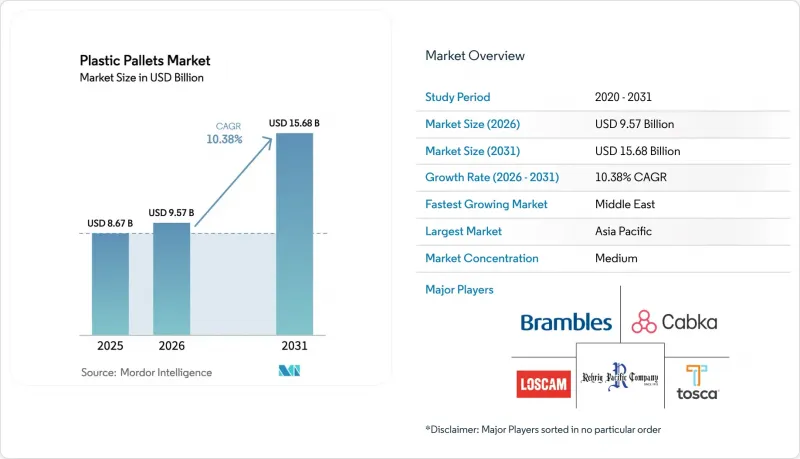
根據 Mordor Intelligence 預測,塑膠托盤市場規模將從 2025 年的 86.7 億美元和 2026 年的 95.7 億美元成長到 2031 年的 156.8 億美元,2026 年至 2031 年的複合年成長率為 10.38%。
本報告材料類型(高密度聚苯乙烯、聚丙烯、再生材料)、托盤類型(可嵌套式、貨架相容式、其他)、終端用戶行業(化學、醫藥/醫療、物流/倉儲、汽車、其他)、負載容量能力(輕載托盤、中載托盤、重載托盤)和地區進行細分。市場預測以美元計價。
全球塑膠托盤市場趨勢與洞察
在醫藥冷鏈中採用衛生塑膠托盤。
如今,藥品經銷商不再將托盤視為一次性緩衝材料,而是將其視為經過認證的設備。加拿大衛生署GUI-0069和美國藥典(USP)第1079章對托盤的可清洗性和可追溯性提出了正式要求,因此買家正轉向使用無孔、可重複使用的托盤平台。由此,能夠記錄清洗過程中微生物數據的冷鏈托盤正在現貨市場取代木棧板。隨著生物製藥對運輸溫度控制的要求日益嚴格,能夠檢驗托盤在衝擊、振動和清潔劑作用下性能的供應商正在獲得多年期合約。這種轉變使得採購標準從單價轉向品質總成本,從而提高了檢驗的木托盤替代品的市場進入門檻。
亞洲出口基地必須遵守ISPM-15標準
國際植物檢疫措施標準(ISPM-15)規定,出口商必須對木質包裝材料進行熱處理或燻蒸,但塑膠托盤卻完全不受此規定約束。美國和歐盟港口對相關法規的嚴格執行,導致不合規貨物的運輸延誤,造成高昂的成本。因此,儘管塑膠托盤的單位成本較高,但中國、越南和印度的出口型製造商仍在轉向使用塑膠托盤,因為塑膠托盤可以簡化清關流程,並降低轉口風險。這帶來了貿易速度提升的益處,塑膠托盤也因此成為即時供應鏈中一種重要的物流「保障」。
高昂的初始資本成本是東南亞新興國家中小企業面臨的一大障礙。
塑膠托盤的價格是同等規格木棧板的三到五倍,這給利潤微薄的小規模出口商帶來了沉重的負擔。該地區缺乏足夠的托盤共用基礎設施,迫使許多公司自行購買托盤,佔用了其有限的流動資金。如果沒有可重複使用包裝材料共用聯盟的支持以及開發銀行的補貼,儘管木棧板的生命週期成本很高,但它們仍可能繼續佔據主導地位,從而阻礙眾多微型出口商採用塑膠托盤。
細分市場分析
截至2025年,高密度聚苯乙烯(HDPE)佔據塑膠托盤市場47.33%的佔有率,但預計到2031年,包含再生材料的產品將以10.96%的複合年成長率成長。雖然原生HDPE仍然是食品和藥品運輸商的首選,因為他們必須滿足美國食品藥物管理局(FDA)和歐盟的過渡限制,但由於歐洲循環經濟法規的日益嚴格,使用再生材料正成為一項競爭優勢。垂直整合的模塑製造商開始尋找廢棄樹脂來源,以保護其利潤率免受與原油價格掛鉤的原生樹脂價格波動的影響,而這些合約的需求已經超過了供應。韓國進行的一項耐久性研究表明,在周轉率高的托盤池中,原生HDPE托盤的使用壽命為9.6年,是聚丙烯托盤的三倍。這印證了HDPE的價值提案,儘管其投入成本較高。
在衛生需求較低且永續性評估標準影響採購的汽車和一般零售業,再生複合材料目前正逐漸成為主流。隨著歐盟設定的到2030年實現10%再生材料含量的目標期限臨近,需求激增,食品業再生材料的市場呈現賣方市場格局。能夠按照FDA 21 CFR Part 177標準進行消毒認證的加工商將獲得更高的價格和優先續約權。由於再生材料供應趨緊,品牌所有者正在投資建造平行供應鏈以降低風險,因此使用原生高密度聚乙烯(HDPE)的塑膠托盤市場預計將保持強勁,而非萎縮。
預計到2025年,貨架式托盤將佔據塑膠托盤市場39.53%的佔有率,這主要得益於其在自動化倉庫中最大化的垂直儲存密度。可堆疊式和可折疊式托盤在出口航線上仍然佔據主導地位,因為這些航線對貨櫃裝載能力和回程傳輸效率要求極高,但隨著零售商優先考慮與自動化系統的兼容性,它們的市場佔有率正在趨於穩定。預計到2031年,展示托盤和客製化托盤的複合年成長率將達到11.23%,因為折扣店和大型量販店正在將預包裝托盤直接運送到銷售區,從而無需人工補貨。
第二代展示單元採用套模圖形、顏色編碼和嵌入式RFID技術,使商店能夠在降低人事費用的同時進一步控制庫存損失。在鋰電池供應鏈中,防靜電客製化產品正迅速普及,因為即使是微小的火花也可能引發熱失控。隨著履約中心維修到高速輸送機,採購負責人開始指定使用公差為±2毫米的貨架相容或可堆疊的SKU,從而淘汰了木質和低精度壓模成型零件。這種規格的轉變正在鞏固自動化托盤和通用出口托盤之間的結構性差異。
區域分析
到2025年,亞太地區將佔全球塑膠托盤市場規模的38.91%,成為全球最大的塑膠托盤市場。中國、印度和東協的出口商傾向於選擇無需ISPM-15處理的塑膠托盤,從而降低海關延誤和轉口風險。印度塑膠產業的目標是到2030年實現445.9億美元的市場規模,國內需求將推動出口和國內運輸對托盤的需求成長。中國仍然是全球最大的塑膠包裝生產國和出口國,由此產生的物流流通保持著較高的托盤周轉率,從而提升了對耐用型高密度聚乙烯(HDPE)托盤的需求。綜合來看,預計到2031年,這些趨勢將推動亞太地區塑膠托盤市場規模的穩定成長。
北美和歐洲構成了一個成熟的第二大市場。美國零售商正在其新建的履約中心部署僅容納精密成型托盤的自動化立體倉庫 (AS/RS) 設備,從而確保穩定的更換週期和高效的托盤共享運作。歐盟的《包裝和包裝廢棄物法規》規定了再利用目標,確保了對多用途包裝的需求,並加速了回收計畫的實施。托盤共享業者在這兩個地區維護密集的回收網路,減少了空駛里程,並將托運人的成本降低了 30-40%。穩定的逆向物流基礎設施降低了托盤損耗率,並有助於預測資產的使用壽命。
預計到2031年,中東地區將以11.41%的複合年成長率(CAGR)實現全球最高成長,主要得益於沙烏地阿拉伯「2030願景」下大型企劃的建設,以及阿拉伯聯合大公國藥品進口增加帶動冷鏈運輸路線的擴張。南美洲的進展則是喜憂參半:巴西和阿根廷的共享倉儲走廊利用率有限,而安地斯山脈國家的倉儲密度不足以支撐經濟復甦。在非洲大部分地區,道路網路分散導致托盤滯留在目的地,阻礙了托盤再利用帶來的經濟效益。預計在這些地區,木棧板仍將佔據主導地位,直到跨境貿易協定簡化手續並改善道路狀況。因此,該地區的成長前景取決於其基礎設施的成熟度,呈現出兩極化的模式。
其他好處
- Excel格式的市場預測(ME)表
- 3個月的分析師支持
目錄
第1章:引言
- 研究假設和市場定義
- 調查範圍
第2章:調查方法
第3章執行摘要
第4章 市場狀況
- 市場概覽
- 市場促進因素
- 在北美和歐洲的藥品冷鏈中引入衛生塑膠托盤
- 亞洲出口基地強制執行ISPM-15,以促進從木材到塑膠的過渡。
- 歐洲第三方物流企業降低總擁有成本(TCO)的資源共享模式
- 美國零售自動化、AS/RS 和輸送機系統需要尺寸穩定的托盤
- 循環經濟目標將提升歐盟對再生高密度聚乙烯托盤的需求
- 中國電池和鋰化工供應鏈對防靜電塑膠托盤的偏好
- 市場限制因素
- 高昂的初始資本成本是東南亞新興國家中小企業進入市場的一大障礙。
- 非洲和南美洲缺乏用於大宗托盤退貨的逆向物流基礎設施
- 原油價格波動導致原生聚烯樹脂價格波動
- 建築業的重度使用者已經意識到,與硬木托盤相比,塑膠托盤的承重能力較低。
- 宏觀經濟因素對市場的影響
- 產業價值鏈分析
- 技術展望
- 塑膠托盤的永續性、回收利用和再利用
- 法律規範和標準
- 波特五力分析
第5章 市場規模與成長預測
- 依材料類型
- 高密度聚苯乙烯
- 聚丙烯
- 回收材料
- 托盤類型
- 可嵌套
- 機架式安裝
- 可堆疊
- 顯示自訂
- 按最終用戶行業分類
- 飲食
- 化學品
- 藥品和醫療保健
- 零售與電子商務
- 物流/倉儲
- 車
- 其他
- 按負載容量
- 輕型托盤
- 中型托盤
- 重型托盤
- 按地區
- 北美洲
- 美國
- 加拿大
- 墨西哥
- 南美洲
- 巴西
- 阿根廷
- 其他南美國家
- 歐洲
- 英國
- 德國
- 法國
- 義大利
- 其他歐洲國家
- 亞太地區
- 中國
- 日本
- 印度
- 韓國
- 其他亞太國家
- 中東和非洲
- 中東
- 阿拉伯聯合大公國
- 沙烏地阿拉伯
- 其他中東國家
- 非洲
- 南非
- 埃及
- 其他非洲地區
- 中東
- 北美洲
第6章 競爭情勢
- 市場集中度
- 策略趨勢
- 市佔率分析
- 公司簡介
- Brambles Limited
- CABKA Group GmbH
- Orbis Corporation
- Schoeller Allibert Group BV
- Rehrig Pacific Company
- Tosca Services, LLC
- Loscam International Holdings
- Craemer Holding GmbH
- Gamma-Wopla NV/Smart-Flow NV
- Q-Pall BV
- Plasgad Plastic Products ACS Ltd.
- NAECO SL
- Polymer Solutions International Inc.
- RPP Containers
- IPS Plastics Pallets
- Shandong Huaxiang Plastic Co., Ltd.
- Beijing Jingliang United Plastic Products Co., Ltd.
- TranPak Inc.
- Allied Plastics, Inc.
- Falkenhahn AG
- Buckhorn Inc.
- iGPS Logistics LLC
第7章 市場機會與未來展望
According to Mordor Intelligence, the plastic pallets market size is projected to expand from USD 8.67 billion in 2025 and USD 9.57 billion in 2026 to USD 15.68 billion by 2031, registering a CAGR of 10.38% between 2026 to 2031.
This report is Segmented by Material Type (High-Density Polyethylene, Polypropylene, Recycled Materials), Pallet Type (Nestable, Rackable, and More), End-User Industry (Chemical, Pharmaceutical and Healthcare, Logistics and Warehousing, Automotive, and More), Load Capacity (Light-Duty Pallets, Medium-Duty Pallets, High-Duty Pallets), and Geography. The Market Forecasts are Provided in Terms of Value (USD).
Global Plastic Pallets Market Trends and Insights
Adoption of Hygienic Plastic Pallets in Pharmaceutical Cold Chains
Pharmaceutical distributors now view pallets as qualified equipment rather than disposable dunnage. Health Canada's GUI-0069 and USP Chapter 1079 formalize cleanability and traceability requirements, driving buyers to non-porous, reusable platforms. Cold-chain pools that document wash-cycle microbiology are therefore displacing spot-market wood. As more biologics move through strict temperature lanes, suppliers that can validate pallet performance under shock, vibration, and cleaning chemicals are securing multi-year contracts. This shift tilts procurement criteria from unit price to total cost of quality and strengthens barriers to entry for unverified wooden alternatives.
Mandates for ISPM-15 Compliance in Asia Export Hubs
International Standards for Phytosanitary Measures 15 requires exporters to heat-treat or fumigate wood packaging, while plastic pallets are exempt from the rule entirely. Enforcement at U.S. and EU ports creates costly delays for non-compliant loads. Export-oriented manufacturers in China, Vietnam, and India are therefore moving to plastic despite a higher ticket price because it shortens customs clearance and mitigates re-export risks. The practical effect is a trade-velocity premium that positions plastic as a logistics insurance policy for just-in-time supply chains.
High Upfront Capital Cost Barrier for SMEs in Emerging Southeast Asia
Plastic pallets cost three to five times as much as comparable wood units, a burden for small exporters operating on slim margins. Because pooling coverage is patchy in the region, many firms must self-purchase, tying up scarce working capital. Without the backing of pooling consortia or subsidies from development banks for reusable packaging, wood will continue to dominate, even with its higher lifecycle costs, hindering its adoption among numerous micro-exporters.
Other drivers and restraints analyzed in the detailed report include:
- Pooling Models Reducing Total Cost of Ownership for 3PLs in Europe
- Retail Automation Requiring Dimensionally Stable Pallets in the United States
- Limited Reverse Logistics Infrastructure in Africa and South America
For complete list of drivers and restraints, kindly check the Table Of Contents.
Segment Analysis
High-density polyethylene accounted for 47.33% of the plastic pallets market share in 2025, while recycled-content variants are forecast to expand at a 10.96% CAGR through 2031. Virgin HDPE remains the first choice for food and pharmaceutical shippers that must meet FDA and EU migration limits, yet tightening circular-economy rules in Europe are making recycled feedstock a competitive necessity. Vertically integrated molders have started locking in post-consumer resin streams to protect margins from crude-linked swings in virgin resin prices, and those contracts are already oversubscribed. A Korean longevity study showed virgin HDPE pallets lasting 9.6 years in high-rotation pools, three times longer than polypropylene, which reinforces HDPE's value proposition despite its higher input cost.
Recycled blends now dominate automotive and general retail lanes, where hygiene barriers are lower, and sustainability scorecards govern sourcing. Demand spikes ahead of the EU's 10% recycled-content deadline for 2030, creating a seller's market for food-grade recyclate. Processors that can certify decontamination to FDA 21 CFR Part 177 standards command premium pricing and priority in contract renewals. As recycled supply tightens, the plastic pallets market for virgin HDPE is expected to hold steady rather than contract, as brand owners fund parallel supply chains to ring-fence risk.
Rackable platforms secured 39.53% of the plastic pallets market share in 2025 by maximizing vertical storage density in automated warehouses. Nestable and stackable designs retained strong positions in export corridors that prize container cube and backhaul efficiency, yet their share is plateauing as retailers prioritize automation compatibility. Display and custom formats are on track for an 11.23% CAGR through 2031, because discounters and big-box stores now roll fully merchandised pallets straight to the sales floor, eliminating manual shelf stocking.
Second-generation display units incorporate in-mold graphics, color coding, and embedded RFID, letting stores cut labor while improving shrink control. Custom anti-static versions are proliferating in lithium-battery supply chains, where a single spark can trigger thermal runaway. As fulfillment centers retrofit with high-speed conveyors, procurement managers are specifying rackable or stackable SKUs built to +-2 mm tolerances, sidelining wood and low-precision compression molds. This specification shift cements an architectural divide between automation-ready pallets and commodity export skids.
Complete Report Scope:
- By Material Type
- High-Density Polyethylene
- Polypropylene
- Recycled Materials
- By Pallet Type
- Nestable
- Rackable
- Stackable
- Display / Custom
- By End-User Industry
- Food and Beverage
- Chemical
- Pharmaceutical and Healthcare
- Retail and E-Commerce
- Logistics and Warehousing
- Automotive
- Other End-User Industries
- By Load Capacity
- Light-Duty Pallets
- Medium-Duty Pallets
- High-Duty Pallets
- By Geography
- North America
- United States
- Canada
- Mexico
- South America
- Brazil
- Argentina
- Rest of South America
- Europe
- United Kingdom
- Germany
- France
- Italy
- Rest of Europe
- Asia Pacific
- China
- Japan
- India
- South Korea
- Rest of Asia Pacific
- Middle East and Africa
- Middle East
- United Arab Emirates
- Saudi Arabia
- Rest of Middle East
- Africa
- South Africa
- Egypt
- Rest of Africa
- Middle East
- North America
Geography Analysis
Asia-Pacific accounted for 38.91% of the global value in 2025, making it the largest plastic pallets market. Export manufacturers in China, India, and ASEAN favor plastic units that bypass ISPM-15 treatment, cutting customs delays and re-export risks. India's plastics sector is targeting USD 44.59 billion by 2030, and domestic demand is driving higher pallet purchases for both export and inland moves. China remains the single biggest producer and exporter of plastic packaging, and the resulting logistics flows sustain high pallet rotation that rewards durable HDPE designs. Together, these dynamics push the regional plastic pallets market size steadily upward through 2031.
North America and Europe form a mature second tier. U.S. retailers are equipping new fulfillment centers with AS/RS equipment that accepts only precision-molded units, ensuring steady replacement cycles and vibrant pooling activity. The EU Packaging and Packaging Waste Regulation locks in reuse targets that guarantee multi-trip demand and accelerate take-back programs. Pooling operators maintain dense retrieval networks across both regions, reducing empty miles and supporting 30-40% cost savings for shippers. Stable reverse-logistics infrastructure keeps pallet loss rates low and underpins predictable asset lifetimes.
The Middle East is forecast to log the fastest regional CAGR at 11.41% through 2031 as Saudi Vision 2030 builds megaproject warehouses and UAE pharmaceutical imports swell cold-chain lanes. South America shows mixed progress because Brazil and Argentina support limited pooling corridors, while Andean markets lack the warehouse density needed for economical retrieval. Most of Africa remains constrained by fragmented road systems that strand pallets at endpoints, blocking reuse economics. Until cross-border trade agreements streamline paperwork and road conditions improve, wooden platforms will dominate in those territories. Regional growth prospects, therefore, bifurcate along lines of infrastructure maturity.
- Brambles Limited
- CABKA Group GmbH
- Orbis Corporation
- Schoeller Allibert Group BV
- Rehrig Pacific Company
- Tosca Services, LLC
- Loscam International Holdings
- Craemer Holding GmbH
- Gamma-Wopla NV / Smart-Flow NV
- Q-Pall BV
- Plasgad Plastic Products ACS Ltd.
- NAECO S.L.
- Polymer Solutions International Inc.
- RPP Containers
- IPS Plastics Pallets
- Shandong Huaxiang Plastic Co., Ltd.
- Beijing Jingliang United Plastic Products Co., Ltd.
- TranPak Inc.
- Allied Plastics, Inc.
- Falkenhahn AG
- Buckhorn Inc.
- iGPS Logistics LLC
Additional Benefits:
- The market estimate (ME) sheet in Excel format
- 3 months of analyst support
TABLE OF CONTENTS
1 INTRODUCTION
- 1.1 Study Assumptions and Market Definition
- 1.2 Scope of the Study
2 RESEARCH METHODOLOGY
3 EXECUTIVE SUMMARY
4 MARKET LANDSCAPE
- 4.1 Market Overview
- 4.2 Market Drivers
- 4.2.1 Adoption of Hygienic Plastic Pallets in Pharmaceutical Cold Chains across North America and Europe
- 4.2.2 Mandates for ISPM-15 Compliance Driving Shift from Wood to Plastic in Asia Export Hubs
- 4.2.3 Pooling Models Reducing Total Cost of Ownership for 3PLs in Europe
- 4.2.4 Retail Automation, AS/RS and Conveyor Systems Requiring Dimensionally Stable Pallets in the United States
- 4.2.5 Circular Economy Targets Pushing Demand for Recyclate-Based HDPE Pallets in the European Union
- 4.2.6 Battery and Chemical Lithium Supply Chains Preferring Anti-Static Plastic Pallets in China
- 4.3 Market Restraints
- 4.3.1 High Upfront Capital Cost Barrier for Small and Medium Enterprises in Emerging Southeast Asia
- 4.3.2 Limited Reverse Logistics Infrastructure for Bulk Return of Pallets in Africa and South America
- 4.3.3 Price Volatility of Virgin Polyolefin Resins Linked to Crude-Oil Swings
- 4.3.4 Perception of Lower Load Capacity Versus Hardwood Pallets Among Heavy-Duty Users in Construction
- 4.4 Impact of Macroeconomic Factors on the Market
- 4.5 Industry Value Chain Analysis
- 4.6 Technological Outlook
- 4.7 Sustainability and Recycling/Reusability of Plastic Pallets
- 4.8 Regulatory Framework and Standards
- 4.9 Porter's Five Forces Analysis
- 4.9.1 Bargaining Power of Suppliers
- 4.9.2 Bargaining Power of Buyers
- 4.9.3 Threat of New Entrants
- 4.9.4 Threat of Substitutes
- 4.9.5 Intensity of Competitive Rivalry
5 MARKET SIZE AND GROWTH FORECASTS (VALUE)
- 5.1 By Material Type
- 5.1.1 High-Density Polyethylene
- 5.1.2 Polypropylene
- 5.1.3 Recycled Materials
- 5.2 By Pallet Type
- 5.2.1 Nestable
- 5.2.2 Rackable
- 5.2.3 Stackable
- 5.2.4 Display / Custom
- 5.3 By End-User Industry
- 5.3.1 Food and Beverage
- 5.3.2 Chemical
- 5.3.3 Pharmaceutical and Healthcare
- 5.3.4 Retail and E-Commerce
- 5.3.5 Logistics and Warehousing
- 5.3.6 Automotive
- 5.3.7 Other End-User Industries
- 5.4 By Load Capacity
- 5.4.1 Light-Duty Pallets
- 5.4.2 Medium-Duty Pallets
- 5.4.3 High-Duty Pallets
- 5.5 By Geography
- 5.5.1 North America
- 5.5.1.1 United States
- 5.5.1.2 Canada
- 5.5.1.3 Mexico
- 5.5.2 South America
- 5.5.2.1 Brazil
- 5.5.2.2 Argentina
- 5.5.2.3 Rest of South America
- 5.5.3 Europe
- 5.5.3.1 United Kingdom
- 5.5.3.2 Germany
- 5.5.3.3 France
- 5.5.3.4 Italy
- 5.5.3.5 Rest of Europe
- 5.5.4 Asia Pacific
- 5.5.4.1 China
- 5.5.4.2 Japan
- 5.5.4.3 India
- 5.5.4.4 South Korea
- 5.5.4.5 Rest of Asia Pacific
- 5.5.5 Middle East and Africa
- 5.5.5.1 Middle East
- 5.5.5.1.1 United Arab Emirates
- 5.5.5.1.2 Saudi Arabia
- 5.5.5.1.3 Rest of Middle East
- 5.5.5.2 Africa
- 5.5.5.2.1 South Africa
- 5.5.5.2.2 Egypt
- 5.5.5.2.3 Rest of Africa
- 5.5.5.1 Middle East
- 5.5.1 North America
6 COMPETITIVE LANDSCAPE
- 6.1 Market Concentration
- 6.2 Strategic Moves
- 6.3 Market Share Analysis
- 6.4 Company Profiles (includes Global Level Overview, Market Level Overview, Core Segments, Financials as available, Strategic Information, Market Rank/Share, Products and Services, Recent Developments)
- 6.4.1 Brambles Limited
- 6.4.2 CABKA Group GmbH
- 6.4.3 Orbis Corporation
- 6.4.4 Schoeller Allibert Group BV
- 6.4.5 Rehrig Pacific Company
- 6.4.6 Tosca Services, LLC
- 6.4.7 Loscam International Holdings
- 6.4.8 Craemer Holding GmbH
- 6.4.9 Gamma-Wopla NV / Smart-Flow NV
- 6.4.10 Q-Pall BV
- 6.4.11 Plasgad Plastic Products ACS Ltd.
- 6.4.12 NAECO S.L.
- 6.4.13 Polymer Solutions International Inc.
- 6.4.14 RPP Containers
- 6.4.15 IPS Plastics Pallets
- 6.4.16 Shandong Huaxiang Plastic Co., Ltd.
- 6.4.17 Beijing Jingliang United Plastic Products Co., Ltd.
- 6.4.18 TranPak Inc.
- 6.4.19 Allied Plastics, Inc.
- 6.4.20 Falkenhahn AG
- 6.4.21 Buckhorn Inc.
- 6.4.22 iGPS Logistics LLC
7 MARKET OPPORTUNITIES AND FUTURE OUTLOOK
- 7.1 White-space and Unmet-Need Assessment

 2026-2030年全球塑膠托盤市場
 塑膠托盤市場:2026-2032年全球市場預測(按產品類型、材料類型、承載能力、尺寸、最終用戶、應用和銷售管道)
 2026-2034年全球塑膠托盤、週轉箱和包裝箱市場規模、佔有率、趨勢和成長分析報告
 塑膠托盤、週轉箱和包裝箱市場規模、佔有率和趨勢分析報告:按產品、應用、地區和細分市場分類(2026-2033 年)
 塑膠托盤市場:依產品類型、托盤類型、最終用途產業和地區分類全球塑膠托盤市場規模、佔有率、趨勢和成長分析報告(2026-2034年)
 塑膠托盤市場規模、佔有率和成長分析(按產品類型、托盤類型、材料、最終用途產業和地區分類)-2026-2033年產業預測
 塑膠托盤市場-全球產業規模、佔有率、趨勢、機會與預測,依材料(高密度聚乙烯、低密度聚乙烯、聚丙烯等)、類型、應用、地區和競爭情況細分,2020-2030 年預測
 塑膠托盤市場機會、成長動力、產業趨勢分析及 2025 - 2034 年預測