


 |
市場調查報告書
商品編碼
2125650
中國感測器市場:市場佔有率分析、產業趨勢與統計、成長預測(2026-2031)China Sensors - Market Share Analysis, Industry Trends & Statistics, Growth Forecasts (2026 - 2031) |
||||||

※ 本網頁內容可能與最新版本有所差異。詳細情況請與我們聯繫。
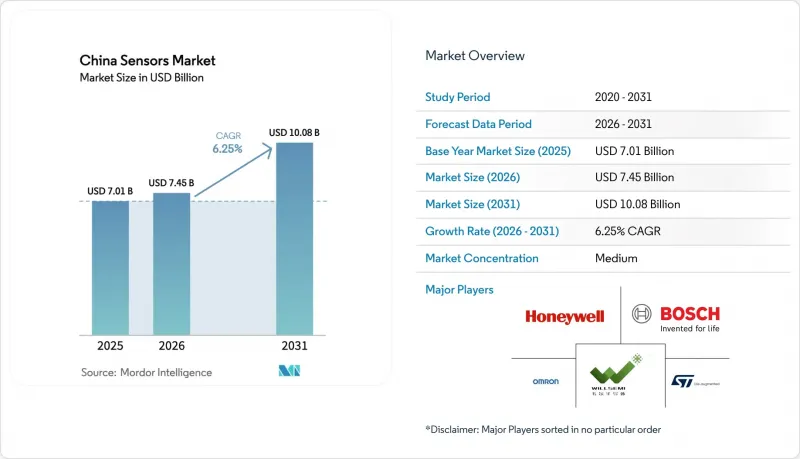
中國感測器市場預計到 2026 年將達到 74.5 億美元,高於 2025 年的 70.1 億美元,預計到 2031 年將達到 100.8 億美元。
預計 2026 年至 2031 年的複合年成長率為 6.25%。
本報告按測量參數(溫度、壓力、液位、流速、接近度等)、操作模式(光學、電阻、生物感測器、壓阻、成像、雷射雷達等)、技術(MEMS、CMOS/IC感測器、光纖、量子/NV中心等)和最終用戶產業(汽車、家用電子電器、能源、工業/製造、醫療/健康等)進行分類。
中國感測器市場的趨勢與洞察
透過政府主導的「中國製造2025」計劃促進本土化。
由於大規模的財政激勵措施和採購優先政策,關鍵感測器零件的國內採購率從2020年的約40%提高到2025年的70%。到2025年初,已建成33個以上的製造研發中心,作為大學與企業合作研發的樞紐。優惠融資、簡化認證流程和智慧財產權支援進一步降低了本土企業的進入門檻,促成了壓力感測器、環境感測器和慣性感測器等領域垂直整合價值鏈的形成,其規模已足以與海外供應商匹敵。
電動車產量的激增推高了對高溫、高壓和電流感測器。
2024年電動車銷量超過350萬輛,維持了較2023年以前水準的三位數成長,單車感測器數量以每年8-10%的速度成長。比亞迪在所有車型上免費標配了「上帝之眼」智慧駕駛平台,甚至在大眾市場車型中也實現了先進的溫度控管、電池壓力和電流測量陣列的標準化。這一趨勢導致靠近主要組裝基地的國內MEMS和分流式電流感測器製造商的累積訂單增加。
依賴進口特種晶圓會帶來供應鏈風險。
儘管國內晶圓廠在成熟製程節點上提高了產能,但中國在高溫和光電感測器所需的SOI、SiC和GaN晶圓方面仍依賴海外供應商。 2024年實施的先進基板出口新規加劇了採購的不確定性,迫使企業儲備緩衝庫存,增加了營運資金需求。由此導致的前置作業時間波動限制了尖端汽車和醫療設備的生產。
細分市場分析
預計到2025年,壓力感測器將佔中國感測器市場佔有率的18.45%,這反映了其在汽車、工業和行動電話領域成熟的嵌入式應用經驗。儘管環境感測器市場規模較小,但預計其複合年成長率將達到16.59%,這是由更嚴格的國家空氣品質標準和地方政府強制性PM2.5監測所推動的。
一線城市空氣品質監測站的快速發展刺激了對高精度氣體和顆粒物感測器的需求,顯著推動了預測期內中國環境感測器市場規模的成長。消費性物聯網空氣清淨機和智慧家居設備也進一步促進了銷售成長。同時,流量感測器和液位感測器在化學和供水事業工程中穩步發展,而振動感測器和磁感測器在結構完整性監測和自主導航等應用中日益普及。
憑藉成熟的封裝生產線和成熟的設計智慧財產權,耐壓型LiDAR元件在2025年維持了31.75%的銷售佔有率。同時,隨著ADAS在中檔電動車的普及,預計到2031年,LiDAR單元的複合年成長率將達到21.53%。 2024年,合賽電子和RoboSense兩家公司合計出貨超過52萬台汽車LiDAR單元,佔全球出貨量的三分之一。
預計到2031年,中國雷射雷達感測器市場規模將達到近14.2億美元,主要得益於GB/T 45500-2025等國家標準的推動,這些標準定義了性能指標。此外,配套的雷達、電容式觸控感測器和光學成像器等成像器也保持了兩位數的成長,滿足了消費性電子設備和工業機器人對多模態感知的需求。
其他好處:
- Excel格式的市場預測(ME)表
- 3個月的分析師支持
目錄
第1章:引言
- 研究假設和市場定義
- 調查範圍
第2章:調查方法
第3章執行摘要
第4章 市場狀況
- 市場概覽
- 市場促進因素
- 政府主導的「中國製造2025」計劃旨在促進感測器供應鏈的本土化。
- 電動車產量的激增帶動了對高溫、高壓和大電流感測器的需求成長。
- 廣東省集中生產的智慧型手機和物聯網穿戴裝置推動了MEMS出貨量的成長。
- 長三角Delta工廠向智慧工廠的維修正在加速工業感測器的應用。
- 遠端患者監護和數位健康平台的日益普及正在推動醫療感測器市場的成長。
- 國內晶圓代工廠降低 8 吋 MEMS 晶圓的成本,正在擴大感測器的潛在市場。
- 市場限制因素
- 依賴進口特種晶圓會帶來供應鏈風險。
- 知識產權的碎片化現狀導致與現有企業之間在交叉授權方面出現糾紛。
- 本地供應商之間的價格競爭給研發預算帶來了壓力。
- 中國的網路安全法律使雲端連接工業感測器的部署變得更加複雜。
- 價值鏈分析
- 監理展望
- 技術展望
- 波特五力模型
- 投資分析
- 宏觀經濟因素對市場的影響
第5章 市場規模與成長預測
- 透過測量參數
- 溫度
- 壓力
- 等級
- 流動
- 鄰近性
- 環境(空氣品質、氣體)
- 化學品
- 慣性(加速計/陀螺儀)
- 磁性
- 振動
- 其他參數
- 透過操作模式
- 光學
- 電阻
- 生物感測器
- 壓阻式
- 影像
- 電容式
- 壓電
- LiDAR
- 雷達
- 其他營運形式
- 透過技術
- MEMS
- CMOS/IC感測器
- 光纖
- 量子和NV色心
- 其他(O-NEMS、薄膜)
- 按最終用戶行業分類
- 車
- 家用電子產品
- 智慧型手機
- 平板電腦、筆記型電腦、個人電腦
- 穿戴式裝置
- 智慧家庭設備
- 其他家用電子電器
- 能源(發電和儲能)
- 工業和製造業
- 醫療保健與健康
- 建築業、農業、礦業
- 航太/國防
第6章 競爭情勢
- 市場集中度
- 策略趨勢
- 市佔率分析
- 公司簡介
- Bosch Sensortec GmbH
- STMicroelectronics NV
- Honeywell International Inc.
- Omron Corporation
- Infineon Technologies AG
- Texas Instruments Inc.
- Panasonic Corporation
- Sensirion AG
- Hesai Technology Co. Ltd.
- NXP Semiconductors NV
- TDK Corporation(InvenSense)
- Analog Devices Inc.
- Melexis NV
- AAC Technologies Holdings Inc.
- Will Semiconductor Co. Ltd.
- Goertek Inc.
- MEMSensing Microsystems Co. Ltd.
- Novosense Microelectronics
- Hanwei Electronics Group Corp.
- OmniVision Technologies Inc.
- Amphenol Advanced Sensors
- Shanghai Zhaohui Pressure Apparatus Co. Ltd.
- Sinochip Electronics Co. Ltd.
- Hefei 3-Nod Sensor Co. Ltd.
- Silan Microelectronics Co. Ltd.
第7章 市場機會與未來展望
According to Mordor Intelligence, China sensors market size in 2026 is estimated at USD 7.45 billion, growing from 2025 value of USD 7.01 billion with 2031 projections showing USD 10.08 billion, growing at 6.25% CAGR over 2026-2031.
This report is Segmented by Parameter Measured (Temperature, Pressure, Level, Flow, Proximity, and More), Mode of Operation (Optical, Electrical Resistance, Biosensors, Piezoresistive, Image, Lidar, and More), Technology (MEMS, CMOS / IC Sensors, Fiber-Optic, Quantum and NV-Centre, and Others), and by End-User Industry (Automotive, Consumer Electronics, Energy, Industrial and Manufacturing, Medical and Wellness, and More).
China Sensors Market Trends and Insights
Government-led "Made in China 2025" localization push
Large-scale fiscal incentives and mandated procurement preferences lifted domestic content in core sensor components toward 70% by 2025, compared with about 40% in 2020. More than 33 Manufacturing Innovation Centres had been launched by early 2025, anchoring joint R&D between universities and enterprises. Preferential financing, expedited certification, and IP support further reduced entry barriers for local firms, fostering a vertically integrated value chain that now rivals overseas suppliers in pressure, environmental, and inertial categories.
EV production surge boosting demand for high-temperature, pressure, and current sensors
EV sales exceeded 3.5 million units in 2024, sustaining a triple-digit expansion from pre-2023 levels and lifting per-vehicle sensor content at an 8-10% annual pace. BYD bundled its 'God's Eye' smart-driving platform across the full model line without extra cost, normalizing advanced thermal-management, battery-pressure, and current-measurement arrays even in mass-market cars. The trend strengthened order books for domestic MEMS and shunt-based current-sensor makers positioned closest to major assembly hubs.
Dependence on imported specialty wafers creates supply-chain risk
Despite domestic fabs adding mature-node capacity, China still relied on overseas suppliers for SOI, SiC, and GaN wafers used in high-temperature and photonic sensors. Renewed export-control measures on advanced substrates in 2024 heightened procurement uncertainty and forced buffer-stock policies, increasing working-capital needs. Resulting lead-time volatility constrained the production of cutting-edge automotive and medical devices.
Other drivers and restraints analyzed in the detailed report include:
- Mass manufacturing of smartphones and IoT wearables clustering in Guangdong
- Smart-factory retrofits across the Yangtze River Delta are accelerating industrial sensor uptake
- Fragmented IP landscape triggering cross-licensing disputes
For complete list of drivers and restraints, kindly check the Table Of Contents.
Segment Analysis
Pressure sensors accounted for 18.45% of China's sensor market share in 2025, reflecting established automotive, industrial, and handset integration footprints. Environmental sensors represented a smaller base yet posted the fastest 16.59% CAGR forecast, propelled by stricter National Ambient Air Quality Standards and municipal PM2.5 monitoring mandates.
Rapid air-quality site build-outs in Tier-1 cities stimulated demand for micro-precision gas and particulate sensors, pushing the China sensors market size for environmental categories at a significant rate during the forecast period. Consumer IoT air-purifiers and smart-home devices further broadened volume. Meanwhile, flow and level sensors advanced steadily in chemical processing and water-utilities projects, while vibration and magnetic devices gained traction in structural health and autonomous navigation use cases.
Piezoresistive components retained a 31.75% revenue share in 2025, anchored by mature packaging lines and well-established design IP. LiDAR units, however, are projected for a 21.53% CAGR through 2031 as ADAS penetration in mid-range EVs climbs. Hesai and RoboSense jointly shipped more than 520,000 automotive LiDARs in 2024, equal to one-third of global deliveries.
The China sensors market size for LiDAR is expected to approach USD 1.42 billion by 2031 on the strength of national standards such as GB/T 45500-2025 that codify performance metrics. Complementary radar, capacitive-touch, and optical imagers sustained double-digit growth, serving consumer devices and industrial robots that require multi-modal perception arrays.
Complete Report Scope:
- By Parameter Measured
- Temperature
- Pressure
- Level
- Flow
- Proximity
- Environmental (Air-quality, Gas)
- Chemical
- Inertial (Accel/Gyro)
- Magnetic
- Vibration
- Other Parameters
- By Mode of Operation
- Optical
- Electrical Resistance
- Biosensors
- Piezoresistive
- Image
- Capacitive
- Piezoelectric
- LiDAR
- Radar
- Other Modes
- By Technology
- MEMS
- CMOS / IC Sensors
- Fiber-Optic
- Quantum and NV-Centre
- Others (O-NEMS, Thin-Film)
- By End-user Industry
- Automotive
- Consumer Electronics
- Smartphones
- Tablets, Laptops and PCs
- Wearables
- Smart Home Devices
- Other Consumer Electronics
- Energy (Generation and Storage)
- Industrial and Manufacturing
- Medical and Wellness
- Construction, Agriculture and Mining
- Aerospace and Defense
List of Companies Covered in this Report:
- Bosch Sensortec GmbH
- STMicroelectronics NV
- Honeywell International Inc.
- Omron Corporation
- Infineon Technologies AG
- Texas Instruments Inc.
- Panasonic Corporation
- Sensirion AG
- Hesai Technology Co. Ltd.
- NXP Semiconductors NV
- TDK Corporation (InvenSense)
- Analog Devices Inc.
- Melexis NV
- AAC Technologies Holdings Inc.
- Will Semiconductor Co. Ltd.
- Goertek Inc.
- MEMSensing Microsystems Co. Ltd.
- Novosense Microelectronics
- Hanwei Electronics Group Corp.
- OmniVision Technologies Inc.
- Amphenol Advanced Sensors
- Shanghai Zhaohui Pressure Apparatus Co. Ltd.
- Sinochip Electronics Co. Ltd.
- Hefei 3-Nod Sensor Co. Ltd.
- Silan Microelectronics Co. Ltd.
Additional Benefits:
- The market estimate (ME) sheet in Excel format
- 3 months of analyst support
TABLE OF CONTENTS
1 INTRODUCTION
- 1.1 Study Assumptions and Market Definition
- 1.2 Scope of the Study
2 RESEARCH METHODOLOGY
3 EXECUTIVE SUMMARY
4 MARKET LANDSCAPE
- 4.1 Market Overview
- 4.2 Market Drivers
- 4.2.1 Government-led "Made in China 2025" localisation push for sensor supply-chains
- 4.2.2 EV production surge boosting demand for high-temperature, pressure and current sensors
- 4.2.3 Mass-manufacturing of smartphones and IoT wearables clustering in Guangdong raises MEMS volumes
- 4.2.4 Smart-factory retrofits across Yangtze River Delta accelerating industrial sensor uptake
- 4.2.5 Rising adoption of remote patient-monitoring and digital health platforms driving medical sensors
- 4.2.6 Falling 8-inch MEMS wafer costs from domestic foundries widening sensor addressable markets
- 4.3 Market Restraints
- 4.3.1 Dependence on imported specialty wafers creating supply-chain risk
- 4.3.2 Fragmented IP landscape triggering cross-licensing disputes with incumbents
- 4.3.3 Price wars among local vendors eroding RandD budgets
- 4.3.4 China Cyber-security Law complicating deployment of cloud-connected industrial sensors
- 4.4 Value Chain Analysis
- 4.5 Regulatory Outlook
- 4.6 Technological Outlook
- 4.7 Porter's Five Forces
- 4.7.1 Bargaining Power of Suppliers
- 4.7.2 Bargaining Power of Buyers
- 4.7.3 Threat of New Entrants
- 4.7.4 Threat of Substitutes
- 4.7.5 Degree of Competition
- 4.8 Investment Analysis
- 4.9 Imapct of Macroeconomic Factors on the market
5 MARKET SIZE AND GROWTH FORECASTS (VALUE)
- 5.1 By Parameter Measured
- 5.1.1 Temperature
- 5.1.2 Pressure
- 5.1.3 Level
- 5.1.4 Flow
- 5.1.5 Proximity
- 5.1.6 Environmental (Air-quality, Gas)
- 5.1.7 Chemical
- 5.1.8 Inertial (Accel/Gyro)
- 5.1.9 Magnetic
- 5.1.10 Vibration
- 5.1.11 Other Parameters
- 5.2 By Mode of Operation
- 5.2.1 Optical
- 5.2.2 Electrical Resistance
- 5.2.3 Biosensors
- 5.2.4 Piezoresistive
- 5.2.5 Image
- 5.2.6 Capacitive
- 5.2.7 Piezoelectric
- 5.2.8 LiDAR
- 5.2.9 Radar
- 5.2.10 Other Modes
- 5.3 By Technology
- 5.3.1 MEMS
- 5.3.2 CMOS / IC Sensors
- 5.3.3 Fiber-Optic
- 5.3.4 Quantum and NV-Centre
- 5.3.5 Others (O-NEMS, Thin-Film)
- 5.4 By End-user Industry
- 5.4.1 Automotive
- 5.4.2 Consumer Electronics
- 5.4.2.1 Smartphones
- 5.4.2.2 Tablets, Laptops and PCs
- 5.4.2.3 Wearables
- 5.4.2.4 Smart Home Devices
- 5.4.2.5 Other Consumer Electronics
- 5.4.3 Energy (Generation and Storage)
- 5.4.4 Industrial and Manufacturing
- 5.4.5 Medical and Wellness
- 5.4.6 Construction, Agriculture and Mining
- 5.4.7 Aerospace and Defense
6 COMPETITIVE LANDSCAPE
- 6.1 Market Concentration
- 6.2 Strategic Moves
- 6.3 Market Share Analysis
- 6.4 Company Profiles {(includes Global level Overview, Market level overview, Core Segments, Financials as available, Strategic Information, Market Rank/Share for key companies, Products and Services, and Recent Developments)}
- 6.4.1 Bosch Sensortec GmbH
- 6.4.2 STMicroelectronics NV
- 6.4.3 Honeywell International Inc.
- 6.4.4 Omron Corporation
- 6.4.5 Infineon Technologies AG
- 6.4.6 Texas Instruments Inc.
- 6.4.7 Panasonic Corporation
- 6.4.8 Sensirion AG
- 6.4.9 Hesai Technology Co. Ltd.
- 6.4.10 NXP Semiconductors NV
- 6.4.11 TDK Corporation (InvenSense)
- 6.4.12 Analog Devices Inc.
- 6.4.13 Melexis NV
- 6.4.14 AAC Technologies Holdings Inc.
- 6.4.15 Will Semiconductor Co. Ltd.
- 6.4.16 Goertek Inc.
- 6.4.17 MEMSensing Microsystems Co. Ltd.
- 6.4.18 Novosense Microelectronics
- 6.4.19 Hanwei Electronics Group Corp.
- 6.4.20 OmniVision Technologies Inc.
- 6.4.21 Amphenol Advanced Sensors
- 6.4.22 Shanghai Zhaohui Pressure Apparatus Co. Ltd.
- 6.4.23 Sinochip Electronics Co. Ltd.
- 6.4.24 Hefei 3-Nod Sensor Co. Ltd.
- 6.4.25 Silan Microelectronics Co. Ltd.
7 MARKET OPPORTUNITIES AND FUTURE OUTLOOK
- 7.1 White-space and Unmet-Need Assessment

 AI封裝感測器市場:按技術、感測器類型、應用、材料、國家和地區分類-全球產業分析、市場規模、市場佔有率及2026年至2033年預測
 歐洲感測器:市場佔有率分析、行業趨勢和統計數據、成長預測(2026-2031 年)美洲感測器:市場佔有率分析、行業趨勢和統計數據、成長預測(2026-2031 年)壓電薄膜感測器市場報告:趨勢、預測和競爭分析(至2035年)感測器:市場佔有率分析、行業趨勢和統計數據、成長預測(2026-2031 年)
 MEMS和感測器材料市場預測至2034年—按材料類型、感測器類型、製造技術、應用和地區分類的全球分析航太感測器材料市場預測至2034年-全球分析(按材料類型、複合材料、功能特性、感測器技術、製造技術、航太平台、應用、最終用戶和地區分類)
 踢擊感測器市場規模、佔有率和成長分析:按感測器類型、應用、輸出類型、最終用戶、分銷管道和地區分類-2026-2033年產業預測
 薄膜感測器市場:2026-2032年全球市場預測(依產品類型、技術、基板類型、整合度及最終用途產業分類)大氣感測器市場:2026-2032年全球市場預測(按感測器類型、技術、安裝方式、應用和最終用戶分類)