


 |
市場調查報告書
商品編碼
2125636
中東地區的犯罪與打擊犯罪:市場佔有率分析、行業趨勢與統計數據以及成長預測(2026-2031 年)Middle East Crime And Combat - Market Share Analysis, Industry Trends & Statistics, Growth Forecasts (2026 - 2031) |
||||||

※ 本網頁內容可能與最新版本有所差異。詳細情況請與我們聯繫。
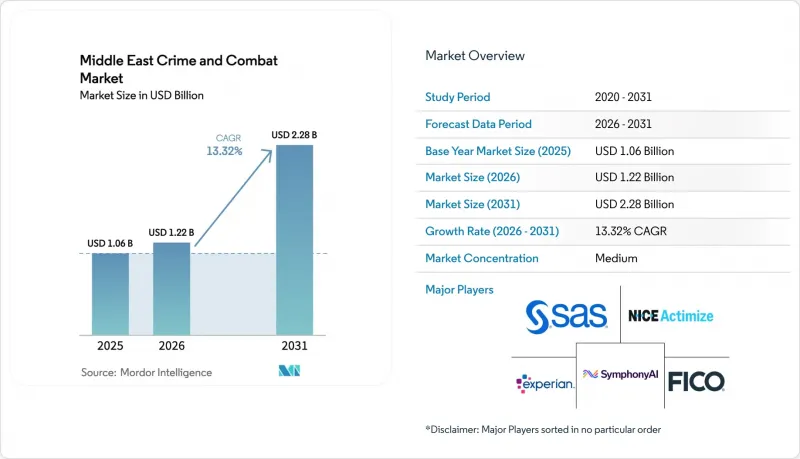
預計中東地區的犯罪和打擊犯罪市場規模將從 2025 年的 10.6 億美元和 2026 年的 12.2 億美元成長到 2031 年的 22.8 億美元,2026 年至 2031 年的年複合成長率(CAGR)為 13.3%。
本報告按解決方案(例如,了解你的客戶 (KYC) 系統、交易監控、合規報告套件、審計和分析)、部署類型(雲端和本地部署)、最終用戶行業(例如,銀行、金融服務和保險 (BFSI)、政府和執法機關)、應用(例如,反洗錢 (AML)、反恐地區融資 (CTF))和地區融資地區進行細分。市場預測以價值(美元)表示。
中東犯罪預防市場的趨勢與洞察
數位支付的迅速普及
預計波灣合作理事會(GCC)國家的數位支付規模將在2025年達到2,270億美元,並在2030年超過3,600億美元。阿拉伯聯合大公國和沙烏地阿拉伯的即時支付網路使得個人之間的轉帳可以在幾秒鐘內完成結算,縮短了處理時間,並迫使銀行引入機器學習引擎進行即時風險評估。預計到2025年,海灣合作理事會成員國的務工人員向南亞的匯款將超過500億美元,這使得非正式匯款管道受到監管。為這些管道提供服務的金融科技公司現在必須實施電子客戶身份驗證(e-KYC)程序,這加劇了部署能夠應對不可預測的流量高峰的雲端案件管理套件的競爭。因此,數位支付的巨大規模和即時正在推動中東犯罪預防和安全市場的持續成長。
海灣合作理事會加強跨境貿易監管
到2025年,海灣合作理事會(GCC)與亞洲、非洲和歐洲之間的貨物貿易總額將達到1.2兆美元。海關當局已開始向金融情報機構提供貿易融資數據,以打擊發票詐騙和規避制裁的行為。阿拉伯聯合大公國的一個區塊鏈試點計畫正在將載貨證券與受益所有人登記冊關聯起來,以近乎即時地識別空殼公司。沙烏地阿拉伯王國(KSA)將於2025年生效的「到港前申報」規則將產生結構化的貨櫃數據,合規引擎將分析這些數據以檢測異常情況,例如連續向低風險地區運送昂貴的電子產品。這些創新需要一套能夠將代理銀行訊息與貨物流動進行配對的分析系統,而傳統的反洗錢工具則缺乏這種能力。這項需求是推動中東反犯罪市場成長的主要動力。
阿拉伯語合規分析師短缺
到2025年,雙語合規分析師的空缺率將達到35%,迫使銀行依賴外籍員工,而這些員工往往難以掌握交易背後的區域性細微差別。 2025年,阿拉伯聯合大公國和沙烏地阿拉伯的大學授予的金融犯罪和阿拉伯語語言學雙學位不足800個,而市場需求卻超過2500個職位。在埃及和科威特,監管機構要求阿拉伯語報告必須在48小時內提交,這給本就人手不足的團隊帶來了過重的負擔。儘管供應商正在引入阿拉伯語自然語言處理模型,但埃及和海灣地區方言的準確率仍低於80%,這再次凸顯了人工處理瓶頸,並限制了中東反犯罪市場的發展速度。
細分市場分析
到2025年,交易監控系統將佔中東打擊犯罪市場38.19%的佔有率,這反映出監管機構強烈要求從制裁、洗錢和恐怖主義融資的角度篩檢所有即時結算和貿易融資指令。在中東打擊犯罪市場中,隨著合成身分組織利用數位錢包,詐欺偵測和案件管理工具的市場規模預計將在2031年之前以13.98%的複合年成長率快速成長。整合式儀錶板允許分析師在反洗錢和詐欺類型之間自由切換,因為它們可以減少警報擁塞並消除資料重複,因此越來越受歡迎。
Oracle金融服務軟體和Fiserv正利用與海灣合作理事會(GCC)成員國銀行的長期合作關係,大力推廣可提升銷售使用核心客戶記錄的詐欺偵測模組。同時,Feedzai和Comply Advantage等新興企業透過提供預訓練模型,將運作時間從12個月縮短至6個月。卡達中央銀行於2026年1月強制要求以XML格式報告可疑交易,此後,市場對合規報告套件的需求迅速成長。能夠追蹤模型偏差和管治的審計和分析平台正成為董事會層面的必備工具,鞏固了其在蓬勃發展的中東反犯罪市場中的地位。
由於阿拉伯聯合大公國和沙烏地阿拉伯的資料居住法規以及傳統硬體成本的不斷攀升,到2025年,本地部署環境仍佔中東反犯罪和打擊市場規模的56.71%。然而,隨著利雅德、吉達、阿布達比和杜拜的超大規模資料中心滿足主權要求並為模型訓練提供彈性運算,預計從2026年到2031年,雲端訂閱的複合年成長率將達到14.04%。
阿拉伯聯合大公國中央銀行於2025年4月發布的指導意見指出,如果加密、存取控制和資料外洩通知符合國家電子安全局 (NESA) 的框架,則公共雲端上的合規工作負載將被批准。大型金融機構正在試行混合模式,將高要求的分析任務卸載到雲端,同時將個人識別資訊保留在本地;而金融科技公司則直接遷移到雲端原生架構,以避免資本投資。供應商正透過多重雲端編配、即時資料脫敏和低延遲區域等技術來凸顯自身優勢,預計將有利於未來中東反詐欺和反犯罪市場採用訂閱模式。
其他好處:
- Excel格式的市場預測(ME)表
- 3個月的分析師支持
目錄
第1章:引言
- 研究假設和市場定義
- 調查範圍
第2章:調查方法
第3章執行摘要
第4章 市場狀況
- 市場概覽
- 市場促進因素
- 數位支付的迅速普及
- 加強海灣合作理事會跨境貿易監管
- 強制性電子KYC框架(阿拉伯聯合大公國、沙烏地阿拉伯)
- 主要銀行人工智慧異常檢測實施現狀
- 來自金融行動特別工作小組(FATF)同儕評估的壓力促使企業在投資前採取合規措施。
- 生成式人工智慧的可解釋性工具包顯著降低了誤報率。
- 市場限制因素
- 阿拉伯語合規分析師短缺
- 分散的傳統核心銀行系統
- 切換到本地部署系統的成本相對較高。
- 碳邊境調節機制:將反洗錢應用擴展至ESG數據
- 產業價值鏈分析
- 監理情勢
- 技術展望
- 宏觀經濟因素對市場的影響
- 波特五力分析
第5章 市場規模與成長預測
- 透過解決方案
- 了解你的客戶(KYC)系統
- 交易監控
- 合規彙報套件
- 審計與分析
- 詐欺檢測/案件管理
- 部署模式
- 雲
- 現場
- 按最終用戶行業分類
- 銀行、金融服務和保險(BFSI)
- 政府和執法機關
- 金融科技公司和支付服務供應商
- 指定的非金融企業和專業
- 透過使用
- 反洗錢措施
- 反恐融資(CTF)
- 詐欺和網路犯罪的檢測
- 監管和稅務合規(FATCA、CRS)
- 按地區
- 阿拉伯聯合大公國
- 沙烏地阿拉伯王國
- 卡達
- 埃及
- 科威特
- 巴林和阿曼
- 其他中東國家
第6章 競爭情勢
- 市場集中度
- 策略趨勢
- 市佔率分析
- 公司簡介
- SAS Institute Inc.
- NICE Ltd(Actimize Solutions)
- Fair Isaac Corporation(FICO)
- ACI Worldwide Inc.
- Oracle Financial Services Software Ltd.
- Fiserv Inc.
- Experian plc
- Refinitiv Ltd(London Stock Exchange Group)
- EastNets FZ-LLC
- Tata Consultancy Services Ltd.
- Temenos AG
- Wolters Kluwer NV
- Fidelity National Information Services Inc.(FIS)
- SymphonyAI Financial Crime
- iSPIRAL IT Solutions Ltd.
- Napier AI Ltd.
- Feedzai SA
- ComplyAdvantage Ltd.
- ThetaRay Ltd.
- BAE Systems Digital Intelligence
- LexisNexis Risk Solutions Inc.
第7章 市場機會與未來展望
According to Mordor Intelligence, the Middle East crime and combat market size is projected to expand from USD 1.06 billion in 2025 and USD 1.22 billion in 2026 to USD 2.28 billion by 2031, registering a CAGR of 13.3% between 2026 and 2031.
This report is Segmented by Solution (Know-Your-Customer Systems, Transaction Monitoring, Compliance Reporting Suites, Auditing and Analytics, and More), Deployment Mode (Cloud, and On-Premises), End-User Vertical (BFSI, Government and Law-Enforcement Agencies, and More), Application (AML, CTF, and More), and Geography. Market Forecasts are Provided in Terms of Value (USD).
Middle East Crime And Combat Market Trends and Insights
Rapid Digital Payments Penetration
Digital payment volumes across Gulf Cooperation Council (GCC) economies reached USD 227 billion in 2025 and are expected to exceed USD 360 billion by 2030. Instant-payment rails in the UAE and KSA settle peer-to-peer transfers in seconds, compressing review windows and compelling banks to embed machine-learning engines that score risk on the fly. Migrant-worker remittances from the GCC to South Asia surpassed USD 50 billion in 2025, bringing informal channels under regulatory purview. Fintechs serving these corridors now carry mandatory e-KYC obligations, driving a scramble for cloud-based case-management suites able to absorb unpredictable traffic spikes. The sheer scale and immediacy of digital payments, therefore, power sustained growth across the Middle East crime and combat market.
Intensifying GCC Cross Border Trade Surveillance
GCC merchandise trade with Asia, Africa and Europe totalled USD 1.2 trillion in 2025, and customs agencies have begun piping trade-finance data into financial-intelligence units to catch invoice fraud and sanctions evasion. The UAE's blockchain pilot links bills of lading to beneficial-ownership registries, exposing shell companies in near real time. KSA's 2025 pre-arrival declaration rule creates structured container data that compliance engines parse for anomalies such as serial shipments of high-value electronics to low-risk jurisdictions. These innovations demand analytics suites that reconcile correspondent-banking messages with cargo movements, a capability absent in legacy AML tools, and this requirement is a key accelerant for the Middle East crime and combat market.
Shortage of Arabic-Speaking Compliance Analysts
Vacancy rates for bilingual compliance analysts hit 35% in 2025, forcing banks to lean on expatriates who often miss regional nuances within transaction narratives. Universities in the UAE and KSA conferred fewer than 800 dual financial-crime and Arabic-linguistics qualifications in 2025 against market demand for more than 2,500 roles. Regulatory filing deadlines in Egypt and Kuwait require Arabic reports within 48 hours, stretching thinly staffed teams. Vendors are embedding Arabic natural-language models, but precision on Egyptian and Gulf dialects remains below 80%, reinscribing manual bottlenecks and tempering the Middle East crime and combat market's attainable growth rate.
Other drivers and restraints analyzed in the detailed report include:
- Mandatory e-KYC Frameworks in UAE and KSA
- AI-Driven Anomaly Detection in Tier-1 Banks
- Fragmented Legacy Core-Banking Stacks
For complete list of drivers and restraints, kindly check the Table Of Contents.
Segment Analysis
Transaction monitoring systems held 38.19% of the Middle East crime and combat market share in 2025, reflecting regulatory insistence that every instant-payment and trade-finance instruction be screened for sanctions, structuring, and terrorist financing. The Middle East crime and combat market size allocated to fraud detection and case-management tools is forecast to jump ata 13.98% CAGR through 2031 as synthetic-identity rings exploit digital wallets. Integrated dashboards that let analysts switch between AML and fraud typologies are in favour because they suppress alert backlogs and eliminate data duplication.
Oracle Financial Services Software and Fiserv leveraged long-standing GCC bank contracts to upsell fraud modules that reuse core customer records, whereas AI-native challengers such as Feedzai and Comply Advantage compress go-lives from 12 to 6 months by shipping pre-trained models. Compliance-reporting suites are growing briskly after the Qatar Central Bank mandated XML suspicious-transaction filings in January 2026. Auditing and analytics platforms that track model bias and governance have become board-level imperatives, cementing their foothold in the expanding Middle East crime and combat market.
On-premises estates retained 56.71% of the Middle East crime and combat market size in 2025 owing to data-residency rules in the UAE and KSA and the sunk cost of legacy hardware. Cloud subscriptions, however, are on course to log a 14.04% CAGR between 2026 and 2031 as hyperscale data centers in Riyadh, Jeddah, Abu Dhabi and Dubai satisfy sovereignty mandates and provide elastic compute for model training.
The Central Bank of the UAE's April 2025 guidance approved public-cloud compliance workloads if encryption, access controls and breach notifications match the National Electronic Security Authority framework. Large lenders are testing hybrid blueprints that keep personally identifiable data on-premises while off-loading heavy analytics tasks to the cloud, whereas fintech leap directly to cloud-native stacks to avoid capital expenditure. Vendors differentiate on multi-cloud orchestration, real-time data masking and low-latency regional zones, tilting future Middle East crime and combat market share in favour of subscription models.
Complete Report Scope:
- By Solution
- Know-Your-Customer (KYC) Systems
- Transaction Monitoring
- Compliance Reporting Suites
- Auditing and Analytics
- Fraud Detection / Case Management
- By Deployment Mode
- Cloud
- On-premises
- By End-user Vertical
- Banking, Financial Services and Insurance (BFSI)
- Government and Law-Enforcement Agencies
- FinTechs and Payment Service Providers
- Designated Non-Financial Businesses and Professions
- By Application
- Anti-Money Laundering (AML)
- Counter-Terrorist Financing (CTF)
- Fraud and Cyber-Crime Detection
- Regulatory and Tax Compliance (FATCA, CRS)
- By Geography
- United Arab Emirates
- Kingdom of Saudi Arabia
- Qatar
- Egypt
- Kuwait
- Bahrain and Oman
- Rest of Middle East
List of Companies Covered in this Report:
- SAS Institute Inc.
- NICE Ltd (Actimize Solutions)
- Fair Isaac Corporation (FICO)
- ACI Worldwide Inc.
- Oracle Financial Services Software Ltd.
- Fiserv Inc.
- Experian plc
- Refinitiv Ltd (London Stock Exchange Group)
- EastNets FZ-LLC
- Tata Consultancy Services Ltd.
- Temenos AG
- Wolters Kluwer NV
- Fidelity National Information Services Inc. (FIS)
- SymphonyAI Financial Crime
- iSPIRAL IT Solutions Ltd.
- Napier AI Ltd.
- Feedzai SA
- ComplyAdvantage Ltd.
- ThetaRay Ltd.
- BAE Systems Digital Intelligence
- LexisNexis Risk Solutions Inc.
Additional Benefits:
- The market estimate (ME) sheet in Excel format
- 3 months of analyst support
TABLE OF CONTENTS
1 INTRODUCTION
- 1.1 Study Assumptions and Market Definition
- 1.2 Scope of the Study
2 RESEARCH METHODOLOGY
3 EXECUTIVE SUMMARY
4 MARKET LANDSCAPE
- 4.1 Market Overview
- 4.2 Market Drivers
- 4.2.1 Rapid Digital-Payments Penetration
- 4.2.2 Intensifying GCC Cross-Border Trade Surveillance
- 4.2.3 Mandatory e-KYC Frameworks (UAE, KSA)
- 4.2.4 AI-Driven Anomaly Detection Adoption in Tier-1 Banks
- 4.2.5 FATF Mutual-Evaluation Pressures Prompting Compliance Pre-Investment
- 4.2.6 Generative-AI Explainability Toolkits Slashing False Positives
- 4.3 Market Restraints
- 4.3.1 Shortage of Arabic-Speaking Compliance Analysts
- 4.3.2 Fragmented Legacy Core-Banking Stacks
- 4.3.3 High On-Premise System Switching Costs
- 4.3.4 Carbon-Border Adjustment Mechanisms Extending AML Scope to ESG Data
- 4.4 Industry Value-Chain Analysis
- 4.5 Regulatory Landscape
- 4.6 Technological Outlook
- 4.7 Impact of Macroeconomic Factors on the Market
- 4.8 Porter's Five Forces Analysis
- 4.8.1 Bargaining Power of Suppliers
- 4.8.2 Bargaining Power of Consumers
- 4.8.3 Threat of New Entrants
- 4.8.4 Threat of Substitutes
- 4.8.5 Intensity of Competitive Rivalry
5 MARKET SIZE & GROWTH FORECASTS (VALUE)
- 5.1 By Solution
- 5.1.1 Know-Your-Customer (KYC) Systems
- 5.1.2 Transaction Monitoring
- 5.1.3 Compliance Reporting Suites
- 5.1.4 Auditing and Analytics
- 5.1.5 Fraud Detection / Case Management
- 5.2 By Deployment Mode
- 5.2.1 Cloud
- 5.2.2 On-premises
- 5.3 By End-user Vertical
- 5.3.1 Banking, Financial Services and Insurance (BFSI)
- 5.3.2 Government and Law-Enforcement Agencies
- 5.3.3 FinTechs and Payment Service Providers
- 5.3.4 Designated Non-Financial Businesses and Professions
- 5.4 By Application
- 5.4.1 Anti-Money Laundering (AML)
- 5.4.2 Counter-Terrorist Financing (CTF)
- 5.4.3 Fraud and Cyber-Crime Detection
- 5.4.4 Regulatory and Tax Compliance (FATCA, CRS)
- 5.5 By Geography
- 5.5.1 United Arab Emirates
- 5.5.2 Kingdom of Saudi Arabia
- 5.5.3 Qatar
- 5.5.4 Egypt
- 5.5.5 Kuwait
- 5.5.6 Bahrain and Oman
- 5.5.7 Rest of Middle East
6 COMPETITIVE LANDSCAPE
- 6.1 Market Concentration
- 6.2 Strategic Moves
- 6.3 Market Share Analysis
- 6.4 Company Profiles (includes Global Level Overview, Market Level Overview, Core Segments, Financials as available, Strategic Information, Market Rank/Share, Products and Services, Recent Developments)
- 6.4.1 SAS Institute Inc.
- 6.4.2 NICE Ltd (Actimize Solutions)
- 6.4.3 Fair Isaac Corporation (FICO)
- 6.4.4 ACI Worldwide Inc.
- 6.4.5 Oracle Financial Services Software Ltd.
- 6.4.6 Fiserv Inc.
- 6.4.7 Experian plc
- 6.4.8 Refinitiv Ltd (London Stock Exchange Group)
- 6.4.9 EastNets FZ-LLC
- 6.4.10 Tata Consultancy Services Ltd.
- 6.4.11 Temenos AG
- 6.4.12 Wolters Kluwer NV
- 6.4.13 Fidelity National Information Services Inc. (FIS)
- 6.4.14 SymphonyAI Financial Crime
- 6.4.15 iSPIRAL IT Solutions Ltd.
- 6.4.16 Napier AI Ltd.
- 6.4.17 Feedzai SA
- 6.4.18 ComplyAdvantage Ltd.
- 6.4.19 ThetaRay Ltd.
- 6.4.20 BAE Systems Digital Intelligence
- 6.4.21 LexisNexis Risk Solutions Inc.
7 MARKET OPPORTUNITIES AND FUTURE OUTLOOK
- 7.1 White-Space and Unmet-Need Assessment

 2026-2030年全球分析市場
 服務分析市場:全球市場預測,2026-2032年
 NeighborIQ 分析市場預測至 2034 年:按分析類型、部署模式、技術、應用、最終用戶和地區分類的全球分析
 全球服務分析市場
 2026年全球分析市場報告
 全球服務分析市場規模、佔有率、趨勢和成長分析報告(2026-2034)
 犯罪分析工具市場 - 全球產業規模、佔有率、趨勢、機會、預測:按類型、按應用、按部署類型、按地區和競爭對手分類,2021-2031年全球犯罪分析工具市場
 全球旋轉工具市場:成長、未來展望與競爭分析(2024-2032 年)
 旋轉工具市場機會、成長動力、產業趨勢分析與預測 2024 - 2032