


 |
市場調查報告書
商品編碼
2125625
鼓風機:市場佔有率分析、產業趨勢與統計、成長預測(2026-2031 年)Blowers - Market Share Analysis, Industry Trends & Statistics, Growth Forecasts (2026 - 2031) |
||||||

※ 本網頁內容可能與最新版本有所差異。詳細情況請與我們聯繫。
根據 Mordor Intelligence 預測,鼓風機市場規模將從 2025 年的 86.9 億美元成長到 2026 年的 90.9 億美元,然後在 2031 年達到 113.9 億美元,2026 年至 2031 年的複合年成長率為 4.62%。
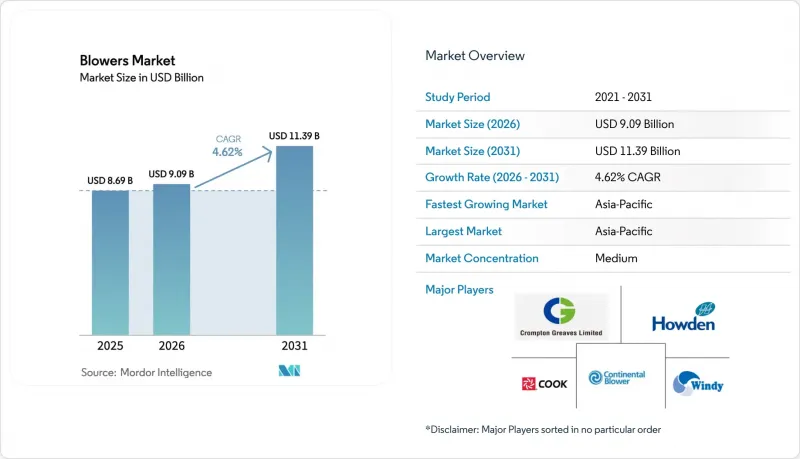
本報告按技術(離心式、軸流式、容積式、高速渦輪式、渦流式)、壓力範圍(低壓、中壓、高壓)、終端用戶行業(發電、石油和天然氣、鋼鐵、化工和石化、採礦和金屬、食品和飲料、暖通空調和非洲清潔室等)以及地區(北美、歐洲、亞太、採礦、中東和非洲)進行分類。
全球鼓風機市場趨勢及洞察
污水處理基礎設施的快速擴張
市政和工業污水處理廠正在提高曝氣能力,曝氣通常佔工廠電力預算的40%至60%,導致對鼓風機的持續需求。堪薩斯州一家水回收廠透過維修,改用高速整合齒輪鼓風機,每年節省了3.5萬美元的能源成本。亞太地區各國政府將水資源短缺問題與更嚴格的廢水法規連結起來,推動了離心式和磁浮渦輪鼓風機的應用,這些鼓風機能夠精確控制溶氧。模組化處理方案幫助小規模市政當局規範採購,並透過鼓勵人們選擇成熟可靠的品牌,間接促進了鼓風機市場的發展。隨著公共產業尋求降低整個生命週期的營運成本,提供數位化監控和預測性維護軟體的供應商獲得了額外的優勢。
對工業空氣排放制定更嚴格的法規
隨著化學、電力和食品加工廠對顆粒物和氣體排放標準的日益嚴格,營運商被迫安裝即使在工況波動的情況下也能保持恆定流量的鼓風機。在美國,計劃在2025年至2029年間新建875吉瓦的發電裝置容量,每個專案都將整合依賴高效能鼓風機的廢氣處理系統。修訂後的歐盟工業排放指令包含連續排放監測,這項規範有利於磁軸承渦輪設計,因為它們具有高可靠性和無油特性。製藥企業和無塵室現在要求風量等級達到100級或更高,這推動了鼓風機市場的監管需求。總體而言,合規成本促使企業採購具有檢驗的能源效率和運轉率指標的高品質設備,使供應商能夠在價格敏感的行業中獲得更高的利潤率。
鋼鐵和銅價格波動
大宗商品價格波動為終端用戶帶來預算不確定性,並擠壓製造商的利潤空間。考慮到離心式鼓風機外殼中鋼材的比重以及馬達繞組中銅的作用,這種影響尤其顯著。製造商正透過多元化金屬供應商和增加庫存來應對,這導致營運資金需求增加。在成本敏感產業,訂單通常會被推遲到價格趨勢穩定後再交付,這暫時抑制了鼓風機市場的需求。 EPC承包商現在在合約中加入價格上漲條款,將部分原物料風險轉移給客戶。雖然避險措施可以起到一定的緩解作用,但持續的市場波動可能會導致計劃於2026-2027年開工的大規模污水處理廠的競標延期。
細分市場分析
預計到2025年,離心式鼓風機技術將佔據鼓風機市場44.25%的佔有率,這反映了其在都市污水處理和一般工業應用中數十年來久經考驗的可靠性。同時,高速渦輪式鼓風機市場預計到2031年將以5.86%的複合年成長率成長,因為買家越來越重視產品全生命週期的節能。離心式鼓風機仍然有需求,尤其是在難以獲得熟練技術人員的發展中地區,因為其較低的初始成本和易於維護的優勢超過了其效率優勢。供應商透過開發混合產品系列來維持其市場佔有率,這些產品組合將自身的離心式產品線與收購的磁浮軸承產品相結合。渦輪式鼓風機擴大整合狀態監測感測器,透過向操作人員提供即時數據,進一步提升了其感知價值。容積式羅茨鼓風機在流量恆定的應用中仍然很重要,例如散裝固體的氣動輸送,但其市場佔有率正在下降。軸流式機械在大容量、低壓冷卻塔中佔據了小眾市場,而渦流式裝置在農場規模的沼氣消化器中發展迅速,因為在這些消化器中,防潮氣流至關重要。
第二代渦輪鼓風機的運作超過 40,000 rpm,並配備先進的微網過濾器,即使在多塵環境下也能延長軸承壽命。一些製造商現在提供軟體,可自動調節葉輪螺距,以在負載波動時保持效率,這是變扭矩污水曝氣的關鍵差異化優勢。儘管磁體供應風險仍然存在,但一些營運商對混合陶瓷軸承技術表現出興趣,儘管這些原型產品尚未達到工業規模驗證。總體而言,離心式設備預計將保持其銷售優勢,但在高價值領域,其銷售成長預計將逐漸落後於渦輪式設備。
區域分析
預計到2025年,亞太地區的鼓風機銷售額將達到37.5億美元,佔全球整體的43.10%。中國的「零排放」法規正在加速都市污水處理廠的維修,而印度的「飲用水生命線計畫」(Jal Jeevan Mission)正在資助新建污水處理設施,這兩項舉措都推動了離心式和渦輪式鼓風機的整體普及。越南和馬來西亞等東協電子產業中心正在加大對無塵室級暖通空調鼓風機的投入,以支持半導體組裝出口的激增。該地區預計5.02%的複合年成長率反映了待開發區基礎設施的開發以及旨在降低能源強度的現有設施維修。
在北美,儘管市場已趨於成熟,但盈利的升級改造仍存在巨大需求。為了符合各州的節能獎勵,公共產業正在用變頻驅動的渦輪鼓風機取代老舊的曝氣設備。美國各地資料中心建設的擴張推動了高壓液冷系統訂單的成長,為供應商提供了高利潤的專案機會。聯邦政府的減排目標正在加速墨西哥灣沿岸石化產業叢集對磁浮軸承技術的早期應用。加拿大沼氣業務的擴張也帶動了用於厭氧消化池的防潮渦流式裝置的銷售。
在歐洲,由於工業排放指令的實施,高價產品得以維持,促使企業採購能夠確保零級空氣潔淨度的無油設備。在德國的化學和製藥公司中,不斷上升的碳排放量正推動企業投資變速離心式鼓風機以降低能源成本。該地區先進的售後市場環境促進了基於訂閱的維護服務的發展,從而擴大了經常性收入來源。儘管到2025年,南美和中東及非洲(MEA)地區的銷售量總合不到10%,但海水淡化廠和採礦項目帶來的成長跡象表明,該地區的鼓風機市場正在蓬勃發展。雖然外匯和政治風險在短期內會抑制鼓風機的普及,但國際金融機構對中東及非洲地區水資源安全的關注正在支撐鼓風機市場的長期成長。
其他好處:
- Excel格式的市場預測(ME)表
- 3個月的分析師支持
目錄
第1章:引言
- 市場分析與定義的前提條件
- 分析範圍
第2章 分析方法
第3章執行摘要
第4章 市場狀況
- 市場概覽
- 市場促進因素
- 污水處理基礎設施的快速擴張
- 加強工業空氣排放法規
- 新興國家發電設施的擴張
- 工業領域的節能維修
- 資料中心對用於液冷的高壓鼓風機的需求
- 農場規模的沼氣池有助於提高渦流鼓風機的性能。
- 市場限制因素
- 鋼鐵和銅價格波動
- 與替代技術相比,能耗高且噪音大。
- 磁浮渦輪鼓風機正從傳統設備手中奪取市場佔有率。
- 稀土元素磁鐵供應鏈中的風險
- 供應鏈分析
- 監理情勢
- 技術展望
- 波特五力分析
第5章:預測市場規模與成長率
- 透過技術
- 離心式
- 軸流式
- 容積式傳遞類型(Roots 類型)
- 高速渦輪型
- 渦流型
- 按壓力範圍
- 低壓(低於 15 kPa)
- 中壓(15-70 kPa)
- 高壓(70 kPa 或更高)
- 按最終用途行業分類
- 發電
- 石油和天然氣
- 鋼
- 化工/石油化工
- 採礦和金屬
- 建築與水泥
- 食品/飲料
- 污水處理
- 暖通空調無塵室
- 其他
- 按地區
- 北美洲
- 美國
- 加拿大
- 墨西哥
- 歐洲
- 德國
- 英國
- 法國
- 義大利
- 西班牙
- 北歐國家
- 俄羅斯
- 其他歐洲國家
- 亞太地區
- 中國
- 印度
- 日本
- 韓國
- 東南亞國協
- 其他亞太國家
- 南美洲
- 巴西
- 阿根廷
- 其他南美國家
- 中東和非洲
- 沙烏地阿拉伯
- 阿拉伯聯合大公國
- 南非
- 其他中東和非洲國家
- 北美洲
第6章 競爭情勢
- 市場集中度
- 策略趨勢(併購、聯盟、購電協議)
- 市場佔有率分析(主要公司的市場排名和佔有率)
- 公司簡介
- Acme Engineering & Manufacturing Corp.
- Airmaster Fan Company Inc.
- Atlas Copco AB
- Continental Blower LLC
- CG Power & Industrial Solutions Ltd.
- DongKun Industrial Co. Ltd.
- Flakt Woods Group SA
- Gardner Denver Holdings Inc.
- Greenheck Fan Corp.
- Howden Group Ltd.
- Loren Cook Company
- Pollrich GmbH
- Ingersoll Rand Inc.
- Chicago Blower Corporation
- Twin City Fan & Blower
- Spencer Turbine Company
- New York Blower Company
- AirPro Fan & Blower Co.
- Atlantic Blowers
- Shandong Zhangqiu Blower Co. Ltd.
- Zhejiang Shangfeng Industrial Holdings
- Hitachi Industrial Equipment Systems Co. Ltd.
第7章 市場機會與未來展望
According to Mordor Intelligence, the blowers market size is expected to grow from USD 8.69 billion in 2025 to USD 9.09 billion in 2026 and is forecast to reach USD 11.39 billion by 2031 at 4.62% CAGR over 2026-2031.
This report is Segmented by Technology (Centrifugal, Axial, Positive-Displacement, High-Speed Turbo, and Regenerative), Pressure Range (Low, Medium, and High), End-Use Industry (Power Generation, Oil and Gas, Iron and Steel, Chemical and Petrochemical, Mining and Metals, Food and Beverage, HVAC and Cleanrooms, and More), and Geography (North America, Europe, Asia-Pacific, South America, and Middle East and Africa).
Global Blowers Market Trends and Insights
Rapid Expansion of Wastewater-Treatment Infrastructure
Municipal and industrial wastewater facilities are increasing their aeration capacity, which typically accounts for 40-60% of a plant's electricity budget, resulting in sustained demand for blowers. A retrofit at the Kansas Water Resource Recovery Facility cut annual energy costs by USD 35,000 after switching to high-speed integrally geared blowers. Asia-Pacific governments are coupling water-scarcity concerns with stricter discharge rules, spurring the uptake of centrifugal and magnetic-bearing turbo models that provide precise dissolved-oxygen control. Modular treatment packages help smaller municipalities standardize procurement, indirectly boosting the blower market by favoring brands with proven reliability. Vendors able to supply digital monitoring and predictive-maintenance software gain further advantage as utilities target whole-of-life operating savings.
Stricter Industrial Air-Emission Regulations
Tightening particulate and gas limits across chemical, power, and food-processing plants are pushing operators to acquire blowers that sustain constant flow under variable conditions.The United States plans 875 GW of new generating capacity between 2025-2029, each project integrating flue-gas treatment systems reliant on high-efficiency blowers. Europe's revised Industrial Emissions Directive incorporates continuous emissions monitoring, a specification that favors magnetic-bearing turbo designs due to their oil-free reliability. Pharmaceutical producers and cleanrooms now require class 100 or better airflow, broadening the regulatory pull on the blower market. Overall, compliance costs steer procurement toward premium machines with verifiable energy and uptime metrics, enabling suppliers to secure higher margins despite price-sensitive sectors.
Steel & Copper Price Volatility
Commodity swings create budget uncertainty for end users and margin pressure for manufacturers, especially given steel's weight in centrifugal-blower housings and copper's role in motor windings. Producers respond by dual-sourcing metals and carrying higher inventories, which raises working-capital needs. Projects in cost-sensitive sectors often defer purchase orders until price signals stabilize, temporarily damping blower market demand. EPC contractors now insert price-escalation clauses into contracts, transferring part of the raw-material risk back to clients. Although hedging instruments offer partial relief, sustained volatility could delay large wastewater plant tenders scheduled for 2026-2027.
Other drivers and restraints analyzed in the detailed report include:
- Power-Generation Additions in Emerging Economies
- Industrial Energy-Efficiency Retrofits
- Magnetic-Levitation Turbo Blowers Cannibalising Legacy Units
For complete list of drivers and restraints, kindly check the Table Of Contents.
Segment Analysis
The blower market size for centrifugal technology accounts for a 44.25% share in 2025, reflecting decades of proven reliability in municipal wastewater and general industrial applications. High-speed turbo designs, however, are projected to register a 5.86% CAGR through 2031, as buyers prioritize lifetime energy savings. Centrifugal models still appeal where lower upfront cost and simpler maintenance outweigh efficiency benefits, especially in developing regions with limited technical skill availability. Suppliers position hybrid portfolios that combine in-house centrifugal lines with acquired magnetic-bearing offerings to defend their market share. Turbo machines are increasingly integrating condition-monitoring sensors, providing operators with real-time data that further enhances their perceived value. Positive-displacement roots blowers retain relevance in flow-constant applications, such as the pneumatic conveying of bulk solids, although their share is declining. Axial machines occupy a niche in high-volume, low-pressure cooling towers, while regenerative units are growing in farm-scale biogas digesters, where moisture-tolerant airflows are crucial.
Second-generation turbo blowers operate at rotational speeds exceeding 40,000 rpm, supported by advanced micro-mesh filters that enhance bearing life in dusty environments. Several manufacturers now bundle software that automatically tunes impeller pitch to maintain efficiency across fluctuating loads, a key differentiator in variable-torque wastewater aeration. As magnet supply risks persist, a subset of operators signals interest in hybrid ceramic-bearing technology, although these prototypes remain unproven at an industrial scale. Overall, centrifugal equipment is expected to keep numerical leadership but cede incremental revenue gains to turbo units in high-value segments.
Complete Report Scope:
- By Technology
- Centrifugal
- Axial
- Positive-Displacement (Roots)
- High-Speed Turbo
- Regenerative
- By Pressure Range
- Low (Below 15 kPa)
- Medium (15 to 70 kPa)
- High (Above 70 kPa)
- By End-use Industry
- Power Generation
- Oil and Gas
- Iron and Steel
- Chemical and Petrochemical
- Mining and Metals
- Construction and Cement
- Food and Beverage
- Waste-Water Treatment
- HVAC & Cleanrooms
- Others
- By Geography
- North America
- United States
- Canada
- Mexico
- Europe
- Germany
- United Kingdom
- France
- Italy
- Spain
- NORDIC Countries
- Russia
- Rest of Europe
- Asia-Pacific
- China
- India
- Japan
- South Korea
- ASEAN Countries
- Rest of Asia-Pacific
- South America
- Brazil
- Argentina
- Rest of South America
- Middle East and Africa
- Saudi Arabia
- United Arab Emirates
- South Africa
- Rest of Middle East and Africa
- North America
Geography Analysis
The Asia-Pacific region underpinned USD 3.75 billion worth of blower sales in 2025, accounting for 43.10% of the global value. China's "Zero Discharge" mandates accelerate municipal wastewater upgrades, while India's Jal Jeevan Mission funds new treatment plants that collectively boost the adoption of centrifugal and turbo blowers. ASEAN electronics hubs in Vietnam and Malaysia are installing cleanroom-grade HVAC blowers to support the fast-rising chip-assembly exports. The region's 5.02% CAGR outlook reflects both greenfield infrastructure and retrofits aimed at lowering energy intensity.
North America follows with mature but lucrative replacement demand. Utilities retrofit aged aeration equipment with VFD-linked turbo blowers to comply with state energy-efficiency incentives. The build-out of data centres across the United States generates high-pressure liquid-cooling orders, providing suppliers with margin-rich project opportunities. Federal emission-reduction targets are accelerating the early adoption of magnetic-bearing technologies in petrochemical clusters along the Gulf Coast. Canada's expanding biogas programs enhance sales of moisture-resistant regenerative units for anaerobic digesters.
Europe sustains premium pricing on the back of the Industrial Emissions Directive, encouraging facilities to buy oil-free machines that guarantee class-zero air purity. Germany's chemical and pharmaceutical complexes are investing in variable-speed centrifugal blowers to reduce energy bills amid rising carbon charges. The region's advanced aftermarket environment favors subscription-based maintenance services, expanding recurring revenue streams. South America and the Middle East & Africa collectively contributed less than 10% of the 2025 volume, but signal upside linked to desalination plants and mining projects. Currency and political risks temper short-term adoption; however, international financiers' focus on water security in the MEA supports long-term growth in the blower market.
- Acme Engineering & Manufacturing Corp.
- Airmaster Fan Company Inc.
- Atlas Copco AB
- Continental Blower LLC
- CG Power & Industrial Solutions Ltd.
- DongKun Industrial Co. Ltd.
- Flakt Woods Group SA
- Gardner Denver Holdings Inc.
- Greenheck Fan Corp.
- Howden Group Ltd.
- Loren Cook Company
- Pollrich GmbH
- Ingersoll Rand Inc.
- Chicago Blower Corporation
- Twin City Fan & Blower
- Spencer Turbine Company
- New York Blower Company
- AirPro Fan & Blower Co.
- Atlantic Blowers
- Shandong Zhangqiu Blower Co. Ltd.
- Zhejiang Shangfeng Industrial Holdings
- Hitachi Industrial Equipment Systems Co. Ltd.
Additional Benefits:
- The market estimate (ME) sheet in Excel format
- 3 months of analyst support
TABLE OF CONTENTS
1 Introduction
- 1.1 Study Assumptions & Market Definition
- 1.2 Scope of the Study
2 Research Methodology
3 Executive Summary
4 Market Landscape
- 4.1 Market Overview
- 4.2 Market Drivers
- 4.2.1 Rapid expansion of wastewater-treatment infrastructure
- 4.2.2 Stricter industrial air-emission regulations
- 4.2.3 Power-generation additions in emerging economies
- 4.2.4 Industrial energy-efficiency retrofits
- 4.2.5 Data-centre liquid-cooling demand for high-pressure blowers
- 4.2.6 Farm-scale biogas digesters boosting regenerative blowers
- 4.3 Market Restraints
- 4.3.1 Steel & copper price volatility
- 4.3.2 High energy consumption and noise versus alternative tech
- 4.3.3 Magnetic-levitation turbo blowers cannibalising legacy units
- 4.3.4 Rare-earth magnet supply-chain exposure
- 4.4 Supply-Chain Analysis
- 4.5 Regulatory Landscape
- 4.6 Technological Outlook
- 4.7 Porter's Five Forces
- 4.7.1 Bargaining Power of Suppliers
- 4.7.2 Bargaining Power of Buyers
- 4.7.3 Threat of New Entrants
- 4.7.4 Threat of Substitutes
- 4.7.5 Competitive Rivalry
5 Market Size & Growth Forecasts
- 5.1 By Technology
- 5.1.1 Centrifugal
- 5.1.2 Axial
- 5.1.3 Positive-Displacement (Roots)
- 5.1.4 High-Speed Turbo
- 5.1.5 Regenerative
- 5.2 By Pressure Range
- 5.2.1 Low (Below 15 kPa)
- 5.2.2 Medium (15 to 70 kPa)
- 5.2.3 High (Above 70 kPa)
- 5.3 By End-use Industry
- 5.3.1 Power Generation
- 5.3.2 Oil and Gas
- 5.3.3 Iron and Steel
- 5.3.4 Chemical and Petrochemical
- 5.3.5 Mining and Metals
- 5.3.6 Construction and Cement
- 5.3.7 Food and Beverage
- 5.3.8 Waste-Water Treatment
- 5.3.9 HVAC & Cleanrooms
- 5.3.10 Others
- 5.4 By Geography
- 5.4.1 North America
- 5.4.1.1 United States
- 5.4.1.2 Canada
- 5.4.1.3 Mexico
- 5.4.2 Europe
- 5.4.2.1 Germany
- 5.4.2.2 United Kingdom
- 5.4.2.3 France
- 5.4.2.4 Italy
- 5.4.2.5 Spain
- 5.4.2.6 NORDIC Countries
- 5.4.2.7 Russia
- 5.4.2.8 Rest of Europe
- 5.4.3 Asia-Pacific
- 5.4.3.1 China
- 5.4.3.2 India
- 5.4.3.3 Japan
- 5.4.3.4 South Korea
- 5.4.3.5 ASEAN Countries
- 5.4.3.6 Rest of Asia-Pacific
- 5.4.4 South America
- 5.4.4.1 Brazil
- 5.4.4.2 Argentina
- 5.4.4.3 Rest of South America
- 5.4.5 Middle East and Africa
- 5.4.5.1 Saudi Arabia
- 5.4.5.2 United Arab Emirates
- 5.4.5.3 South Africa
- 5.4.5.4 Rest of Middle East and Africa
- 5.4.1 North America
6 Competitive Landscape
- 6.1 Market Concentration
- 6.2 Strategic Moves (M&A, Partnerships, PPAs)
- 6.3 Market Share Analysis (Market Rank/Share for key companies)
- 6.4 Company Profiles (includes Global level Overview, Market level overview, Core Segments, Financials as available, Strategic Information, Products & Services, and Recent Developments)
- 6.4.1 Acme Engineering & Manufacturing Corp.
- 6.4.2 Airmaster Fan Company Inc.
- 6.4.3 Atlas Copco AB
- 6.4.4 Continental Blower LLC
- 6.4.5 CG Power & Industrial Solutions Ltd.
- 6.4.6 DongKun Industrial Co. Ltd.
- 6.4.7 Flakt Woods Group SA
- 6.4.8 Gardner Denver Holdings Inc.
- 6.4.9 Greenheck Fan Corp.
- 6.4.10 Howden Group Ltd.
- 6.4.11 Loren Cook Company
- 6.4.12 Pollrich GmbH
- 6.4.13 Ingersoll Rand Inc.
- 6.4.14 Chicago Blower Corporation
- 6.4.15 Twin City Fan & Blower
- 6.4.16 Spencer Turbine Company
- 6.4.17 New York Blower Company
- 6.4.18 AirPro Fan & Blower Co.
- 6.4.19 Atlantic Blowers
- 6.4.20 Shandong Zhangqiu Blower Co. Ltd.
- 6.4.21 Zhejiang Shangfeng Industrial Holdings
- 6.4.22 Hitachi Industrial Equipment Systems Co. Ltd.
7 Market Opportunities & Future Outlook
- 7.1 White-Space & Unmet-Need Assessment

 鼓風機市場-2026-2032年全球市場預測
 真空鼓風機市場:策略性洞察與預測(2026-2031 年)
 2026-2030年全球工業鼓風機市場
 2026-2030年全球火炬鼓風機市場
 工業鼓風機市場機會、成長要素、產業趨勢分析及2026-2035年預測。
 工業鼓風機市場報告:按類型、商業模式、最終用戶和地區分類(2026-2034 年)除塵噴槍市場:2026-2032年全球預測(按產品類型、工作壓力、推進劑類型、最終用途和分銷管道分類)
 2026年全球工業風機租賃服務市場報告鼓風機全球市場規模、佔有率、趨勢和成長分析報告(2026-2034)感應鼓風機市場按類型、容量、應用和最終用途分類,全球預測(2026-2032年)