


 |
市場調查報告書
商品編碼
2125616
美國工業木器塗料:市場佔有率分析、產業趨勢與統計、成長預測(2026-2031)United States Industrial Wood Coatings - Market Share Analysis, Industry Trends & Statistics, Growth Forecasts (2026 - 2031) |
||||||

※ 本網頁內容可能與最新版本有所差異。詳細情況請與我們聯繫。
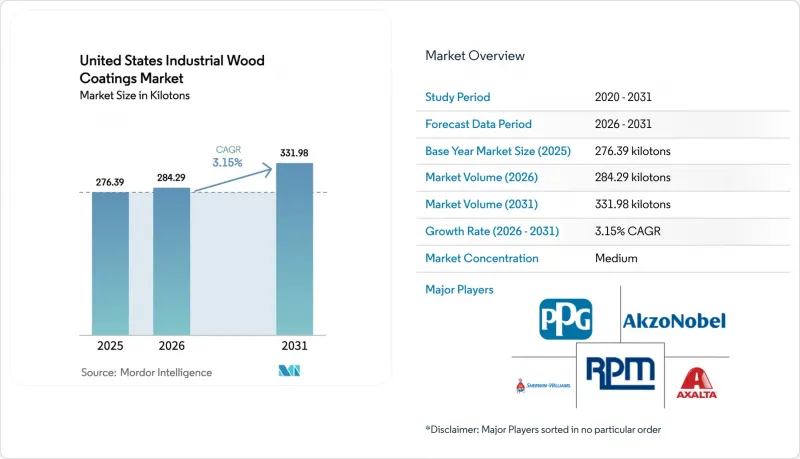
根據 Mordor Intelligence 預測,美國工業木器塗料市場將從 2025 年的 276.39 千噸成長到 2026 年的 284.29 千噸,然後在 2031 年達到 331.98 千噸,2026 年至 2031 年的複合年成長率為 3.15%。
本報告依樹脂類型(環氧樹脂、丙烯酸樹脂、醇酸樹脂、聚氨酯樹脂、聚酯樹脂及其他)、製程(水性、溶劑型、UV固化和粉末固化)以及終端用戶產業(木製家具、細木工製品、地板材料和甲板及其他)進行分類。市場預測以噸為單位。
美國工業木器塗料市場趨勢與洞察
美國家具和櫥櫃產量增加
從2024年第三季到2025年第三季度,國內家具產量下降了4.6%,而商用辦公家具和訂製櫥櫃的產量則增加了3-5%。這推動了按訂單生產模式的轉變,這種模式更有利於快速固化的水性塗料。製造工廠正在將從訂單到訂單的前置作業時間縮短至24-48小時,幾乎沒有時間等待溶劑揮發。因此,木製家具的需求正以3.61%的複合年成長率成長,穩步提升其對工業木器塗料市場整體成長的貢獻。供應商正在將研發預算重新分配到高固態丙烯酸塗料和可在數分鐘內固化的低溫紫外線固化系統上,這使得工廠能夠騰出空間並加速現金流週轉。此外,生產的兩極化正在推動低經營模式的發展,這種模式要求產品符合所有標準並能適用於各種基材。
新冠疫情後的住宅翻新熱潮
儘管借貸成本略有上升,但在房屋價值不斷成長的支撐下,2025年全年住宅翻新支出依然居高不下。櫥櫃翻新承包商(目前佔塗料總用量的12-15%)更傾向於使用水性壓克力顏料和LED-UV系統,因為這些產品可以實現當日重新安裝。國會預算辦公室(CBO)預測,2025年至2029年間,美國每年將有168萬套住宅開工,證實了未來十年對木工產品的需求將持續成長。翻新市場對不含揮發性有機化合物(VOC)、無味塗料的需求不斷成長,正在加速工業木器塗料市場從溶劑含量高的傳統產品轉向新型產品的轉變。擁有高度移動著色能力的本地塗料製造商正抓住這一機遇,從依賴大型量販店分銷的全國性品牌手中奪取市場佔有率。
嚴格的聯邦和州VOC/HAP限值規定(SCAQMD、CARB)
為加州、東北部公路塗料市場以及全美各地分別維護不同的SKU,導致生產批次分散,單位成本上升。每個新的配方週期都需要12到18個月的時間,以及5萬到15萬美元的實驗室、現場和排放氣體測試費用。因此,小規模的品牌要么退出受監管地區,要么將契約製造給全國性的競爭對手,加速了行業整合。監管的日益嚴格對溶劑型聚氨酯的影響尤其嚴重,迫使規範制定者轉向符合監管要求的水性體系,即使這意味著犧牲一些最佳耐久性。隨著時間的推移,監管合規性的差距將縮小工業木器塗料市場中符合條件的溶劑型產品的範圍。
細分市場分析
預計到2025年,聚氨酯的銷量將佔總銷售量的60.15%,並在2031年之前以3.69%的複合年成長率成長,這主要得益於耐磨地板材料和耐光戶外家具的需求。隨著「建造出租」產業對耐用、工廠預製木製品的需求不斷成長,聚氨酯在工業木器塗料市場的佔有率預計將會擴大。在需要快速固化和高人流量的領域,水性丙烯酸塗料的市場佔有率正在被聚氨酯蠶食,但在室內櫥櫃領域,由於氣味和保險成本比極致的耐刮擦性更為重要,水性丙烯酸塗料的優勢更加明顯。醇酸塗料仍用於裝飾性玻璃,而環氧塗料則用於保護實驗室工作台和餐桌免受化學腐蝕。聚酯樹脂與紫外光固化和低溫粉末塗裝相結合,其加工能力比傳統烘烤系統提高了5到10倍,從而形成了一個兼顧性能和永續性的細分市場。
特殊硝化纖維素漆仍然是儀器塗料的主要成分,它能形成具有聲學共振效果的薄膜,並便於重新塗裝。這些小眾化學品的單價通常是主流產品的兩到三倍(每加侖),儘管銷售量相對較小,但仍能保持較高的利潤率。總體而言,聚氨酯預計仍將保持其在工業木器塗料市場的最大佔有率,但價值成長將穩步轉向水性塗料、UV塗料和粉末塗料等創新產品,這些產品價格更高,監管空間也更大。
其他好處:
- Excel格式的市場預測(ME)表
- 3個月的分析師支持
目錄
第1章:引言
- 市場分析與定義的前提條件
- 分析範圍
第2章 分析方法
第3章執行摘要
第4章 市場狀況
- 市場概覽
- 市場促進因素
- 美國國內家具和櫥櫃產量增加
- 新冠疫情後住宅裝修熱潮
- 透過低VOC配方法規進行推廣(OTC/EPA)
- 引入機器人技術和輸送機噴塗線
- 租賃型住宅正在推動對預製木製品的需求。
- 市場限制因素
- 嚴格的聯邦和州VOC/HAP限制(SCAQMD,CARB)
- 石油樹脂和二氧化鈦價格波動
- 聚酯多元醇間歇性供不應求
- 價值鏈分析
- 波特五力分析
第5章:預測市場規模與成長率
- 依樹脂類型
- 環氧樹脂
- 丙烯酸纖維
- 阿爾基多
- 聚氨酯
- 聚酯纖維
- 其他(如硝化纖維素)
- 透過技術
- 水溶液
- 溶劑型
- 紫外線固化型
- 粉末
- 按最終用戶行業分類
- 木製家具
- 細木工(窗戶、門、裝飾線)
- 地板材料和甲板材料
- 其他(樂器、體育器材)
第6章 競爭情勢
- 市場集中度
- 策略趨勢
- 市佔率(%)/排名分析
- 公司簡介
- Akzo Nobel NV
- Axalta Coating Systems
- Benjamin Moore & Co.
- CERAMIC INDUSTRIAL COATINGS
- Diamond Vogel
- Hempel A/S
- ICP Industrial Solutions Group
- Jotun A/S
- PPG Industries Inc.
- RPM International Inc.
- Stiles Industrial Coatings
- Teknos Group
- The Sherwin William Company
第7章 市場機會與未來展望
According to Mordor Intelligence, the United States industrial wood coatings market size is expected to grow from 276.39 kilotons in 2025 to 284.29 kilotons in 2026 and is forecast to reach 331.98 kilotons by 2031 at a 3.15% CAGR over 2026-2031.
This report is Segmented by Resin Type (Epoxy, Acrylic, Alkyd, Polyurethane, Polyester, and Others), Technology (Water-Borne, Solvent-Borne, UV-Curable, and Powder), End-User Industry (Wooden Furniture, Joinery, Flooring and Decking, and Others). Market Forecasts are Provided in Terms of Volume (Tons).
United States Industrial Wood Coatings Market Trends and Insights
Rising U.S. Furniture and Cabinetry Production
Domestic furniture output slipped 4.6 % between Q3 2024 and Q3 2025, yet commercial office furniture and custom cabinetry volumes expanded 3-5 %, underscoring a shift toward made-to-order programs that favor fast-cure water-borne coats. Mill shops are shortening order-to-ship windows to 24-48 hours, leaving little tolerance for solvent flash-off. As a result, wooden furniture demand is tracking a 3.61 % CAGR and steadily widening its contribution to overall industrial wood coatings market growth. Suppliers are reallocating research and development budgets toward high-solids acrylics and low-temperature UV systems that cure in minutes, enabling shops to reclaim floor space and accelerate cash cycles. The production bifurcation also incentivizes inventory-light business models that require universally compliant, multi-substrate products.
Residential Remodeling Boom Post-COVID
Remodeling outlays stayed elevated through 2025, buoyed by accumulated home-equity gains even as borrowing costs edged higher. Cabinet-refacing contractors-now 12-15 % of total coating volume-prefer water-borne acrylics and LED-UV systems that allow same-day re-installation. The Congressional Budget Office's forecast of 1.68 million annual housing starts from 2025-2029 underpins sustained millwork demand well into the next decade. The remodeling channel's appetite for zero-VOC, odor-free finishes is accelerating the transition away from solvent-heavy legacies within the industrial wood coatings market. Regional paint makers with agile tinting infrastructure are capitalizing on this shift, picking up share from national brands encumbered by big-box distribution.
Stringent Federal and State VOC/HAP Ceilings (SCAQMD, CARB)
Maintaining discrete SKUs for California, the Northeast OTR, and the broader U.S. fragments production runs and lifts unit costs. Each new formulation cycle demands 12-18 months and USD 50,000-150,000 in lab, field, and emissions testing. Smaller brands consequently withdraw from complex jurisdictions or cede toll-manufacturing to national competitors, hastening consolidation. The regulatory squeeze weighs heaviest on solvent-borne polyurethanes, nudging specifiers toward water-borne systems that meet limits yet trade off peak durability. Over time, the compliance gap will narrow the addressable solvent-borne pool inside the industrial wood coatings market.
Other drivers and restraints analyzed in the detailed report include:
- Regulatory Push Toward Low-VOC Formulations (OTC/EPA)
- Adoption of Robotics and Conveyorized Spray Lines
- Volatile Petro-Resin and TiO2 Prices
For complete list of drivers and restraints, kindly check the Table Of Contents.
Segment Analysis
Polyurethane held 60.15 % of 2025 volume and will track a 3.69 % CAGR to 2031, sustained by abrasion-resistant flooring and sun-fast exterior joinery. The industrial wood coatings market size for polyurethane is projected to expand in tandem with Build-to-Rent demand for durable, factory-finished millwork. Water-borne acrylics, though faster curing, cede high-traffic niches to polyurethanes but win interior cabinetry jobs where odor and insurance costs matter more than ultimate scratch resistance. Alkyds persist in decorative glazing, while epoxies protect laboratory benches and food-service tables from chemical abuse. Polyester resins, paired with UV-cure and low-temperature powder, are opening throughput gains five to ten times higher than legacy bake systems, creating sub-segments where performance and sustainability align.
Specialty nitrocellulose lacquers remain staples for musical instruments, enabling thin-film builds that resonate acoustically and ease refinishing. These niche chemistries command two to three times the per-gallon price of mainstream products, sustaining robust margins despite negligible volume. Overall, polyurethanes will retain the largest slice of the industrial wood coatings market share, yet the value growth narrative will steadily migrate toward water-borne, UV, and powder innovations that carry higher price points and regulatory headroom.
Complete Report Scope:
- By Resin Type
- Epoxy
- Acrylic
- Alkyd
- Polyurethane
- Polyester
- Others (Nitrocellulose, etc.)
- By Technology
- Water-Borne
- Solvent-Borne
- UV-Curable
- Powder
- By End-User Industry
- Wooden Furniture
- Joinery (Windows, Doors, Molding)
- Flooring and Decking
- Others (Musical instruments, Sports goods)
List of Companies Covered in this Report:
- Akzo Nobel N.V.
- Axalta Coating Systems
- Benjamin Moore & Co.
- CERAMIC INDUSTRIAL COATINGS
- Diamond Vogel
- Hempel A/S
- ICP Industrial Solutions Group
- Jotun A/S
- PPG Industries Inc.
- RPM International Inc.
- Stiles Industrial Coatings
- Teknos Group
- The Sherwin William Company
Additional Benefits:
- The market estimate (ME) sheet in Excel format
- 3 months of analyst support
TABLE OF CONTENTS
1 Introduction
- 1.1 Study Assumptions and Market Definition
- 1.2 Scope of the Study
2 Research Methodology
3 Executive Summary
4 Market Landscape
- 4.1 Market Overview
- 4.2 Market Drivers
- 4.2.1 Rising U.S. furniture and cabinetry production
- 4.2.2 Residential remodeling boom post-COVID
- 4.2.3 Regulatory push toward low-VOC formulations (OTC/EPA)
- 4.2.4 Adoption of robotics and conveyorised spray lines
- 4.2.5 "Build-to-Rent" housing boosts pre-finished millwork
- 4.3 Market Restraints
- 4.3.1 Stringent federal and state VOC/HAP ceilings (SCAQMD, CARB)
- 4.3.2 Volatile petro-resin and TiO2 prices
- 4.3.3 Intermittent polyester-polyol shortages
- 4.4 Value Chain Analysis
- 4.5 Porter's Five Forces
- 4.5.1 Bargaining Power of Suppliers
- 4.5.2 Bargaining Power of Buyers
- 4.5.3 Threat of New Entrants
- 4.5.4 Threat of Substitutes
- 4.5.5 Degree of Competition
5 Market Size and Growth Forecasts (Volume)
- 5.1 By Resin Type
- 5.1.1 Epoxy
- 5.1.2 Acrylic
- 5.1.3 Alkyd
- 5.1.4 Polyurethane
- 5.1.5 Polyester
- 5.1.6 Others (Nitrocellulose, etc.)
- 5.2 By Technology
- 5.2.1 Water-Borne
- 5.2.2 Solvent-Borne
- 5.2.3 UV-Curable
- 5.2.4 Powder
- 5.3 By End-User Industry
- 5.3.1 Wooden Furniture
- 5.3.2 Joinery (Windows, Doors, Molding)
- 5.3.3 Flooring and Decking
- 5.3.4 Others (Musical instruments, Sports goods)
6 Competitive Landscape
- 6.1 Market Concentration
- 6.2 Strategic Moves
- 6.3 Market Share(%)/ Ranking Analysis
- 6.4 Company Profiles {(includes Global level Overview, Market level overview, Core Segments, Financials as available, Strategic Information, Products and Services, and Recent Developments)}
- 6.4.1 Akzo Nobel N.V.
- 6.4.2 Axalta Coating Systems
- 6.4.3 Benjamin Moore & Co.
- 6.4.4 CERAMIC INDUSTRIAL COATINGS
- 6.4.5 Diamond Vogel
- 6.4.6 Hempel A/S
- 6.4.7 ICP Industrial Solutions Group
- 6.4.8 Jotun A/S
- 6.4.9 PPG Industries Inc.
- 6.4.10 RPM International Inc.
- 6.4.11 Stiles Industrial Coatings
- 6.4.12 Teknos Group
- 6.4.13 The Sherwin William Company
7 Market Opportunities and Future Outlook
- 7.1 White-Space and Unmet-Need Assessment

 中東·非洲的產業用木材塗料市場:2025年亞洲的產業用木材塗料市場:2025年南北美洲的產業用木材塗料市場:2025年歐洲的產業用木材塗料市場:2025年產業用木材塗料的全球市場:2025年(報告套組)