

 |
市場調查報告書
商品編碼
2125612
歐洲生物炭:市場佔有率分析、產業趨勢與統計、成長預測(2026-2031)Europe Biochar - Market Share Analysis, Industry Trends & Statistics, Growth Forecasts (2026 - 2031) |
||||||

※ 本網頁內容可能與最新版本有所差異。詳細情況請與我們聯繫。
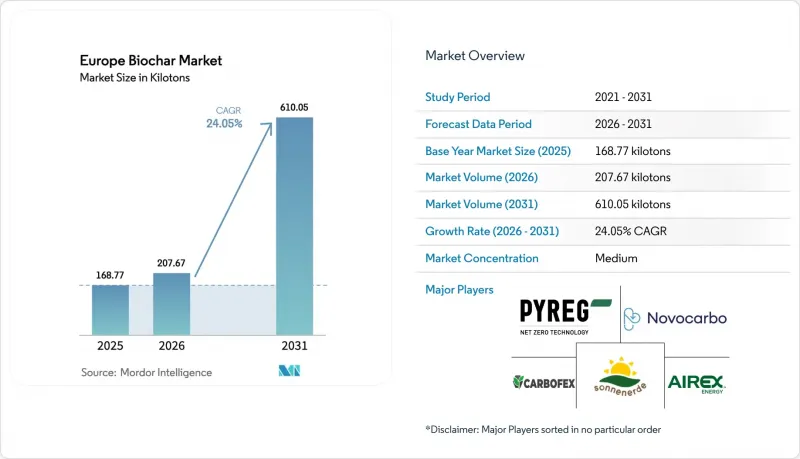
根據 Mordor Intelligence 估計,2025 年歐洲生物炭市場價值為 168.77 千噸,預計到 2026 年將持續成長至 207.67 千噸,到 2031 年達到 610.05 千噸。
預測期(2026-2031 年)的複合年成長率預計為 24.05%。
本報告按技術(熱解、氣化系統及其他技術)、應用(農業、畜牧業、工業應用及其他應用)和地區(德國、英國、法國、義大利、西班牙、北歐國家、土耳其、俄羅斯和其他歐洲國家)進行細分。市場預測以噸為單位。
歐洲生物炭市場的趨勢與洞察
歐盟對再生能源和有機農業的需求正在激增。
根據歐盟通用農業政策(CAP),2023年至2027年間,歐盟已撥款81億歐元用於有機和再生農業項目,生物炭被認定為一種土壤改良劑,符合生態計畫的津貼。在法國,2024年有機農地面積增加了11%,並且已證實,在乾旱脅迫下施用生物炭可使穀物和葡萄產量提高15%至22%。為此,法國農業部決定將生物炭納入國家土壤健康藍圖。 2025年,德國啟動了一項耗資5000萬歐元的示範項目,該項目涵蓋500個農場,旨在檢驗生物炭的固碳效果並最佳化田間實施流程。雖然補貼刺激了市場需求,但由於缺乏關於顆粒大小、原料來源和每種作物施用量的統一農業指南,導致田間試驗結果存在差異,阻礙了生物炭的廣泛應用。在義大利和西班牙,生物炭仍處於「實驗性」類別,直到國內法律完全採納歐盟法規 2019/2783,阻礙了其廣泛應用。
擴大碳權購買協議
2024年,隨著微軟、Shopify和Stripe等公司將永續碳移除列為優先事項,自願買家購買生物炭移除證書的數量同比成長161%,達到4.7萬張,交易價格為每噸二氧化碳當量150-200歐元。 2025年,NOVOCARBO與一家瑞士再保險公司簽署了一份為期10年、10萬噸的收購契約,獲得了1800萬歐元的預付款。這筆資金用於在勃蘭登堡州建造一座年產1.2萬噸的工廠。目前,89%的已簽發合約都需接受歐洲生物炭認證(EBC)的審核,這提高了品質和長期性標準。價格波動仍然劇烈,到2025年底,由於對長期性索賠的審查,現貨價格下跌了22%,這給沒有長期合約的生產商的利潤率帶來了壓力。歐盟的碳移除認證計畫於 2026 年推出,預計將提高監測和檢驗標準,預計將有利於擁有內部分析能力的綜合性企業。
歐盟生質能和廢棄物物流的碎片化正在推高原料成本。
由於收集和乾燥基礎設施不足,原料成本差異巨大:北歐林業殘餘物的成本為每噸35歐元,而南歐農業廢棄物則高達每噸90歐元。 2024年,德國僅有38%的農業殘餘物用於工業生產,其餘則被焚燒或遺棄在田間。西班牙和義大利的橄欖修剪殘餘物分散在小規模農戶手中,當運輸距離超過80公里時,生物炭生產往往無利可圖。法國國家農業食品與環境研究院(INRAE)於2025年在法國試點的移動式熱解裝置可將原料成本降低42%,但該裝置需要180萬歐元的投資,因此只有資金雄厚的合作社才能負擔得起。歐盟的生質能動員策略包括從2026年開始為收集中心提供聯合資金,但實質的改善可能要到2028年或更晚才能看到。
細分市場分析
到 2025 年,熱解將佔據歐洲生物炭市場 75.06% 的市場佔有率,預計到 2031 年,其市場佔有率將以 24.55% 的複合年成長率成長。 PYREG 的連續進料反應器,例如 P500 和 P1500,能夠處理耐濕混合殘渣,且對氧氣濃度和溫度控制的要求低於氣化爐,從而將安裝時間縮短至 9 個月,並將 2022 年至 2025 年的每噸資本支出降低 28%。
氣化系統目前仍屬於小眾領域,但由於合成氣的聯產可以抵消高昂的資本投入,因此在紙漿、造紙和鋸木廠等一體化生產設施中越來越受到關注。瑞典Bussme Energy公司的下吸式氣化系統熱效率高達85%,吸引了許多尋求替代石化燃料的工廠的目光。水熱碳化和微波熱解由於能耗高、原料相容性有限,目前仍處於中試階段。儘管管理體制對技術本身持中立態度,但由於熱解裝置具有優異的原料適應性和穩定的碳穩定性,其EBC認證率已達92%。
其他好處:
- Excel格式的市場預測(ME)表
- 3個月的分析師支持
目錄
第1章:引言
- 市場分析與定義的前提條件
- 分析範圍
第2章 分析方法
第3章執行摘要
第4章 市場狀況
- 市場概覽
- 市場促進因素
- 歐盟內部對再生農業和有機農業的需求激增
- 擴大碳權購買協議
- 將CMC14生物炭納入歐盟肥料產品法規
- 利用熱熱解回收工業餘熱用於區域供熱的經濟可行性
- 利用生物炭從污水污泥中回收磷
- 市場限制因素
- 歐盟生質能和廢棄物物流的碎片化正在推高原料成本。
- 目前歐盟通用沒有關於田間生物炭施用量的農業指引。
- 未認證煤炭中潛在長期多環芳烴/重金屬的責任
- 價值鏈分析
- 波特五力分析
第5章:預測市場規模與成長率
- 透過技術
- 熱解
- 氣化系統
- 其他技術
- 透過使用
- 農業
- 家畜
- 工業用途
- 其他用途
- 按地區
- 德國
- 英國
- 法國
- 義大利
- 西班牙
- 北歐國家
- 土耳其
- 俄羅斯
- 其他歐洲國家
第6章 競爭情勢
- 市場集中度
- 策略趨勢
- 市佔率(%)/排名分析
- 公司簡介
- Airex Energy
- Bussme Energy AB
- Carbofex Ltd
- Carbon Centric
- Carbon Finland Oy
- Carbon Gold Ltd
- CARBUNA
- CharLine GmbH
- Circular Carbon GmbH
- EGoS GmbH
- EOC Energy Ocean
- LUCRAT GmbH
- Nettenergy BV
- NOVOCARBO GMBH
- PYREG GmbH
- Sonnenerde GmbH
- Verora AG
第7章 市場機會與未來展望
According to Mordor Intelligence, the Europe biochar market size was valued at 168.77 kilotons in 2025 and is estimated to grow from 207.67 kilotons in 2026 to reach 610.05 kilotons by 2031, at a CAGR of 24.05% during the forecast period (2026-2031).
This report is Segmented by Technology (Pyrolysis, Gasification Systems, and Other Technologies), Application (Agriculture, Animal Farming, Industrial Uses, and Other Applications), and Geography (Germany, United Kingdom, France, Italy, Spain, Nordic Countries, Turkey, Russia, and Rest of Europe). The Market Forecasts are Provided in Terms of Volume (Tons).
Europe Biochar Market Trends and Insights
EU Regenerative & Organic-Farming Demand Surge
Organic and regenerative agriculture programs funded under the EU Common Agricultural Policy allocate EUR 8.1 billion for 2023-2027, and biochar qualifies as a subsidized soil amendment under Eco-Schemes. France expanded organic acreage by 11% in 2024 and documented cereal and vineyard yield gains of 15%-22% when biochar was applied under drought stress, prompting its Ministry of Agriculture to embed biochar in the national soil-health roadmap. Germany launched a EUR 50 million demonstration covering 500 farms in 2025 to validate sequestration and fine-tune field protocols. While subsidies pull demand forward, inconsistent agronomic guidelines on particle size, feedstock origin, and crop-specific rates create variable field results that slow mainstream adoption. Italy and Spain lag because biochar still carries an experimental classification until domestic law fully transposes EU Regulation 2019/2783.
Scale-Up of Carbon-Credit Purchase Agreements
Voluntary buyers procured 47,000 biochar removal certificates in 2024, up 161% year over year, at EUR 150-200 per t of CO2e, as corporates such as Microsoft, Shopify, and Stripe prioritized durable removals. NOVOCARBO locked a 10-year, 100,000-ton offtake with a Swiss reinsurer in 2025, securing EUR 18 million in advance revenue that financed a 12 kt plant in Brandenburg. European Biochar Certificate (EBC) audits now accompany 89% of issuances, tightening quality and permanence standards. Pricing remains volatile; spot values fell 22% in late 2025 amid scrutiny of durability claims, so producers without long-term contracts face margin pressure. Forthcoming EU Carbon Removal Certification, slated for 2026, is expected to raise monitoring and verification thresholds, advantaging integrated players with in-house analytics.
Fragmented EU Biomass-Waste Logistics Inflate Feedstock Costs
Feedstock costs swing from EUR 35/t for Nordic forestry residues to EUR 90/t for Southern European agricultural waste because collection and drying infrastructure is patchy. Only 38% of German agricultural residues were utilized industrially in 2024, with the remainder burned or left in the field. Olive-pruning residues in Spain and Italy are scattered across smallholder farms, and transport beyond 80 km often renders biochar production uneconomic. Mobile pyrolysis units piloted by France's INRAE in 2025 cut feedstock expense 42% but carry a EUR 1.8 million capex that suits only well-capitalized cooperatives. The EU Biomass Mobilisation Strategy will co-fund aggregation hubs from 2026, yet meaningful relief may not arrive until 2028.
Other drivers and restraints analyzed in the detailed report include:
- Inclusion of CMC14 Biochar in EU Fertilising Products Regulation
- Industrial Heat-Recovery Economics from District-Heating Pyrolysis
- Absence of Pan-EU Agronomic Guidelines for Biochar Field-Rates
For complete list of drivers and restraints, kindly check the Table Of Contents.
Segment Analysis
Pyrolysis controlled 75.06% of the 2025 Europe biochar market share, and its portion of the Europe biochar market size is forecast to grow at a 24.55% CAGR through 2031. Continuous-feed reactors such as PYREG's P500 and P1500 process moisture-tolerant mixed residues at lower oxygen and temperature control requirements than gasifiers, slashing installation timelines to nine months and dropping per-ton capex by 28% between 2022 and 2025.
Gasification systems remain niche but appeal to integrated pulp, paper, and sawmill sites where syngas co-production offsets higher capex; Bussme Energy's downdraft units in Sweden attain 85% thermal efficiency and attract mills targeting fossil fuel substitution. Hydrothermal carbonization and microwave pyrolysis remain at pilot scale due to high energy demand and limited feedstock compatibility. Regulatory regimes are technology-neutral, but pyrolysis plants have captured 92% of EBC certifications because of superior feedstock tolerance and consistent carbon stability.
Complete Report Scope:
- Technology
- Pyrolysis
- Gasification Systems
- Other Technologies
- Application
- Agriculture
- Animal Farming
- Industrial Uses
- Other Applications
- Geography
- Germany
- United Kingdom
- France
- Italy
- Spain
- Nordic Countries
- Turkey
- Russia
- Rest of Europe
List of Companies Covered in this Report:
- Airex Energy
- Bussme Energy AB
- Carbofex Ltd
- Carbon Centric
- Carbon Finland Oy
- Carbon Gold Ltd
- CARBUNA
- CharLine GmbH
- Circular Carbon GmbH
- EGoS GmbH
- EOC Energy Ocean
- LUCRAT GmbH
- Nettenergy BV
- NOVOCARBO GMBH
- PYREG GmbH
- Sonnenerde GmbH
- Verora AG
Additional Benefits:
- The market estimate (ME) sheet in Excel format
- 3 months of analyst support
TABLE OF CONTENTS
1 Introduction
- 1.1 Study Assumptions & Market Definition
- 1.2 Scope of the Study
2 Research Methodology
3 Executive Summary
4 Market Landscape
- 4.1 Market Overview
- 4.2 Market Drivers
- 4.2.1 EU regenerative & organic-farming demand surge
- 4.2.2 Scale-up of carbon-credit purchase agreements
- 4.2.3 Inclusion of CMC14 biochar in EU Fertilising Products Regulation
- 4.2.4 Industrial heat-recovery economics from district-heating pyrolysis
- 4.2.5 Biochar-enabled phosphorus recycling from sewage-sludge streams
- 4.3 Market Restraints
- 4.3.1 Fragmented EU biomass-waste logistics inflate feedstock costs
- 4.3.2 Absence of pan-EU agronomic guidelines for biochar field-rates
- 4.3.3 Potential long-term PAH / heavy-metal liability for non-certified char
- 4.4 Value Chain Analysis
- 4.5 Porter's Five Forces
- 4.5.1 Bargaining Power of Suppliers
- 4.5.2 Bargaining Power of Buyers
- 4.5.3 Threat of New Entrants
- 4.5.4 Threat of Substitutes
- 4.5.5 Degree of Competition
5 Market Size & Growth Forecasts (Volume)
- 5.1 Technology
- 5.1.1 Pyrolysis
- 5.1.2 Gasification Systems
- 5.1.3 Other Technologies
- 5.2 Application
- 5.2.1 Agriculture
- 5.2.2 Animal Farming
- 5.2.3 Industrial Uses
- 5.2.4 Other Applications
- 5.3 Geography
- 5.3.1 Germany
- 5.3.2 United Kingdom
- 5.3.3 France
- 5.3.4 Italy
- 5.3.5 Spain
- 5.3.6 Nordic Countries
- 5.3.7 Turkey
- 5.3.8 Russia
- 5.3.9 Rest of Europe
6 Competitive Landscape
- 6.1 Market Concentration
- 6.2 Strategic Moves
- 6.3 Market Share (%)**/Ranking Analysis
- 6.4 Company Profiles (includes Global-Level Overview, Market-Level Overview, Core Segments, Financials as available, Strategic Information, Products & Services, Recent Developments)
- 6.4.1 Airex Energy
- 6.4.2 Bussme Energy AB
- 6.4.3 Carbofex Ltd
- 6.4.4 Carbon Centric
- 6.4.5 Carbon Finland Oy
- 6.4.6 Carbon Gold Ltd
- 6.4.7 CARBUNA
- 6.4.8 CharLine GmbH
- 6.4.9 Circular Carbon GmbH
- 6.4.10 EGoS GmbH
- 6.4.11 EOC Energy Ocean
- 6.4.12 LUCRAT GmbH
- 6.4.13 Nettenergy BV
- 6.4.14 NOVOCARBO GMBH
- 6.4.15 PYREG GmbH
- 6.4.16 Sonnenerde GmbH
- 6.4.17 Verora AG
7 Market Opportunities & Future Outlook
- 7.1 White-Space & Unmet-Need Assessment

 生物炭:市場佔有率分析、產業趨勢與統計、成長預測(2026-2031)
 生物炭市場規模、佔有率、成長、全球產業分析、區域趨勢及2026年至2034年預測。
 生物炭市場:2026-2032年全球市場預測(依製造技術、原料類型、產品形態、反應器配置、活化方法、應用、通路和最終用戶分類)
 全球生物炭市場:按原料、技術、形態、應用和最終用戶分類-市場規模、產業動態、機會分析和預測(2026-2035 年)
 功能性生物炭市場-全球產業規模、佔有率、趨勢、機會、預測:依技術、應用、區域和競爭格局分類,2021-2031年南美洲生物炭:市場佔有率分析、產業趨勢與統計及成長預測(2026-2031 年)
 生物炭市場規模、佔有率和成長分析:按原料類型、製造方法、應用、終端用戶產業和地區分類-2026-2033年產業預測
 生物炭市場規模、佔有率和趨勢:按原料類型、技術類型、產品形式、應用和地區分類,並預測2026年至2034年
 生物炭生產設備市場:按類型、技術和地區分類全球生物炭市場(2026-2036)