


 |
市場調查報告書
商品編碼
2125611
類器官:市場佔有率分析、產業趨勢與統計、成長預測(2026-2031)Organoids - Market Share Analysis, Industry Trends & Statistics, Growth Forecasts (2026 - 2031) |
||||||

※ 本網頁內容可能與最新版本有所差異。詳細情況請與我們聯繫。
根據 Mordor Intelligence 預測,類器官市場規模將從 2025 年的 12 億美元和 2026 年的 14.2 億美元成長到 2031 年的 32.9 億美元,2026 年至 2031 年的年複合成長率(CAGR)為 18.31%。
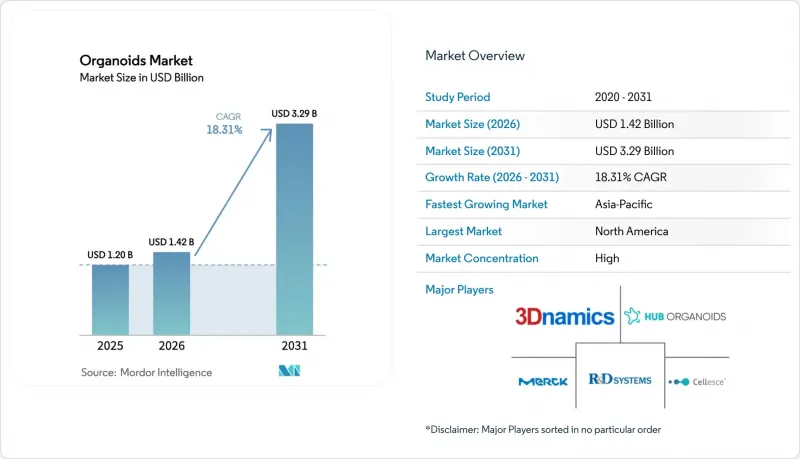
本報告按來源(例如,源自多功能能幹細胞)、器官類型(例如,腸道、肝臟、大腦、腎臟)、應用(例如,藥物發現和篩檢)、最終用戶(例如,學術和研究機構)、技術(例如,3D生物列印)和地區(例如,北美、歐洲、亞太地區)進行細分。市場預測以貨幣價值(美元)表示。
全球類器官市場趨勢與洞察
擴大類器官在癌症藥物研發的應用。
2025年發表於《自然醫學》的一項研究表明,結直腸癌類器官在84%的病例中能夠預測化療反應,優於傳統細胞株,這進一步擴大了其在製藥行業的應用。羅氏公司2025年年度報告顯示,該公司已建立了一個包含1000多個患者來源模型(涵蓋12種腫瘤類型)的內部生物樣本庫,目前正以此為基礎最佳化先導化合物篩檢。美國國家癌症研究所(NCI)投入了「人類-核醣體圖譜網路」(Human-to-Mortar Atlas Network)1億美元,該網路創建了整合類器官檢測的空間轉錄組圖譜,用於指導聯合治療的設計。參與研發的公司報告稱,臨床前研究時間縮短了6-12個月,降低了後期研究的退出率,並提高了研發投資的盈利。這些成果強化了將類器官市場納入腫瘤學常規工作流程的經濟合理性。
擴大精準醫療和個人化醫療的臨床臨床實驗。
在馬克西瑪公主中心,基於類器官的治療性介入使復發性兒童固體癌的客觀緩解率提高了23個百分點。基於這些數據,荷蘭保險公司決定試行推行相關報銷方案。 2025年3月,日本厚生勞動省批准了首個基於患者來源培養細胞的伴隨診斷,該診斷能夠提供僅靠組織病理學檢查無法獲得的14天功能評估結果。目前,類器官檢測正被納入籃子試驗,用於招募具有通用分子標靶的患者,從而降低篩檢成本並加快罕見癌症適應症的受試者招募。隨著保險公司收緊證據標準,類器官產生的功能反應數據將進一步支持保險報銷談判,從而推動類器官市場的擴張。
特殊基質和生長因子高成本
Matrigel 每毫升售價 400 至 600 美元,而大規模篩檢通常需要 5 至 10 毫升,導致每次實驗的試劑成本高達 6000 美元。諸如 R-spondin 和 Wnt3a 等必需重組蛋白每毫克售價 300 至 800 美元,且由於其半衰期短,需要大量使用。根據 2024 年國際幹細胞研究學會 (ISSCR) 的一項調查,62% 的受訪者認為試劑成本是主要障礙,有些實驗室甚至重新採用2D模型。儘管供應商正在推出不含動物源性成分的水凝膠並提供批量購買折扣,但成本降低的幅度仍然有限,這阻礙了資源匱乏地區的推廣應用,並減緩了類器官市場的成長速度。
細分市場分析
至2025年,成人幹細胞衍生類器官將佔銷售額的58.43%,提供經監管機構批准且經過充分檢驗的胃腸道和肝臟模型。多功能幹細胞株係有助於深入了解發育過程和罕見疾病,但由於分化所需時間較長,其處理能力有限。預計到2031年,腫瘤來源的培養細胞將以20.65%的複合年成長率成長,成為類器官市場中成長最快的細分領域。諾華目前擁有涵蓋15種腫瘤類型的800多個患者來源的細胞系,可進行平行藥物篩檢並縮短先導化合物的最佳化週期。 2025年,《自然生物技術》雜誌報道,腫瘤類器官在10代傳代後仍能維持基因組的完整性,證明了其在縱向研究中的穩定性。隨著生物銀行的擴張,腫瘤衍生模型預計將在 10 年內超過成人幹細胞株的絕對銷售額,這凸顯了向精準腫瘤學的策略轉變。
CRISPR基因編輯技術與腫瘤類器官的融合正在協助合成致死性的發現,而人工智慧影像技術則加速了表現型解讀。這些進展與製藥業對早期概念驗證的需求相契合,推動了類器官市場這一供應領域的結構性成長。針對腫瘤譜系客製化的專有培養基有望為供應商帶來持續穩定的收入,但成本控制對於打入中型製藥公司的預算仍然至關重要。因此,競爭優勢正轉向將來源、篩檢、生物資訊學和法規遵從整合到單一合約中的服務包。
到2025年,腸道模型將佔器官特異性銷售額的28.65%,其應用範圍廣泛,包括發炎性腸道疾病、微生物組研究和腸道病原體檢測。肝臟類器官在肝毒性篩檢方面表現出色,而腦模型儘管培養要求複雜,卻可用於神經發育研究。預計2026年至2031年,胰臟模型的複合年成長率將達到20.76%,成為該領域成長最強勁的細分市場。 2024年發表在《細胞代謝》(Cell Metabolism)雜誌上的一項研究表明,胰臟模型能夠忠實地模擬BETA細胞胰島素分泌受損的情況,從而推動糖尿病治療開發平臺的進展。此外,囊腫纖維化基金會於2025年投資1,500萬美元,將胰臟類器官庫擴充至500個病患樣本,並加速CFTR調變器的檢驗。
目前,懸浮生物反應器能夠實現厘米級胰臟培養,從而拓展了細胞治療種子株的開發可能性。隨著監管機構對臨床級生產方案的評估,胰臟類器官在藥物篩檢和再生醫學領域正日益凸顯其戰略重要性。掌握規模化生產技術的供應商將在類器官市場這一高成長領域中佔據先發優勢。
區域分析
預計到2025年,北美將引領市場,佔43.65%的銷售額,主要得益於美國國立衛生研究院(NIH)提供的4,800萬美元「組織晶片」計畫津貼以及美國食品藥物管理局(FDA)較為寬鬆的監管政策。加拿大已投資1,200萬加元用於其國家生物樣本庫建設,而墨西哥已成為美國製藥客戶外包類器官服務的重要目的地。集中在波士頓和舊金山灣區的創業投資持續投資於基質、成像和生物反應器領域的新創企業,從而支撐了該地區對類器官市場的需求。
歐洲正受惠於總額達950億歐元的「地平線歐洲」框架計劃,德國聯邦教育與研究部額外撥款3,000萬歐元,用於支持旨在推廣標準化方案的能力中心。英國醫學研究理事會(MRC)已投資1,800萬英鎊,用於拓展人類發育生物學資源,以建構類器官模型,並積極吸引跨國公司合作。法國、義大利和西班牙正利用歐洲結構基金支持罕見疾病領域的應用,並擴大區域內的應用範圍。這些努力共同建構了一個整合的供應鏈,從而提升了歐洲類器官市場的競爭力。
預計到2031年,亞太地區的複合年成長率將達到19.43%。中國正透過投資5億元建設區域中心,推進方案標準化與人才培育。臨床需求不斷成長,日本已批准類器官伴隨診斷,韓國也正在實施250億韓元的計畫。印度正利用其低廉的人事費用吸引合約服務,澳洲則投資1,000萬澳元建造一個旨在促進原住民健康的生物樣本庫。這些計畫共同提升了區域能力,並擴大了全球類器官市場的規模。
儘管中東、非洲和南美洲仍處於發展中階段,但基礎建設的早期跡像已初見端倪。巴西聖保羅研究基金會和南非醫學研究理事會已啟動試點項目,以實現方案的在地化,這預示著未來這些方案有望得到廣泛應用。目前,歐洲和北美冷凍保存的類器官菌株出口正在填補供應缺口,這為物流公司帶來了早期商機。
其他好處:
- Excel格式的市場預測(ME)表
- 3個月的分析師支持
目錄
第1章:引言
- 市場分析與定義的前提條件
- 分析範圍
第2章 分析方法
第3章執行摘要
第4章 市場狀況
- 市場概覽
- 市場促進因素
- 擴大類器官在癌症治療藥物發現的應用。
- 擴大精準醫療和個人化醫療的臨床臨床實驗。
- 政府資助3D細胞培養基礎設施
- 逐步淘汰臨床前研究中的動物試驗。
- 大規模類器官生物庫的商業化
- 基因編輯技術與先進微流體平台的整合
- 市場限制因素
- 特殊基質和生長因子高成本
- 缺乏標準化的可重複性方案
- 圍繞複雜人體模型的倫理和監管方面的模糊之處
- 活體類器官運輸中冷鏈物流的限制因素
- 價值鍊和供應鏈分析
- 監理情勢
- 技術展望
- 類器官生物樣本庫的現狀
- 波特五力分析
第5章:預測市場規模與成長率
- 按供應來源
- 源自多功能細胞的類器官
- 成體幹細胞衍生的類器官
- 腫瘤來源的患者類器官
- 依器官類型
- 腸子
- 肝
- 腦
- 腎
- 肺
- 胰臟
- 心
- 其他器官類型
- 透過使用
- 藥物發現與篩檢
- 疾病和毒性建模
- 精準醫療與個人化醫療
- 再生醫學
- 類器官生物銀行服務
- 其他用途
- 最終用戶
- 學術研究機構
- CRO/CDMO
- 醫院和診斷檢查室
- 製藥和生物技術公司
- 透過技術
- 利用3D生物列印技術的類器官
- 人工智慧驅動的自動化平台
- 微流體晶片器官整合
- 基於支架的3D培養
- 無懸浮/無支架培養
- 按地區
- 北美洲
- 美國
- 加拿大
- 墨西哥
- 歐洲
- 德國
- 英國
- 法國
- 義大利
- 西班牙
- 其他歐洲國家
- 亞太地區
- 中國
- 日本
- 印度
- 澳洲
- 韓國
- 其他亞太國家
- 中東和非洲
- GCC
- 南非
- 其他中東和非洲國家
- 南美洲
- 巴西
- 阿根廷
- 其他南美國家
- 北美洲
第6章 競爭情勢
- 市場集中度
- 市佔率分析
- 公司簡介
- Advanced BioMatrix Inc.
- ATCC
- BICO Group AB
- Cellesce Ltd
- CN Bio Innovations Ltd
- Corning Inc.
- Emulate Inc.
- Eppendorf SE
- Greiner Bio-One International GmbH
- HeartBeat.bio AG
- Hubrecht Organoid Technology
- InSphero AG
- Lonza Group AG
- Merck KGaA
- MIMETAS BV
- Miltenyi Biotec BV & Co. KG
- QGel SA
- Sartorius AG
- STEMCELL Technologies Inc.
- Thermo Fisher Scientific Inc.
第7章 市場機會與未來展望
According to Mordor Intelligence, the organoids market size is projected to expand from USD 1.20 billion in 2025 and USD 1.42 billion in 2026 to USD 3.29 billion by 2031, registering a CAGR of 18.31% between 2026 to 2031.
This report is Segmented by Source (Pluripotent Stem-Cell-Derived, and More), Organ Type (Intestinal, Liver, Brain, Kidney, and More), Application (Drug Discovery & Screening, and More), End User (Academic & Research Institutes, and More), Technology (3-D Bioprinting-Assisted, and More), and Geography (North America, Europe, Asia-Pacific, and More). The Market Forecasts are Provided in Terms of Value (USD).
Global Organoids Market Trends and Insights
Rising Adoption of Organoids in Oncology Drug Discovery
Colorectal tumor organoids predicted chemotherapy response in 84% of cases during a 2025 Nature Medicine study, outperforming traditional cell lines and spurring broader pharmaceutical uptake. Roche's 2025 annual report disclosed an internal biobank exceeding 1,000 patient-derived models spanning 12 tumor types, which now underpins lead-optimization screens. The U.S. National Cancer Institute allocated USD 100 million to the Human Tumor Atlas Network, which created spatial transcriptomic maps that integrate with organoid assays to inform combination-therapy design. Sponsors report preclinical timeline compression of 6-12 months and lower late-stage attrition, reinforcing return on R&D capital. These gains strengthen the economic rationale that propels the organoids market toward routine oncology workflows.
Expansion of Precision Medicine Trials and Personalized Therapies
Organoid-guided interventions raised objective response rates by 23 percentage points in relapsed pediatric solid tumors at the Princess Maxima Center, a data point that convinced Dutch insurers to test reimbursement pathways. Japan's Ministry of Health, Labour and Welfare cleared the first companion diagnostic based on patient-derived cultures in March 2025, providing a 14-day functional readout unattainable with histopathology alone. Basket trials now embed organoid assays to enroll patients with shared molecular targets, shrinking screening costs and accelerating recruitment in rare oncology indications. As payers tighten evidence standards, functional response data generated by organoids further underpins reimbursement negotiations, boosting adoption in the organoids market.
High Cost of Specialized Matrices and Growth Factors
Matrigel ranges from USD 400-600 per milliliter, and large screens often require 5-10 milliliters, pushing reagent bills to USD 6,000 per experiment. Essential recombinant proteins such as R-spondin and Wnt3a cost another USD 300-800 per milligram, with high turnover owing to short half-lives. A 2024 ISSCR survey found 62% of respondents citing reagent expense as a primary barrier, prompting some labs to revert to two-dimensional models. Suppliers are rolling out animal-free hydrogels and bulk-pricing schemes, but cost compression remains incremental, holding back uptake in resource-constrained regions and thereby tempering the organoids market growth rate.
Other drivers and restraints analyzed in the detailed report include:
- Government Funding for 3-D Cell Culture Infrastructure
- Shift Away from Animal Testing in Preclinical Research
- Lack of Standardized Reproducibility Protocols
For complete list of drivers and restraints, kindly check the Table Of Contents.
Segment Analysis
Adult stem-cell-derived organoids anchored 58.43% of 2025 revenue by offering well-validated gastrointestinal and hepatic models that regulators recognize. Pluripotent stem-cell lines supply developmental and rare-disease insights, although longer differentiation timelines limit throughput. Tumor-derived cultures are forecast to log a 20.65% CAGR through 2031, the fastest-growing slice of the organoids market. Novartis now maintains more than 800 patient-derived lines across 15 tumor types, enabling parallel drug screens that shorten lead optimization windows. Nature Biotechnology reported in 2025 that tumor organoids retained genomic fidelity across 10 passages, validating stability for longitudinal studies. As biobanking expands, tumor-derived models are positioned to overtake adult stem-cell lines in absolute revenue within a decade, underscoring the strategic shift toward precision oncology.
The convergence of CRISPR gene editing with tumor organoids supports synthetic-lethal discovery, while AI-enabled imaging accelerates phenotypic readouts. These advances align with pharmaceutical demand for earlier proof-of-concept, reinforcing structural growth in this source segment of the organoids market. Proprietary culture media tailored to tumor lineages promise additional recurring revenue for suppliers, although cost containment remains essential to penetrate mid-tier pharma budgets. Consequently, competitive differentiation is migrating toward service bundles that integrate derivation, screening, bioinformatics, and regulatory support into a single contract.
Intestinal models captured 28.65% of organ-type revenue in 2025 through applications spanning inflammatory bowel disease, microbiome studies, and enteric pathogen assays. Liver organoids excel in hepatotoxicity screens, while brain models, despite culture complexity, enable neurodevelopmental research. Pancreas models are projected to book a 20.76% CAGR over 2026-2031, the strongest trajectory inside this segmentation. A 2024 Cell Metabolism study demonstrated faithful recapitulation of beta-cell insulin secretion defects, advancing diabetes drug pipelines. The Cystic Fibrosis Foundation's USD 15 million outlay in 2025 expanded its pancreatic organoid repository to 500 patient samples, facilitating CFTR modulator testing.
Suspension bioreactors now enable centimeter-scale pancreatic cultures, opening potential for cell-therapy seed stocks. As regulatory agencies evaluate clinical-grade manufacturing protocols, pancreas organoids gain strategic relevance for both drug screening and regenerative approaches. Suppliers that master scale-up technologies will secure early-mover advantage in this high-growth pocket of the organoids market size.
Complete Report Scope:
- By Source
- Pluripotent Stem-Cell-Derived Organoids
- Adult Stem-Cell-Derived Organoids
- Tumor-Derived Patient Organoids
- By Organ Type
- Intestinal
- Liver
- Brain
- Kidney
- Lung
- Pancreas
- Cardiac
- Other Organ Types
- By Application
- Drug Discovery & Screening
- Disease & Toxicology Modelling
- Precision & Personalised Medicine
- Regenerative Medicine
- Organoid Biobanking Services
- Other Applications
- By End User
- Academic & Research Institutes
- CROs & CDMOs
- Hospitals & Diagnostics Labs
- Pharmaceutical & Biotech Companies
- By Technology
- 3-D Bioprinting-Assisted Organoids
- AI-Guided Automated Platforms
- Micro-Fluidic Organ-On-Chip Integrated
- Scaffold-Based 3-D Culture
- Suspension / Scaffold-Free Culture
- Geography
- North America
- United States
- Canada
- Mexico
- Europe
- Germany
- United Kingdom
- France
- Italy
- Spain
- Rest of Europe
- Asia-Pacific
- China
- Japan
- India
- Australia
- South Korea
- Rest of Asia-Pacific
- Middle East & Africa
- GCC
- South Africa
- Rest of Middle East & Africa
- South America
- Brazil
- Argentina
- Rest of South America
- North America
Geography Analysis
North America led with 43.65% revenue in 2025, propelled by NIH's USD 48 million Tissue Chip grants and the FDA's permissive regulatory stance. Canada injected CAD 12 million into a national biobank while Mexico emerged as a near-shoring destination for contract organoid services catering to U.S. pharma clients. Venture capital concentrations in Boston and the San Francisco Bay Area continue to seed start-ups across matrices, imaging, and bioreactors, underpinning local demand in the organoids market.
Europe benefits from Horizon Europe's EUR 95 billion framework, with Germany's Federal Ministry of Education and Research adding EUR 30 million for competence centers that disseminate harmonized protocols. The United Kingdom's Medical Research Council deployed GBP 18 million to extend its Human Developmental Biology Resource into organoid models, attracting multinational collaborations. France, Italy, and Spain leverage European Structural Funds to support rare-disease applications, expanding regional uptake. Together, these initiatives foster an integrated supply chain that boosts European organoids market competitiveness.
Asia-Pacific is forecast to clock a 19.43% CAGR to 2031. China's CNY 500 million investment in regional centers seeks to standardize protocols and train personnel. Japan's approval of an organoid companion diagnostic and South Korea's KRW 25 billion program expand clinical demand. India lures contract services through lower labor costs, while Australia channels AUD 10 million into biobanks targeting indigenous health. These programs collectively elevate regional capacity, broadening the global organoids market base.
Middle East, Africa, and South America remain nascent but show early signs of infrastructure build-out. Brazil's Sao Paulo Research Foundation and South Africa's Medical Research Council launched pilot initiatives to localize protocols, hinting at future uptake. Export of cryopreserved organoid lines from Europe and North America currently fills supply gaps, indicating early-stage opportunity for logistics providers.
- Advanced BioMatrix Inc.
- ATCC
- BICO Group AB
- Cellesce
- CN Bio Innovations Ltd
- Corning
- Emulate
- Eppendorf
- Greiner Bio One International
- HeartBeat.bio AG
- Hubrecht Organoid Technology
- InSphero
- Lonza Group
- Merck
- Mimetas
- Miltenyi Biotec B.V. & Co. KG
- QGel SA
- Sartorius
- Stem Cell Technologies
- Thermo Fisher Scientific
Additional Benefits:
- The market estimate (ME) sheet in Excel format
- 3 months of analyst support
TABLE OF CONTENTS
1 Introduction
- 1.1 Study Assumptions & Market Definition
- 1.2 Scope Of The Study
2 Research Methodology
3 Executive Summary
4 Market Landscape
- 4.1 Market Overview
- 4.2 Market Drivers
- 4.2.1 Rising Adoption of Organoids in Oncology Drug Discovery
- 4.2.2 Expansion of Precision Medicine Trials and Personalized Therapies
- 4.2.3 Government Funding for 3-D Cell Culture Infrastructure
- 4.2.4 Shift Away from Animal Testing in Preclinical Research
- 4.2.5 Commercialization of Large-Scale Organoid Biobanks
- 4.2.6 Integration of Gene-Editing and Advanced Microfluidics Platforms
- 4.3 Market Restraints
- 4.3.1 High Cost of Specialized Matrices and Growth Factors
- 4.3.2 Lack of Standardized Reproducibility Protocols
- 4.3.3 Ethical and Regulatory Ambiguity Around Complex Human Models
- 4.3.4 Limited Cold-Chain Logistics for Live Organoid Transport
- 4.4 Value / Supply-Chain Analysis
- 4.5 Regulatory Landscape
- 4.6 Technological Outlook
- 4.7 Organoid Biobank Landscape
- 4.8 Porter's Five Forces Analysis
- 4.8.1 Threat Of New Entrants
- 4.8.2 Bargaining Power Of Suppliers
- 4.8.3 Bargaining Power Of Buyers
- 4.8.4 Threat Of Substitutes
- 4.8.5 Competitive Rivalry
5 Market Size & Growth Forecasts (Value, USD)
- 5.1 By Source
- 5.1.1 Pluripotent Stem-Cell-Derived Organoids
- 5.1.2 Adult Stem-Cell-Derived Organoids
- 5.1.3 Tumor-Derived Patient Organoids
- 5.2 By Organ Type
- 5.2.1 Intestinal
- 5.2.2 Liver
- 5.2.3 Brain
- 5.2.4 Kidney
- 5.2.5 Lung
- 5.2.6 Pancreas
- 5.2.7 Cardiac
- 5.2.8 Other Organ Types
- 5.3 By Application
- 5.3.1 Drug Discovery & Screening
- 5.3.2 Disease & Toxicology Modelling
- 5.3.3 Precision & Personalised Medicine
- 5.3.4 Regenerative Medicine
- 5.3.5 Organoid Biobanking Services
- 5.3.6 Other Applications
- 5.4 By End User
- 5.4.1 Academic & Research Institutes
- 5.4.2 CROs & CDMOs
- 5.4.3 Hospitals & Diagnostics Labs
- 5.4.4 Pharmaceutical & Biotech Companies
- 5.5 By Technology
- 5.5.1 3-D Bioprinting-Assisted Organoids
- 5.5.2 AI-Guided Automated Platforms
- 5.5.3 Micro-Fluidic Organ-On-Chip Integrated
- 5.5.4 Scaffold-Based 3-D Culture
- 5.5.5 Suspension / Scaffold-Free Culture
- 5.6 Geography
- 5.6.1 North America
- 5.6.1.1 United States
- 5.6.1.2 Canada
- 5.6.1.3 Mexico
- 5.6.2 Europe
- 5.6.2.1 Germany
- 5.6.2.2 United Kingdom
- 5.6.2.3 France
- 5.6.2.4 Italy
- 5.6.2.5 Spain
- 5.6.2.6 Rest of Europe
- 5.6.3 Asia-Pacific
- 5.6.3.1 China
- 5.6.3.2 Japan
- 5.6.3.3 India
- 5.6.3.4 Australia
- 5.6.3.5 South Korea
- 5.6.3.6 Rest of Asia-Pacific
- 5.6.4 Middle East & Africa
- 5.6.4.1 GCC
- 5.6.4.2 South Africa
- 5.6.4.3 Rest of Middle East & Africa
- 5.6.5 South America
- 5.6.5.1 Brazil
- 5.6.5.2 Argentina
- 5.6.5.3 Rest of South America
- 5.6.1 North America
6 Competitive Landscape
- 6.1 Market Concentration
- 6.2 Market Share Analysis
- 6.3 Company Profiles (Includes Global-Level Overview, Market-Level Overview, Core Segments, Financials As Available, Strategic Information, Market Rank/Share For Key Companies, Products & Services, And Recent Developments)
- 6.3.1 Advanced BioMatrix Inc.
- 6.3.2 ATCC
- 6.3.3 BICO Group AB
- 6.3.4 Cellesce Ltd
- 6.3.5 CN Bio Innovations Ltd
- 6.3.6 Corning Inc.
- 6.3.7 Emulate Inc.
- 6.3.8 Eppendorf SE
- 6.3.9 Greiner Bio-One International GmbH
- 6.3.10 HeartBeat.bio AG
- 6.3.11 Hubrecht Organoid Technology
- 6.3.12 InSphero AG
- 6.3.13 Lonza Group AG
- 6.3.14 Merck KGaA
- 6.3.15 MIMETAS BV
- 6.3.16 Miltenyi Biotec B.V. & Co. KG
- 6.3.17 QGel SA
- 6.3.18 Sartorius AG
- 6.3.19 STEMCELL Technologies Inc.
- 6.3.20 Thermo Fisher Scientific Inc.
7 Market Opportunities & Future Outlook
- 7.1 White-Space & Unmet-Need Assessment

 類器官和球狀體市場規模、佔有率和成長分析:按類型、來源、器官、應用、最終用戶、技術和地區分類-2026-2033年產業預測
 2034年全球類器官與球狀體市場機會與策略全球類器官市場:機會與策略展望(至2034年)
 類器官及球狀體市場分析及預測(至2035年):依類型、產品類型、服務、技術、應用、最終使用者、組件、材料類型、製程、設備分類
 全球類器官和球狀體市場規模、佔有率、趨勢和成長分析報告(2026-2034年)
 類器官市場按產品類型、技術、應用和最終用戶分類 - 全球預測 2026-2032
 類器官及球狀體市場機會、成長促進因素、產業趨勢分析及預測(2025-2034年)
 類器官和球狀體的全球市場:各類型,各來源,各用途,各終端用戶,各地區-市場規模,產業動態,機會分析,預測(2025年~2033年)2025年全球類器官市場報告
 2021-2031年歐洲類器官市場報告:範圍、細分、動態與競爭分析