


 |
市場調查報告書
商品編碼
2125591
結構鋼:市場佔有率分析、產業趨勢及統計、成長預測(2026-2031)Steel Sections - Market Share Analysis, Industry Trends & Statistics, Growth Forecasts (2026 - 2031) |
||||||

※ 本網頁內容可能與最新版本有所差異。詳細情況請與我們聯繫。
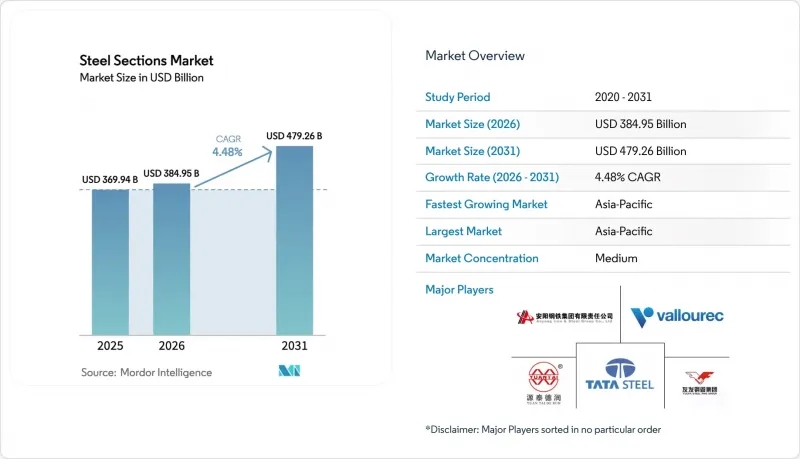
據 Mordor Intelligence 稱,2025 年結構鋼市場價值為 3699.4 億美元,預計到 2031 年將達到 4792.6 億美元,而 2026 年為 3849.5 億美元,預測期(2026-2031 年)的複合年成長率為 4.48%。
本報告按產品類型(重型結構鋼、輕型結構鋼、鋼筋)、終端用戶行業(住宅建築、製造業等)、製造/成型方法(軋延型鋼等)和地區(亞太地區、北美地區等)對產業進行細分。報告提供了上述所有細分市場的市場規模和預測(以美元計)。
全球纖維鋼市場趨勢與洞察
大型企劃正在重塑區域需求趨勢。
在亞太和中東地區,已簽署長期供應合約以穩定鋼鐵廠產量。印度的國家基礎設施計劃到2025年將撥款1.4兆美元用於交通、能源和城市發展項目,預計每年將消耗超過20萬噸結構鋼。沙烏地阿拉伯的「2030願景」承諾投資5000億美元用於NEOM新城及相關項目,這將滿足未來十年累計超過1000萬噸的結構鋼需求。撒哈拉以南非洲的投資,例如茅利塔尼亞新建的鐵礦石鐵路,進一步實現了需求多元化,並促使鋼鐵廠根據專案規格調整產品組合。生產商受益於可預測的採購量,這使他們能夠協商更有利的原料契約,並降低現貨價格波動帶來的風險。即使私人建築週期放緩,此因素仍透過支撐基本消費繼續支撐結構鋼市場。
模組化建築正在加速冷成型產品的應用。
由於異地預製可以將施工時間縮短30-40%,並減少現場勞動力,因此對輕質冷彎型鋼的需求正在不斷成長。在英國,政府對異地比例超過50%的項目提供15%的資本成本補貼,使得採用模組化建造方式的住宅開工率從2020年的3%上升到2024年的7%。 30-40%的重量減輕降低了地基荷載和對起重機的需求,而嵌套式結構框架系統則避免了運輸寬度的限制。在日本,消防安全法規的修訂允許在10層建築中使用冷彎型鋼,使目標市場擴大了約40%。隨著供應鏈的成熟,預計在許多中層建築應用中,冷彎型鋼的成本將與軋延梁持平,為截面市場開闢了清晰的成長路徑。
原料價格波動給利潤率帶來了壓力。
2024年,受天氣影響以及中國生產配額制度的影響,海運航線發生改變,導致鐵礦石和焦結煤價格年內波動20%至25%。依賴廢鋼的電弧爐生產也面臨土耳其出口限制後歐洲廢鋼價格飆升18%的困境。儘管倫敦金屬交易所(LME)新推出的期貨合約提供了避險選擇,但其流動性不足,中型製造商難以有效利用。營運資金緊張迫使小規模生產商減產,導致供應進一步收緊,價格持續波動,最終拖累了結構鋼市場的成長前景。
細分市場分析
到2025年,鋼筋將佔鋼材型材市場銷售額的48.07%,反映出其在高層住宅、橋樑和交通基礎設施項目的鋼筋混凝土中扮演重要角色。亞太和非洲地區公共工程支出協調一致,都市化正以前所未有的速度推進,這為鋼筋市場的發展提供了有利條件。諸如印度地鐵擴建等大型項目,穩定了鋼廠的運轉率,並推動了對微合金鋼筋的投資,以滿足嚴格的抗震要求。然而,如果私人住宅市場週期降溫,例如2024年歐洲的景氣衰退,鋼筋市場的成長速度將會放緩。為了實現差異化競爭,製造商現在在鋼筋上加裝數位追蹤標籤,以便驗證鑄造批號和機械性能,從而降低大規模建築工地上鋼筋造假的風險。
儘管重型結構鋼市場基數較小,但預計到2031年,其複合年成長率將達到5.36%,成為該類別中成長最快的市場。這項需求主要受航太和汽車產業轉向使用先進高強度結構鋼以減輕電池重量的驅動。熱機械控制加工技術使鋼廠無需後續熱處理即可獲得超過700兆帕的屈服強度,進而降低15%的能耗。此外,可再生能源的擴張也推動了用於風力發電機塔筒和輸電塔筒的中空結構鋼的需求。這些趨勢共同確保了結構鋼市場前景的穩健發展。
區域分析
預計到2025年,亞太地區將佔全球鋼型材市場收入的70.22%,這主要得益於中國「一帶一路」計劃的推進、印度1.4兆美元的國家基礎設施管道項目以及東南亞地鐵建設的蓬勃發展。 2024年,由於中國房地產行業的槓桿率下降,鋼筋需求減少了1200萬噸,但高鐵和可再生能源項目在一定程度上抵消了這一影響,顯示該地區的需求呈現多元化趨勢。日本和韓國在尖端冶金技術領域處於領先地位,並向越南和印尼的合作夥伴企業出口淬火和自回火技術。隨著快速的都市化進程,預計到2031年,亞太地區仍將是鋼型材市場的主要參與者。
中東和非洲地區預計將以6.45%的複合年成長率成為該地區成長最快的地區,這主要得益於沙烏地阿拉伯耗資5000億美元的「2030願景」項目以及海灣國家跨境鐵路走廊的建設。非洲各國政府正在發展港口和物流網路,以高效出口礦產資源,茅利塔尼亞長達42公里的專用鐵礦石鐵路就是一個例證。由於國內產能有限,該地區仍依賴進口,這為亞洲和歐洲的鋼鐵企業提供了建立合資企業和服務中心、深化市場滲透的良機。
歐洲和北美呈現不同的發展趨勢。貨幣緊縮政策抑制了歐洲的住宅開工量,導致2024年該地區消費量下降3.5%。碳邊境調節機制(CBAM)的不確定性促使低碳鋼提前投入使用,雖然銷售量下降,但價格堅挺支撐了市場。在北美,非住宅建築成長了2.1%,這主要得益於對資料中心和符合綠色稅額扣抵的製造工廠的投資。拉丁美洲經濟復甦帶動了供應成長,但外匯波動和政治風險限制長期預測。這些趨勢共同作用,維持了結構鋼市場地域分散的格局,並進一步鞏固了亞洲的主導地位。
其他好處:
- Excel格式的市場預測(ME)表
- 3個月的分析師支持
目錄
第1章:引言
- 市場分析與定義的前提條件
- 分析範圍
第2章 分析方法
第3章執行摘要
第4章 市場狀況
- 市場概覽
- 市場促進因素
- 亞洲、中東和北非(MENA)地區的大型基礎設施項目
- 更嚴格的抗震標準正在促進截面的加固。
- 模組化/異地建造的引入
- 低碳區的脫碳溢價
- 透過數位化設計(BIM/數位孿生)減少廢棄物
- 高級高強度低合金鋼和耐候鋼
- 市場限制因素
- 鐵礦石和廢鐵價格波動
- 貿易救濟措施導致貿易壁壘增加
- 碳排放強度懲罰(CBAM 類型)
- 熟練焊工和鈑金工人短缺
- 價值鍊和供應鏈分析
- 監理情勢
- 技術展望
- 產業吸引力:五力分析
- 新進入者的威脅
- 買方的議價能力
- 供應商的議價能力
- 替代品的威脅
- 競爭強度
第5章:預測市場規模與成長率
- 依產品類型
- 重型結構用鋼材
- 輕型結構鋼
- 鋼筋
- 按最終用戶行業分類
- 住宅
- 製造業
- 電力和公用事業
- 商業和基礎設施建設
- 石油和天然氣
- 其他(航太、汽車等)
- 透過製造/成型工藝
- 熱軋延型材
- 冷彎型鋼
- 其他(焊接、層壓)
- 按地區
- 北美洲
- 美國
- 加拿大
- 墨西哥
- 南美洲
- 巴西
- 阿根廷
- 秘魯
- 其他南美國家
- 歐洲
- 英國
- 德國
- 法國
- 義大利
- 西班牙
- 比荷盧經濟聯盟(比利時、荷蘭、盧森堡)
- 北歐國家(丹麥、芬蘭、冰島、挪威、瑞典)
- 其他歐洲國家
- 亞太地區
- 中國
- 印度
- 日本
- 澳洲
- 韓國
- 東協(印尼、泰國、菲律賓、馬來西亞、越南)
- 其他亞太國家
- 中東和非洲
- 沙烏地阿拉伯
- 阿拉伯聯合大公國
- 卡達
- 科威特
- 土耳其
- 埃及
- 南非
- 奈及利亞
- 其他中東和非洲國家
- 北美洲
第6章 競爭情勢
- 市場集中度
- 策略趨勢
- 市佔率分析
- 公司簡介
- ArcelorMittal SA
- China Baowu Steel Group
- Nippon Steel Corp.
- POSCO Holdings Inc.
- Tata Steel Ltd.
- Nucor Corp.
- JFE Steel Corp.
- Gerdau SA
- Hyundai Steel
- Evraz plc
- Vallourec
- Anyang Steel Group
- Youfa Steel Pipe Group
- Yuantai Derun Group
- SSAB AB
- APL Apollo Tubes
- Liberty Steel Group
- China Steel Corp.
- Qatar Steel
- Benxi Steel
- Steel Dynamics Inc.
第7章 市場機會與未來展望
According to Mordor Intelligence, the steel sections market size was valued at USD 369.94 billion in 2025 and is estimated to grow from USD 384.95 billion in 2026 to reach USD 479.26 billion by 2031, at a CAGR of 4.48% during the forecast period (2026-2031).
This report Segments the Industry Into by Product Type (Heavy Structural Steel, Light Structural Steel, and Rebar), by End-User Industry (Residential Construction, Manufacturing, and More), by Manufacturing / Formation Route(Hot-Rolled Sections, and Others), and by Geography (Asia-Pacific, North America, and More). The Report Offers Market Size and Forecasts in Value (USD) for all the Above Segments.
Global Steel Sections Market Trends and Insights
Infrastructure Mega-Projects Reshape Regional Demand Profiles
Asia-Pacific and Middle East programs are locking in long-duration supply contracts that stabilize mill output. India's National Infrastructure Pipeline sets aside USD 1.4 trillion for transport, energy, and urban projects through 2025, absorbing over 200,000 tonnes of structural sections every year. Saudi Arabia's Vision 2030 pledges USD 500 billion to NEOM and related ventures, translating to a cumulative requirement exceeding 10 million tonnes of structural sections over the decade. Sub-Saharan investments, such as Mauritania's new iron-ore rail link, further diversify demand and encourage mills to align product mix with project specifications. Producers benefit from predictable offtake volumes, allowing more favorable raw-material contracts and reducing exposure to spot-price swings. This driver sustains the steel sections market by underpinning baseline consumption even when private construction cycles soften.
Modular Construction Accelerates Cold-Formed Adoption
Off-site fabrication trims build schedules by 30%-40% and reduces site labor, driving preference for lightweight cold-formed profiles. In the United Kingdom, residential starts using modular techniques rose to 7% in 2024 from 3% in 2020, bolstered by a 15% capital-cost subsidy for projects exceeding 50% off-site content. Weight savings of 30%-40% curb foundation loads and crane requirements, while nested framing systems sidestep transport width limits. Japan's revised fire-resistance rules now permit cold-formed sections in 10-story buildings, expanding the addressable market by roughly 40%. As supply chains mature, cost parity with hot-rolled beams is expected in many medium-rise applications, providing a clear growth corridor for the steel sections market.
Raw-Material Price Volatility Compresses Margins
Iron ore and coking coal prices swung 20%-25% intra-year in 2024 as weather disruptions and Chinese production quotas reshaped seaborne flows. Scrap-dependent electric-arc furnaces faced an 18% jump in European scrap prices after Turkey restricted exports. Although new futures contracts on the London Metal Exchange offer hedging, low liquidity limits accessibility for mid-tier mills. Tight working capital forces smaller producers to throttle output, further tightening supply and perpetuating volatility, thereby tempering growth prospects for the steel sections market.
Other drivers and restraints analyzed in the detailed report include:
- Decarbonization Premiums Reward Low-Carbon Producers
- Tightening seismic codes driving section upgrades
- Trade-Remedy Measures Fragment Global Supply Chains
For complete list of drivers and restraints, kindly check the Table Of Contents.
Segment Analysis
Rebar captured 48.07% of the steel sections market revenue in 2025, reflecting its entrenched role in reinforced concrete for residential towers, bridges, and transit projects. The segment benefits from synchronized public works outlays in Asia-Pacific and Africa, where urbanization continues to set new records. High-volume contracts, such as India's metro expansions, guarantee steady mill loading and encourage investment in micro-alloyed bar to meet stringent seismic requirements. However, growth moderates when private housing cycles cool, as witnessed in Europe's 2024 downturn. To differentiate, producers now bundle rebar with digital tracking tags that confirm heat numbers and mechanical properties, reducing counterfeit risk on large job sites.
Heavy structural steel, though holding a smaller base, is set to record a 5.36% CAGR to 2031, the fastest in this category. Demand stems from aerospace and automotive platforms shifting toward advanced high-strength profiles to offset battery mass. Thermo-mechanical control processing lets mills deliver yield strengths above 700 MPa without downstream heat treatment, slashing energy use by 15%. Hollow sections for wind-turbine towers and transmission pylons also ride the renewable-energy build-out. Collectively, these trends secure a robust outlook for the steel sections market.
Complete Report Scope:
- By Product Type
- Heavy Structural Steel
- Light Structural Steel
- Rebar
- By End-user Industry
- Residential Construction
- Manufacturing
- Power & Utilities
- Commercial & Infrastructure Construction
- Oil & Gas
- Others (aerospace, automotive, etc.)
- By Manufacturing / Formation Route
- Hot-rolled sections
- Cold-formed sections
- Others (welded, built up)
- By Geography
- North America
- United States
- Canada
- Mexico
- South America
- Brazil
- Argentina
- Peru
- Rest of South America
- Europe
- United Kingdom
- Germany
- France
- Italy
- Spain
- BENELUX (Belgium, Netherlands, and Luxembourg)
- NORDICS (Denmark, Finland, Iceland, Norway, and Sweden)
- Rest of Europe
- Asia-Pacific
- China
- India
- Japan
- Australia
- South Korea
- ASEAN (Indonesia, Thailand, Philippines, Malaysia, Vietnam)
- Rest of Asia-Pacific
- Middle East and Africa
- Saudi Arabia
- United Arab Emirates
- Qatar
- Kuwait
- Turkey
- Egypt
- South Africa
- Nigeria
- Rest of Middle East and Africa
- North America
Geography Analysis
Asia-Pacific generated 70.22% of the steel sections market revenue in 2025, powered by China's Belt and Road extensions, India's USD 1.4 trillion National Infrastructure Pipeline, and Southeast Asian metro builds. Even as China's real-estate deleveraging cut rebar demand by 12 million tonnes in 2024, high-speed rail and renewable projects partially offset the decline, demonstrating the region's diversified pull. Japan and South Korea push metallurgical frontiers, exporting quenching and self-tempering know-how to partners in Vietnam and Indonesia. Rapid urban growth means that Asia-Pacific will remain the anchor for the steel sections market through 2031.
The Middle East and Africa will post the fastest regional CAGR at 6.45%, lifted by Saudi Arabia's USD 500 billion Vision 2030 projects and Gulf cross-border rail corridors. African governments pursue port and logistics networks to move mineral exports efficiently, illustrated by Mauritania's 42 km iron-ore railway. Limited domestic capacity keeps the region reliant on imports, creating opportunities for Asian and European mills to establish joint ventures or service centers that deepen market penetration.
Europe and North America trace divergent paths. Tight monetary policy squeezed European residential starts, pushing regional consumption down 3.5% in 2024. CBAM-related uncertainty encourages early adoption of low-carbon grades, supporting price resilience despite weaker volumes. North America recorded a 2.1% uptick in non-residential construction, led by data-center and manufacturing plant investments eligible for green tax credits. Latin America's rebound adds incremental tons, although currency swings and political risk temper long-range forecasts. Collectively, these dynamics sustain a geographically diversified steel sections market while reinforcing Asia's leadership.
- ArcelorMittal SA
- China Baowu Steel Group
- Nippon Steel Corp.
- POSCO Holdings Inc.
- Tata Steel Ltd.
- Nucor Corp.
- JFE Steel Corp.
- Gerdau S.A.
- Hyundai Steel
- Evraz plc
- Vallourec
- Anyang Steel Group
- Youfa Steel Pipe Group
- Yuantai Derun Group
- SSAB AB
- APL Apollo Tubes
- Liberty Steel Group
- China Steel Corp.
- Qatar Steel
- Benxi Steel
- Steel Dynamics Inc.
Additional Benefits:
- The market estimate (ME) sheet in Excel format
- 3 months of analyst support
TABLE OF CONTENTS
1 Introduction
- 1.1 Study Assumptions & Market Definition
- 1.2 Scope of the Study
2 Research Methodology
3 Executive Summary
4 Market Landscape
- 4.1 Market Overview
- 4.2 Market Drivers
- 4.2.1 Infrastructure mega-projects in Asia & MENA
- 4.2.2 Tightening seismic codes driving section upgrades
- 4.2.3 Modular/off-site construction adoption
- 4.2.4 Decarbonisation premium for low-carbon sections
- 4.2.5 Digital design (BIM/digital twins) reducing waste
- 4.2.6 Advanced HSLA & weather-resistant steels
- 4.3 Market Restraints
- 4.3.1 Volatile iron-ore & scrap prices
- 4.3.2 Rising trade-remedy barriers
- 4.3.3 Carbon-intensity penalties (CBAM-type)
- 4.3.4 Skilled welder/fabricator shortages
- 4.4 Value / Supply-Chain Analysis
- 4.5 Regulatory Landscape
- 4.6 Technological Outlook
- 4.7 Industry Attractiveness - Porter's Five Force Analysis
- 4.7.1 Threat of New Entrants
- 4.7.2 Bargaining Power of Buyers
- 4.7.3 Bargaining Power of Suppliers
- 4.7.4 Threat of Substitutes
- 4.7.5 Intensity of Rivalry
5 Market Size & Growth Forecasts (Values, In USD Billion)
- 5.1 By Product Type
- 5.1.1 Heavy Structural Steel
- 5.1.2 Light Structural Steel
- 5.1.3 Rebar
- 5.2 By End-user Industry
- 5.2.1 Residential Construction
- 5.2.2 Manufacturing
- 5.2.3 Power & Utilities
- 5.2.4 Commercial & Infrastructure Construction
- 5.2.5 Oil & Gas
- 5.2.6 Others (aerospace, automotive, etc.)
- 5.3 By Manufacturing / Formation Route
- 5.3.1 Hot-rolled sections
- 5.3.2 Cold-formed sections
- 5.3.3 Others (welded, built up)
- 5.4 By Geography
- 5.4.1 North America
- 5.4.1.1 United States
- 5.4.1.2 Canada
- 5.4.1.3 Mexico
- 5.4.2 South America
- 5.4.2.1 Brazil
- 5.4.2.2 Argentina
- 5.4.2.3 Peru
- 5.4.2.4 Rest of South America
- 5.4.3 Europe
- 5.4.3.1 United Kingdom
- 5.4.3.2 Germany
- 5.4.3.3 France
- 5.4.3.4 Italy
- 5.4.3.5 Spain
- 5.4.3.6 BENELUX (Belgium, Netherlands, and Luxembourg)
- 5.4.3.7 NORDICS (Denmark, Finland, Iceland, Norway, and Sweden)
- 5.4.3.8 Rest of Europe
- 5.4.4 Asia-Pacific
- 5.4.4.1 China
- 5.4.4.2 India
- 5.4.4.3 Japan
- 5.4.4.4 Australia
- 5.4.4.5 South Korea
- 5.4.4.6 ASEAN (Indonesia, Thailand, Philippines, Malaysia, Vietnam)
- 5.4.4.7 Rest of Asia-Pacific
- 5.4.5 Middle East and Africa
- 5.4.5.1 Saudi Arabia
- 5.4.5.2 United Arab Emirates
- 5.4.5.3 Qatar
- 5.4.5.4 Kuwait
- 5.4.5.5 Turkey
- 5.4.5.6 Egypt
- 5.4.5.7 South Africa
- 5.4.5.8 Nigeria
- 5.4.5.9 Rest of Middle East and Africa
- 5.4.1 North America
6 Competitive Landscape
- 6.1 Market Concentration
- 6.2 Strategic Moves
- 6.3 Market Share Analysis
- 6.4 Company Profiles (includes Global level Overview, Market level overview, Core Segments, Financials as available, Strategic Information, Products & Services, and Recent Developments)
- 6.4.1 ArcelorMittal SA
- 6.4.2 China Baowu Steel Group
- 6.4.3 Nippon Steel Corp.
- 6.4.4 POSCO Holdings Inc.
- 6.4.5 Tata Steel Ltd.
- 6.4.6 Nucor Corp.
- 6.4.7 JFE Steel Corp.
- 6.4.8 Gerdau S.A.
- 6.4.9 Hyundai Steel
- 6.4.10 Evraz plc
- 6.4.11 Vallourec
- 6.4.12 Anyang Steel Group
- 6.4.13 Youfa Steel Pipe Group
- 6.4.14 Yuantai Derun Group
- 6.4.15 SSAB AB
- 6.4.16 APL Apollo Tubes
- 6.4.17 Liberty Steel Group
- 6.4.18 China Steel Corp.
- 6.4.19 Qatar Steel
- 6.4.20 Benxi Steel
- 6.4.21 Steel Dynamics Inc.
7 Market Opportunities & Future Outlook
- 7.1 White-space & Unmet-need Assessment


