


 |
市場調查報告書
商品編碼
2125588
電動汽車電池冷卻液:市場佔有率分析、行業趨勢和統計數據、成長預測(2026-2031)Electric Vehicle Battery Coolant - Market Share Analysis, Industry Trends & Statistics, Growth Forecasts (2026 - 2031) |
||||||

※ 本網頁內容可能與最新版本有所差異。詳細情況請與我們聯繫。
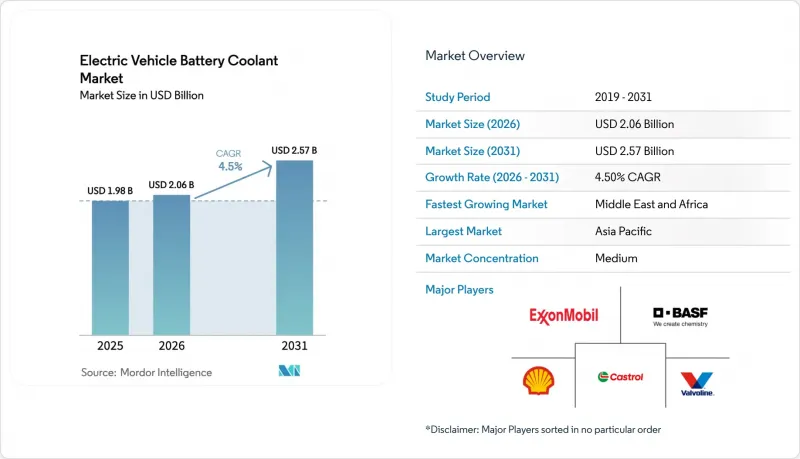
據 Mordor Intelligence 稱,2025 年電動車電池冷卻液市值為 19.8 億美元,預計到 2031 年將從 2026 年的 20.6 億美元成長至 25.7 億美元,預測期(2026-2031 年)的複合年成長率為 4.50%。
本報告按冷卻液類型(水性冷卻液、介電液等)、驅動系統(電池式電動車等)、車輛類型(摩托車等)、分銷管道(OEM、售後市場)、最終用途(電池組等)和地區進行細分。市場預測以美元計價。
全球電動汽車電池冷卻液市場趨勢及洞察
全球電動車生產加速
預計到2025年,全球小型電動車(EV)產量將顯著成長,因此,冷卻液的需求量也將隨著電池容量的增加而相應成長。冷卻液對於維持電池效能至關重要,每單位容量的電池需要一定量的冷卻液。然而,儘管產量有所成長,但銷售收入卻未能跟上腳步。這主要是因為大多數平台仍然使用利潤率低的乙二醇基混合冷卻液。比亞迪作為一家主要的電動車製造商,仍然依賴傳統的冷卻液,這凸顯了產量與產生收入之間的差距。因此,供應商正將重心從單純提高銷售量轉向提升產品特性,例如導熱性和介電強度。這種轉變在歐洲和北美市場尤其明顯,這些地區的目的地設備製造商(OEM)願意投資研發能夠支援快速充電的高品質冷卻液。這導致市場兩極化,銷售量成長與價值創造之間的脫節日益加劇。
OEM廠商向液冷電池組過渡
為了滿足用戶對續航里程和充電性能的預期,汽車製造商普遍正在放棄風冷電池組。通用汽車(GM)的Ultium平台透過在冷板內循環乙二醇水溶液來實現高性能直流充電,而每輛車的材料成本僅略有增加。特斯拉的4680結構電池組透過在圓柱形電池之間加入冷卻水通道,實現了重量減輕和循環壽命延長。福特和大眾也採用了類似的設計,BASF已簽署契約,為其基於MEB平台的車型提供其特殊冷卻液。液冷技術如今也成為一項保質措施,確保了整個產業經濟週期內的穩定需求。
電動車專用冷卻液單價高
介電和奈米流體產品比乙二醇貴得多,這限制了它們在價格敏感型市場的普及。 Engineered Fluids公司的「BitCool」定價僅適用於賽車和浸沒式冷卻應用,因為這些應用的保固風險較高。除非該冷卻液能夠顯著縮短充電時間或大幅延長電池壽命,否則原始設備製造商(OEM)不太可能接受如此高的價格。目前,這些優勢僅在實驗室環境下得到檢驗。BASF價格相對較低的「G40 EV」取得了一些進展,但這仍然會導致車輛整體材料成本的增加,尤其是在那些價格是購車決策主要因素的市場。
細分市場分析
由於汽車製造商優先考慮成熟的供應鏈和低價格,水基混合液在2025年佔據了56.10%的市場佔有率。介電液因其能夠滿足800V架構的需求而獲得了顯著的市場佔有率。同時,先進的奈米流體預計將以7.18%的複合年成長率成長,因為石墨烯添加劑能夠提高導熱性,並開闢出一個高階細分市場。預計到2031年,電動車電池冷卻液中奈米流體的市場規模將顯著擴大,凸顯了性能主導應用的日益普及。長期應用將取決於穩定劑的化學成分,這些穩定劑能夠防止顆粒在10年運作週期內發生聚集。
此外,電動車電池冷卻液市場正穩定成長,奈米顆粒逐步引入乙二醇基質中,在不超出原始設備製造商(OEM)設定的過濾器堵塞風險閾值的前提下,提高了導熱性能。能夠提供檢驗的3000小時分散數據的供應商有望儘早獲得契約,但實現全面推廣的關鍵仍然在於證明其長期耐久性。
預計到2025年,電池式電動車(BEV)將佔總需求的73.12%,這代表了電動車電池冷卻液的市場規模,預計該市場規模將與全球電動車交付量的成長保持一致。燃料電池電動車(FCEV)雖然仍屬於小眾市場,但由於氫燃料卡車和巴士對介電液的需求,預計其複合年成長率將達到10.36%,成為成長最快的市場。儘管絕對銷量仍然不高,但這一趨勢將確保特種化學品供應商獲得極高的利潤率。插混合動力汽車(PHEV)的市場規模預計在預測期內將有所萎縮,這將進一步鞏固純電動車(BEV)在冷卻液供應領域的主導地位。
由於燃料電池電動車 (FCEV) 固有的堆電壓和高廢熱產生,它們依賴氟化介電材料,這使得擁有專利複合技術的領先公司在確保未來合約方面處於不成比例的巨大優勢地位。
區域分析
預計到2025年,亞太地區將佔全球銷售量的46.13%。這主要得益於中國電動車銷量的顯著成長以及GB 38031標準的實施,該標準強制要求50kWh以上的電池組採用液冷技術。比亞迪正從中國石化採購低成本的乙二醇,這給海外供應商帶來了價格壓力。同時,印度的FAME-II政策正在加速高階摩托車採用液冷技術,以應對夏季超過40 度C的高溫。日本仍然是燃料電池公車介電材料的主要供應國,韓國GS Caltex公司則獲得了現代和起亞800伏車型的獨家供應。
2025年,歐洲在全球銷量中佔了相當大的佔有率。這主要是由於二氧化碳排放量相關的車輛罰款和不含PFAS的法規導致每公升成本上升,使符合監管規定的化學成分供應商受益。大眾汽車在該地區電動車(EV)的高銷量是其與BASF簽訂供應合約的基礎,該合約在保證供應量的同時,也對導電率設定了嚴格的限制。北美也佔據了相當大的佔有率。 《通貨膨脹控制法案》規定的國內採購要求鼓勵汽車製造商利用位於德克薩斯州和安大略省的國內乙二醇工廠,從而加速了生產回流的投資,並保護了利潤率免受進口價格波動的影響。
儘管中東和非洲地區在2025年的總銷售量中佔比不高,但由於海灣國家計程車電氣化程度的提高,對高溫穩定冷卻劑的需求不斷成長,預計該地區將實現6.15%的複合年成長率。沙烏地阿拉伯為Lucid吉達工廠提供的資金,為該地區早期參與企業混合業務的企業創造了巨大的機會。南美洲佔總銷售額的3%,其中巴西的乙醇生產傳統推動了對生物基丙二醇的需求,有助於減少對石化燃料的依賴,並支持該地區的價值鏈發展。
其他好處:
- Excel格式的市場預測(ME)表
- 3個月的分析師支持
目錄
第1章:引言
- 研究假設和市場定義
- 調查範圍
第2章:調查方法
第3章執行摘要
第4章 市場狀況
- 市場概覽
- 市場促進因素
- 全球電動車產量增加
- 在 OEM(目的地設備製造商)生產中過渡到水冷電池組。
- 快速充電基礎設施的擴建
- 嚴格的安全規章制度,旨在防止熱失控
- 800V架構正在推動對介電液的需求成長。
- 炎熱氣候下兩輪和三輪電動車的蓬勃發展
- 市場限制因素
- 專用電動車冷卻液單價高
- 乙二醇原料價格波動劇烈
- 冷卻劑的導電性沒有統一的標準。
- 固態電池可以降低熱負荷。
- 價值供應鏈分析
- 監理情勢
- 技術展望
- 波特五力模型
第5章 市場規模與成長預測
- 冷卻液類型
- 水性冷卻劑
- 介電液(非導電油)
- 先進奈米流體
- 依推進類型
- 電池式電動車(BEV)
- 混合動力電動車(HEV)
- 插電式混合動力車(PHEV)
- 燃料電池汽車(FCEV)
- 車輛類型
- 摩托車
- 三輪車
- 搭乘用車
- 商用車輛
- 非公路電動車
- 透過分銷管道
- 目的地設備製造商 (OEM)
- 售後市場
- 按最終用途
- 電池組
- 電機和電力電子
- 按地區
- 北美洲
- 美國
- 加拿大
- 其他北美國家
- 南美洲
- 巴西
- 阿根廷
- 其他南美國家
- 歐洲
- 德國
- 英國
- 法國
- 義大利
- 西班牙
- 其他歐洲國家
- 亞太地區
- 中國
- 印度
- 日本
- 韓國
- 其他亞太國家
- 中東和非洲
- 阿拉伯聯合大公國
- 沙烏地阿拉伯
- 南非
- 土耳其
- 其他中東和非洲國家
- 北美洲
第6章 競爭情勢
- 市場集中度
- 策略趨勢
- 市佔率分析
- 公司簡介
- Exxon Mobil Corporation
- BASF SE
- Shell plc
- Castrol Limited(BP plc)
- Valvoline Inc.
- TotalEnergies SE
- FUCHS SE
- Prestone Products Corporation
- Arteco NV
- Dober
- GS Caltex Corporation
- Engineered Fluids
- XING Mobility
- Motul SA
第7章 市場機會與未來展望
According to Mordor Intelligence, the electric vehicle battery coolant market size was valued at USD 1.98 billion in 2025 and estimated to grow from USD 2.06 billion in 2026 to reach USD 2.57 billion by 2031, at a CAGR of 4.50% during the forecast period (2026-2031).
This report is Segmented by Coolant Type (Water-Based Coolants, Dielectric Fluids, and More), Propulsion Type (Battery Electric Vehicles, and More), Vehicle Type (Two-Wheelers, and More), Distribution Channel (Original Equipment Manufacturer, and Aftermarket), End-Use Application (Battery Packs, and More), and Geography. The Market Forecasts are Provided in Terms of Value (USD).
Global Electric Vehicle Battery Coolant Market Trends and Insights
Accelerating Global EV Production Volumes
In 2025, global production of light-duty electric vehicles (EVs) experienced significant growth, driving a corresponding increase in coolant demand proportional to the installed battery capacity. Coolants are essential for maintaining battery performance, with each unit of capacity requiring a specific volume of fluid. However, despite the rise in production, revenue growth has not kept pace. This is primarily due to a majority of platforms continuing to use low-margin glycol blends. A prominent EV manufacturer, BYD, exemplifies this trend by relying on legacy coolants, highlighting the gap between production volume and revenue generation. Consequently, suppliers are shifting their focus from sheer volume growth to enhancing product attributes such as thermal conductivity and dielectric strength. This shift is particularly evident in European and North American markets, where original equipment manufacturers (OEMs) are willing to invest in premium fluids that enable rapid charging. This has created a divided market landscape, where unit expansion and value creation are increasingly decoupled.
OEM Shift Toward Liquid-Cooled Battery Packs
To meet range and charging expectations, automakers have largely moved away from air-cooled packs. General Motors' Ultium platform circulates glycol-water through cold plates, enabling high-performance DC charging with a slight increase in material costs per vehicle. Tesla's 4680 structural pack uses coolant channels between cylindrical cells, achieving reduced mass and an extended cycle life. Ford and Volkswagen adopt similar designs, while BASF clinches a proprietary blend contract for MEB-based models. Liquid cooling has evolved into a warranty hedge, ensuring consistent demand throughout industry cycles.
High Unit Cost of Specialized EV Coolants
Dielectric and nanofluid products are significantly more expensive than glycol, limiting their adoption in price-sensitive markets. Engineered Fluids' BitCool is priced at a level justified primarily in racing or immersion-cooling applications, where warranty risks are heightened. OEMs are unlikely to accept such a premium unless the fluid can demonstrably reduce charge time significantly or extend battery life substantially-benefits currently validated only in lab settings. While BASF is making strides with its G40 EV at a comparatively lower price, it still leads to an increase in total vehicle material costs in markets where affordability heavily influences purchasing decisions.
Other drivers and restraints analyzed in the detailed report include:
- Expansion of Fast-Charging Infrastructure
- Stringent Safety Rules on Thermal-Runaway Mitigation
- Volatile Glycol Feed-Stock Prices
For complete list of drivers and restraints, kindly check the Table Of Contents.
Segment Analysis
Water-based blends secured 56.10% of 2025 revenue as automakers favored mature supply chains and low price points. Dielectric fluids captured a notable share serving 800-volt architectures, while advanced nanofluids are set for a 7.18% CAGR as graphene additives raise thermal conductivity and carve a premium niche . The electric vehicle battery coolant market size for nanofluids is projected to climb significantly by 2031, underscoring performance-led adoption. Longer-term uptake hinges on stabilizer chemistries that prevent particle agglomeration over ten-year duty cycles.
Secondarily, the electric vehicle battery coolant market faces a glide path where incremental nanoparticle adoption into glycol matrices boosts conductivity without breaching OEM filter-clog risk thresholds. Suppliers offering validated 3,000-hour dispersion data stand to win early contracts, but extended durability proof remains the gating factor for full-scale rollouts.
Battery electric vehicles accounted for 73.12% of 2025 demand, equating to an electric vehicle battery coolant market size that grows in line with global electric vehicle (EV) deliveries. Fuel cell electric vehicles, though niche, will post the highest 10.36% CAGR as hydrogen trucks and buses demand dielectric fluids. This dynamic secures outsized margins for specialty chemical suppliers even as absolute liters remain modest. Plug-in hybrids shrink over the horizon period, reinforcing battery electric vehicle (BEV) primacy in coolant volume.
Inherent stack voltage and higher waste-heat generation make fuel cell electric vehicles (FCEVs) reliant on fluorocarbon-based dielectrics, positioning early movers with patent-protected formulations to capture a disproportionate share of future contracts.
Complete Report Scope:
- By Coolant Type
- Water-Based Coolants
- Dielectric Fluids (Non-conductive Oils)
- Advanced Nanofluids
- By Propulsion Type
- Battery Electric Vehicles (BEVs)
- Hybrid Electric Vehicles (HEVs)
- Plug-in Hybrid Electric Vehicles (PHEVs)
- Fuel Cell Electric Vehicles (FCEVs)
- By Vehicle Type
- Two-Wheelers
- Three-Wheelers
- Passenger Cars
- Commercial Vehicles
- Off-Highway EVs
- By Distribution Channel
- Original Equipment Manufacturer (OEM)
- Aftermarket
- By End-Use Application
- Battery Packs
- Motors and Power Electronics
- By Geography
- North America
- United States
- Canada
- Rest of North America
- South America
- Brazil
- Argentina
- Rest of South America
- Europe
- Germany
- United Kingdom
- France
- Italy
- Spain
- Rest of Europe
- Asia-Pacific
- China
- India
- Japan
- South Korea
- Rest of Asia-Pacific
- Middle East and Africa
- United Arab Emirates
- Saudi Arabia
- South Africa
- Turkey
- Rest of Middle East and Africa
- North America
Geography Analysis
Asia-Pacific generated 46.13% of 2025 revenue, anchored by China's significant electric vehicle (EV) sales and the GB 38031 rule that mandates liquid cooling for packs above 50 kWh. BYD sources low-cost glycol from Sinopec, squeezing foreign suppliers on price, while India's FAME-II policy pushes liquid cooling into premium two-wheelers that tackle summer temperatures above 40 °C. Japan remains a niche dielectric hub for fuel-cell buses, and South Korea's GS Caltex secures captive demand from Hyundai-Kia 800-volt models.
Europe delivered a notable share of global revenue in 2025 as CO2 fleet penalties and PFAS-free rules raised per-liter costs and favored suppliers with compliant chemistries. Volkswagen's significant regional electric vehicle (EV) sales underpin a BASF supply pact that guarantees volume but dictates tight conductivity limits. North America added a significant share; the Inflation Reduction Act content rules channel OEMs to domestic glycol plants in Texas and Ontario, accelerating reshoring investments while protecting margins against import volatility.
The Middle East and Africa, though only a nominal share of the 2025 volume, post a 6.15% CAGR as Gulf taxi electrification demands high-temperature-stable coolants. Saudi funding of Lucid's Jeddah plant seeds a regional blending opportunity for early movers. South America contributes 3% of revenue, with Brazil's ethanol heritage spurring bio-based propylene glycol that trims fossil reliance and supports local value chains.
- Exxon Mobil Corporation
- BASF SE
- Shell plc
- Castrol Limited (BP p.l.c.)
- Valvoline Inc.
- TotalEnergies SE
- FUCHS SE
- Prestone Products Corporation
- Arteco NV
- Dober
- GS Caltex Corporation
- Engineered Fluids
- XING Mobility
- Motul S.A.
Additional Benefits:
- The market estimate (ME) sheet in Excel format
- 3 months of analyst support
TABLE OF CONTENTS
1 Introduction
- 1.1 Study Assumptions and Market Definition
- 1.2 Scope of the Study
2 Research Methodology
3 Executive Summary
4 Market Landscape
- 4.1 Market Overview
- 4.2 Market Drivers
- 4.2.1 Accelerating Global Electric Vehicle Production Volumes
- 4.2.2 Original Equipment Manufacture (OEM) Shift Toward Liquid-Cooled Battery Packs
- 4.2.3 Expansion of Fast-Charging Infrastructure
- 4.2.4 Stringent Safety Rules on Thermal-Runaway Mitigation
- 4.2.5 800-V Architectures Boosting Dielectric-Fluid Demand
- 4.2.6 Two/Three-Wheeler Electric Vehicle Boom in Hot Climates
- 4.3 Market Restraints
- 4.3.1 High Unit Cost of Specialized Electric Vehicle Coolants
- 4.3.2 Volatile Glycol Feed-Stock Prices
- 4.3.3 No Universal Standard on Coolant Conductivity
- 4.3.4 Solid-State Batteries May Cut Thermal Load
- 4.4 Value / Supply-Chain Analysis
- 4.5 Regulatory Landscape
- 4.6 Technological Outlook
- 4.7 Porter's Five Forces
- 4.7.1 Threat of New Entrants
- 4.7.2 Bargaining Power of Suppliers
- 4.7.3 Bargaining Power of Buyers
- 4.7.4 Threat of Substitutes
- 4.7.5 Industry Rivalry
5 Market Size and Growth Forecasts (Value, USD)
- 5.1 By Coolant Type
- 5.1.1 Water-Based Coolants
- 5.1.2 Dielectric Fluids (Non-conductive Oils)
- 5.1.3 Advanced Nanofluids
- 5.2 By Propulsion Type
- 5.2.1 Battery Electric Vehicles (BEVs)
- 5.2.2 Hybrid Electric Vehicles (HEVs)
- 5.2.3 Plug-in Hybrid Electric Vehicles (PHEVs)
- 5.2.4 Fuel Cell Electric Vehicles (FCEVs)
- 5.3 By Vehicle Type
- 5.3.1 Two-Wheelers
- 5.3.2 Three-Wheelers
- 5.3.3 Passenger Cars
- 5.3.4 Commercial Vehicles
- 5.3.5 Off-Highway EVs
- 5.4 By Distribution Channel
- 5.4.1 Original Equipment Manufacturer (OEM)
- 5.4.2 Aftermarket
- 5.5 By End-Use Application
- 5.5.1 Battery Packs
- 5.5.2 Motors and Power Electronics
- 5.6 By Geography
- 5.6.1 North America
- 5.6.1.1 United States
- 5.6.1.2 Canada
- 5.6.1.3 Rest of North America
- 5.6.2 South America
- 5.6.2.1 Brazil
- 5.6.2.2 Argentina
- 5.6.2.3 Rest of South America
- 5.6.3 Europe
- 5.6.3.1 Germany
- 5.6.3.2 United Kingdom
- 5.6.3.3 France
- 5.6.3.4 Italy
- 5.6.3.5 Spain
- 5.6.3.6 Rest of Europe
- 5.6.4 Asia-Pacific
- 5.6.4.1 China
- 5.6.4.2 India
- 5.6.4.3 Japan
- 5.6.4.4 South Korea
- 5.6.4.5 Rest of Asia-Pacific
- 5.6.5 Middle East and Africa
- 5.6.5.1 United Arab Emirates
- 5.6.5.2 Saudi Arabia
- 5.6.5.3 South Africa
- 5.6.5.4 Turkey
- 5.6.5.5 Rest of Middle East and Africa
- 5.6.1 North America
6 Competitive Landscape
- 6.1 Market Concentration
- 6.2 Strategic Moves
- 6.3 Market Share Analysis
- 6.4 Company Profiles (includes Global Level Overview, Market Level Overview, Core Segments, Financials as Available, Strategic Information, Market Rank/Share for Key Companies, Products and Services, SWOT Analysis, and Recent Developments)
- 6.4.1 Exxon Mobil Corporation
- 6.4.2 BASF SE
- 6.4.3 Shell plc
- 6.4.4 Castrol Limited (BP p.l.c.)
- 6.4.5 Valvoline Inc.
- 6.4.6 TotalEnergies SE
- 6.4.7 FUCHS SE
- 6.4.8 Prestone Products Corporation
- 6.4.9 Arteco NV
- 6.4.10 Dober
- 6.4.11 GS Caltex Corporation
- 6.4.12 Engineered Fluids
- 6.4.13 XING Mobility
- 6.4.14 Motul S.A.
7 Market Opportunities & Future Outlook
- 7.1 White-Space & Unmet-Need Assessment

 全球電動車電池冷卻市場:策略性洞察與預測(2026-2031年)
 電動汽車電池冷卻市場機會、成長要素、產業趨勢分析及2026-2035年預測
 電動汽車電池冷卻液市場:依冷卻液類型、車輛類型、電池類型、銷售管道、國家及地區分類-產業分析、市場規模、市場佔有率及2026年至2033年預測
 浸沒式電池冷卻系統市場:按車輛類型、類型、推進類型、冷卻液類型和地區分類
 汽車鋁合金散熱器釬焊市場:依車輛類型、芯體類型、冷卻方式、生產過程和銷售管道,全球預測,2026-2032年2026-2034年全球電動車電池組冷卻系統市場規模、佔有率、趨勢與成長分析報告
 日本電動車電池冷卻系統市場規模、佔有率、趨勢和預測(按冷卻技術、電池類型、車輛類型、動力方式、最終用戶和地區分類),2026-2034年
 全球下一代電動車冷卻液市場預測(至2032年):按流體類型、性能特徵、應用、最終用戶和地區分類的分析
 2021-2031 年歐洲電動車電池浸入式冷卻市場報告(範圍、細分、動態和競爭分析)
 2021-2031年亞太地區電動汽車電池浸入式冷卻市場報告(範圍、細分、動態和競爭分析)